Entertainment
New LACMA building to get three outdoor artworks to join 'Urban Light' and the Rock

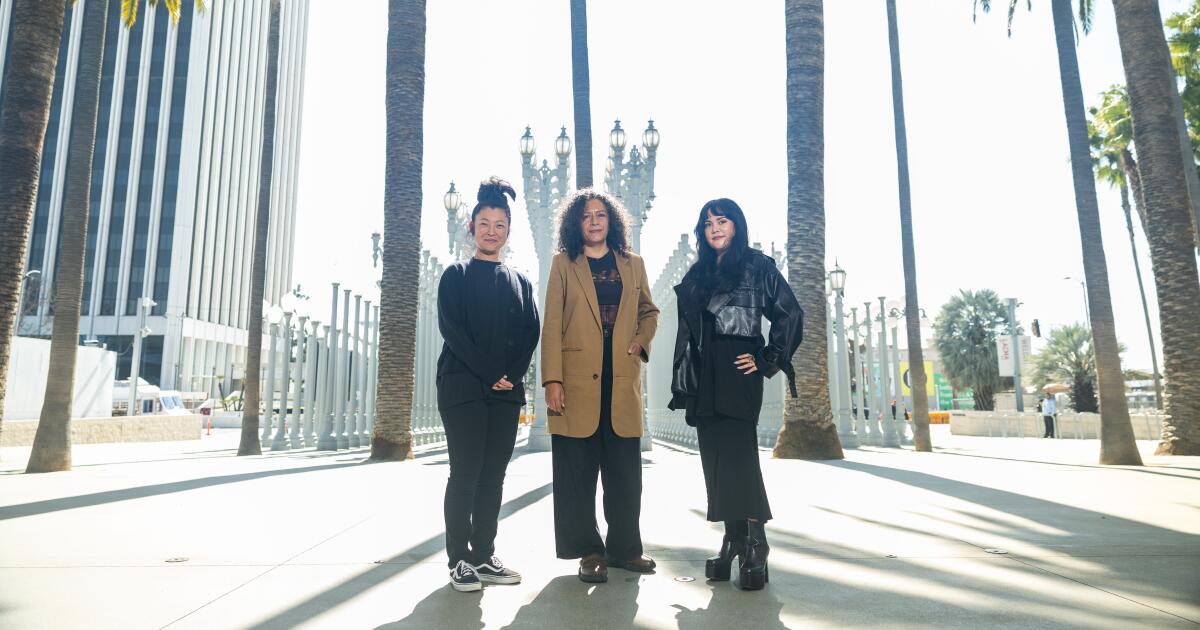
Three artists have been commissioned to create the first wave of installations for the Los Angeles County Museum of Art’s new David Geffen Galleries, scheduled to open in April next year. The expansive site-specific works will help to define the look and feel of the Peter Zumthor-designed building, and in the case of one artwork — a 75,000-square-foot stretch of embellished and brushed concrete — literally provide the ground on which visitors walk.
The artists — Mariana Castillo Deball, Sarah Rosalena and Shio Kusaka — were all picked based on their previous work at LACMA and for how themes espoused in their art, including land rights and a fascination with the cosmos, fit with the ethos of the new building’s modernist design.
“I have a rule in my life: If you get stuck, you ask people for advice. If you get really stuck, you ask an artist,” said LACMA President and Chief Executive Michael Govan during a recent visit to the site, where Castillo Deball was immersed in crafting her piece, “Feathered Changes.”
The idea for Castillo Deball’s commission rose from the question of what to do around the 900-foot-long concrete building, which curves over Wilshire Boulevard and is outfitted with floor-to-ceiling glass. Traditional landscape architecture wasn’t cutting it, Govan said, and he kept thinking about the idea of a map on the ground.
A detail of artist Mariana Castillo Deball’s “Feathered Changes,” a commission for LACMA’s David Geffen Galleries.
(Mariana Castillo Deball)
“Feathered Changes” serves as the museum plaza floor and occupies an area roughly the size of three football fields. It forms a series of concrete islands leading to various entrances and extends through the restaurant. The piece, which is characterized by an earth-colored mix of unfinished concrete that both complements and contrasts with the building, is imprinted with pieces of Castillo Deball’s feathered serpent drawings inspired by ancient murals from Teotihuacán, Mexico. Other areas are raked in patterns resembling a Zen garden, and some contain replica tracks of native animals, including coyotes, bears and snakes. Small stones have been cast into the mix, creating a rough, uneven color and texture.
“This is the biggest challenge I’ve had in my life,” Castillo Deball said after using a custom rake to carve wet concrete at the base of the building. Concrete workers swarmed around her in hardhats. “It’s a place that is gonna be totally public, so everybody can go in and step on it,” she said. “It’s a very democratic piece of art that is also in dialogue with this amazing building, with the collection, with the curators.”
Castillo Deball, who splits her time between Mexico City and Berlin, is no stranger to large-scale, L.A.-based projects. She created four landscape-focused collages for the concourse level of Metro’s Wilshire/La Cienega station. But the LACMA commission is by far the biggest piece of art she has made, and she said she’s learned a great deal from the process.
“I feel like an engineer,” she said, smiling from under her hardhat. “I never knew so much about concrete and rebar.”
Castillo Deball also relishes collaborating with the team of specialized workers employed to assist her in pouring — and taming — the tricky cement.
“They’re all Mexican. They come from Jalisco, and we communicate in Spanish,” she said. “And they always ask me, what am I doing? What does it mean? And then a lot of solutions, we also develop them together. And they’re so curious and proud that a Mexican artist is doing something like this.”
The building, which has asymmetrical overhead lighting resembling stars, represents the sky, Govan noted, and Castillo Deball’s artwork tethers the building to the land.
“All the other ground solutions seemed mechanical,” Govan said.
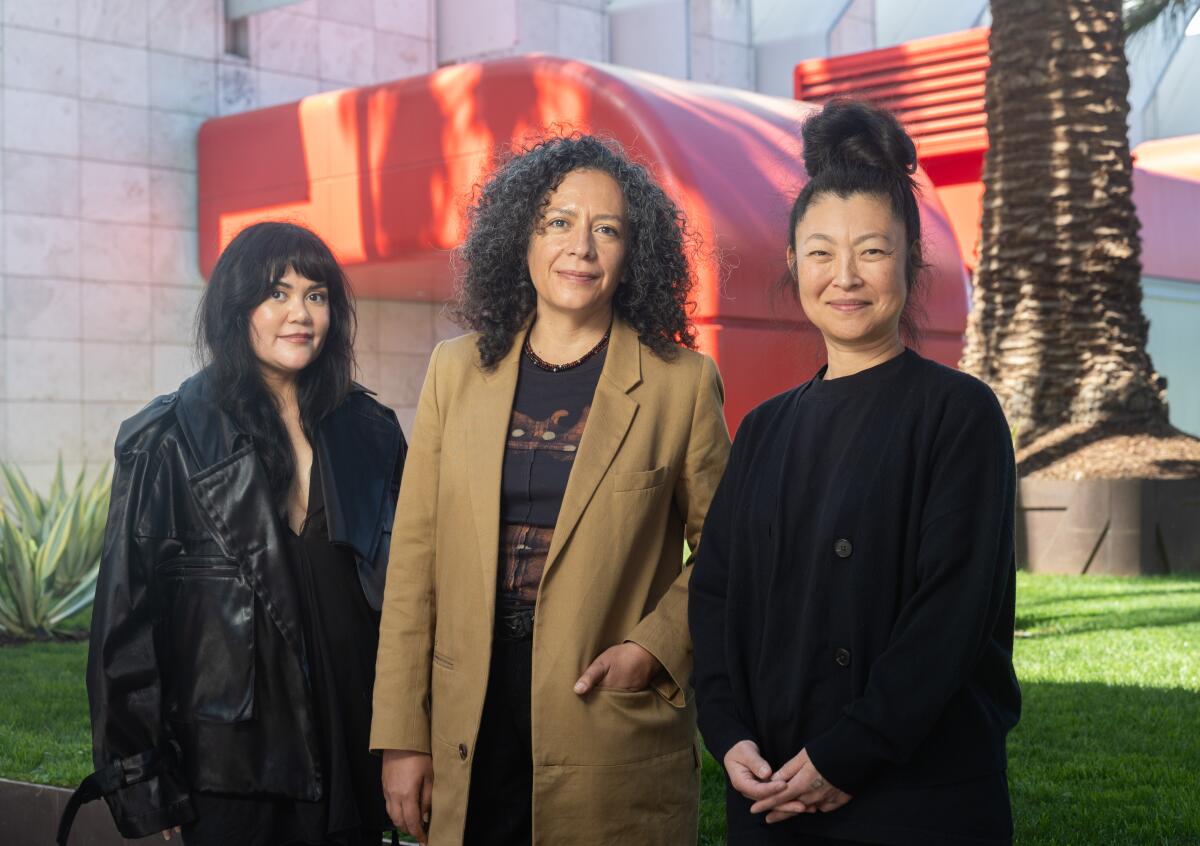
Sarah Rosalena, from left, Mariana Castillo Deball and Shio Kusaka were selected to create new works based, in part, on how themes espoused in their art fit with the ethos of the modernist design of the new David Geffen Galleries.
(Myung J. Chun / Los Angeles Times)
Govan had recently flown in from Tilburg in the Netherlands, where he visited the TextielMuseum’s TextielLab with interdisciplinary artist and weaver Sarah Rosalena. Her commission — an 11-by-26½-foot tapestry invoking the ethereal topography of Mars — was being woven on one of the largest Jacquard looms in the world. A few weeks later, a test swath of the tapestry was shipped to LACMA so Rosalena could see how colors and materials looked and felt.
“I was really interested in pushing the textile to really think about terrain,” said Rosalena, standing over the tapestry, which was laid out on a long conference table in a nearby office tower with a bird’s-eye view of the new building. “So that’s experimenting with different yarns. Some of it looks like clouds. Some of it almost looks like ocean or water. Some of it looks atmospheric, but definitely otherworldly.”
Rosalena is an Angeleno of Wixárika heritage whose practice merges ancient Indigenous craft with computer-driven science and technology to challenge colonial narratives and examine global problems such as climate change and cultural hegemony. She has fond memories of watching her grandmother weave on a backstrap loom while growing up in La Cañada Flintridge, and found that she was just as skilled at computer programming as she was at making textiles.

Sarah Rosalena’s 26-foot long weaving, “Omnidirectional Terrain” (2025), in progress on the jacquard-rapier loom at TextielLab in Tilburg, Netherlands.
(Alexandra Ross)
“My mother would also do a lot of weaving and beading,” said Rosalena, a professor at UC Santa Barbara. But it wasn’t until she got interested in photo and digital media processes that she saw their relationship to weaving.
When it’s complete, the tapestry, “Omnidirectional Terrain,” will hang on the 30-foot wall in the museum restaurant, where it will be visible through the glass that looks in from the courtyard and Castillo Deball’s “Feathered Changes.” The patterns that Castillo Deball will have created underfoot will run beneath Rosalena’s work — the earth beneath a mercurial red sky.
The third commission, by ceramicist Kusaka, will be around the corner from the first two, in a plaza. Kusaka laid out a series of drawings on small white pieces of paper on the conference table, tracing the evolution of her idea from a basic sketch to what she hopes will be its final iteration: a 12-foot-tall interactive sculpture featuring a flying saucer atop a cone of bright light, which children and adults can enter, ostensibly to be beamed up to the craft — if only for a fun photograph.
“When students are in the education center, they’re looking through glass at it, which will be a nice inspiration,” Govan said. “You’ll also see it as you’re on Wilshire. What is that interesting thing? So that was the idea.”
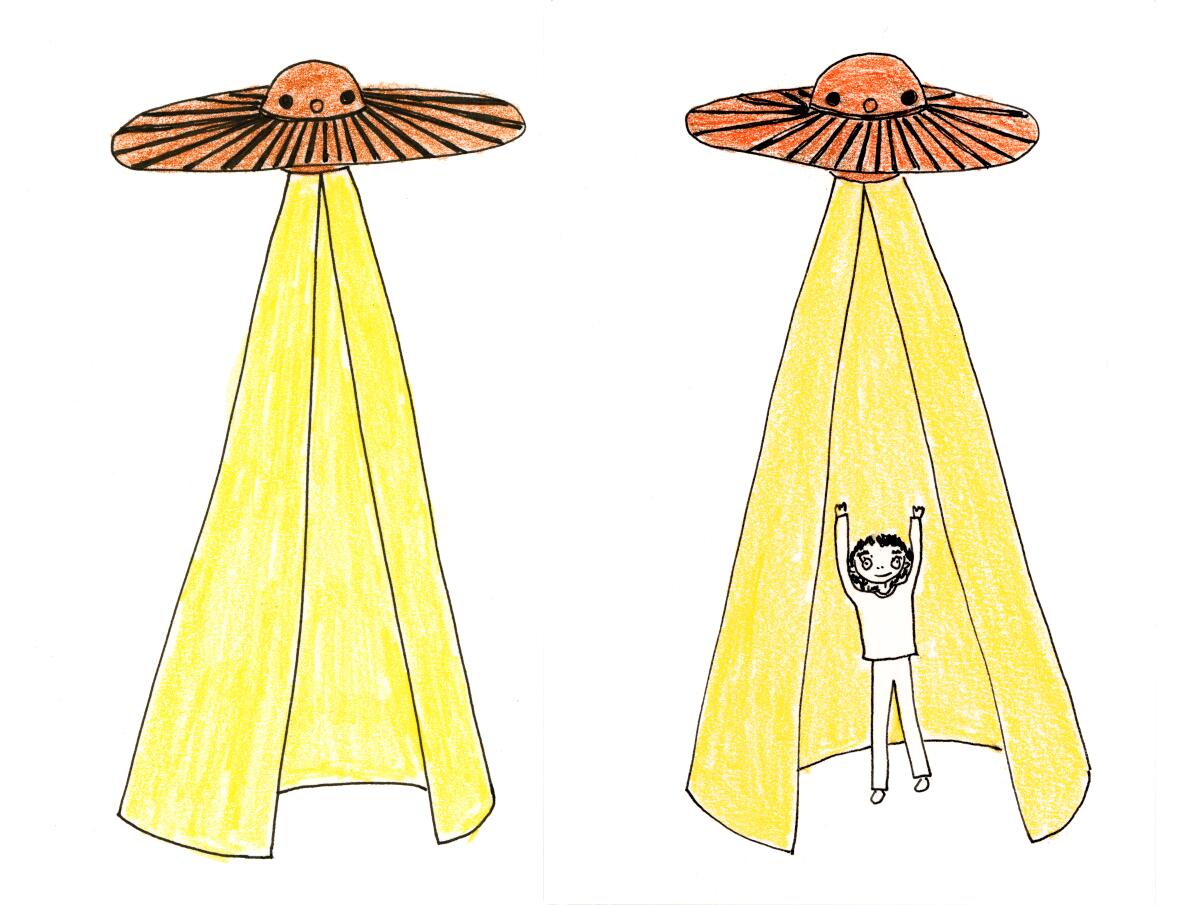
Preparatory sketches for Shio Kusaka’s LACMA-commissioned sculpture. The second includes a figure to show scale.
(Shio Kusaka)
Creating visitor attractions that can be shared on social media has proved a savvy marketing strategy at LACMA, where Chris Burden’s “Urban Light” installation of city streetlamps and Michael Heizer’s “Levitated Mass,” often referred to as the Rock, have grown from Instagram moments to beloved civic landmarks.
Kusaka’s playful forms are most commonly seen in her ceramic pots, vases and vessels, often glazed with bright colors and decorated with whimsical geometric patterns. Her obsession with space and space creatures finds its lineage in some pots she shows from a book of her work. Some have buttons resembling the control panel of a spaceship; others have little faces that could be alien.
“I don’t like making big things for no reason. I really like small things I can hold,” Kusaka said. “But it’s really fun to have a reason that I can go this big, which might be a part of why I want a person to go inside.”
Kusaka was born in Japan and learned traditional crafts from her grandparents. Her grandmother taught tea ceremonies, and her grandfather taught calligraphy.
“I never thought that I was gonna relate to what they did at the time. But I do see the relationship now,” said Kusaka, explaining how she began her study of ceramics in college in Boulder, Colo. “So I was touching ceramics a lot, and then I learned how to look at tools and to appreciate their functions.”
Her fanciful commission for LACMA charts a new course, but in a way, she said, it’s still a vessel.

Movie Reviews
‘Night Nurse’ Review: A Caretaker Explores Her Kink for Elder Abuse in the Year’s Strangest Erotic Thriller

There are any number of erotic thrillers in which rich old men are robbed blind and/or left for dead, but Georgia Bernstein’s admirably bizarre “Night Nurse” might be the first movie of its kind where elder abuse is the source — and possible subject— of its erotic thrills. If there are others, I’m not sure I want to know.
But this woozy debut feature doesn’t rely on its audience being turned on by the relationship between a nubile caretaker and her dementia-addled patient. Their psychosexual bond, meanwhile, hinges on cold-calling vulnerable old people under the guise of a grandchild in financial distress. (“I’m in trouble, nana, send me $10,000 or I’ll be left to rot in jail!” That sort of thing). With its slim wisp of a premise stretched into a Strickland-esque dreamscape that substitutes kink for conflict, the film itself hardly seems convinced by its own wrinkled lust — all desperate kisses and non-touching poses of subservience. More important to Bernstein is what that lust reveals about her characters’ deepest needs, specifically how their need to care and be cared for can be as easily perverted as any other form of desire.

As moody and weightless as the noir-accented score that blows through the movie like a curlicue gust of wind in an old cartoon (credit to musicians Sam Clapp and Steven Jackson), “Night Nurse” lacks the pulse required for its stray feelings to come alive. Still, the film ambiently taps into the latent eroticism of teasing out the distance between how you see yourself and who you really are. Bernstein plays with that distance like a telephone cord wrapped around her fingers, and Eleni — played by the excellent newcomer Cemre Paksoy, powerfully helpless — only frays even more as the receiver is brought near the hook. “Everything I did before today wasn’t me,” the nurse tells co-worker Mona (Eleonore Hendricks) after starting a new job at an Illinois retirement home. “It was somebody else.”
What she did before today remains unexplored (specifically, what she did to get herself fired from her last gig), but I’m guessing she’s probably changed less than she thought. There’s a faraway flicker in her eyes the moment she catches the vibe between Mona and Douglas (a ribald and elusive Bruce McKenzie), a white-haired seventysomething who shows early signs of dementia but still commands an undiminished sexual energy. “I’m not an invalid,” he coos as Mona bathes him in the tub, to which she replies, “yes, you are,” in a supplicant tone that hints at a rich history of power games between them.
Later that same night, Douglas will force Eleni to call a stranger, pretend that she’s their granddaughter, and ask for money — he’ll wrap the phone cord around the nurse’s body as she talks and shove her against the wall as they kiss. She’s into it. So into it that he has to clarify the terms of his whole deal: “If you’re looking for a pogo stick, I’m really not your guy.” But Eleni isn’t looking for anything to bounce on. She just wants to be needed, and maybe to need someone in return. Someone who will see her for who she really is and allow her the fantasy of pretending she isn’t being herself when she cons vulnerable strangers out of their money — when she exploits how enthralled those strangers are by the care they have for their loved ones.
“Night Nurse” doesn’t belabor the psychology, as Bernstein prefers to express her story through heavy-lidded suggestion. Somnambulating from the moment it starts, the film moves through a series of beautifully arranged poses that stretch their latent meaning thin across the surface (Lidia Nikonova’s cinematography lacquers every shot with a seductive dreaminess). We see Douglas smoking in a lawn chair with Mona and Eleni curled around his feet. Eleni riding in the backseat of a convertible as the wind blows through her curls. The full staff of nurses — all of them under Douglas’ sway — stumbling around his condo in a state of zonked out bliss as they roll on the prescription drugs they’ve stolen from the residents.
Once you’ve seen one shot of this movie, you’ve practically seen them all, at least until things escalate during a rushed and unsatisfying third act that forces Eleni into an honest confrontation with herself. People will do just about anything to feel needed — they’ll give whatever degree of care allows them to receive it in return. “Night Nurse” understands that desire, but remains far too numb to treat it.
Grade: C+
The Independent Film Company will relase “Night Nurse” in theaters on Friday, July 10.
Entertainment
Lucas Museum to give free annual passes to South L.A. neighbors, host community preview day
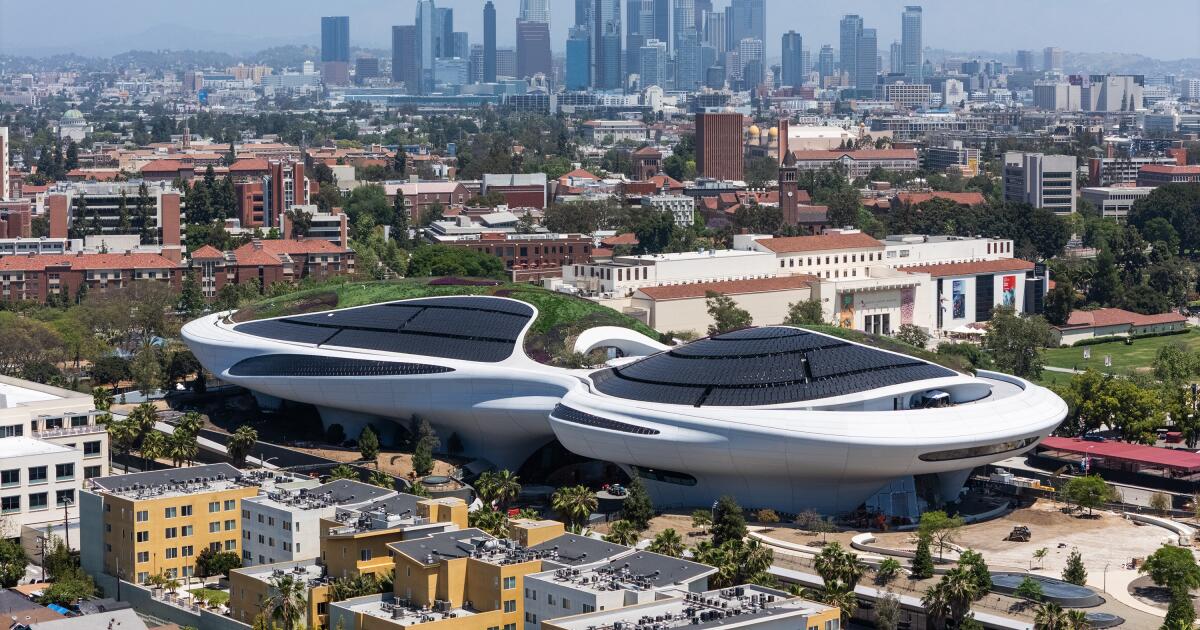
The Lucas Museum of Narrative Art, which is moving at light speed toward its Sept. 22 opening, announced Thursday that it will give free annual passes to its South L.A. neighbors living in the 90037 ZIP Code. The 300,000-square-foot, $1-billion museum located in Exposition Park will also host a special community preview day on Sept. 13, more than a week before the general public gets to step inside.
The 90037 ZIP Code has a population of more than 65,000 and is bordered roughly by the 110 Freeway to the west, Slauson Avenue to the south, Central Avenue to the east and Martin Luther King Jr. Boulevard to the north. Residents can register for passes at lucasmuseum.org/lm37 and will be alerted in August when the program launches. Pass holders can reserve tickets for themselves and one guest.
Tickets for non-pass holders go on sale July 21. They cost $25 for adults and $21 for seniors. Kids 17 and under are free.
“Storytelling has the power to bring people together and create a sense of community,” said Lucas Museum Chief Executive Tracey Bates in a news release about the program. “Through LM37, we are inviting our South Los Angeles neighbors to make the museum part of their lives and take their own path of discovery through the art, programs and experiences that will help shape this new cultural hub for Los Angeles.”
The community preview day is designed to give local business owners, community partners, civic leaders and registered LM37 pass holders a sneak peak of the 10,000 square feet of exhibition space, as well as the expansive gardens with 11 acres of park space.
The opening programming, curated by co-founder George Lucas, features 20 inaugural exhibitions across more than 30 galleries, including one titled “Star Wars in Motion,” containing vehicle designs, high-speed racers, flying vessels, props, costumes and illustrations from the first six films in the beloved franchise.
More than 1,200 objects will be on display from Lucas’ personal collection of narrative art. Highlights include work by Norman Rockwell and Dorothea Lange, as well as a variety of manga, children’s book illustrations and comics.

Last year’s “Superman” ended with Iggy Pop singing “Because I’m a punk rocker, yes I am” — an ironic coda for a superlatively square hero. But it rings straightforwardly true for Superman’s cousin.
Milly Alcock’s Kara Zor-El, or Supergirl, sports not a spandex suit but a Blondie T-shirt. When we meet her in Craig Gillespie’s “Supergirl,” she’s been on an interstellar bender for days. She’s more Courtney Love than Clark Kent.
Nonchalant and sarcastic, Kara is also a little Han Solo-ish, you might say, given that she moves capriciously through the galaxy in her junky spaceship while getting in fights in extraterrestrial bars. She’s a welcome, jagged riff on more buttoned-up superheroes, and Alcock is terrific in the role. If only “Supergirl” was as good as she is.
While the latest DC release, and second under James Gunn’s stewardship, has its moments, “Supergirl” struggles to match Kara’s punk-rock energy with an equally spirited supporting cast and story.
Skepticism seems to have gathered for “Supergirl” ahead of its release. Many fans have argued it wasn’t the right next step for DC Universe. But I’m not so sure. Alcock’s breezy cameo in “Superman” was one of that movie’s highlights. Handing the follow-up to her, and her faithful floating dog Krypto, strikes me as an extremely natural next step. When in doubt, follow the dog.
And much of “Supergirl” is winning. It resides almost entirely in space, touching down only momentarily on Earth. In its consistently creative production design, clever needle drops and underdog story arc, “Supergirl” resides a little closer to Gunn’s “Guardians of the Galaxy” movies than other DC entries. Its outer space is filled with cosmic detritus, mean characters and cute critters. Seth Rogen as the voice of a tiny alien co-piloting a space bus is an inspired concoction, as is a shabbier sci-fi realm with rest stops along the intergalactic highway.
-

 New Mexico7 minutes ago
Hidden gem in Cloudcroft, New Mexico has best BBQ in US
-

 North Carolina10 minutes ago
North Carolina Airport Looks to Expand Commercial Service | AirlineGeeks.com
-

 North Dakota15 minutes ago
San Francisco plots risky socialist bank modeled after controversial experiment
-

 Ohio22 minutes ago
Feeling itchy? Ohio leads nation with 6 cities on Orkin’s 2026 bed bug list
-

 Oklahoma25 minutes ago
Oklahoma’s Brent Venables named to 2026 Dodd Trophy Preseason watch list
-

 Oregon30 minutes ago
Ryan Reynolds-backed Aviation Gin shutters Oregon distillery
-

 Pennsylvania37 minutes ago
PA state rep. wants to force the York State Fair to change its name
-

 Rhode Island40 minutes ago
R.I. leading multi-state lawsuit against Trump administration housing policy – The Boston Globe

