Entertainment
New LACMA building to get three outdoor artworks to join 'Urban Light' and the Rock

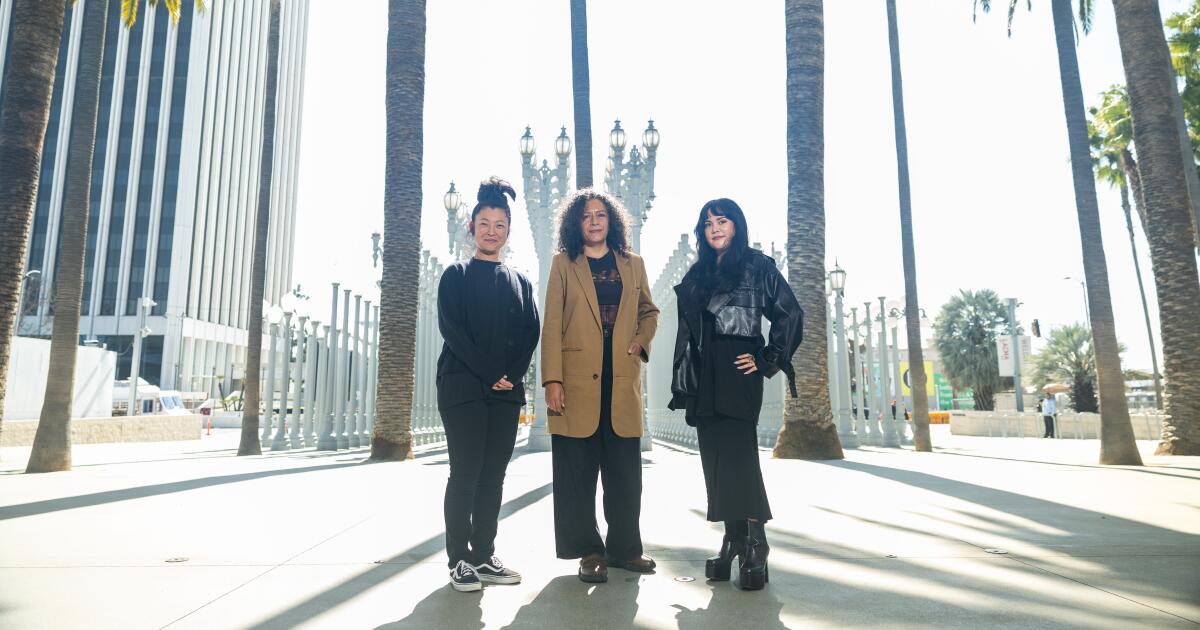
Three artists have been commissioned to create the first wave of installations for the Los Angeles County Museum of Art’s new David Geffen Galleries, scheduled to open in April next year. The expansive site-specific works will help to define the look and feel of the Peter Zumthor-designed building, and in the case of one artwork — a 75,000-square-foot stretch of embellished and brushed concrete — literally provide the ground on which visitors walk.
The artists — Mariana Castillo Deball, Sarah Rosalena and Shio Kusaka — were all picked based on their previous work at LACMA and for how themes espoused in their art, including land rights and a fascination with the cosmos, fit with the ethos of the new building’s modernist design.
“I have a rule in my life: If you get stuck, you ask people for advice. If you get really stuck, you ask an artist,” said LACMA President and Chief Executive Michael Govan during a recent visit to the site, where Castillo Deball was immersed in crafting her piece, “Feathered Changes.”
The idea for Castillo Deball’s commission rose from the question of what to do around the 900-foot-long concrete building, which curves over Wilshire Boulevard and is outfitted with floor-to-ceiling glass. Traditional landscape architecture wasn’t cutting it, Govan said, and he kept thinking about the idea of a map on the ground.
A detail of artist Mariana Castillo Deball’s “Feathered Changes,” a commission for LACMA’s David Geffen Galleries.
(Mariana Castillo Deball)
“Feathered Changes” serves as the museum plaza floor and occupies an area roughly the size of three football fields. It forms a series of concrete islands leading to various entrances and extends through the restaurant. The piece, which is characterized by an earth-colored mix of unfinished concrete that both complements and contrasts with the building, is imprinted with pieces of Castillo Deball’s feathered serpent drawings inspired by ancient murals from Teotihuacán, Mexico. Other areas are raked in patterns resembling a Zen garden, and some contain replica tracks of native animals, including coyotes, bears and snakes. Small stones have been cast into the mix, creating a rough, uneven color and texture.
“This is the biggest challenge I’ve had in my life,” Castillo Deball said after using a custom rake to carve wet concrete at the base of the building. Concrete workers swarmed around her in hardhats. “It’s a place that is gonna be totally public, so everybody can go in and step on it,” she said. “It’s a very democratic piece of art that is also in dialogue with this amazing building, with the collection, with the curators.”
Castillo Deball, who splits her time between Mexico City and Berlin, is no stranger to large-scale, L.A.-based projects. She created four landscape-focused collages for the concourse level of Metro’s Wilshire/La Cienega station. But the LACMA commission is by far the biggest piece of art she has made, and she said she’s learned a great deal from the process.
“I feel like an engineer,” she said, smiling from under her hardhat. “I never knew so much about concrete and rebar.”
Castillo Deball also relishes collaborating with the team of specialized workers employed to assist her in pouring — and taming — the tricky cement.
“They’re all Mexican. They come from Jalisco, and we communicate in Spanish,” she said. “And they always ask me, what am I doing? What does it mean? And then a lot of solutions, we also develop them together. And they’re so curious and proud that a Mexican artist is doing something like this.”
The building, which has asymmetrical overhead lighting resembling stars, represents the sky, Govan noted, and Castillo Deball’s artwork tethers the building to the land.
“All the other ground solutions seemed mechanical,” Govan said.
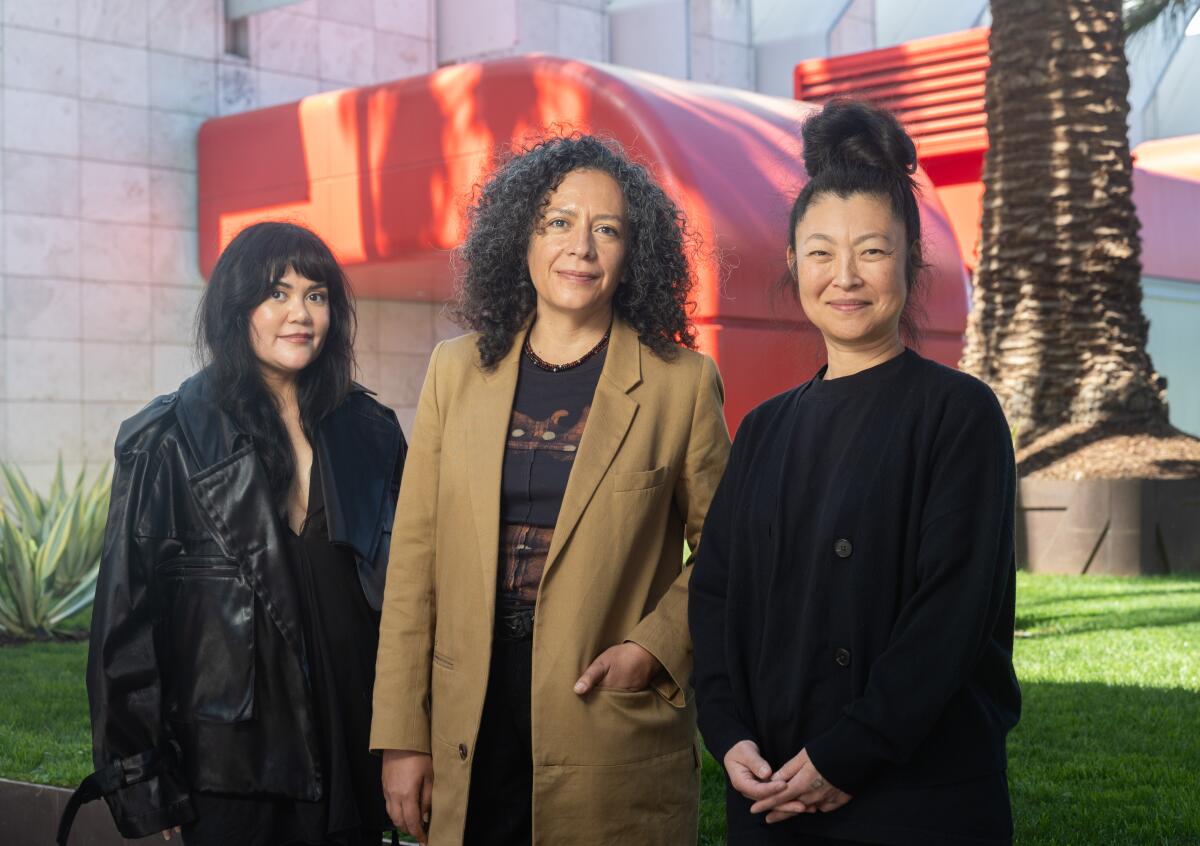
Sarah Rosalena, from left, Mariana Castillo Deball and Shio Kusaka were selected to create new works based, in part, on how themes espoused in their art fit with the ethos of the modernist design of the new David Geffen Galleries.
(Myung J. Chun / Los Angeles Times)
Govan had recently flown in from Tilburg in the Netherlands, where he visited the TextielMuseum’s TextielLab with interdisciplinary artist and weaver Sarah Rosalena. Her commission — an 11-by-26½-foot tapestry invoking the ethereal topography of Mars — was being woven on one of the largest Jacquard looms in the world. A few weeks later, a test swath of the tapestry was shipped to LACMA so Rosalena could see how colors and materials looked and felt.
“I was really interested in pushing the textile to really think about terrain,” said Rosalena, standing over the tapestry, which was laid out on a long conference table in a nearby office tower with a bird’s-eye view of the new building. “So that’s experimenting with different yarns. Some of it looks like clouds. Some of it almost looks like ocean or water. Some of it looks atmospheric, but definitely otherworldly.”
Rosalena is an Angeleno of Wixárika heritage whose practice merges ancient Indigenous craft with computer-driven science and technology to challenge colonial narratives and examine global problems such as climate change and cultural hegemony. She has fond memories of watching her grandmother weave on a backstrap loom while growing up in La Cañada Flintridge, and found that she was just as skilled at computer programming as she was at making textiles.

Sarah Rosalena’s 26-foot long weaving, “Omnidirectional Terrain” (2025), in progress on the jacquard-rapier loom at TextielLab in Tilburg, Netherlands.
(Alexandra Ross)
“My mother would also do a lot of weaving and beading,” said Rosalena, a professor at UC Santa Barbara. But it wasn’t until she got interested in photo and digital media processes that she saw their relationship to weaving.
When it’s complete, the tapestry, “Omnidirectional Terrain,” will hang on the 30-foot wall in the museum restaurant, where it will be visible through the glass that looks in from the courtyard and Castillo Deball’s “Feathered Changes.” The patterns that Castillo Deball will have created underfoot will run beneath Rosalena’s work — the earth beneath a mercurial red sky.
The third commission, by ceramicist Kusaka, will be around the corner from the first two, in a plaza. Kusaka laid out a series of drawings on small white pieces of paper on the conference table, tracing the evolution of her idea from a basic sketch to what she hopes will be its final iteration: a 12-foot-tall interactive sculpture featuring a flying saucer atop a cone of bright light, which children and adults can enter, ostensibly to be beamed up to the craft — if only for a fun photograph.
“When students are in the education center, they’re looking through glass at it, which will be a nice inspiration,” Govan said. “You’ll also see it as you’re on Wilshire. What is that interesting thing? So that was the idea.”
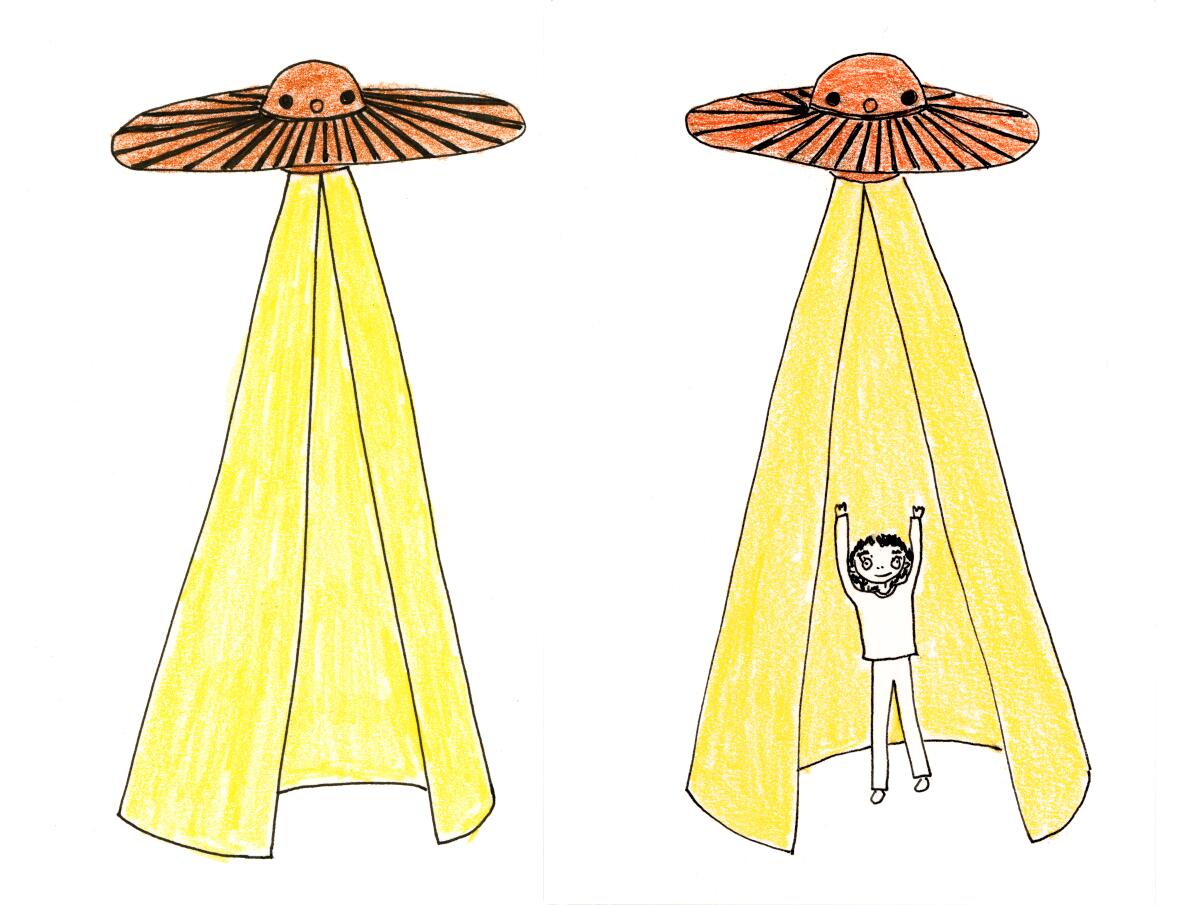
Preparatory sketches for Shio Kusaka’s LACMA-commissioned sculpture. The second includes a figure to show scale.
(Shio Kusaka)
Creating visitor attractions that can be shared on social media has proved a savvy marketing strategy at LACMA, where Chris Burden’s “Urban Light” installation of city streetlamps and Michael Heizer’s “Levitated Mass,” often referred to as the Rock, have grown from Instagram moments to beloved civic landmarks.
Kusaka’s playful forms are most commonly seen in her ceramic pots, vases and vessels, often glazed with bright colors and decorated with whimsical geometric patterns. Her obsession with space and space creatures finds its lineage in some pots she shows from a book of her work. Some have buttons resembling the control panel of a spaceship; others have little faces that could be alien.
“I don’t like making big things for no reason. I really like small things I can hold,” Kusaka said. “But it’s really fun to have a reason that I can go this big, which might be a part of why I want a person to go inside.”
Kusaka was born in Japan and learned traditional crafts from her grandparents. Her grandmother taught tea ceremonies, and her grandfather taught calligraphy.
“I never thought that I was gonna relate to what they did at the time. But I do see the relationship now,” said Kusaka, explaining how she began her study of ceramics in college in Boulder, Colo. “So I was touching ceramics a lot, and then I learned how to look at tools and to appreciate their functions.”
Her fanciful commission for LACMA charts a new course, but in a way, she said, it’s still a vessel.

Entertainment
Lucas Museum to give free annual passes to South L.A. neighbors, host community preview day
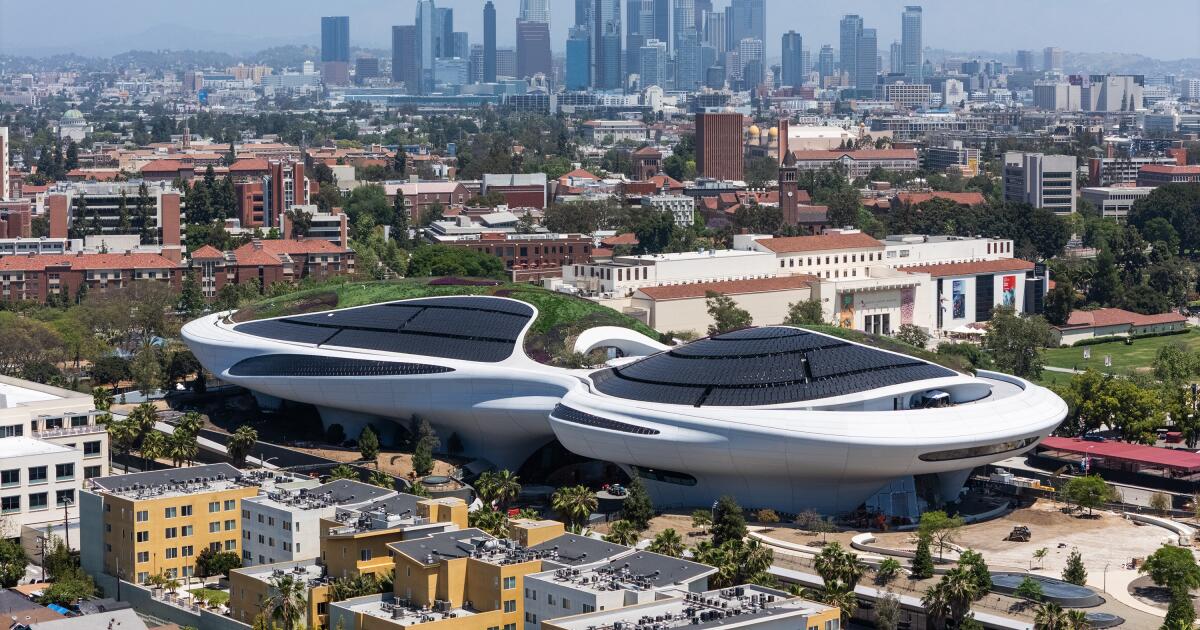
The Lucas Museum of Narrative Art, which is moving at light speed toward its Sept. 22 opening, announced Thursday that it will give free annual passes to its South L.A. neighbors living in the 90037 ZIP Code. The 300,000-square-foot, $1-billion museum located in Exposition Park will also host a special community preview day on Sept. 13, more than a week before the general public gets to step inside.
The 90037 ZIP Code has a population of more than 65,000 and is bordered roughly by the 110 Freeway to the west, Slauson Avenue to the south, Central Avenue to the east and Martin Luther King Jr. Boulevard to the north. Residents can register for passes at lucasmuseum.org/lm37 and will be alerted in August when the program launches. Pass holders can reserve tickets for themselves and one guest.
Tickets for non-pass holders go on sale July 21. They cost $25 for adults and $21 for seniors. Kids 17 and under are free.
“Storytelling has the power to bring people together and create a sense of community,” said Lucas Museum Chief Executive Tracey Bates in a news release about the program. “Through LM37, we are inviting our South Los Angeles neighbors to make the museum part of their lives and take their own path of discovery through the art, programs and experiences that will help shape this new cultural hub for Los Angeles.”
The community preview day is designed to give local business owners, community partners, civic leaders and registered LM37 pass holders a sneak peak of the 10,000 square feet of exhibition space, as well as the expansive gardens with 11 acres of park space.
The opening programming, curated by co-founder George Lucas, features 20 inaugural exhibitions across more than 30 galleries, including one titled “Star Wars in Motion,” containing vehicle designs, high-speed racers, flying vessels, props, costumes and illustrations from the first six films in the beloved franchise.
More than 1,200 objects will be on display from Lucas’ personal collection of narrative art. Highlights include work by Norman Rockwell and Dorothea Lange, as well as a variety of manga, children’s book illustrations and comics.

Last year’s “Superman” ended with Iggy Pop singing “Because I’m a punk rocker, yes I am” — an ironic coda for a superlatively square hero. But it rings straightforwardly true for Superman’s cousin.
Milly Alcock’s Kara Zor-El, or Supergirl, sports not a spandex suit but a Blondie T-shirt. When we meet her in Craig Gillespie’s “Supergirl,” she’s been on an interstellar bender for days. She’s more Courtney Love than Clark Kent.
Nonchalant and sarcastic, Kara is also a little Han Solo-ish, you might say, given that she moves capriciously through the galaxy in her junky spaceship while getting in fights in extraterrestrial bars. She’s a welcome, jagged riff on more buttoned-up superheroes, and Alcock is terrific in the role. If only “Supergirl” was as good as she is.
While the latest DC release, and second under James Gunn’s stewardship, has its moments, “Supergirl” struggles to match Kara’s punk-rock energy with an equally spirited supporting cast and story.
Skepticism seems to have gathered for “Supergirl” ahead of its release. Many fans have argued it wasn’t the right next step for DC Universe. But I’m not so sure. Alcock’s breezy cameo in “Superman” was one of that movie’s highlights. Handing the follow-up to her, and her faithful floating dog Krypto, strikes me as an extremely natural next step. When in doubt, follow the dog.
And much of “Supergirl” is winning. It resides almost entirely in space, touching down only momentarily on Earth. In its consistently creative production design, clever needle drops and underdog story arc, “Supergirl” resides a little closer to Gunn’s “Guardians of the Galaxy” movies than other DC entries. Its outer space is filled with cosmic detritus, mean characters and cute critters. Seth Rogen as the voice of a tiny alien co-piloting a space bus is an inspired concoction, as is a shabbier sci-fi realm with rest stops along the intergalactic highway.
Entertainment
Justin Baldoni and wife break silence after ‘It Ends With Us’ legal battle with Blake Lively

Justin Baldoni has broken his silence after reaching a settlement in a lengthy and highly publicized legal dispute with Blake Lively.
Baldoni and his wife, Emily Baldoni, presented a united front in an Instagram video the couple shared Wednesday that began, “So we have not spoken publicly for the better part of the last two years, and it’s not because we haven’t had anything to say, because Lord knows we have.”
The “It Ends With Us” actor and director said that although they’d wanted to address the debacle that involved dueling lawsuits with Lively, nearly two years of tit-for-tat fodder and culminated in a confidential settlement, “something was telling us not to.”
The couple said they prayed about when to make a public statement. “This feels like the moment,” Emily said.
“What does feel important,” she continued, “is that we can genuinely say that we are sitting here today feeling immense gratitude for so many things and so many people and so many things that have happened to us.”
“Gratitude has saved us,” Justin added.
“I also feel that it’s important as we say that — in that gratitude — it doesn’t negate the injustice and the pain that we have also felt in the last few years, and we’ve had to wrestle with so many things and try to understand so many things,” Emily said. “How could something like this even happen? Let alone disguised as a fight for women. So much to unpack. And the truth is, reality is, is that there’s been a lot of trauma for us to move through as a family, which also makes it hard to speak.”
“We don’t even know this is the right thing to say, but we just know we need to share something,” Justin said. “What I will say is that there have been so many painful things that have been spoken into existence — “
“Untruthful,” Emily broke in.
“We didn’t want to add to the noise, so we just wanted to let the justice system run its course,” he said.
“And the truth and the facts have spoken for themselves,” Emily said.
The couple’s statement comes a year and a half after Lively filed a bombshell lawsuit against Baldoni alleging sexual harassment, retaliation and several other charges on the heels of a messy “It Ends With Us” summer release and press tour that fueled rumors of on-set turmoil.
Less than a month after the allegations against Baldoni rallied Hollywood against him, he countersued Lively, her publicist Leslie Sloane and her husband, Ryan Reynolds, for $400 million in damages, claiming they’d smeared his name in the press and wrestled away his control of the film. His suit was later dismissed.
In May, two weeks ahead of the trial, Lively and Baldoni reached an agreement to resolve their legal dispute, bringing an abrupt end to the contentious battle.
“The parties in the Blake Lively and Wayfarer Studios litigation have reached an agreement to resolve the matters,” lawyers for both sides said in a joint statement.
“The end product — the movie ‘It Ends With Us’ — is a source of pride to all of us who worked to bring it to life. Raising awareness, and making a meaningful impact in the lives of domestic violence survivors — and all survivors — is a goal that we stand behind. We acknowledge the process presented challenges and recognize concerns raised by Ms. Lively deserved to be heard. We remain firmly committed to workplaces free of improprieties and unproductive environments. It is our sincere hope that this brings closure and allows all involved to move forward constructively and in peace, including a respectful environment online.”
In June, a federal judge ordered Baldoni and his production company to pay Lively’s attorney fees related to his unsuccessful defamation lawsuit against her, but rejected her bid for additional damages.
“So, how are we doing?” the filmmaker said in the Instagram video. “We are healing, and if you’ve ever been through something traumatic, you know that healing isn’t linear. It lives different every day, and we have had to rethink for ourselves what is real. What matters, and it’s this. It’s our family. It’s our friends. It’s our community. It’s our faith.”
Times staff writer Josh Rottenberg contributed to this report.
-
Culture41 minutes ago
Which Version of the ‘Odyssey’ Should You Read?
-
 Lifestyle44 minutes ago
Terry Tempest Williams on why women with big ideas get labeled ‘crazy’ : Wild Card with Rachel Martin
-

 Technology56 minutes ago
Google’s Nest Thermostat has hit its best price of the year
-

 World59 minutes ago
Argentinian flight instructor jumps to death from plane, 22-year-old student forced to land alone
-

 Politics1 hour ago
Omar’s disclosures erased millions, leaving her with potential negative net worth. She won’t explain why.
-

 Health1 hour ago
Dr Oz links obesity to chronic disease surge, says GLP-1s can ‘jumpstart’ better health
-

 Sports1 hour ago
Pirates star pitcher makes unfortunate history after being taken out in middle of perfect game bid
-

 Technology1 hour ago
Medical identity theft follows you into the doctor’s office

