Midwest
Firefighter paramedic led secret life as mafia hitman before family fell apart: son

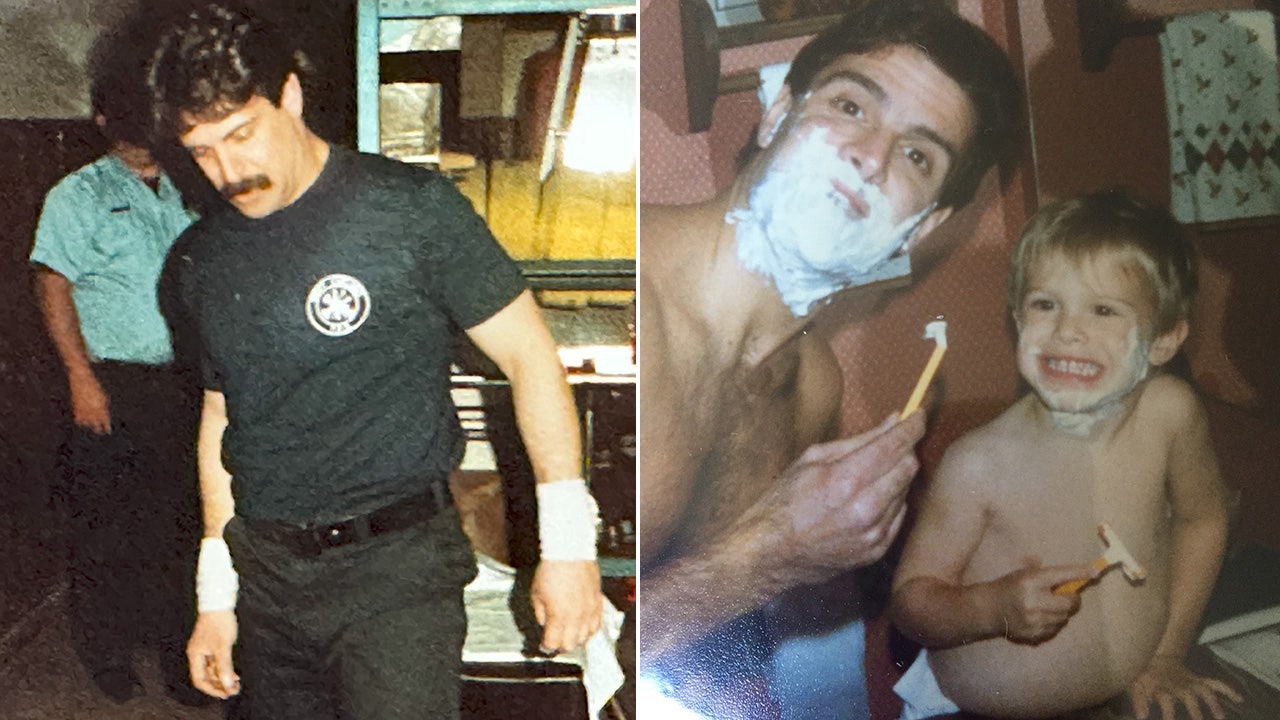
In 2013, Ken Tekiela revealed a secret to his son that he had been keeping for over 20 years.
At the time, he had been battling a crippling heroin addiction for about a decade and had been estranged from the 28-year-old for about five years. But his firstborn, who believed things were worsening for the patriarch, put him in a detox facility to help him get clean.
“He relapsed a few times, but his journey to recovery was positive,” Kyle Tekiela told Fox News Digital. “Once he felt like he had recovered . . . I think that opened up some doors for him. And I think it gave him the confidence to tell me. But it was a huge shock. It was like, ‘Did I hear that correctly?’”
MASSACHUSETTS MAN’S DEATHBED CONFESSION RATTLES FAMILY AFTER DECADES ON THE RUN: ‘IT WASN’T A WEIRD DAD JOKE’
Ken Tekiela at the firehouse, circa 1984. (Kyle Tekiela)
Tekiela, a celebrated firefighter paramedic and father of two, confessed that he had led a secret double life as a hitman for the Chicago mob.
Kyle is now detailing his father’s story in a true-crime podcast titled “Crook County,” a co-production of iHeartPodcasts and Tenderfoot TV.
It explores how Tekiela, known as “The Kid,” reportedly rose through the ranks of the Chicago Outfit and its lasting impact on his family. It features candid sit-down interviews with Tekiela and other loved ones.
Kyle Tekiela is an award-winning filmmaker and Ken Tekiela’s oldest son. (Kyle Tekiela)
“These are family secrets that probably should have stayed buried,” Kyle admitted. “But they’ve come to light, and it’s not easy to digest.
“It took a long time for me to process it before I was confident enough to share it with others. But I did have to ask myself, is this something we bury forever? Or do we own it and say, ‘This is who we are,’ and make the best of it and maybe learn some lessons from it, too?”
Ken Tekiela is seen here cooking in the firehouse kitchen. In 1982, he passed all his tests to become a firefighter paramedic. Kyle Tekiela said his father asked the original capo who invited him into the Outfit if he could pursue his dream of working for the fire department. The capo, whose name wasn’t revealed, gave him his blessing. (Kyle Tekiela)
Growing up, Kyle saw his father as “a local hero” who was revered in his community. Working 24-hour shifts and being away from home was normal for Tekiela and his family. However, he always remained devoted to his most important role – that of father.
FOLLOW THE FOX TRUE CRIME TEAM ON X
“Crook County” is available for streaming. (iHeartPodcasts and Tenderfoot TV)
“That was his job,” said Kyle. “We thought we had a super dad growing up. He was a firefighter paramedic, and their schedules are typically somewhere around 24, 48 hours or somewhere in between. That gave him a lot of time away from home.”
Tekiela’s dedication to duty stemmed from tragedy. In 1979, American Airlines Flight 191 crashed near Chicago’s O’Hare International Airport. A total of 273 people died. Tekiela was about 23 years old at the time.
Aerial view of emergency vehicles the morning after the plane crashed at O’Hare International Airport in Chicago on May 26, 1979. (UPI/Bettmann Archive/Getty Images)
“Watching all these first responders, firefighters and paramedics go and try to get control of the scene inspired him,” said Kyle. “That’s what made him go, ‘I want to be that. I want to help people.’ At that point, he had been working for the mob, not helping people.”
According to “Crook County,” Ken Tekiela successfully kept his mafia life a secret from his family and closest friends for over two decades. (Kyle Tekiela )
But before duty called, Tekiela described having a tumultuous childhood. He said he was kicked out of his house by his mother at age 16. Struggling to find a way and living out of his car, a desperate Tekiela robbed a drug dealer, who turned out to be the nephew of a capo. The FBI describes a capo in the mafia as a ranking made member who leads a crew of soldiers, similar to a military captain.
The Chicago Outfit was the city’s branch of the American mafia. Its most notorious leader was Al Capone. (Photo12/Universal Images Group via Getty Images)
Tekiela was 17 at the time. Kyle said the capo found his father and questioned him. Then he made an offer that the patriarch couldn’t refuse.
SIGN UP TO GET THE TRUE CRIME NEWSLETTER
Ken Tekiela’s high school photo. (Kyle Tekiela)
“It was the wrong place, wrong time, wrong decision,” Kyle explained. “But he had spunk. And the capo saw that. So they brought him in. He had nowhere else to go, so he had no choice. . . . He was the little guy under their wings. He was ‘The Kid.’ And he wanted to impress them.”
According to Kyle, Tekiela’s role in the Outfit was to “take out the people that the mob wanted out of the mob.”
“People who were f—–g up and being selfish, or stealing from the organization,” Kyle explained.
Ken Tekiela with his then-girlfriend, Holly. They married in 1984. (Kyle Tekiela)
Kyle believes that the secret to his father’s survival – not getting killed or thrown in jail – was “not asking too many questions.” In 1982, Tekiela became a firefighter paramedic, making him an asset to the Outfit.
“It was about just doing your job, doing it well, and going home – not doing anything extra,” said Kyle. “A lot of these guys did stuff on the side to get extra money. They’re selling drugs, which you’re not supposed to do. They were running girls. They were stealing. . . . He didn’t want to be like those other guys. And I think mentally, that took him a long way.”
The Chicago Outfit was active in the city during the ‘70s and ’80s. Seen here is a mugshot of Chicago Outfit mob boss Joseph “Joey” Hohn Aiuppa (1907-1997), circa 1980. (Potter and Potter Auctions/Gado/Getty Images)
“Who knows what would have happened if he didn’t become a firefighter,” Kyle reflected. “And I think selfishly, the mob realized that, as a first responder, he’s an asset. They’ve got someone going to crime scenes. . . . He can have a family, be a civilian, but [the mob] also has a guy on the inside who can do their bidding – or their beating, I should say.”
GET REAL-TIME UPDATES DIRECTLY ON THE TRUE CRIME HUB
Ken Tekiela in his 20s. By then he was working with the Chicago Outfit, his son claimed. (Kyle Tekiela)
Tekiela’s wife never suspected that her husband may have had a double life. They married in 1984 and Kyle was born a year later.
“For my mom, ignorance was bliss,” said Kyle. “She believed everything he told her. She didn’t dig. She wasn’t suspicious. And if she’s not suspicious, the kids are not suspicious.
“He was able to keep that whole world away from our little home that he kept outside the city in the suburbs. It was just a regular middle-class town. And because of his career as a firefighter, he had respect in the community. And he had that time away from the house to do whatever he needed to do for the Outfit.”
Ken Tekiela fighting a fire. In 1999, he suffered a work-related injury that resulted in an addiction to heroin. (Kyle Tekiela)
Things took a turn when Kyle was in high school. When he was about 16 years old, his parents began fighting frequently. He noticed that his father’s inflamed veins “were terrible” and that he acted “erratic.”
“When I was 14, he got into an accident,” said Kyle. “He was holding a ladder for a firefighter who was going up into the attic of a tall ceiling warehouse during a fire. . . . The ladder kicked out, and it fell on top of the firefighter.
“The ladder and firefighter fell on top of my dad. . . . It almost killed him. He had a bunch of surgeries, and the doctors were prescribing opiates. . . . Then he just started using [heroin]. In his words, ‘I took a liking to those painkillers, but after a while it wasn’t enough.’ He got addicted, and it just became out of his control.”
Ken Tekiela with his wife Holly. Kyle Tekiela was 17 when he first suspected that his father was using drugs. (Kyle Tekiela)
The podcast details how Tekiela ultimately lost his job, and “everything fell apart pretty quickly” with the mob.
It was during Tekiela’s recovery at a detox facility, and a yearning to rebuild his relationship with his son, that he started opening up about his past.
WATCH: SAMMY THE BULL GRAVANO: MAFIA IS LIKE BOY SCOUTS, COMPARED TO POLITICIANS
“I think . . . he feels relief and has accepted his reality, his history,” said Kyle. “He hasn’t lived a very good life over the last 10, 15 years. . . . It’s been hard. . . . I pay his rent. I just bought him a car. He’s like a child. And I think everyone knows my dad f—d up big time and destroyed our whole family. But they didn’t know why.”
Kyle Tekiela said the last time he saw his father was in 2023. (Kyle Tekiela)
“Even though the context is horrible, it’s still his story, and his story has meaning,” Kyle reflected. “I think for him, he thought, ‘Am I going to be a drug dealer or a drug addict who ruined my family, or am I going to finally tell people who I was, how I got there, how I tried to get out but couldn’t and how it fell apart?’
“Even after he told me all this stuff, even after all the pain and struggle we went through with his addiction, I still love him,” Kyle continued. “And I respect him more now that he finally told me everything. . . . Now I know there was a reason why he was keeping secrets. There’s a reason why he was on drugs. It’s hard to keep a secret, and he had to deal with the pain somehow.”
Kyle, himself a husband and father to a 10-year-old son, said that speaking to Tekiela for the podcast has been “a healing experience.” Today, Kyle and Ken speak on the phone “occasionally.” Kyle said he assumes his father is “still using in some capacity.”
Kyle Tekiela speaks to his father on the phone occasionally. (Kyle Tekiela)
“I can see the real remorse in him,” said Kyle. “When he tells these stories – these awful things he had to do – there’s real remorse. He’s ashamed of it all.”
Today, Tekiela has “zero fear” of speaking out. Kyle feels the same way.
FORMER MOB BOSS FINDS GOD IN PRISON, WALKS AWAY FROM ‘EVIL LIFESTYLE’: ‘MY FAITH IS ROCK SOLID’
Ken Tekiela tells his story in “Crook County.” (Kyle Tekiela)
“This is not just another story about the mob,” said Kyle. “It’s a journey of discovery between a father and a son. . . . There’s a lot of growth. And the thing is, a lot of people don’t want to talk about their feelings. They feel it’s weak to talk about your feelings or to seek therapy. But by watching my dad essentially treat me like a therapist and tell me everything – I could see the weight lift off of him.”
“I think it’s so important for families to talk about hard truths,” said Kyle. “As soon as you start keeping secrets, that’s when it all falls apart.”
New episodes of “Crook County” are available for streaming weekly.
Read the full article from Here


The Detroit Pistons have put Isaiah Stewart on the trade block with multiple offers swirling around the ever-changing rumor mill.
Several teams would benefit from having Stewart, who averaged 10 points, five rebounds and 1.6 blocks per game last season, on a solid 55% from the floor. However, despite linking up well with Jalen Duren, Stewart earning a total of $30 million over the next two years simply doesn’t fit with their future outlook.
Stewart has been linked to the blockbuster three-team trade involving Giannis Antetokounmpo; however, if we set that aside, who else could use his talents ahead of the upcoming season?
Stewart embracing the north?
A possible swap involving the Toronto Raptors could be on the cards. The Raptors have been desperate for frontcourt depth, and the Pistons could definitely use more playmaking and shooting options on their roster.
For Detroit, trading Stewart for youngsters Gradey Dick and Jamal Shead makes perfect sense, with the Pistons able to mould them into backups for Cade Cunningham and Ausar Thompson.
While Shead provided relief for Immanuel Quickley, Dick fell out of the rotation and will be eager for a second chance in the Motor City.
Bringing a much-needed wing player to Detroit, via Cleveland
The Cleveland Cavaliers could bring a talented wing player to Detroit in the shape of Max Strus, whose presence would really help the Pistons.
What they’re short on is two-way wings who can ease the pressure off their stars, and Strus can fit perfectly into that gaping hole.
Beyond his floor-spacing ability, he can also create offense by attacking closeouts, addressing another area where Detroit has struggled.
Look no further than their playoff meeting, which the Cavs won with Strus averaging around 10 points per game in the series, capped with a 20-point showing off the bench in Game 5 that helped swing momentum in the Cavaliers’ favor.
Stewart’s salary and defense helps Denver
One issue that plagued the Denver Nuggets this season was their rim protection, and defense in the paint.
With Stewart, who posted just under two blocks per game last season, his defensive style would really help the Nuggets, but he would be in a similar position to the one he is currently in Detroit: A backup to Nikola Jokic.
Why does this move make sense for both parties? Well, look no further than the money involved. If Denver shipped Cameron Johnson and Christian Braun, who are both on the trade block, it would save the Nuggets money and give Detroit two strong players with championship pedigree.
Stewart is under contract for $15 million in 2026-27, with a team option for the same amount in 2027-28, bringing his total value to $30 million. Johnson’s set to make $23 million, and Braun’s is on $21.5 million. This works better for Denver than it would for the Pistons, but having Johnson and Braun only boosts Detroit’s championship credentials.
Follow

MILWAUKEE – One person was killed in a two-vehicle crash in Milwaukee in the early morning hours of Sunday, June 21.
The driver of the other vehicle was arrested at the scene.
Crash and arrest
What we know:
According to the Milwaukee Police Department, the crash happened at about 1:15 a.m. near 11th and Greenfield.
A vehicle crossed the roadway then struck another vehicle, killing the driver. The victim, a 47-year-old, was being treated for life-threatening injuries but died from those injuries at the scene.
FREE DOWNLOAD: Get breaking news alerts in the FOX LOCAL Mobile app for iOS or Android
It is suspected that the driver of the striking vehicle was impaired. The 24-year-old suspect was arrested on scene in connection with the accident, and charges will be referred to the Milwaukee County District Attorney’s Office for review.
The Source: The Milwaukee Police Department sent FOX6 the information.

MINNEAPOLIS (WJON News) — A popular Broadway show will be hitting a Minnesota stage this fall. Mamma Mia! will jump-start the Broadway on Hennepin series at the Orpheum Theatre in Minneapolis from September 15th to the 20th.
Mamma Mia! has been seen in 50 productions in 16 different languages.
The 25th Anniversary production of Mamma Mia! made its return to Broadway last year for a limited run at the Winter Garden Theatre, where it got its start. The show also had a record-setting 14-year run on Broadway and toured from 2000 to 2017 with four different touring companies.
Mamma Mia! has grossed over $7 billion at the box office.
It inspired the blockbuster smash starring Meryl Streep, Pierce Brosnan, and Amanda Seyfried as well. The 2018 follow-up, Mamma Mia! Here We Go Again is the most successful live musical movie sequel of all time.
Mamma Mia! is written by Catherine Johnson and directed by Phyllida Lloyd with choreography by Anthony Van Laast. Tickets for the show go on sale at 10:00 a.m. on Friday.
QUIZ: Can You Identify These Awesome ’80s Movies From Just a Single Freeze-Frame?
From a stranded alien trying to phone home to a group of kids on a treasure hunt, see how many of these iconic ’80s blockbusters you can recognize from a single freeze frame.
Gallery Credit: Stephen Lenz
Glaring Continuity Errors From Popular TV Series
Gallery Credit: Stacker
LOOK: Iconic TV Shows With Only One Cast Member Surviving
From Diff’rent Strokes to Gilligan’s Island, several of the most iconic TV shows in history now have only one surviving main cast member.
Gallery Credit: Stephen Lenz
-

 Los Angeles, Ca37 minutes ago
31st annual Rodeo Drive Concours d’Elegance provides perfect Father’s Day activity
-

 Detroit, MI55 minutes ago
3 Isaiah Stewart Trade Packages That Would Make Sense for Detroit Pistons
-

 San Francisco, CA1 hour ago
Giants Reach Franchise Milestone Never Before Seen in San Francisco
-

 Dallas, TX1 hour ago
Mavericks’ Potential 2026 NBA Draft Trade Down Target Revealed
-

 Miami, FL1 hour ago
Could the Heat bring Duncan Robinson back in a Deal for Giannis Antetokounmpo?
-

 Boston, MA1 hour ago
Volunteer rescuer seriously injured Friday helping unresponsive teenage hiker in NH – The Boston Globe
-

 Denver, CO2 hours ago
7 injured in 3 overnight crashes across Denver, police say
-

 Seattle, WA2 hours ago
Kraken Acquire Panthers Wing Mackie Samoskevich | Seattle Kraken

