Business
Column: Meet the architect of Trump's attack on birthright citizenship, a California lawyer facing disbarment


Donald Trump’s flurry of first-day executive orders aimed at remaking American government in his image may have Americans’ heads spinning, but one stands out from the rest for its sheer audacity.
That’s the order to rescind “birthright citizenship,” which is constitutionally granted to almost all children born within the U.S. borders.
Opposition to birthright citizenship emerged almost immediately with its enactment as part of the 14th Amendment, which was adopted in 1868, and has waxed and waned in parallel with political controversies over immigration.
All persons born or naturalized in the United States, and subject to the jurisdiction thereof, are citizens of the United States.
— U.S. Constitution, 14th Amendment
But its emergence as a core issue for Trump owes much to the work of a California lawyer. He’s John C. Eastman, a longtime Trump advisor who is facing disbarment proceedings due to his role in the Jan. 6 insurrection.
Eastman has advocated a reconsideration of birthright citizenship — or as I wrote in 2020, “flogging this dead horse” — for years. He has consistently been in the minority among legal authorities on the topic.
Still, he maintains, as he did in a recent conversation with me, that “the leading scholars on this issue all agree with me.”
He added: “I’ve probably been most prominent more recently in articulating that position.” He declined to say if he had consulted with the Trump campaign or transition team before Trump issued the executive order.
Eastman’s criticism of birthright citizenship unfurled mostly through legal treatises and in conservative publications until 2020, when an article he wrote for Newsweek made him the public face of the issue.
The article, which appeared the day after Joe Biden picked Kamala Harris as his 2020 running mate, questioned whether Harris was eligible for the office of president (or by extension vice president) because she didn’t meet the constitutional requirement that a president be a “natural born citizen.”
“Her father was (and is) a Jamaican national, her mother was from India, and neither was a naturalized U.S. citizen at the time of Harris’ birth in 1964,” Eastman wrote. “That … makes her not a ‘natural born citizen.’”
Within days, Eastman’s argument was taken up by Trump, who cited him as a “very highly qualified and very talented lawyer.”
Newsweek, however, promptly disavowed Eastman’s article. In an editor’s note, the magazine tried to rebut objections that it had been tied in with the “birther” claims that Barack Obama had not been born in the U.S. Rather, it said, the article was merely airing a legitimate legal debate. Two days later, it posted a second note, in which it stated that “this op-ed is being used by some as a tool to perpetuate racism and xenophobia. We apologize. … We entirely failed to anticipate the ways in which the essay would be interpreted, distorted and weaponized.”
Before examining the persistence of attacks on birthright citizenship, a few words about Eastman. The former dean and law professor at the Fowler School of Law of Orange County-based Chapman University has seen his activities as a lawyer for Trump lead his career down a dark hole.
Eastman played an important role in promoting Trump’s false claim that the 2020 election was stolen from him, and addressed the crowd at Trump’s Washington rally on Jan. 6, 2021, that led to the attack on the Capitol that day.
A week after that rally, Eastman and Chapman reached an agreement under which he agreed to retire from the university, effective immediately.
In January 2023, the State Bar of California launched disbarment proceedings against Eastman, citing his efforts to promote Trump’s unfounded claim that the election was stolen. After a more than monthlong trial in the state bar court, in a March 27, 2024, ruling, Bar Judge Yvette Roland found Eastman culpable on 10 of the 11 state bar charges and recommended his disbarment.
Eastman “made multiple false and misleading statements in his professional capacity as attorney for President Trump in court filings and other written statements,” Roland ruled.
Under state bar rules, as long as Roland’s disbarment recommendation stands, Eastman is ineligible to practice law in California. His license was also suspended by the Washington, D.C., bar. He is also facing felony charges in Georgia and Arizona connected with the 2020 election; both cases, in which Eastman has pleaded not guilty, are pending. None of these cases involve the birthright issue.
Eastman is still fighting disbarment, based in part on his position that his actions on Trump’s behalf are protected by his 1st Amendment free-speech rights and that his claims about the election being stolen weren’t knowingly false. Oral arguments before the state bar court are scheduled for March 19. If the disbarment recommendation stands, the final decision will be made by the state Supreme Court.
That brings us back to the birthright issue. The 14th Amendment was enacted as a direct response to the Supreme Court’s egregious 1857 Dred Scott decision, which held that persons of African descent, such as enslaved people and formerly enslaved people, could not be considered citizens under the Constitution.
In its very first line, the amendment states forthrightly, “All persons born or naturalized in the United States, and subject to the jurisdiction thereof, are citizens of the United States.”
Legalistic debate over birthright tends to parse the clause “subject to the jurisdiction thereof.”
Most legal scholars — and courts that have considered the issue — accept the prevailing conclusion that it was meant to exclude chiefly children of foreign diplomats and ministers and those of occupying foreign armies, who remain under the jurisdiction of their own countries.
(Native American tribes were also excluded initially on the reasoning that the tribes claimed sovereign authority, but they were brought under the amendment’s protection in 1924.)
Some critics argue that the amendment could not have bestowed citizenship on the children of illegal immigrants because “illegal immigration” didn’t exist in 1868, as the U.S. then had no immigration restrictions.
That’s a dubious claim, constitutional scholar Garrett Epps has written. “‘Illegal aliens’ are ‘subject to the jurisdiction’ of both state and federal legal systems. They can be, and are every day, arrested, prosecuted and sentenced (even to death) in American courts,” and can be sued in civil courts.
What Trump could do about birthright citizenship is unclear. Repealing the 14th Amendment would require a new constitutional amendment, a lengthy and complicated process.
Some experts have said that Congress could act to redefine “jurisdiction,” but even a leading expert on the topic, Rogers M. Smith of the University of Pennsylvania, has acknowledged being in the “minority of scholars who think the Congress can act” to exclude undocumented immigrants’ children.
Trump might be hoping that the current Supreme Court majority, which has disdained its own precedents, would scrap this one — though whether it would discard a precedent that has stood for more than a century is an imponderable.
The Supreme Court’s support of a broad definition of birthright citizenship dates to 1898, in a ruling involving Wong Kim Ark, whose citizenship as the U.S.-born child of Chinese immigrants was challenged because his parents had had no right to become citizens themselves. The court rejected the challenge.
In a 1982 case, all nine justices accepted the view that undocumented immigrants, “even after their illegal entry” to the U.S., are covered by the 14th Amendment.
A remarkable feature of birthright citizenship is that the broadest definition is supported not only by progressives, but conservatives. Newsweek published a rebuttal to Eastman’s article in 2020 by conservative UCLA law professor Eugene Volokh. At the same time, the libertarian Cato Institute attacked Eastman’s claims head-on. And on Inauguration Day, Cato’s director of immigration studies, David J. Bier, issued a series of broadsides against Trump’s executive order, calling it a “blatantly unconstitutional… attack on American tradition, the rule of law, the Constitution, and indeed Americans themselves.”
In truth, the core issue of birthright citizenship isn’t constitutional. It’s political, and its politics are acrid in the extreme. The issue is inextricably bound up with racism and the notion of America as a beacon of white supremacy.
That has been the one constant in the opposition to birthright citizenship since the enactment of the 14th Amendment, legal scholar Rachel E. Rosenbloom has observed, noting that opposition is typically couched “in a highly racialized language of crisis and invasion.”
A proponent of a proposed 2009 California ballot initiative aimed at cutting off public benefits for undocumented immigrants, for example, asserted that “illegals and their children” were engaged in “invasion by birth canal.” (The measure didn’t make it onto the ballot.)
Trump has repeatedly employed the rhetoric of xenophobia and invasion to justify his attacks on immigrants. “They’re poisoning the blood of our country,” he said at a rally in 2023, referring to immigrants “from Africa, from Asia, all over the world. They’re pouring into our country.”
Opposition to birthright citizenship has tended to surge alongside concerns about immigration, especially when the latter has had a racist component. The Wong Kim Ark case was designed as a test of the Chinese Exclusion Act of 1882; the 1982 case arose as a challenge to a Texas law that denied funding for the K-12 education of undocumented immigrant children. (The Supreme Court struck down the law.)
Eastman told me in 2020 that he was troubled by what he called the “false charge” that he questioned birthright citizenship merely “because Kamala Harris is Black.” He said then that he had been studying and writing about so-called birthright citizenship for nearly 20 years “in all sorts of contexts,” not merely Black politicians.
Notwithstanding Eastman’s disavowal of racist intent, one can’t attribute the same innocence to Trump and his immigration policy team. In his Jan. 20 executive order on border security, he again invoked “the language of crisis and invasion” — “Over the last 4 years,” the order states, “the United States has endured a large-scale invasion at an unprecedented level.”
Truly, the ideological basis of the attack on birthright citizenship has barely changed in 127 years.

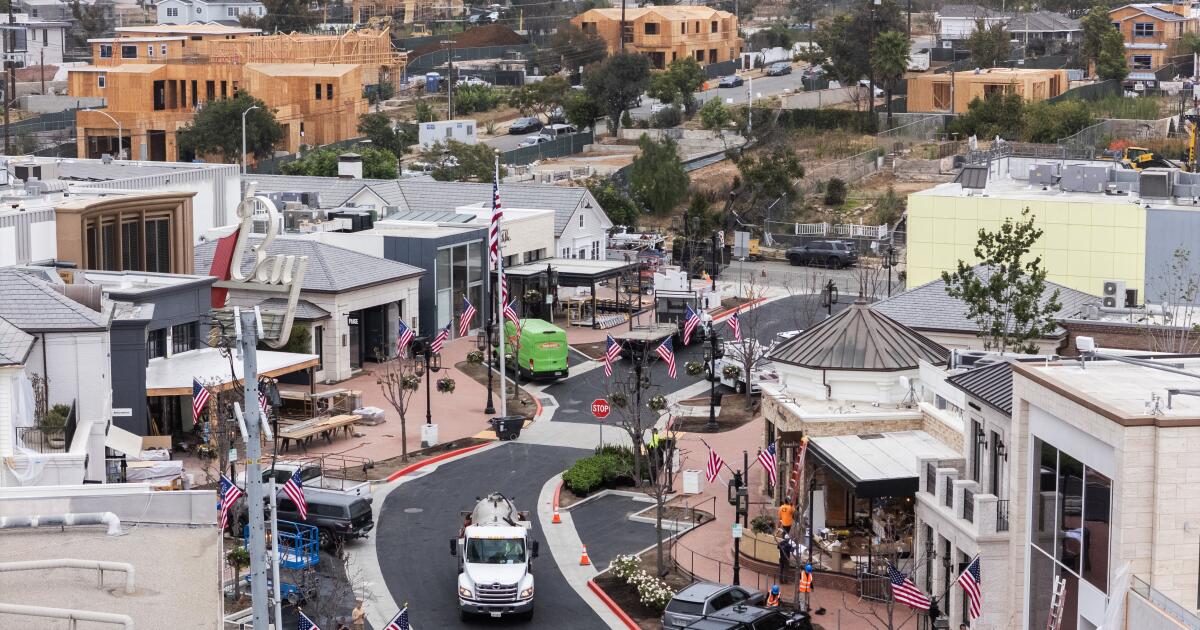
The luxury shopping center in Pacific Palisades will reopen next month after more than $100 million in renovations forced by the January 2025 wildfire that devastated the Los Angeles neighborhood.
Palisades Village will reopen Aug. 15, owner Rick Caruso announced Wednesday. The outdoor center survived the blaze that destroyed homes and other businesses but needed refurbishment to eliminate contaminants that the fire could have spread.
Crews are putting finishing touches on mall buildings after tearing them down to the studs, treating the wood and rebuilding the walls, Caruso said.
“Everybody’s working, and stores are moving their products in,” he said. “It’s a really cool feeling that people have really locked arms and are working together.”
An electrician installs lighting for a restaurant at Rick Caruso’s Palisades Village on Thursday. The shopping center is scheduled to reopen mid-August.
(Myung J. Chun / Los Angeles Times)
Pacific Palisades resident Allison Polhill, who is rebuilding the home of 30 years that her family lost in the blaze, said she is “thrilled” at the prospect of returning to the mall she used to frequent. Its comeback is a boost for the community, she said.
“Every single step that we make to reopen our commercial corridors is going to bring more people back into the Palisades,” said Polhill, who expects to move back into her home at the end of August.
A total of 6,822 structures were destroyed in the Palisades fire, including more than 5,500 residences and 100 commercial businesses, according to the California Department of Forestry and Fire Protection.
Caruso previously attributed the mall’s survival to the hard work of private firefighters and the fire-resistant materials used in the mall’s construction.
The $200-million shopping and dining center opened in 2018 with a movie theater and a roster of upmarket tenants, including Erewhon, which may be the only grocer in the heart of the fire-ravaged neighborhood when it opens.
Caruso’s company was able to fill the mall with tenants despite the long shutdown.
Palisades Village is 99% leased, with the majority of tenants returning, said Jackie Levy, chief financial and revenue officer. Nearly one-third of the shops and restaurants are new to the property.
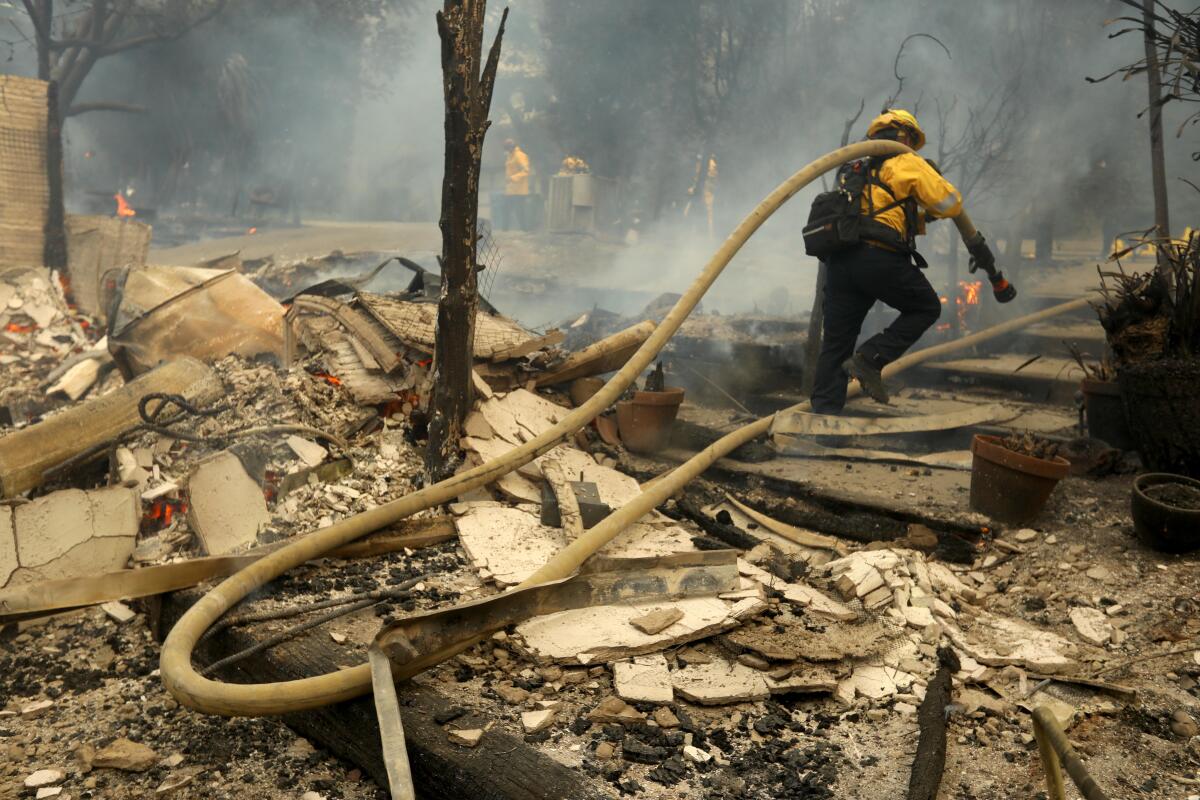
A firefighter carries a hose back to his rig while walking through a destroyed home from the Palisades fire in Pacific Palisades on Jan. 7, 2025.
(Genaro Molina / Los Angeles Times)
Last year, Pacific Palisades-based fashion designer Elyse Walker said she would reopen her eponymous store in Palisades Village after losing her 25-year flagship location on Antioch Street to the inferno.
Other neighborhood shops destroyed in the fire that are reopening at the mall include K Bakery and Loomey’s Toys, which caters to children up to age 12 and used to be across the street from Palisades Elementary Charter School.
“It’s been a journey and I’m excited because I wasn’t sure that there was going to be a place to come back to,” said toy store owner Amanda Rastegar. “Hopefully we can bring some of that magic back.”
Rastegar’s home in the Palisades survived but was damaged by the fire. The family returned about eight weeks ago. Her last memory of the fire was a burning supermarket.
“I just couldn’t wrap my brain around what was happening,” she said. “By the time I left, Gelson’s was on fire.”
Among the returning tenants is Angelini Ristorante & Bar. Well-known Los Angeles chef Gino Angelini said he will be in the kitchen next month for a return of the Italian restaurant.
“We won’t do a big celebrity open,” he said. “We want to have a very soft opening and see our customers come back.”

Construction takes place at Rick Caruso’s Palisades Village on Thursday. The shopping center is scheduled to reopen mid-August.
(Myung J. Chun / Los Angeles Times)
An elaborate celebration would not feel “correct for me,” Angelini said, because the devastation has been “very sad” for so many.
Other new tenants include local chef Nancy Silverton, who has agreed to move in with a new Italian steakhouse called Spacca Tutto. Women’s activewear retailer LESET will open its first West Coast location.
Caruso said he is optimistic that customers will return to the center, even though many Pacific Palisades residents are still dispersed. One tracking system estimated that about 30% of the Village’s customer base was impacted by the fire, he said.
“That means 70% did not get impacted, so there’s a lot of customers still left out there,” Caruso said. Historically, the center drew customers from as far away as Beverly Hills and Calabasas, as well as Malibu, Brentwood and Santa Monica.
He also hopes many will be inspired to visit the revived mall.
“I believe in the goodness of people and I believe that people are going to want to support the Palisades,” he said. “They’re going to want to be there and support the businesses that have had the courage and the heart to reopen.”

Walmart is rapidly expanding its network of electric vehicle chargers designed for customers to use while they shop.
The network could help fill gaps in EV infrastructure in states with greater need for chargers. Walmart, which has more than 5,000 locations in the U.S. and hundreds in California, says more than 90% of Americans live within 10 miles of one of its stores.
The chargers also offer an incentive for customers to choose Walmart — Walmart Plus members will receive a 10% discount off an average price of $0.46 per kilowatt-hour of energy at the company’s chargers.
Walmart chargers are already available at more than 75 locations in 17 states, with Texas boasting the most charging stations, followed by Florida and Arizona.
Matthew Nelson, Walmart’s director of energy policy, said last week on LinkedIn that the network will soon reach 29 states, including California.
“We are delivering on the promise of affordable, reliable and convenient charging,” Nelson said in his post.
According to Walmart’s website, six charging stations are coming to California soon, though the company did not offer a specific timeline.
The chargers will be installed at stores in Antelope, Brea, Fresno, Stockton, Suisun City and Vallejo.
Most charging sites in California will include eight to 16 fast-charging stalls, said Walmart spokesperson Kelsey Bohl.
The company first announced plans in April 2023 to install its own EV chargers at Walmart and Sam’s Club stores, with a goal of installing thousands of chargers by 2030. Partnering with ABB E-Mobility and Alpitronic, it added 25 new charging sites this past May and six more in June.
“Walmart is building a leading retail-integrated EV fast-charging network, focused on delivering an affordable, reliable and convenient charging experience where customers already shop,” Bohl said in an emailed statement. “Customers can charge while they shop, access stations through the Walmart app they already use, and benefit from affordable pricing.”
The charging stations already available include 612 individual charging stalls using 400-kilowatt chargers. Each stall has a dual charging cord with both Combined Charging System and North American Charging Standard connectors. The standard connectors, designed by Tesla, are smaller and lighter than the combined systems.
The primary way to pay for the chargers is through the Walmart app, but the company is also experimenting with built-in credit card readers to allow those without the app to use the stations.
Customers can check charger availability on the Walmart app. The company said the chargers will be available 24 hours a day.

Robotaxis could be turning into robocops.
A self-driving Waymo reported two teens to San Mateo, Calif., police on Monday after they were found drinking alcohol and shooting toy guns in the back of the vehicle.
According to a social media post from the San Mateo Police Department, officers detained two 15-year-olds after the Waymo they were riding in contacted the department and stopped in a parking lot until law enforcement arrived.
“Parents do you know where your teens are?” the San Mateo Police Department wrote on Facebook following the incident. “Waymo does!”
Officers removed both teens from the vehicle and determined they were using toy guns to shoot Orbeez out the windows. Orbeez are small, water-absorbing beads sold at toy stores.
“Toy guns, water guns, and BB guns all pose real dangers, especially to an untrained eye,” the Police Department said. “The simple handling of them can cause fear in [passersby].” “
A video posted on Facebook shows at least five officers and a police dog responding to the scene and approaching the Waymo with their weapons raised.
Waymo did not immediately respond to a request for comment.
Waymo vehicles have internal cameras and microphones that may be used in an emergency or to “promote safety and security,” according to Waymo’s online support page.
The cameras are also used to ensure the vehicles are clean and to help find lost items, according to the support page.
The company said it does not use facial recognition or other biometric identification technologies to identify individuals.
“In more urgent circumstances, support may access live video during a trip,” the Waymo page said.
The San Mateo Police Department’s Facebook post has garnered nearly 60 comments, with one user accusing Waymo of “snitching.”
“At least they got a designated driver?!” one user commented.
-

 Los Angeles, Ca37 minutes ago
Loved ones search for missing 34-year-old Southern California woman
-

 Detroit, MI57 minutes ago
Chickens, geese found at vacant home after nonprofit reports them stolen
-

 San Francisco, CA1 hour ago
What’s next for San Francisco Giants as MLB trade deadline approaches?
-
 Dallas, TX1 hour ago
Dallas millionaire files lawsuit against groundwater district
-

 Miami, FL1 hour ago
7 more women arrested at southwest Miami-Dade massage parlors, accused of prostitution in undercover sting
-

 Boston, MA1 hour ago
‘They’re my buddies’: 96-year-old Back Bay woman befriends French soccer team
-

 Denver, CO1 hour ago
Denver officers cited for separate incidents, 1 fired
-

 Seattle, WA2 hours ago
Study finds dangerous chemicals in the breast milk of Seattle moms

