Business
California's FAIR Plan, the home insurer of last resort, may need a bailout after the L.A. fires

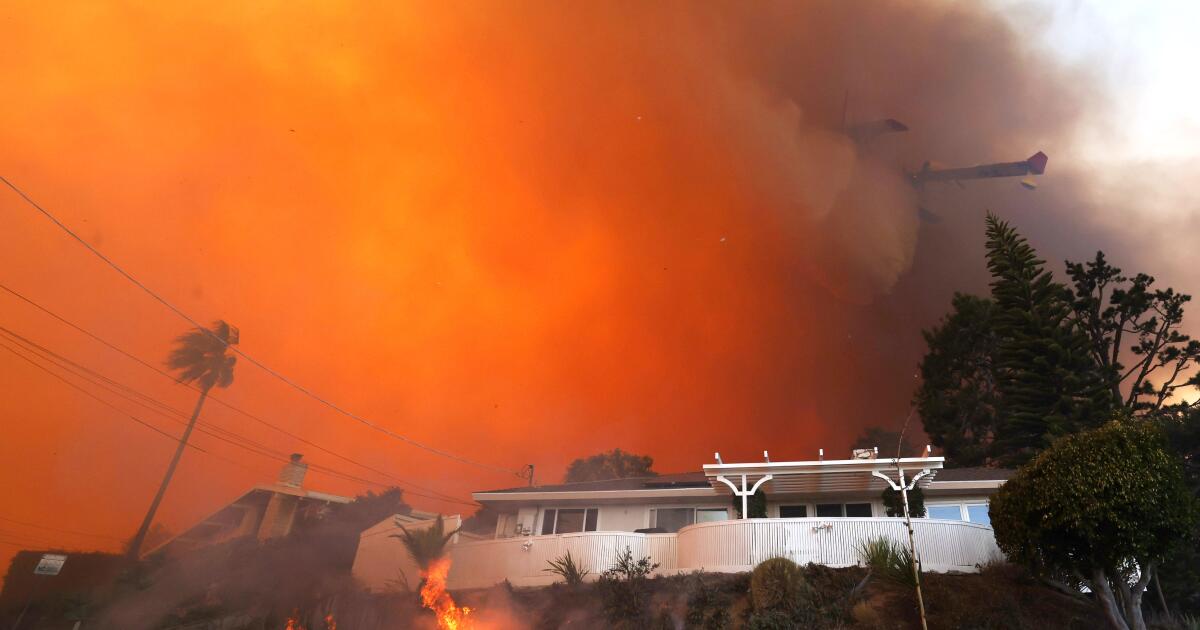
The California FAIR Plan Assn., the state’s property insurer of last resort, was born of smoldering ashes — not of a wildfire, but of one of the worst urban disturbances in U.S. history.
The Watts riots in 1965 damaged or destroyed more than 600 buildings, causing insurers to flee and highlighting the need for a new type of carrier to step in.
Established by the Legislature to also cover communities at risk for wildfires, the plan has proved resilient, paying out billions of dollars over the decades, including after the 2018 Camp fire that destroyed the town of Paradise and cost insurers $12.5 billion.
Now, however, the FAIR Plan is facing its biggest crisis since the 1994 Northridge earthquake, when it was bailed out by the state’s licensed property insurance companies, which operate the plan and provide it with a financial backstop.
The temblor caused some $15.3 billion in insured losses for the industry, but even after inflation, the Palisades and San Gabriel Valley’s Eaton fires alone are expected to be costlier.
CoreLogic, a leading property data and analytics firm, estimates the losses of those fires at $35 billion to $45 billion, not including the other smaller blazes that broke out. The fires have damaged or destroyed more than 12,000 structures and killed at least 27 people. Many homeowners in the fire zones were on the FAIR Plan after insurers pulled back from California’s troubled insurance market.
Forking over billions of dollars could wipe out the plan’s $377 million in reserves, as well as $5.78 billion worth of reinsurance the FAIR Plan announced Friday it had. The reinsurance requires the plan to pay the first $900 million in claims and has other limitations.
To avoid insolvency, the plan could be forced to lean on its member carriers. And they, in turn, might levy surcharges on their own policyholders to pay for any assessments.
“The L.A. wildfires are on track to be the costliest natural disaster in California in modern times,” said former state Insurance Commissioner Dave Jones. “And as the climate crisis worsens, the FAIR Plan faces extraordinary financial challenges with covering the risks private insurers are declining to cover because of climate change.”
The insurer offers basic insurance to rebuild after a fire, as well as coverage for personal property and expenses incurred while a home is rebuilt, and some optional protections. However, it can be costly and dwelling coverage is capped at $3 million. Further, the plan recommends policyholders consider buying additional private insurance for floods, earthquakes and other uncovered losses, including theft and liability.
It’s unclear what the FAIR Plan’s final bill will total, but its statewide exposure to financial losses has tripled to $458 billion over the last several years, according to the plan’s website. During that time, hundreds of thousands of homeowners, especially in foothills and other neighborhoods at high risk for fires, have piled into the plan as insurers have pulled back from the market over growing wildfire losses.
Based on preliminary estimates released Friday, the plan said that it has insured 22% of the structures within the Palisades fire zone as defined by Cal Fire, giving it a potential loss exposure of more than $4 billion. And it has insured 12% of the structures in the Eaton fire zone, giving it a potential exposure there of more than $775 million.
So far, the plan said it has received 3,600 claims but expects that number to grow and has boosted staff to handle the volume. It said it typically receives claims representing 31% of its total exposure, but its actual losses can be different.
“Our No. 1 focus remains on serving our customers and ensuring all covered claims are paid. The Southern California wildfires have been devastating for families and communities, far beyond the loss of property,” it said.
Jewlz Fahn and her husband, Terry, signed up for the FAIR Plan last year after State Farm, which had insured them for more than a decade, did not renew the fire, personal property and loss-of-use coverage they had for their home on Fiske Street, which burned down near the heart of Pacific Palisades.
They were able to get similar coverage for their dwelling — a little under $2 million — but their personal property coverage was slashed from $1.55 million to $153,000 and their loss-of-use insurance, which will covers their living expenses while their home is rebuilt, also dropped sharply from $620,160 to $153,000. More frustrating, Fahn said, has been the inability to get a timely payment for living expenses.
“I just finally got a phone call Wednesday from my claims manager — eight days after the fire started. They are very overwhelmed. I was trying to keep my cool, and I was told that they are trying to give an advance of a six-month payment, which for us would be a total of $52,038,” said Fahn, 52, who has been living in a Century City hotel with her husband.
In contrast, she said, a friend received a $75,000 payment within days of the fire from her commercial carrier.
The last time the plan faced such a financial catastrophe was after the 1994 earthquake, which caused $24 billion in insured damages for the industry in 2013 dollars, according to the Insurance Information Institute.
The plan assessed its members $260 million for wildfire and earthquake costs, according to the state Department of Insurance, leading to the establishment in 1996 of the California Earthquake Authority, a not-for-profit that now provides about two thirds of the state’s earthquake coverage.
As the FAIR Plan’s liabilities have soared, California Insurance Commissioner Ricardo Lara pushed through a series of reforms last year that seek to encourage private insurers to write more policies in communities at risk for wildfires by giving them concessions, including the right to charge their California customers for the cost of reinsurance they buy attributable to state risks.
Those reforms are just getting underway but one controversial provision intended to bolster the FAIR Plan’s finances in the event of a catastrophe could burden homeowners statewide with the cost of any bailout.
The measure allows the plan to assess its member carriers — once it runs through its reserves, reinsurance and catastrophe bonds — up to $1 billion to pay residential claims and $1 billion to pay commercial claims. The carriers could then surcharge their residential and commercial customers for half of what they are assessed. (Homeowners could not be surcharged for commercial losses.)
Insurers also can surcharge policyholders for 100% of assessments in excess of those amounts. Any surcharges would require the approval of the insurance commissioner.
Consumer Watchdog — which wrote the 1988 ballot measure that provided for an elected insurance commissioner with the authority to review and turn down insurer rate requests — called the provision an industry bailout last year. The group said existing law did not allow for the surcharges. Lara maintained it did and said he was offering consumers some protection.
“For us, it’s pretty simple. Homeowners across the state should not be on the hook for the L.A. fires because insurance companies abandoned those neighborhoods and dumped homeowners on the FAIR Plan,” said Carmen Balber, executive director of the Los Angeles consumer group.
Lara’s spokesperson, Michael Soller, said he could not comment on whether the commissioner would approve any surcharges but noted the provision calls for the FAIR Plan to run through all its financial resources before any assessment can even be considered.
“That adds another layer to prevent us from ever getting to a place where they have to pass costs along,” he said.
There were no homeowner surcharges after the Northridge earthquake.
The FAIR Plan in its update said that if it needs to assess its member carriers it would be based on their market share in 2023, but it has not yet reached that determination.
State Farm General, the state’s biggest home insurer, has become a punching bag after the fires due to its announcement last year that it would not renew some 72,000 residential and commmercial policies statewide. Last week, it rescinded that decision for all L.A. County residential customers whose policies had not yet lapsed.
Jon Farney, chief executive of parent company State Farm, told the Times last week that the Bloomington, Ill., insurer would recoup what charges it could from its own policyholders as allowed under state law.
“If there was a FAIR Plan assessment and the ability to pass that surcharge on, yeah, that’s what we would do,” he said.
Mercury Insurance, one of the state’s largest home insurers, announced a week after the fires started that its initial analysis showed its losses would probably exceed the $150 million it must pay before its reinsurance kicks in and covers higher losses. It also said its reinsurance would cover any FAIR Plan assessment.
The company declined to say whether it would surcharge its customers, deferring any comment to Lara, who a company spokesperson said “will set out guidelines.”
The idea that millions of Californians who live nowhere near the Los Angeles County fires could face surcharges on homeowner policies — that in some instances already have risen by hundreds or thousands of dollars over the last several years — has sent lawmakers in Sacramento scrambling for an alternative.
Just two days after the Palisades fire began, legislators introduced a bill that would allow the FAIR Plan to float bonds if the insurer faces “liquidity challenges.” The FAIR Plan said it supports the bill.
“The most important question for us right now is: ‘How can we help?’” Assembly Speaker Robert Rivas said in unveiling the legislation sponsored by two Southern California lawmakers.
A spokesperson for Gov. Gavin Newsom said, “The climate crisis has changed everything” and that the governor and insurance commissioner were still trying to assess the effects of the fires on the plan but would be “vigilant as the FAIR Plan explores the options they have to make sure impacted Californians have their claims paid.”
Jones, the former insurance commissioner, is dubious that floating potentially billions of dollars of tax-free bonds to pay claims will solve the crisis, although they would be very helpful in making sure there is money available to pay FAIR Plan claims.
“Bonds will help them pay off the claims as they come in, but they have got to be able to pay off the bonds. And the only way they’re going to be able to pay off the bonds is with an assessment if they run out of money,” he said. “Bonds are not a magic wand.”
Times staff writer Ben Poston contributed to this report.


The luxury shopping center in Pacific Palisades will reopen next month after more than $100 million in renovations forced by the January 2025 wildfire that devastated the Los Angeles neighborhood.
Palisades Village will reopen Aug. 15, owner Rick Caruso announced Wednesday. The outdoor center survived the blaze that destroyed homes and other businesses but needed refurbishment to eliminate contaminants that the fire could have spread.
Crews are putting finishing touches on mall buildings after tearing them down to the studs, treating the wood and rebuilding the walls, Caruso said.
“Everybody’s working, and stores are moving their products in,” he said. “It’s a really cool feeling that people have really locked arms and are working together.”
An electrician installs lighting for a restaurant at Rick Caruso’s Palisades Village on Thursday. The shopping center is scheduled to reopen mid-August.
(Myung J. Chun / Los Angeles Times)
Pacific Palisades resident Allison Polhill, who is rebuilding the home of 30 years that her family lost in the blaze, said she is “thrilled” at the prospect of returning to the mall she used to frequent. Its comeback is a boost for the community, she said.
“Every single step that we make to reopen our commercial corridors is going to bring more people back into the Palisades,” said Polhill, who expects to move back into her home at the end of August.
A total of 6,822 structures were destroyed in the Palisades fire, including more than 5,500 residences and 100 commercial businesses, according to the California Department of Forestry and Fire Protection.
Caruso previously attributed the mall’s survival to the hard work of private firefighters and the fire-resistant materials used in the mall’s construction.
The $200-million shopping and dining center opened in 2018 with a movie theater and a roster of upmarket tenants, including Erewhon, which may be the only grocer in the heart of the fire-ravaged neighborhood when it opens.
Caruso’s company was able to fill the mall with tenants despite the long shutdown.
Palisades Village is 99% leased, with the majority of tenants returning, said Jackie Levy, chief financial and revenue officer. Nearly one-third of the shops and restaurants are new to the property.
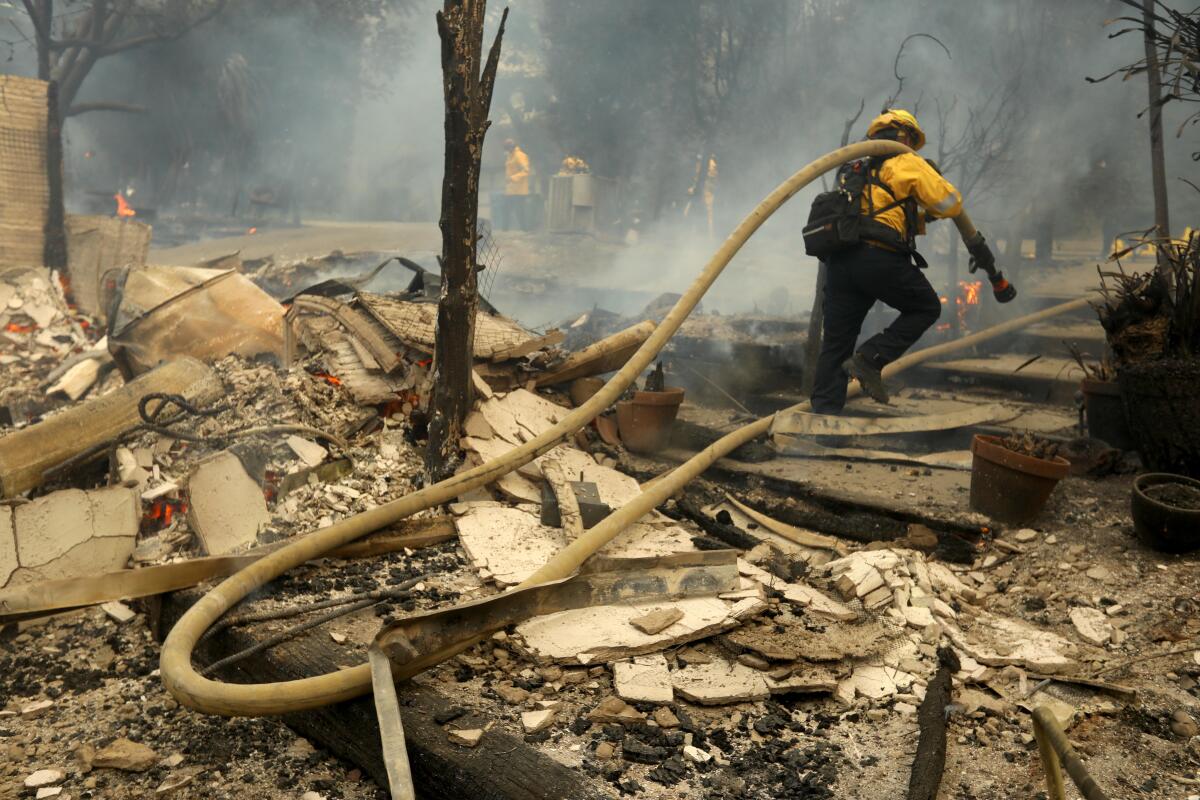
A firefighter carries a hose back to his rig while walking through a destroyed home from the Palisades fire in Pacific Palisades on Jan. 7, 2025.
(Genaro Molina / Los Angeles Times)
Last year, Pacific Palisades-based fashion designer Elyse Walker said she would reopen her eponymous store in Palisades Village after losing her 25-year flagship location on Antioch Street to the inferno.
Other neighborhood shops destroyed in the fire that are reopening at the mall include K Bakery and Loomey’s Toys, which caters to children up to age 12 and used to be across the street from Palisades Elementary Charter School.
“It’s been a journey and I’m excited because I wasn’t sure that there was going to be a place to come back to,” said toy store owner Amanda Rastegar. “Hopefully we can bring some of that magic back.”
Rastegar’s home in the Palisades survived but was damaged by the fire. The family returned about eight weeks ago. Her last memory of the fire was a burning supermarket.
“I just couldn’t wrap my brain around what was happening,” she said. “By the time I left, Gelson’s was on fire.”
Among the returning tenants is Angelini Ristorante & Bar. Well-known Los Angeles chef Gino Angelini said he will be in the kitchen next month for a return of the Italian restaurant.
“We won’t do a big celebrity open,” he said. “We want to have a very soft opening and see our customers come back.”

Construction takes place at Rick Caruso’s Palisades Village on Thursday. The shopping center is scheduled to reopen mid-August.
(Myung J. Chun / Los Angeles Times)
An elaborate celebration would not feel “correct for me,” Angelini said, because the devastation has been “very sad” for so many.
Other new tenants include local chef Nancy Silverton, who has agreed to move in with a new Italian steakhouse called Spacca Tutto. Women’s activewear retailer LESET will open its first West Coast location.
Caruso said he is optimistic that customers will return to the center, even though many Pacific Palisades residents are still dispersed. One tracking system estimated that about 30% of the Village’s customer base was impacted by the fire, he said.
“That means 70% did not get impacted, so there’s a lot of customers still left out there,” Caruso said. Historically, the center drew customers from as far away as Beverly Hills and Calabasas, as well as Malibu, Brentwood and Santa Monica.
He also hopes many will be inspired to visit the revived mall.
“I believe in the goodness of people and I believe that people are going to want to support the Palisades,” he said. “They’re going to want to be there and support the businesses that have had the courage and the heart to reopen.”

Walmart is rapidly expanding its network of electric vehicle chargers designed for customers to use while they shop.
The network could help fill gaps in EV infrastructure in states with greater need for chargers. Walmart, which has more than 5,000 locations in the U.S. and hundreds in California, says more than 90% of Americans live within 10 miles of one of its stores.
The chargers also offer an incentive for customers to choose Walmart — Walmart Plus members will receive a 10% discount off an average price of $0.46 per kilowatt-hour of energy at the company’s chargers.
Walmart chargers are already available at more than 75 locations in 17 states, with Texas boasting the most charging stations, followed by Florida and Arizona.
Matthew Nelson, Walmart’s director of energy policy, said last week on LinkedIn that the network will soon reach 29 states, including California.
“We are delivering on the promise of affordable, reliable and convenient charging,” Nelson said in his post.
According to Walmart’s website, six charging stations are coming to California soon, though the company did not offer a specific timeline.
The chargers will be installed at stores in Antelope, Brea, Fresno, Stockton, Suisun City and Vallejo.
Most charging sites in California will include eight to 16 fast-charging stalls, said Walmart spokesperson Kelsey Bohl.
The company first announced plans in April 2023 to install its own EV chargers at Walmart and Sam’s Club stores, with a goal of installing thousands of chargers by 2030. Partnering with ABB E-Mobility and Alpitronic, it added 25 new charging sites this past May and six more in June.
“Walmart is building a leading retail-integrated EV fast-charging network, focused on delivering an affordable, reliable and convenient charging experience where customers already shop,” Bohl said in an emailed statement. “Customers can charge while they shop, access stations through the Walmart app they already use, and benefit from affordable pricing.”
The charging stations already available include 612 individual charging stalls using 400-kilowatt chargers. Each stall has a dual charging cord with both Combined Charging System and North American Charging Standard connectors. The standard connectors, designed by Tesla, are smaller and lighter than the combined systems.
The primary way to pay for the chargers is through the Walmart app, but the company is also experimenting with built-in credit card readers to allow those without the app to use the stations.
Customers can check charger availability on the Walmart app. The company said the chargers will be available 24 hours a day.

Robotaxis could be turning into robocops.
A self-driving Waymo reported two teens to San Mateo, Calif., police on Monday after they were found drinking alcohol and shooting toy guns in the back of the vehicle.
According to a social media post from the San Mateo Police Department, officers detained two 15-year-olds after the Waymo they were riding in contacted the department and stopped in a parking lot until law enforcement arrived.
“Parents do you know where your teens are?” the San Mateo Police Department wrote on Facebook following the incident. “Waymo does!”
Officers removed both teens from the vehicle and determined they were using toy guns to shoot Orbeez out the windows. Orbeez are small, water-absorbing beads sold at toy stores.
“Toy guns, water guns, and BB guns all pose real dangers, especially to an untrained eye,” the Police Department said. “The simple handling of them can cause fear in [passersby].” “
A video posted on Facebook shows at least five officers and a police dog responding to the scene and approaching the Waymo with their weapons raised.
Waymo did not immediately respond to a request for comment.
Waymo vehicles have internal cameras and microphones that may be used in an emergency or to “promote safety and security,” according to Waymo’s online support page.
The cameras are also used to ensure the vehicles are clean and to help find lost items, according to the support page.
The company said it does not use facial recognition or other biometric identification technologies to identify individuals.
“In more urgent circumstances, support may access live video during a trip,” the Waymo page said.
The San Mateo Police Department’s Facebook post has garnered nearly 60 comments, with one user accusing Waymo of “snitching.”
“At least they got a designated driver?!” one user commented.
-

 News24 minutes ago
Three more people charged with damaging Reflecting Pool after Trump’s multimillion-dollar restoration | CNN Politics
-

 Los Angeles, Ca2 hours ago
Loved ones search for missing 34-year-old Southern California woman
-

 Detroit, MI2 hours ago
Chickens, geese found at vacant home after nonprofit reports them stolen
-

 San Francisco, CA2 hours ago
What’s next for San Francisco Giants as MLB trade deadline approaches?
-
 Dallas, TX2 hours ago
Dallas millionaire files lawsuit against groundwater district
-

 Miami, FL2 hours ago
7 more women arrested at southwest Miami-Dade massage parlors, accused of prostitution in undercover sting
-

 Boston, MA2 hours ago
‘They’re my buddies’: 96-year-old Back Bay woman befriends French soccer team
-

 Denver, CO3 hours ago
Denver officers cited for separate incidents, 1 fired

