Sports
Deion Sanders went from NFL star to successful college coach. Did his teammates see it coming?


Thirty-five years ago, new Atlanta Falcon Deion Sanders arrived in Suwanee, Ga., with a carefully crafted reputation.
During his college career at Florida State, he had driven to a game in a white stretch limo and stepped out wearing a tuxedo. Sanders was known for strutting into end zones in a way hardly anyone else dared do at the time. He told media members that Florida receivers “must think I’m God.”
“He was known for his flashy suits and alligator shoes, gold chains and his signature diamond-studded dollar sign, maybe a silk pork pie hat,” Falcons teammate Tim Green wrote in an email.
So Green had concerns.
Then he met him.
“The first time I saw him in person was in training camp in the Falcon Inn lobby, I did a double take,” Green wrote. “Prime Time was just Deion, dressed in a pair of Falcons shorts and a nondescript T-shirt.”
Green asked him why he wasn’t wearing his signature jewelry.
“Aw, that’s just for show, Tim,’” Sanders told the defensive end.
Green, like almost everyone, saw the style initially but the substance eventually. The substance has resurfaced this season as he has led the University of Colorado to a 9-3 record. Sanders has been so impressive that he may draw interest from NFL teams looking for a head coach.
The Athletic spoke with 10 people who worked with Sanders during his NFL days. None envisioned Sanders as a coach who would turn around a major college football program, but their stories make it easier to connect the dots between Neon Deion and Coach Prime.
Sanders’ path to the Alamo Bowl this weekend wound through eight years of coaching at the high school level and three years at Jackson State. But it began when he was doing the Deion Shuffle.
Though Sanders the football player was often perceived as self-aggrandizing, some in his circle saw something else. They saw him as a unifier.
“The players gravitated to him,” says Jerry Glanville, who coached Sanders for four years in Atlanta. “They loved him.”
Deion Sanders began his NFL career with the Falcons in 1989, also playing baseball for the New York Yankees and Atlanta Braves well into the 1990s. (Focus on Sport / Getty Images)
Glanville says teammates enjoyed it when Sanders brought celebrity friends like MC Hammer and Mr. T around the team.
When quarterback Bobby Hebert played against Sanders as a member of the Saints, he says he thought Sanders was cocky. Then Hebert signed with the Falcons as a free agent in 1993.
“As a teammate, you see he got along with everybody,” Hebert says. “We are both from the South, so we would go get a cane pole and go fishing together. The No. 1 asset he has is communication skills — how he interacted with the players in the locker room and meeting room. It didn’t matter if they were White or Black, and he was able to relate to different generations.”
Hebert believes Sanders’ ability to relate serves him well as a coach.
“When he is 70 or 80, he’ll still be able to relate to 20-year-olds,” Hebert says. “I would bet he’s an unbelievable recruiter.”
Green believes Sanders’ Christian faith, which he is vocal about, helps him as a leader.
“It’s the basis for his leadership,” Green wrote. “Jesus said to lead is to serve … and as the bright star of our team, he used his position to serve and therefore lead. He was humble and kind to every single man in that locker room.”
In 1992, Sanders agreed to film a Nike commercial in which he would appear as “Sanderclause.” Director Mike Gann asked him to pick five “brothers” from the team to be in the commercial with him to play “ghetto elves.” Sanders showed up with three African Americans and two White players, including Green. When Gann expressed dismay, Sanders told him, “I brought three of my Black brothers and two of my White brothers.”

GO DEEPER
Deion Sanders’ unrivaled legend at Florida State: ‘The best athlete ever known to man’
Sanders signed with the 49ers after the 1993 season and some of his new teammates viewed the addition with trepidation.
Steve Young says Sanders pulled him aside on his first day with the team.
“I want you to know that the marketing stuff is one of my geniuses,” Sanders told the quarterback. “But don’t let it confuse you. I am a tremendous teammate. I’m great in the locker room. I’ll always be there for game day. So you don’t ever have to worry about it or doubt it. Now, this other stuff, just get some popcorn and watch me.”
Young found out it wasn’t just talk.
“There is a sophistication to his ways,” Young says. “That conversation was unusual in how direct and mature it was. And then he was a tremendous teammate and amazing in the locker room, everything you could want. He was able to separate the work section and the popcorn section. And I think what they are seeing at Colorado now is very similar.”
In 1994, the 49ers were a team on the cusp. The Cowboys had been beaten them in the NFC Championship Game in each of the two previous seasons, and they needed something — someone — to push them past their rivals. With a bump from Sanders, they beat the Cowboys in the NFC Championship Game and then defeated the Chargers in the Super Bowl. Sanders had interceptions in both games.
“He brought a new energy,” says Merton Hanks, who played safety for the 49ers in those days. “He was able to bring in a superstar wattage, but at the same time blend into the culture we had established with other superstars like Jerry Rice and Steve Young while tweaking the culture as we went along. That team wasn’t as corporate as the previous 49ers champions were. I give Deion all the credit in the world for what he did with that team.”
Blending in was more challenging for Sanders when he signed with the Cowboys in 1995. After winning two Super Bowls, the Cowboys looked like they were starting to splinter in 1994 under new coach Barry Switzer.
Jason Garrett, a backup quarterback on that Cowboys team, says the players who set the tone for the Cowboys had won the Super Bowls before Switzer — Troy Aikman, Michael Irvin, Emmitt Smith, Darryl Johnston, Mark Stepnoski, Mark Tuinei and Tony Tolbert. However, he said Sanders was embraced as a leader as well.
“I’m not sure I’ve been around a guy who had more of an ability to naturally connect with teammates,” he says. “Obviously the defensive backs and guys on defense were all close with him. But he was amazing at developing relationships with everybody on the team.”
In training camp, Cowboys players drove golf carts like those on a public course. Sanders, however, had a Mercedes golf cart with air conditioning and other upgrades. Garrett says no one resented him for it.
The Cowboys had longer meetings than Sanders was accustomed to, and he found the chairs in the Cowboys meeting room uncomfortable, so Sanders bought a luxurious, ergonomic chair — ostensibly for himself.
“It was like he was making a statement,” Cowboys linebacker Jim Schwantz says. “‘We’re meeting too much so I’m going to get this nice chair.’ But then he let everybody else sit in it.”

Deion Sanders won a Super Bowl with the 49ers in the 1994 season, then won another the following year with Michael Irvin, right, and the Cowboys. (Monica Davies / AFP via Getty Images)
Sanders also worked with younger defensive backs in practice, according to Schwantz. “Deion was always forthcoming with his knowledge and tried to help the younger players,” Schwantz says.
One of Sanders’ pregame rituals was laying his uniform on the floor, from his neckband to his socks. Whenever defensive end Charles Haley saw the uniform, he messed it up — he did it at least three times before every game. Instead of getting angry, Sanders laughed with him. That helped Sanders earn Haley’s respect. Haley was a volatile presence on those Cowboys teams, but Sanders calmed him and acted as a liaison between Haley and the teammates he offended, according to Schwantz.
Sanders’ presence helped the Cowboys reclaim their throne as the NFL’s best, and he won his second Super Bowl in two seasons. Five years later, he left for a seven-year, $56 million contract with Washington. There, Sanders was part of an uncomfortable mix of future Hall of Fame cornerbacks. He started along with Champ Bailey, who was in his second season, while Darrell Green, a team legend, came off the bench.
“It was an awkward situation with him and Darrell Green and Champ Bailey as far as who’s going to be the guy and who’s going to start,” says Mark Carrier, a safety on that team. “It just made for a little uneasiness for everybody. But he didn’t go around saying, ‘It should be me, should be me.’ It was never like that. It was just always about being professional. ‘How can I help the team? What do we need to do to win?’”
After Carrier allowed a touchdown pass, he says Sanders lifted his spirits. And he remembers him being kind to his wife and playing catch with his son.
Washington, however, was a mess, and Sanders, at 33, surprisingly retired after the season.
Four years later, he made a comeback with the Ravens. By then, Sanders was a role player who had to navigate the big personalities of Ray Lewis and Ed Reed.
“He understood I’m not the guy, and I don’t have to be,” says Brian Billick, the coach of those teams. “I can let Ray and Ed be out front, follow their leadership and then work in that next level to be a leader himself.”
Billick remembers Sanders counseling young players, especially those with attitudes that weren’t helping them or the team.
“He was very upfront with them about the mistakes he made when he was younger, both on and off the field,” Billick says. “He wanted to be an example, and I imagine he’s the same way now with his college players.”
No coach has success without passion for the game. Sanders’ colleagues observed an abundance of it in him during his time in the league.
Green says he never saw a player as serious about the game as Sanders.
“I remember when a helicopter dropped him off when he was playing for the Braves and the Falcons at the same time,” Green wrote. “He hopped off that bird onto the grass, raced into the locker room, emerged in record time, sprinted right into the middle of a team drill and began making calls for the secondary.”
Ken Herock, the Falcons’ player personnel director who drafted Sanders, marveled at how quickly Sanders transitioned between baseball and football.
“He put in a lot of time to catch up with film study, and then went on the field like it was just automatic,” Herock says.
However, some teammates in Dallas questioned Sanders’ work ethic and influence, according to the book “Boys Will Be Boys” by Jeff Pearlman. Sanders refused to take part in the team’s strength program and didn’t pay attention to tape in team meetings, where he doodled and dozed off, according to the book.
Then-Cowboys cornerback Kevin Smith told Pearlman there was a division between Sanders and Aikman, who didn’t appreciate any player who wasn’t completely committed to making the Cowboys the best they could be.
“When Deion came in, something changed for the worse,” Smith said. “Guys who should have been studying football on a Wednesday at 12 were focused on other things. Deion was such a freaky athlete that he could shake one leg and be ready to cover anyone. But the guys following his lead weren’t nearly as talented.”
GO DEEPER
Travis Hunter is the Heisman Trophy winner who wasn’t afraid to be different
Regardless, Sanders enhanced the team dynamic with competitiveness, according to Garrett.
“Some of the best competitions I ever saw in practice were between Deion and Michael Irvin, one-on-one,” Garrett says. “It was something else. He brought a different energy.”
Both Hanks and Carrier remember Sanders watching tape right up until games began.
“He always didn’t have to study, but he was a studier,” Hanks says. “Literally minutes before going out on game day, he’d be studying film for any edge he could find. And that’s what you’re seeing in his coaching career.”
“He’s one of the few people I ever saw have video going in his locker all the time,” Carrier says. “He was always trying to find an edge.”
Sanders, in the opinion of Herock, understood what he was seeing on tape better than most. As a result of Sanders’ feel for personnel, Herock sometimes consulted him about cornerbacks and wide receivers. “He was pretty sharp in that regard,” Herock says.
Billick says Sanders showed an intuitive understanding of the game and could take a global view of the Ravens defense instead of focusing solely on his assignment. Hanks says he was an underrated student of the game. Schwantz and Garrett called him one of the smartest football players they were around.
Seven years ago, Garrett, then head coach of the Cowboys, found himself on an airplane with Sanders as both were returning to Dallas from the NFL Scouting Combine in Indianapolis. Sanders, who was broadcasting for NFL Network and coaching at Triple A Academy in Dallas, suggested that he talk to the Cowboys defensive backs. Garrett asked if he’d also be willing to speak with the coaching staff. Two days later, Sanders stood before the Cowboys coaches in the defensive meeting room at Valley Ranch and gave one of the best clinics Garrett ever has witnessed.
Sanders began by talking about a cornerback’s stance in press coverage and demonstrated his, getting low and waving his arms so his fingertips were grazing the ground.
“People used to say I did this because I was a hot dog,” Sanders told them. “No, that wasn’t it. It was about me making sure my knees were bent and my ass was down enough. That was my gauge to make sure I was as low as I needed to be.”
He went on to talk about where his eyes should go, wide receiver splits, how a cornerback can benefit from being aware of down and distance, how he played Cover 2 and press bail and much more.
Sanders talked for three hours and then spent another couple of hours on the field with the group.
“A lot of veteran coaches were looking at me like, ‘Holy s—,’” Garrett says. “It was just amazing, phenomenal.”
When Sanders was playing, all the attention was on his flash — his spectacular flash. Also evident but not often acknowledged were many qualities of a winning coach.
(Top illustration: Will Tullos / The Athletic; photos: John E. Moore III, David Madison, John Biever / Sports Illustrated, Mitchell Layton, Albert Dickson / Getty Images)



NEWYou can now listen to Fox News articles!
When will Team USA lose in the 2026 FIFA World Cup? Or, will it not lose at all?
Let’s check out the odds for the Americans’ stage of elimination at FanDuel Sportsbook, as of June 11.
Team USA — Stage of elimination odds
Last 32: +170 (bet $10 to win $27 total)
Last 16: +220 (bet $10 to win $32 total)
Group stage: +500 (bet $10 to win $60 total)
Quarterfinals: +500 (bet $10 to win $60 total)
Semifinals: +1200 (bet $10 to win $130 total)
Runner-up: +2800 (bet $10 to win $290 total)
Outright winner: +6000 (bet $10 to win $610 total)
This page may contain affiliate links to legal sports betting partners. If you sign up or place a wager, FOX Sports may be compensated. Read more about Sports Betting on FOX Sports.
The outlook appears to be … ho-hum?
If the odds ring true, the Americans are expected to make it out of the group stage but fall in the first knockout stage game.
How would that result stack up against previous results? Well, at the 2022 World Cup, Team USA made it to the Round of 16, which was viewed as a stellar accomplishment.
The U.S. men’s national team currently has 60-1 odds to lift the 2026 FIFA World Cup trophy this summer (Photo by Omar Vega/USSF/Getty Images).
In 2018, the USA did not qualify for the World Cup, and in 2014 and 2010, the Americans also made it to the Round of 16. Their best result this century occurred in 2002, when the Americans made it all the way to the quarterfinals before being eliminated.
In 1998, Team USA lost in the group stage, in 1994, it fell in the Round of 16, and in 1990, it also fell in the group stage.
With the expanded World Cup format, 32 teams will advance to the knockout stage (out of 48), giving teams a much better chance of getting out of the group stage than in previous tournaments. In past years, only 50% of the field advanced to the knockout round, but now 66.6% of teams will move on.
With that being said, anything less than a knockout round appearance on home soil would be viewed as a major failure this summer for Team USA.
The second result on the oddsboard is the “Last 16,” meaning the USA would make it out of the group stage and win one knockout stage game, before falling in the second knockout stage game. The third result is that the Americans failed to make it out of the group stage, and the fourth is that they made it to the quarterfinals, meaning they won two knockout stage games.
Making the semis, losing in the championship game and winning the championship are the three results with the longest odds.
The U.S. begins its World Cup journey on Friday as the Stars and Stripes face Paraguay at Los Angeles Stadium. Getting off to a fast start in the group is crucial for the team’s World Cup dreams of making a deep run this summer.
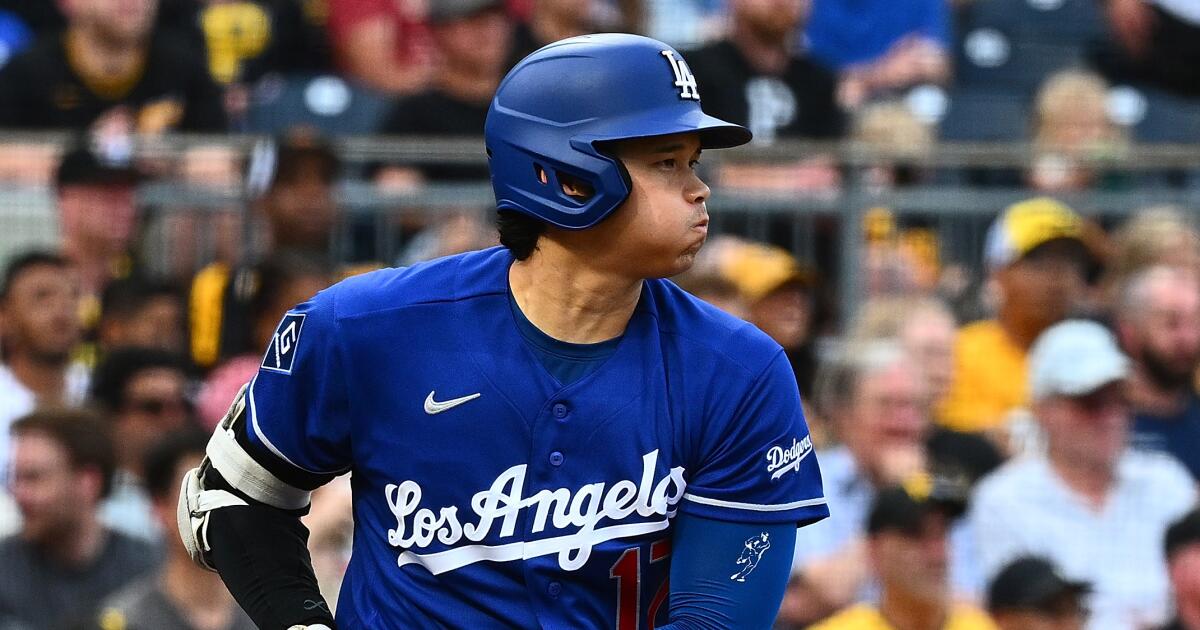
PITTSBURGH — The Dodgers couldn’t have asked for better timing, as Shohei Ohtani’s leadoff spot came back around.
They were clinging to a two-run lead in the top of the seventh inning against the Pirates on Thursday. With one out and runners on first and second, the Dodgers superstar, who had already reached base four times, was due up.
Instead, Santiago Espinal stepped up to the plate as a pinch-hitter.
Ohtani left the game with inflammation in his left knee, the Dodgers announced. They did not immediately offer an explanation for the injury.
Before leaving, Ohtani hit a solo home run — his second homer in as many games — a single and drew two walks.
It was an impressive performance, coming a day after he took on two-way duties. On the mound Wednesday, he allowed three earned runs in 6⅔ innings.
Earlier in the game Thursday, Dodgers starting pitcher Justin Wrobleski exited with a bruised right hamstring, the team said.
The fifth inning had already begun to spiral on him. After throwing four scoreless innings, he surrendered two solo home runs to Rafael Flores Jr. (the first of his major-league career) and Brandon Lowe.
Then Bryan Reynolds hit a line-drive comebacker off Wrobleski’s leg. The ball ricocheted to the edge of the infield grass, where first baseman Freddie Freeman picked it up.
Wrobleski was already racing toward first base. But after turning to catch the throw, he missed the base and stumbled backward into Reynolds, who tripped over Wrobleski’s extended left foot.
Wrobleski limped away, and an athletic trainer followed him, circling back to the mound. But as he was setting up to throw a warm-up pitch, manager Dave Roberts came out to make a pitching change.

NEWYou can now listen to Fox News articles!
Seven-time NBA champion Robert Horry has some simple advice for Caitlin Clark: Fight back.
Horry, 55, was asked about the criticism the Indiana Fever star has gotten for complaining to the referees, and Horry said Clark needs to protect herself.
“You think about when you when you’re the best, everybody want to knock you out. And I think a lot of people are going after her and for me, just play the game,” Horry told Fox News Digital at The World Cup 2026 Kickoff Party Blue Carpet at the Los Angeles Memorial Coliseum.
Indiana Fever guard Caitlin Clark waits for play to resume during the fourth quarter against the Golden State Valkyries at Chase Center in San Francisco, Calif., on May 28, 2026. (David Gonzales/Imagn Images)
“Some other players around the league didn’t protect themselves, and the (harassment) went on, so my best advice (for) her is protect yourself. Don’t let nobody try to punk you.”
Horry played with Basketball Hall of Famer Shaquille O’Neal and cited him as an example of a player who fought back.
“I think I (played) with one of the greatest players (in) Shaquille O’Neal, he got hammered. I know he’s bigger and stronger than Caitlin, but he got to a point where he just started fighting back. You know, someone (elbowed him), you elbow him back.”
Clark has taken some hard fouls during her three seasons in the WNBA, with many fans wondering if the treatment from her competitors is intentional. The 24-year-old frequently pleads her case to the referees after contact, which has drawn the ire of fans who say she complains too much.
ZERO BS. JUST DAKICH. TAKE THE DON’T @ ME PODCAST ON THE ROAD. DOWNLOAD NOW!
Caitlin Clark of the Indiana Fever reacts after a foul was called during the first half against the Portland Fire at Moda Center in Portland, Oregon, on May 30, 2026. (Ali Gradischer/Getty Images)
Fever fans at least weren’t complaining when Clark buried a game-winning 3-pointer to help secure a 78-76 win over the Washington Mystics on Monday. Clark had 19 points, five assists and three rebounds in the win.
The Fever have had a tumultuous start to the season, but are over .500 at 6-5. In 10 games, Clark has averaged 18.7 points, 8.7 assists and 4.5 rebounds per game.
Horry played in the NBA for 16 seasons. He began his career with the Houston Rockets, spending four and a half seasons with them and being a key part of their championship-winning teams in the 1993-94 and 1994-95 seasons. The Alabama native was then traded to the Phoenix Suns, where he spent half a season before signing with the Los Angeles Lakers.
CLICK HERE TO DOWNLOAD THE FOX NEWS APP
Robert Horry and Candice Horry pose on the blue carpet for the World Cup 2026 Kickoff Party at the Los Angeles Memorial Coliseum on June 9, 2026. (Kirby Lee/Imagn Images)
Horry was a key contributor during the Lakers’ three-peat from 1999-2001 and earned his third, fourth and fifth career NBA titles. After spending seven seasons with the Lakers, Horry joined the Spurs, where he won two more championships in 2004-05 and 2006-07.
In 16 seasons, Horry averaged 7 points, 4.8 rebounds and 2.1 assists per game.
Follow Fox News Digital’s sports coverage on X, and subscribe to the Fox News Sports Huddle newsletter.
-

 Los Angeles, Ca29 minutes ago
Fire breaks out under roller coaster at Six Flags Magic Mountain
-

 Detroit, MI49 minutes ago
Mayor Sheffield absent from People Mover board during alleged wrongdoing
-

 San Francisco, CA59 minutes ago
Day Around the Bay: All BART Stations In San Francisco Now Have Free Wi-Fi
-

 Dallas, TX1 hour ago
Reunion Tower debuts World Cup light show as Dallas welcomes fans
-

 Boston, MA1 hour ago
New England restaurants adding gratuity to bills during World Cup
-

 Denver, CO1 hour ago
1 transported after e-bike crash on I-70 in Denver
-

 Seattle, WA1 hour ago
WEST SEATTLE CRIME WATCH: Street robbery reported north of Morgan Junction
-

 San Diego, CA1 hour ago
San Diego Fire-Rescue Foundation prepared to step up support amid budget concerns

