Business
On a quest for global domination, Chinese EV makers are upending Thailand's auto industry


BANGKOK — Japanese car factories in Thailand — which for decades has been the premiere hub of auto manufacturing in Southeast Asia — are shutting down or scaling back.
Subaru said it will stop producing cars at its plant this month. Suzuki plans to cease operations by the end of 2025. And Honda and Nissan say they are reducing production.
The primary culprit: Chinese electric vehicles.
As the world embraces zero-emission vehicles, Thailand has been courting Chinese automakers, which in their quest for global dominance have spent more than $1.4 billion here as of last year to build EV factories.
“Japanese automakers are under significant pressure to cut costs to compete with Chinese brands,” said Larey Yoopensuk, chairman of the Federation of Thailand Automobile Workers. “They are now questioning whether staying in Thailand is still worthwhile.”
Thailand’s government — which wants 30% of the cars it produces to be electric by 2030 — sees Chinese investment as a crucial piece of the future of its auto industry, which now accounts for 800,000 jobs and 10% of the country’s GDP.
The paradigm shift has become a source of anxiety for Thai auto workers, who have long helped produce Japanese cars and the parts that go into them, including exhaust pipes, brakes and doors. Even if Chinese factories replace Japanese ones, Yoopensuk worried that there may not be a place for him or his colleagues in the new order.
One reason is that Chinese companies in Thailand have historically been intolerant of labor unions.
“Over the past decade, this industry has been booming, with unionized workers achieving better living conditions and high incomes,” said Yoopensuk, who has worked in auto manufacturing for 35 years. “If forced out, many workers — particularly older ones — may struggle to find jobs elsewhere.”
He was also concerned that Chinese EV manufacturers would use more automation and favor immigrants from China and Vietnam over Thai workers when hiring.
“This is an issue we’re pushing back against, encouraging these companies to also create employment opportunities here,” he said.
China’s foray into Thailand’s auto industry could herald what’s to come in other parts of the world, as EV adoption grows and Chinese brands go global. Last year, the Chinese behemoth BYD, which opened a factory in Thailand this summer, briefly surpassed Tesla in global sales.
“I don’t think there is any real precedent where those Chinese EV manufacturers are reshaping the industrial landscape in another country,” said David Williams, an expert on labor standards and supply chains in Asia for the International Labor Organization.
Thailand exports just over two-thirds of the cars it makes, with the biggest share going to Australia followed by Saudi Arabia, the Philippines and Vietnam.
Its most important market is domestic, and the news has been dismal. Total passenger car sales in Thailand fell 23% through September compared to the same period last year. Experts blamed rising household debt and increasingly stringent rules for securing auto loans.
Electric cars — nearly all of them Chinese — were the one bright spot, with sales up 11%.
Gasoline-powered cars still make up more than 90% of all sales in Thailand, but that is expected to fall as the government continues its push for EVs with subsidies for buyers and manufacturers.
BYD said its new plant would eventually generate about 10,000 jobs and produce 150,000 vehicles a year. When the company launched in Thailand, its distributor offered steep discounts on several models, bringing the cheapest models below $25,000.
That has intensified a price war that further threatens Japanese brands, which are fighting to keep up with cleaner cars of their own.
According to the Thai government, they have committed to investing more in local production of hybrids — which run on both battery motors and internal combustion engines — and electric pickup trucks. Honda started producing EVs in Thailand last December.
As gas-powered cars fall out of favor, some auto parts will be rendered obsolete, such as hydraulic-based steering systems and alternators.
The Thai Auto Parts Manufacturers Assn. has reportedly estimated that only about a dozen of the more than 600 auto parts makers in Thailand will be able to supply Chinese EVs.
Those that can transition to making parts for electric cars may still struggle to compete with Chinese rivals. Some auto parts suppliers have already shuttered as business has contracted.
Supat Ratanasirivilai, managing director of Thai Metal Aluminum, which produces aluminum-made parts for Japanese and American cars, said he has been negotiating with Chinese automakers since the start of the year.
But those talks have stalled since Chinese companies told him that his prices are 30-40% too high.
“We were hoping that when the Japanese carmakers’ production dropped, we may get some benefit from the Chinese carmakers,” he said. “But obviously they are not buying from the Thai suppliers.”
His company is pushing the Thai government to implement more protective measures for local workers, such as requiring EVs to be built with more locally sourced parts.
“The Thai government is really opening up everything for the Chinese carmakers. It has been very difficult for us,” he said. “I don’t know what’s to come next.”
Special correspondent Poypiti Amatatham in Bangkok contributed to this report.

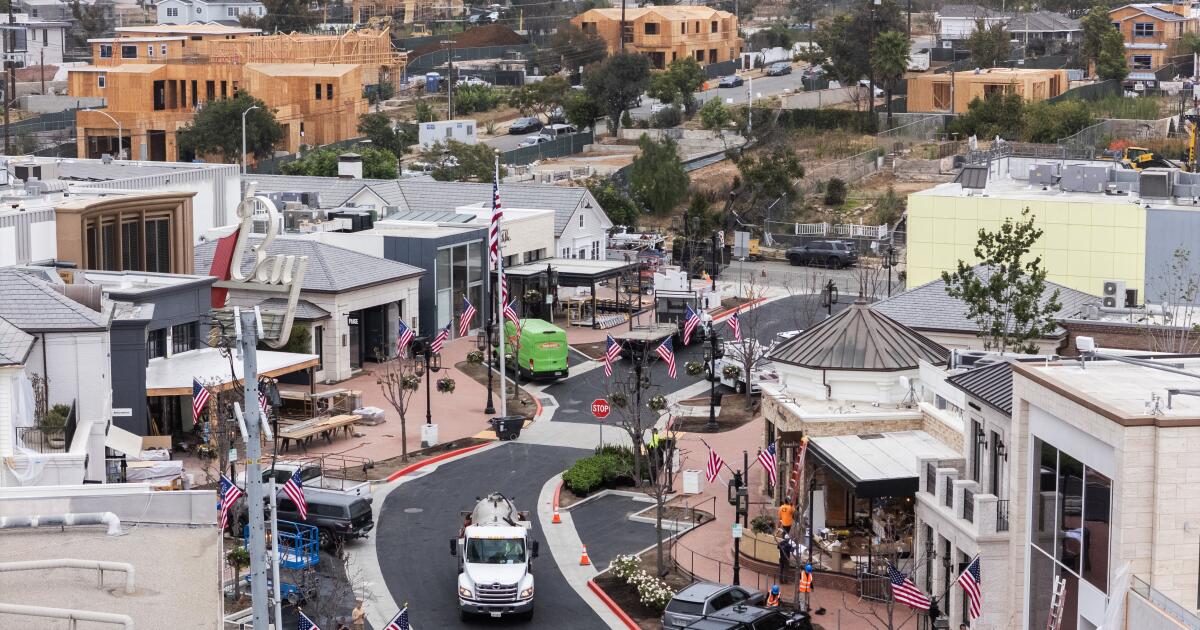
The luxury shopping center in Pacific Palisades will reopen next month after more than $100 million in renovations forced by the January 2025 wildfire that devastated the Los Angeles neighborhood.
Palisades Village will reopen Aug. 15, owner Rick Caruso announced Wednesday. The outdoor center survived the blaze that destroyed homes and other businesses but needed refurbishment to eliminate contaminants that the fire could have spread.
Crews are putting finishing touches on mall buildings after tearing them down to the studs, treating the wood and rebuilding the walls, Caruso said.
“Everybody’s working, and stores are moving their products in,” he said. “It’s a really cool feeling that people have really locked arms and are working together.”
An electrician installs lighting for a restaurant at Rick Caruso’s Palisades Village on Thursday. The shopping center is scheduled to reopen mid-August.
(Myung J. Chun / Los Angeles Times)
Pacific Palisades resident Allison Polhill, who is rebuilding the home of 30 years that her family lost in the blaze, said she is “thrilled” at the prospect of returning to the mall she used to frequent. Its comeback is a boost for the community, she said.
“Every single step that we make to reopen our commercial corridors is going to bring more people back into the Palisades,” said Polhill, who expects to move back into her home at the end of August.
A total of 6,822 structures were destroyed in the Palisades fire, including more than 5,500 residences and 100 commercial businesses, according to the California Department of Forestry and Fire Protection.
Caruso previously attributed the mall’s survival to the hard work of private firefighters and the fire-resistant materials used in the mall’s construction.
The $200-million shopping and dining center opened in 2018 with a movie theater and a roster of upmarket tenants, including Erewhon, which may be the only grocer in the heart of the fire-ravaged neighborhood when it opens.
Caruso’s company was able to fill the mall with tenants despite the long shutdown.
Palisades Village is 99% leased, with the majority of tenants returning, said Jackie Levy, chief financial and revenue officer. Nearly one-third of the shops and restaurants are new to the property.
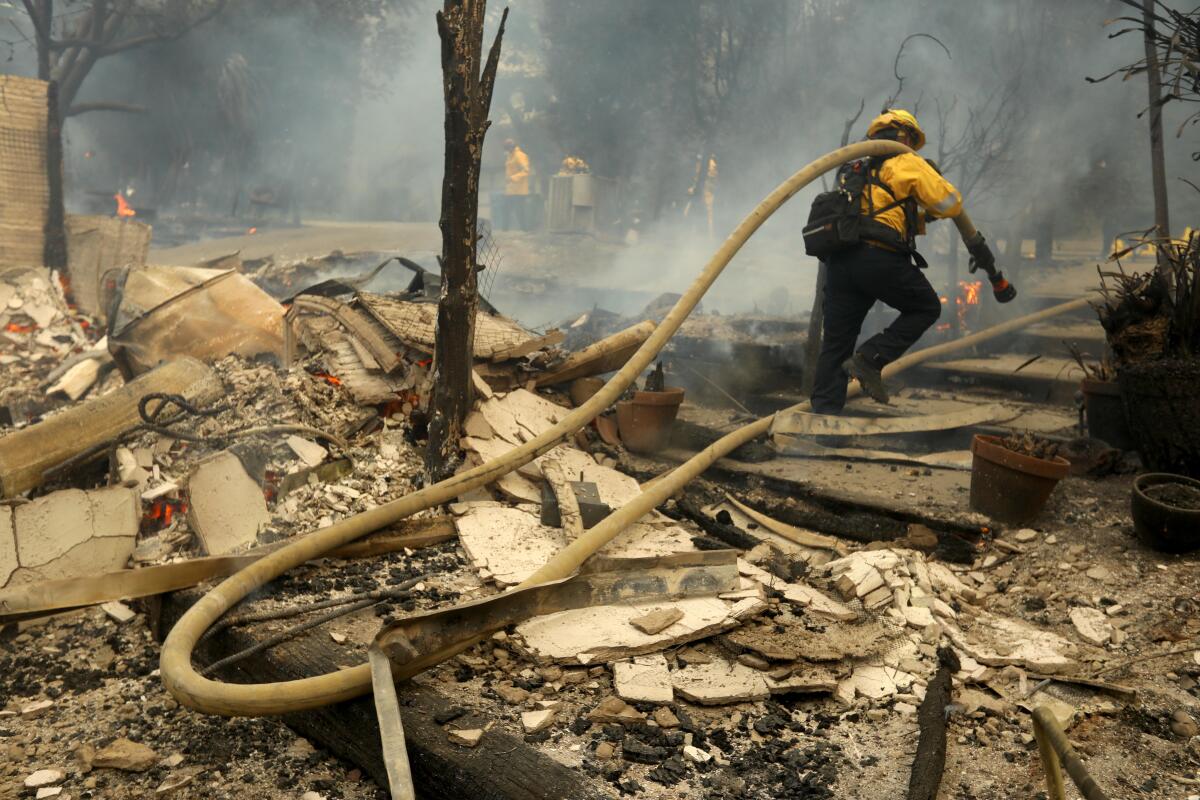
A firefighter carries a hose back to his rig while walking through a destroyed home from the Palisades fire in Pacific Palisades on Jan. 7, 2025.
(Genaro Molina / Los Angeles Times)
Last year, Pacific Palisades-based fashion designer Elyse Walker said she would reopen her eponymous store in Palisades Village after losing her 25-year flagship location on Antioch Street to the inferno.
Other neighborhood shops destroyed in the fire that are reopening at the mall include K Bakery and Loomey’s Toys, which caters to children up to age 12 and used to be across the street from Palisades Elementary Charter School.
“It’s been a journey and I’m excited because I wasn’t sure that there was going to be a place to come back to,” said toy store owner Amanda Rastegar. “Hopefully we can bring some of that magic back.”
Rastegar’s home in the Palisades survived but was damaged by the fire. The family returned about eight weeks ago. Her last memory of the fire was a burning supermarket.
“I just couldn’t wrap my brain around what was happening,” she said. “By the time I left, Gelson’s was on fire.”
Among the returning tenants is Angelini Ristorante & Bar. Well-known Los Angeles chef Gino Angelini said he will be in the kitchen next month for a return of the Italian restaurant.
“We won’t do a big celebrity open,” he said. “We want to have a very soft opening and see our customers come back.”

Construction takes place at Rick Caruso’s Palisades Village on Thursday. The shopping center is scheduled to reopen mid-August.
(Myung J. Chun / Los Angeles Times)
An elaborate celebration would not feel “correct for me,” Angelini said, because the devastation has been “very sad” for so many.
Other new tenants include local chef Nancy Silverton, who has agreed to move in with a new Italian steakhouse called Spacca Tutto. Women’s activewear retailer LESET will open its first West Coast location.
Caruso said he is optimistic that customers will return to the center, even though many Pacific Palisades residents are still dispersed. One tracking system estimated that about 30% of the Village’s customer base was impacted by the fire, he said.
“That means 70% did not get impacted, so there’s a lot of customers still left out there,” Caruso said. Historically, the center drew customers from as far away as Beverly Hills and Calabasas, as well as Malibu, Brentwood and Santa Monica.
He also hopes many will be inspired to visit the revived mall.
“I believe in the goodness of people and I believe that people are going to want to support the Palisades,” he said. “They’re going to want to be there and support the businesses that have had the courage and the heart to reopen.”

Walmart is rapidly expanding its network of electric vehicle chargers designed for customers to use while they shop.
The network could help fill gaps in EV infrastructure in states with greater need for chargers. Walmart, which has more than 5,000 locations in the U.S. and hundreds in California, says more than 90% of Americans live within 10 miles of one of its stores.
The chargers also offer an incentive for customers to choose Walmart — Walmart Plus members will receive a 10% discount off an average price of $0.46 per kilowatt-hour of energy at the company’s chargers.
Walmart chargers are already available at more than 75 locations in 17 states, with Texas boasting the most charging stations, followed by Florida and Arizona.
Matthew Nelson, Walmart’s director of energy policy, said last week on LinkedIn that the network will soon reach 29 states, including California.
“We are delivering on the promise of affordable, reliable and convenient charging,” Nelson said in his post.
According to Walmart’s website, six charging stations are coming to California soon, though the company did not offer a specific timeline.
The chargers will be installed at stores in Antelope, Brea, Fresno, Stockton, Suisun City and Vallejo.
Most charging sites in California will include eight to 16 fast-charging stalls, said Walmart spokesperson Kelsey Bohl.
The company first announced plans in April 2023 to install its own EV chargers at Walmart and Sam’s Club stores, with a goal of installing thousands of chargers by 2030. Partnering with ABB E-Mobility and Alpitronic, it added 25 new charging sites this past May and six more in June.
“Walmart is building a leading retail-integrated EV fast-charging network, focused on delivering an affordable, reliable and convenient charging experience where customers already shop,” Bohl said in an emailed statement. “Customers can charge while they shop, access stations through the Walmart app they already use, and benefit from affordable pricing.”
The charging stations already available include 612 individual charging stalls using 400-kilowatt chargers. Each stall has a dual charging cord with both Combined Charging System and North American Charging Standard connectors. The standard connectors, designed by Tesla, are smaller and lighter than the combined systems.
The primary way to pay for the chargers is through the Walmart app, but the company is also experimenting with built-in credit card readers to allow those without the app to use the stations.
Customers can check charger availability on the Walmart app. The company said the chargers will be available 24 hours a day.

Robotaxis could be turning into robocops.
A self-driving Waymo reported two teens to San Mateo, Calif., police on Monday after they were found drinking alcohol and shooting toy guns in the back of the vehicle.
According to a social media post from the San Mateo Police Department, officers detained two 15-year-olds after the Waymo they were riding in contacted the department and stopped in a parking lot until law enforcement arrived.
“Parents do you know where your teens are?” the San Mateo Police Department wrote on Facebook following the incident. “Waymo does!”
Officers removed both teens from the vehicle and determined they were using toy guns to shoot Orbeez out the windows. Orbeez are small, water-absorbing beads sold at toy stores.
“Toy guns, water guns, and BB guns all pose real dangers, especially to an untrained eye,” the Police Department said. “The simple handling of them can cause fear in [passersby].” “
A video posted on Facebook shows at least five officers and a police dog responding to the scene and approaching the Waymo with their weapons raised.
Waymo did not immediately respond to a request for comment.
Waymo vehicles have internal cameras and microphones that may be used in an emergency or to “promote safety and security,” according to Waymo’s online support page.
The cameras are also used to ensure the vehicles are clean and to help find lost items, according to the support page.
The company said it does not use facial recognition or other biometric identification technologies to identify individuals.
“In more urgent circumstances, support may access live video during a trip,” the Waymo page said.
The San Mateo Police Department’s Facebook post has garnered nearly 60 comments, with one user accusing Waymo of “snitching.”
“At least they got a designated driver?!” one user commented.
-

 World7 minutes ago
Critics say Turkey’s verbal attacks on Israel have crossed into antisemitism
-

 Politics10 minutes ago
WATCH: Dana White drops 2028 hints while raving about his favorite Trump cabinet secretary
-

 Health15 minutes ago
Katie Couric couldn’t remember the year or the president during frightening brain episode
-

 Sports22 minutes ago
Justin Verlander announces he will retire after this season: ‘I’ve realized that time has come’
-

 Technology24 minutes ago
Apple AI security update proves hackers move fast
-
Business30 minutes ago
Fire-damaged Pacific Palisades shopping center sets reopening date
-
 Entertainment37 minutes ago
Rhea Seehorn celebrates her ‘Pluribus’ Emmy nomination as she waits to hear about Carol and the atom bomb
-

 Lifestyle40 minutes ago
Urban Jürgensen: Introducing Elite Watchmaking to New Audiences

