Arizona
Farmers will face new water rules as Arizona designates new management area near Willcox


Southern Arizona farmer Bryan Fontes talks about the local water supply
Bryan Fontes Intro/Interview on the Douglas Active Management Area, or AMA.
The Arizona Department of Water Resources designated an Active Management Area in the Willcox groundwater basin on Friday, following a series of public hearings in which the agency presented evidence of aquifer depletion and increasing ground subsidence.
The aquifer is the only source of water for homes, farms, industries, and municipal providers.
Residents in the basin voted against such a designation two years ago. The agency used a second legal pathway to establish the AMA because it determined critical conditions in the basin meet all requirements. It was the first time since 1980 that the state used such powers.
“I think it shows that the agency has maybe learned that if you don’t take action it just gets worse. And I think it just became so apparent to everyone,” said Kathy Ferris, former state Department of Water Resources director who helped write the 1980 Groundwater Management Act.
Political pushback to create groundwater regulations in rural communities has been strong, particularly from key legislators like Rep. Gail Griffin, R-Hereford. But local leaders and domestic water users’ demand for rural groundwater protection has also grown louder across the state, calling for action against unrestricted groundwater pumping.
“Even though it is late, I applaud the department and the administration for doing this,” Ferris said.
The AMA, which is in both Graham and Cochise counties, will effectively block any agricultural expansion. Under the designation, no new lands can be farmed in the basin. Additionally, growers must prove “substantial capital investment” in lands that had not been irrigated in the past five years if they want to irrigate them in the future. About 6,500 acres of farmland would need to go through this test.
“While there is a range of views on the AMA, the urgency of addressing our water challenges cannot be overstated,” Willcox Mayor Greg Hancock said in a statement, praising Gov. Katie Hobbs’ action. “We are committed to ensuring that our community’s voice is heard throughout this process.”
Lingering concerns about agricultural rules
Hobbs’ office said in a statement that the AMA will “protect over 8,100 people and the local economies that rely on the Willcox Basin.”
Many residents who opposed the AMA see the action as a state “overreach.” Others argue that there is an urgent need to stop agricultural expansion, but the regulatory tool, as it is, would give unfair water allotments to growers using the least water, hurt numerous family operations, and leave the largest water users virtually unaffected.
Growers in the Douglas AMA, which was designated by popular vote in 2022, have raised concerns over fixed water allotments tied to the growers’ crop history. The management plan was approved on Nov. 27 with minimal changes to the proposed version.
Hearing concerns from local growers, Ethan Orr, associate director of the University of Arizona Cooperative Extension, said he expects ADWR to consider changes to how water allotments and irrigated grandfathered rights are determined, making sure they are “not punishing growers who have invested in greater water efficiency or reduced water-usage crops.”
“ADWR staff is really competent and they are trying incredibly hard to do the right thing in this implementation,” he said. “It’s just making sure they have the right guidance and guidelines, legislatively and scientifically.”
Some of this guidance is tied to finding the right data sources and scientific evidence for things like crops’ water use, but also from the need to narrow guidelines to determine “substantial capital investment” because the statute for it is very broad, he added.
Special programs and funding could help growers save more water and adapt to some of the Douglas and Willcox AMA rules. Orr said he expects the Water Irrigation Efficiency Program, run by the university, could help. The initial $64 million in funding has all been allocated and the program is not taking new applications, but there is talk in the state Legislature to approve more funding the next session, he said.
Having lawmakers modify rules on how those funds are distributed by giving priority to growers on “emerging AMAs” could help.
Compared with other parts of the state, there is not much room for water efficiency in the Sulphur Springs Valley. Groundwater pumping has ramped up due to agricultural expansion, which the AMA can’t undo, and many farmers grow water-intensive crops, though they mostly use center pivots and drip irrigation.
“There’s marginal gains to make there,” Orr said. Programs could still focus on helping some growers transition and make the best use of these technologies by installing new tools like soil moisture sensors and weather trackers.
Locals still hope for amendments
The Sulphur Springs Water Alliance, which holds a wide range of views and brings together farmers, ranchers, homeowners, utility companies, and city and county staff, didn’t take a position on the AMA designation.
The alliance acknowledged that “groundwater declines at current rates threaten the long-term economies and well-being of residents and agricultural operations.” The group added that water use reductions “must be enacted at a sufficient pace, ranging typically from 20 to 50 years” to have real results, yet sustain a viable agricultural economy.
In a letter to ADWR, the alliance wrote that if an AMA were enacted, it should be followed by amendments or a future redesignation to a regulatory tool “specific to the nuances of the Willcox Basin.”
The alliance believes the standards of any groundwater management plan should give authority to local stakeholders who “represent the values and well-being of the local community,” have adaptive and flexible agricultural programs that don’t penalize farms that have taken steps to reduce water use, allow the transfer of water allotments and irrigation rights, and seek state and federal funding to support research and incentives to reduce water use.
Any changes to modify AMA statutes or create new regulation frameworks for rural Arizona would need to happen in the Legislature, Ferris said.
“It’s not very realistic unless legislative leaders in the Republican Party want to work toward that goal,” she said. “But they really haven’t been showing that. The idea has been to pass something that wouldn’t do anything.”
Clara Migoya covers agriculture and water issues for The Arizona Republic and azcentral. Send tips or questions to clara.migoya@arizonarepublic.com.



MESA – Mary Salcedo is the executive director of Arizona Roller Derby, but everyone on the team knows her as MaryMorphosis, or Morph for short.
A derby name is as good as a legal name once you join a league. Arizona Roller Derby – the second-oldest flat track roller derby league in the world – has plenty of unique monikers on its two home and travel teams.
During a doubleheader homestand, players introduce themselves.
“What’s your name?”
“Mecca,” said Sara Mecca-Whitlock, an interior architect in Phoenix.
“Brooklyn Dodge-her,” said Kristi Baptiste, a grandma and senior project manager from Ventura, California.
The rules surrounding derby names are loose. Some players have nicknames bestowed upon them when they join.
“Since I was wearing a Brooklyn shirt, they started calling me Brooklyn, and we added the Dodge-her later,” Baptiste said. “The funny thing is, I am not an L.A. Dodger fan. I don’t even watch baseball.”
It’s clear Roller Derby isn’t like other organized sports. There is no professional threshold to work toward as a goal. Players show up year after year, paying to participate, paying to travel and returning to the community they find along the way.
Across the country, including in Phoenix, teams find a way to organize players and facilities to play the sport.
Selecting derby names is part of the process.
-
MAXimum HOverdrive of the Bad News Beaters poses for a photo as she skates at the Broadway Recreation Center in Mesa on Saturday, June 27, 2026. (Photo by Samad Khan/Cronkite News) -
Goldy Knocks, left, and Hella Naughty of the Bad News Beaters pose after their match at the Broadway Recreation Center in Mesa on Saturday, June 27, 2026. (Photo by Samad Khan/Cronkite News) -
Bad News Beaters skater Dr. Doctor flashes a hand sign while posing for a photo at the Broadway Recreation Center in Mesa on Saturday, June 27, 2026. (Photo by Samad Khan/Cronkite News)
“Sure, man,” said Rachel Sherman, a 13-year veteran of Arizona Roller Derby and an electrician training in an apprentice program. “My dad, with the perfect dad joke, was like, ‘Well, I guess if you’re going to change your name, you should probably change your number to four. So I am four sure, man.”
Elaina Bryan, a 25-year-old receptionist in Phoenix and lifelong derby player, said her nickname is Squeezer.
“There was a particular one of my mom’s friends, who I would give a really good squeeze, big hug to,” Bryan said. “So my name actually used to be a little squeezer, but now that I’m an adult, it’s just squeezer.”
The names used outside of derby are not relevant on the track. Official rosters are submitted only with the players’ derby names.
“You think about the parts of you that you want to foster that can handle the intensity, the eyes on you, the attention, the strength, the perseverance and determination,” Sure, man said. “You give that a name and it becomes this kind of alter ego that then you’re allowing it to blossom and grow in this space.”
Roller Derby’s history
Roller derby was officially born on Aug.13, 1935, when promoter Leo Seltzer debuted the first Transcontinental Roller Derby event at the Chicago Coliseum. Initially created as endurance marathons during the Great Depression, the event evolved into the full-contact sport we know today.
After peaking in popularity on television in the 1950s and 60s, the sport largely faded out, but in 2001, a modern revival took place in Austin, Texas, which popularized the grassroots, flat-track format that is played globally today.
“We (will) hit our 25th season in 2028, which is pretty significant,” MaryMorphosis said, “We’re hoping to go out huge.”
Arizona Roller Derby is older than the Women’s Flat Track Derby Association, which was founded in 2004 as the United Leagues Coalition and formally changed its name to the WFTDA in 2005. WFTDA is the international governing body of the sport. Today, it has over 400 member leagues on six continents.
Arizona Roller Derby doesn’t compete on a bank track. They can play on any flat surface if they have a way to lay down track boundaries.
A bank track is a raised and curved surface, like a NASCAR track. It’s the kind of roller derby played in the 2009 movie with Elliot Page, “Whip it.”
After the COVID-19 pandemic, Arizona Roller Derby lost the warehouse space it rented full-time and the participation numbers dwindled. Now the group rents temporary spaces across the East Valley to accommodate practices and competitions, like Saturday’s doubleheader.
“I would hope that we would have our own space again, “ MaryMorphosis said. “We need to double our membership to do that.”
On a Saturday afternoon in June, players began arriving at the Broadway Recreation Center in Mesa. The same people that would be competing on track in a few hours used thin rope and white electrical tape to lay down the track borders on top of the gymnasium hardwood.
The rules
The Saturday doubleheader featured two Arizona Roller Derby home teams, and two travel teams from California.
Bad News Beaters are the first home team. They go against the West Coast Derby Knockouts.
Derby games last one hour. Two 30-minute halves are broken up by a 15-minute intermission. The intensity on the track lasts for two-minute jams before lines switch off and new players sub in for the next jam.
Mecca, a jammer on Bad News Beaters, points out that “there’s four blockers from each team that get on the track and one jammer from each team.”
A jammer’s helmet cover, a large polyester cap with stars on both sides, indicates they are the one person on the track who can score points for their team.
One blocker is known as the pivot. They wear a similar, bright-colored cap, but theirs has a line running through the center. At any point, a jammer can remove their star and pass it to the pivot. For the remainder of the jam, the pivot acts as the Jammer to score points.
“I’m a pushy jammer, and I like being strong,” MaryMorphosis said, “and I like breaking people apart.”
The jammers line up behind a jam line while the eight blockers stand anywhere in the box in front of the jam line but behind the pivot line.
Waiting in the box is Californian blocker Brooklyn Dodge-her, and her daughter, Rocky Bye Baby. They are there to throw their bodies into the Bad News Beaters jammer to stop them from scoring points.
Brooklyn Dodge-her was recruited to derby 12 years ago. She volunteers as a coach for the West Coast Derby youth travel team on top of training and competing herself.
“Mondays for the kids, Tuesday for myself. Wednesday I get a break,” Brooklyn said. “Thursday for myself. Friday for the kids. Saturday if we don’t have a game, I get free. And Sunday in the morning it’s the kids and in the evening it’s the adults.”
At 51, she is competing in her last season of roller derby.
“I became a grandmother,” Brooklyn said. “I have to start spending some time with a grandbaby. I’ll probably get bored and be like, ‘Y’all want me back?’”
The officials blow the whistle to signal the start of a jam and the jammers push off their line straight into the bodies in front of them.
“If I get through the pack first I get what’s called lead jammer,” Mecca said. “On the second time through, they get one point for every blocker from the opposite team that they pass legally with their hips. That can go for two minutes.”
The lead jammer can call off the jam at any point, especially if it prevents the other jammer from scoring any points for the opposing team.
“Does it matter if the jammer is behind me? Do I have two or more blockers in the box? Then don’t call it,” MaryMorphosis said, “because it might be worth losing the points just to have your teammates out.”
A player in the penalty box at the end of a jam will remain in the box during the start of the next jam.
The ways to receive penalties include hitting someone in the head, hitting someone in the back, or getting back on the track in front of somebody that was in front of you when you left. All penalties must be served for 30 seconds.
A game requires a whopping seven skating referees and even more non-skating officials. Those positions are entirely filled by volunteers.
Robert Cushman began 17 years ago in Nebraska when his wife started competing in roller derby. Years after their divorce, he continues to enjoy participating in the sport while living in Tucson.
“Most of us don’t get paid anything,” Cushman said. “Usually Phoenix will give us like a gas stipend.”
Even as an official he uses a derby name. He goes by Manosaur, a reference to the animated series “Venture Bros.”
“I usually go once a week to the scrimmage down in Tucson, and then I usually come up here for whatever games they have,” Cushman said.
During jams, Manosaur skates around the inside of the track, monitoring the action to keep the play fair.
“Watch the pack,” Mecca said. “Don’t worry too much about the jammer when they’re by themselves. But once we enter the pack again, then it gets crazy.”
Mecca is a mom of five who started playing roller derby in North Carolina. She said she retired for six years as she finished up her military career and went back to school. Eventually she began coaching the ASU derby team. Two years ago, she began playing again.
The West Coast Derby Knockouts dominated, 223-53.
“They were taking the pivot line constantly instead of the jam line,” MaryMorphosis said after the game. “They were just really big. And both our blockers and our jammers were thrown off.”
Game two
Morph sits in the stands after the early afternoon loss and watches the second match of the day. The home team, Skate Riot Project, took on Orange County Roller Derby.
She became executive director in January and takes on the administrative responsibilities on top of competing and working full time.
“I love building and growing community,” MaryMorphosis said. “It was an opportunity to do that and step into just a significant leadership role.”
She began playing derby in 2022 when she still lived in upstate New York.
“I broke my leg three months in,” MaryMorphosis said, “like shattered it. Recovery was rough.”
After two surgeries and a cross-country move to start a new job as a project manager at Arizona State’s School of Biological and Health Systems Engineering, MaryMorphosis had her first uninterrupted derby season in 2025.
“I don’t know what kept me coming back,” she said. “I guess it was the community.”
Meanwhile, Elaina Bryan, or Squeezer, is another recent Arizona transplant and a blocker on Skate Riot Project.
“My mom started playing back in 2008, actually, and we went to practices with her,” Squeezer said. “Eventually, they had enough kids’ interest that they started a kids team.”
She was 9 when she started playing in Bakersfield, California. She played on her college team and then moved to Arizona in October. Now she plays on a travel team as well as the home team.
“I was just kind of trying to see where I fit in and started to find people at that same level to start connecting with,” Squeezer said, “and just kind of started building up my social circle.”
Teams are comprised of players of all ages, but everyone is connected to the community that exists in Derby. It’s more everlasting than the final scores.
“I went to a yard sale,” Brooklyn Dodge-her said. “We didn’t even get across the street and they were like, ‘You want to play roller derby? It was a West Coast yard sale.”
MaryMorphosis did not hearing back from one roller league before she stumbled on the practice of another team.
“I was literally in the mall because my old league had taken over an Old Navy, and they were skating in the mall,” MaryMorphosis said. “I was buying yarn at Michael’s, and I was like, ‘OK, that’s the sign.’”
When Skate Riot Project lost to Orange County Roller Derby 125-100, the teams shook hands and huddled together. Orange County picked its MVP Jammer, blocker and MVP overall from SRP, and SRP picked its players from Orange County. They hugged each other as they presented the awards.
“We’re playing the game against another team, and it’s really intense and like we’re very serious and focused with our team,” Squeezer said. “But afterwards, we all hang out and we goof around.”
With the games over, the players begin clearing out the temporary space. The track gets peeled off the gymnasium floor and the tape is put into trash bags.
The four teams get in their cars and head to the after-party together.
“If the only thing we do for the next five years is become the place for people to be themselves, that’s a win,” MaryMorphosis said.
This <a target=”_blank” href=”https://cronkitenews.azpbs.org/2026/07/10/roller-derby-still-has-home-in-arizona/”>article</a> first appeared on <a target=”_blank” href=”https://cronkitenews.azpbs.org”>Cronkite News</a> and is republished here under a <a target=”_blank” href=”https://creativecommons.org/licenses/by-nd/4.0/”>Creative Commons Attribution-NoDerivatives 4.0 International License</a>.<img src=”https://i0.wp.com/cronkitenews.azpbs.org/wp-content/uploads/2026/02/favicon1.png?resize=85%2C85&ssl=1″ style=”width:1em;height:1em;margin-left:10px;”>
<img id=”republication-tracker-tool-source” src=”https://cronkitenews.azpbs.org/?republication-pixel=true&post=105044″ style=”width:1px;height:1px;”><script> PARSELY = { autotrack: false, onload: function() { PARSELY.beacon.trackPageView({ url: “https://cronkitenews.azpbs.org/2026/07/10/roller-derby-still-has-home-in-arizona/”, urlref: window.location.href }); } } </script> <script id=”parsely-cfg” src=”//cdn.parsely.com/keys/cronkitenews.azpbs.org/p.js”></script>

LAS VEGAS (KSNV) — Reno and Las Vegas are the two fastest-warming cities in the entire country.
Tonight we take a look at what neighboring Arizona is doing to address similar heat challenges, and whether those steps can work in Nevada.
Las Vegas has several areas called urban heat islands, which are hotter than the surrounding areas because of less vegetation, such as trees, and more concrete development.
Residents in East Las Vegas, one of the areas considered an urban heat island, say they’re not surprised that temperatures continue to rise, especially in their part of town.
“Definitely, when you go more to outskirts, there’s definitely more shade, more trees everywhere, but more in the center of town it’s very much less,” said Anthony Flores.
He believes there could be more relief from the heat.
“More water accessibility, more shade overall,” said Flores, whose line of work causes him to be outside every day. “I usually drink over two gallons of water a day just to keep not getting heat stroke.”
Charlie Ponce agrees with him.
“Definitely more trees that are useful, not like palm trees or anything like that. Parks that have like the water parks in them,” said Ponce. “Yeah, splash pads.”
Valley cities and Clark County have implemented steps like having cooling stations and tree-planting campaigns to help address heat challenges.
Phoenix and other parts of Arizona are also experiencing extreme heat every summer, as well as drought issues.
UNLV Public Policy Professor Dr. Ben Leffel says there are steps in the neighboring state that can be useful here in Nevada, where temperatures historically continue to be on the rise.
“For example, Phoenix has an ordinance that says that tenants must have rooms that are coolable to at least 86 degrees Fahrenheit,” said Dr. Leffel. “And that’s then also that first responders are equipped with chilled IV therapy and cold water immersion and things like that.”
News 3 spoke with heat mitigation and management experts in Arizona to see what they believe has been working for them.
One thing they mentioned was that Arizona has the first state-level chief heat officer.
“We have much better and much more accurate numbers now about who’s actually getting sick and who’s dying from heat-related deaths, and what the causes and kind of contributing factors are. So, if you don’t track something, you can’t understand what’s going on with it,” said Dr. Ladd Keith, Heat Resilience Initiative Director at the University of Arizona.
Ponce thinks it would help in Las Vegas.
“Like, let them know to tell the public like, hey, in these areas it’s getting out of hand, and this is what we can do as a community, or just have someone like regulated or watch over it,” she said.
And the city of Phoenix also has an entire heat office, something that can be beneficial on a local level, like being able to coordinate between different groups like homeless outreach, the hospitals, etcetera.
“Statewide coordination of cooling centers, lessons learned that are shared across different working groups, and so just a lot of cooperation that really creates a lot of efficiency too, and so I think that’s an important thing to note, is there is a cost to this, but the efforts are saving lives, and I think it’s making government more efficient,” said Keith.
Amy Scoville-Weaver, the Healthy Cities Program Director in Arizona for The Nature Conservancy, says the Phoenix Metro has done well with increasing vegetation, including in areas where there’s drought.
“So we’re looking at supporting and planting hardy trees, drought-tolerant trees, trees that are already designed, designed to live and thrive in water-scarce environments,” said Scoville-Weaver.
She says they also look at improving infrastructure to support it.
“So when it does rain, the water doesn’t just go down asphalt, get polluted, and go through a storm drain; rather, that water is being diverted to vegetation that needs it,” said Scoville-Weaver.
Leffel says another thing to keep in mind is heat safety can also come from indoor policies.
“For example, Phoenix has an ordinance that says that tenants must have rooms that are coolable to at least 86 degrees Fahrenheit,” he said.
A new Nevada law that went into effect last week requires larger jurisdictions to come up with heat mitigation plans.

Cardinals’ Burch shares what he learned as a rookie in 2025
Arizona Cardinals second-year player Jordan Burch says his defensive line teammates have formed a bond heading into the 2026 NFL season.
Last year in early July, Cardinals edge rusher Jordan Burch was a rookie third-round draft pick out of Oregon who was looking forward to his first NFL training camp and eventual first season.
That rookie year is behind him now, and Burch has identified what he needs to improve on heading into his second season. He said he now knows what to expect and look for, and after talking with outside linebackers coach Matt Feeney, Burch built an offseason plan with which he was comfortable.
“I don’t think anything was like a surprise,” Burch said on Thursday, July 9, at the Cardinals’ Tempe headquarters. “I kind of know what to prep for, so this offseason I can look at my old plays, and then I can call my coach and tell him, from last year to this year, what does he want to see on the field.”
Burch seeks to improve his pass rush. He played in all 17 games last season and had five solo tackles with a sack, and also broke up three passes.
Much of his position was dropping into pass coverage, so Burch looks to recognize pass catchers’ routes better in 2026. He gets help from veteran Josh Sweat, who is there to answer questions about the position they share.
“Every week, every game going against somebody good,” Burch said about takeaways from last season. “The talent of the quarterbacks. We’re playing the Rams, how quickly they get the ball out.”
Burch looks forward to building a stronger bond with his teammates, having invited some of them for dinner or to watch TV. He said he was happy with his progress as a player throughout last season.
The Cardinals open training camp Wednesday, July 22, at State Farm Stadium. It’s a week earlier than most teams because Arizona plays the Carolina Panthers in the Aug. 6 Hall of Fame Game in Canton, Ohio.
Cardinals legend Larry Fitzgerald will be among those inducted into the Pro Football Hall of Fame Aug. 8.
-
 Entertainment4 minutes ago
Emily Ratajkowski’s viral essay on sex life as a single mom scores her a seven-figure book deal
-

 Lifestyle11 minutes ago
The BoF Podcast | Decoding Paris Haute Couture: Wonder, Restraint and the Call of the Void
-
 Politics14 minutes ago
Trump ousts bipartisan commission in latest effort to reshape elections before midterm
-
 Science19 minutes ago
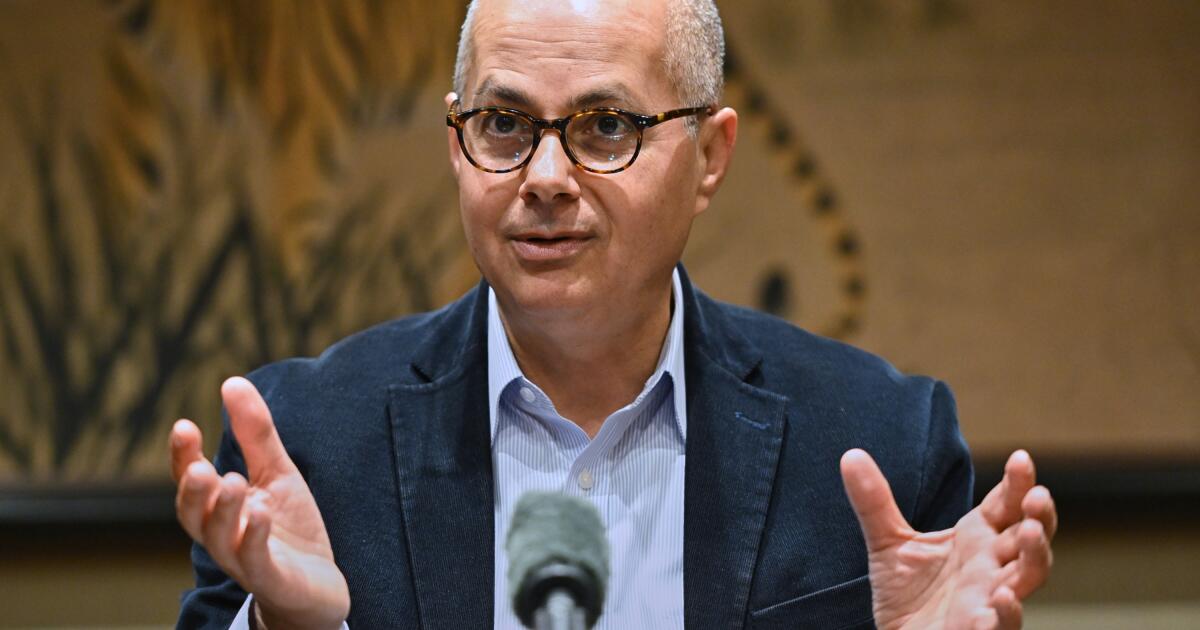
Nobel Prize winner leaving UC Berkeley for new role in China
-
 Sports26 minutes ago
Mikel Merino lifts Spain over Belgium, setting up World Cup showdown with France
-

 World34 minutes ago
Belgium to introduce new road tax in 2027, even for transiting drivers
-
 News59 minutes ago
Graham Platner makes it official in Maine, submitting paperwork to leave Senate race
-

 Los Angeles, Ca2 hours ago
Knee irritation forces Shohei Ohtani out of Friday start, All‑Star game

