Montana
Land Board approves 33,000-acre conservation easement in northwest Montana


A proposal to put nearly 33,000 acres of working forestland in northwest Montana into a conservation easement has cleared its last major hurdle.
In a 3-1 vote on Monday, the Montana Land Board adopted language amending an agreement between timber company Green Diamond and Montana Fish, Wildlife, and Parks that closes the book on a conservation project that took four years and nearly $40 million to finalize.
The Montana Great Outdoors Conservation Easement is located between Kalispell and Libby and encompasses parts of the Salish and Cabinet mountains. The roughly 33,000 acres of land will be protected from development to support wildlife habitat and “key landscape connectivity,” according to FWP.
An FWP memo on the project says the easement also provides “permanent free public recreation access” to the enrolled lands while sustaining their use as a working forest.
The U.S. Forest Service’s Montana Forest Legacy Program is putting $20 million toward the easement. Habitat Montana, a fund administered by FWP, is contributing $1.5 million, and the Trust for Public Lands coordinated another $4.2 million of financial support for the project. Finally, Green Diamond is donating about $14 million of the land’s value.
The easement is perpetual, meaning the terms of the agreement will remain in effect indefinitely, even if Green Diamond later sells the land.
In addition to supporting long-term timber harvest, the easement will confer tax benefits to Green Diamond, which owns and manages working forests in nine states throughout the southern and western U.S. According to a FAQ on the easement, Green Diamond will continue to pay local property taxes in Lincoln, Sanders and Flathead counties once the easement is recorded.
The easement faced a tumultuous path to adoption. When the Land Board first voted on it in October, WRH Nevada Properties, which owns the mineral estate beneath approximately half of the 33,000 acres, argued that the easement jeopardized its ability to develop the subsurface mineral estate.
Peter Scott, an attorney representing WRH and Citizens for Balanced Use, argued before the Land Board on Oct. 21 that the board would be ill-advised to authorize the easement while a lawsuit over it is pending, and given that ground-disturbing activities are “not compatible” with the Montana Forest Legacy Program’s purpose.
“The folks that fund mineral exploration are not looking for conservation easements as part of their program,” Scott said. “In fact, they’re leaving and taking their mineral exploration money elsewhere. From their standpoint, Montana is not open for business in the context of mineral exploration.”
To help alleviate that concern, the board voted in October to draft language recognizing its intention to protect the mineral rights holders’ ability to access and develop their mineral rights within the easement’s bounds.
The board’s 3-1 vote effectively alters the easement to read that the mineral rights holders “shall not be infringed upon.” The mineral rights holder will retain the ability to “enter and use the [conserved land] for exploration, recovery and development of the minerals consistent with state law,” per the language adopted by the board.
State Superintendent and Land Board member Elsie Arntzen opposed a final vote on the easement, arguing that more discussion is needed and indicating that the state Legislature, which is set to gavel in for its biennial session next month, may be inclined to weigh in. She sought to postpone final action until at least the spring, a delay Gov. Greg Gianforte did not support for fear it would compromise the Forest Service’s $20 million contribution to the easement.
RELATED

Habitat conservation in Montana undergoing a ‘sea change’
When Montana Fish, Wildlife and Parks quietly unveiled a proposal to put Habitat Montana funds toward 30- and 40-year conservation leases, proponents described it as a “new conservation planning tool” while opponents warned of a “sea change” that could weaken one of the state’s most popular habitat protection programs.
“The staff worked with all of the concerned parties to get language that was agreeable. For us to make additional changes here, without consultation with all of the parties, would put us in a difficult position,” Gianforte said, adding that Arntzen had effectively missed her window to oppose the easement writ large.
“At this point, the easement has been approved, subject to this language,” Gianforte continued. “I feel a strong compunction to honor the local consensus which has been built around this, which I think is reflected in this modified language.”
Arntzen also attempted to issue a “no” vote by proxy for Montana Attorney General and Land Board member Austin Knudsen. Gianforte, who chairs the Land Board, said only members who are actively present can vote.
Gianforte also struck down an amendment offered by Secretary of State and Land Board member Christi Jacobsen to make the easement subject to a 99-year term rather than perpetual.
The easement “has been granted, has been finalized,” Gianforte said. “So I would rule your amendment out of order.”
A variety of conservation and forestry-oriented organizations support the easement, arguing that it contributes to conservation and recreational objectives, and supports local economies reliant on forestry by facilitating access to a long-term timber supply. Those groups include Rocky Mountain Elk Foundation, Montana Wildlife Federation, Trust for Public Land, Montana Wood Products Association, Montana Logging Association,Stimson Lumber and FH Stoltze Land & Lumber.
A trio of current and former elected officials opposed the easement in a letter to the Land Board, arguing that more due diligence should have been done to assess the prevalence of subsurface minerals and communicate with WRH about the project. A letter signed by Rep. Steve Gunderson, R-Libby; Sen. Dan Bartel, R-Lewistown; and Kerry White, a former state representative from Bozeman who now leads Citizens for Balanced Use, a nearly 20-year-old nonprofit that calls for more motorized recreation and resource development on public land.
The second stage of the Montana Great Outdoors Conservation Easement is still in development. It’s estimated to top 52,000 acres to the west and south of the Lost Trail National Wildlife Refuge.
LATEST STORIES
Little green surprises
Green pasta is easy to make, and a festive option for holiday lasagna and more.
Little Shell Tribe marks 5 years of federal recognition
Five years after federal recognition, the Little Shell tribe is starting to see its holdings grow around its Great Falls headquarters. The tribe has institutionalized cultural programs, developed housing assistance with the U.S. Department of Housing and Urban Development and made business investments around the region.
The Session: We’re back. So are newly elected party leaders.
The Session is back for the 69th Montana Legislature. This week, we preview lawmakers work that starts January 6. Reporters talk about new party leaders, legislative rules, and how the governor wants to spend public money.



Montana
Montana Supreme Court Decides International Child Custody Case – Transnational Litigation Blog

Image by Clker-Free-Vector-Images from Pixabay
The Uniform Child Custody Jurisdiction Enforcement Act discourages forum shopping in child custody disputes by assigning subject-matter jurisdiction to the court located in the “home state” of the child. In Allen v. Allen, decided on April 21, 2026, the Montana Supreme Court had to determine whether the child’s “home state” was Montana or the Netherlands. This case shines an important spotlight on the importance of timing in international child custody disputes. The left-behind parent’s likelihood of success is strongly correlated with how quickly he or she acts to vindicate their legal rights.
Facts
Jonathan Edward Allen (Father) and Petronella Gerline (Van Oosterom) Allen (Mother) were married in Colorado in 2009. Father is a United States citizen. Mother is a dual citizen of the United States and the Netherlands. Their child (R.A.A.) was born in 2015. In 2020, the family moved from Colorado to Montana.
In August 2023, after Father and Mother began having marital difficulties, Mother and R.A.A. relocated to the Netherlands. In February 2024, Mother filed a petition for divorce and custody with the District Court of Central Netherlands (Netherlands District Court).
In January 2025, Father filed a petition with the District Court of The Hague seeking the return of R.A.A. pursuant to the Hague Convention on the Civil Aspects of International Child Abduction. This petition was denied. Although the court held that R.A.A. had been wrongfully removed from the United States, the court reasoned that the one-year automatic return period had passed and that R.A.A. had become settled in her new environment in the Netherlands. This decision was affirmed on appeal.
In September 2025, Father filed an Emergency Motion for Temporary Custody and Petition for Permanent Parenting Plan in Montana state court. That court dismissed the petition on the grounds that it lacked subject-matter jurisdiction. Specifically, it held that it lacked the power to adjudicate the dispute because Montana was no longer the “home state” of R.A.A. Father, acting pro se, appealed to the Montana Supreme Court.
Analysis
The Uniform Child Custody Jurisdiction and Enforcement Act (UCCJEA) assigns exclusive subject-matter jurisdiction to courts located in the child’s “home state” when it comes to matters relating to child custody. The “home state” is “the state in which a child lived with a parent or a person acting as parent for at least 6 consecutive months immediately before the commencement of a child custody proceeding.” The UCCJEA specifically provides that courts “shall treat a foreign country as if it were a state of the United States” for purposes of resolving these disputes.
On the facts presented in Allen v. Allen, the Montana Supreme Court correctly held that it lacked subject-matter jurisdiction to consider Father’s emergency motion. Mother and R.A.A. relocated to the Netherlands in August 2023. Six months later—in February 2024—R.A.A.’s home state shifted to the Netherlands. The Dutch courts—rather than the Montana courts—now had exclusive subject-matter jurisdiction to resolve custody disputes involving R.A.A. Father did not file his motion in Montana until September 2025, which was nineteen months too late.
Conclusion
If Father had filed his suit in Montana before February 2024, he could have shown that Montana was R.A.A.’s “home state” because the child had not yet resided in the Netherlands for six months. The suit was, however, not filed until September 2025.
If Father had filed suit in the Netherlands before August 2024, he could have argued that R.A.A. should be returned to the United States pursuant to the Hague Convention on the Civil Aspects of International Child Abduction because the child had not yet resided in the Netherlands for a year. The suit was, however, not filed until January 2025.
The key takeaway of Allen v. Allen is the need for speed in international child custody cases. The timelines baked into the relevant laws and treaties mandate that the left-behind parent move quickly to assert their rights. If they are slow off the mark, they be forced to litigate in foreign courts under less favorable legal rules.

MISSOULA, Mont. — The Clark Fork River has long been a defining feature of Missoula, shaping the city’s culture, economy and outdoor lifestyle.
The river is so closely tied to the area that it helped inspire the well-known book and film “A River Runs Through It.” But local conservation advocates say its importance goes far beyond scenery.
“Without the Clark Fork River, Missoula would just be another town,” said Lisa Ronald, Northern Rockies associate conservation director for American Rivers. “We wouldn’t be the River City. I think we’re known in Montana as Missoula the River City, and it’s really because of the Clark Fork River and its central role in business, in economics, in recreation, that really makes Missoula the town that it is.”
Carmen Murill, a field organizer with Wild Montana, said the river is deeply woven into daily life for people who live in Missoula.
“A lot of us would wonder what to do on a beautiful or a rainy summer day,” Murill said. “I mean, it’s really a lifeforce of town. And I think it’s pretty unique that Missoula, as a community is living and breathing on both sides of the river. It’s really like two downtowns but connected by the Clark Fork.”
Conservation groups say protecting the river begins with community involvement.
Advocates encourage residents and visitors to spend time outdoors, whether on a trail, in the woods or along the river, and to learn how they can become better stewards of the environment.

MISSOULA — Sam Forstag edged out Ryan Busse to secure the Democratic nomination in Montana’s 1st Congressional District.
Busse conceded the race to Forstag on Wednesday morning. Forstag had trailed behind Busse Tuesday evening, but he made up ground as the votes were counted into the early hours of Wednesday morning. The other two candidates in the race, Russl Cleveland and Matt Rains, are sitting at third and fourth, respectively.
Forstag leads in close race for Montana’s 1st Congressional District
Forstag spent eight years as a wildland firefighter, including four as a smokejumper, and he’s been vice president of the local National Federation of Federal Employees union. Last week, U.S. House of Representative Alexandria Ocasio-Cortez, D-New York, held a rally in Missoula to support Forstag’s campaign.
He told MTN on Tuesday that his campaign has been for the working class.
“We got a whole lot of people here that have been working their tail off to finally get some working-class representation in Washington,” Forstag noted. “So proud of everything we’ve done and so grateful.”
Forstag further noted he wants Montanans to be able to afford groceries, have universal free childcare and restore and expand Affordable Health Care Act subsidies.
“Hearing people’s stories and struggles and commonalities in the ways that we’re all fighting in the system that does not serve us so often, and the government serves corporations and the richest people in this country more than working people. It has been frustrating and saddening, but it has also inspired so much hope in me, like the fixes we can actually make,” he told MTN.
The 1st Congressional District covers much of western Montana, including Kalispell, Missoula, Butte and Bozeman. It is currently held by Rep. Ryan Zinke, R-Montana, who chose not to seek reelection.
By securing the nomination, Forstag is slated tol face off against Libertarian candidate Nick Sheedy and Republican candidate Aaron Flint in November.
-

 Los Angeles, Ca36 minutes ago
Overnight military training brings loud flash bangs, simulated gunfire to quiet Pasadena neighborhood
-

 Detroit, MI58 minutes ago
Detroit Lions add UDFA rookie WR during OTAs
-

 San Francisco, CA1 hour ago
How to watch San Francisco Giants vs. Milwaukee Brewers
-

 Dallas, TX1 hour ago
3 different Cowboys 53-man roster projections pinpoint contested roster spots
-

 Miami, FL1 hour ago
Jeff Hafley suggests Miami Dolphins entertain Malik Willis Tush Push
-

 Boston, MA1 hour ago
Karen Read sues the police agencies that investigated her Boston police boyfriend’s death
-
 Denver, CO1 hour ago
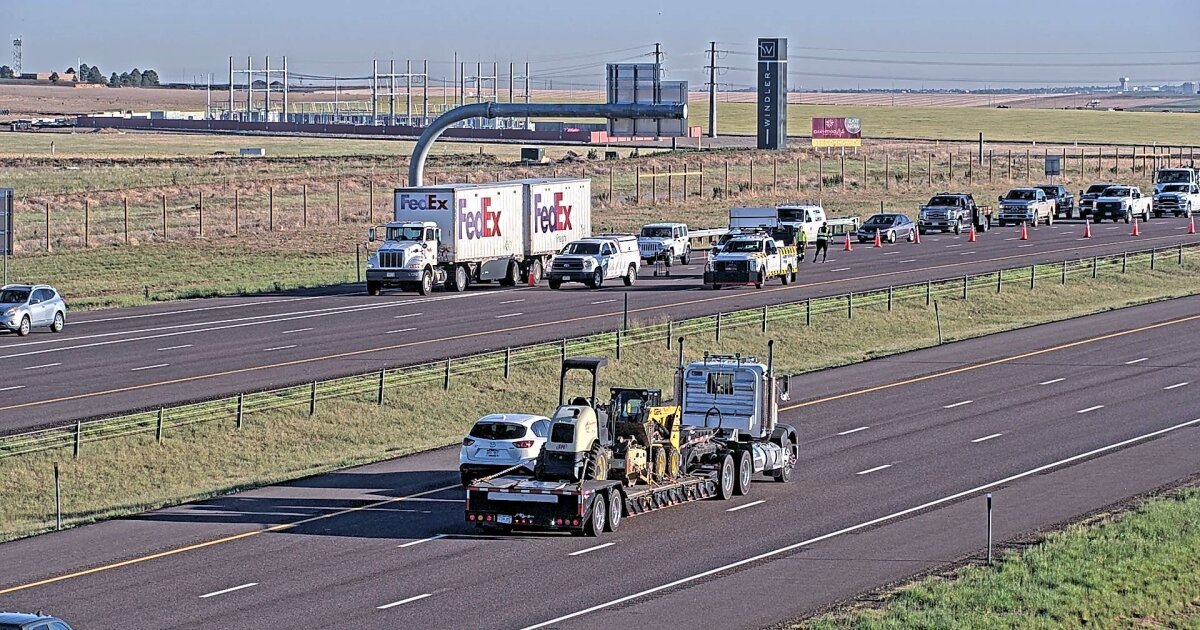
Pedestrian dies after hit by car on southbound E-470, Aurora police say
-

 Seattle, WA2 hours ago
Seattle paying $2.6M to settle sexual harassment lawsuit filed by four female SPD officers – MyNorthwest.com

