Montana
Montana Land Board decides to take stronger role in water decisions • Daily Montanan


The Montana Land Board decided to take back the authority it ceded decades ago at its May meeting, but the decision to do that, along with a recent Supreme Court ruling, has cast an uneasy tension between state leaders and the agricultural community.
As temperatures continue to rise and the threat of fire grows, ranchers and farmers continue to be concerned about their land and access to water. In Montana, water rights are notoriously complex and litigious, with some disputed claims still outliving the residents who originally brought them.
At issue is how the State of Montana claims water rights when dealing with state-owned leased lands. Like many western states, large tracts of land are held in trust by the state and money made from leasing the land goes into a fund to support public education.
However, a recent court case and the management of water rights by the Montana Department of Natural Resources and Conservation, the state agency in charge of the trust lands, has sparked renewed concerns that the state may try to take water rights away from property owners.
The case, Schutter vs. State Land Board, was decided in May and the state’s highest court ruled that if a resident filed a water claim, even if the source of the water was on private land, that if it has been used in part to water state land then the state owns part of that water right. That has led to an uproar from the agricultural community, which is worried that simply transferring water from private land to leased state land will create an opportunity for the state to take water rights.
From that decision and recent contentious land board meetings, the Montana Land Board, comprised of the five “constitutional” officers (the governor, attorney general, auditor, secretary of state and superintendent of public education), has revisited its policy of delegating legal challenges to the state’s Department of Natural Resources.
Because of the uproar and concern from the Schutter case, the land board decided to reverse a decades-long policy of delegating water rights decisions to agency officials, and will now require any potential future water cases go to the board for permission to proceed. In other words, the DNRC will no longer be able to litigate or challenge cases without first getting the approval of the land board, a change brought by Montana Attorney General Austin Knudsen, who had previously vowed to update the policy to bring more oversight to the elected leaders and less authority to the agency.
The proposal was supported unanimously. All members of the state’s Land Board are Republican.
Though the policy promised more oversight, farmers, ranchers, attorneys and those in agriculture seemed uncertain whether the move would help with disputes.
Many members of the agriculture community testified that they were still worried about the uncertainty they saw in the application of Montana law. Many expressed concern that during dry years if they used water they owned on state land to help, the state may try to claim a portion of it.
“We have to be assured that if we use our water on state land,” said Sen. Butch Gillespie, who gave public comment as both a rancher and Republican state senator.
Carl DeVries, a rancher from Roberts and a member of the Senior Agricultural Water Rights Alliance agreed.
“We need assurances if it is a temporary situation,” DeVries said.
For months, farmers and ranchers have said that without more protections or assurances that they would be hesitant to lease land for fear of losing water rights.
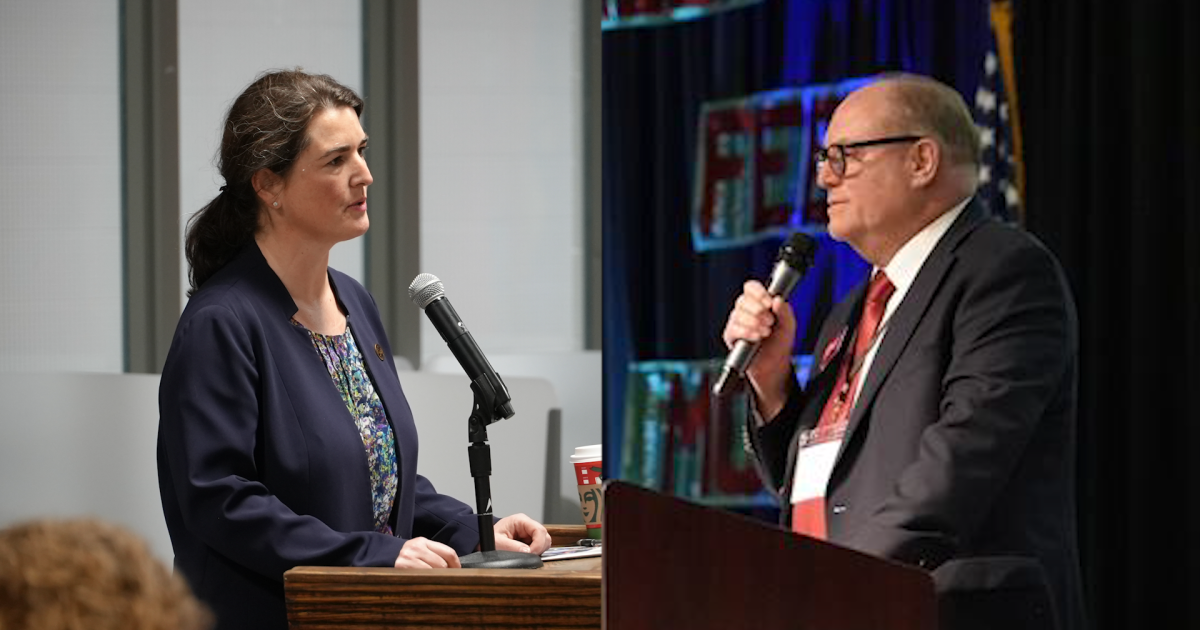
Lt. Gov. Kristen Juras worked with the DNRC to present to the Land Board an overview about how the state department works with residents who bid on and win the state leases. Juras is not only the lieutenant governor, but comes from an agricultural background and is an attorney. She pointed out that paperwork can be filed with the state to protect temporary water usage on state land.
Betsy Story, a water law attorney from Helena, said that she was still concerned about the gray areas of the law, including when the state claims part of a water right that originates completely on private land. What happens, she asked, if another person in the future wins the lease for state land? She said a situation like that raises plenty of thorny legal issues.
Knudsen said he hoped returning legal oversight to the land board will help mitigate some of the conflict.
“This means that if the DNRC wants to make a legal claim, it must get explicit approval from us,” Knudsen said. “This should be as much as it can be in the public.”







If a furry, playful, hugg-able, lovable kitten would be a great addition to your place, now’s the time to visit the Humane Society of Western Montana.
MEET BAKER AND BUSBOY
It was another Take Me Home Tuesday at the radio stations with the Humane Society. Katie brought in “Baker” (black kitty) and “Busboy” (gray kitty), who along with their two siblings “Chef” and “Cook” form a Fantastic Four of pure joy.
These two-month-old little ones were found in the Polson area and surrendered to the shelter. They just had their spay/neuter surgeries Monday (July 13) and they will be looking for their forever homes starting Wednesday (July 15).

Whether you are looking for one kitten or the whole “kitchen,” visit the shelter and fall in love with Baker, Busboy, Chef and Cook.
EVER CONSIDERED BEING A FOSTER HOME FOR SHELTER PETS?
It is kitten season at the Humane Society of Western Montana. The Humane Society is always looking for Fosters to take care of tiny kittens until they are old enough to be adopted. They currently have some that are with mom cats, and some that are bottle babies. And there is always a need for volunteers willing to nurture them until they are of adoption age.
And of course one of the perks of being a Foster is, if you fall in love with a kitten, you pretty much get first dibs.
READ MORE: Volunteers Hit ‘The Ridge’ To Improve Montana Elk Hunting Opportunities
So, whether you are looking to adopt or would like more information about being a foster home, be sure to visit the Humane Society of Western Montana soon. They are open from 1:00 – 6:00 pm Wednesdays through Sundays at 5930 Highway 93 South in Missoula. See more cats AND dogs waiting to be adopted on the shelter’s ADOPT webpage here.
LOOK: Can you tell the difference between these common pets?
Can you tell the difference between a hamster and a guinea pig? How about a betta and a guppy? Test your pet ID skills in our cute quiz.
Gallery Credit: Stephen Lenz


HEBGEN LAKE, Mont. — A man was rescued after nearly drowning while swimming in Rainbow Point, located 10 miles north of West Yellowstone.
The Gallatin County Sheriff’s Office, along with Hebgen Basin Rural EMS personnel and Montana Fish, Wildlife and Parks, responded to reports of a swimmer in distress.
Officials say bystanders saw a man become unresponsive while swimming roughly 100 yards off the shoreline.
They, along with a boating group, located the man, pulled him out of the water, and performed life-saving measures until first responders arrived.
The man was airlifted to Eastern Idaho Regional Medical Center. Officials say he is in critical condition.
The Gallatin County Sheriff’s Office released the following information:
-

 Connecticut3 minutes ago
Connecticut Sun hold off Portland Fire on Camp Day at Mohegan Sun Arena
-

 Delaware9 minutes ago
Harrington-area man killed after truck hits him after lying on roadway
-

 Florida15 minutes ago
Man, 74, becomes oldest inmate executed in Florida in state’s 10th lethal injection this year
-

 Georgia21 minutes ago
Athlon Sports tabs Florida-Georgia among SEC’s best games in 2026
-

 Hawaii27 minutes ago
4,000 troops lose air conditioning in Hawaii
-

 Idaho33 minutes ago
Idaho is home to the nation's first DarkSky Reserve. Now it's home to the nations first DarkSky Certified Resort
-

 Illinois39 minutes ago
2 teens hospitalized after being rescued by bystanders from Lake Michigan at Illinois Beach State Park near Zion
-

 Indiana45 minutes ago
‘Big Boy’ locomotive returns for overnight stay in northeast Indiana

