
Connect with us

Movie Reviews

Film Review: Two classic films that are great for Christmas watching are also touching reflections

Published

on

Film Review: Two classic films that are great for Christmas watching are also touching reflections

Meet Me in St. Louis is only partly a Christmas movie. The musical follows the Smith family of St. Louis from the summer of 1903 until the spring of 1904. The opening song goes “Meet Me in St. Louis, Louie, meet me at the fair” – and the fair is the St. Louis World’s Fair, known as the Louisiana Purchase Exposition. All four sections of the movie are magnificent, but the Christmas sequence is especially poignant, and it’s marked by the film’s star Judy Garland singing the beautiful, wistful “Have Yourself a Merry Little Christmas.”

One reason for the sadness is that Meet Me in St. Louis is a wartime picture. It premiered in New York on December 30, 1944, right in the middle of “The Battle of the Bulge,” the German counteroffensive that made millions of people all over the world wonder if they would ever see another Christmas. Even though the story starts in 1903, the movie signals the profound changes coming to America because of World War II. The lovely, romantic gas lights in the Smith home will give way to more efficient electric lights, but for Americans in 1944, family life, courtship, food — just about everything — will change.

Metro-Goldwyn-Mayer (Loew’s Inc.)

Advertisement
The movie poster from the film Meet Me In St. Louis. The film isn’t strictly a Christmas movie, but it does have an iconic Christmas moment.

The Christmas sequence includes a big, colorful dance for young people, and they all get matched up with the person they most like. But hanging over the family is the father’s decision to move them to New York. When Garland sings, her despairing little sister Tootie, rushes out to destroy all the snow people in the back yard. And the movie honors her despair.

But Meet Me in St. Louis is also about how World War II diminished the power of men in their families — while the men were away, the women ran the home, worked in factories, ferried airplanes all over the world and were major figures in the creation of the first computer. So, many currents run under Meet Me in St. Louis, but the complexities only make the film more astonishing and delightful. Characters cope with change and through the movie find joy and excitement — as does the audience.

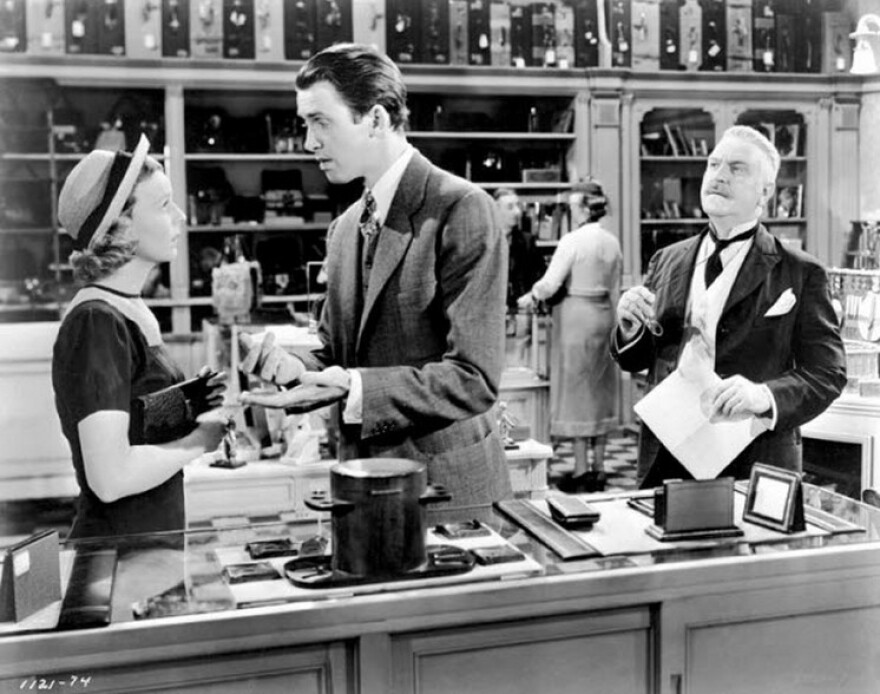
American actor Jimmy Stewart is featured in a still from the film The Shop Around the Corner. Stewart would go on to be in notable holiday films.

German-born Ernst Lubitsch brought middle-European angst and manners to his great comedies in the ‘30s and early ‘40s. Unlike Meet Me in St. Louis, The Shop around the Corner takes place in Budapest and not the middle America. The staff of the gift shop is a cross-section of Europe. Characters are evasive, and comically terrified of giving offense. Lubitsch loved indirection and suggestion. The movie came out in 1940, but doesn’t mention the war, yet you feel it all through the picture, and audiences in 1940 knew it for certain. Lubitsch loved the interaction of real life troubles and laughter in his comic fantasies. The shop owner is even driven to attempt suicide before the affection of his staff brings him back to himself and his feeling that this little store is for him a wonderful home.

The lead clerk, played by James Stewart, and the newest employee (Margaret Sullavan) feud throughout the movie. By the rules of romantic comedy, strife will turn to love, but the convoluted getting there is pure delight. Lubitsch and screenwriter Samson Raphaelson are masters of ironic comedy and of puncturing the pompous. When the owner tells the staff that he wants an absolutely honest opinion, which of course he doesn’t, one man over and over runs for cover. But in this tiny, self-absorbed microcosm, Christmas brings out the unexpected best in its people. A former head of production at United Artists called The Shop around the Corner a perfect movie. I agree.

Advertisement

Watch Meet Me In St. Louis for free on Tubi TV or on a variety of streaming services.
The Shop Around the Corner is available on many streaming services or for free here.

Continue Reading
Click to comment

Leave a Reply

Your email address will not be published. Required fields are marked *

This site uses Akismet to reduce spam. Learn how your comment data is processed.

Movie Reviews

‘The Invite’ Movie Review – Spotlight Report

Published

on

‘The Invite’ Movie Review – Spotlight Report

The Invite is a remake of the Spanish film The People Upstairs, itself based on a play by the same director Cesc Gay. With all remakes, the question is: What’s this version bringing to the table. In this case, it’s a rock solid cast with great chemistry and some very snappy direction by Olivia Wilde.

Joe (Seth Rogen) and Angela (Olivia Wilde) are a dysfunctional couple with some noisily amorous upstairs neighbours. They invite Hawk (Edward Norton) and Piña (Penélope Cruz) to dinner and hijinks ensue.

There’s a lot to like about The Invite. Each member of the cast is funny in their own way. Rogen plays his usual schlub but his character is more nuanced than usual, with the rapid-fire jokes masking a deep frustration and melancholy. Wilde‘s Angela is a persnickety neurotic, but it’s not hard to see why. Cruz plays a sultry therapist who’s in permanent flirt mode but is also holding something back. Norton steals the show with a quietly hilarious performance as a retired firefighter who is all too eager to share his new age insights. The way each person interacts with the other results in a rollercoaster of cringe comedy, acerbic satire and genuine gut-busters. This is a film that relies entirely on performance and actually succeeds.

Advertisement

The story itself is a little masterpiece. Adapted from Gay’s original by Rashida Jones and Will McCormack, the dialogue is quick, laden with not-very-subtextual motivations and always up to something. It’s very even-handed, and all the characters are sympathetic but flawed in amusing ways. Watching the increasingly desperate Joe and Angela bouncing off the Hawk and Piña is both funny and excruciating. Joe’s attraction to Piña is played fairly straight, but Angela’s attraction to Hawk becomes side-splitting as she pours out her soul to his Zen-calm ears and gets responses that make her even more attracted to him and by the end she’s practically hyperventilating.

The Invite does take something of a turn towards the end, although the film is in a state of continual twist throughout. This final shift throws the couples’ dysfunction into stark terms but doesn’t ruin anything. In the end, it moves from a somewhat misanthropic tone to a sincere and compassionate one. It skillfully makes you complicit in Joe and Angela’s spatting and then forces you to reconsider. The comedy is so intense throughout the film that when this happens it might lose some viewers, but it’s well-earned, true to the characters and it’s a very satisfying payoff.

The Invite is a small film that feels like a return to a better era in cinema. It’s a remake that is worth watching for its performances, and it’s very, very funny. It’s the sort of film that can be watched at home given its confined setting, but it generates enough laughs that seeing with an audience is a real pleasure.

Continue Reading

Movie Reviews

Movie Review: ‘Supergirl’ – Catholic Review

Published

on

Movie Review: ‘Supergirl’ – Catholic Review

NEW YORK (OSV News) – At what is meant to be a poignant moment in the DC Comics adaptation “Supergirl” (Warner Bros.), the title character, played by Milly Alcock, is told by her mother (Emily Beecham) that she doesn’t have to be nice but she must be good. The recipient of this advice takes it to heart in a way that lends the whole film an unpleasant tone.

We’re not talking Deadpool depths of obscene snark here. Yet scrappy Supergirl, aka Kara Zor-El, in contrast to her affable cousin — and fellow Kryptonian — Superman (David Corenswet), does not come across as especially likeable.

Nor is she a figure to be imitated since, before she embarks on the quest to which most of the running time is devoted, early scenes show her waking up with a succession of staggering hangovers. She gets blotto, we later learn, in an effort to blot out her troubled past. The only positive ingredient in her current life is the bond she shares with her beloved dog, Krypto.

So when evil alien Krem of the Yellow Hills (Matthias Schoenaerts) wounds Krypto with a poisoned dart, leaving him with only hours to live, Supergirl is desperate to help the pup survive. Learning that Krem carries the antidote with him wherever he goes, she sets off on an interplanetary hunt for the villain, racing against time.

Supergirl has already crossed paths with another of Krem’s victims, Ruthye (Eve Ridley). Having watched as Krem slaughtered her entire family, Ruthye is out for revenge and wants to join forces with Supergirl.

Advertisement

Since Ruthye, though courageous, is undersized and completely untrained for combat, Supergirl initially tries to ditch her. But Ruthye is not to be so easily rebuffed.

The unlikely duo eventually acquire an informal ally in the person of cigar-chomping, motorcycle-riding freelance warrior Lobo (Jason Momoa). Lobo has reasons of his own for hating the band of brigands Krem leads.

As scripted by Ana Nogueira, director Craig Gillespie’s scifi adventure includes more than one exchange in which Supergirl warns Ruthye about the morally corrupting effects of exacting vengeance. Yet this thoroughly respectable ethical message is completely undermined as the action reaches its climax.

“Supergirl” may not be a dose of Kryptonite. But it’s no energy-infusing sunbath either.

The film contains much harsh but bloodless violence, a scene of urination, a passing reference to nonscriptural religious ideas, a couple of mild oaths, several uses each of crude and crass language and an obscene gesture. The OSV News classification is A-III – adults. The Motion Picture Association rating is PG-13 — parents strongly cautioned. Some material may be inappropriate for children under 13.

Advertisement

Read More Movie & Television Reviews

Copyright © 2026 OSV News

Continue Reading

Movie Reviews

‘Balaramana Dinagalu’ review: A restrained look at the gangster mind

Published

on

‘Balaramana Dinagalu’ review: A restrained look at the gangster mind

In K M Chaitanya’s Aa Dinagalu (2007), actor Atul Kulkarni, playing gangster Agni Sreedhar, says man is the biggest weapon in the underworld. “The rest are just properties,” he adds. The yesteryear Kannada crime drama, based on the real incidents from a big chapter of the Bengaluru underworld, stood out for its understated storytelling.

In Balaramana Dinagalu, which has the skeleton of a sequel to Aa Dinagalu, weapons are seen in the first scene. As the film progresses, we encounter an arsenal of knives, razors, machetes, and guns — each an extension of the gangsters’ identities and an indispensable tool in their quest to remain feared and lethal. Chaitanya attempts to make the movie a mix of reality and entertaining tropes.

Balaramana Dinagalu (Kannada)

Director: K M Chaitanya

Cast: Vinod Prabhakar, Priya Anand, Atul Kulkarni, Ashish Vidyarthi, Ramesh Indira

Runtime: 151 minutes

Advertisement

Storyline: Balarama, an ordinary young man from a remote village in Karnataka, becomes a dreaded gangster who rules Bengaluru

The director has roped in the same cast, who played the dreaded gangster trio of Kotwal Ramachandra (essayed by Sharath Lohitashwa), Jayaraj (Ashish Vidyarthi), and Agni Sreedhar (Atul) in Aa Dinagalu. That’s what makes one instantly curious about Balaramana Dinagalu. The only difference in the latest movie from the previous one is the fictionalised names of the real dons. Jayaraj becomes Jayaram, Sreedhar is Shashidhar, and Muthappa Rai is called Monnappa Rai (played by Ramesh Indira).

Even if these characters are the big draw in the movie, the plot revolves around the journey of Balarama, a character with a small yet significant presence in Aa Dinagalu. Vinod Prabhakar’s portrayal of the titular role is the film’s biggest takeaway. He makes us feel for the character, and is quite impressive in the final portions of the movie, where Balarama struggles to break free from the underworld’s trap.

Balaramana Dinagalu is impressive when it reflects the psychology of a gangster. Jayaram is shown helping the needy while Balarama urges young boys to focus on education. It’s as if these men who commit heinous acts, have a heart as well. Shashidhar is often called “intellectual gangster”, as the film reflects how the underworld fears well-read men in the field. Politicians and policemen, the supposedly the protectors of people being part of the crime nexus, strengthen the movie’s world-building.

The film falters in its inability to rise above the plot’s predictability. Balarama’s journey is no different from the often-seen life of an innocent man from a small town who becomes a gangster owing to uncontrollable circumstances. I wish the film had delved a bit more into Balaram’s personality. Why does he not resist becoming a gangster? What dreams did he have when he moved to Bengaluru from a small town?

Advertisement

“My hands speak louder than my words,” says Balarama. This signals that he is someone who settles conflicts with fists rather than conversations. Despite this detail, Balaram’s entry into the underworld feels too sudden. The predictability strips the sheen away from the well-shot action sequences, as the result of every fight is known beforehand.

Chaitanya is careful not to glorify the act of violence. He wants to portray the negative effects of violence on the children in a family, as the movie ends with a hard-hitting frame. It’s impressive that the actor-director duo has delivered a non-hero-worshipping gangster saga.

That said, the movie could have benefited from a couple of gripping episodes. While it’s important not to romanticise the life of a gangster, there is no harm in delivering moments of peak tension, the biggest plus of the genre. 

The assassination of Jayaram, the impact of Kotwal’s elimination on the underworld, or the Sakleshpura incident involving Monnappa Rai, had the potential to offer edge-of-the-seat, high-stakes portions, but they are rushed. The love story is simple, but it lacks emotional intensity between the lead couple. Santhosh Narayanan’s dance numbers are forgettable (despite it being his forte) while his montage melodies are beautiful.

Balaramana Dinagalu adopts a restrained, almost clinical approach to the gangster genre. While that keeps it from glorifying violence, it also leaves the narrative feeling a touch too neat and emotionally muted.

Advertisement

Balaramana Dinagalu is currently running in theatres

Published – June 28, 2026 07:58 pm IST

Continue Reading
Advertisement

Trending
