Lifestyle
These L.A. musicians investigated a medical mystery. What they discovered launched a new skincare line


The love story of musicians Ann Marie Simpson-Einziger and Mike Einziger was fortified in a lab.
After meeting through a mutual colleague in 2010, the Santa Monica-based couple’s courtship began the following year, as they were collaborating with Oscar-winning composer Hans Zimmer on a series of film scores. Einziger is best known as the founding guitarist of California-based rock band Incubus. His wife is a renowned composer and violinist for artists including Jethro Tull, Ringo Starr, Dave Matthews Band and Stevie Nicks.
The couple had been seeing one another for only about a year when together they stumbled upon a medical mystery. It resulted in a thrilling scientific discovery, the founding of a biotech beauty company called Mother Science — and their own unique happily-ever-after.
“It was an unexpected journey,” said Simpson-Einziger.
“We were simply trying to answer a series of unanswered scientific questions,” her husband added.
It all began in 2012 when Simpson-Einziger developed a fungal infection while traveling abroad. A classically trained violinist by trade, she was performing with composer A.R. Rahman in India when she noticed lightened patches of skin on her back and under her bra line. They resembled “loosely drawn flower blooms, with rounded edges,” she said.
After consulting her dermatologist, Simpson-Einziger was diagnosed with a temporary fungal infection called Tinea versicolor, which can lighten or darken skin pigmentation as a result of humidity.
“It’s an imbalance of the microbiome,” Simpson-Einziger said. “The condition was harmless, it resolves on its own and [I was told] that the lightened patches of skin would all go back to normal. But I got so curious.”
“We learned pretty quickly that there were no real hypotheses about how this was happening.”
— Mike Einziger, co-founder of Mother Science and Incubus guitarist
Ann Marie Simpson-Einziger and Mike Einziger both have science backgrounds, which is what inspired their initial curiosity. She majored in biology at UVA and later taught physics and chemistry between music gigs. He studied at Harvard.
(Al Seib / For The Times)
Armed with an undergraduate degree in biology from the University of Virginia, the former physics and chemistry teacher pored through science journals like Pigment International and Chembiochem to find articles that better explained the science behind her skin condition. She then began to wonder if whatever had caused it could also be used as a skincare aid that reduced dark spots.
She enlisted the help of her then-fiancé, Einziger, who also happened to have a background in science. He had recently completed the two-year Special Student program at Harvard University’s Graduate School of Arts and Sciences, where he studied cosmology and evolutionary biology. He still had access to the university’s considerable research databases, which meant he could help her look up articles on Tinea versicolor. Soon, he joined her obsession.
“There was tons of literature to research, but nothing coming at it from our perspective,” said Einziger. “We learned pretty quickly that there were no real hypotheses about how this was happening.”
Though they still couldn’t prove it, Simpson-Einziger’s theory that her skin condition could be of use in the beauty world kept them both up at night.
“I actually had a nightmare that somebody took her idea,” he said.
It was then, in 2015, that he called Dr. Jonathan Sackier, a family friend and biotech and medical entrepreneur, who co-invented robotic surgery.

In 2023 Mother Science launched its first product, the Molecular Hero Serum ($89). The product is meant to reduce hyperpigmentation and brighten skin.
(Al Seib / For The Times)
“I taught his daughter violin lessons when I was a recent college graduate living in Virginia,” Simpson-Einziger said.
“We went to [him] fully prepared that we were going to get laughed out of the room,” Einziger added.
Sackier remembers the couple’s uncertainty during the phone call. “Ann-Marie was in the background, whispering, ‘He’s going to think we’re idiots,’” he said. “[Mike] asked if I could identify what it was about the fungal infection that was causing depigmentation and having identified it, could I synthesize or somehow isolate the chemical so that we could do something to impact pigmentation disorders.”
A surgeon by specialty, Sackier connected them with his colleague, Timothy Macdonald, a scientist and professor emeritus of chemistry and pharmacology at the University of Virginia.
“I have taken many projects to him over the years,” Sackier said. “I call him ‘Dr. No,’ because he always says, ‘No, that doesn’t make sense. No, that won’t work.’ When I told him this, he went, ‘Holy moly, that’s impressive.’”
Macdonald began advising the couple and helped connect them with a North Carolina-based research organization called PharmaDirections. The drug development company helped design a scientific program to explore various compounds that had caught the Einzigers’ attention while researching.
After countless studies, they discovered that a naturally occurring molecule that had co-evolved with the human microbiome, Malassezin (pronounced mal-uh-say-zin), could be beneficial for sun spots. While the molecule was identified and named in 2001, the Einzigers were the first to recognize that Malassezin could be valuable in the context of skincare.
“Malassezin is made from a yeast,” said New York-based dermatologist Dr. Amy Wechsler. “When someone has the yeast infection on their skin, the skin often bleaches temporarily.”
The couple filed an application to patent the discovery in 2016. (It was officially granted in 2018.) They then worked with a team of scientists including cosmetic chemist Susan Goldsberry and beauty innovation entrepreneur Tim McCraw to develop Malassezin into a topical serum after previously manufacturing it through a separate process called chemical synthesis.
They began testing to see if it could benefit melanocytes, the skin cells that produce melanin, the dark pigment in question. The couple used their personal savings to fund the initial research.
“I justified it as, ‘How much would I pay for an education where experts in the field teach me how to characterize a molecule and then commercialize it?’” Simpson-Einziger said. “That one-on-one education was worth what we put into investigating this molecule.”
They brought on beauty industry veteran Edna Coryell, McCraw’s daughter, as co-founder and CEO of Mother Science in August 2017 to oversee further research and development, which involved in vitro studies, 3D cell cultures, ex vivo skin testing and genetic analysis. Coryell had never brought a new ingredient to the market until Malassezin.
“It is very rare,” said Coryell. “Truly, as we were going through [the process], it was writing the playbook for this.’”
The Einzigers also collaborated with Dr. Pearl Grimes, director of the Vitiligo & Pigmentation Institute of Southern California, who specializes in vitiligo and pigmentation disorders.
“This is somebody who’s been looking at Tinea versicolor for decades,” Einziger said. “Her first reaction was, ‘How did you guys figure this out?’”
“I was 100% fascinated,” Grimes said of reviewing their initial in vitro studies. “The science [and] the concept was disruptive.”
Grimes assembled a clinical program, which led to proof-of-concept data that’s since been published in peer-reviewed journals including the American Academy of Dermatology and Journal of Drugs in Dermatology.
She went so far as to take a skin biopsy from her own elbow for lab testing. Using VISIA skin analysis technology, she found that the serum helped fade hyperpigmentation on the sample.
“That’s when I really knew that it worked,” Grimes said. “I used it in a stubborn area, and I could clearly see via photographic documentation that it was responding.”
“Having holes punched in my face was an ultimate act of belief in what we’ve made.”
— Ann Marie Simpson-Einziger, co-founder of Mother Science and violinist

“We had a lot of people who said, ‘You don’t want to do this. This is too hard. It’s going to take years.’” Simpson-Einziger said. “I remember thinking, ‘Years don’t scare me.’”
(Al Seib / For The Times)
Einziger also biopsied a patch on his arm for Grimes to analyze. “We felt responsible,” he said. “Mine was done before we even did the human clinical study.”
Simpson-Einziger joked that she too “put real skin in the game” after she said she had her face punch-biopsied — a procedure in which an instrument is used to remove a deeper skin sample — three times.
“Having holes punched in my face was an ultimate act of belief in what we’ve made,” Simpson-Einziger said.
Once the Einzigers confirmed that the data supported their initial hypothesis in a human clinical study, they moved forward with a business plan for what eventually became Mother Science. (It joins the couple’s two other co-founded businesses, including Mixhalo, a networking technology company for live events.)
Mother Science — named as a nod to French physicist and chemist Marie Curie — was born as a result of raising an initial round of approximately $3.2 million in seed funding from a small group of venture capitalists and angel investors, including Hawktail’s Michael Polansky and Drew Houston, the co-founder of Dropbox. After more than six years of research, Malassezin became the DNA of Mother Science, which officially launched in 2023 with its first product, Molecular Hero Serum ($89). The product is meant to reduce hyperpigmentation and brighten skin.
“It’s a powerful antioxidant,” Simpson-Einziger said. “When we started testing, we learned that Malassezin happens to offer superior protection against hydroxyl and peroxyl free radicals, which are [some of] the most damaging. We had this molecule that was going to do something marvelous in protecting the skin.”
A second product, Retinol Synergist ($96), was released earlier this year. And Molecular Genesis Barrier Repair Moisturizer ($68), featuring Malassezin, will be released on Jan. 7.
“Malassezin is really versatile, as it’s able to target hyperpigmentation, improve the skin’s moisture barrier and provide potent antioxidant protection without any irritation,” said Connecticut-based dermatologist Dr. Mona Gohara, who is also an associate clinical professor at Yale University. “The beauty of it is it’s gentle but also highly efficacious.”
In 2016, the same year the Einzigers filed a patent for their scientific discovery, the couple married. They are now parents to four children including a nearly one-year-old son. Because their courtship intersected with their scientific passion project, they consider Mother Science their fifth child.
“We had a lot of people who said, ‘You don’t want to do this. This is too hard. It’s going to take years.’” Simpson-Einziger said, pausing. “I remember thinking, ‘Years don’t scare me. I have a baby. I’m going to have to take care of a human for 18 years.’ There are no guarantees when you have a child how they’re going to turn out, but you do it out of love, out of passion, and it makes your life richer.”
While the couple continues to grow Mother Science’s product lineup, Simpson-Einziger is most proud of their process of discovery itself.
“We’re excited about contributing to science, and having that legacy as part of our brand,” she said.
She hopes Malassezin will one day be as universally known as Vitamin C and hyaluronic acid.
“I want people talking about Malassezin, not even about our brand, just about Malassezin,” she said.
In other words, she and her husband hope the ingredients of their products will be front and center — not themselves.
“Nobody is excited about coming to me for their skincare needs,” Einziger, who still regularly sells out stadiums with Incubus, said with a laugh. “I’m just a person who plays music who happens to be curious about the skin microbiome.”

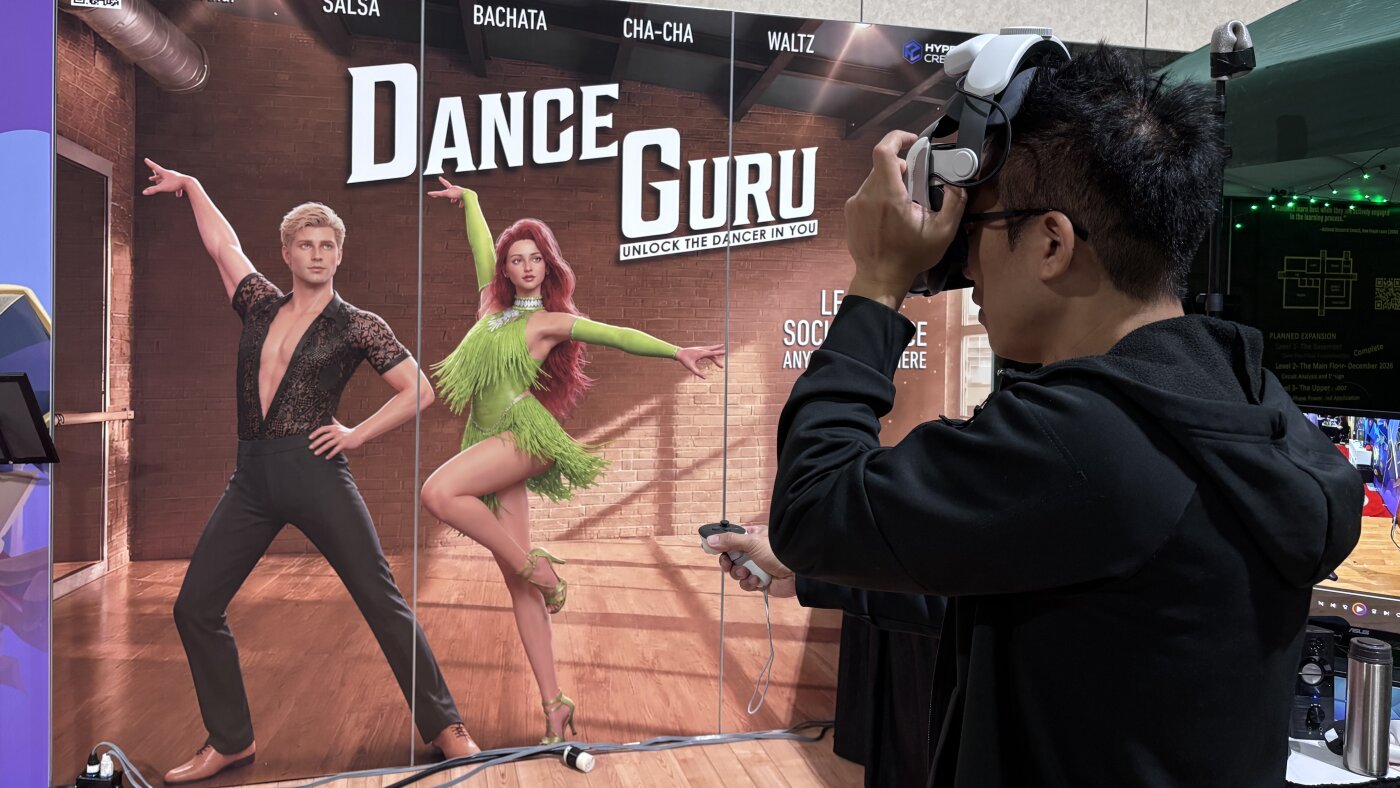
Entrepreneur David Huang tests out a VR headset while conducting demonstrations of the social dance lesson app Dance Guru at the Augmented World Expo in Long Beach, Calif., June 17, 2026.
Chloe Veltman/NPR
hide caption
toggle caption
Chloe Veltman/NPR
Wedding season is in full swing, bringing with it a familiar sense of dread for anyone who fears the dance floor.
But relief may finally be at hand with the help of a new app, Dance Guru, and a virtual reality (VR) headset.
The social dance instruction app transports users to a spacious, digital dance studio. Waiting inside is a computer-generated coach: a handsome, male avatar wearing a shirt open to his navel. He speaks with a slightly gravelly English accent.
“Watch me now,” he instructs at the start of a waltz lesson — which NPR tried out at the Augmented World Expo in Long Beach, Calif., an annual conference showcasing the latest developments in virtual and augmented reality.
The avatar then demonstrates a basic box step.

From there, the lesson becomes interactive. The coach tells the user to hold his hand while an electric pinging sound tracks the student’s foot placement.
“One, two, three, four, five, six,” the virtual teacher counts down.
When the user stumbles, he remains remarkably patient. “Do not worry, foundations take time. Let’s try that again. Work on grounding your steps more intentionally.”
Solving the beginner’s dilemma
Dance Guru creator David Huang said he came up with the idea for the app a couple of years ago out of frustration.
“I always wanted to learn to dance and I was always terrible at it,” Huang said. “And I always ended up stopping midway through the lessons.”
He soon realized that many beginners hit the exact same roadblocks.

“Private lessons are too expensive, and you feel like you’re always forgetting the dance steps,” Huang said. “You cannot find a partner to dance with. So I figured maybe I can create something like this.”
The Dance Guru platform currently offers tutorials in salsa, bachata, waltz, and cha-cha, in both lead and follow modes. To make the digital instruction feel authentic, Huang used motion-capture technology to record the movements of real-life dance teachers — with their permission.
Building on the legacy of online tutorials and video games
Dance Guru belongs to a small but growing wave of apps using VR to demystify social dance. At a nearby booth, conference attendee Victor Chen is testing out a competing app called Trip the Light. It currently offers salsa lessons, as well as freestyle options, where a user can dance with a partner without having to learn specific steps.

Trip the Light’s booth at the Augmented World Expo included posters of the app’s virtual instructors. Real-life performers, who gave Trip the Light permission to motion capture their movements, were used as a basis for these avatars.
Chloe Veltman/NPR
hide caption
toggle caption
Chloe Veltman/NPR
“A lot of times when you’re trying to learn a choreography, it’s watching a YouTube video and you have to pause it, rewind, and play it,” Chen said. “If you were to have a virtual avatar dancing in front of you and correcting for any parts that you missed, it might be a lot easier.”
Interactive video games like Dance Dance Revolution and Just Dance, and YouTube tutorials have been helping people improve their skills in private for years. But those games are mostly aimed at solo players. Unlike the new generation of immersive VR apps, they cannot simulate the mechanics or confidence required for partner dancing on a live dance floor.
The reality check
But this kind of app won’t work for every dancer.
“Everyone learns a little bit differently. And so unless you have a game that has lots of different ways of teaching, you’re going to have things that work for some people and don’t work for others,” said Ariana Katana, a trained contemporary dancer and dance content creator who’s active on YouTube, Twitch and other platforms. “Also, it’s hard to dance with a headset on.”
And then there’s the issue of not being able to physically feel a virtual partner’s hand or shoulder while dancing with them. Patrick Ascolese, the creator of Trip the Light, said the experience could become more tactile in the future. “Haptic suits and wearables will be coming, but I think we’re a little away from that,” he said.
Ascolese said even with their limitations, immersive tools like Trip the Light have immense potential as judgment-free training grounds — giving reluctant dancers the baseline confidence they need to eventually step onto the dance floor with real partners in the real world, including at weddings.
“Just like anything else, practice makes perfect,” said Ascolese. “So the more time you spend in VR with a virtual partner, it works towards helping you get over that social hurdle. We are teaching you the moves that you have to do in order to go out and have fun.”
Jennifer Vanasco edited the broadcast and digital versions of this story. Chloee Weiner mixed the audio.





For half a century, Deidre Hall has taken on every kind of disaster in the drama-packed town of Salem, Ill., as a star of “Days of Our Lives.”
There was the time — actually, it happened twice — when her character, Dr. Marlena Evans, was famously possessed by the devil and even levitated.

In Sunday Funday, L.A. people give us a play-by-play of their ideal Sunday around town. Find ideas and inspiration on where to go, what to eat and how to enjoy life on the weekends.
Or the time a serial killer, who was actually Marlena under hypnosis, seemed to kill several beloved characters. The long-running show’s storylines have become legendary, and in March, while promoting “Hail Mary,” actor Ryan Gosling even gave Hall a shout-out, admitting he was a fan, praising the hard work of soap opera actors and calling her an “OG acting inspiration.”
But Hall’s real life in Santa Monica is much quieter than her character’s, and she likes it that way.
“When I bought my house in Santa Monica, I didn’t realize how great it would be to live near Montana Avenue,” says Hall, 78, about the popular shopping spot. Every day, she walks to the main street with her golden retriever, Riley, and enjoys Pilates, art and good food along the way. “The owners of the Farms Market even keep dog biscuits, so guess where the dog wants to go every time we walk — the Farms, of course,” she says, laughing.
When she isn’t filming the daily soap opera, which airs on Peacock, Hall enjoys raising monarch butterflies, exploring the shops and restaurants on Montana, and hosting movie nights at home with her two sons.
Here’s what a perfect day in L.A. looks like for her.
This interview has been lightly edited and condensed for length and clarity.

7 a.m.: Breakfast and dog walk
I usually kick off my day with a protein shake, feed our golden retriever and take her out for a walk. She’s a phenomenal girl. When we adopted her, her name was Riley, but I did think about naming her after Mrs. Hughes from “Downton Abbey.”

10 a.m.: Church and garden time
After I walk the dog and go to church, I like to spend some time in my yard. I’m not a natural gardener, but I really enjoy it. I started raising monarch butterflies because my identical twin sister, who played my twin on the show, planted a butterfly garden. Monarchs are amazing because they are transitional. Every year, they travel from Mexico to southern New England, but it’s getting harder for them. Their numbers have dropped by about 80%. To help, I plant milkweed, which is what they need to survive. I buy my milkweed from the Staghorn Garden on Wilshire Boulevard in Santa Monica. Julie, who owns the nursery, is delightful and has a wide variety of milkweed. The monarchs always seem to find my garden. Julie was raising some caterpillars too, and she cared a lot about them. We talked about how important it is to help the butterflies. That’s why I do this. Sometimes I get milkweed with eggs already on it, and Julie knows her butterflies are going to a good home.

1 p.m.: Walk to Montana Avenue for some lunch
I live near Montana and love taking long walks, going to Pilates and trying out the great restaurants nearby, like R+D Kitchen and La La Land. I’m a big fan of the waffles at the Courtyard Kitchen. Just a few days ago, I had a chicken salad on raisin bread with an Arnold Palmer, and it was delicious. It is right on Montana and has a nice outdoor seating area. It’s one of my favorite spots. La La Land always has a long line in the morning, which is perfect if you want coffee. They serve coffee, doughnuts, croissants and avocado toast. There’s plenty of outdoor seating, and you can even bring your dog.

2 p.m.: Peek inside a clock shop
There’s a small clock shop on Montana Avenue that’s closed on Sundays, but if you walk by, you’ll see all kinds of clocks — standing, table and wall clocks. The owner is great at fixing them. Once, I bought a wall clock from MacKenzie-Childs, but it didn’t work. And I was really upset because it matched everything else on my countertop. I brought it to the owner and said, “I love this, but I can’t make it work.” He fixed it right away. His name is John, but I call him Geppetto. And we all know why. He really does have a magic touch.

2:30 p.m.: Visit a neighborhood art gallery
Ten Women Gallery is run by 10 artists, all of whom show their work there. I was drawn to some watercolors there, bought a few cards and spoke with one of the artists. She told me, “You seem to love watercolors,” and mentioned that the artist who painted them, Pamela Harnois, lives in Los Angeles and teaches nearby. I got Pamela’s name and found out she taught at the Brentwood Art School. I was so inspired by her gift that I started taking private lessons with her on Saturdays. That gallery is where I discovered my love for watercolor painting.

3 p.m.: Grab some ice cream at Rori’s
The other day, my longtime girlfriend wanted to get ice cream and told me, “We are walking to Rori’s Artisanal Creamery.” It’s a small shop on Montana near Lincoln. They make everything themselves, using local ingredients from grass-fed cows with no added hormones. The place is family-owned and probably has the healthiest ice cream you’ll find. They switch up their flavors often, but my favorite is the salted caramel.

6 p.m.: Family dinner and movie night at home
R+D Kitchen is always packed, so my sons, who are 31 and 33, do the cooking. They come over, and together we make salads and cook dinner. There’s a neighborhood grocery store called the Farms, off Montana, a small family-run place that has everything we need. Everyone knows each other there, and people bring their dogs. We try to have movie night every Sunday. Sometimes the day changes, but we always make sure to have one night a week where we cook a meal and sit down as a family. Keeping that tradition has become really important to us. My sons are great cooks, which is funny because they definitely didn’t get that from me. [Laughs]
9 p.m.: Take Riley for one last walk and visit neighbors
After dinner, I take my dog for a walk. It’s a great way to meet neighbors. We always go around the same block. We’ve met so many people, and since she’s a golden retriever, she loves meeting everyone.

10 p.m.: News, knitting and bedtime
I am a news junkie, so I usually watch whatever is on the news before I go to bed. I have a long-standing passion for knitting. Lately, though, the news would make me drop a stitch.
For Iris van Herpen, couture is a laboratory as much as a runway. Our chief fashion critic, Vanessa Friedman, takes us inside this Dutch designer’s latest Paris show — from sci-fi-inspired gowns to an audacious attempt at a dress made of charged plasma.
-

 Maine5 minutes ago
As Democrats pick up the pieces after Graham Platner, many wonder: how did this happen?
-

 Maryland5 minutes ago
Afternoon Summertime Storms Across Maryland Today
-

 Michigan13 minutes ago
117th annual Race to Mackinac takes off from Chicago’s Monroe Harbor
-

 Massachusetts20 minutes ago
Officials ID man and woman killed in Route 6 crash in Dartmouth
-

 Minnesota23 minutes ago
Minnesota weather: Warm Saturday with hotter days ahead
-

 Mississippi28 minutes ago
Tracking Mississippi State baseball players, signees picked in 2026 MLB Draft
-

 Missouri35 minutes ago
Missouri pushes for more nuclear energy to power the future
-
Montana38 minutes ago
Montana Lottery Mega Millions, Big Sky Bonus results for July 10, 2026

