West
Blue state gun crackdown called out as threat to law-abiding owners

A new state tax on guns and ammunition could hurt people who want to protect themselves in Colorado, some residents said, with one county official telling Fox News Digital the move is meant to “turn law-abiding gun owners into criminals” and “reduce gun ownership.”
Colorado imposed a 6.5% excise tax on gun sales in addition to pre-existing federal taxes, the latest in a slew of gun control measures that have passed this year. Proposition KK, the first such measure to be established through a ballot referendum, garnered 54.4% of votes on Nov. 5.
“The fact that they think that all this crime is caused by guns is ridiculous,” El Paso County Commissioner Stan VanderWerf told Fox News Digital. “It’s not caused by the guns at all, it’s caused by evil intent – these laws turn law-abiding gun owners into criminals. But … the point is to reduce gun ownership. The point is to eliminate points of sale to make it harder to purchase, own and procure a gun.
“If the Democrats in the legislature had their way, they would get rid of guns altogether. Because they know that they’re up against the Second Amendment, they’re following a lot of processes that the state of California has done – they slowly close things off on the fringes and then slowly close into the middle.”
COLORADO DEMS PUSH SWEEPING GUN CONTROL LAWS THAT ARE FLYING UNDER NATIONAL RADAR: ‘PUBLIC IS FED UP’
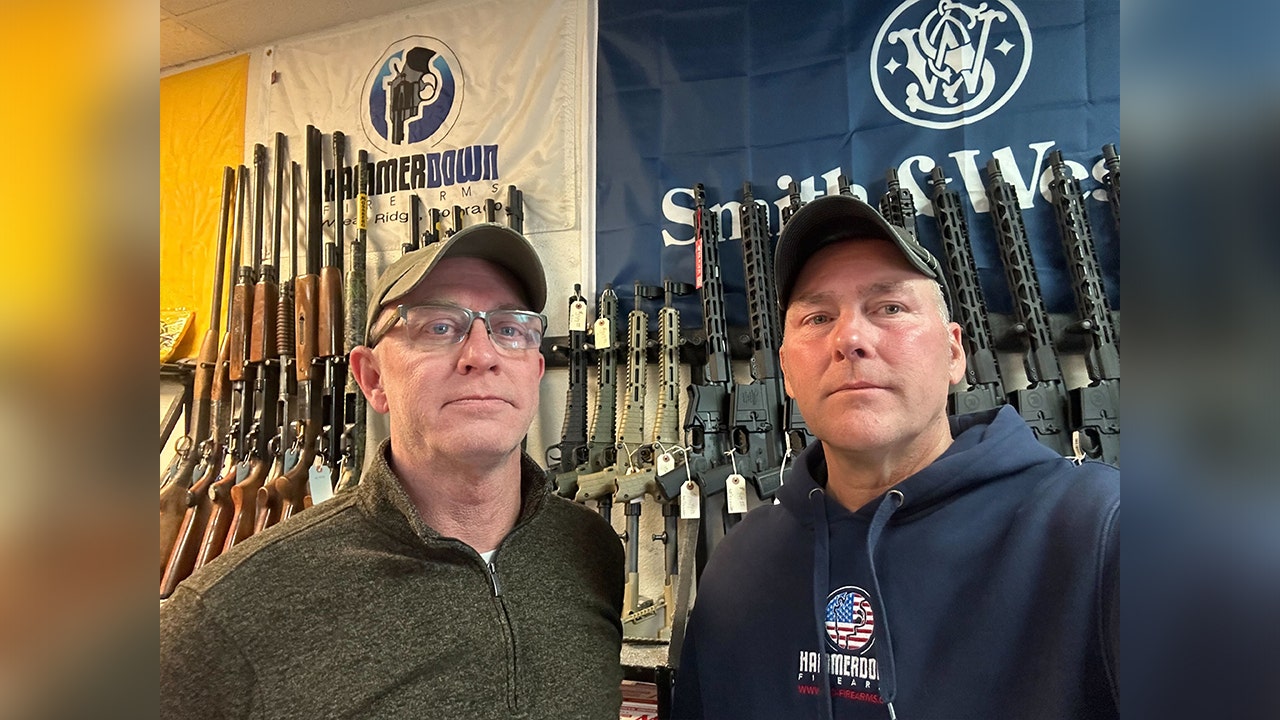
Hammer Down Firearms owners Mike Rickert, left, and Chris Jandro, right, in Wheat Ridge, Colorado characterized Proposition KK as the latest attempt “to kill small gun stores.” (Chris Jandro)
The tax could also hurt small business owners, critics said.
Chris Jandro and Mike Rickert, who have owned Hammer Down Firearms in the far-out Denver suburb of Wheat Ridge since 2012, said they wish that politicians would take a different approach to combating crime. Their store, they said, has seen 34 attempted burglaries since they opened – one successful burglary in 2017 resulted in $200,000 in losses.
“Nobody seems to care about that, but we’re going to pass laws to affect law-abiding citizens,” Jandro said last week. “Isn’t it fascinating? You have to be taxed for a constitutional right!”
Guns are already taxed at 10 to 11% on a federal level. Rickert and Jandro said that, in addition to the federal tax, they must charge an 8% sales tax in the city of Wheat Ridge.
“This bill was intended to kill small gun stores – it creates an effective tax rate of about 25%,” Rickert said. “That’s a poll tax, a sin tax – you can’t exercise your constitutional rights as a gun owner.”
The tax will apply to all sales by licensed firearms dealers, manufacturers and ammunition vendors operating within Colorado – but Jandro and Rickert said that the tax will disproportionately impact businesses like theirs.
“[Big sporting goods chains] have a team of lawyers. It’s easier to put us out of business, because we don’t have the deep pockets that big box stores do,” Jandro said.
Expected to generate $39 million annually, the funds will be directed toward mental health and public safety initiatives throughout the state – particularly toward services for victims of domestic violence, according to the bill.
Majority leader and state Rep. Monica Duran – a Democrat, major advocate of the bill, and Wheat Ridge resident – said that Coloradans had “made the right choice to step up and help fill funding gaps in crime victim services” by voting for Prop KK.
SEMI-AUTOMATIC GUN BAN NIXED IN COLORADO’S DEMOCRATIC-CONTROLLED STATEHOUSE AFTER HISTORIC PROGRESS
Rep. Monica Duran (D), left, talks with Rep. Marc Snyder (D) at house chambers during a special session of the Colorado legislature at the Colorado Capitol in Denver, Colorado, on Friday, November 17, 2023. (Photo by Hyoung Chang/The Denver Post)
“Without the support from crime victim services as a young single mother trapped in an abusive relationship, there is no way I’d be here today celebrating the passage of Prop KK,” Duran wrote in a statement. “From navigating the challenging judicial system to helping secure child care, crime victim services play a major role in uplifting survivors by providing them the resources they need to start anew. Thank you, from the bottom of my heart, for your support of Prop KK.”
“If you were a domestic violence victim, you think you would want some protection,” Jandro said. “We get a lot of women – because there’s a restraining order, because of their ex, because they want to be protected. Now these women can’t protect themselves from domestic violence, because [Colorado State Representative] Monica Duran thinks they’re safer without a gun.”
VanderWerf called the suite of gun control laws “insensitive to public safety,” saying that additional fines and hoops to jump through will inordinately affect “people that don’t have a lot of resources and feel like they need a firearm to provide for their own personal protection,” especially victims of domestic abuse.
COLORADO HOUSE PASSES SEMIAUTOMATIC FIREARM BAN THAT FACES UPHILL BATTLE IN STATE SENATE
A photo of various handguns on display. (iStock)
“This applies to women who may need to overpower someone more powerful than them,” he said. “A woman who might be a single parent, trying to raise two kids – do they have time to take all these courses? To do all this kind of work? To pay all this money in order to carry a firearm? No, it’s difficult to them.
“It’s like saying if someone robs a bank, the state government will produce an excise tax that will force the other account owners in the bank to pay for the losses. The real way to solve these problems is to deal with mental health correctly, not to treat it as an artifact of something about guns.”
Duran could not be reached for comment at press time.
Proposition KK is the latest in a suite of anti-gun legislation that has passed through the state. Last year, a three-day waiting period was imposed on all gun purchases in the state.
Another Colorado Senate bill passed this year, 24-066, requires credit card companies to give firearm purchases a specific merchant category code to make those purchases easier to track and tip off law enforcement when an alarming number of gun purchases are made.
Gun sellers are now required to get state permits on top of their federal permits through the ATF, and undergo training through the state under SB 24-1353.
As of this year, gun owners also must lock their firearms in a container when leaving them inside their locked car, under SB 24-1348; another bill requires concealed carry permit holders to undergo an eight-hour training course, rather than a three-hour course, and refresh that training every five years.
Read the full article from Here


HONOLULU (HawaiiNewsNow) – A woman has died after a crash that shut down the H-1 Freeway westbound in Honolulu Saturday.
According to the Honolulu Police Department, officers responded to a single-vehicle crash just before 6 p.m. near the Aala Street overpass.
Sources said a woman in her late 20s was pronounced dead at the scene.
First responders remain on scene, and the investigation is ongoing.
The city said via HNL Alert that all westbound lanes of the freeway near the Aala Street overpass are closed and access is restricted to emergency vehicles only.
Officials said those on the H-1 West are being diverted off the freeway at the North School Street cutoff.
Drivers are asked to avoid the area.
Copyright 2026 Hawaii News Now. All rights reserved.

IDAHO FALLS — After nearly two days of traveling, McKenna Christensen walked through the Chișinău International Airport in Moldova ready to change her life forever.
About six months before, Christensen, who was born in Moldova and adopted by an Idaho Falls couple, discovered shocking information about her adoption. She was never supposed to be adopted.
“There were a lot of illegal things going on (in Moldova) at the time with children. Children were very much a source of money,” Christensen told EastIdahoNews.com in December. “Pediatricians would tell parents, ‘Sorry, your child died, it was very sick.’ And then they would not release a body. This was a very common thing that happened over in the ’90s.”
For Christensen, she learned that her mother had been diagnosed with cancer while she was pregnant with her. She was very sick at the time of her birth, so the family was told that Christensen would be placed in a care facility while her mother regained her health.
But Christensen, who was originally named Marcela Ibrian, never saw her family again. Instead, she was apparently trafficked by the hospital, ending up at an orphanage and then adopted.
“I was targeted before I was even born. My mom checked into the hospital about a month before I was born, and the social services lady told her that she could leave me at the maternity ward to get some resources and to have some help while they navigated this diagnosis for her,” says Christensen. “At that moment, they actually put me into the system and said, ‘This baby is going to be available in February.’”
After discovering this life-changing information through her biological sister, whom she miraculously found through a Facebook group dedicated to reuniting separated Romanian families, Christensen traveled 5,750 miles across the world to find the people who had been looking for her for over 30 years.
“I was standing in the airport looking for a sign and my two sisters, literally out of nowhere, just clamored me,” says Christensen. “We stood there, and we were all, obviously, bawling. But then they walked me out, and there were probably like seven or eight other people waiting for me in the lobby. (They) had had balloons and flowers — all the guys had bouquets of flowers for me — and all of them were bawling … it was a lot, but it was so good.”
Christensen says it was overwhelming in the best way to finally meet people who shared her DNA, even though they had met many times on video calls.
“It’s different when you meet in person, it’s so different,” says Christensen.
During her stay, Christensen said she was taken care of by her biological family as if they’d known her forever, going to family dinners, getting ready with her sisters, dancing with the neighbors, and even watching home videos of her biological parents, who have passed away.
“It’s just like, (they) want to do everything for you. There is this added level because they’ve wanted to do all of these things for me for 30-plus years,” Christensen says.
Christensen’s family all live on the same street in the same village, making it a very tight-knit community. When she first arrived, Christensen says she was getting ready for dinner when her sisters began giving her gifts and helping her with her hair and dress, something she was not accustomed to.
“I had picked out a dress, and I showered and got out, and my one sister hands me a completely different dress that she had bought me,” says Christensen. “Then one sister proceeds to blow dry my hair, and the other one is putting slippers on my feet, and the other is trying to feed me a sandwich. It was so sweet, they just wanted to do all the things for me.”
The feeling of being pampered and fawned over was staggering for Christensen, though she knew much of it stemmed from her biological family not knowing what happened to her for so long and wanting to make up for lost time.
“I feel like you could really tangibly tell — or like feel in the air, and grab it — how badly they wanted this, which I was so happy to let them do all of that,” says Christensen. “I feel like a lot of this trip was so much for them, like more so for them than me, honestly, in some way. I’m just so glad that they got to have that.”
During the trip, Christensen says she noticed many similarities and shared traits between herself and her siblings, traits she never knew might be hereditary.
“For the Easter feast, I went over to my sister’s house just to kind of get away from people, and she was kind of setting up her feast. I remember she hopped on the counter to grab a dish that was on top of her fridge, and I remember thinking, ‘Oh my gosh, I do that!’” says Christensen. “We’re both really short, and we both get on the counter; it was little things like that. I was like, “Oh, I’m like these people.”
Throughout the trip, Christensen used AI headphones that translated Romanian, the main language in Moldova, into English so she could easily have conversations with locals.
“I had learned Romanian going into the trip, but they speak Russian Romanian, and there’s a Romani language that they speak as well,” Christensen says. “Amongst each other, they speak Romani, but if they’re speaking to a friend about something, they speak Russian. They would speak Romanian if they were talking directly to me, which I knew enough to get by.”
Through the technology and her own knowledge of the languages, Christensen was able to have conversations with people who knew her parents and were around when they lost her as a baby.
“People would just come up to me and cry when they saw me, because I think, some people told me on a translator, that I remind them of my mother, or I remind them of my father,” Christensen said. “They had heard so much about what happened to me, or people in the village and people that were related to me … people would just cry when they saw me, which was beautiful but also very overwhelming at the same time.”
After the first night, Christensen said she was overwhelmed with emotions of love and connection, needing to debrief and get lots of sleep before the rest of her incredible journey.
“I went back to the bedroom, called my husband, and bawled. I was just like, I don’t know, there is so much love with these people, and I have no idea how to give it back,” says Christensen. “I had never been taught how to receive so much love, and I was never told how to give it back. And that was both frustrating, but also I was just so grateful to them.”
Because she was in Moldova during Orthodox Easter, or Paștele Blajinilor (Easter of the Dead), as they call it there, Christensen got to experience her heritage and culture in ways she could’ve never imagined.
In what is often called the “most Moldovan tradition,” community members will gather at the cemeteries on the holiday to share large meals, clean graves, and exchange presents in honor of their deceased loved ones.
“Everyone in the village takes all these gifts, and you go to the cemetery with food and all these gifts, and you put them on the grave of your loved one. Then the father comes around, and he blesses all the graves like he did when they passed,” says Christensen. “You exchange gifts with people, but you do it in memory of the person that passed. So, people gave me T-shirts, cups, candy or dresses, and they’d be like, ‘This is in the loving memory of your mother.’ It’s so cool. It’s almost like the gifts are coming from your deceased loved one.”
At the cemetery one day, Christensen says she felt an overwhelming sense of calm as she studied her parents’ grave and thought about her ancestors.
“I recall this one moment that was really interesting. It may have only lasted a minute or so, but I stood there in front of (my parents’) graves, and I looked at my dad, and I feel like we look very similar. We have the same forehead, we have the same eyes. It’s like I was kind of noticing how we look alike. And then I panned over and looked at my mother, and I had this feeling like I knew who she was — not like from pictures, but almost like I had known her in a different time in my life, and I remembered it.”
Later in the trip, Christensen says her family showed her a video of her parents, which she says was fascinating to watch, as she had no memory of them.
“I look up at the screen, and they’re watching this video of my mom and dad, and everyone in the family hadn’t seen this video in years,” Christensen said. “It was just one of the big moments that was like, ‘Oh, we’re together as a family.”
Leaving Moldova was difficult, says Christensen, as she realized throughout her stay how different her life could’ve been if she had not been trafficked after birth.
“We all experienced our parents dying, and our outcomes were drastically different. My parents died, and I came to America and got an education, and I have a family,” says Christensen. “I never had to not know where my next meal was coming from. For them, their parents died, and their whole life fell apart for a while, and they really had to rebuild it.”
Though she says she deals with guilt over the differences in their situations, Christensen says she is focusing on returning to Moldova in the future, bringing her husband and children to meet her biological family.
“For a couple of days after I got home, I felt really guilty, almost, that I was able to have a good life, and they had to work so hard to have the life they have,” says Christensen. “I think I saw firsthand how hard their lives were, and I will never have a life that hard. And while I’m so grateful, I almost don’t know what to do with that information.”
As for now, Christensen says she feels a pull towards giving part of her life to helping trafficked adoptees connect with their families.
“I decided that the thing I want to do with the information that I have is dedicate a piece of my life to advocating for adoptees,” Christensen says. “These adoptees — whether their experience was good or bad, whether they’ve found their family or they haven’t — I always want to make sure that I’m a person who holds space for them in one way or another so they feel heard and understood. I don’t know what that will look like yet.”
The Key Takeaways for this article were generated with the assistance of large language models and reviewed by our editorial team. The article, itself, is solely human-written.
The Montana Lottery offers multiple draw games for those aiming to win big.
Here’s a look at July 4, 2026, results for each game:
Winning Powerball numbers from July 4 drawing
17-38-46-50-69, Powerball: 20, Power Play: 2
Check Powerball payouts and previous drawings here.
Winning Lotto America numbers from July 4 drawing
09-17-22-35-37, Star Ball: 05, ASB: 02
Check Lotto America payouts and previous drawings here.
Winning Big Sky Bonus numbers from July 4 drawing
04-13-19-26, Bonus: 07
Check Big Sky Bonus payouts and previous drawings here.
Winning Montana Cash numbers from July 4 drawing
09-13-17-27-33
Check Montana Cash payouts and previous drawings here.
Feeling lucky? Explore the latest lottery news & results
When are the Montana Lottery drawings held?
- Powerball: 8:59 p.m. MT on Monday, Wednesday, and Saturday.
- Mega Millions: 9 p.m. MT on Tuesday and Friday.
- Lucky For Life: 8:38 p.m. MT daily.
- Lotto America: 9 p.m. MT on Monday, Wednesday and Saturday.
- Big Sky Bonus: 7:30 p.m. MT daily.
- Powerball Double Play: 8:59 p.m. MT on Monday, Wednesday, and Saturday.
- Montana Cash: 8 p.m. MT on Wednesday and Saturday.
- Millionaire for Life: 9:15 p.m. MT daily.
Missed a draw? Peek at the past week’s winning numbers.
This results page was generated automatically using information from TinBu and a template written and reviewed by a Great Falls Tribune editor. You can send feedback using this form.
-
Connecticut5 minutes ago
Mary Ball Tomolonius Obituary
-

 Delaware12 minutes ago
Woman shot in parking lot of pizza shop in Delaware
-

 Florida15 minutes ago
1 dead, 3 injured after lightning strikes family off Florida beach
-
Georgia20 minutes ago
Georgia Lottery Powerball, Cash 3 results for July 4, 2026
-

 Hawaii27 minutes ago
Fatal crash closes H-1 West near Aala St. overpass
-

 Idaho30 minutes ago
Idaho woman reunites with biological family in Moldova after being kidnapped at birth
-

 Illinois42 minutes ago
Georgia man saved rare 1998 Lamborghini Diablo SV from Illinois just in time before it was destroyed
-

 Indiana45 minutes ago
Indy Fourth Fest delayed due to severe weather


