Lifestyle
L.A. isn't a walking city? The man behind Great Los Angeles Walk would like a word


The morning I meet Michael Schneider at a quaint coffee shop in Glendale, it quickly becomes clear that he walked here. His sneakers are the first clue — worn, white Nike trainers smudged with dirt. It’s uncharacteristically warm out this morning and his sweat-speckled forehead offers the second clue. His lean, exercised frame cinches my suspicion.
L.A. really is a walking city.
Explore our ground-level guide to the people and places keeping our sidewalks alive.
“I’ve probably walked more than 10,000 steps already today,” he tells me proudly, checking the health data on his phone to be sure — and it’s only 10:30 a.m.
In a city built for cars, Schneider is committed to exploring the city on foot, often heading out from his Adams Hill home at 11 p.m., in the dark, to get his steps in after the day’s work is done. In fact, over the last two decades, Schneider, 51, has traversed the length of Los Angeles on foot 18 times, covering nearly 300 miles in all during those journeys. But he didn’t do it alone.
Schneider is the founder of the Great Los Angeles Walk, an annual citywide event he started in 2006 to mark his 10th anniversary of moving to the city from Chicago. What began as a DIY, mobile celebration of L.A. — with just his wife, a handful of friends and several dozen readers of his blog, Franklin Avenue — has morphed into a local tradition, drawing up to 500 participants every November on the Saturday before Thanksgiving. Each walk spans the length of an iconic L.A. boulevard, trekking about 14 to 16 miles and stopping along the way to explore its sun-scorched sidewalks and faded public murals, its high-end furniture boutiques, cheap motels and historic churches, its food carts piled high with fresh fruit and its buzzing freeway overpasses — from below.
The very first Great Walk, inspired by journalist Kevin Roderick’s 2005 book, “Wilshire Boulevard: Grand Concourse of Los Angeles,” had participants hoofing the entire 15-plus miles of Wilshire, from downtown L.A. to the ocean. The only marketing Schneider did for the event was a simple blog post announcing the trek. About 40 people attended.
“It was almost a lark,” says Schneider, the television editor at trade publication Variety. “I had no idea how many people would show up.”
The second walk, which drew 100 people, took place on Pico Boulevard, inspired by Times food critic Jonathan Gold, who famously ate his way down the street in his early 20s. Gold emailed Schneider food-stop recommendations at the time. The event has since tackled Santa Monica Boulevard, Beverly Boulevard, Melrose Avenue, Sunset Boulevard and Hollywood Boulevard, among many others.
On top of being a terrific pre-holiday workout, the Great Walk debunks the ever-persistent beliefs that L.A. is not a walking city and that its physical sprawl impedes the ability to build community. Scores of individuals have met during the Great Walk, including Westwood residents Cat and Steve Whalen, who ended up getting married in 2023. They still do the walk every year.
“I remember bonding over the architecture of this old Public Storage facility,” Cat Whalen said of meeting her husband in 2016. “It’s an event that combines our love of walking and urban landscapes and architecture — and, of course, there’s the social component.”
Over the years, participants have ranged from stroller-bound babies to residents in their late 80s. Attendees arrive alone or with a community group. Since 2017, long-distance swimmer Diana Nyad has come with members of her EverWalk nonprofit, which encourages walking for health and human connection. Walkers have traveled from as far as Amsterdam and Japan to join the festivities; one man journeys from Santa Fe, N.M., every year to participate — barefoot. He’s become part of the colorful fabric of the event.
“I always run into him about midway through the walk,” Schneider says. “He’s got his camera and he’s barefoot. That’s just what he does.”
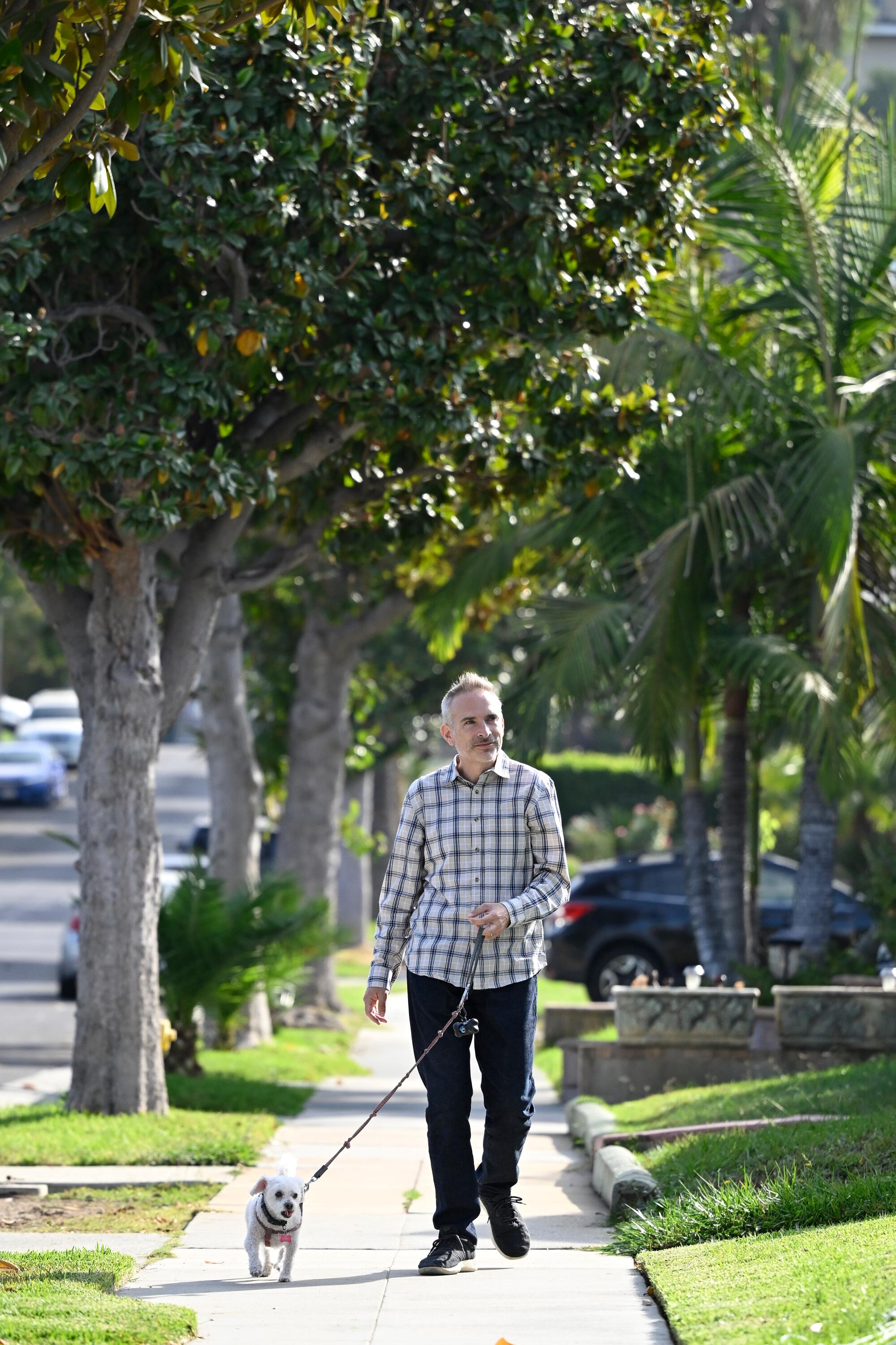
Michael Schneider with his dog, Jacks. Schneider founded the Great Los Angeles Walk in 2006.
(Robert Hanashiro/For The Times)
The Great Walk has been covered by local blogs, television stations and newspapers, including The Times. But less has been written about Schneider himself, who has amassed nearly 20 years’ worth of looky-loo knowledge while strolling through the peaks and valleys of the city.
Sitting at the coffee shop, Schneider looks every bit the suburban dad. He wears a trim salt-and-pepper goatee and a zip-up hoodie, and takes every opportunity to boast about his two sons, 19 and 15, who have joined the walk nearly every year of their lives. His eldest first took part at age 1½ and his youngest at 3 months old.
But Schneider’s normcore exterior belies an undercurrent of intensity: There’s a particular, obsessive mindset required to conceive of and execute such an ambitious public expedition every year over two decades. (The Great Walk even continued during the pandemic.) Not to mention chronicling those journeys in detailed blog posts, which are meticulously archived online. It requires a passion for cities, urban history and, perhaps, cartography; an affinity for architecture and urban design; a love of community; and a knack for numbers. During our interview, Schneider repeatedly referred to stats from his Noom weight-loss app, his cornflower blue eyes glimmering as he spoke of caloric intake versus exercise expenditure in steps and miles.
In sum, he’s a collector. Of miles and health stats, of vinyl records, of books about L.A. — and of people. He first developed the habit as an “Air Force brat” kid growing up, moving with his family between the Philippines, Oklahoma and Hawaii, when he began obsessively accumulating information about the television business.
“I was that kid, at 7, who knew who Ted Turner was,” Schneider says, chuckling. “I collected TV Guides from whatever city we’d travel through on vacation.”
After college at Northwestern and a year working between Chicago and Washington, D.C., Schneider moved to L.A. in 1996 with the TV trade publication Electronic Media. In ’99, he landed a job as a reporter at Variety and met his wife, Maria. He wasn’t much of an exerciser, but she liked to walk. Their early dates were spent exploring the city on foot, including taking Los Angeles Conservancy walking tours downtown and hiking in Griffith Park. Schneider fell in love with L.A. history and found that walking its concrete stretches helped him feel more rooted in the city.
“When I first came to L.A., I was like: Where is the core?” he says. “I didn’t understand why people didn’t know where to congregate. Now I get it. It’s all these different cores.”
Schneider also has collected handfuls of odd, serendipitous moments from the Great Walk. The event has passed weddings in progress, film crews shooting, even buildings on fire. Once, in 2009, the group streamed past the Nate Holden Performing Arts Center on Washington Boulevard and Magic Johnson appeared in the window to cheer them on. Two years earlier, on Pico Boulevard, a crane holding a billboard toppled over and chaos ensued.
“Traffic stopped, police were everywhere, no one could get through,” Schneider recalls. “But here we were, just walking on by.”
Schneider doesn’t make any money off of the Great Walk; it’s free to participants and he doesn’t pay to advertise the event. In recent years, there have been sponsors, including The Times, who might give him free ads, say, or pass out water in exchange for a mention on the blog.
“But there’s no business model,” Schneider says. “We’re not an official organization. This is just a grassroots group of people getting together to walk.”
Nineteen years of crisscrossing L.A. on foot has given Schneider a rare, bird’s-eye-view of the city, from a boots-on-the-ground perspective. And he’s had to alter the walk as the city around it has morphed.
“In recent years, obviously, there’s been a lot more homelessness on the streets, along with more trash,” he says. “So I’ve been mindful of trying to choose streets where it’s less of an issue.”
The city’s construction boom also has been particularly noticeable, he says.
“Just the amount of change that we’ve seen in recent years in development — that’s a positive. More housing, more buildings. But it’s also sad when you walk by and that historic building, like the Ambassador [Hotel], is no longer there — that’s a negative,” he says.
Schneider kicks off each Great Walk at a landmark, such as Walt Disney Concert Hall, the Shrine Auditorium or the Exposition Park Rose Garden, where there’s typically a guest speaker giving a pep talk. Roderick and Nyad have taken the megaphone, as have performer-urban explorer Charles Phoenix and journalist-historic preservationist Chris Nichols. And there’s always an “afterparty” at a venue near the finish line.

2023 photo of Michael Schneider with long-distance swimmer Diana Nyad.
(Michael Schneider)
This year’s walk will pay homage to Schneider’s family. He has one son at UCLA and a nephew at USC. So the walk will start downtown at the Los Angeles Memorial Coliseum in Exposition Park near USC’s campus and end on UCLA’s campus at the Bruin Statue. Between those points, the 14.2-mile trek will traverse parts of Vermont Avenue, Washington Boulevard, Culver Boulevard, Overland Avenue, Pico Boulevard and Westwood Boulevard.
“It just so happens, in recent years, that Saturday before Thanksgiving is the day of the USC-UCLA game,” Schneider says. “I was like: OK, this is too good. We have to do it.”
Where will the Great Walk take place next year, for its milestone 20th anniversary?
“Back to Wilshire,” Schneider says without pause. “It’s gonna have to be the OG.”
While the Great L.A. Walk may be associated with exercise, Schnieder repeatedly reminds participants that the goal is to go slow.
“It’s about taking your time,” he says. “Go into a store you’ve never seen, take the time to look at a sculpture, stop at that church. The key is to feel like you’ve learned more about Los Angeles. I still learn things. I still see things I’ve never seen before.”
When our conversation ends, Schneider does what he’s always done. He heads out the door and starts walking.


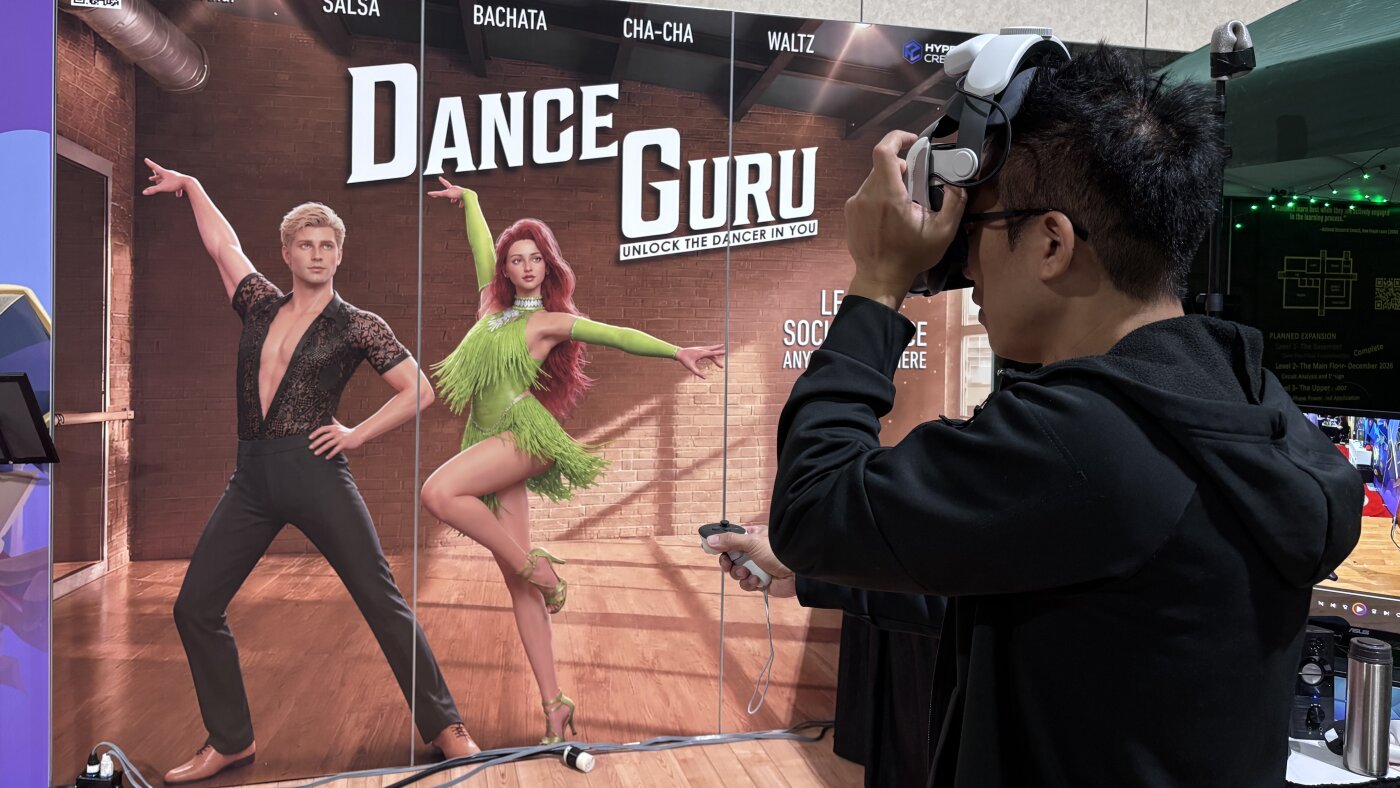
Entrepreneur David Huang tests out a VR headset while conducting demonstrations of the social dance lesson app Dance Guru at the Augmented World Expo in Long Beach, Calif., June 17, 2026.
Chloe Veltman/NPR
hide caption
toggle caption
Chloe Veltman/NPR
Wedding season is in full swing, bringing with it a familiar sense of dread for anyone who fears the dance floor.
But relief may finally be at hand with the help of a new app, Dance Guru, and a virtual reality (VR) headset.
The social dance instruction app transports users to a spacious, digital dance studio. Waiting inside is a computer-generated coach: a handsome, male avatar wearing a shirt open to his navel. He speaks with a slightly gravelly English accent.
“Watch me now,” he instructs at the start of a waltz lesson — which NPR tried out at the Augmented World Expo in Long Beach, Calif., an annual conference showcasing the latest developments in virtual and augmented reality.
The avatar then demonstrates a basic box step.
From there, the lesson becomes interactive. The coach tells the user to hold his hand while an electric pinging sound tracks the student’s foot placement.
“One, two, three, four, five, six,” the virtual teacher counts down.
When the user stumbles, he remains remarkably patient. “Do not worry, foundations take time. Let’s try that again. Work on grounding your steps more intentionally.”
Solving the beginner’s dilemma
Dance Guru creator David Huang said he came up with the idea for the app a couple of years ago out of frustration.
“I always wanted to learn to dance and I was always terrible at it,” Huang said. “And I always ended up stopping midway through the lessons.”
He soon realized that many beginners hit the exact same roadblocks.

“Private lessons are too expensive, and you feel like you’re always forgetting the dance steps,” Huang said. “You cannot find a partner to dance with. So I figured maybe I can create something like this.”
The Dance Guru platform currently offers tutorials in salsa, bachata, waltz, and cha-cha, in both lead and follow modes. To make the digital instruction feel authentic, Huang used motion-capture technology to record the movements of real-life dance teachers — with their permission.
Building on the legacy of online tutorials and video games
Dance Guru belongs to a small but growing wave of apps using VR to demystify social dance. At a nearby booth, conference attendee Victor Chen is testing out a competing app called Trip the Light. It currently offers salsa lessons, as well as freestyle options, where a user can dance with a partner without having to learn specific steps.

Trip the Light’s booth at the Augmented World Expo included posters of the app’s virtual instructors. Real-life performers, who gave Trip the Light permission to motion capture their movements, were used as a basis for these avatars.
Chloe Veltman/NPR
hide caption
toggle caption
Chloe Veltman/NPR
“A lot of times when you’re trying to learn a choreography, it’s watching a YouTube video and you have to pause it, rewind, and play it,” Chen said. “If you were to have a virtual avatar dancing in front of you and correcting for any parts that you missed, it might be a lot easier.”
Interactive video games like Dance Dance Revolution and Just Dance, and YouTube tutorials have been helping people improve their skills in private for years. But those games are mostly aimed at solo players. Unlike the new generation of immersive VR apps, they cannot simulate the mechanics or confidence required for partner dancing on a live dance floor.
The reality check
But this kind of app won’t work for every dancer.
“Everyone learns a little bit differently. And so unless you have a game that has lots of different ways of teaching, you’re going to have things that work for some people and don’t work for others,” said Ariana Katana, a trained contemporary dancer and dance content creator who’s active on YouTube, Twitch and other platforms. “Also, it’s hard to dance with a headset on.”
And then there’s the issue of not being able to physically feel a virtual partner’s hand or shoulder while dancing with them. Patrick Ascolese, the creator of Trip the Light, said the experience could become more tactile in the future. “Haptic suits and wearables will be coming, but I think we’re a little away from that,” he said.
Ascolese said even with their limitations, immersive tools like Trip the Light have immense potential as judgment-free training grounds — giving reluctant dancers the baseline confidence they need to eventually step onto the dance floor with real partners in the real world, including at weddings.
“Just like anything else, practice makes perfect,” said Ascolese. “So the more time you spend in VR with a virtual partner, it works towards helping you get over that social hurdle. We are teaching you the moves that you have to do in order to go out and have fun.”
Jennifer Vanasco edited the broadcast and digital versions of this story. Chloee Weiner mixed the audio.


For half a century, Deidre Hall has taken on every kind of disaster in the drama-packed town of Salem, Ill., as a star of “Days of Our Lives.”
There was the time — actually, it happened twice — when her character, Dr. Marlena Evans, was famously possessed by the devil and even levitated.

In Sunday Funday, L.A. people give us a play-by-play of their ideal Sunday around town. Find ideas and inspiration on where to go, what to eat and how to enjoy life on the weekends.
Or the time a serial killer, who was actually Marlena under hypnosis, seemed to kill several beloved characters. The long-running show’s storylines have become legendary, and in March, while promoting “Hail Mary,” actor Ryan Gosling even gave Hall a shout-out, admitting he was a fan, praising the hard work of soap opera actors and calling her an “OG acting inspiration.”
But Hall’s real life in Santa Monica is much quieter than her character’s, and she likes it that way.
“When I bought my house in Santa Monica, I didn’t realize how great it would be to live near Montana Avenue,” says Hall, 78, about the popular shopping spot. Every day, she walks to the main street with her golden retriever, Riley, and enjoys Pilates, art and good food along the way. “The owners of the Farms Market even keep dog biscuits, so guess where the dog wants to go every time we walk — the Farms, of course,” she says, laughing.
When she isn’t filming the daily soap opera, which airs on Peacock, Hall enjoys raising monarch butterflies, exploring the shops and restaurants on Montana, and hosting movie nights at home with her two sons.
Here’s what a perfect day in L.A. looks like for her.
This interview has been lightly edited and condensed for length and clarity.

7 a.m.: Breakfast and dog walk
I usually kick off my day with a protein shake, feed our golden retriever and take her out for a walk. She’s a phenomenal girl. When we adopted her, her name was Riley, but I did think about naming her after Mrs. Hughes from “Downton Abbey.”

10 a.m.: Church and garden time
After I walk the dog and go to church, I like to spend some time in my yard. I’m not a natural gardener, but I really enjoy it. I started raising monarch butterflies because my identical twin sister, who played my twin on the show, planted a butterfly garden. Monarchs are amazing because they are transitional. Every year, they travel from Mexico to southern New England, but it’s getting harder for them. Their numbers have dropped by about 80%. To help, I plant milkweed, which is what they need to survive. I buy my milkweed from the Staghorn Garden on Wilshire Boulevard in Santa Monica. Julie, who owns the nursery, is delightful and has a wide variety of milkweed. The monarchs always seem to find my garden. Julie was raising some caterpillars too, and she cared a lot about them. We talked about how important it is to help the butterflies. That’s why I do this. Sometimes I get milkweed with eggs already on it, and Julie knows her butterflies are going to a good home.

1 p.m.: Walk to Montana Avenue for some lunch
I live near Montana and love taking long walks, going to Pilates and trying out the great restaurants nearby, like R+D Kitchen and La La Land. I’m a big fan of the waffles at the Courtyard Kitchen. Just a few days ago, I had a chicken salad on raisin bread with an Arnold Palmer, and it was delicious. It is right on Montana and has a nice outdoor seating area. It’s one of my favorite spots. La La Land always has a long line in the morning, which is perfect if you want coffee. They serve coffee, doughnuts, croissants and avocado toast. There’s plenty of outdoor seating, and you can even bring your dog.

2 p.m.: Peek inside a clock shop
There’s a small clock shop on Montana Avenue that’s closed on Sundays, but if you walk by, you’ll see all kinds of clocks — standing, table and wall clocks. The owner is great at fixing them. Once, I bought a wall clock from MacKenzie-Childs, but it didn’t work. And I was really upset because it matched everything else on my countertop. I brought it to the owner and said, “I love this, but I can’t make it work.” He fixed it right away. His name is John, but I call him Geppetto. And we all know why. He really does have a magic touch.

2:30 p.m.: Visit a neighborhood art gallery
Ten Women Gallery is run by 10 artists, all of whom show their work there. I was drawn to some watercolors there, bought a few cards and spoke with one of the artists. She told me, “You seem to love watercolors,” and mentioned that the artist who painted them, Pamela Harnois, lives in Los Angeles and teaches nearby. I got Pamela’s name and found out she taught at the Brentwood Art School. I was so inspired by her gift that I started taking private lessons with her on Saturdays. That gallery is where I discovered my love for watercolor painting.

3 p.m.: Grab some ice cream at Rori’s
The other day, my longtime girlfriend wanted to get ice cream and told me, “We are walking to Rori’s Artisanal Creamery.” It’s a small shop on Montana near Lincoln. They make everything themselves, using local ingredients from grass-fed cows with no added hormones. The place is family-owned and probably has the healthiest ice cream you’ll find. They switch up their flavors often, but my favorite is the salted caramel.

6 p.m.: Family dinner and movie night at home
R+D Kitchen is always packed, so my sons, who are 31 and 33, do the cooking. They come over, and together we make salads and cook dinner. There’s a neighborhood grocery store called the Farms, off Montana, a small family-run place that has everything we need. Everyone knows each other there, and people bring their dogs. We try to have movie night every Sunday. Sometimes the day changes, but we always make sure to have one night a week where we cook a meal and sit down as a family. Keeping that tradition has become really important to us. My sons are great cooks, which is funny because they definitely didn’t get that from me. [Laughs]
9 p.m.: Take Riley for one last walk and visit neighbors
After dinner, I take my dog for a walk. It’s a great way to meet neighbors. We always go around the same block. We’ve met so many people, and since she’s a golden retriever, she loves meeting everyone.

10 p.m.: News, knitting and bedtime
I am a news junkie, so I usually watch whatever is on the news before I go to bed. I have a long-standing passion for knitting. Lately, though, the news would make me drop a stitch.
For Iris van Herpen, couture is a laboratory as much as a runway. Our chief fashion critic, Vanessa Friedman, takes us inside this Dutch designer’s latest Paris show — from sci-fi-inspired gowns to an audacious attempt at a dress made of charged plasma.
-

 Finance10 minutes ago
New changes to financial aid will be minor for UND students, bigger for loan borrowers in repayment
-

 Fitness13 minutes ago
The NHS has reignited the hybrid working debate – but WFH isn’t the health risk, this is
-

 Movie Reviews25 minutes ago
‘Only Beautiful Things to Look At’ Review: A Handsome but Muffled Portrait of State-Sanctioned Cruelty
-

 World33 minutes ago
Colombia Adds Massive Soundstage as Bogotá Audiovisual Market Attendance Soars and ‘Narcos’ Star-Led ‘Rookies’ Cleans Up in Project Prizes
-
News40 minutes ago
How a Beer Hall Keeps Up With a World Cup Crowd
-
Lifestyle1 hour ago
Shy on the dance floor? Virtual reality ‘partners’ aim to help you find your groove
-

 Technology1 hour ago
Are you filthy enough for a $700 portable shower?
-

 World1 hour ago
Former British MP and reality TV star Ann Widdecombe found dead; man arrested for murder

