Lifestyle
Veteran news editor expects Trump 'to go after the press in every conceivable way'


Then-President Donald Trump holds up The Wall Street Journal as he speaks at the White House on April 19, 2020.
Tasos Katopodis/Getty Images
hide caption
toggle caption
Tasos Katopodis/Getty Images
Heading into a second term, New Yorker editor David Remnick says Donald Trump’s anger “has been never so intense as it’s been against the press.” The president-elect has referred to the news media as the “Enemy of the American people,” has threatened retribution against outlets that have covered him negatively and has suggested that that NBC, CBS and ABC should have their licenses revoked.
Marty Baron, the former executive editor of the Washington Post, says he expects the incoming administration “to go after the press in every conceivable way … [using] every tool in the toolbox — and there are a lot of tools.”
“I think [Trump’s] salivating for the opportunity to prosecute and imprison journalists for leaks of national security information — or what they would call national security information,” Baron says. “I would expect that he would deny funding to public radio … and TV. And that he will seek to exercise control over the Voice of America and its parent company, the U.S. Agency for Global Media, as he did in his previous administration, trying to turn it into a propaganda outlet.”

Remnick sees parallels between Trump’s approach to the media and that of Russian President Vladimir Putin. Both men, he says, challenge traditional notions of the truth. “The Putin regime shows us when there is no truth, everything is possible,” Remnick says. “Lying has come from White Houses for decades and decades. But Donald Trump has changed the game.”
Baron adds that Trump’s target goes beyond the press: “The objective here is to suppress free expression by anyone. … So this is just the first step. And I think people should keep that in mind.”
Interview highlights
On the Washington Post‘s announcement in the weeks before the 2024 election that it would not be endorsing either presidential candidate
Baron: I don’t think there’s any great explanation for this decision 11 days before the election [other] than that [Post owner Jeff Bezos] was yielding to pressure from Donald Trump on his other interests, which are substantially larger than The Post, particularly Amazon, which has many contracts with the federal government, particularly in terms of cloud computing, and Blue Origin, a commercial space enterprise that is essentially wholly dependent upon the federal government for its contracts. …

If this had been a decision that was made three years ago, two years ago, a year ago, maybe even six months ago, I would say fine. It’s not that important to me whether news organizations like The Post make a presidential endorsement. Of course, people can make up their own minds. They don’t need The Post to help them. But I don’t think there’s any logical explanation for this decision other than “Don’t poke the bear.” And I think this was an effort to not poke the bear. And I think it was notably unsuccessful, because nobody can reasonably argue that trust in the Washington Post today is higher than it was prior to this decision. It is substantially lower. I’ve never seen a reputation for a company so severely damaged in such a short period of time. And I think it was a regrettable and deeply wrong decision on [Bezo’s] part.
On the pressure media outlets are facing
Remnick: If you look at the waning influence of what’s called the mainstream press, and if you look at statistics about trust in the press and the ecology of the press, the combination of economic pressures combined with Trump’s pressures has been of immense concern to all of us who were involved in this activity. … These pressures are immense. And Trump knows it. And he knows how it’s affected his political fortunes in the most positive way.

Baron: When [Trump] talks about his triumphs during his first term, he’s cited the undermining confidence in the mainstream press — he’s called it one of his greatest successes. … It’s not the only reason the confidence in the press has declined. There are a variety of reasons. … But the big factors have been market fragmentation and the fact that people can find any site that affirms their preexisting point of view and any conspiracy theory, no matter how crazy it is, they can find somebody who says that’s true.
On the media’s responsibility in losing the trust of the people
Baron: I don’t think that we’ve accurately and adequately reflected the concerns of a lot of Americans in this country. I’ve often been asked whether we had failures in our coverage of Donald Trump in 2015 and 2016. And I say that the greatest failure came well before that in that we did not anticipate that this country could produce a candidate like Donald Trump. We did not understand the level of grievance and anger toward the so-called elites, including and maybe especially the press — although if you look at the salaries of most journalists, they don’t qualify as elite. And so I think we didn’t really do a good enough job of getting out in the country and really understanding the concerns of ordinary Americans. …
I’m concerned that a portion of the journalistic community, if you can call it that, have engaged in what I would consider to be advocacy and activism of a sort. That’s not true of everybody by any means, not even true of the majority of the journalists. But there’s a segment out there that believes in that. And I think that that has hurt us. And we should aim to be an independent arbiter of the facts, try to put them in context in an effort to get at the truth over time. And we should be more focused on the kinds of questions we want to ask and trying to get answers to those questions than thinking that we have the answers to those questions before we embark on reporting. Otherwise, the so-called reporting is merely an exercise in confirmation bias.
On how the collapse of local news contributed to polarized media
Remnick: There are all kinds of news deserts all over the country that have been created by this new news ecology, so that small newspapers and medium-sized newspapers have either shriveled to the point of disappearance or they’ve closed their doors completely. Newsrooms across the river here in New Jersey, for example, that used to have a couple hundred people in them have a couple dozen, at best. They’re hanging on by their fingernails. If that had been replaced by websites with equally aggressive, or even better, news gatherers, of reporters and editors, that would be one thing, but they haven’t.
Baron: Many people in communities, they’ve never even seen a reporter. They’ve never met a reporter. Their impressions of what journalists are is formed by arguments that they see on cable news, partisan arguments, what they see on cable news. And that is really unfortunate, because that is not the way that most journalists carry themselves.
On the American public not being able to agree on facts
Baron: The sad reality today is that we as a society do not share a common set of facts. But it’s actually a lot worse than that. We cannot even agree on what a fact is on how to determine a fact, because all of the elements that we have used in the past to determine what a fact is have been devalued, dismissed, denigrated, denied. All of that things like education, expertise, actual experience, and above all, evidence. …
So the idea here is to obliterate the idea that there is some truth, independent truth that can be determined by independent arbiters of truth, whether it be not just journalists, but the courts as well, or anybody else, and that the only truth, at least in Trump’s mind, is the one that comes out of his own mouth.
On what traditional media can learn from social media influencers
Baron: We have to be better communicators. We have to recognize that the way that people are receiving information today is radically different from the way that we received information when we were growing up and the way we maybe prefer to receive information today. So we have a lot to learn from influencers, actually, in terms of how to do that. Our authority is not just being questioned today, but our authenticity is being questioned today. And these influencers are coming across as much more authentic and therefore people think they’re more authoritative.
Monique Nazareth and Thea Chaloner produced and edited this interview for broadcast. Bridget Bentz, Molly Seavy-Nesper and Meghan Sullivan adapted it for the web.

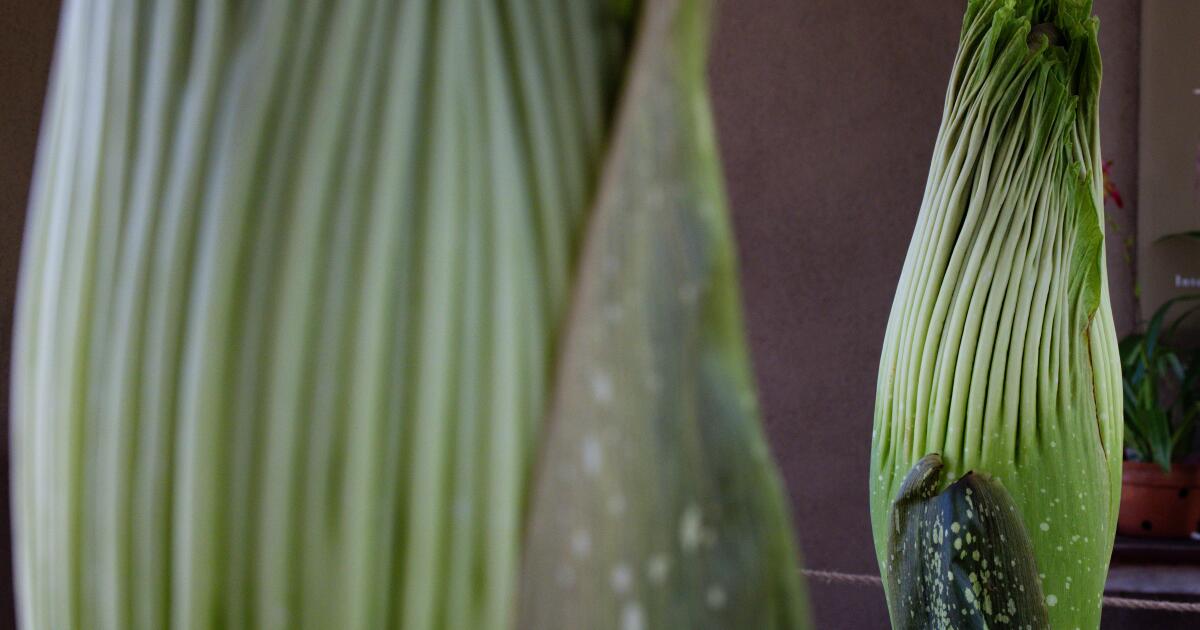
Get ready to catch a whiff of stink. Not one, but two rare corpse flowers are set to bloom at the Huntington in the coming days, with one of them making its first-ever public bloom.
If both plants unfurl on the same day, it would be just the second time a double bloom has ever occurred at the Huntington.
For those unfamiliar with these funky flora, be warned. Corpse flowers bloom for just 24 to 48 hours, and once opened, they reek of gym socks, rotten eggs and decaying flesh … or, well, a corpse.
Brandon Tam, associate curator of orchids for the Huntington, speaks to reporters in front of two corpse flowers as they prepare to bloom.
(Kayla Bartkowski / Los Angeles Times)
Couple that with their tropical native climate of Sumatra, Indonesia, and you’re in for a sweaty, stinky viewing experience.
The stench is important for pollination, said Brandon Tam, the Huntington’s associate curator of orchids. It attracts carrion beetles and flesh flies, which lay their eggs on rotting animal carcasses.
At the Huntington, pollinators aren’t the only thing it entices. Since the garden exhibited its first corpse flower in 1999, thousands of people flock to its conservatory every summer, just to smell these putrid plants.

-
Share via
It smells like rotting flesh, but thousands of people will be lining up to catch a whiff.
“The kids that first came in 1999 are now bringing their kids — their own kids — to experience this over 20 years later,” Tam said. “It’s amazing, this plant, the impact that it has had over many generations.”
Glendale resident Trinity Shi, 42, witnessed three blooms at the Huntington in 2022 and 2023 and compared the smell to rotten fish: pungent, but not unbearable. She was excited to feature such an unusual specimen on her Instagram plant blog, @cubehousejungle, and hopes to make it to this year’s bloom too.
“It feels really prehistoric to look at this plant, because it is so giant,” Shi said of the corpse flower, which can grow over 12 feet tall. “It’s become kind of like a mascot for the Huntington.”
Thanks to cultivation techniques, the Huntington coaxes the plants to bloom every two to three years, not four to six like they do in their natural habitat, where they’re endangered.
Still, the blooms are notoriously unpredictable, Tam said. He guessed one of the plants will bloom in the coming days.
This upcoming bloom spotlights a plant nicknamed Odora, who last opened in 2024, and Odorysseus, a rookie public bloomer. Visitors offered name suggestions for Odorysseus on the Huntington’s Instagram page, where contenders included Stinkerbell, Gagatha and Count Flatula, among others.
It’s not unusual for the Huntington to have multiple soon-to-be bloomers on display. But only once, in 2018, did two plants actually unfurl on the same day.

A detailed view of a corpse flower as it prepares to bloom.
(Kayla Bartkowski / Los Angeles Times)
For Odora and Odorysseus, siblings from a 2002 pollination, a double bloom is unlikely, Tam said. The plants are inclined to bloom out of sequence, “because they want to pollinate another plant that’s in the vicinity.” That can’t happen if they bloom simultaneously.
Though many refer to these plants as “flowers,” they are actually an “inflorescence,” a flowering structure containing hundreds of smaller blooms inside.
When it’s almost time for the plant to open, the spadix — a conic protrusion from inside the plant — emerges and accelerates in growth, climbing up to six inches per day. After a few days, its growth slows down.
“When it gets to about the one-inch range, we’ll know it’s about to bloom for us fairly soon,” Tam said.
When it does bloom, the spathe — leaflike structures encasing the plant — unfurl around 3 or 4 p.m., reaching maximum size in the early hours of the morning. The odor comes from the spadix, which heats up to about 98 degrees to strengthen the smell.

Brandon Tam, associate curator of orchids at the Huntington, walks past the corpse flowers as they prepare to bloom.
(Kayla Bartkowski / Los Angeles Times)
From there, visitors have until about 3 to 5 p.m. to smell the plant before it closes back up and collapses, losing its odor. Eventually, the plant returns as a leaf or a flower, photosynthesizing energy in preparation for its next bloom.
Today, the Huntington houses 43 corpse flowers, making it one of the largest corpse flower collections in North America. The Huntington cultivates them on-site and has distributed many to botanic gardens and zoos across the country.
“It’s important when it comes to conservation that we make plants accessible,” Tam said. “If we’re able to share these plants with other organizations and other hobbyists, we’re able to decrease the amount of plant theft that occurs in the wild, where a lot of conservation work is much needed.”
Eager sniffers can visit the Huntington from 10 a.m. to 5 p.m. Wednesday to Monday. Be sure to stay hydrated, cool and patient, as it’s humid inside the conservatory and lines can be long. For those who want to track the blooms’ progress from afar, catch the Huntington’s online livestream.
Library, art museum, botanical garden
The Huntington
Address: 1151 Oxford Road, San Marino
Admission: $13-34; children 3 and under, free; “Museums for All” (SNAP EBT) program, $5.
Info: huntington.org
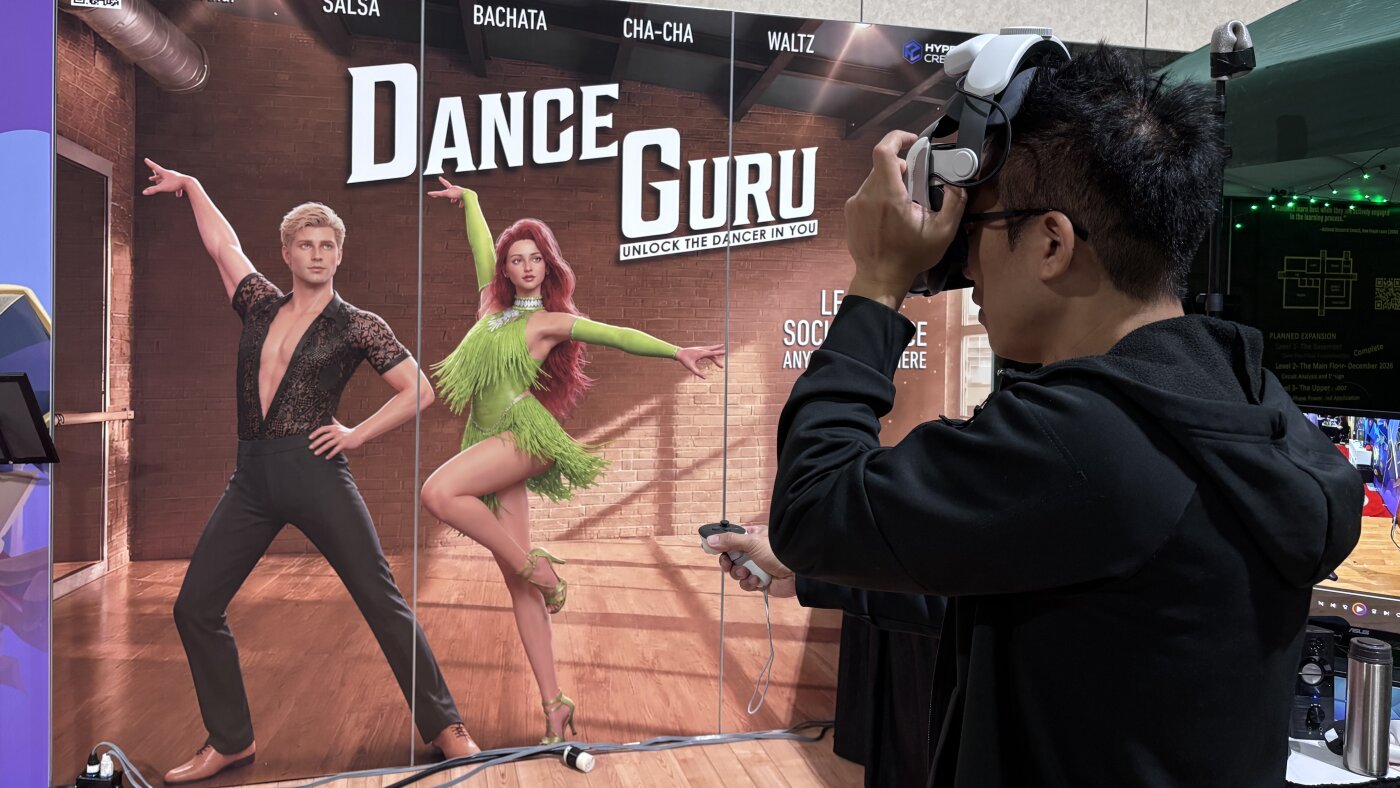
Entrepreneur David Huang tests out a VR headset while conducting demonstrations of the social dance lesson app Dance Guru at the Augmented World Expo in Long Beach, Calif., June 17, 2026.
Chloe Veltman/NPR
hide caption
toggle caption
Chloe Veltman/NPR
Wedding season is in full swing, bringing with it a familiar sense of dread for anyone who fears the dance floor.
But relief may finally be at hand with the help of a new app, Dance Guru, and a virtual reality (VR) headset.
The social dance instruction app transports users to a spacious, digital dance studio. Waiting inside is a computer-generated coach: a handsome, male avatar wearing a shirt open to his navel. He speaks with a slightly gravelly English accent.
“Watch me now,” he instructs at the start of a waltz lesson — which NPR tried out at the Augmented World Expo in Long Beach, Calif., an annual conference showcasing the latest developments in virtual and augmented reality.
The avatar then demonstrates a basic box step.

From there, the lesson becomes interactive. The coach tells the user to hold his hand while an electric pinging sound tracks the student’s foot placement.
“One, two, three, four, five, six,” the virtual teacher counts down.
When the user stumbles, he remains remarkably patient. “Do not worry, foundations take time. Let’s try that again. Work on grounding your steps more intentionally.”
Solving the beginner’s dilemma
Dance Guru creator David Huang said he came up with the idea for the app a couple of years ago out of frustration.
“I always wanted to learn to dance and I was always terrible at it,” Huang said. “And I always ended up stopping midway through the lessons.”
He soon realized that many beginners hit the exact same roadblocks.

“Private lessons are too expensive, and you feel like you’re always forgetting the dance steps,” Huang said. “You cannot find a partner to dance with. So I figured maybe I can create something like this.”
The Dance Guru platform currently offers tutorials in salsa, bachata, waltz, and cha-cha, in both lead and follow modes. To make the digital instruction feel authentic, Huang used motion-capture technology to record the movements of real-life dance teachers — with their permission.
Building on the legacy of online tutorials and video games
Dance Guru belongs to a small but growing wave of apps using VR to demystify social dance. At a nearby booth, conference attendee Victor Chen is testing out a competing app called Trip the Light. It currently offers salsa lessons, as well as freestyle options, where a user can dance with a partner without having to learn specific steps.

Trip the Light’s booth at the Augmented World Expo included posters of the app’s virtual instructors. Real-life performers, who gave Trip the Light permission to motion capture their movements, were used as a basis for these avatars.
Chloe Veltman/NPR
hide caption
toggle caption
Chloe Veltman/NPR
“A lot of times when you’re trying to learn a choreography, it’s watching a YouTube video and you have to pause it, rewind, and play it,” Chen said. “If you were to have a virtual avatar dancing in front of you and correcting for any parts that you missed, it might be a lot easier.”
Interactive video games like Dance Dance Revolution and Just Dance, and YouTube tutorials have been helping people improve their skills in private for years. But those games are mostly aimed at solo players. Unlike the new generation of immersive VR apps, they cannot simulate the mechanics or confidence required for partner dancing on a live dance floor.
The reality check
But this kind of app won’t work for every dancer.
“Everyone learns a little bit differently. And so unless you have a game that has lots of different ways of teaching, you’re going to have things that work for some people and don’t work for others,” said Ariana Katana, a trained contemporary dancer and dance content creator who’s active on YouTube, Twitch and other platforms. “Also, it’s hard to dance with a headset on.”
And then there’s the issue of not being able to physically feel a virtual partner’s hand or shoulder while dancing with them. Patrick Ascolese, the creator of Trip the Light, said the experience could become more tactile in the future. “Haptic suits and wearables will be coming, but I think we’re a little away from that,” he said.
Ascolese said even with their limitations, immersive tools like Trip the Light have immense potential as judgment-free training grounds — giving reluctant dancers the baseline confidence they need to eventually step onto the dance floor with real partners in the real world, including at weddings.
“Just like anything else, practice makes perfect,” said Ascolese. “So the more time you spend in VR with a virtual partner, it works towards helping you get over that social hurdle. We are teaching you the moves that you have to do in order to go out and have fun.”
Jennifer Vanasco edited the broadcast and digital versions of this story. Chloee Weiner mixed the audio.




For half a century, Deidre Hall has taken on every kind of disaster in the drama-packed town of Salem, Ill., as a star of “Days of Our Lives.”
There was the time — actually, it happened twice — when her character, Dr. Marlena Evans, was famously possessed by the devil and even levitated.
In Sunday Funday, L.A. people give us a play-by-play of their ideal Sunday around town. Find ideas and inspiration on where to go, what to eat and how to enjoy life on the weekends.
Or the time a serial killer, who was actually Marlena under hypnosis, seemed to kill several beloved characters. The long-running show’s storylines have become legendary, and in March, while promoting “Hail Mary,” actor Ryan Gosling even gave Hall a shout-out, admitting he was a fan, praising the hard work of soap opera actors and calling her an “OG acting inspiration.”
But Hall’s real life in Santa Monica is much quieter than her character’s, and she likes it that way.
“When I bought my house in Santa Monica, I didn’t realize how great it would be to live near Montana Avenue,” says Hall, 78, about the popular shopping spot. Every day, she walks to the main street with her golden retriever, Riley, and enjoys Pilates, art and good food along the way. “The owners of the Farms Market even keep dog biscuits, so guess where the dog wants to go every time we walk — the Farms, of course,” she says, laughing.
When she isn’t filming the daily soap opera, which airs on Peacock, Hall enjoys raising monarch butterflies, exploring the shops and restaurants on Montana, and hosting movie nights at home with her two sons.
Here’s what a perfect day in L.A. looks like for her.
This interview has been lightly edited and condensed for length and clarity.

7 a.m.: Breakfast and dog walk
I usually kick off my day with a protein shake, feed our golden retriever and take her out for a walk. She’s a phenomenal girl. When we adopted her, her name was Riley, but I did think about naming her after Mrs. Hughes from “Downton Abbey.”

10 a.m.: Church and garden time
After I walk the dog and go to church, I like to spend some time in my yard. I’m not a natural gardener, but I really enjoy it. I started raising monarch butterflies because my identical twin sister, who played my twin on the show, planted a butterfly garden. Monarchs are amazing because they are transitional. Every year, they travel from Mexico to southern New England, but it’s getting harder for them. Their numbers have dropped by about 80%. To help, I plant milkweed, which is what they need to survive. I buy my milkweed from the Staghorn Garden on Wilshire Boulevard in Santa Monica. Julie, who owns the nursery, is delightful and has a wide variety of milkweed. The monarchs always seem to find my garden. Julie was raising some caterpillars too, and she cared a lot about them. We talked about how important it is to help the butterflies. That’s why I do this. Sometimes I get milkweed with eggs already on it, and Julie knows her butterflies are going to a good home.

1 p.m.: Walk to Montana Avenue for some lunch
I live near Montana and love taking long walks, going to Pilates and trying out the great restaurants nearby, like R+D Kitchen and La La Land. I’m a big fan of the waffles at the Courtyard Kitchen. Just a few days ago, I had a chicken salad on raisin bread with an Arnold Palmer, and it was delicious. It is right on Montana and has a nice outdoor seating area. It’s one of my favorite spots. La La Land always has a long line in the morning, which is perfect if you want coffee. They serve coffee, doughnuts, croissants and avocado toast. There’s plenty of outdoor seating, and you can even bring your dog.

2 p.m.: Peek inside a clock shop
There’s a small clock shop on Montana Avenue that’s closed on Sundays, but if you walk by, you’ll see all kinds of clocks — standing, table and wall clocks. The owner is great at fixing them. Once, I bought a wall clock from MacKenzie-Childs, but it didn’t work. And I was really upset because it matched everything else on my countertop. I brought it to the owner and said, “I love this, but I can’t make it work.” He fixed it right away. His name is John, but I call him Geppetto. And we all know why. He really does have a magic touch.

2:30 p.m.: Visit a neighborhood art gallery
Ten Women Gallery is run by 10 artists, all of whom show their work there. I was drawn to some watercolors there, bought a few cards and spoke with one of the artists. She told me, “You seem to love watercolors,” and mentioned that the artist who painted them, Pamela Harnois, lives in Los Angeles and teaches nearby. I got Pamela’s name and found out she taught at the Brentwood Art School. I was so inspired by her gift that I started taking private lessons with her on Saturdays. That gallery is where I discovered my love for watercolor painting.

3 p.m.: Grab some ice cream at Rori’s
The other day, my longtime girlfriend wanted to get ice cream and told me, “We are walking to Rori’s Artisanal Creamery.” It’s a small shop on Montana near Lincoln. They make everything themselves, using local ingredients from grass-fed cows with no added hormones. The place is family-owned and probably has the healthiest ice cream you’ll find. They switch up their flavors often, but my favorite is the salted caramel.

6 p.m.: Family dinner and movie night at home
R+D Kitchen is always packed, so my sons, who are 31 and 33, do the cooking. They come over, and together we make salads and cook dinner. There’s a neighborhood grocery store called the Farms, off Montana, a small family-run place that has everything we need. Everyone knows each other there, and people bring their dogs. We try to have movie night every Sunday. Sometimes the day changes, but we always make sure to have one night a week where we cook a meal and sit down as a family. Keeping that tradition has become really important to us. My sons are great cooks, which is funny because they definitely didn’t get that from me. [Laughs]
9 p.m.: Take Riley for one last walk and visit neighbors
After dinner, I take my dog for a walk. It’s a great way to meet neighbors. We always go around the same block. We’ve met so many people, and since she’s a golden retriever, she loves meeting everyone.

10 p.m.: News, knitting and bedtime
I am a news junkie, so I usually watch whatever is on the news before I go to bed. I have a long-standing passion for knitting. Lately, though, the news would make me drop a stitch.
-

 Technology11 minutes ago
After years of teasing, the viral Nopia synth is ‘basically finished’
-

 World14 minutes ago
Beloved musicians among victims in deadly Bahamas plane crash; aviation authority grounds flights
-

 Politics19 minutes ago
Trump-aligned House holdouts accused of holding ‘life-saving’ veterans bill ‘hostage’ over SAVE America Act
-

 Health26 minutes ago
Simple sitting change linked to lower risk of cancer death, study finds
-

 Sports28 minutes ago
Golf star records lowest round in LPGA major history with astounding performance at Evian Championship
-

 Technology34 minutes ago
Meta Verified scam threatens Facebook deletion
-
 Business41 minutes ago
Meta discontinues Instagram feature on new AI image generation tool after Hollywood backlash
-
 Entertainment44 minutes ago
Huey Lewis details how he ‘can’t enjoy music’ anymore because he is ‘basically deaf’

