Sports
From zero stars to leading Big Ten in tackles: The rise of UCLA's Carson Schwesinger


Often it’s his awareness in the seconds before the snap that has turned Carson Schwesinger from zero-star prospect to hero of the UCLA defense.
Scanning the players across the line of scrimmage, he examines body positioning and mannerisms that can provide a tipoff.
Does the offensive tackle place both hands on his thighs? It’s probably going to be a pass.
Does the quarterback lick his hands? He’s probably going to throw the ball.
UCLA linebacker Carson Schwesinger tackles Penn State quarterback Beau Pribula while defensive back Bryan Addison runs forward on Oct. 5 at Beaver Stadium in University Park, Pa.
(Gregory Fisher / Icon Sportswire via Getty Images)
Does the running back stand a certain way? He’s probably going to take a handoff.
Down and distance enhance the likelihood of one play call over another. Schwesinger runs through the possibilities in his mind. Then he runs to where he thinks the play is going to develop.
“Once the play starts,” Schwesinger said, “you really only have one or two play options that are possible and then you react based off those.”
His instincts are usually right.
In the first five starts of his career, the redshirt junior linebacker has led the Bruins with double-digits tackles each game. Twelve against Louisiana State. Thirteen against Oregon. Fifteen against Penn State. Thirteen against Minnesota. Ten against Rutgers.
“He’s a heat-seeking missile,” fellow Bruins linebacker Kain Medrano said, “just going in there and causing havoc in any way he can.”
Along the way, the former walk-on has emerged as the Big Ten leader with 6.4 solo tackles per game as the Bruins (2-5 overall, 1-4 Big Ten) prepare to face Nebraska (5-3, 2-3) on Saturday at Memorial Stadium in Lincoln. He’s also the first UCLA player to log double figures in tackles in five consecutive games since current Dallas Cowboys veteran Eric Kendricks did so in 2014 on the way to winning the Butkus Award that goes to the nation’s top college linebacker.
His unlikely rise, combined with a perfectionist approach and wholesome demeanor, prompted one teammate to call him “Captain America.” Another went with “Sunshine,” a nod to the similarly blond-haired hero of “Remember the Titans.”
“He’s just one of those guys who does everything right, who does everything for the team,” said UCLA safety Bryan Addison, who came up with the “Captain America” nickname, “and then he comes out here on Saturdays and plays even better.”
It’s what Schwesinger does on every other day of the week that impresses most. Showing up at practice with the attitude that he must prove himself anew every time he steps on the field, Schwesinger reintroduces himself to teammates with another highlight play.
“In his mind, he starts from ground zero every single day,” said defensive coordinator Ikaika Malloe, who has made Schwesinger the centerpiece of his scheme. “That’s a skill set that’s very rare and he understands that the way he made it through this path, it ain’t from taking a day off.”
Maybe that’s the only way to go about things when you’ve been forced to prove yourself from the start.
The brothers had long goofed around playing football in the backyard, even devising creative games while bouncing on the trampoline.
Now it was time for the younger sibling to get serious.
His brother Ethan already enrolled in a flag football league where the minimum age requirement was 6, Carson was only 5. At least that’s what it said on his birth certificate.

Carson Schwesinger, left, stands beside his older brother, Ethan, during a youth football game.
(Courtesy of Schwesinger family)
Representing the younger son as a year older than he was so that boys could play together meant that Dennis Schwesinger would get to coach them simultaneously.
“I don’t know if this is OK to say or not,” Dennis said with a laugh, “but we weren’t altering his birth certificate to make him younger, we were making him older.”
Carson continued playing with older kids even when he progressed to tackle, no one ever questioning his size or toughness. As he moved from linebacker to defensive end to guard to running back to safety, his father’s words always reverberated in his head.
“You’ve got to get in there and outwork them, outthink them, outperform them,” Dennis had told his son, “until there’s no doubt in anybody’s mind that you should be in there.”
By the time he arrived at Oaks Christian High after a year at Santa Clarita Christian, Schwesinger was almost impossible to keep off the field. He played both ways, starring at safety and slot receiver. He also tended to play hurt, forcing coach Charles Collins to keep a watchful eye on whether the gutsy guy was trying to hide an injury.
Whenever he wasn’t practicing or playing, Schwesinger could often be found immersing himself in another film session.
“He’s what I call a football junkie,” Collins said. “He loves ball — not just football but he the loves the actual part of scheme, so that comes from film study and understanding scheme and anticipation. Being on the other side of the ball, he has a unique advantage because he understands splits, spacing and down and distance and those type of things, which takes him to the play.”

Carson Schwesinger, left, and his older brother, Ethan, pose for a photo on a football field.
(Courtesy of Schwesinger family))
While Schwesinger was indispensable for his high school team, some bad timing limited his college opportunities. His senior year came during the COVID-19 pandemic. College coaches weren’t exactly flocking to campus.
When Chip Kelly, then UCLA’s coach, inquired about linebacker Ethan Calvert, Collins told him to consider Schwesinger. Eventually, Calvert went to Utah and Schwesinger became a Bruin as a walk-on after his only other offer — to a school he can’t remember today — would have required him to pay more in tuition.
“Sure enough it ended up happening that Chip brought him in there,” Collins said, “and right away he saw exactly what I was talking about.”
First impressions were made far away from the spot where he stars today.
As a member of the scout team for special teams, Schwesinger kept making plays.
“He was blocking kicks [in practice] and it was kind of like, what is he doing on the other side?” said Malloe, then the Bruins special teams coordinator and outside linebackers coach. “I should bring him on my side instead of him embarrassing my special teams.”
Working in the shadows, Schwesinger felt encouragement when strength and conditioning coach Keith Belton learned his name and kept tabs on how he was doing. He was also championed by Malloe, who made a similar rise from walk-on to starting safety and linebacker on a Washington team that won a share of the Pac-10 title in 1995.
After never playing as a freshman, Schwesinger had dazzled enough in practice to earn a promotion before his redshirt freshman season in 2022. Near the end of fall training camp, Schwesinger was one of six players whom Kelly called in front of the team before making an announcement.

UCLA linebacker Carson Schwesinger (49) pressures LSU quarterback Max Johnson at the Rose Bowl on Sept. 1, 2021.
(Luis Sinco / Los Angeles Times)
They were now on scholarship.
In addition to the excitement he felt, Schwesinger also realized the importance of doubling down on his determination.
“When it’s a goal that you’ve worked for and it finally gets there,” he said, “you feel a sense of accomplishment, but also I wanted to keep going.”
Schwesinger appeared in every game in 2022 as a reserve linebacker and on special teams, making a combined 15 tackles. Last season, he reprised that role, making two tackles for loss among his 12 tackles.
A year later, he’s matched or exceeded his 2023 season tackle total in four different games. His ability to predict the play has led to the exponential rise in production given that Malloe said “60% to 70% of the game is won presnap.”
Schwesinger’s special talent is equaled by his capacity to make the tackle once he meets the ballcarrier. This requires knowing the player’s moves — will he try to run him over, spin around him or beat him with a burst of speed?
“He understands not just the fundamentals that we work on,” Malloe said, “but how it applies to a particular guy.”
Malloe’s scheme revolves around his 6-foot-2, 225-pound playmaker, the defensive coordinator doing his best to funnel plays to wherever Schwesinger is on the field. That trust, Schwesinger said, has allowed him to play freer and faster. It also has also helped make the most plays on the team, including two sacks and 6.5 tackles for loss.
“You just kind of get out of his way,” Malloe said. “If you let him be him, then we’re really, really good.”
One of the few times Schwesinger didn’t make the play this season, allowing Minnesota’s Darius Taylor to leak out of the backfield for a last-minute touchdown catch to give the Golden Gophers a victory at the Rose Bowl, Malloe apologized to the linebacker. Malloe said it was his play call that doomed the Bruins.
At the next practice, Schwesinger wanted to work on correcting the play so that it wouldn’t happen again.
“That’s the part that people don’t see — how intense he is toward being perfect,” Malloe said. “He understands that he won’t [be] but the intensity level and how much he studies film, to me he practices like a professional.”
Schwesinger’s film studies are rivaled only by his dedication to his bioengineering major. While most of his teammates slept, watched movies or chatted on the five-hour flight back from Rutgers, Schwesinger allowed himself a brief respite to finish watching “The Hangover” before shifting to homework in preparation for a midterm.
If a career in pro football doesn’t work out, Schwesinger said, he might develop the next generation of wearable electronics in sports. Maybe he could even create something to help others develop his instincts before a play.
In the meantime, he’ll continue working to remain a central part of UCLA’s defense, even if it may seem as if there’s no displacing him now.
“It doesn’t matter how good you think you are,” Schwesinger said, “you’ve got to make sure that everybody else thinks you’re that good to where they have to put you in.”



Sports
Conor McGregor’s long-awaited Octagon return cut short by apparent knee injury seconds into UFC 329

NEWYou can now listen to Fox News articles!
Nearly five years after his last walk to the Octagon, Conor McGregor made his long-awaited UFC return Saturday night against fellow MMA star Max Holloway in the main event of UFC 329 in Las Vegas.
McGregor opened aggressively, attempting a running kick before throwing a head kick moments later. He appeared to slip on both tries. Holloway quickly capitalized after the second, taking top position and landing a right hand before McGregor was able to work his way back to his feet.
Moments later, McGregor hit the canvas again after trying to throw a kick with his right leg, which appeared to buckle underneath him.
CLICK HERE FOR MORE SPORTS COVERAGE ON FOXNEWS.COM
Conor McGregor of Ireland participates in the walkout before facing Max Holloway of the United States in their welterweight bout during UFC 329 at T-Mobile Arena in Las Vegas. (Ian Maule/Getty Images)
The official inside the Octagon waved off the fight moments later, giving Holloway a TKO victory.
During the broadcast, UFC CEO Dana White pointed to a first-round replay that appeared to show the moment McGregor suffered the injury. The apparent injury was not to the same leg McGregor broke during his 2021 fight against Dustin Poirier, which led to a lengthy absence from the Octagon.
The loss extended McGregor’s long winless drought, with his last UFC victory coming by first-round TKO against Donald “Cowboy” Cerrone in January 2020.
JAKE PAUL’S BUSINESS PARTNER GIVES TIMELINE ON RETURN TO RING AFTER CAREER-THREATENING INJURY
McGregor earned a unanimous decision over Holloway in a featherweight clash in 2013, when neither was an MMA megastar. In the blink of an eye, McGregor’s star rose.
Conor McGregor and Max Holloway face off during the UFC 329 ceremonial weigh-in at T-Mobile Arena in Las Vegas, Nevada, on July 10, 2026. (Chris Unger/Zuffa LLC)
On Wednesday, he admitted he got caught up in his own stardom after winning UFC belts in two weight classes and becoming one of the biggest names in combat sports.
“I launched an Irish whiskey,” McGregor said. “I didn’t drink heavily, if at all, at that time of my life. I was an athlete at the top of my game. Next thing you know, thousands upon thousands of bottles (are) in my garage.
RONDA ROUSEY REVEALS WHAT INSPIRED HER TO END NINE-YEAR MMA HIATUS FOR ONE FINAL FIGHT
“‘Sell this, Conor.’ OK, I’d leave my property with two bottles under my arm, and that was it. I was caught. And I wasn’t used to it. And that’s it. God gave me these lessons. That’s it. I was trapped and caught, and it is what it is.”
Conor McGregor jumps into the air for a kick as he fights Max Holloway in a welterweight bout at UFC 329 in Las Vegas, Nevada. (John Locher/AP)
CLICK HERE TO DOWNLOAD THE FOX NEWS APP
Easier said than done, perhaps, as the controversial former champion has been embroiled in multiple controversies and legal issues over the past several years.
The Associated Press contributed to this report.
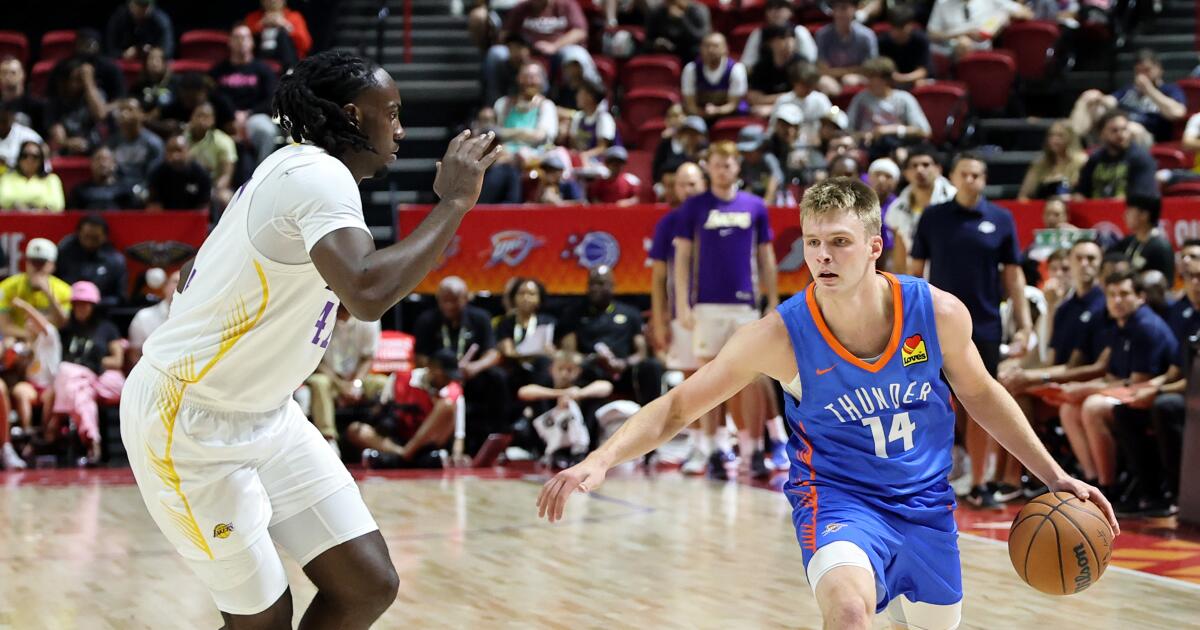
LAS VEGAS — The door opened for Arthur Kaluma to show his worth for the Lakers in the NBA Summer League on Saturday night.
He did so in a big way.
Kaluma had 34 points and five rebounds during the Lakers’ 91-70 win over the Dallas Mavericks at the Thomas & Mack Center.
He was 11 for 16 from the field and six for 10 from three-point range.
With Lakers rookie guard Cameron Carr unable to play because of a right thumb contusion, Kaluma took over the scoring role. Carr, the 24th pick in the NBA draft, is averaging 17 points per game.
“Cam doesn’t play tonight, so he gets a little bit more minutes, gets a couple more touches,” said Lakers Summer League coach Ty Abbott about Kaluma. “But he’s done a really good job of making the most of it when he doesn’t have actions run for him. So the way that he’s been able to stay ready, find windows for himself has kept him in a rhythm. So, on a night like tonight, when we can run some actions for him, he knocks them down and just plays out of his mind. It was great.”
Kaluma said he was “a little nervous” but his three-point shooting said otherwise.
“When [teammate] Jon Elmore came down and he pitched it back to me for a three … I just knew when it came off my hand it was cash,” Kaluma said. “So I said, ‘Yeah, I’m hot.’ It went on from there.”
Late in the fourth quarter, Kaluma lined up a three-pointer, setting his feet and scoring from 29 feet out. He flashed three fingers and smiled. His teammates on the bench stood and cheered, as did the fans.
“We have such a great group of guys this year at Summer League and going through this it’s hard to get that camaraderie with a group,” Kaluma said. “But I feel like everybody wants to see everybody succeed and I felt that tonight. I’m not going to lie to you. They tell me to shoot the ball. I passed up a couple of shots and they were mad at me the other day.”
Kaluma played for the South Bay Lakers in the G League last season. He averaged 14.6 points per game, 4.9 rebounds and shot 55% from the field, 37% from three-point range.
“The G can get grimey, you know what I’m saying? It’s a time where everybody is trying to fight for a position and there is a certain hunger that you have to have in order to be successful in the G,” Kaluma said. “And I feel like that drive that I had my first year in it pushed me into this summer to really get better and work on my game and come here and have the opportunity to perform.”
Kaluma wasn’t alone in helping the Lakers improve to 2-0 in Summer League play.
Adou Thiero ran the court, took a lob pass from Chris Mañon and threw down a two-handed dunk. He had another solid outing with 15 points and four rebounds. He shot just four for 12 from the field, but was a plus-15.
But the night belonged to Kaluma.
“I pride myself on the defensive end,” he said. “I know I got hot offensively, but the shot was just falling today, you know what I’m saying? My game is three-and-D. I lock-up on defense and I know I can hit open shots. I just got hot today and I’m not going to try to let it get to my head.”
Sports
Golf star records lowest round in LPGA major history with astounding performance at Evian Championship

NEWYou can now listen to Fox News articles!
There are good days on the golf course, and then there is what Haeran Ryu just did on Saturday.
Ryu, 25, recorded the lowest round in LPGA major history on Saturday with an 11-under 60 at the Evian Championship. With the South Korean golfer’s historic round, she holds a three-stroke lead.
Ryu’s round comes just two weeks after winning her first major at the Women’s PGA Championship. On the 18th hole, Ryu left a 30-foot eagle putt a few inches short, and instead settled for a birdie.
CLICK HERE FOR MORE SPORTS COVERAGE ON FOXNEWS.COM
Haeran Ryu of South Korea reacts on the 18th green after the third round of The Amundi Evian Championship at Evian Resort Golf Club in Evian-les-Bains, France, on July 11, 2026. (Stuart Franklin/Getty Images)
She said after the round that she had no idea what she had done until she counted up her scorecard.
“But after the putt and I counted my score with my caddie,” she said. “Oh my God, it’s 11-under par today. It was so amazing. My caddie says, ‘Yep.’ I’m so happy right now.”
If Ryu had made the eagle putt on the 18th hole, she would have been just the second player to shoot a 59 in LPGA history.
ZERO BS. JUST DAKICH. TAKE THE DON’T @ ME PODCAST ON THE ROAD. DOWNLOAD NOW!
Haeran Ryu of South Korea celebrates a birdie on the 15th green during the third round of The Amundi Evian Championship at Evian Resort Golf Club on July 11, 2026, in Evian-les-Bains, France. (Stuart Franklin/Getty Images)
Her 60 broke the record for the lowest round in an LPGA major by one shot. Leona Maguire and Jeungeun Lee6 in 2021, and Hyo Joo Kim in 2014, each shot 61 at the Evian Championship, which was designated as an LPGA major in 2013.
The lowest round in a men’s major is 62, which is shared by four players — Branden Grace at Royal Birkdale in the 2017 British Open, Xander Schauffele and Rickie Fowler in the 2023 U.S. Open at Los Angeles Country Club, and Schauffele and Shane Lowry in the 2024 PGA Championship at Valhalla.
CLICK HERE TO DOWNLOAD THE FOX NEWS APP
Haeran Ryu of South Korea and Lottie Woad of England interact after their round on the 18th green during the third round of the Amundi Evian Championship at Evian Resort Golf Club in Evian-les-Bains, France, on July 11, 2026. (Stuart Franklin/Getty Images)
Ryu hopes her historic third round can help propel her to a second major win in three weeks.
“That is amazing, amazing dream,” Ryu said. “So I just want that one to come true, but we have one more day.”
The Associated Press contributed to this report.
Follow Fox News Digital’s sports coverage on X, and subscribe to the Fox News Sports Huddle newsletter.
-

 Montana3 minutes ago
Missoula and Western Montana neighbors: Obituaries for July 12
-

 Nebraska9 minutes ago
MLB Draft: Cubs select Nebraska RHP Carson Jasa in the 3rd round
-

 Nevada12 minutes ago
Nevada joins western coalition that aiming to strengthen regional power grid
-

 New Hampshire17 minutes ago
Rescue Crews Help Injured Woman Off Mt. Washington
-
North Carolina17 minutes ago
Key Raleigh real estate figure who helped bring Hurricanes to North Carolina has died
-

 New Jersey25 minutes ago
Today in History: July 12, riot erupts in New Jersey over police beating of Black taxi driver
-

 New Mexico27 minutes ago
Complicated legacy: Former students reflect on St. Catherine Indian School
-

 North Dakota40 minutes ago
Today in History: July 12, 1932 – A rumor turned into not only one tornado but a flock of them

