Sports
As the Clippers open their new arena, breaking down the true value of a new home

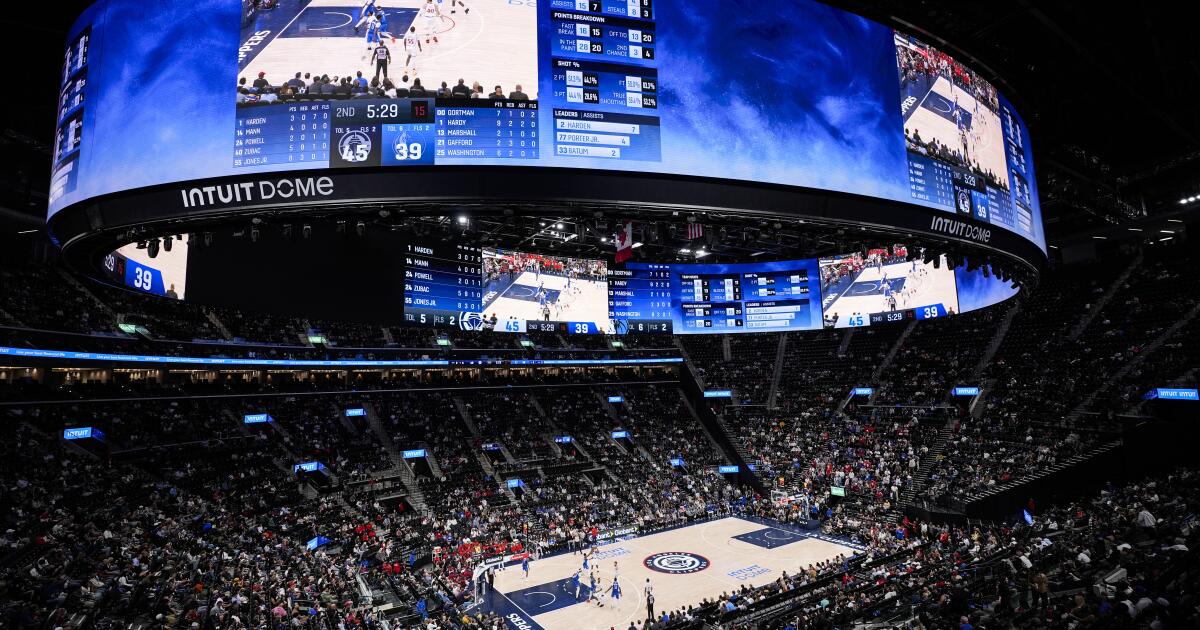
For Dan Kennedy, the odd thing about his homecoming was how it never quite felt like home.
When the goalkeeper was signed by Chivas USA in 2008, the club was one of the two Major League Soccer franchises in Los Angeles, and Kennedy was a local talent raised in Orange County who had later starred at UC Santa Barbara.
By the time Chivas folded six seasons later, no one had appeared in more games or played more minutes in its history than Kennedy. Yet in all that time, he said, he often felt more comfortable playing on the road.
The Galaxy, the original tenant in the Carson stadium that housed both teams, had two training fields to Chivas’s one. The shared weight room was painted in Galaxy colors. The Galaxy’s schedule featured prime-time dates, where Chivas played weekend matinees. Chivas branding was visible on match day, but quickly taken down.
“When they weren’t having success, I would say it was certainly less bothersome,” Kennedy said. “But when they were rolling and winning championships, we were trying to figure out what this club was even going to be — if it was going to continue in Major League Soccer. And it was so evident that we just didn’t have a home, and didn’t have identity, and we were just second fiddle.”
There’s a term for that kind of stadium-sharing: groundshare. Yet unofficially, such co-tenants often call it something different: a total drag.
The Clippers’ Cam Christie dunks the ball during a preseason game at the new Intuit Dome in Inglewood on Oct. 14.
(Jae C. Hong / Associated Press)
Born out of convenience, the arrangements often lose their appeal for reasons that range from financial, logistical or cultural.
No one needs to explain that to the Clippers, who spent their first 40 years in Los Angeles as a roommate. After 15 years sharing the Sports Arena with USC basketball, the NBA franchise spent the last 25 as the third tenant at Crypto.com Arena, behind the Kings and Lakers in the pecking order for preferential dates.
Now, that is no longer the case. On Wednesday, the Clippers will host their first regular-season NBA game at Intuit Dome, in Inglewood, whose $2-billion-plus construction bill was footed by Steve Ballmer, the tech billionaire. Upon buying the team in 2014, Ballmer didn’t initially believe it needed new digs. Within a year, however, Ballmer began asking himself something that everyone involved in groundshare ponders, at some point.
What’s the value of having a home to call one’s own?
The answer can mean different things to different stakeholders. But few were even asking that question in the 1960s and 70s, as a new trend swept across the U.S.
From Seattle’s Kingdome to RFK Stadium in Washington D.C., cavernous, municipal-owned stadiums were erected that could house both football and baseball. It was a uniquely North American boom; in Europe, shared stadiums like the famed San Siro, where both of Milan’s top soccer clubs play, are the exception.
“It just seemed like the cost prudent thing to do,” said J.C. Bradbury, an economist at Kennesaw State University. “Hey, we’re going to build one for baseball and football, basketball and hockey. Boom, that’s done. And what happened is, you did end up with a lot of these second-class tenants in these facilities.”
By the 1990s, as the older stadiums’ decades-long leases came up, those tenants wanted out, and in the process, ushered in a new era of single-team stadium construction —– bespoke buildings of brick or steel, designed with just one team in mind.
To team owners who build such stadiums financed either in part or in whole by public money, the value was obvious: control over new revenue streams and design for buildings paid for using only a fraction of their own wealth. In one such case, according to a review of public policy toward stadium construction that Bradbury co-authored last year, the Atlanta Falcons received $200 million in bonds to build the new stadium it opened in 2017, as well as revenue from a hotel tax worth hundreds of million more it could keep even after the bonds were paid off.
For the public, the payoff was often murkier. Bradbury and his co-authors analyzed, in no uncertain terms, that “no economic justification exists for subsidizing professional sports venues at observed levels.” Looking for value beyond the bottom line, they also collected studies that attempted to measure intangible social benefits from living in a city with a pro team. That level of value-add that researchers were trying to identify was often difficult to quantify — property values near stadiums, one measure, didn’t soar — but also not non-existent.
In Columbus, Ohio, such value was evident from the start for Jamey Stang.
Stang grew up in Ohio as the son of soccer-loving German immigrants. He traveled around the Midwest watching his father play for a local German social group, and spent weekends in vain trying to find highlights of European games. By 1994, Stang was a recent college graduate when he heard Columbus had earned an MLS franchise, and was so enthusiastic that he went door-to-door to canvas for a tax levy intended to fund a new Columbus Crew stadium.
“I was going to get to watch true professional soccer in the city that I lived in,” Stang said, “and I was ecstatic about it.”
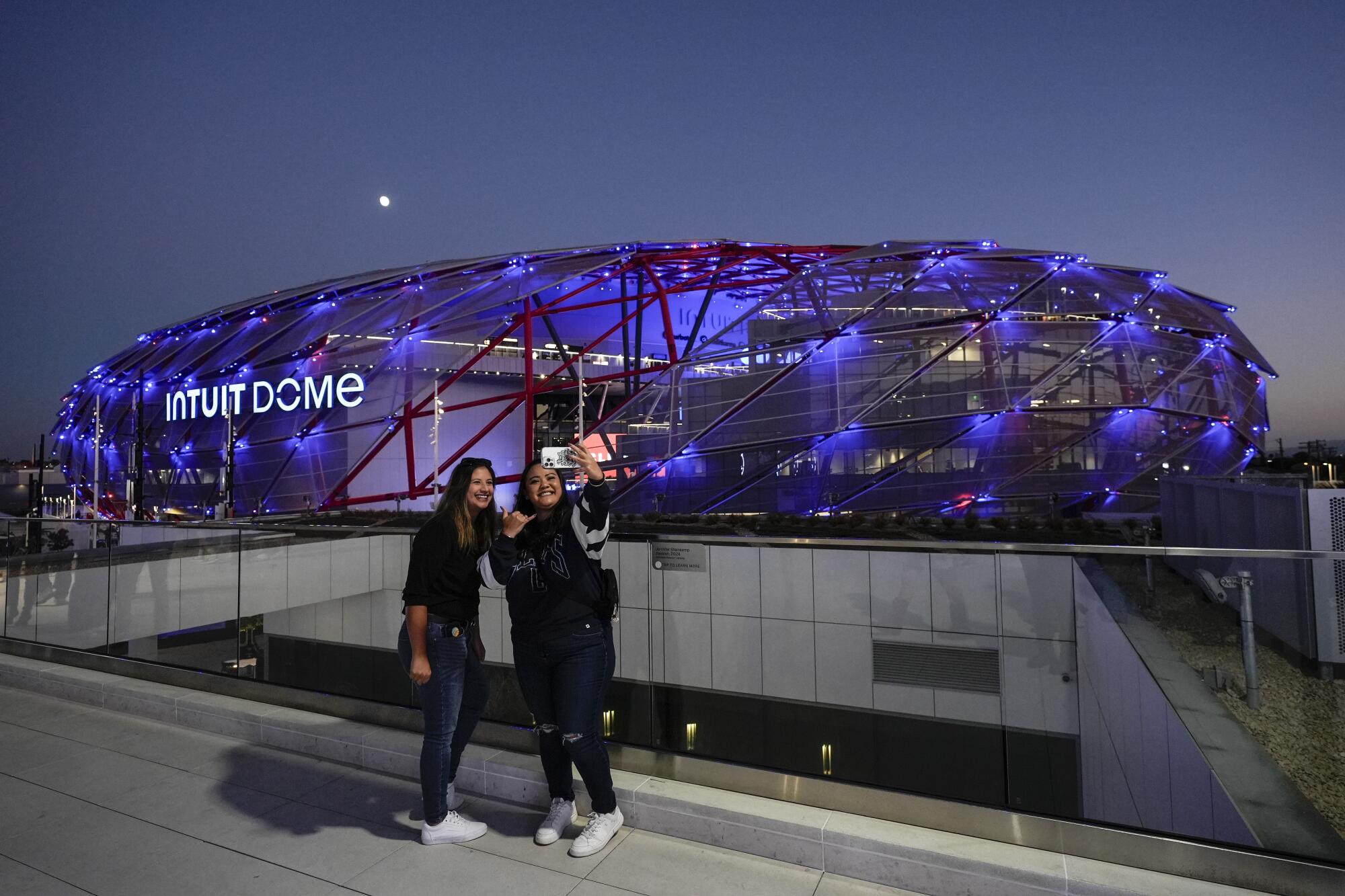
Two fans take a selfie outside the Intuit Dome, the new home of the Clippers, before a preseason game on Oct. 14.
(Jae C. Hong / Associated Press)
For three years, the Crew temporarily shared Ohio Stadium, the home of Ohio State football, an experience that was both impersonal and highly personal. Even the Crew’s biggest games barely made a dent in the stadium’s capacity, and yet the city’s soccer community was so small, Stang felt he knew just about every supporter in the stands. After games, he and other fans mingled with players at a bar across the street.
The Crew’s new stadium, which opened in 1999, looked like a hunk of metal that lived up to its derisive nickname, “The Erector Set.” Located in a muddy lot on the state fairgrounds, it was far from downtown, restaurants and bars. But it had tailgating and built an intense connection between those who showed up, Stang said. In 2006, he began bringing his daughter, then 7, to sit together in the rowdy supporters section, where fan groups banged drums and held aloft a giant banner known as “tifo.” She took pictures with players like Brian McBride.
If the stadium had its drawbacks, it was also a pioneer — the first soccer-specific pro stadium in the U.S., one that kicked off yet another new wave of construction. (The Galaxy’s Carson home opened four years later.) When MLS started in the mid-1990s, its original business plan called for its teams playing as a secondary tenant in someone else’s stadium.
Flipping that expectation has helped grow the league’s popularity and keep it viable, MLS commissioner Don Garber told The Times.
“The ability to see the game the way that it’s supposed to be seen from the stands, and also the fact that other people who might not have been soccer fans saw the way that the investment was being made in the league, I think both those things together were able to help save the league,” Stang said.
The league’s desire to avoid a Chivas-level mistake was so apparent that when it folded and the league announced a new L.A. franchise, LAFC, it stipulated that the team wouldn’t begin play until its own stadium could be completed. At $350 million, LAFC’s stadium opened as the most expensive soccer-specific stadium in the league’s history. Of the 29 teams now in MLS, 22 play in soccer-specific stadiums. At July’s All-Star break, the league reported an average attendance of more than 23,000, the highest at that point in its history, with stadiums at a record 94% of capacity.
It was a four-mile move into a tiny stadium.
Jana Woodson remembers it as a huge deal.
In 2009, the University of Richmond’s football team left behind City Stadium, the 22,000-seat municipal field it had shared with a lower-division professional soccer team for 14 years, for an 8,700-seat home, built with $25 million in university and donor money, that was on-campus and all their own. The capacity was about 700 seats smaller than their previous season’s average crowd size, yet it sparked a surge in revenue, “greatly increasing the number of season tickets we got,” along with donations, said Woodson, an assistant athletics director for marketing and fan development.
When Woodson joined Tulane University as a deputy athletic director in 2017, she saw something similar happening. Three years earlier, the New Orleans university opened Yulman Stadium to return football to campus after 39 years playing at the city’s 83,000-seat downtown Superdome. In 2013, its final Superdome season, Tulane averaged 19,747 fans. As in MLS, college teams have left behind large stadiums for bespoke buildings that are described in the industry with a buzzword — “right-sized.”
An on-campus stadium isn’t a shortcut to on-field success. It took the Green Wave five seasons in their new stadium to produce a winning record. But in the last six years, the Green Wave have produced four winning seasons — as many as in their previous 21 seasons. In 2022, their 12-2 season finished with a Cotton Bowl victory over USC and a top-25 rankings for the first time since 1998. Woodson couldn’t directly connect the stadium to that turnaround, but did contend that its connection to campus life — the stadium shared a concourse with other athletic facilities — was reinvigorating.
Game days that once sent students and alumni three miles away from campus now brought them back to campus, where “people are excited to come because that’s where their heart is, right?” Woodson said. “College athletics is about, for alumni and fans, the university … and it’s nostalgic to come back.”
Continuing that momentum is hard. Just ask the Minnesota Twins and Minnesota Golden Gophers football, who shared the Metrodome with the NFL’s Vikings for decades before opening their own stadiums in 2010 and 2009, respectively. Both watched attendance spike in the first few seasons in their new homes, only to flatline to Metrodome-era levels.
That trend experienced by some teams hasn’t daunted others. In November, the University of South Florida will break ground on a 35,000-seat on-campus stadium that is projected to cost $340 million. Since the school started playing football in 1997, its home field has been about 11 miles south of campus at the home of the NFL’s Tampa Bay Buccaneers. There, terms of their lease allow the Bulls to earn revenue from ticket sales and limited sponsorships, but not a cut from premium-seat sales, the parking lots, or concessions, said Michael Kelly, USF’s athletic director.
As with Tulane, playing in an NFL facility had been a selling point in recruiting, but sharing had lost its luster with the school and its board of trustees who watched as rivals such as Central Florida built their own stadiums and saw, in general, donations to those schools rise. Kelly hailed the new building as a “tool for engagement” for the school’s 400,000 alumni.
“I kind of keep thinking it’s like a 26-year-old still living in their parents’ basement,” Kelly said. “It’s fine, and save some rent and stuff but sooner or later you got to move out and do your own thing.”
Though the push for a new USF stadium began long before tectonic plates holding together college athletics began shaking — from rampant conference realignment to a House settlement that will soon allow schools to share revenue with their own athletes — Kelly acknowledged that it also doesn’t hurt public perception to have a shiny new stadium act as a billboard to either recruits or conference executives.
“To revenue share, you have to have revenues to share, right?” Kelly said. “And to be able to build the tools that we need to raise more money, to engage more with the community, to have the revenue streams like a stadium can provide, it will undoubtedly provide some of those economic engines.”
If groundshare is going out of style — the Dallas Mavericks and Philadelphia 76ers, who both share home stadiums with NHL teams, have made noise about opening new stadiums — it also is not dead.
Despite a push to build a stadium on Manhattan’s West Side two decades ago, the New York Jets, who have been co-tenants for their entire existence, still share MetLife Stadium with the NFL’s Giants. And in 2020, the Rams and Chargers left behind temporary but separate homes at USC’s Coliseum and the Galaxy’s Dignity Health Sports Park to move into Inglewood’s SoFi Stadium.
One year after construction wrapped on SoFi that brought together the NFL franchises, the Clippers held the groundbreaking for Intuit Dome just across West Century Boulevard, the first step in their downtown divorce from the Lakers and Kings. For 40 years, the Clippers lived a fragmented existence, with their business office downtown, a short walk from Crypto.com Arena, while their basketball staff worked and the team practiced 14 miles away, in Playa Vista. When it came time to build their own arena, the owner ordered up outdoor plazas and community spaces on the arena’s 26-acre site in an attempt to recreate the feel of a campus, where fans can and want to visit even on days without games.
The dome won’t be immune from what Bradbury called “spillover effects” on the surrounding area, such as increased traffic, noise or crime. But the economist said that when viewing a pro team as a private business looking to spur revenue through a new location, no different than a grocery store or restaurant, moving the team through private funding was the most “desirable” of options for stadium construction.
“Some of [moving the team to Inglewood] may be for the community,” Bradbury said. “I do think that when you’re fabulously wealthy and own a sports team, maybe you might just say, hey, my fans deserve better, and I got money to do that, why not? But I suspect, as in most cases, owners rarely make decisions that are not in their financial interest, and they normally end up paying off.”
Ballmer spent upward of $2 billion on the complex, but speaks of a payoff that is as much cultural as commercial. Inside the team, small customs such as walking into the building and giving a fist bump to the same attendant at the front desk, are talked about as the type of details that turn home -court into an advantage. Time will tell.
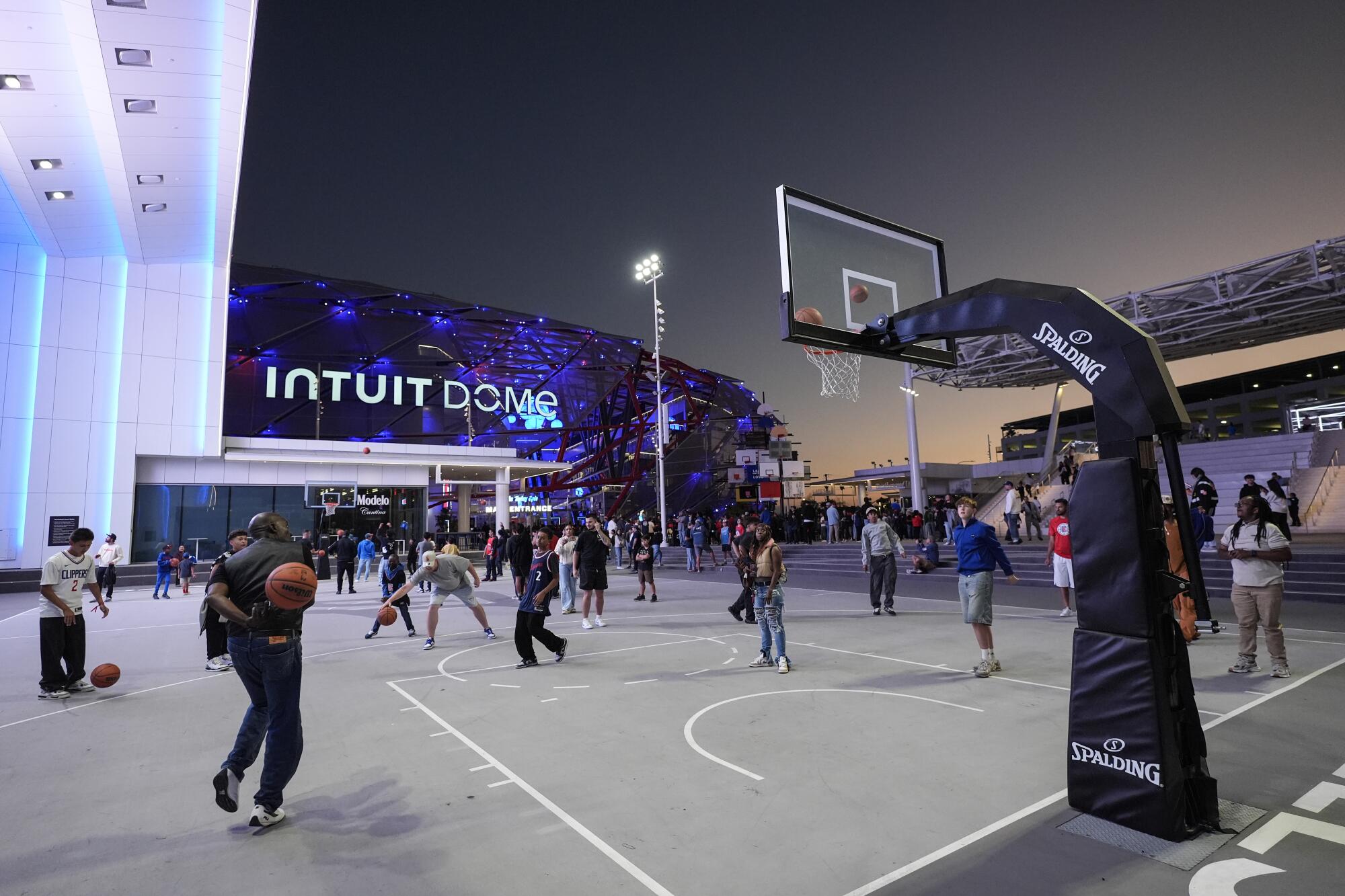
Fans play basketball outside the Intuit Dome, the Clippers’ new home, before a preseason game against the Dallas Mavericks on Oct. 14.
(Jae C. Hong / Associated Press)
Kennedy felt that difference at the end of his MLS career when he returned to Los Angeles in 2015 to play for the Galaxy.
“You come into the same stadium, but yet have a completely different player experience,” Kennedy said.
He still wonders what might have happened had Chivas gotten its own L.A. stadium, a project Kennedy said Shawn Hunter, the president and chief executive of Chivas USA, was working on during their overlap at the club. (Through the minor-league baseball team he has since founded, Hunter could not be reached for comment.) Not having their own stadium didn’t lead to the club’s folding in 2014 alone, Kennedy said, but it certainly didn’t help.
“Pro sports in the United States now is a massive real estate play,” Kennedy said. “We’ve seen it time and time again: If you create a home atmosphere that’s special it just becomes a tougher place to play across any sport. You get a hot playoff team at home with great fan support, they’re going to have a little bit of an advantage.”

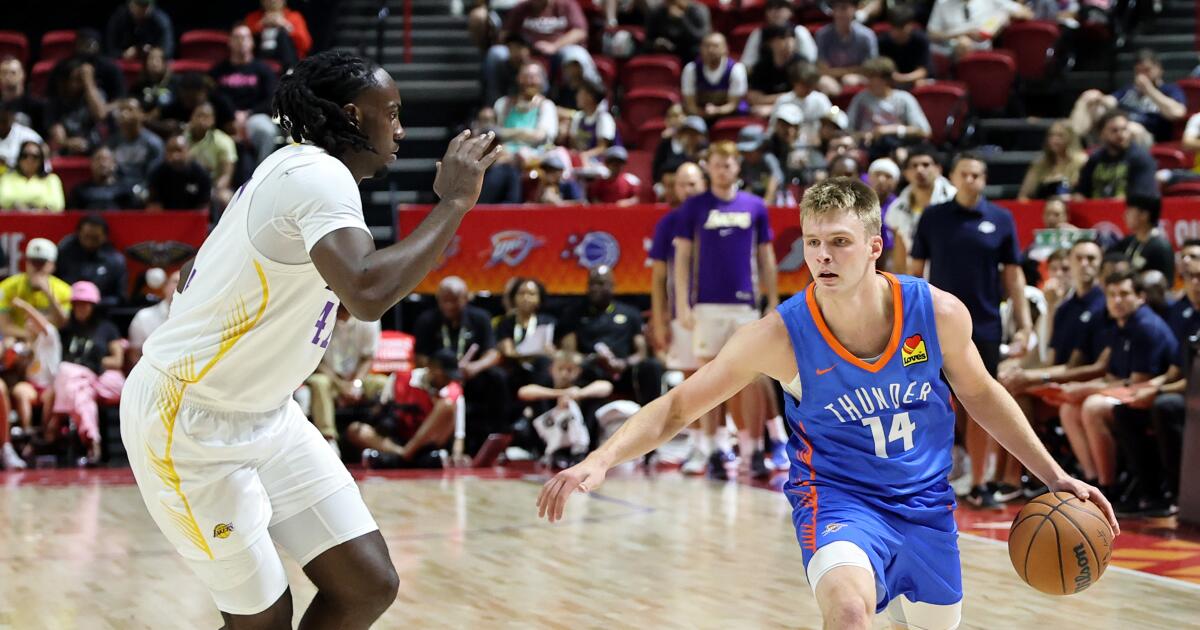
LAS VEGAS — The door opened for Arthur Kaluma to show his worth for the Lakers in the NBA Summer League on Saturday night.
He did so in a big way.
Kaluma had 34 points and five rebounds during the Lakers’ 91-70 win over the Dallas Mavericks at the Thomas & Mack Center.
He was 11 for 16 from the field and six for 10 from three-point range.
With Lakers rookie guard Cameron Carr unable to play because of a right thumb contusion, Kaluma took over the scoring role. Carr, the 24th pick in the NBA draft, is averaging 17 points per game.
“Cam doesn’t play tonight, so he gets a little bit more minutes, gets a couple more touches,” said Lakers Summer League coach Ty Abbott about Kaluma. “But he’s done a really good job of making the most of it when he doesn’t have actions run for him. So the way that he’s been able to stay ready, find windows for himself has kept him in a rhythm. So, on a night like tonight, when we can run some actions for him, he knocks them down and just plays out of his mind. It was great.”
Kaluma said he was “a little nervous” but his three-point shooting said otherwise.
“When [teammate] Jon Elmore came down and he pitched it back to me for a three … I just knew when it came off my hand it was cash,” Kaluma said. “So I said, ‘Yeah, I’m hot.’ It went on from there.”
Late in the fourth quarter, Kaluma lined up a three-pointer, setting his feet and scoring from 29 feet out. He flashed three fingers and smiled. His teammates on the bench stood and cheered, as did the fans.
“We have such a great group of guys this year at Summer League and going through this it’s hard to get that camaraderie with a group,” Kaluma said. “But I feel like everybody wants to see everybody succeed and I felt that tonight. I’m not going to lie to you. They tell me to shoot the ball. I passed up a couple of shots and they were mad at me the other day.”
Kaluma played for the South Bay Lakers in the G League last season. He averaged 14.6 points per game, 4.9 rebounds and shot 55% from the field, 37% from three-point range.
“The G can get grimey, you know what I’m saying? It’s a time where everybody is trying to fight for a position and there is a certain hunger that you have to have in order to be successful in the G,” Kaluma said. “And I feel like that drive that I had my first year in it pushed me into this summer to really get better and work on my game and come here and have the opportunity to perform.”
Kaluma wasn’t alone in helping the Lakers improve to 2-0 in Summer League play.
Adou Thiero ran the court, took a lob pass from Chris Mañon and threw down a two-handed dunk. He had another solid outing with 15 points and four rebounds. He shot just four for 12 from the field, but was a plus-15.
But the night belonged to Kaluma.
“I pride myself on the defensive end,” he said. “I know I got hot offensively, but the shot was just falling today, you know what I’m saying? My game is three-and-D. I lock-up on defense and I know I can hit open shots. I just got hot today and I’m not going to try to let it get to my head.”
Sports
Golf star records lowest round in LPGA major history with astounding performance at Evian Championship

NEWYou can now listen to Fox News articles!
There are good days on the golf course, and then there is what Haeran Ryu just did on Saturday.
Ryu, 25, recorded the lowest round in LPGA major history on Saturday with an 11-under 60 at the Evian Championship. With the South Korean golfer’s historic round, she holds a three-stroke lead.
Ryu’s round comes just two weeks after winning her first major at the Women’s PGA Championship. On the 18th hole, Ryu left a 30-foot eagle putt a few inches short, and instead settled for a birdie.
CLICK HERE FOR MORE SPORTS COVERAGE ON FOXNEWS.COM
Haeran Ryu of South Korea reacts on the 18th green after the third round of The Amundi Evian Championship at Evian Resort Golf Club in Evian-les-Bains, France, on July 11, 2026. (Stuart Franklin/Getty Images)
She said after the round that she had no idea what she had done until she counted up her scorecard.
“But after the putt and I counted my score with my caddie,” she said. “Oh my God, it’s 11-under par today. It was so amazing. My caddie says, ‘Yep.’ I’m so happy right now.”
If Ryu had made the eagle putt on the 18th hole, she would have been just the second player to shoot a 59 in LPGA history.
ZERO BS. JUST DAKICH. TAKE THE DON’T @ ME PODCAST ON THE ROAD. DOWNLOAD NOW!
Haeran Ryu of South Korea celebrates a birdie on the 15th green during the third round of The Amundi Evian Championship at Evian Resort Golf Club on July 11, 2026, in Evian-les-Bains, France. (Stuart Franklin/Getty Images)
Her 60 broke the record for the lowest round in an LPGA major by one shot. Leona Maguire and Jeungeun Lee6 in 2021, and Hyo Joo Kim in 2014, each shot 61 at the Evian Championship, which was designated as an LPGA major in 2013.
The lowest round in a men’s major is 62, which is shared by four players — Branden Grace at Royal Birkdale in the 2017 British Open, Xander Schauffele and Rickie Fowler in the 2023 U.S. Open at Los Angeles Country Club, and Schauffele and Shane Lowry in the 2024 PGA Championship at Valhalla.
CLICK HERE TO DOWNLOAD THE FOX NEWS APP
Haeran Ryu of South Korea and Lottie Woad of England interact after their round on the 18th green during the third round of the Amundi Evian Championship at Evian Resort Golf Club in Evian-les-Bains, France, on July 11, 2026. (Stuart Franklin/Getty Images)
Ryu hopes her historic third round can help propel her to a second major win in three weeks.
“That is amazing, amazing dream,” Ryu said. “So I just want that one to come true, but we have one more day.”
The Associated Press contributed to this report.
Follow Fox News Digital’s sports coverage on X, and subscribe to the Fox News Sports Huddle newsletter.

Taylor Crabb is no stranger to South California beaches. The Long Beach State alum returns home this weekend to compete in AVP League matches.
It marks the first time AVP will compete in Long Beach since 2020 and allows players to compete at the 2028 Olympics beach volleyball venue.
Crabb, 34, made his AVP debut in 2013 with his brother, Trevor, and advanced from the qualifier in Manhattan Beach before finishing 25th in his first tournament.
After years of competing with various different partners, Taylor Crabb and Andy Benesh have delivered the top performances this AVP season.
The following interview with Crabb has been edited for clarity and length.
Are you excited to compete in this weekend’s event at Long Beach?
Crabb: Very excited. A lot of my college teammates and part of the school have reached out, saying that they’re gonna come. So I’m excited to get a chance to play in front of them again.
When was the last time you were in Long Beach?
Crabb: I always try to go down there for alumni events or any big games they have. I went to UCLA against Long Beach last year, when it was No. 1 versus No. 2, so I always try to get down there and support them.
You missed out on the chance to compete in the 2020 Olympics because of COVID-19 restrictions and chose not to pursue a spot at the 2024 Olympics. Are you fired up to try to compete in the 2028 Olympics, knowing that Long Beach will host the competition?
Crabb: Yeah, it’s definitely an exciting time having the Olympics in Long Beach, and we kind of get to break it in this weekend. As you said, Tokyo didn’t go the way I wanted, but I’m going full force now. I have a great partner in Andy Benesh, who obviously went to the Paris Olympics, and if it weren’t for the Olympics being in Long Beach, and me getting a partner like Andy, I’m not even sure I’d be going for it, but because of those two things, I want to make the most of it.
You mentioned that if it wasn’t for a partner like Andy, you wouldn’t be going for it. What do you mean by that?
Crabb: I didn’t feel motivated by playing in all the international events, but now, I think, sitting out kind of lit the fire under me, and I’m really motivated now.
You’ve had different partners throughout your time. What other motivation does Andy give you?
Crabb: He’s been, in my mind, the top blocker for the U.S. the last four or five years. Seeing the professionalism he brings every day to practice, on and off the court, while traveling and when showing up to tournaments, it rubs off on you and that’s really motivating to see. And I just want to make him proud.
Why do you love volleyball?
Crabb: A lot of reasons, but it’s just a feeling I have when I’m out there on the court. It feels natural. It feels like home. I was born into a volleyball family. I had a volleyball in my hands my entire life, so I’ve always just enjoyed it.
-
 Politics22 seconds ago
Trump slashes wildlife protections, putting endangered California animals at risk
-
Sports8 minutes ago
Lakers’ Arthur Kaluma erupts for 34 points in breakout Summer League performance
-

 World18 minutes ago
Sheikh Hamad bin Khalifa Al Thani, architect of modern Qatar
-
 News48 minutes ago
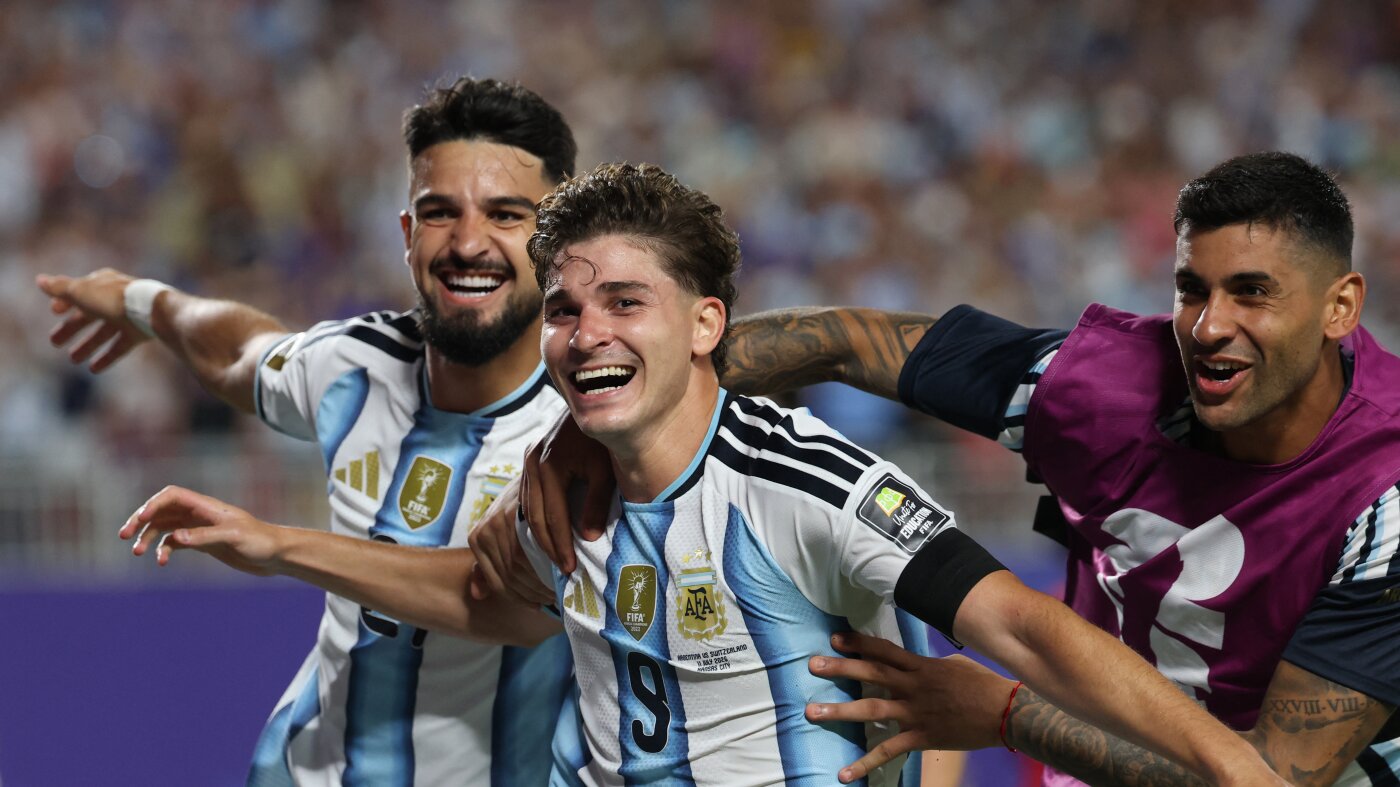
Messi and Argentina survive another close call to reach the World Cup semifinals
-

 Los Angeles, Ca2 hours ago
19-year-old arrested, accused of distributing marijuana to minors across Riverside County
-

 Detroit, MI3 hours ago
Phillies end the Tigers’ winning streak at 6 with a 4-2 victory
-

 San Francisco, CA3 hours ago
Giants select Barry Bonds’ nephew Peyton in third round
-

 Dallas, TX3 hours ago
Mark Cuban takes legal action against the Dallas Mavericks ownership over proposed arena deal

