Politics
Arizona mining country produced Latino leaders for L.A. Now, some are staying


To get to Clifton, you have to really want to get to Clifton.
The nearest big city is Tucson, about three hours away. After spending the night at an uncharacteristically ratty Holiday Inn Express in Willcox, I took U.S. Route 191 through a succession of towns, each seemingly smaller than the last.
The morning drive was quiet and scenic through hills dotted with creosote bushes, spiky cacti and spindly ocotillo plants leading up to Safford, the hometown of a good friend who got the hell out of there. Route 191 bends east here, passing by blooming cotton fields nourished by the Gila River before the terrain becomes rockier and steeper.
Seven days. Seven states. Nearly 3,000 miles. Gustavo Arellano talks to Latinos across the Southwest about their hopes, fears and dreams in this election year.
Soon, I saw what has drawn so many to Clifton over the last 150 years: one of the world’s largest open-pit copper mines.
The Morenci mine looked like the Sarlacc monster from the “Star Wars” movies. Once-picturesque cliffs had been carved into a series of pale terraces that descended hundreds of feet. Dust rose from the bottom. Rows of houses with the same gray roofs stood below me as I drove past a training center operated by the mine owner, Freeport-McMoRan.
When you picture an Old West town, Clifton is it. A decommissioned railroad car stood gleaming next to the main road. A hole blasted out of a cliff once served as a jail cell, according to a plaque. Silhouettes of cowboys decorated a motel.
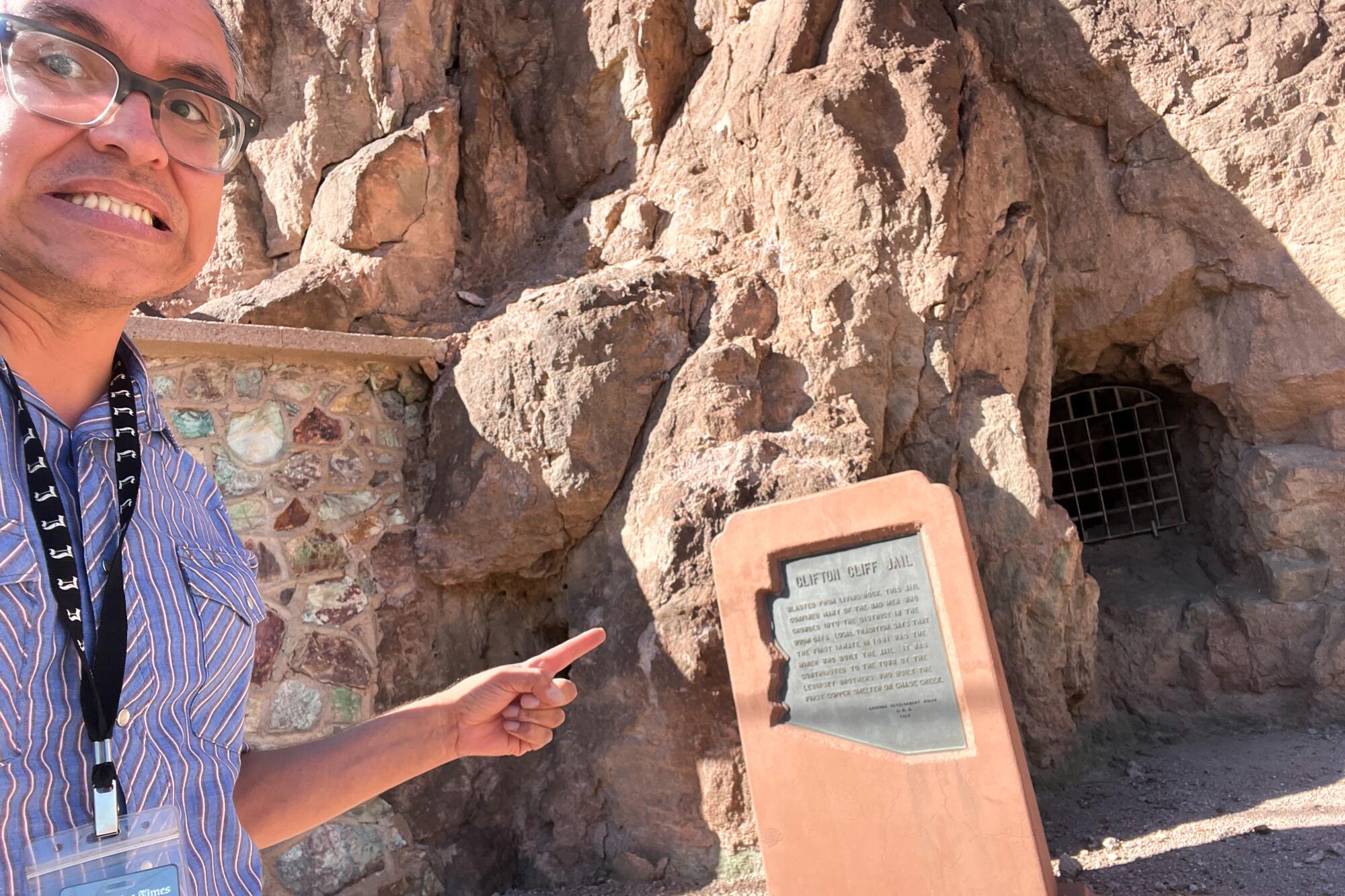
Times columnist Gustavo Arellano with a plaque commemorating a jail cell carved out of a cliff in Clifton, Ariz.
(Gustavo Arellano / Los Angeles Times)
I was looking for a different history.
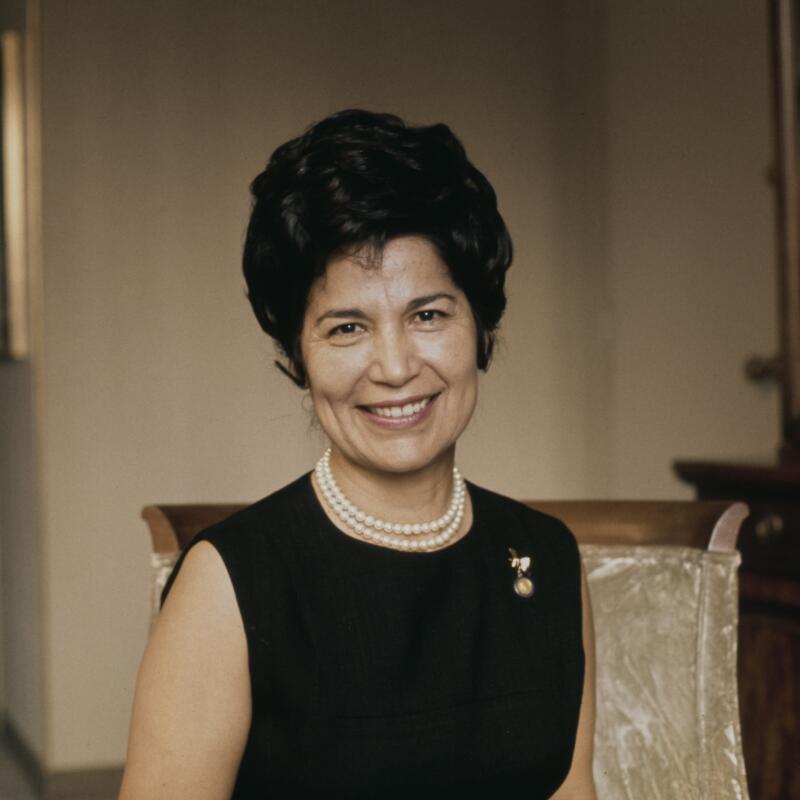
For generations, Mexican immigrants have landed in this area before decamping to Los Angeles. Some of the most important names in L.A. Latino politics — former U.S. Rep. Esteban Torres, Councilmember Richard Alatorre, U.S. Treasurer Romana Acosta Bañuelos — were born in Arizona mining towns or traced their lineage there.
I share those roots.
1

2
3
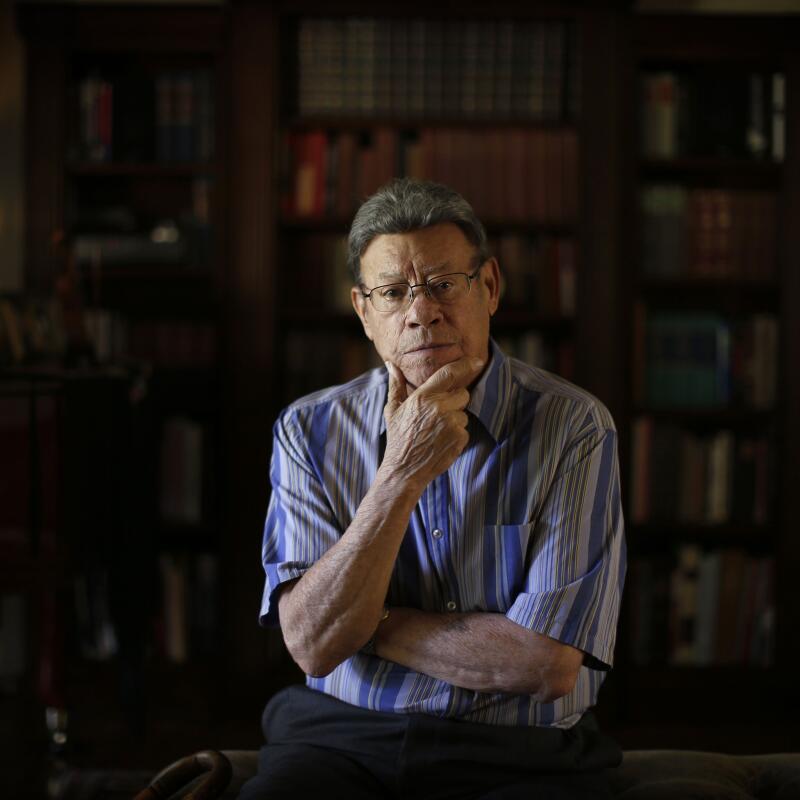
1. Richard Alatorre is among the L.A. politicians with roots in Arizona mining towns. (Carolyn Cole / Los Angeles Times) 2. The list includes Romana Acosta Bañuelos. (Bettmann Archive via Getty Images) 3. Esteban Torres also hails from mine country. (Barbara Davidson / Los Angeles Times)
My maternal grandmother, Marcela Miranda Fernández, was born in 1912 near Clifton, in a town called Metcalf. Her future husband, my maternal grandfather, José Miranda Bermúdez, spent time there as a child before migrating to Anaheim to pick oranges.
My grandparents were always vague when they spoke about Metcalf — but I had vowed to visit one day. A reporting trip to see how Latino voters were faring as the presidential election approached was as good a reason as any.
And now I had another question: Why would anyone want to stay in a place so many had left?

The 1970 U.S. census recorded Clifton’s population as 5,079. A crippling strike in the early 1980s led to the decertification of the miners union and spurred an exodus. By 2002, only about 2,600 people remained, according to Greenlee County statistics.
One of those who left was Janeene Carrillo.
“Growing up here was amazing,” she told me as we enjoyed breakfast at the Little Frisco, a newish diner in town. (Random L.A. connection: She’s related to the Arechigas, one of the last families evicted from Chavez Ravine). “It was probably the best childhood any kid could have. Because you’re safe. Everyone knows everyone.”
But other than the mines, opportunities were limited. After graduating high school in the late 1990s, she headed to Phoenix to study acting.
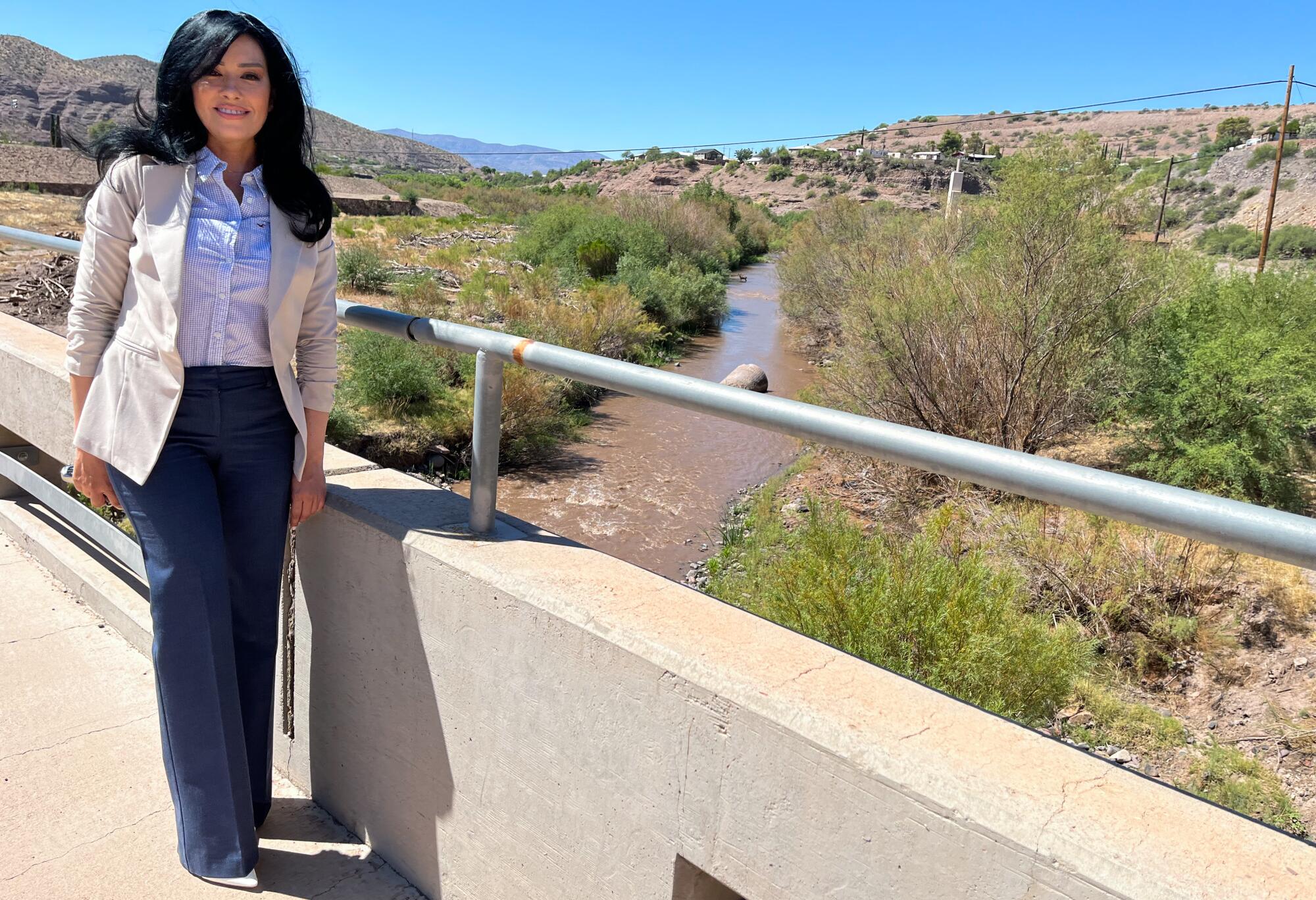
Janeene Carrillo, councilmember for the town of Clifton, Ariz., on a bridge overlooking the San Francisco River. The 45-year-old wants to bring businesses to the mining town in anticipation of Clifton’s main source of employment, the nearby Morenci copper mine, shutting down in the future.
(Gustavo Arellano / Los Angeles Times)
Family matters brought her back home in 2012, and she began thinking about how to make Clifton a place where people wanted to stay.
Today, she is a member of the town council, and Clifton is staging a modest comeback. The most recent census pegged the population at nearly 4,000. The median household income is $78,862, fueled by a boom in mining jobs, while the cost of living has remained low.
“We’re getting people from New Mexico, from even the Midwest,” said Carrillo, 45, picking at an omelet. “I’ve seen people come from Mississippi, from Alabama. We’re a work in progress.”
Now a security guard for Freeport-McMoRan, she is the third generation of her family to work at the mine. Wearing a cream-colored sports coat, Carrillo brushed her perfectly coiffed, jet black hair out of her eyes while we talked. Her urban polish was a contrast to the stereotypical copper country getup of checkered shirt, western-style belt buckle, bolo tie and Stetson hat.
Once [Donald] Trump came around, I decided that’s not the Republican that I am.
— Janeene Carrillo
In Phoenix, Carrillo ditched acting after the double gut punch of a cousin’s murder and the Sept. 11, 2001, terrorist attacks made her feel that government was too lax on “bad guys.” She volunteered for the Maricopa County Sheriff’s Department and helped to process passports, realizing that “a lot of people need a voice because they don’t have it.”
The divisions that surfaced in the 2016 election made her ditch the GOP, become an independent and get involved in politics.
“Once [Donald] Trump came around, I decided that’s not the Republican that I am,” said Carrillo, who is “into hearing both sides.”

She voted for Joe Biden in 2020 and plans to vote for Kamala Harris this year out of distaste for Trump’s “disrespect” toward military veterans.
“And I really got passionate about the right and the wrong, and how some [politicians] can get away with things, especially when running for president, you know?” she said.
Carrillo worked as a town clerk to learn the mechanics of local government, then unsuccessfully applied for an open council seat in 2021. The following year, she beat an incumbent.
“We needed something different — someone new, someone younger,” Carrillo responded when I asked why she won. “I felt like I’m looking at Clifton, like I’m on new ground. Because I never lived here as an adult, I can see what’s wrong, what’s broken. I can see the faults. I can see the patterns and what Clifton needs.”
What does her hometown need?
“There’s always talk about how the mine is probably only going to be working until maybe 2045,” she said. “And I don’t want Clifton to be dependent on the mine.”
She mentioned bringing in national chains — an Old Navy, a Target, even a Boston Market — so people don’t have to drive to Safford or beyond for necessities, and a truck stop to take advantage of the traffic that passes through. The jobs and revenue would allow Clifton to offer more municipal services, such as youth sports.
The problem, she said, is that no one outside Clifton pays attention to it.

In Clifton, Ariz., the median household income is $78,862, fueled by a boom in mining jobs, while the cost of living has remained low. The open–pit copper mine in nearby Morenci, shown in 2004, is a major employer.
(Mark Boster / Los Angeles Times)
“On the news, when they’re doing the weather, they totally ignore us,” she said, frowning. “All they say is, ‘Oh, precipitation is moving to the east,’ but they don’t say the name. And I’m like, ‘Why don’t they say our name?’”
This erasure also applies to Clifton’s miners, I pointed out. The archetypal American miner nowadays is from Appalachia — Trump rallied with them in West Virginia. The Biden administration, including Harris as vice president, promised to invest hundreds of millions of dollars in moribund coal towns. This year, it announced that Freeport-McMoRan would receive up to $80 million to invest in clean energy to operate the Morenci mine — but none of the money would go directly to towns such as Clifton.
“Latinos have given so much to the mining industry because of the struggles that they have to … overcome,” Carrillo said, describing how Mexicans in the area were once buried apart from whites, and housing segregation existed right up to the 1970s.
“We need our stories told,” she continued. “We need Americans to know what we’ve accomplished — we help build the United States.”

Does discrimination still exist in Clifton? The town is 54% Latino and 38% white.
“Everyone is married with everyone nowadays, and that’s great,” she said with a grin. I looked around Little Frisco, and Carrillo was right. Mixed race couples ate breakfast with their children in tow.
I said I was surprised to not see any presidential campaign posters in town, amid a plethora of local ones.
In 2020, Trump won two-thirds of the vote in Greenlee County while losing Arizona in a squeaker he falsely maintains was stolen. But on the drive to Clifton, I had seen few signs of the county’s red heart — or of national politics at all.
“No one wants to get into feuds,” Carrillo said. “Because you have to be seeing everybody — you know, much more than what you would in the city. I think everyone’s really careful on how they display who they’re voting for.”
Carrillo attributed the local support for Trump — especially among Latinos — to the overtures he has made to the mining industry.
But she thinks the Biden administration’s investment in the Morenci mine may help Harris make inroads in Greenlee County this year.
“They’re seeking a candidate who supports” the hometown’s livelihood, Carrillo said.
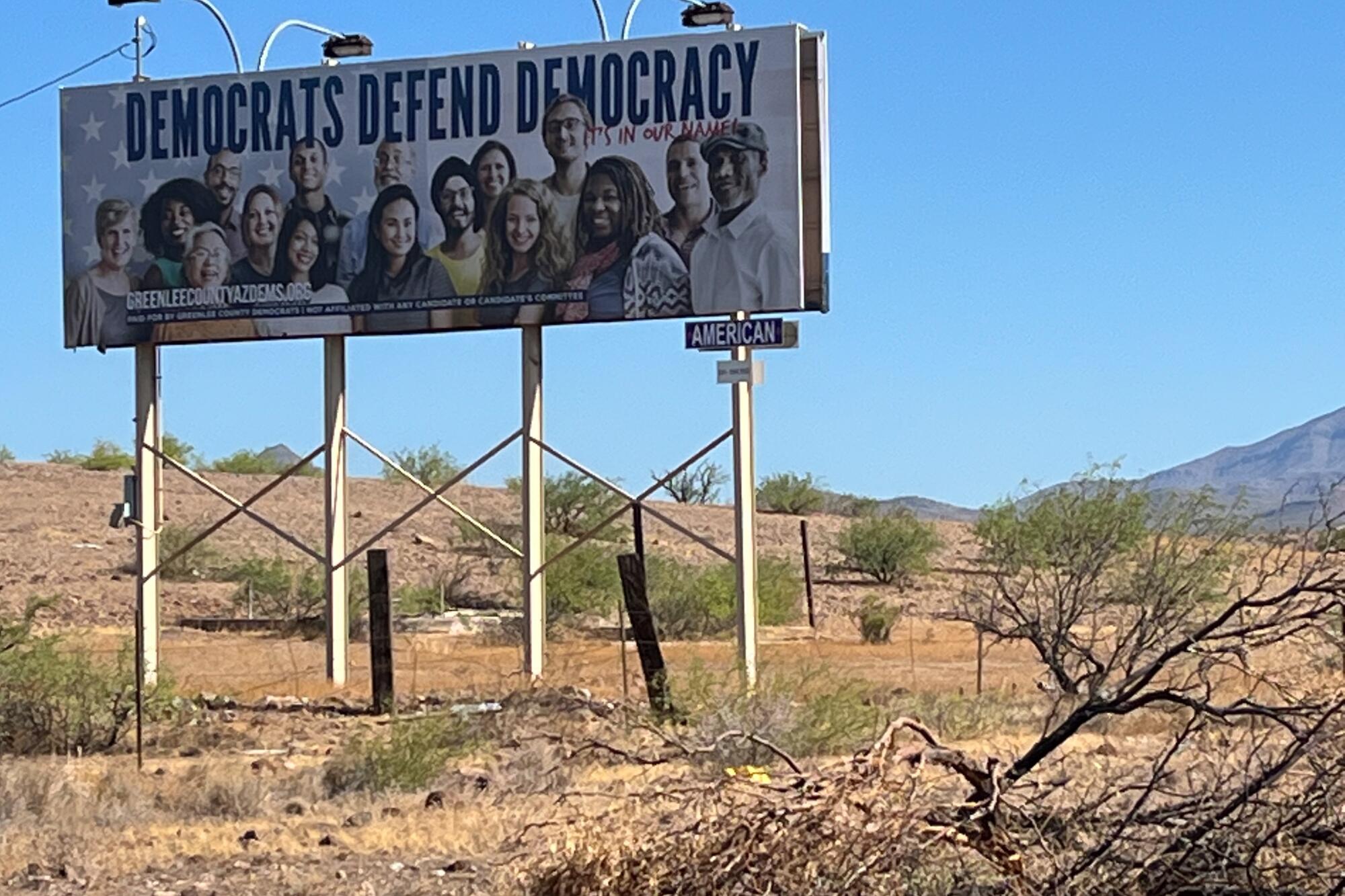
A billboard promoting the Greenlee County Democratic Party near the unincorporated community of Three Way, Ariz. In 2020, Donald Trump won two-thirds of the vote in Greenlee County while losing Arizona.
(Gustavo Arellano / Los Angeles Times)
After taking some photos at a historic bridge spanning the San Francisco River, we drove up U.S. Route 191 to Metcalf, where my grandmother was born. Beyond a gate was a hill as tall as a high-rise building — turned into a dump for the Morenci mine in the 1930s. Somewhere underneath the detritus was the town, buried and abandoned.
I texted a photo to some of my cousins with the note, “Somos de aquí.”
We’re from here.
Suddenly, a Greenlee County sheriff’s vehicle made a U-turn, flashed its lights and drove directly toward us.
“Everything all right here?” Deputy Daniel Medina asked as he got out of his car. “There was a crash here recently, so I want to make sure you guys were OK.”
The name sounded familiar.
“Hey, you’re running for sheriff — I saw your signs!” I exclaimed, identifying myself as a reporter.
He smiled, greeted Carrillo, excused himself and drove off.
I soon left Clifton as well, taking winding back roads toward my next stop. Signs for Medina and his opponents were everywhere. For Harris or Trump?
None.

Politics
Graham’s death ignites GOP scramble for Senate seat as Trump hints he already has a favorite

NEWYou can now listen to Fox News articles!
Sen. Lindsey Graham’s, R-S.C., sudden death from an undisclosed illness has triggered a two-pronged approach to replace him, and President Donald Trump will likely be a focal point in the process.
Graham’s passing overnight comes at a time when Republicans in the upper chamber need every vote they can get. The Senate GOP now holds a 52-seat majority, and with the timetable for Sen. Mitch McConnell’s, R-Ky., absence still unclear, that majority is now effectively 51 votes.
That will up the pressure, and drama, to find a replacement for the longtime South Carolina lawmaker.
LINDSEY GRAHAM, SOUTH CAROLINA SENATOR WHO ROSE FROM SMALL-TOWN ROOTS TO GOP POWER BROKER, DIES AT 71
Sen. Lindsey Graham speaks with reporters aboard Air Force One with President Donald Trump and Secretary of Commerce Howard Lutnick on the way back to Washington, D.C., on Jan. 4, 2026. (Jim Watson/AFP via Getty Images)
Trump, during an appearance on NBC’s “Meet the Press” on Sunday, said, “I have somebody that I think would be great.”
“But I don’t want to say it now because it’s just, it’s too soon with Lindsey,” Trump said. “I don’t wanna even talk about anybody, but I do have somebody that I think is really good.”
It’s a process guided by the Constitution and state law. The first step will require South Carolina Gov. Henry McMaster, a Republican, to appoint a replacement for Graham on a temporary basis.
McMaster, a close ally of Trump, can appoint a temporary replacement as soon as he wants. That pick will serve until the next special or general election.
MCCONNELL FACES FRESH CALLS TO COME CLEAN ABOUT HEALTH ISSUES
Fox News Digital did not immediately hear back from McMaster’s office on when he would make the announcement, or who he was considering for the seat.
Graham was already in-cycle running for a fifth term in the upper chamber, and he easily cruised to a primary victory early last month. That means that whoever McMaster taps would serve until the end of the year to finish off the remainder of Graham’s fourth term.
The second prong is finding his long-term successor.
The candidate filing period for that special election to win the GOP nomination opens July 21. The election is slated for Aug. 11, according to South Carolina law.
That race could see several familiar faces in South Carolina GOP politics jumping in, including McMaster himself, who is termed out as governor.
TRUMP’S ENDORSEMENT POWER FACES ANOTHER GOP TEST IN SOUTH CAROLINA AFTER ALAN WILSON ADVANCES
Rep. Nancy Mace, R-S.C., departs the U.S. Capitol after a series of House votes on funding for Homeland Security and a War Powers resolution on Iran on March 5, 2026, in Washington, D.C. (Andrew Harnik/Getty Images)
Trump heaped praise on McMaster, noting that he endorsed his first bid for the White House in 2016.
“Henry’s been a great governor, you know now he’s termed out, but he’s going to do the right thing,” Trump said. “I think Henry will be fantastic.”
There are six members of South Carolina’s GOP congressional delegation who could toss their hats into the mix. Rep. Nancy Mace, R-S.C., who recently lost a bid for the GOP gubernatorial nomination, is eyeing jumping into the special election.
A person familiar with Mace’s plans told Fox News Digital, “Congresswoman Mace is considering a bid to run.”
Then there’s Rep. Joe Wilson, R-S.C., the longest-serving Republican member of the Palmetto State’s delegation. He quickly snuffed speculation about whether he’d leap into the fray.
CLICK HERE TO DOWNLOAD THE FOX NEWS APP
“I was grateful to speak with President Trump today reminiscing about our mutual friend, Senator Lindsey Graham,” Wilson said on X. “I assured him my goal is to remain in the House to keep his two-vote majority for the American people!!!”
Then there’s the remaining four: South Carolina Republican Reps. Ralph Norman, who also lost out on scoring the GOP nomination for governor, Russell Fry, William Timmons and Sheri Biggs, none of whom, so far, have signaled that they would jump into the battle for Graham’s seat.
Meanwhile, South Carolina Lt. Gov. Pamela Evette could also be in the mix.
A source familiar told Fox News Digital that Evette is receiving “tons of encouragement from all across the state and from around the country” to serve as the temporary caretaker for Graham’s seat.
The source said that Evette is also being encouraged to run to seek a full six-year term in the Senate.
Evette, a top South Carolina ally of Trump’s and McMaster’s, was endorsed by both as she finished first in South Carolina’s Republican gubernatorial primary in this year’s race to succeed McMaster.
But after Trump also endorsed her GOP rival in the runoff, State Attorney General Alan Wilson, she was trounced by Wilson a few weeks ago in the runoff election
Fox News Digital did not immediately receive responses to requests for comment from possible contenders in the House.
WASHINGTON — The Supreme Court’s conservative justices say they decide cases based on the words and original history of the Constitution — and not on their personal or political views.
Following the lead set by the late Justice Antonin Scalia, they say they see history and “originalism” as a guiding principle to prevent judges from changing the Constitution to adjust to new and changing times.
This text-and-history approach is said to contrast with an evolving or “living Constitution” favored by progressives and liberal activists.
But this year saw a flip of sorts on birthright citizenship.
The foremost conservatives agreed with President Trump that the surge of illegal immigration called for reconsidering the promise of citizenship at birth set out in the 14th Amendment of 1868.
“The number of illegal immigrants in this country exploded” in recent years, Justice Samuel A. Alito Jr. wrote in dissent. The rule of citizenship at birth provides “a powerful incentive to enter or remain in this country illegally,” he added.
“The Constitution is an enduring document,” wrote Justice Brett M. Kavanaugh, but its rules and meaning must adjust to “modern situations that were unknown or unanticipated by the Constitution’s Framers.”
In a concurring opinion, he said that “significant illegal immigration into the United States is a new circumstance that was largely unknown as of 1868.”
There were no federal immigration laws in the mid-19th century, but it was an era when a surge of Irish immigrants had settled on the East Coast and large numbers of Chinese immigrants came to California.
Under the law, their children were deemed to be citizens at birth.
Among the conservative originalists, only Justice Amy Coney Barrett signed the majority opinion that was written by Chief Justice John G. Roberts Jr. and joined by the three liberals.
The opening words of the 14th Amendment of 1868 say: “All persons born or naturalized in the United States and subject to the jurisdiction thereof are citizens of the United States.”
In 1898, the Supreme Court upheld the rule of citizenship at birth in the case of Wong Kim Ark, who was born in San Francisco to Chinese parents.
In an executive order, Trump proposed to end birthright citizenship for the newborns whose parents were in the country illegally or temporarily.
Writing for the court, the chief justice said the words of the 14th Amendment were clear and were clearly understood at the time. He dismissed the “dramatically revisionist view” that has been cited recently.
Kavanaugh voted with the majority to block Trump’s order from taking effect. He did so because Congress had adopted birthright citizenship in a 1952 law.
“Consistent with the 14th Amendment, Congress could … enact new legislation establishing exceptions to birthright citizenship,” he wrote.
Justices Clarence Thomas and Alito wrote long dissents arguing that the framers of the 14th Amendment did not or would not have favored birthright citizenship.
They pointed to recent scholarship by law professors that raised questions about the accepted understanding of the 14th Amendment and the citizenship rule.
Thomas said citizenship of the child should turn on whether the parents were “domiciled” in this country. Black people who were enslaved were undoubtedly domiciled here, but the same is not true of temporary visitors.
Justice Neil M. Gorsuch agreed in part with Thomas and questioned whether the newborns of temporary visitors should be deemed as citizens at birth.
Many court commentators were surprised by the close 5-4 divide on the constitutional issue.
“Given how clear the language was, I expected it to be 7 to 2,” said Melissa Murray, a New York University law professor. “I really gasped when I saw it was 5-4. This is not settled. We’re not done with this debate.”
Sarah Isgur, a podcaster and SCOTUSblog analyst, said that “originalism is getting more and more muddled. Either the history matters or it doesn’t.”
However, she agreed with Kavanaugh’s approach of leaving it to Congress to reconsider the issue.
Not all originalists are conservative.
Yale Law Professor Akhil Amar, a constitutional historian, argued that the history of birthright citizenship is clear and not subject to revisionist thinking. He said the Reconstruction Congress adopted this principle of citizenship at birth and stated their intent in clear words in the 14th Amendment.
“When a baby is born on American soil and an American flag flies above, that baby is a birthright citizen, as the Reconstruction Republicans across the land understood,” he wrote in February. This rule “has virtually nothing to do with the baby’s parents.”
Last week, he was mostly cheered by the court’s ruling.
“It’s a triumph, but it should have been 9-0,” Amar said on a review of the court term sponsored by SCOTUSblog. “Shame on the dissenters. They didn’t even the address the statute” and its wording.
But the majority led by Roberts “clearly affirmed the plain meaning of the constitutional text and its history. And that’s a win,” he said.
History has a recurring role at the Supreme Court.
Isgur noted the court will hear arguments in the fall on whether the 2nd Amendment of 1791 gives gun owners a right to have “assault weapons” like AR-15 rifles.
She said the court will decide then between history and changed circumstances.
At issue is whether these modern rapid-fire rifles fit within the history of the gun rights protected by the 2nd Amendment or instead represent a new and dangerous threat to public safety that was unknown in 1791.
Scalia’s opinion upholding gun rights in 2008 is often cited as a model of originalism, but it too emerged from a court divided 5-4.
The 2nd Amendment says, “A well-regulated Militia, being necessary to the security of a free state, the right of the people to keep and bears Arms, shall not be infringed.”
For decades, the Supreme Court had all but ignored the 2nd Amendment, viewing it as a somewhat outdated provision involving militias, akin to the 3rd Amendment. It forbids having soldiers “quartered in any house … in time of peace.”
Four liberal dissenters in 2008 said the court should stand by that understanding of history.
Justice John Paul Stevens said the 2nd Amendment was added to the Constitution to protect state militias from federal interference. Moreover, the reference to “bear arms” suggests it was about militias, he said.
But Scalia’s opinion stands as the landmark precedent, and he said the dissenters had the history all wrong.
The right to have guns for self-defense arose in England and came to the American colonies. “By the time of the founding, the right to have arms had become fundamental for English subjects,” he wrote.
The 2nd Amendment did not establish a new right, he said. Rather, it “codified a pre-existing right [of] having and using arms for self-preservation and [defense],” he wrote.
“There seems to us no doubt, on the basis of both text and history,” Scalia wrote, “that the 2nd Amendment conferred an individual right to keep and bear arms.”

NEWYou can now listen to Fox News articles!
Sen. Lindsey Graham, R-S.C., died Saturday evening following a “brief and sudden” illness, according to a statement from his office.
“On the evening of Saturday, July 11, U.S. Senator Lindsey Graham passed away from a brief and sudden illness,” his office said.
“Senator Graham’s family appreciates prayers at this time and asks for privacy during this incredibly difficult period,” it continued.
CLICK HERE TO DOWNLOAD THE FOX NEWS APP
Sen. Lindsey Graham, R-S.C., speaks with reporters about aid to Ukraine, on Capitol Hill, Wednesday, March 10, 2022, in Washington. (AP Photo/Alex Brandon)
This is a breaking story; check back for updates.
-

 World5 minutes ago
New Germany sex-crime figures reignite migration fight as exploitation probe expands
-

 Politics12 minutes ago
Graham’s death ignites GOP scramble for Senate seat as Trump hints he already has a favorite
-

 Health15 minutes ago
Man turns tragic loss of best friend to suicide into urgent outreach to lonely strangers
-

 Sports20 minutes ago
2026 World Cup Young Player of the Tournament Odds: Lamine Yamal Favored
-

 Technology27 minutes ago
Rescue robot of tomorrow may be a cockroach in scuba suit
-
 Business30 minutes ago
L.A. cardrooms applaud court ruling to allow blackjack
-
 Entertainment35 minutes ago
Dan Finnerty profaned Bonnie Tyler’s hit in ‘Old School.’ He regrets the f-bombs at her shows
-
 Lifestyle42 minutes ago
Welcome to the summer of hot store openings and must-see art shows in L.A.

