Denver, CO
A Populus Hotel sneak-peek leads Doors Open Denver’s 20th year


Populus Hotel stands out even among Denver’s prettiest, strangest and most historic buildings.
The newly built structure catches the eye with an exterior designed to mimic an Aspen tree, with 65 different window shapes and a triangular footprint rooted in one of Denver’s busiest intersections, on the corner of West Colfax Avenue and 14th Street.
It’s the nation’s first carbon-positive hotel, developer Urban Villages has said, and the perfect place to celebrate Doors Open Denver 2024. The Sept. 26-Sunday, Sept. 29, event invites the public into local architectural wonders and offers expert commentary on their creation and history.
Attendees can also be the first to attend an event at Populus before it opens to the public on Oct. 18.
“The building is newsworthy across the country because of its sustainability approach and materials, and (for being) carbon positive,” said Meg Touborg, president and CEO of the Denver Architecture Foundation, which produces Doors Open Denver. “That level of innovation and engineering is absolutely remarkable and certainly we wanted to bring fans of Denver’s built environment inside such a novel building.”
The Doors Open Denver gala at Populus takes place from 6 to 8 p.m. on Sept. 28, and costs $150 per ticket. But you don’t have to spend that much to take part. Doors Open Denver features more than two dozen other buildings in Denver, ranging from the Globeville neighborhood in the north to Baker neighborhood in the south, that people can explore and learn about in-person, with a guide, or on a virtual audio tour.
Open sites, where people can tour at leisure, include Five Points’ Blair Caldwell African American Research Library, the Capitol Hill Mansion, and downtown’s Byron R. White U.S. Courthouse. Guided tours take place at the rest of the sites, with a map at denverarchitecture.org.
New this year are open houses at architecture firms, which offer insight into the nitty-gritty of building design and planning. The 20th year of Doors Open Denver is also themed Denver Through Time, with an emphasis on how Denver’s best buildings have changed the city’s identity over the decades. That includes inside tours of historical landmarks such as South Broadway’s Mayan Theatre, but also a spotlight on Colfax, Denver’s long and infamously gritty stretch.
Guided tours of single buildings typically run an hour and a half and cost $20 per person. Not all sites are accessible to people with disabilities. Tickets and more details are available at denverarchitecture.org.
“We’re also looking at how Denver is reanimating buildings in new ways, because the city is really a leader in adaptive re-use, as you can see at Union Station,” Touborg said. “The new, $20 million Cleo Parker Robinson Dance project is another great example, which is why we’re touring their construction site, a former church, with (Robinson) talking about its history.”
The Robinson tour costs $55, since it includes additional programming and a performance. Doors Open Denver also features a keynote lecture with architect Vishaan Chakrabarti at Denver Art Museum (on Sept. 26, with tickets for $65), a photo-contest reception at Colorado Photographic Arts Center (also Sept. 26; free), a cocktail reception (Sept. 26, $95, at a private residence), and a wrap party at the Posner Center for International Development (free, Sept. 29). Other events include a screening, book signings and author appearances.
Subscribe to our weekly newsletter, In The Know, to get entertainment news sent straight to your inbox.



Denver, CO
Colorado Court of Appeals reverses sanction against Denver DA for pattern of discovery violations

The Colorado Court of Appeals this month reversed a discovery sanction against the Denver District Attorney’s Office after a judge found prosecutors violated a man’s rights two years ago when they turned over an exculpatory 911 recording just six days before his jury trial was set to begin.
Denver District Court Judge Eric Johnson dismissed all of the charges against the defendant to punish prosecutors for what he said was a larger pattern and practice of discovery violations by the Denver District Attorney’s Office, a sanction that has become significantly more common across the state in recent years as the Denver DA’s office and others have faced scrutiny over flawed practices.
The Court of Appeals left alone the judge’s discovery violation finding but rejected the sanction in a July 2 opinion, finding that Johnson did not give prosecutors a real chance to contest the judge’s finding of a broader pattern of such misconduct within the Denver District Attorney’s Office before he dismissed the attempted-murder case.
“Defense counsel never even mentioned a pattern and practice of violations before the court ruled from the bench,” the opinion reads. “Instead, the court raised the issue sua sponte (on its own) in its bench ruling. As a result, the prosecutor had no advance notice that the court believed that the District Attorney’s Office engaged in a pattern and practice of discovery violations or, based on that finding, that the court would impose the most severe possible discovery sanction.”
Judges must give prosecutors the opportunity to research and respond to allegations of a pattern of misconduct before imposing a sanction, the Court of Appeals panel found. They noted their ruling is the first time the issue has been considered in a reported case, that is, a published opinion that sets legal precedent.
The higher court sent the case back to Denver District Court for a new sanctions hearing on the discovery violation. They noted in their opinion that Johnson could once again dismiss the case as a sanction against prosecutors, as long as prosecutors have an opportunity to be heard first.
In the underlying case, which appears to be sealed and no longer public, defendant Ahmad Ahmed was charged with attempted murder and four counts of assault after authorities said he stabbed a person in front of a Family Dollar store in 2022. Two of the victim’s friends then threw rocks at Ahmed to drive him away, prosecutors contended. Ahmed later claimed he acted in self-defense.
Prosecutors did not share five 911 call recordings regarding the stabbing with defense attorneys until six days before Ahmed’s jury trial was scheduled to start in 2024. In one of those recordings, the 911 caller described Ahmed as the victim in the incident, not the assailant, and described the other people throwing rocks at Ahmed.
Ahmed’s defense attorneys immediately sought out the witness, who said he was willing to testify in the case but that he was traveling and would not be available for the jury trial scheduled six days later.
That prompted Ahmed’s defense team to object to the discovery violation in court, arguing that the 911 caller’s account was exculpatory and that prosecutors should have disclosed the recording to the defense team much earlier in the case, as required by Colorado’s rules of evidence. The defense asked Johnson to dismiss the case or issue other sanctions.
Prosecutors argued that the witness’s account was not exculpatory because the 911 caller saw only the second half of the incident — the rock-throwing — and not the preceding stabbing.
Johnson agreed with the defense, finding prosecutors violated Ahmed’s due process rights, and then took the extra step of finding that such misconduct was a pattern within the Denver District Attorney’s Office. Johnson cited two additional cases, one in which a prosecutor turned over crime scene photos “days before trial” and another in which the prosecutor turned over videos “a week before trial,” according to the opinion. He dismissed the case in part because it could not be rescheduled before a speedy trial deadline.
“The court concluded, considering the age and nature of the case, as well as the District Attorney’s Office’s recurring pattern of late discovery, that dismissal was the appropriate sanction,” the opinion reads.
A spokeswoman for the district attorney’s office declined to comment and James Karbach, a spokesman for the Office of the Colorado State Public Defender, declined to comment since the criminal case is ongoing.
The Denver District Attorney’s Office has faced recent scrutiny for its discovery practices.
The office in October acknowledged that prosecutors failed to disclose police records to defendants in as many as 756 cases since 2022. Denver judges also found discovery violations in at least seven cases during the first few months of 2025, prompting at least two mid-trial dismissals.
Colorado officials are considering changing how the discovery system works after a task force found in December that the state’s system needs to be updated.
Sign up to get crime news sent straight to your inbox each day.

DENVER (KDVR) — More sunny and hot conditions are in Denver’s weather forecast for the rest of the weekend and into next week.
Denver weather tonight: Mainly clear
Saturday night will stay mainly clear and warm. Low temperatures will fall to the mid 60s, which is about 5 degrees warmer than normal for this time of year.
Denver weather tomorrow: Sunny, hot
Sunday will be sunny, breezy and hot with wind gusts out of the south southwest picking up to 20-30 mph. High temperatures will climb to the mid 90s, which is more than 5 degrees warmer than normal for this time of year, but well below the daily record of 102 set in 2024.

Looking ahead: Hot week ahead
Sunshine and a warming trend continues on Monday. High temperatures will reach just below the daily record of 100 degrees set in 2003.

More sunny and dry conditions are on the way through the workweek. Every day will start with a low in the 60s, then plenty of sunshine helping to boost high temperatures to the mid to upper 90s.

There is a slight chance for showers, mostly in the High Country, that return by the end of the week and the start of the weekend.

Getty
Peyton Watson #8 of the Denver Nuggets is a potential Lakers free-agent target.
The Los Angeles Lakers are still exploring means to improve their roster ahead of the upcoming season. Moves have been made already, but there are opportunities to add more talent around Luka Doncic.
One potential target for L.A. is Denver Nuggets star, Peyton Watson. In a proposed multi-team deal involving the Miami Heat and New Orleans Pelicans, the Lakers could land the high upside talent.
In the deal:
Both Watson and Jones have been linked with a move to L.A. this offseason, but no deal has been able to push forward. This proposal offers a chance to get both with one swing.
Lakers’ Outline for Acquiring Peyton Watson Through Trade
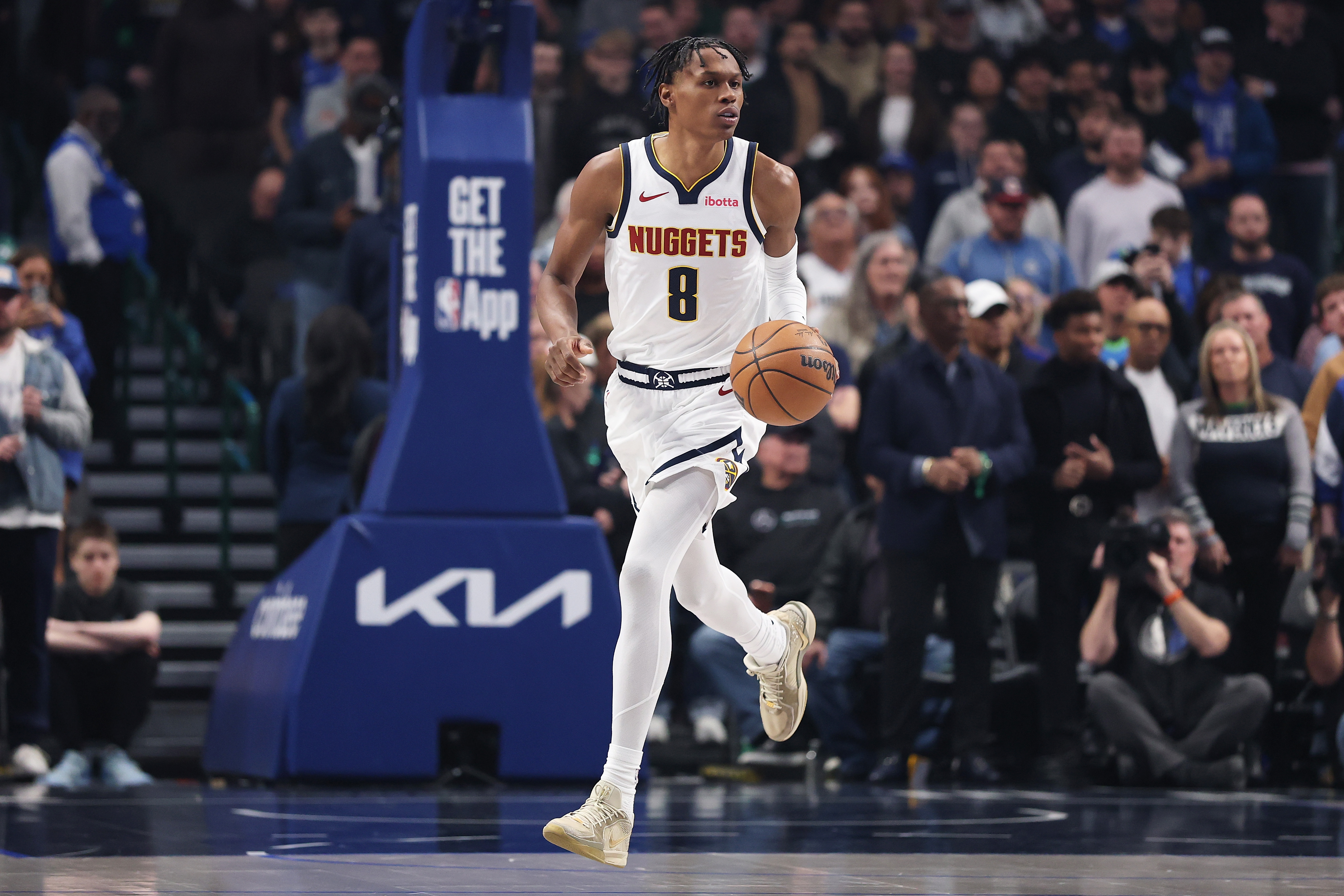
GettyDALLAS, TEXAS – JANUARY 14: Peyton Watson #8 of the Denver Nuggets handles the ball during a game against the Dallas Mavericks at American Airlines Center on January 14, 2026 in Dallas, Texas.
Watson, 23, is a restricted free agent, which makes any approach difficult. The Nuggets could match any offer to retain him and are reportedly planning to do so.
The 6-foot-8 star is coming off a breakout season in Mile High City, averaging 14.6 points, 4.9 rebounds, 2.1 assists and 1.1 blocks per game. He shot 49.1% from the field and 41.1% from three while starting 40 of his 54 appearances.
Watson’s camp is reportedly seeking north of $25 million per year which is unfavorable for the Nuggets at this point. Denver already has huge commitments to Nikola Jokic, Jamal Murray, Anthony Gordon and Christian Braun.
The Lakers can capitalize on the Nuggets’ need to move for pieces for flexibility and pitch a move for Watson. There would be adequate space to fit in the incoming star with the outgoings in this framework.
The Lakers can offer Watson a multi-year deal that doesn’t affect their flexibility. Vanderbilt’s outgoing deal is the most notable, which is why the Lakers have put him at the top of their moving list for now.
Watson’s Upside and Adding Herb Jones to the Roster

GettyLuka Doncic #77 of the Los Angeles Lakers passes the ball as he is pressured by Herbert Jones #2 and Jeremiah Fears #0 of the the New Orleans Pelicans during the second quarter of an 2025 Emirates NBA Cup game at Smoothie King Center on November 14, 2025 in New Orleans, Louisiana.
The Lakers would also get Jones out of this trade from the Pelicans. He is on a three-year, $68 million extension going through 2028-29 with a player option. His cap hit for 2026-27 sits at around $14.9 million.
With Watson and Jones, the Lakers would be bringing in roughly $38 million worth of salary, adding both Saddiq Rey for depth while sending out only about $26 million. This scenario would push L.A. well over its luxury limit but not into restrictive zones.
A potential lineup having Watson and Jones alongside Doncic, Austin Reaves and the newly acquired Walker Kessler, is positioned to be a strong core.
The real hurdle is getting Denver to move on from Watson. The franchise is committed to keeping him, even if it means giving up one of their more seasoned stars. They did activate a qualifying offer, making him restricted and they intend to match offers. Although a sign-and-trade is not impossible and the Lakers can work with that.
Adel Ahmad Adel is a writer with over five years of experience covering the NBA. His work has appeared on various media platforms, both national and local. More about Adel Ahmad
-

 Texas2 minutes ago
Texas leaders question federal handling of fatal ICE shooting
-

 Utah5 minutes ago
Babylon Fire crosses 106,000 acres, nears 50% containment
-

 Vermont10 minutes ago
Vermont’s McCarthy picked in second round of MLB Draft by Atlanta Braves
-

 Virginia17 minutes ago
West Virginia teenager says she was sexually harassed by trans peer in locker room | Fox News Video
-

 Washington20 minutes ago
Washington Syrah Is the State’s Best-Kept Secret
-

 Wisconsin25 minutes ago
Three missing after boat overturns on Lake Pepin late Saturday night
-

 West Virginia32 minutes ago
DEP headquarters renovation project making progress in Kanawha City – WV MetroNews
-
 Wyoming35 minutes ago
Health and elections: Vote like your life depends on it

