Business
Commentary: Farewell to Peter Duesberg, a godfather of scientific disinformation


It can hardly be disputed that science and medicine today are awash in disinformation.
It’s why respected scientists get physically assaulted and hauled before partisan committees in Congress to be smeared. It’s why childhood vaccine rates in some places are plummeting and measles is on the rampage across the country.
Therefore, it behooves us to look at the origins of this outbreak of politically manipulated pseudoscience. Nature has given us a peg, with the death Jan. 13 of former UC Berkeley scientist Peter Duesberg, at 89.
Peter Duesberg was an AIDS denialist. He is the precursor to contemporary denialists like RFK Jr., who brought AIDS denialism into the 21st century.
— Yale epidemiologist Gregg Gonsalves
At the dawn of research into what is now known as HIV/AIDS, Duesberg took the heterodox view that HIV was a harmless virus that had nothing to do with AIDS.
“That virus is a pussycat,” he said. He maintained that the cause of AIDS had to be found elsewhere, notably the lifestyles and drug habits of gay men. His claim motivated a phalanx of AIDS deniers, the forebears of the anti-vaccine militants today.
“Duesberg was a pioneer of disinformation on infectious disease,” says John P. Moore, professor of microbiology and immunology at Weill Cornell Medical College and the author of a devastating 1996 takedown in Nature of Duesberg’s claims.
Duesberg’s embrace of a dangerously wrong hypothesis to the point that it destroyed his career is almost a Shakespearean narrative.
The German native built a career in the U.S. as a brilliant virologist with significant discoveries to his credit and long had been revered among his colleagues. But that ended when he entered the HIV wars. By 1996, Richard Horton, then the editor of the Lancet, the British medical journal, could marvel: “He is now perhaps the most vilified scientist alive.”
Some of the adversaries against whom he leveled ad hominem attacks — he accused Anthony S. Fauci, the respected immunologist and long-term director of the National Institute of Allergies and Infectious Diseases, of committing mass murder by promoting the use of the highly toxic drug AZT against HIV — could barely hear his name without suffering apoplectic fits. AZT remains part of standard HIV therapies and is estimated to have saved or prolonged millions of lives.
Asked by science journalist William Booth to respond to a Duesberg statement, Robert Gallo, the co-discoverer of HIV, replied, “I cannot respond without shrieking.” Fauci derided Duesberg’s scientific claims as “absolute and total nonsense.”
But it would be a mistake to think that Duesberg’s baleful influence on medical science will end with his death.
Duesberg’s heirs are all around us. Actually, they’re more than that — they’re now in charge.
As secretary of Health and Human Services, Duesberg’s most highly placed follower, Robert F. Kennedy Jr., is presiding over what has become an overtly anti-vaccination and anti-science agency with a stranglehold on government health policy and funding.
“Peter Duesberg was an AIDS denialist,” says Gregg Gonsalves, a Yale epidemiologist who was active in the AIDS research community starting in the 1990s. “He is the precursor to contemporary denialists like RFK Jr., who brought AIDS denialism into the 21st century.”
Indeed, Kennedy has embraced the denialist position that HIV is not the cause of AIDS: In a 2023 interview with New York magazine, Kennedy attributed the conclusion that HIV and AIDS were inextricably linked to “phony, crooked studies to develop a cure that killed people,” referring to AZT.
In his 2021 book “The Real Anthony Fauci,” Kennedy highlighted Duesberg’s depiction of Fauci as an all-powerful scientific panjandrum intent on blocking his grant applications because his findings might be costly for Fauci’s patrons, Big Pharma.
Kennedy also picked up Duesberg’s broader brief against government science agencies such as the Centers for Disease Control and Prevention. Duesberg’s claim was that the CDC existed only to drum up medical emergencies so the NIH could solve them, ensuring the continued flow of taxpayer dollars into both agencies.
Starting in the mid-1970s, Duesberg asserted and Kennedy quoted, “‘the CDC increasingly needed a major epidemic’ to justify its existence.”
Kennedy added his own gloss: “Drumming up public fear of periodic pandemics was a natural way for NIAID and CDC bureaucrats to keep their agencies relevant.”
One can draw a straight line from that statement to the unapologetic malevolence with which Kennedy treats the CDC and NIH, insinuating that they’re rife with corruption and conflicts of interest. I sought a comment from Kennedy about Duesberg’s influence on his thinking, but received no reply.
Because AIDS isn’t caused by a virus, Duesberg maintained, the antiviral drugs used as therapies were worse than the disease. He specifically targeted AZT, then as now a common component of AIDS therapies.
The publicity his claims received encouraged untold patients to refuse AZT, causing a toll that may number in the millions. Duesberg met with South African President Thabo Mbeki and chaired a South Africa conference on alternative AIDS theories in 2000, and influenced Mbeki to deny AZT treatments for South African patients. That policy contributed to more than 300,000 deaths from AIDS in that country alone.
“That’s his biggest legacy in terms of the death toll,” Moore says.
Duesberg’s intellectual journey points to an eternal question in science: At what point does a theory become so discredited and the empirical evidence against it so strong, that its advocates should be ignored?
For Duesberg, that point may have come in 1989, when he published an article in the Proceedings of the National Academy of Sciences outlining his position in detail. The article was filled with with so many assertions about virus science that experienced virologists knew to be false that it “closed the book on him,” Moore told me.
But as Jon Cohen of Science magazine would observe, “the press was less skeptical.” Journalists saw Duesberg as an iconoclastic truth-teller because he carried “visible credentials,” as Gallo put it — after all, he was a professor at a leading research university and a member of the elite National Academy of Sciences.
The press feasted on Duesberg’s self-portrayal as the victim of ostracism arising from professional jealousies — a target of cancel culture before that was a thing. But it rang as false then as do those of RFK Jr.’s anti-science appointees who claim today to have been silenced for their unorthodox views while proclaiming their victimhood at university-sponsored symposiums and appearances on Fox News.
Duesberg’s position also appealed to “the unwary, desperate or gullible” with “twisted facts and illogical lines of argument,” Moore wrote in 1996.
He attracted followers eager to make their name by challenging the scientific consensus on HIV and AIDS.
One was Robert Willner, who had lost his medical license in Florida for claiming to have cured an AIDS patient by administering ozone. Willner went on the road with presentations that included his injecting himself with blood from an AIDS sufferer, as if to show that there was nothing to be feared from HIV. (Willner died in 1995 of a heart attack.)
In his 1989 article, Duesberg had insisted that the true cause of AIDS was drug use by abusers and nitrite poppers favored by homosexuals. AIDS had only been discovered and named, he wrote, because “the particular permissiveness toward these risk groups in metropolitan centers encouraged the clustering of cases that was necessary to detect AIDS.”
His advice was that AIDS prevention efforts should be “concentrated on AIDS risks rather than on transmission of HIV,” which — if followed — would have set AIDS research inexorably down the wrong path.
Duesberg kept making his argument well after evidence that the human immunodeficiency virus, HIV, causes AIDS became incontestable. It’s on that evidence that AIDS treatment is based today, with spectacular success — with proper treatment, an AIDS patient can live about as long as an uninfected individual. In the old days, an infection was a death sentence.
The memorial page posted by UC Berkeley after Duesberg’s death walked a tightrope in acknowledging his descent into infamy. In its first sentence, it labeled him as a “public controversialist,” a term new to me. It recounted, “In his later years, Peter enjoyed being a maverick and the center of controversy.”
But it candidly addresses the controversies he triggered by noting that his unorthodox stance “was amplified by political leaders to the detriment of public health.”
And it delivers a final verdict that “the scientific consensus is that HIV is indeed the primary cause of AIDS, and that the current suite of anti-retroviral agents is very effective in slowing or halting the progression of the disease and its spread in the population.”


Robotaxis could be turning into robocops.
A self-driving Waymo reported two teens to San Mateo, Calif., police on Monday after they were found drinking alcohol and shooting toy guns in the back of the vehicle.
According to a social media post from the San Mateo Police Department, officers detained two 15-year-olds after the Waymo they were riding in contacted the department and stopped in a parking lot until law enforcement arrived.
“Parents do you know where your teens are?” the San Mateo Police Department wrote on Facebook following the incident. “Waymo does!”
Officers removed both teens from the vehicle and determined they were using toy guns to shoot Orbeez out the windows. Orbeez are small, water-absorbing beads sold at toy stores.
“Toy guns, water guns, and BB guns all pose real dangers, especially to an untrained eye,” the Police Department said. “The simple handling of them can cause fear in [passersby].” “
A video posted on Facebook shows at least five officers and a police dog responding to the scene and approaching the Waymo with their weapons raised.
Waymo did not immediately respond to a request for comment.
Waymo vehicles have internal cameras and microphones that may be used in an emergency or to “promote safety and security,” according to Waymo’s online support page.
The cameras are also used to ensure the vehicles are clean and to help find lost items, according to the support page.
The company said it does not use facial recognition or other biometric identification technologies to identify individuals.
“In more urgent circumstances, support may access live video during a trip,” the Waymo page said.
The San Mateo Police Department’s Facebook post has garnered nearly 60 comments, with one user accusing Waymo of “snitching.”
“At least they got a designated driver?!” one user commented.
Business
Commentary: How right-wing anti-transgender attacks led to a Supreme Court ruling upholding sex discrimination
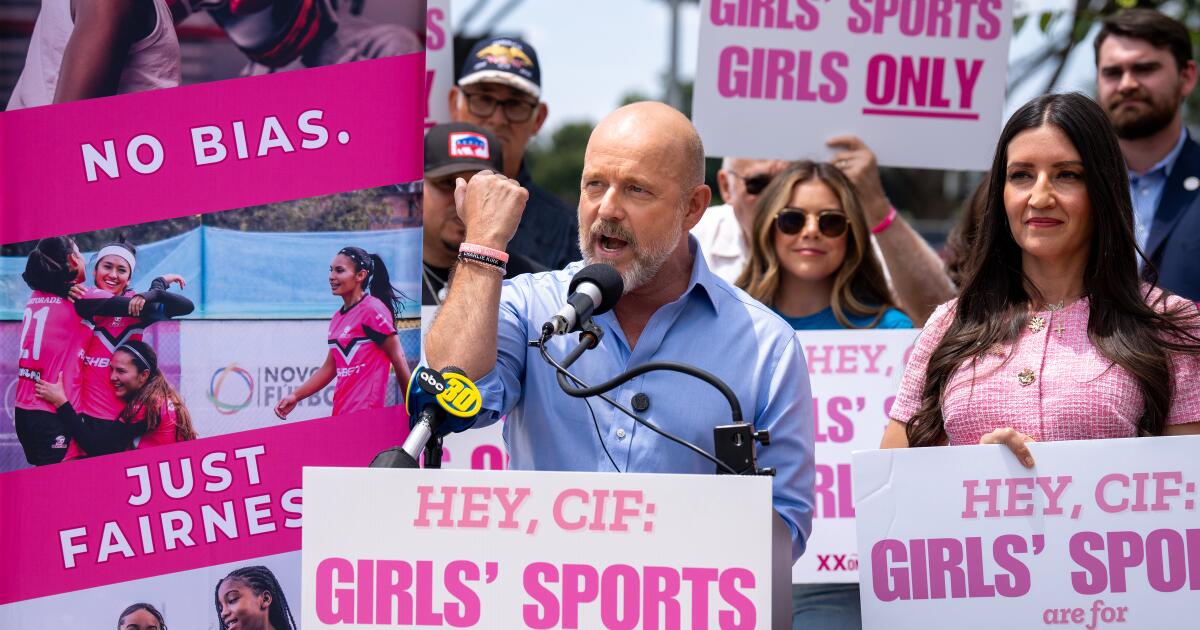
At the Supreme Court, the unfounded fear of boys masquerading as girls in youth sports rolled the clock back on gender equality.
On the surface, the Supreme Court’s June 30 opinion upholding state laws barring transgender girls from women’s and girl’s sports teams looks like a victory for women’s rights.
The 6-3 opinion by Justice Brett M. Kavanaugh certainly presents itself that way. “Females and males have inherent physical differences relevant to athletic performance,” Kavanaugh wrote. “Therefore, in contact sports, forcing female athletes to compete against males can create significant safety risks.” He also asserted that “forcing female athletes to compete against males can undermine competitive fairness.”
The ruling applied to prohibitions enacted in Idaho and West Virginia against “biological” males’ participation on women’s teams in public schools. Federal judges in both states overturned the bans. The Supreme Court majority restored them. The ruling essentially upholds similar bans enacted in 25 other states.
There was no record of any transgender person participating in school sports in the State, let alone any ‘problem’ with transgender students … creating unfair competition or unsafe conditions.
— Justice Sonia Sotomayor, demolishing the Supreme Court’s argument in favor of banning transgender girls from girl’s sports
Kavanaugh, like Donald Trump and others in the anti-transgender camp, maintained that one’s gender is an immutable fact of life, established even before birth.
Anything else, Trump stated in an executive order he issued on inauguration day 2025, could only be the product of “gender ideology extremism.” The U.S., his order stated, recognizes “two sexes, male and female. These sexes are not changeable and are grounded in fundamental and incontrovertible reality.” That’s a “biological truth,” he declared.
In his own version of this overconfident and factually insupportable conclusion, Kavanaugh wrote: “As all agree, females and males have inherent physical differences relevant to athletic performance.”
Science recognizes that some people are “born with sex traits that don’t fit into typical male or female patterns,” to cite a discussion on the Cleveland Clinic web page on the topic “intersex.” The condition “may involve chromosomes, hormones, reproductive organs or genitals.”
From a psychological standpoint, medical science recognizes “gender dysphoria” as a real condition often requiring counseling and medical intervention such as the use of puberty blockers and hormones to stave off the development of secondary sex characteristics until the condition can be resolved.
No one disputes that there are physical differences between the sexes. Few would dispute that on average or even at the median, males may be bigger and more powerful than females, or that in certain contact sports the difference may be telling and on occasion dangerous.
But that’s not the same as asserting that the physical differences between males and females invariably mean that men will invariably prevail over women in all competitions or that their participation will endanger women.
The International Olympic Committee — in a policy statement Kavanaugh cited incompletely — says that in “most running and swimming events,” males have a 10% to 12% advantage over women. That’s a range that would accommodate the full spectrum of outcomes — transgender females win, cisfemales win, they tie. (The “cis” prefix denotes those living consistent with their birth gender.)
West Virginia and Idaho addressed this ambiguity by banning transgender women from all girls’ teams. So under their rules transgender girls can’t play football or soccer with cisgirls. But what’s the argument in favor of banning them from the 100-yard dash, or cross-country track, or diving, or archery?
But something else is going on here. The Supreme Court’s ruling was almost preordained, given the years-long campaign by conservatives to demonize transgender individuals as if they’re members of an alien species.
It will be recalled that during his presidential campaign, Trump spun a despicable fantasy in which children were kidnapped in school and secretly subjected to sex-change operations.
Trump’s executive order wiped out policies aimed at protecting transgender adults from discrimination. He moved to outlaw gender-affirming medical therapies for anyone under 19 by cutting off federal funding for healthcare institutions that provide such care.
He banned transgender individuals from serving in the military and ordered federal prison officials to move transgender inmates into the general populations consistent with their birth genders, which exposes them to physical assault. (Federal Judge Royce Lamberth of Washington, D.C., has blocked the government from transferring three transgender women into the male prison population or terminating their hormone treatments.)
I wrote during Trump’s first term, when his anti-transgender policies were still gestating, that the goal was to show that “one can target any community, as long as it doesn’t have a strong political voice or political power. These are the actions of bullies and cowards, pretending to be strong.”
Last year, the Supreme Court struck its first blow against transgender rights by upholding a Tennessee law banning transgender care, including puberty blockers and hormone therapy, for minors. Similar laws have been enacted in 25 other states. The majority in that ruling by Chief Justice John G. Roberts Jr. was identical to the one in the June 30 ruling — Roberts, Kavanaugh, and Justices Clarence Thomas, Samuel A. Alito Jr., Neil M. Gorsuch and Amy Coney Barrett.
Who are the targets of this ideological campaign? They number only about 1.6 million U.S. adults, or one-half of 1% of the U.S. population. About 300,000 adolescents ages 13 to 17, or 1.4%, identify as transgender, according to a study by UCLA School of Law.
In West Virginia, as Justice Sonia Sotomayor observed in her dissenting opinion, “there was no record of any transgender person participating in school sports in the State, let along any ‘problem’ with transgender students … creating unfair competition or unsafe conditions.”
In endorsing the flat bans directed at transgender women in Idaho and West Virginia, Kavanaugh argued that any attempt to implement case-by-case judgments of students’ requests to join sports teams inconsistent with their biological gender would create “an enormous practical and administrability problem.”
Is that so? That wasn’t the case in Maine, where the annual K-12 population is more than 170,000. There, a committee was charged with determining whether a student’s participation in a sport consistent with their gender identity but inconsistent with their biological sex would “result in an unfair athletic advantage” or present a risk of injury to others. The committee held 56 hearings from 2013 through 2021, or an average of seven per year. During the entire time span, only four involved transgender girls. (The outcome of those hearings couldn’t be learned.)
It was Maine’s policy, one might recall, that provoked a confrontation between Trump and Maine Gov. Janet Mills at the White House last year, when Trump threatened to withhold federal funding from the state unless it barred transgender students from competing on women’s sports teams. “We’ll see you in court,” Mills snapped.
Whether the Idaho and West Virginia laws genuinely protect girls from unfair competition is questionable. (The Idaho law is styled the “Fairness in Women’s Sports Act.”) In practice, the laws may subject women in public schools to “invasive sex verification procedures,” as educational expert George Theoharis of Syracuse University wrote after the court ruling.
They’re also based on a retrograde view of women as fragile creatures needing men’s protection, Theoharis wrote — “the same logic that has historically been used to justify excluding women from making their own healthcare decisions and girls from rigorous math and science; that physically demanding work is simply beyond them.” (There don’t appear to be any state laws barring transgender women from competing in men’s sports.)
Becky Pepper-Jackson, the plaintiff in the West Virginia case, in which she is identified only as B.P.J., is the only transgender girl who sought to join girl’s teams — track and cross-country — in the state. That was in 2021, just after West Virginia passed its law and she was about to enter sixth grade. She didn’t appear to pose any competitive risk to others on the track and cross-country teams she applied to join — her lawyers told the Supreme Court that on those no-cut teams, she “came in near the back.”
Anyway, she had not gone through male puberty, which theoretically might have endowed her with a competitive advantage, because she had been taking puberty blockers and female hormones.
Thanks to the court’s ruling, Sotomayor observed in a dissent joined by Justices Elena Kagan and Ketanji Brown Jackson, West Virginia can deny Becky access to school sports “because it thinks they have an inherent athletic advantage, even if the facts show that they do not.”
B.P.J., Sotomayor wrote, “cannot practice on girls’ teams, even if she would not take anyone’s spot in an eventual competition, even if everyone who tries out for the team makes it, and even if having the chance to participate could aid immensely in treating B. P. J.’s gender dysphoria.”
So whose interest was really protected by the Supreme Court?

An Orange County real estate investor accused of criminally defrauding an Arizona bank of nearly $100 million pleaded not guilty Monday and remains in custody.
Mahender Makhijani, 44, of Corona del Mar — who also was ordered by an arbitrator to pay $1.34 billion in a separate civil fraud case — was arraigned in Santa Ana federal court on two charges.
He is accused of bank fraud and making a false statement to a bank in a June 8 case involving a $100 million real estate loan made by Phoenix-based Western Alliance Bank. He was taken into custody on June 10.
Makhijani is accused of providing bogus collateral for the October 2024 loan now in default. In a civil lawsuit, Western Alliance said the outstanding balance as nearly $99 million.
Prosecutors say he falsified title insurance policies that showed the bank would have a first lien on the underlying collateral if the loan went bad, when in fact it did not.
A trial was set for August 11 before U.S. District Judge David O. Carter in Santa Ana.
Michael Schachter, his criminal defense attorney, did not respond to messages seeking comment.
In the civil case, an arbitrator in May ordered Makhijani to pay Laguna Beach real estate mogul Mohammad Honarkar $1.34 billion after ruling he had fraudulently induced him into a 2021 joint venture — and then wrested control and lost to creditors more than two dozen properties Honarkar had owned.
Makhijani has not been criminally charged in that case, but prosecutors alleged in an affidavit in support of the bank fraud charges that he used “force and threats” in his dealings with Honarkar and others — including taking over the landmark Hotel Laguna in 2023 that Honarkar was renovating.
Prosecutors sought to hold Makhijani without bail after his arrest.
The affidavit noted he is a legal Indian immigrant with a home and bank accounts in that country, has access to private jets and threatened to “run away” if caught in a difficult situation.
The request was denied and he was granted $500,000 bail.
However, Makhijani remains in custody after a hearing sought by prosecutors last month before Magistrate Judge Autumn Spaeth.
The judge declined to accept a $450,000 cashier’s check submitted by a Makhijani associate for the bail, finding insufficient proof the source of the funds was legitimate, according to court records.
Makhijani is not prominent outside Orange County real estate circles, but he established a thriving distressed-assets business over the last decade that attracted prominent Southern California real estate investors.
Prosecutors said it paid for a lifestyle that included two multimillion-dollar homes in Corona del Mar, a luxury apartment in Newport Beach and various luxury vehicles.
As of last month, prosecutors had not fully traced his assets, which they believe are not held in his name and some of which may be in India.
The businessman employed an array of shell companies and strawmen to sign documents on his behalf, and to stand in for him as operators of his companies, according to the affidavit.
Makhijani told an associate he took extra precautions because wanted to insulate himself from litigation and that “they were sharks in the distressed world who took advantage of people,” the affidavit stated.
-

 Oregon11 seconds ago
A Song Gives a Look Into Oregon’s Largest Juvenile Corrections Facility
-

 Pennsylvania5 minutes ago
Federal lawsuit: Conviction for small amount of marijuana should not preclude getting a license to carry a firearm
-

 Rhode Island12 minutes ago
What will happen at the 2026 Rhode Island State Amateur? History.
-

 South-Carolina15 minutes ago
Oh, Goodbye: Four-Star South Carolina RB Aiden Gibson Flips To Rutgers
-

 South Dakota20 minutes ago
South Dakota governor’s office reports helping with over 800 deportations as feds deliver funding
-

 Tennessee27 minutes ago
A Tennessee woman was heard screaming, ‘he’s got a gun.’ Now her husband is pleading guilty to her murder.
-

 Texas30 minutes ago
US immigration officer shoots and kills man in Texas
-

 Utah35 minutes ago
Chicago man guilty of trafficking 25 lbs of cocaine through Utah with gun, $14k in cash

