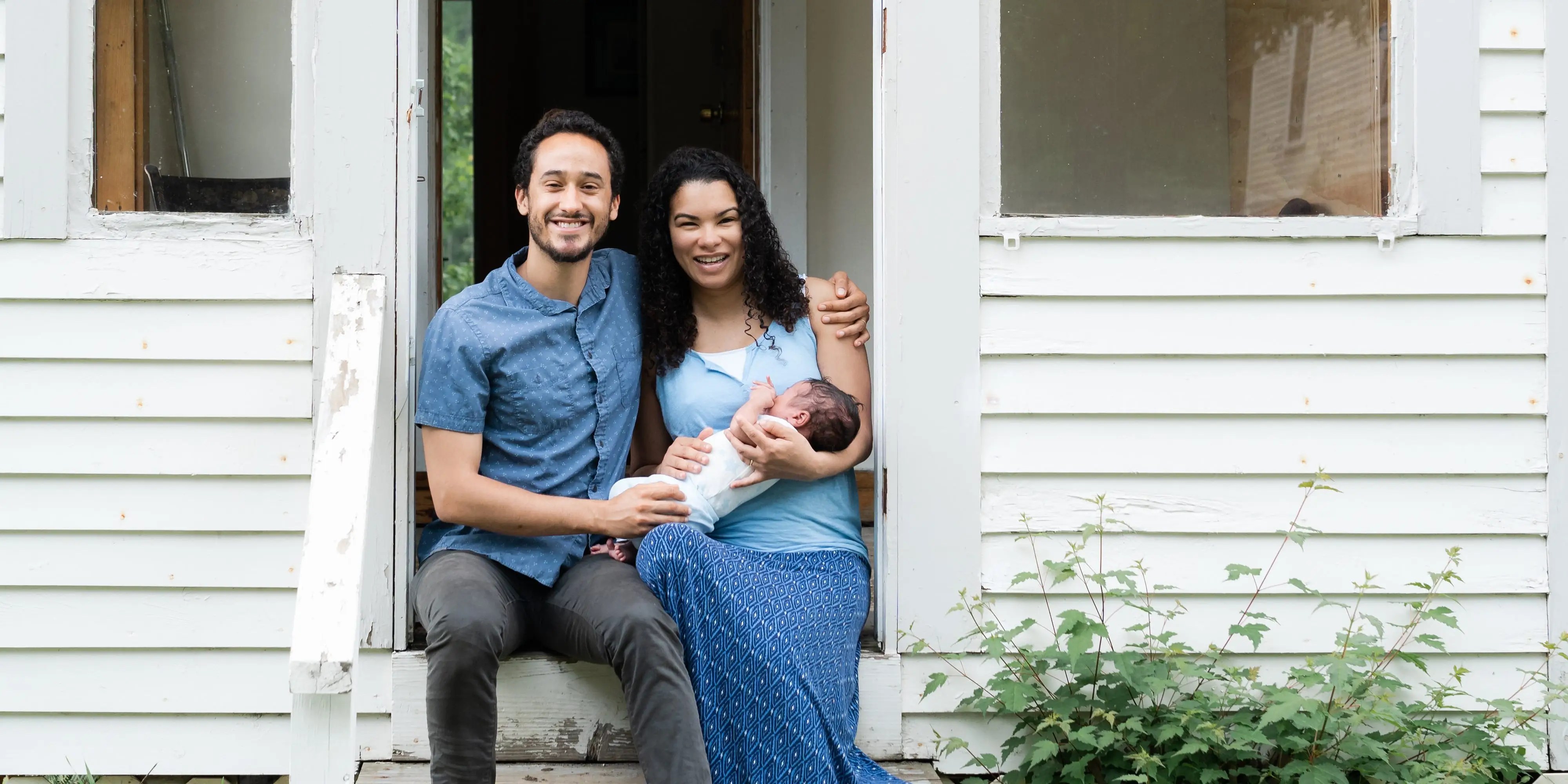
They were looking for an affordable place they could call their own: A house where they could put down more permanent roots, that ideally came with one or more acres of land where they could garden and start homesteading projects.
The couple found a one-bedroom home in Vermont.
Two Of Us Photography. Photo provided by Full Joy Farm.
It was around the same time as the pandemic, so the couple decided to take advantage of their remote working arrangements to explore different towns.
Advertisement
“Because our work was remote — we were both working in schools at the time, which shut down — we were able to move around a bit on this sort of spring break trip,” Taylor, 34, told Business Insider.
During their road trip, the couple stumbled onto the Upper Valley area in Vermont and fell in love with the location.
The couple lived in an apartment in Brooklyn prior to moving to Vermont.
Full Joy Farm.
With that, they decided to take the leap and moved out of NYC into a 350-square-foot studio apartment in Hartford, Vermont, near Dartmouth College, which they found online.
Advertisement
“It was probably slated for one person related to the college. But those lists of apartments, that’s public access, so it doesn’t have to be a Dartmouth student who lives there,” Tatum, 30, told BI.
The couple temporarily lived in an apartment in Hartford, Vermont, before they found their one-bedroom house.
Full Joy Farm.
It was a temporary arrangement — and a way to have an official address in Vermont — while they continued looking for proper housing in the area.
A fixer-upper within their budget
When they chanced upon the listing for a one-bedroom, one-bathroom fixer-upper in the small town of Pomfret, it was love at first sight.
Advertisement
“I thought it would be perfect for us,” Taylor, who is an artist, said. “At the time, it wasn’t a house, so I didn’t see it set up in a residential way. It was not lived in for at least, I want to say, about a decade or more.”
The exterior of the one-bedroom house in Vermont.
Full Joy Farm.
The 650-square-foot cottage was being used as an office for a local business, but Taylor saw its potential despite that.
“I saw the beauty of the natural lighting, there was a lot of sunlight. There are a lot of neat details with the wood and the cabinets which I thought were really cute. And then, mostly, the outdoor space was what we wanted,” she said.
Advertisement
The living room area and sofa.
Full Joy Farm.
The charming house came with 2.6 acres of land. It was initially listed for $225,000, but the price had been steadily decreasing.
“Not very popular on the market as far as a one-bedroom house, but we wanted a small house and it was perfect for when the price was reduced,” Taylor said.
The couple bought the property for $160,000 in March 2021. It took them about three to four months to close on the house, and moving in felt good.
Advertisement
Tatum did some of the renovation work himself.
Full Joy Farm.
“We packed up and moved a dozen or more times during the summer of 2020, so to be able to do that for the last time and unpack the boxes — knowing that we had no intentions to repack them — was a great relief,” Tatum, who works in parks and recreation, said.
Turning the house into a home
Although Tatum did some of the renovation work himself, the couple also hired a carpenter to assist them with some projects.
The first thing the couple did was fix up the sliding door that leads to their porch. The door was broken, and the wood underneath was rotting.
Advertisement
The couple plans to live here in the long term.
Full Joy Farm.
“With winter fast approaching, we absolutely had to take care of that in the first months of us getting here,” Tatum said. At that point, the couple was also expecting their first child, and that served as another form of motivation to improve things around the house.
While they’re still on the grid, the couple also invested in solar panels for their home.
“I think it’s a good investment since we’ll save a lot of money over time. And I think it’s an indication that we intend to be here for the long run,” Tatum said.
Advertisement
In an effort to be more sustainable, most of the items in the home are either gifted, thrifted, or free.
Taylor says that most of the items in the house are gifted, thrifted, or free.
Full Joy Farm.
“I encourage people always to use what’s there, whether it’s salvage or free materials, instead of going out and trying to buy a bunch of stuff to set your home and garden up,” Taylor said.
The couple’s home is located on the main road of their town, which consists of about 1,000 people spread out across miles of mostly farmland. They’re 20 minutes from the nearest hospital and about an hour and a half from the city of Burlington.
Advertisement
While they have neighbors right across the street, the population density in the town is low.
“So our neighbors are right across the street from us. For context, they have about 75 acres, and their neighbors have 500. And we live on about two and a half acres here,” Tatum said.
The couple enjoys the privacy that their home affords them.
Full Joy Farm.
What the couple loves about their home is the amount of privacy it affords them, without being too secluded.
Advertisement
“Maybe they could hear through the walls in our Brooklyn apartment, but if we needed help and we were to yell loudly here, our neighbors would hear us,” Tatum added.
The couple also manages a small campsite on their land where people can come and enjoy the outdoors. There’s a firepit where guests can start a campfire, and a composting toilet is available. Rates start from $24 a night for a maximum of four guests.
While the campsite is open all year round, Taylor says most people come between April and November.
The couple manages a campsite on their land.
Full Joy Farm.
Advertisement
City versus small-town living
Life in Vermont is quite different from in NYC.
For instance, they drive now, whereas they didn’t before.
“In New York City, I did not drive. I walked to work, I biked to work. If I wanted to visit a friend 90 minutes away, that meant I was on a train and we traveled 10 miles. And here, I drive 10 miles to work every day,” Tatum said.
The way they interact with their community is also very different.
“In New York City, we’re not waving at everyone we pass by because if you did that, you’d go insane. It’s too many people, and not everyone is your friend there,” Tatum said. “But here in Vermont, everyone waves at you, and you learn to wave back. It’s very friendly and very welcoming.”
Advertisement
The play area for their son, who is now 2 years old.
Full Joy Farm.
While it was tough to make friends in Vermont at first — since it was the pandemic — it became easier to get to know new people, especially after they had their son.
“We met other parents and families through playgroups and things like that, and got to know our neighbors more,” Taylor said.
The slower pace of life in Vermont has been refreshing compared to the hustle and bustle of the city, Taylor, who was originally from Pennsylvania, added.
Advertisement
“I lived in New York City for about four years, and it’s something that I knew I wouldn’t be able to sustain long-term in terms of the sensory overwhelm and the pace of life,” she said.
The couple says they like the slower pace of life in the countryside.
Full Joy Farm.
That said, with a two-year-old toddler in tow, the young parents are “still exhausted,” Tatum, who is originally from NYC, said.
“The pace here is slower, but that doesn’t mean that we’re not running around, trying to get him from play date to day care and back to work. I just can’t imagine how we’d pull it off in New York,” he added.
Advertisement
Getting used to life in the country
The Barnes family isn’talone in their journey.
More and more Americans are being priced out of the city. A single person in NYC would have to make about $140,000 to live comfortably, and this amount jumps to $318,000 for a family of four consisting of two adults and two children.
It comes as no surprise that many lower-earning New Yorkers and even young families are choosing to move to the suburbs or leave the country entirely in order to enjoy a lower cost of living. A December 2023 report from the Fiscal Policy Institute found that 65,242 residents who earned between $32,000 and $65,000 left NYC in 2022, compared to 50,160 of those who earned over $172,000.
However, the couple says that things aren’t as straightforward as it seems.
“Compared to New York City, the mortgage is half that of what we paid for rent,” Tatum said. “And while that may look good on paper, the reality is that being homeowners means that those savings go to the repairs and the projects that allow us to push up our comfort in the space and our enjoyment of the house.”
Advertisement
At the end of the day, everything balances out, he said.
“We’re not suddenly wealthy because we are living in the country,” he added.
The couple found a one-bedroom house with 2.6 acres of land in Vermont.
Full Joy Farm.
The couple has some advice for those who want to move out of the city and into the country: Learn to let your guard down.
Advertisement
Tatum said that living in cities can teach people to be alert and wary of others, but that’s not how things necessarily work in the countryside.
“In small, rural towns, people often have good intentions — and you need to only reach out and ask for help to receive it,” he added. “Your greatest threat is not your fellow man, but the raccoons that are going to find their way into your attic or kill your chickens or the bears that are going to get too curious around your bird feeder. It’s a different set of threats, and it’ll take a little bit of time for your brain to make the switch.”
Have you recently built or renovated your dream home? If you’ve got a story to share, get in touch with me at agoh@businessinsider.com.
Check out the details from the Vermont/New Hampshire All-Star Hockey Classic at the University of Vermont on Saturday, June 27.
Women’s game: Vermont 2 and New Hampshire 1 in overtime.
Vermont stats
Advertisement
Goalies: Addie Croteau of U32 had 8 saves, and Dahlia Steele of BFA-St. Albans had 5 saves
Goals: Lilliana Fournier of Missisquoi Valley Union scored in the third period at 1:03, unassisted. Just 14 seconds into overtime (3v3), Zoe Zanleoni (Hartford) scored, assisted by Morgan Rivard (Kingdom Blades)
Sportsmanship award: Leah Miller (Essex)
MVP: Zoe Zanleoni (Hartford)
New Hampshire
Advertisement
Goalie saves: Andy Lindquist 30 saves
Goal: Meagan Rinko scored in the first period, at 14:50, unassisted with a power play goal
Sportsmanship: Sara Forman
MVP: Andy Linquist (Lebanon High School)
Men’s Game NH 1 VT 0
Advertisement
Vermont
Goalies: Thomas Barnes (CVU) 9 saves, and Ethan Fortin (Spaulding) 12 saves
Sportsmanship: Ethan Fortin (Spaulding)
MVP: Jack Kelly
New Hampshire
Advertisement
Goalie saves: Jorgen Drent 22 saves
Goals: The lone first-period goal was scored at 12:38 by Chad Lariviere (Concord High School), unassisted
Sportsmanship: Nolan Swiesz (Oyster River High School)
MVP: Jorgen Drent (Concord High School)
Buster Brush Award: Grace Raleigh (Rice High School)
Advertisement
Sam Caswell Award: Meagan Rinko (Oyster River / Portsmouth)
Powerball, Mega Millions jackpots: What to know in case you win
Here’s what to know in case you win the Powerball or Mega Millions jackpot.
Just the FAQs, USA TODAY
The Vermont Lottery offers several draw games for those willing to make a bet to win big.
Advertisement
Those who want to play can enter the MegaBucks and Lucky for Life games as well as the national Powerball and Mega Millions games. Vermont also partners with New Hampshire and Maine for the Tri-State Lottery, which includes the Mega Bucks, Gimme 5 as well as the Pick 3 and Pick 4.
Drawings are held at regular days and times, check the end of this story to see the schedule.
Here’s a look at June 28, 2026, results for each game:
Winning Pick 3 numbers from June 28 drawing
Day: 3-7-3
Evening: 3-8-8
Advertisement
Check Pick 3 payouts and previous drawings here.
Winning Pick 4 numbers from June 28 drawing
Day: 7-2-3-0
Evening: 2-5-9-9
Check Pick 4 payouts and previous drawings here.
Winning Millionaire for Life numbers from June 28 drawing
04-11-31-54-58, Bonus: 03
Advertisement
Check Millionaire for Life payouts and previous drawings here.
Feeling lucky? Explore the latest lottery news & results
Are you a winner? Here’s how to claim your lottery prize
For Vermont Lottery prizes up to $499, winners can claim their prize at any authorized Vermont Lottery retailer or at the Vermont Lottery Headquarters by presenting the signed winning ticket for validation. Prizes between $500 and $5,000 can be claimed at any M&T Bank location in Vermont during the Vermont Lottery Office’s business hours, which are 8a.m.-4p.m. Monday through Friday, except state holidays.
For prizes over $5,000, claims must be made in person at the Vermont Lottery headquarters. In addition to signing your ticket, you will need to bring a government-issued photo ID, and a completed claim form.
All prize claims must be submitted within one year of the drawing date. For more information on prize claims or to download a Vermont Lottery Claim Form, visit the Vermont Lottery’s FAQ page or contact their customer service line at (802) 479-5686.
Advertisement
Vermont Lottery Headquarters
1311 US Route 302, Suite 100
Barre, VT
05641
When are the Vermont Lottery drawings held?
Powerball: 10:59 p.m. Monday, Wednesday, and Saturday.
Mega Millions: 11 p.m. Tuesday and Friday.
Gimme 5: 6:55 p.m. Monday through Friday.
Lucky for Life: 10:38 p.m. daily.
Pick 3 Day: 1:10 p.m. daily.
Pick 4 Day: 1:10 p.m. daily.
Pick 3 Evening: 6:55 p.m. daily.
Pick 4 Evening: 6:55 p.m. daily.
Megabucks: 7:59 p.m. Monday, Wednesday and Saturday.
Millionaire for Life: 11:15 p.m. daily
What is Vermont Lottery Second Chance?
Vermont’s 2nd Chance lottery lets players enter eligible non-winning instant scratch tickets into a drawing to win cash and/or other prizes. Players must register through the state’s official Lottery website or app. The drawings are held quarterly or are part of an additional promotion, and are done at Pollard Banknote Limited in Winnipeg, MB, Canada.
Advertisement
This results page was generated automatically using information from TinBu and a template written and reviewed by a Vermont editor. You can send feedback using this form.
The Vermont Chamber has said it, in startlingly emphatic, hey wake-up because it is frightening close to too bloody late challenge, that if listened to, and acted on, could save the Green Mountain State.
The title of the Chamber’s missive which has been printed on various news sites is: “Vermont is in Trouble.” They follow it up with explanations that, if you love this beautiful state you will panic. Which is absolutely the correct reaction. But it is only the correct reaction if you are willing to help do something to solve the myriad pile of problems facing us.
The chamber states the issue this way: “We are aging, shrinking, and pricing out our own children, workers, and entrepreneurs. Schools face consolidation, taxes are climbing, and employers struggle to fill jobs. We’re too dependent on federal funding to support state spending. A housing shortage is driving up prices, slowing economic growth, and leaves young people feeling forced out. Staying the course is not a viable option. It only gets worse from here if nothing changes.”
Advertisement
They suggest some solutions:
Regulatory Modernization: Move from a culture of “permission” to a culture of “production.”
Fiscal Stewardship: Align our budget with economic reality.
Intentional Growth: Actively recruit and retain a diverse, working-age population.
Accountability: Ensure enacted policies achieve their goals.
Advertisement
Each of these is elaborated on by the Chamber. They also go on to say: “Vermont has experienced the nation’s largest percent decrease in population last year, becoming the only state losing population to both natural changes and net migration… Let’s choose abundance because Vermonters can no longer afford to choose scarcity.”
It is a Cri du Coeur that should be heard by every legislator, selectboard or city council, every business owner, civic organization, in the state. This isn’t a project for next year. This is a problem that demands immediate action!
In March I wrote a column remembering Governor Phil Hoff’s Vermont marketing campaign known as “Vermont the Becking Country.” The campaign brought thousands of people to the state. The same slogan might well, with an attractive invitation advertising campaign might get noticed by people and companies on the lookout for new opportunities. Newcomers should be happily welcomed. But missionaries from afar won’t solve our problems. This is a job for Vermonters.
The chamber mentions the crying need for new housing and laments that, “For decades, Vermont has treated growth as a threat to mitigate… True equity requires expanding supply rather than fighting over the crumbs of a shrinking economy.”
Their words need to be heeded. Immediately. We have dug ourselves a very deep hole. We aren’t going to climb out of it in a year or two. It is going to take years of constant hard work and a sizable fortune to get Vermont back to growing rather than shrinking. But if our children and grandchildren are going to have Vermont as a viable choice where to live and work, we need to begin making Vermont viable again immediately.
Advertisement
The Vermont Chamber is correct. They have stated the problem in bold words. They have challenged the government, the business community, the education system, the news media, and every single one of us to step up and begin the hard work of making the Vermont the Beckoning Country once again!
When the legislature returns to Montpelier in the fall, they need to get to work and Governor Scott can’t sit back and wait for the lawmakers to craft a long series of brilliant remedies to fix what is broken. Governor Scott needs to roll up his sleeves and work closely with those writing the bills. He also should gather members from the business world and those from not-for-profit organizations. Getting Vermont back on track is going to take an “All hands-on deck” attitude.
Time is running out for Vermont. The Green Mountain State is too precious to all it to wither away.
Eric Peterson has been contributing columns to various publications for decades. Opinions expressed by columnists do not necessarily reflect the views of Vermont News & Media.