Vermont
Why Does Vermont Have the Lowest Birth Rate in the Nation? | Seven Days


Claire MacQueen has no plans to have children anytime soon. It is not a question of desire or emotional readiness. MacQueen, 27, has always felt called to motherhood, envisioning it as one of life’s most fulfilling endeavors.
“Not just to be a mom, but a really good one,” she said.
MacQueen, a technical writer at a software company, said she simply can’t afford it.
Although MacQueen and her partner both work and have minimal debt, they feel unable to get far enough ahead of expenses to take the plunge. A large chunk of their shared income gets gobbled up by the $2,000 they spend each month on utilities and rent for their one-bedroom Burlington apartment.
The couple desperately want to buy a house, which would provide room to start a family and allow them to start building equity. Instead, they have been forced to raid their savings to cover more pressing expenses: vet bills, car repairs, large medical fees.
Having a child right now feels irresponsible, MacQueen said. She has no idea when that might change.
“A lot of things will need to fall into place,” she said.
Many young Vermonters making such calculations are coming to a similar conclusion. They are holding off on having children and having fewer when they ultimately do. Vermonters in their twenties and thirties overwhelmingly point to affordability as the key reason. Many also express a growing unease about the future and express doubt that they’ll be able to provide their children with a better chance to succeed than they had growing up. These factors, cited in interviews and responses to a query Seven Days posted on social media, show that the dwindling number of young Vermonters is partly due to the state’s high costs of housing and health care, both of which have proved difficult to fix.
For more than a decade, Vermont has had the nation’s lowest birth rate. The actual number of children born in the Green Mountain State is smaller today than before the Civil War, when Vermont had fewer than half as many residents it does now. Since Donald Trump was elected president, the inflow of immigrant families, which tend to be relatively larger, has slowed to a trickle.
The state’s high cost of living and an almost impenetrable housing market have made it difficult for young Vermonters to achieve the traditional milestones — marriage and homeownership — that they expect to reach before having children.
“You don’t have to be an economist or read the Wall Street Journal to know that today’s generation is not automatically getting ahead,” said Karen Benjamin Guzzo, a demographer at the University of North Carolina at Chapel Hill. “A lot of people look at their own lives, then envision the future and say, ‘I don’t know if I should do this.’”
Birth rates in affluent nations have declined for decades. After resisting the trend, the U.S. is now in the midst of its own sustained drop. Vermont’s rock-bottom position suggests that it is experiencing a particularly dramatic version of dynamics playing out elsewhere in the country.
The impacts extend well beyond the empty desks that are driving Vermont’s debate over school consolidation. While fewer births ease strain on the environment and public services, the trend also means that fewer young workers are available to fill job openings or support the growing population of seniors as baby boomers retire.
Countries have been trying for years to crank up birth rates through cash incentives or tax breaks, with little to no success. And the factors that appear to discourage Vermonters of childbearing age are hardly new. The state’s politicians have discussed the dearth of affordable housing and the rising cost of health care for years; Vermonters pay the highest insurance premiums in the nation. Progress in addressing these costs has been limited.
One area where Vermont has made strides toward easing the financial burden of parenthood is childcare. Major investments into its system have won plaudits for successfully expanding capacity and bringing costs down for some. Wait lists remain common, though, and some families still wind up paying $1,000 a month or more.
What seems clear is that any attempt to populate the state with more young Vermonters requires that policy makers address the dollars-and-cents anxieties of potential parents such as MacQueen.
How Low Will We Go?
Vermont wasn’t always a poster child for the baby bust.
In 1960, near the tail end of the baby boom, Vermont’s birth rate was slightly above the national average, at 126 per 1,000 women of childbearing age.
Over the next few decades, births in Vermont tracked national trends, generally declining as more women entered the workforce. Then, in the mid-1990s, Vermont’s births dropped precipitously to well below national rates.

It is hard to pinpoint what triggered the nosedive. But one potential explanation is that the shift toward waiting longer to have children — what demographers call the “postponement transition” — began to play out in Vermont much earlier than elsewhere.
Vermont is a highly educated, left-leaning state with comparatively low rates of religion. The first groups to delay childbearing en masse coming out of the women’s movement? Secular liberals who attended college and used their early twenties to earn degrees and launch their careers.
Whatever the reason, Vermont’s birth rate remains far below the national average. Vermont recorded 5,023 births in 2024, more than 1,500 fewer than annual tallies from the late 1850s. The state’s fertility rate is 41.5 per 1,000 women of childbearing age, lagging the national average of 53.
The question now is how much further Vermont’s birth rate may fall.
Younger people today report greater ambivalence about having children than past generations. And Seven Days heard from several couples in their thirties who say they’ve decided to not have children at all.
Still, national surveys suggest that the overwhelming majority of people still say they want children — between two and three, on average. They’re just having fewer — perhaps because the longer couples wait, the harder it is to get pregnant. Female fertility declines with age. A 25-year-old woman is two to five times more more likely to conceive as a woman who is 40.
Guzzo, the demographer, said she’s amused when people are surprised by the trend toward delayed parenthood. For decades, the U.S. sought to discourage women from having children until they could properly support them.
“We shamed teen moms. We shamed unintended pregnancies,” she said. A lesson drummed into members of today’s generation was to be sure they had everything in order before having children.
“A lot of people just don’t feel ready,” she said.
It Takes a Village — and a Home
In interviews, the most common reason Vermont couples gave for holding off on children was the desire to better establish themselves financially. That may include paying off student loans or saving up to afford childcare.
Very often that means buying a home, which can be a Herculean task in a competitive housing market such as Vermont’s, where prices have risen far faster than incomes.
The median home price in Vermont has doubled over the past decade, to about $500,000. A couple would need to earn at least $150,000 a year, based on current interest rates, to comfortably afford such a home. And that’s only if they can manage to scrounge up $100,000 for a down payment.
It’s nearly impossible to find the type of classic, affordable starter home that allowed past generations to build equity. Builders are no longer interested in them, citing low margins amid rising construction costs. Exacerbating the shortage of available single-family homes is a trend toward aging in place, coupled with a lack of affordable options for Vermont’s burgeoning senior population.
The new units coming online now are predominantly studios and one-bedroom apartments — not exactly suitable for young families.
James Mullin and Emmaleigh Hancock, two young professionals in their late twenties, say they’re struggling to envision homeownership in Vermont.
Mullin works as a legal assistant at a law firm, and Hancock is pursuing a PhD in molecular physiology and biophysics at the University of Vermont. Once she graduates, Hancock plans to attend a postdoctoral program elsewhere, likely at the University of Arizona, which specializes in the type of cardiac research she’s conducting.
After that, the couple said they want to return to Vermont to start a family.
And yet the salary Hancock expects to make with her degree wouldn’t likely be enough for them to afford a home in the area, they said.
Mullin, who was born and raised in Addison County, has resigned himself to the possibility that his own children won’t grow up in the Green Mountains.
“We want to buy a house, and we want to have kids,” he said. “It just feels like you can’t do both here.”
Even those who decide to put homeownership on the back burner say they’re not sure how they’d pay for kids in Vermont.
Raised in Utah, Katherine Ham came east for college and chose to accept a teaching job in Vermont for the same reasons she now thinks it would be a great place to raise children. “The different seasons, the culture, the close-knit communities,” she said. “It’s such a beautiful, wonderful place.”
Ham, now 24, wants to start her family soon, in part to give her older parents plenty of time with their grandchildren. But the one-bedroom apartment in Colchester that she rents with her wife has neither the space nor amenities they’d like for an infant.
“I’m not going to have a child without a washer and dryer,” Ham said.
A friend recently sent them a Zillow listing for a suburban townhouse in Philadelphia. The $1,900 monthly rent matches what they pay now and would get them three bedrooms and two bathrooms spread across two floors. It also comes with laundry hookups. Ham predicted they’d move within the year.
One and Done
Vermont’s falling birth rates can be explained to some degree by the decisions of couples such as Rachel Bishop, 29, and Zach Bish, 32, who, in February 2025, welcomed their first child — and, they insist, their last.
Proudly “one and done,” the Barre couple said they have decided against a second child after carefully considering the pros and cons.
On one hand, parenting has been tremendously fulfilling, Bishop said, each month bringing the equivalent of a “software update” to the living, breathing being she created.
“Now all of a sudden she’s walking,” Bishop said. “That’s been insanely cool.”
But Bishop, who works as a funeral director, believes that she has enjoyed the experience in part because having only one child to care for has allowed motherhood to augment, rather than supplant, her life.
“My whole identity hasn’t been taken over,” she said.
She worries that might change if she were to add a second child to the mix. In addition, she doubts that they’d be able to afford another kid.
The savings the couple built up before she got pregnant evaporated after she took off a few months from work to care for their newborn, which left her husband’s job selling motorcycles as their only income source. She’s now back to work full time and covering their monthly expenses. But despite a generous state subsidy, childcare still costs $600 a month.
There’s a difference, Bishop said, between getting by and building the type of life that she wants for her family. “If my kid wants to be able to go to a dance class or play a sport, I want to be able to afford that, too.”
Bishop said she’s been told repeatedly by friends, family and even strangers in the checkout line that she’ll change her mind. She’s skeptical. She and her husband would need to work more hours to afford a second child, at the risk of missing their daughter’s childhood, which already feels like it’s flying by.
Love is not a finite resource. But time, money and attention do seem to have a spending limit.
Rachel Bishop
“Love is not a finite resource,” Bishop said. “But time, money and attention do seem to have a spending limit.”
For Amanda Northrop and Jordan Armstrong, the question of a second child was left unanswered for the first half of their 10-year-old daughter’s life.
Northrop was a 33-year-old grad school student at the University of Vermont when she gave birth. Armstrong had just started working as a lab tech at the UVM Medical Center. They managed to purchase a home thanks to some familial generosity: Armstrong’s mother sold them her house in South Burlington and gifted the down payment. But the couple still had to rely on childcare, paying upwards of $1,500 some months.
“It was like a second mortgage,” she said.

The couple somehow made it work, taking on debt to cover their expenses, and Northrop assumed that they would eventually have another child.
Then their daughter entered the public school system, and the monthly childcare bill disappeared, providing Northrop a profound sense of relief. That’s when the decision solidified in their minds: They wouldn’t have any more children.
Now 43, Northrop, who works as a biologist, feels confident that they made the right call, partly because Vermont’s increased cost of living has made it even more difficult to get by. To save money, the family limits how often they eat out. When they take the rare vacation, they stick to places within driving distance.
Her daughter, whom Northrop describes as a “cool kid” that will “talk your ear off about frogs,” has gradually accepted that she’ll be an only child. But every now and then, Northrop said, her daughter still asks about the prospect of having a sibling one day, a trace of sadness in the girl’s voice.
Baby Benefits
Expanded tax credits. A $5,000 “baby bonus.” Granting parents more voting power than those without children. These are just some of the ideas officials in the Trump administration have floated over the past year to slow America’s declining birth rate.
They reflect the growing influence of a faction of conservatives known as “pronatalists,” who believe the government should establish policies that promote procreation.
Critics note an irony in the White House’s embrace of a more-babies mantra at the same time that it is slashing the social safety net that many low-income families rely on.
There’s another reason to be skeptical: Policies that seek to incentivize women to have children haven’t worked in other countries.
“A baby bonus or tax credits, they’re not bad. No one’s going to say no to money,” said Guzzo, the demographer. But for families on the fence about children, $5,000 is unlikely to make much of a difference, she said.
What could help, demographers say, are policies that make it easier for people to balance starting families with their careers. That often begins with affordable childcare.
Vermont has made some notable progress toward that goal. In 2023, the state installed a payroll tax to help raise an annual $125 million to bolster the childcare system. The money has been used to expand subsidies for families and provide better funding to childcare providers.
The funding has been credited with adding more than 1,700 new childcare slots, and thousands more families now qualify for at least some assistance, including those making more than $200,000.
Parents who qualify for assistance pay the same “family share,” or co-pay, regardless of how many children they enroll in a program. For bigger families, the savings can be quite substantial: upwards of $20,000 a year, in some cases. Some say they’ve chosen to have another child in part because they knew they would be able to maintain the same childcare payments, Seven Days has previously reported.
Still, challenges remain, including a persistent shortage of childcare slots for infants and a lack of awareness about how the subsidy program works. Many families likely don’t know that they qualify, or that they could pay the same rate they do now if they had another child.
It’s too soon to know whether the changes will have any impact on birth rates.
“It will take time for people to feel like they can rely on that,” said Dr. Kristin Smith, a family demographer and visiting associate professor at Dartmouth College.
Of course, childcare is only one piece of the affordability puzzle, and parents are delaying pregnancy for many reasons, some of which are well beyond Vermont’s control.
An Uncertain Future

Cara Simoneau always pictured herself with a family and planned to start trying for kids at 27, the same age as Claire MacQueen. Then she reached that age and decided, like MacQueen, that she lacked the financial means.
Much has fallen into place in the eight years since. Simoneau and her husband now own a house in Jericho, which they closed on a few weeks before the pandemic lockdown started and Vermont’s housing prices began to skyrocket. Simoneau’s parents moved up to Vermont from Massachusetts and have offered to help out with childcare, which could save the couple thousands of dollars a year.
And yet Simoneau, now 35, still isn’t trying to get pregnant and can’t say for certain if she ever will.
A series of developments in the U.S. over the past few years — the second election of Trump, the reversal of Roe v. Wade by the majority-conservative U.S. Supreme Court and, most recently, the war in Iran — have unsettled Simoneau so deeply that she has paused her pursuit of motherhood indefinitely.
For people such as her, the decision of whether to have children transcends dollars and cents, hinging instead on less tangible factors such as trepidation over the future. Those modern anxieties can involve war, an overheating planet, growing political divisiveness and gun violence in schools.
For now, Simoneau is channeling her pent-up parent energy into doting on her two cats, Popcorn and Lentil. But she said she has also been evaluating her stance on children on a near-weekly basis as she confronts the reality that each passing month could make it more difficult for her to get pregnant.
People around Simoneau support her decision. Her husband, who is three years younger, “very much understands that, at the end of the day, it’s going to be my body that’s changing,” she said.
If anyone is gently steering her toward a decision, it’s her sister, who seems thrilled at the prospect of having a kid around, “one that she can give back at the end of the day,” Simoneau said, laughing.
Simoneau said she feels sad when she thinks that she may never get to experience the joy of parenthood with her husband, whom she describes as the “most amazing, wonderful human being.” She daydreams about raising a child who bears his traits, or who “loves cats like I do, who wants to play video games, who wants to explore the woods.”
Yet more frightening for her, for now at least, is the idea of having children in a society that feels like it is crumbling around her.
She hopes the midterm elections in November will help her make a decision, one way or another. ➆
The original print version of this article was headlined “Baby Bust | Vermont’s birth rate is the lowest in the nation. Why aren’t we having more kids?”

About the Series
Seven Days is delving into the far-reaching ramifications of the declining number of young Vermonters.
Got a tip or feedback? Write to us at genzero@sevendaysvt.com.
This article appears in April 29 • 2026.




Powerball, Mega Millions jackpots: What to know in case you win
Here’s what to know in case you win the Powerball or Mega Millions jackpot.
Just the FAQs, USA TODAY
The Vermont Lottery offers several draw games for those willing to make a bet to win big.
Those who want to play can enter the MegaBucks and Lucky for Life games as well as the national Powerball and Mega Millions games. Vermont also partners with New Hampshire and Maine for the Tri-State Lottery, which includes the Mega Bucks, Gimme 5 as well as the Pick 3 and Pick 4.
Drawings are held at regular days and times, check the end of this story to see the schedule.
Here’s a look at July 6, 2026, results for each game:
Winning Powerball numbers from July 6 drawing
17-44-63-66-67, Powerball: 04, Power Play: 2
Check Powerball payouts and previous drawings here.
Winning Gimme 5 numbers from July 6 drawing
04-12-30-34-38
Check Gimme 5 payouts and previous drawings here.
Winning Pick 3 numbers from July 6 drawing
Day: 5-7-2
Evening: 5-7-8
Check Pick 3 payouts and previous drawings here.
Winning Pick 4 numbers from July 6 drawing
Day: 7-9-1-6
Evening: 9-8-4-1
Check Pick 4 payouts and previous drawings here.
Winning Megabucks Plus numbers from July 6 drawing
01-06-24-32-37, Megaball: 04
Check Megabucks Plus payouts and previous drawings here.
Winning Millionaire for Life numbers from July 6 drawing
02-08-32-54-56, Bonus: 03
Check Millionaire for Life payouts and previous drawings here.
Feeling lucky? Explore the latest lottery news & results
Are you a winner? Here’s how to claim your lottery prize
For Vermont Lottery prizes up to $499, winners can claim their prize at any authorized Vermont Lottery retailer or at the Vermont Lottery Headquarters by presenting the signed winning ticket for validation. Prizes between $500 and $5,000 can be claimed at any M&T Bank location in Vermont during the Vermont Lottery Office’s business hours, which are 8a.m.-4p.m. Monday through Friday, except state holidays.
For prizes over $5,000, claims must be made in person at the Vermont Lottery headquarters. In addition to signing your ticket, you will need to bring a government-issued photo ID, and a completed claim form.
All prize claims must be submitted within one year of the drawing date. For more information on prize claims or to download a Vermont Lottery Claim Form, visit the Vermont Lottery’s FAQ page or contact their customer service line at (802) 479-5686.
Vermont Lottery Headquarters
1311 US Route 302, Suite 100
Barre, VT
05641
When are the Vermont Lottery drawings held?
- Powerball: 10:59 p.m. Monday, Wednesday, and Saturday.
- Mega Millions: 11 p.m. Tuesday and Friday.
- Gimme 5: 6:55 p.m. Monday through Friday.
- Lucky for Life: 10:38 p.m. daily.
- Pick 3 Day: 1:10 p.m. daily.
- Pick 4 Day: 1:10 p.m. daily.
- Pick 3 Evening: 6:55 p.m. daily.
- Pick 4 Evening: 6:55 p.m. daily.
- Megabucks: 7:59 p.m. Monday, Wednesday and Saturday.
- Millionaire for Life: 11:15 p.m. daily
What is Vermont Lottery Second Chance?
Vermont’s 2nd Chance lottery lets players enter eligible non-winning instant scratch tickets into a drawing to win cash and/or other prizes. Players must register through the state’s official Lottery website or app. The drawings are held quarterly or are part of an additional promotion, and are done at Pollard Banknote Limited in Winnipeg, MB, Canada.
This results page was generated automatically using information from TinBu and a template written and reviewed by a Vermont editor. You can send feedback using this form.

Authorities have identified the girl and her older brother who died in a Vermont river after going missing last week.
Sandro Lala, 25, had jumped into the Lamoille River to save his sister, 11-year-old Yazmin Yupangui, when she fell into the Lamoille River near Arrowhead Mountain Lake in Georgia, Vermont, on Wednesday, according to the Vermont State Police.
Autopsies determined that the siblings, who both lived in Cambridge, Vermont, died in accidental drownings, according to police.
Yazmin’s body was found Thursday by a police underwater recovery team, while Lala’s body was found in Arrowhead Mountain Lake on Saturday morning.
Police had previously said a group of relatives were fishing along the shore when a young girl fell into the water, and a man jumped in to try to rescue her. Neither resurfaced after that, prompting a large search, including multiple agencies, on the water near where Lamoille River empties into the lake.

Mountain bike enthusiasts have been working for years on an ambitious 485-mile multi-use trail known as the Velomont that will span the length of Vermont.
When finished, the collaborative project will knit together existing trail networks, connect 27 communities, and include 30 new huts and five downtown hostels for overnight stays.
New trail construction is finally ramping up after years spent on permits, plans and public input. And organizers say they’re focused on ensuring the Velomont is accessible for everyone.
“For us, it’s not a huge lift to just be mindful when we’re trying to build trail or improve trail to think about the adaptive rider,” said Angus McCusker, the Velomont trail director with the nonprofit Vermont Huts and Trails.
McCusker is referring to the growing number of athletes with disabilities who mountain bike with specially designed equipment.
“The challenge,” he said, “is we’re connecting to existing trail networks that were never intended for adaptive bikes. So, where we can, we’re trying to do adaptive assessments.”
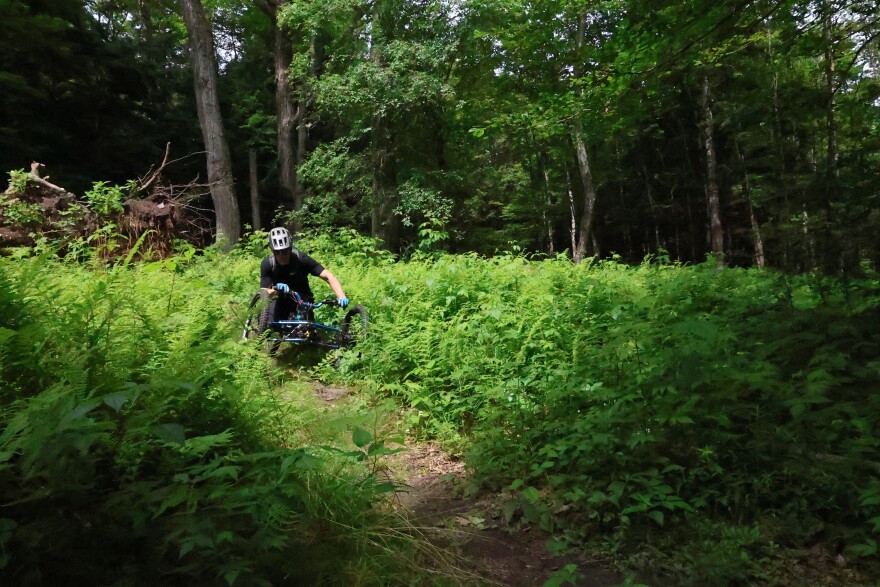
Louis Arevalo of Essex Junction is one of several adaptive athletes helping with that, most recently on some slightly overgrown trails in the Randolph Town Forest.
Zoe McDonald
/
Vermont Public
Arevalo was paralyzed in a skiing accident six years ago. An avid mountain biker before, he now rides a recumbent-style three wheeler that sits low to the ground. Arevalo pedals and steers with his arms, and gets a boost from an electric motor.
“Once you realize what these bikes are capable (of) or this equipment actually opens up, it kind of blows your mind,” he said.
But adaptive rigs like Arevalo’s are wider and heavier than regular mountain bikes, and not all trails are user-friendly.

Zoe McDonald
/
Vermont Public

Zoe McDonald
/
Vermont Public
Nick Bennette, who tested a different type of adaptive bike that day, got hung up on several tight turns.
Bennette is executive director of the Vermont Mountain Bike Association, another nonprofit spearheading efforts around the Velomont. He and others involved in the assessment have been taking detailed notes on ways to make the trails more accessible.
“Just scalloping out a bit of material on the outside of that corner,” said Bennette, pointing to the area the bike got caught. “That will allow adaptive bikes to make that corner without really changing the way the trail rides.”
This type of work is not just happening on the trails. Organizers are also trying to reduce barriers at overnight accommodations along the network.

Zoe McDonald
/
Vermont Public
This summer, contractors are turning an old office building near the trail in downtown Randolph into an ADA accessible hostel. And two remote huts along the trail in Stratton and Chittenden will have locked sheds with off-road wheelchairs so bikers don’t have to haul their own.
At the Chittenden Brook Hut, McCusker highlighted a new ramp and wider driveway.
“So if you’re an adaptive rider, you can imagine rolling right up here and you can transfer to your chair that’s available here, and then roll down the ramp and go down to the fireplace, to the privy, to make your meal,” he said.

Zoe McDonald
/
Vermont Public
Louis Arevalo stayed at the hut last summer with other adaptive riders — his first camping trip since his accident.
“It was really refreshing to have easy access to a beautifully built hut that was easy to navigate, and then have these world-class trails right out the door,” he said. “And with these Velomont trails, I can actually plan a hut-to-hut trip with other people.”
Jeff Alexander is counting on it. He’s director of strategic partnerships with Vermont Adaptive Ski and Sports, a nonprofit that helps people with disabilities access outdoor recreation.
An economic impact analysis the group commissioned estimates their programming generated more than $10 million last year.
“So the adaptive community has money, they travel, they want to travel and they want to play with everybody,” Alexander said. “We just need to level the playing field so that everyone can play together.”
Zoe Mcdonald
/
Vermont Public
-

 Minnesota59 seconds ago
Minnesota Lynx bested by Connecticut Sun 90-89
-

 Mississippi8 minutes ago
Mississippi Lottery Mississippi Match 5, Cash 3 results for July 6, 2026
-
Missouri11 minutes ago
Missouri teachers push back on governor’s A-F school grading plan
-

 Montana16 minutes ago
The Record is Clear: The Wilderness Society, Greater Yellowstone Coalition, and Montana Wilderness Association have Consistently Undermined the Roadless Rule
-

 Nebraska23 minutes ago
Pine-Richland receiver Khalil Taylor pulls hat trick, picks Nebraska over Penn State
-

 Nevada26 minutes ago
Nevada Youth Sports estimates $250K in damage after Fourth of July firework fire
-

 New Hampshire31 minutes ago
Suspected gunman in Hampton Beach shooting was in U.S. Navy
-

 New Jersey38 minutes ago
I took my kids to this New Jersey hotel and stopped making fun of the state (for now)


