Lifestyle
They're about to turn 30. Their views on ambition, love and 'hotness' feel revolutionary

One night when I was out at a bar, reporting for a story, I struck up a conversation with a comedian who was in her early 30s. I’d recently turned 29 and I expressed that I was feeling anxious about my impending milestone birthday.
“The worst part about 30 is 29,” she told me in a playful yet reassuring tone. It was a joke that her comedian friend Kevin had shared with her.
The words felt true. Since my 29th birthday, I kept thinking about all of the things I hadn’t achieved yet. I hadn’t made the Forbes 30 under 30 list, I had no prospects for a husband, the sheer thought of having a pet (let alone a child) made my stomach turn and the only valuables I owned were my iPhone and my car.
Arguably, turning any age can lead someone to think about all they have yet to accomplish, but there’s something distinct about being 29 years old. It exists right there on the brink between your 20s, when you’re expected and encouraged to make many mistakes, and your 30s, when society suddenly expects you to have it all figured out because you’re suddenly an actual adult. So if you’ve reached the final lap of your 20s and you haven’t crossed off multiple culturally defined boxes — get married, have a family, buy a house and have a thriving career, etc. — it’s easy to feel left behind.
Eventually, I had a mental shift. I figured that it was unlikely that I’d accomplish all of these things within a year, so I decided to focus on making 29 the most memorable year of my 20s — a last hurrah, if you will — and to set myself up for success in my 30s. I realized that I didn’t need to rush to check milestones off my bucket list just because I was turning 30. I still had time and the self-imposed pressure was neither helpful nor necessary. I just needed to be present.
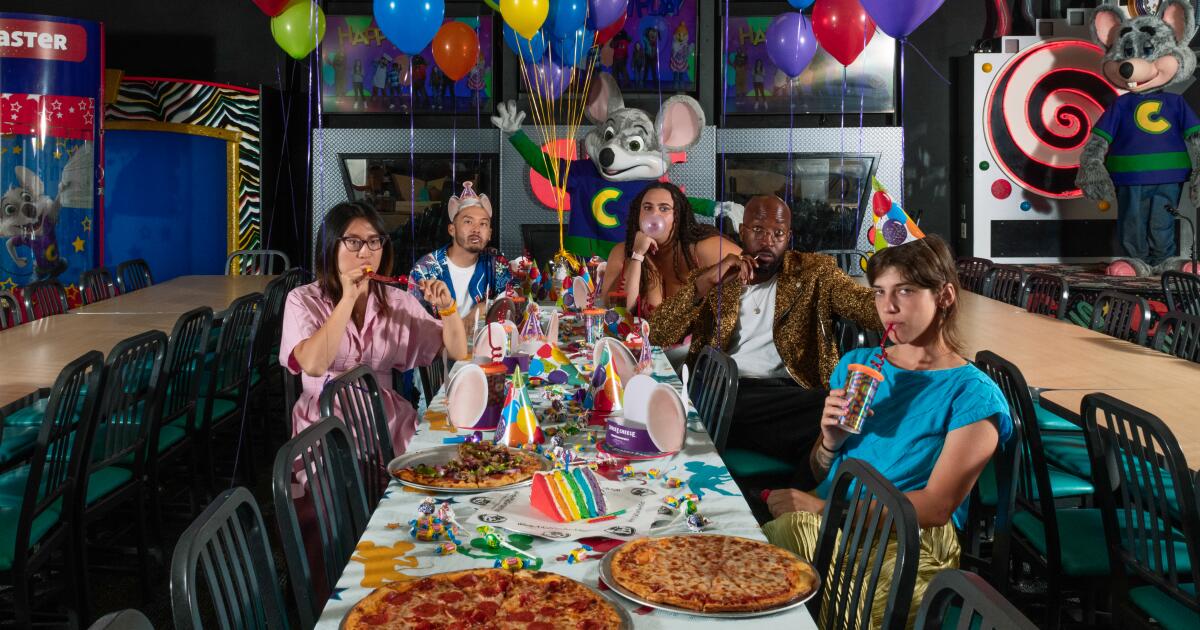
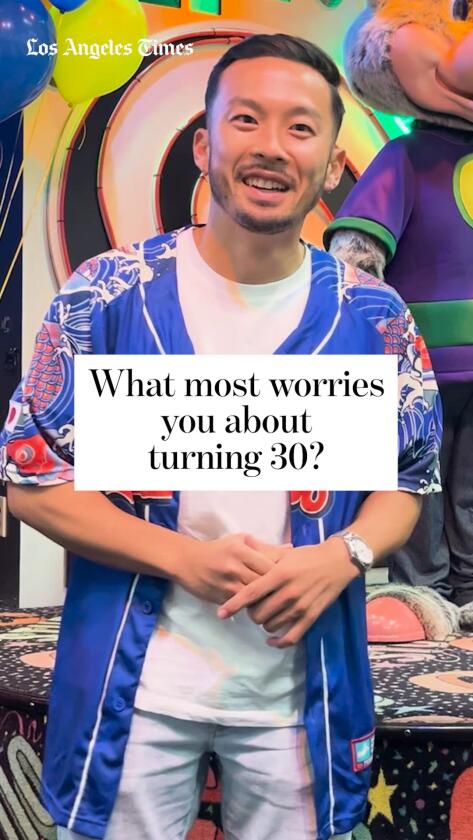
I knew I couldn’t be the only person who had big feelings about turning 30, so I started talking to other 29-year-olds in L.A. about their anxieties, fears and hopes for crossing over the 30 bridge. While some said their life doesn’t mirror what they thought it would look like at this age, many are more hopeful than anxious about what’s to come. This story features six Angelenos on the brink of 30, photographed in their homes around L.A. We also had a birthday photo shoot at iconic entertainment center Chuck E. Cheese. It’s a nostalgic place for people my age — I had my very first birthday party there so it felt only right to return.
As I get ready to celebrate my 30th birthday, I’m feeling excited about what feels like a new chapter in my life. Reflecting on my 20s, I dedicate Cleo Sol’s song “Rose in the Dark” to this revelatory whirlwind of a decade. The next one will be even sweeter.
Responses have been lightly edited for length and clarity.

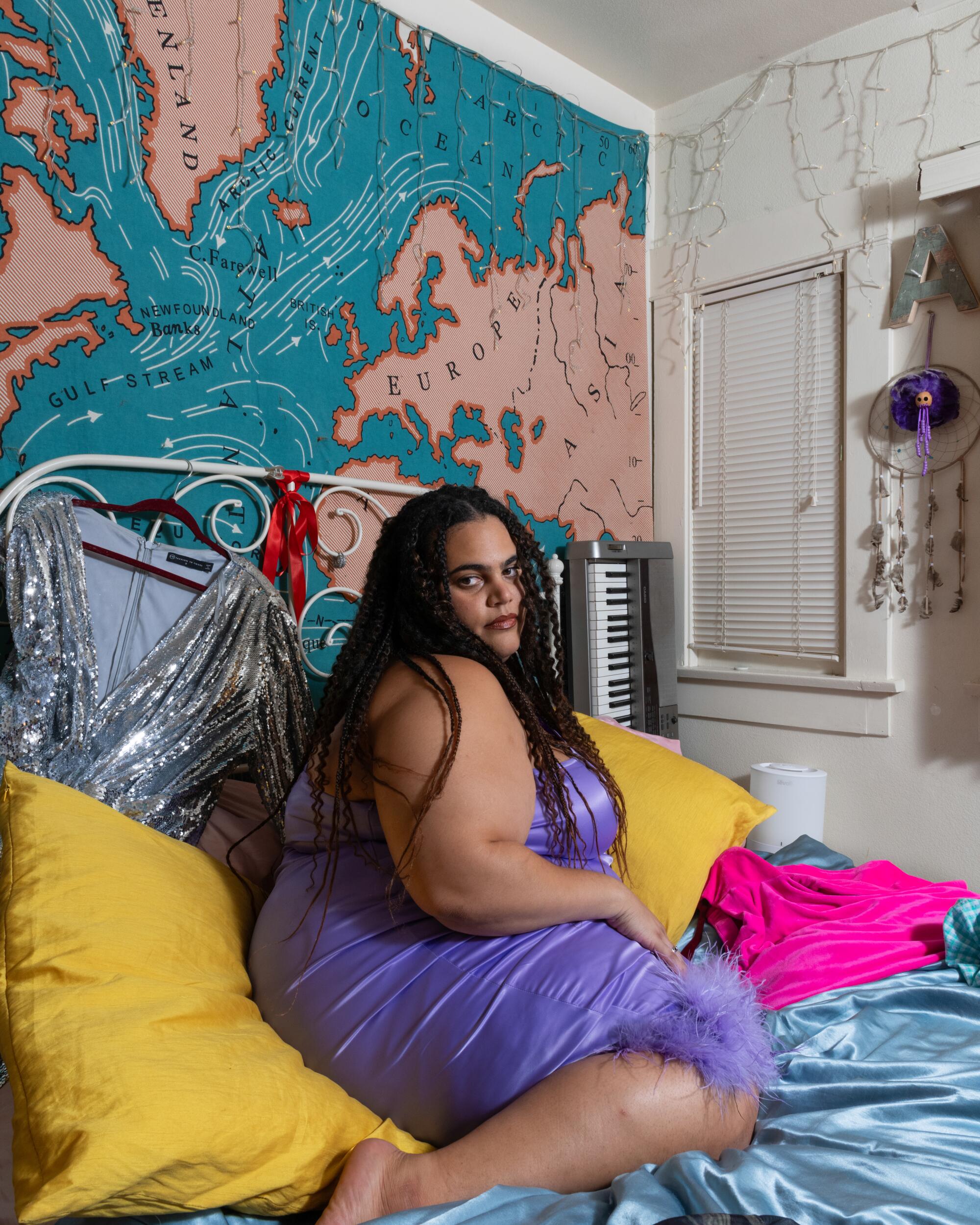
Anabel Inigo at home in Mid-City.
Occupation: Assistant to TV producers
How are you feeling about turning 30?
I always think about if my 13-year-old self would be proud of me and how 30 felt so important to me. By 30, I wanted to have made my first film, be a millionaire, have made the [Forbes] 30 under 30 list, but I’ve done none of those things. At my job as an assistant — with an MFA I thought I needed — I’m cleaning a coffee pot and I’m so worried that all of my decades will just never bring what I expect. I know you learn more as you grow up but what if all you learn is that you shouldn’t be ambitious? And what does that mean when that’s always been such a big part of who you are?
Have other people placed any expectations on you because you are turning 30?
My mother and my grandparents always wanted big things for me. I am a first-generation college student from a family where my generation should be the ones that “make it.” What does that mean when I haven’t?
“I’m so worried that all of my decades will just never bring what I expect. I know you learn more as you grow up but what if all you learn is that you shouldn’t be ambitious?”
— Anabel Inigo
How are you spending the last year of your 20s?
Being an assistant, following my dream. I have two roommates, living in a city I always wanted to live in, but still in so many ways I’m unfulfilled.
What do you hope your 30s will look and feel like?
I want my 30s to be the years where what I wanted in my 20s comes true. I was in grad school until I was 26, so this will be the first decade I’m not in school and I can just focus on myself. For my 30th birthday, I plan to go on a cruise, something I did when I was 15. Maybe I’m starting a tradition?
What song would you like to dedicate to your 20s?
“Gotta Get Through This” by Daniel Bedingfield.

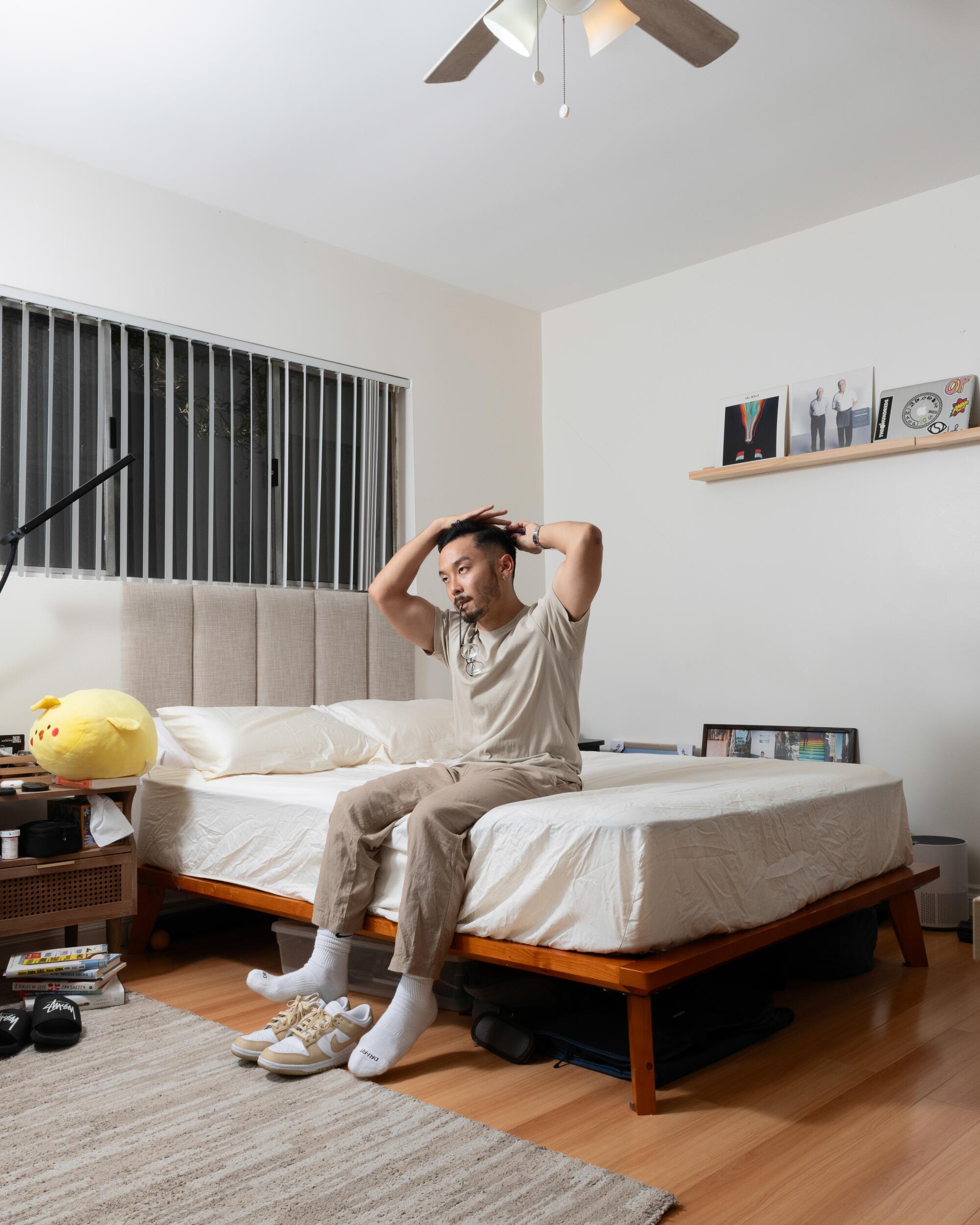
Ryan Kageyama poses for a portrait in his home in Palms, Los Angeles.
Occupation: Works in tech operations
How are you feeling about turning 30?
Turning 30 is the inevitable milestone often used as a baseline for other life achievements such as getting married, having kids and becoming a homeowner. I am nowhere near accomplishing any of those milestones as I am a bachelor living on the westside of L.A. Yet, I don’t feel any sense of urgency to settle to pursue any specific life goals since most of my peers are in a similar situation. I love my job and the flexibility that comes with it and I have an active social life on the weekends. I am planning for the future without sacrificing too much in the present, which makes me feel at ease with the impending 30th birth year. My next step is finding out where I want to be for my 30s and to lay roots for the rest of my life, but I am not too concerned about it right now.
When I turned 20, I thought my life would be vastly different at the time I turned 30. I naively predicted based on societal norms and associated my own happiness to these details. Now that I’m about to turn 30 without a partner, kids or a home, I don’t feel disappointed nor do I feel unhappy. Everyone has their own journey. It’s yours to make the most of it.
Have other people placed any expectations on you because you are turning 30?
One of my siblings [recently] got married and my other sibling is on the journey to be married. Someone at my brother’s wedding asked me “Which sibling are you? The doctor or the single one?” This type of remark would [normally] bother me, but now I’ve given it a good laugh and moved on. The term “Funcle” is starting to sound nice to me and I will certainly embrace it.
How are you spending the last year of your 20s?
I’ve spent the last year of my 20s making meaningful connections with new faces and reconnecting with old friends. I started saying yes to more things like run clubs and random weekday outings. I worked on personal projects like stand-up comedy, podcasting and community organizing through coffee and music. Honestly, this has been one of the best years of my life and I’m still excited for the next decade.
“The term ‘Funcle’ is starting to sound nice to me.”
— Ryan Kageyama
What do you hope your 30s will look and feel like?
I imagine my 30s evolving into my self-care era. My body is catching up to me, and I think it’s about time to put my body and mental well-being before anything else. My knees won’t last forever but I will be damned if I didn’t try get the most of out them while I still can. I hope to finally buy a home in a location where I can set my roots. I want to get a dog too!
What song would you like to dedicate to your 20s?
“adore u” by Fred Again.

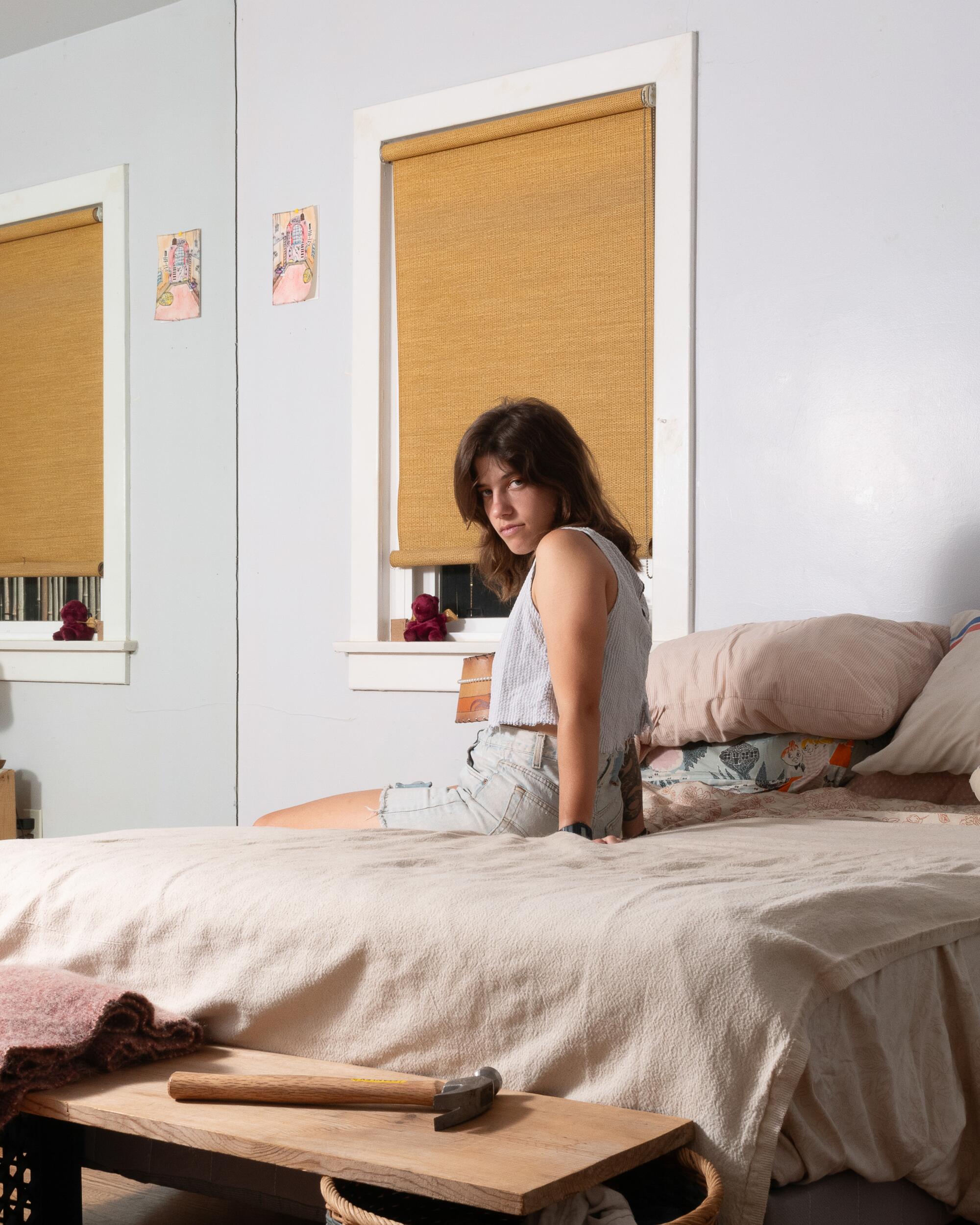
Nat Agoos at home in Mount Washington.
Occupation: Works at a nonprofit
How are you feeling about turning 30?
The overall feeling is appreciative. Every year I turn another year older, I become more and more aware of time, of the rapidity of life and of all the things I want to do before it’s all over. I wish we could live until, like, 300. And when I zoom in a bit more, I almost already feel nostalgia for the past nine years, which as we all know, are hectic ones. You exit your teens, the curtains to “adulthood” kind of suddenly whip open, and as they do (and as your brain is verging on becoming fully developed), you must, not so graciously, find your way. The tumult feels (slightly) less shaky and my path onward, after endless trial and error, feels just settled enough to garner a sense of confidence I definitely did not have in my early 20s.
But while I am feeling a greater sense of what I want and what I don’t want, I am simultaneously entering this middle space, between Phase 1 of adulthood and Phase 2 of adulthood, which has introduced a new type of uncertainty I haven’t met yet. It’s like, with this greater sense of who I am, who I want to be, the next natural step is to go forth with that knowledge, full steam ahead. To settle down. But as I exit my 20s I can almost feel them pulling me back, yelling from a distance, “Don’t go yet! There’s still so much chaos to impart on you!” The idea of “settling down” is a scary one.
Lastly, I feel young. More young than I’ve ever felt, even though I am older than I have ever been. I’m at this interesting age where while I still have [so] much to learn, I feel like I understand my life in a way I haven’t before. As my awareness of life increases, so does my awareness of how young I am (not to brag). As a kid/young adult, that thought doesn’t really cross your mind. I’d like to savor every last moment of it.
Have other people placed expectations on you because of your age?
If they have, I’ve been too busy imparting my own expectations on myself to notice!
How are you spending the last year of your 20s?
As I mentioned before, I am feeling equally pulled by the uncertainty of my 20s, and the “settled-ness” of my 30s. I plan to embrace being yanked, to absorb as much as I can, to bring as much of my free spirit and curiosity that early adulthood hands out at no charge into my next chapter, and to take things slow.
What do you hope your 30s will look and feel like?
I hope for a new type of chaos. A chaos where I get to explore the parts of me that I discovered in my 20s, giving space for missteps or unforeseen results. To harness my new sense of control in a way that doesn’t require me to 100% be in control. And to not to forget to continue to question, no matter how positive I may feel.
What song would you like to dedicate to your 20s?
“Praise You” by Fatboy Slim.

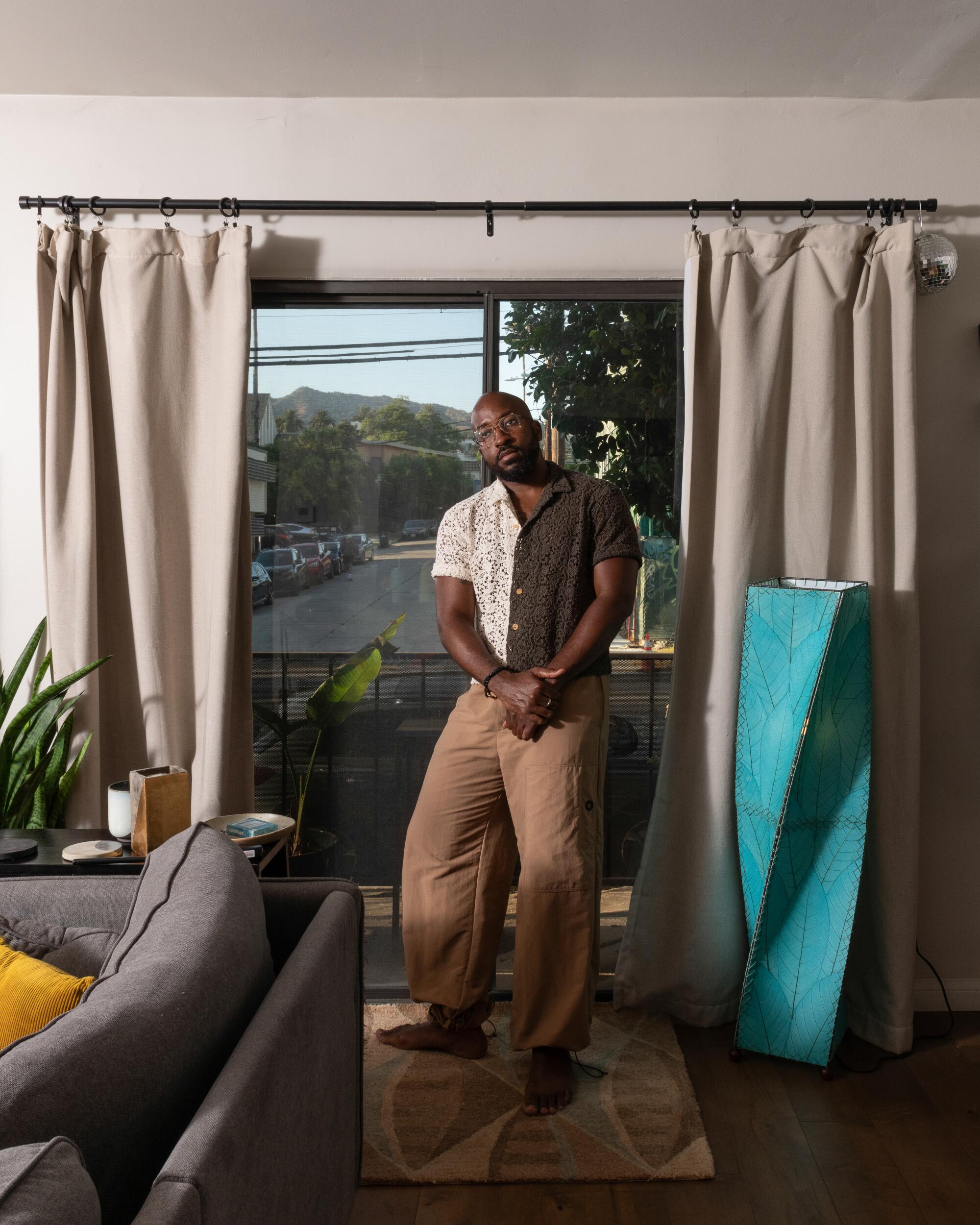
Dave Harris at home in Los Feliz.
Occupation: TV, film and theater writer
How are you feeling about turning 30?
Hot. I believe that everyone just gets hotter with every year of life and each birthday continues this trend. So actually more than anything, I just believe that I and everyone I love will get hotter and hotter by the year, by the day even. I don’t just mean aesthetically (though I do); I mean energetically. If this was the ascendant glow-up of the 20s, then my God the 30s, it’s full of stars.
Have other people placed any expectations on you because you are turning 30?
Society is generally bad at perceiving how old Black people are. Also all the men in my family lose their hair and grow beards at 25. So I’m often working in rooms where people assume I’m older than I am, and I let them. And because of life circumstances, I’ve had to operate like someone older than I am since elementary school. So in a way, turning 30 actually feels like I’ve been here for some time and now I just get to claim it.
How are you spending the last year of your 20s?
I’m working a lot and cooking for the people I love. I’m dancing more. I’m chasing spontaneity. I’m finding new things to love. It’s not some revelation. There are things I didn’t know I could love until I had a stable income. Like what the hell, if sixth-grade me who only had a microwave and mini-fridge at home could watch 29-year-old me make agnolotti del plin on a Tuesday?
What do you hope your 30s will look and feel like?
Because of generational instability, family hasn’t reliably been a part of my life and the trajectory of my life has often pulled me far away from the place I’m from (Philly). I’ve been proud of that because I’ve gotten to do and see so much more than what I grew up with. I travel, I work from a place of desire and not from a place of fear, I have a community of friends that I can’t imagine life without, and still, more than any other year, I find myself craving the irreplicable intimacy of family. This can be a lonely desire because so many people in my life have economically and emotionally stable families, so I hold this space tenderly. And yet, I hope that I’ll have the means to help carry my family with me through my 30s. Whereas my 20s were marked by a feeling of chasing, I think my 30s might be marked by a feeling of return. It’s hard to heal familial wounds when your family is living paycheck to paycheck.
“There are things I didn’t know I could love until I had a stable income. Like what the hell, if sixth grade me who only had a microwave and mini-fridge at home could watch 29-year-old me make agnolotti del plin on a Tuesday?”
— Dave Harris
I feel like I am a part of a generation of overachieving Black artists who maybe did not grow up with a lot and were taught that “Education is the key!” and through education and institutions, we toiled through that upwards mobility ladder. The 20s are a decade of mandated change. Turning 21, finishing college, grad school, first apartments, movement. If every parent wants their child to achieve a better life than they did, then I accomplished that by simply getting into college. Even though my career is in a scarcity-based industry, I feel I’ve been on a particular path with particular goals. In some ways, my 20s were both astronomical and predictable. My whole life I’ve defined myself by an idea of success, and every year that definition has become more and more uniquely my own. There has been such freedom in that. I’m so happy with my 20s. I want my 30s to be even happier. I’m most excited for the things I haven’t imagined yet. I can’t believe that I sound this optimistic because I don’t think of myself as an optimistic person, but there are so many other ways my life could have turned out.
What song would you like to dedicate to your 20s?
“Back in my Bag” by Rapsody

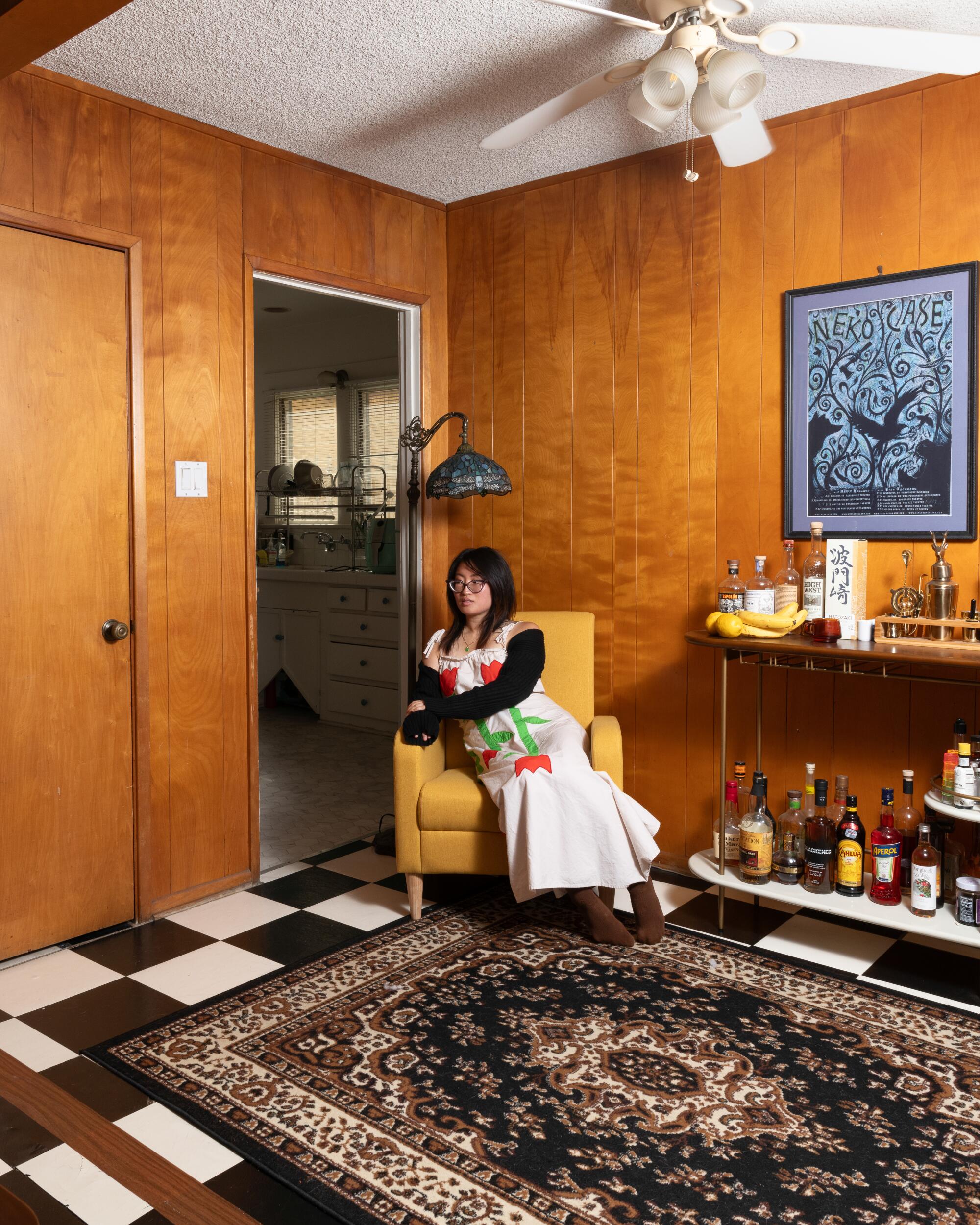
Holly Giang at home in Los Feliz.
Occupation: Works in product strategy
How are you feeling about turning 30?
I’m thrilled; I’m confident that my 30s will be my most fulfilling decade yet. My 20s were full of rich experiences, and it was full of hustle, vulnerability and decision paralysis. As I enter my 30s, I feel extremely curious, energized and at peace. I believe I now have the luxury of time to savor the present and the resources to try out the things my kid self wanted to do.
Have other people placed any expectations on you because you are turning 30?
Yes. I’ve certainly been fielding more questions from family (and strangers) about marriage and children. Societal expectations undeniably place a heavy burden on women in the workplace and at home. Having clarity and conviction (and therapy!) has allowed me to set and manage these expectations with my family since my early 20s, which has helped me to navigate the pressure and remain unbothered.
How are you spending the last year of your 20s?
After navigating three stressful life events, including ending my long-term partnership and moving to L.A. on the same day, I’m focused on reprioritizing my life and being more self-serving. I want to make sense of this city, to plant roots and build community. My food expeditions via bike and Metro have served as the gateway to feeling more connected to different parts of the city, and I’ve met plenty of kind Angelenos along the way.
What do you hope your 30s will look and feel like?
Based on what I learned in my 20s, I’m hoping my 30s will be marked by a renewed sense of confidence, independence, growth and adventure.
What song would you like to dedicate to your 20s?
“Unwritten” by Natasha Bedingfield.

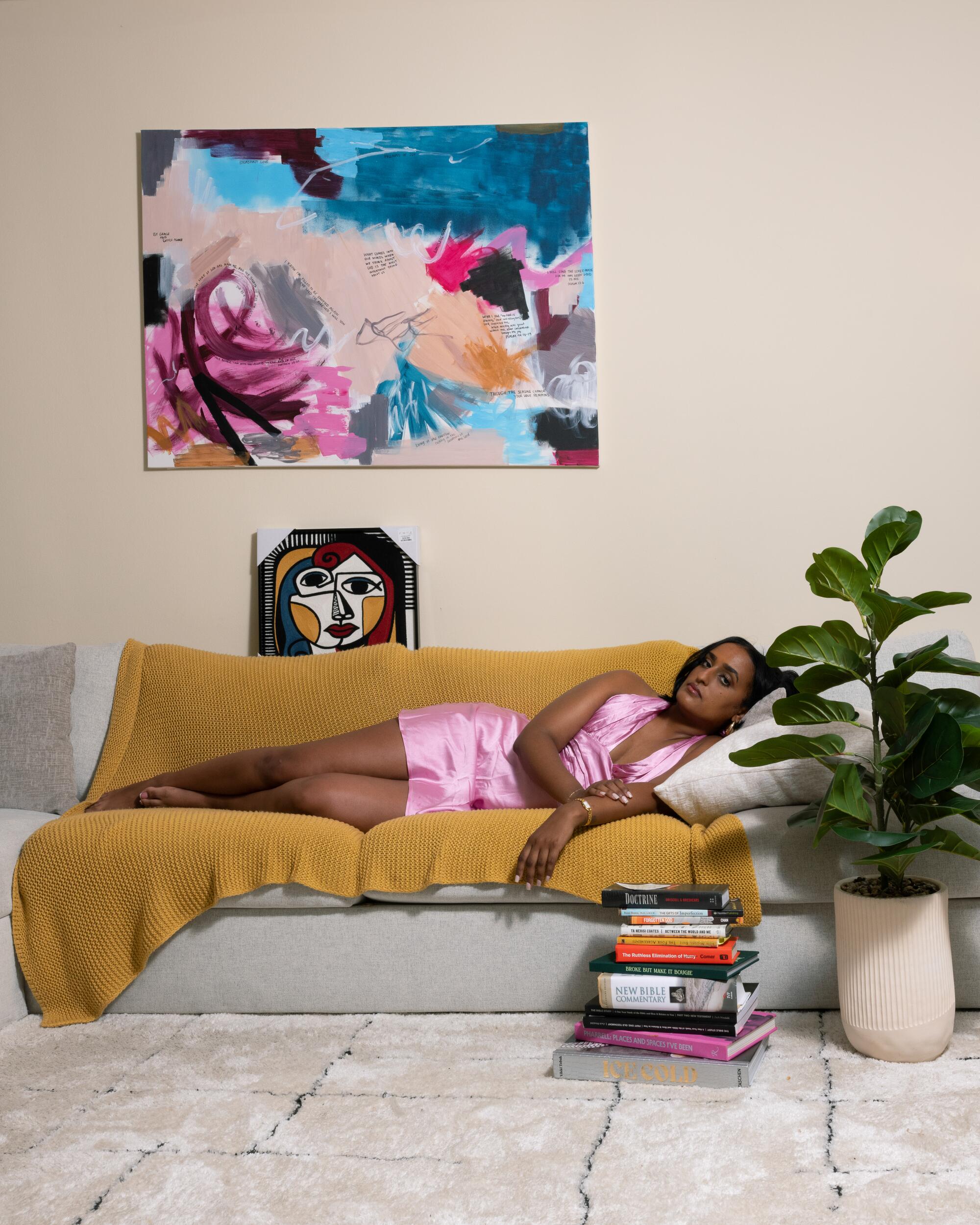
Kidist Mekonnen at home in Inglewood.
Occupation: Senior associate project manager
How are you feeling about turning 30?
If you asked me a couple years ago, I would have told you that I was terrified. But now as I get closer, I’m much less anxious. Part of that being that it’s a blessing to grow older, wiser and the lessons of my 20s will help me step into my 30s.
Have other people placed any expectations on you because you are turning 30?
Absolutely. I know most people have good intentions when asking about different milestones you need to hit at a certain age, but I think there is often a lack of acknowledgment of how it may make us feel. Social media already spews out enough expectations on us, so it can get even more overwhelming when it comes directly from family and friends. I constantly remind myself of the many milestones we can celebrate for others that are not just the typical ones. To feel loved and celebrated at any stage and moment in life feels amazing and I hope to do that for all my friends.
How are you spending the last year of your 20s?
My biggest regret was not traveling aboard in college and now as a real adult I’m trying to play catch-up with my travels. I’m hoping I can spend more time this year exploring! I have yet to take my first real solo trip internationally, so I’m looking forward to planning that. I also want to spend a lot of time outdoors and prioritizing my health/fitness. I’m also allowing myself to feel all things I need to feel. I’m so grateful for God and what He’s been able to show me this last half of my 20s.
What do you hope your 30s will look and feel like?
I pray my 30s will be a lot of time spent laughing, loving on others and being kind to myself. There’s so much I can say I want to plan for now, but being in my last year of my 20s, I just want to be in the moment and be around my community.
What song would you like to dedicate to your 20s?
“Beautiful” by Mali Music.


Lifestyle
L.A. Affairs: It’s hot when a man drives to me. But would this new guy make the trek from the Valley?
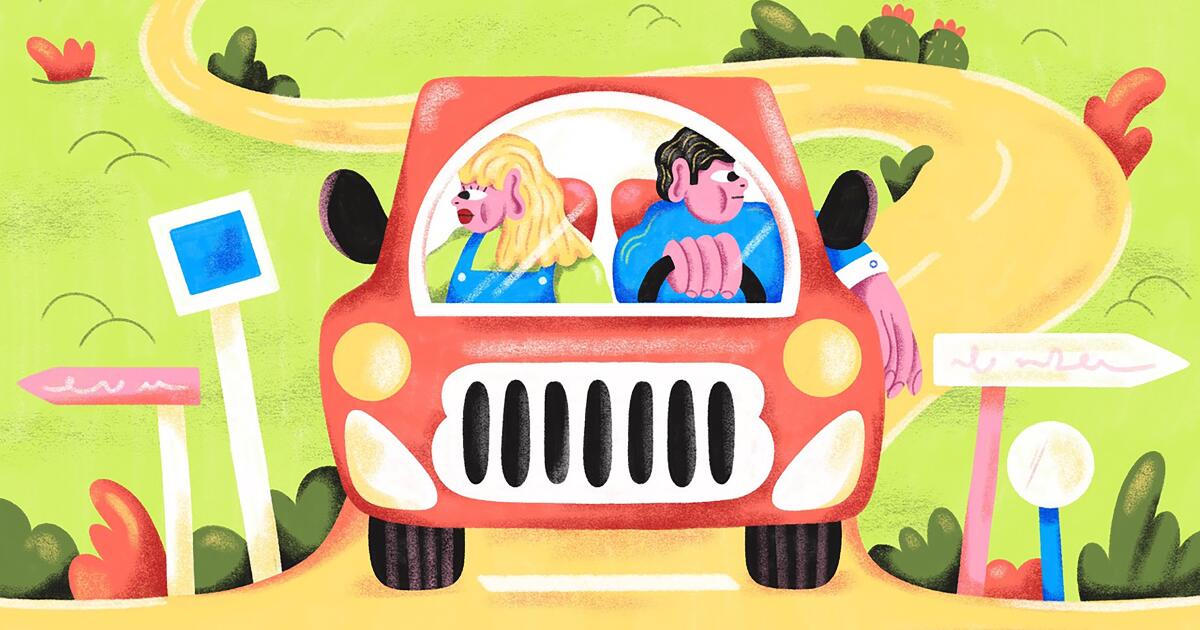
I met Dan on Hinge.
He lives in Woodland Hills, and I live in Venice. In Los Angeles, this is considered a long-distance relationship. In another city it might be nothing. Here, it’s a factor.
But I believe that with the right person, you can make anything work, so I stay open. I’m a native New Yorker, and if I were living in Brooklyn and a guy lived on the Upper West Side, that would be a 45-minute subway ride, which is truly nothing in New York. So with that same logic, I try to have flexibility with men in L.A.
When we started planning our first date, Dan suggested three options: a hike on mushrooms, a wine tasting or a walk on the beach.
A hike on mushrooms is something I’d only do with someone I already trust, not someone I just met online. I don’t do first-date hikes because I don’t like feeling trapped if the guy’s a dud. So I chose the wine tasting.
Then I learned the wine tasting was in West Hills.
On a Friday night, driving there from Venice would be insane. So I said I didn’t want to meet there because of the traffic. He suggested Malibu. That was also not ideal on a Friday.
I was getting annoyed — this was a pink flag because in my dating world, the guy is supposed to come to the woman’s neighborhood in the early days. I’ve gone out with plenty of men from the Valley who effortlessly suggested they come to me. It’s not rare or impossible.
I suggested he come to the Westside. I didn’t specifically say Venice, and in hindsight, I probably should have. He landed on Brentwood, which was manageable for both of us. On our first date, we met at an Irish pub on Wilshire Boulevard. He was cuter and more interesting than I had expected, and with the Guinness flowing, we had fun.
When I got home, he texted me: “Well, I like you 🙂 Less the tik tok and the lack of rock music in your life, but it’s not a deal breaker — there are other qualities 🙂 What are your thoughts?”
I noticed the slight negativity but was mostly dazzled that a man texted immediately after the date to say he liked me. In the modern dating economy, this felt rare.
The next day, both of our evening plans fell through, so we made a last-minute date. The wine tasting he originally suggested still sounded like fun, and although it meant me driving to the Valley, I was up for it now that we’d met.
We sipped flights at Malibu Wines & Beer Garden in its airy, romantic courtyard and played a flirty version of Truth or Dare. Halfway through, he dared me to kiss him.
We ended with sushi on Ventura Boulevard and a short make-out session in his car. He invited me to Thanksgiving at his uncle’s, which felt too soon, but also sweet.
After the second date, he texted and said he had his kids that week and was also hosting an event on Thursday, so his only day to meet was Wednesday. I said great.
On Tuesday night, he checked if we were still on, and I said yes.
Then he texted: “I’m flexible on time but not on location. I have a big event on Thursday, hopefully you can come to me again.”
My stomach tightened. This again?
So I texted back: “I drove to you last time, which was a bit of an exception for me especially in the early days, but the wine tasting location sounded special. Usually guys come to my area. How about we switch it up this time?”
He replied: “I appreciate the effort! Because of my event, I’d rather be close to a computer just if needed … Here is what i offer:
— I’ll come to your area anytime next week/end
— Lunch/dinner on me
I want to continue where we stopped last time 😉 No pressure of course, but let’s snuggle”
I responded: “Ok let’s meet next week. Snuggles sound nice … let’s see what happens …”
Then he wrote: “So I won’t see you tomorrow?”
I replied: “Unless you wanna come to me and bring your laptop along, let’s rain check until you have more flexibility.”
He said: “Dang, you are hard. I’ll let you know tomorrow around midday if it’s ok.”
And then — surprise — he decided to come.
He drove to Venice for a 5 p.m. date. He said his ETA was 5 p.m., and it ended up being 5:25 p.m., typical 405 Freeway.
When he showed up, he was in a cranky mood. On our way to KazuNori in Marina del Rey, I thanked him for picking me up and told him I think it’s hot when the guy comes to the girl.
“You’re just saying that because you want me to come to you more,” he said, not playfully, but aggressively.
That was basically the end for me. But there I was, in his car, heading to dinner. So I stayed pleasant and tried to make the best of it.
I shared that in the early stages of dating, I find it’s good etiquette for the guy to come to the woman’s neighborhood. He immediately disagreed and started ranting about how dating rules are ridiculous and how they swing in women’s favor. He resented paying for dates and declared he wasn’t looking to “sponsor a woman’s life.”
“If women want equality and equal rights,” he said, “then it should apply all across the board, including dating, and the man shouldn’t have to pay.”
I said women don’t actually have equal rights because we get paid less than men and often receive lower salaries than men in the same position.
I tried to change the subject and reset the mood, but he insisted we keep hashing it out.
I tried to explain masculine/feminine dynamics: providing and protecting, giving and receiving.
“What does the man get out of this arrangement?” he asked.
It was like watching someone’s personality warp into Mr. Hyde. Then he brought up another point: He’s a single dad of two kids, so he gets tired; and because I don’t have kids, that should factor into who drives where.
At this point, I was barely engaging and focused on eating my hand rolls, and I couldn’t wait to get home.
The check came, and I happily split it, wanting nothing further from him.
In the car back to my place, he remarked: “It’s obvious we’re never gonna see each other again.”
Obvious, but did it need to be stated?
Then he showed me a Spotify playlist he’d made for me of his favorite electronic music, because he knows I like EDM.
“Oh, that’s sweet,” I said.
“Yeah, that’s how I show interest. Through things like this, not who drives to who,” he replied.
When I got out of the car, we wished each other luck, and I headed inside and shut the door.
Two hours later, he sent me the playlist. I’ve yet to listen to it.
It wasn’t the distance that ruined it. It was the resentment. I’m not looking for a man who feels burdened by the effort. I’m looking for a man who sees the value of courting a woman in the first place.
The author is a writer, comedian and former psychologist who lives in Venice. She is the creator of the new vertical series “Manfari.” She’s on Instagram: @solange_neue and @manfari.show.
L.A. Affairs chronicles the search for romantic love in all its glorious expressions in the L.A. area, and we want to hear your true story. We pay $400 for a published essay. Email LAAffairs@latimes.com. You can find submission guidelines here. You can find past columns here.

Lonnie Bunch III is the 14th Secretary of the Smithsonian. He’s pictured above in September 2017.
J. Scott Applewhite/AP
hide caption
toggle caption
J. Scott Applewhite/AP
In a memo addressed to staffers sent Tuesday, the secretary of the Smithsonian, Lonnie G. Bunch III, defended the institution after the White House issued a 162-page report that characterizes the National Museum of American History as a place which has become “subject to institutional capture by a radical, activist ideology that is fundamentally opposed to telling the noble, honest story of the great country we know and love.”
In his email, which NPR has obtained, Bunch wrote in part: “While there will always be room for improvement, this report is not a fair characterization of the work and totality of the National Museum of American History. At the Smithsonian, our work is driven by scholarship, accuracy and an uncompromising commitment to tell the fullness of America’s story. As public servants and the keepers of this institution, we are charged with helping a nation find understanding, hope and clarity and as part of that duty, we are dedicated to excellence, reflection and growth.”

He continued: “We remain focused on what grounds us: a steadfast commitment to scholarship, nonpartisanship, independence, accuracy and integrity. For nearly 180 years, the Smithsonian has worked alongside partners across government — from the White House to Congress to our governing Board of Regents — guided by our enduring mission to increase and diffuse knowledge. That purpose remains: to pursue knowledge with rigor and to serve the American public with clarity and care.”
The White House report was issued on July 4 by the Domestic Policy Council under the title “Saving America’s Story: How Ideological Capture at the Smithsonian Institution’s National Museum of American History Erases Our Heritage.”

The council faults the National Museum of American History on a multitude of fronts, saying it underemphasized the Founding Fathers and early colonial and Revolutionary history; was not sufficiently celebratory of the country’s 250th anniversary; and that it engaged in “anti-white,” “illegal alien” and transgender activism.
It also accuses the museum of trying to “indoctrinate” teachers and students through its exhibitions, programming and teaching resources.
In the report, the council also specifically criticizes museum director Anthea Hartig, who has led the National Museum of American History since 2019 and is concurrently the president of the Organization of American Historians, calling her “an activist advancing an ideological agenda contradictory to the museum’s founding purpose of fostering patriotism.”

The Trump administration has made the Smithsonian museums one of its primary targets in its efforts to reshape cultural narratives to align with its viewpoints. In August 2025, the White House requested a “comprehensive internal review” of eight Smithsonian museums, including the National Museum of American History, following an executive order issued by President Trump in March 2025 in which he called for the removal of “improper ideology” from the Smithsonian’s offerings.
According to the Smithsonian’s charter, all of its 21 museums, 14 education and research centers, and the National Zoo are meant to be run independently of the federal government. The Smithsonian is overseen by Bunch and a board of regents, which includes Vice President Vance, Supreme Court Chief Justice John Roberts and other members appointed by Congress.
In an interview with NBC’s Meet the Press on Sunday, Bunch spoke about the Smithsonian’s 250th anniversary special exhibition at the Smithsonian Castle, which is called “American Aspirations.”
He told NBC: “It’s really important for people to understand that America is much an ideal as it is a place, that it’s a series of aspirations that have really shaped who this country is. And so for me, what is so powerful is to say, ‘Let us honor the words of Thomas Jefferson and the founders, but let us use those to challenge us to be better.’”
Jennifer Vanasco edited this story.

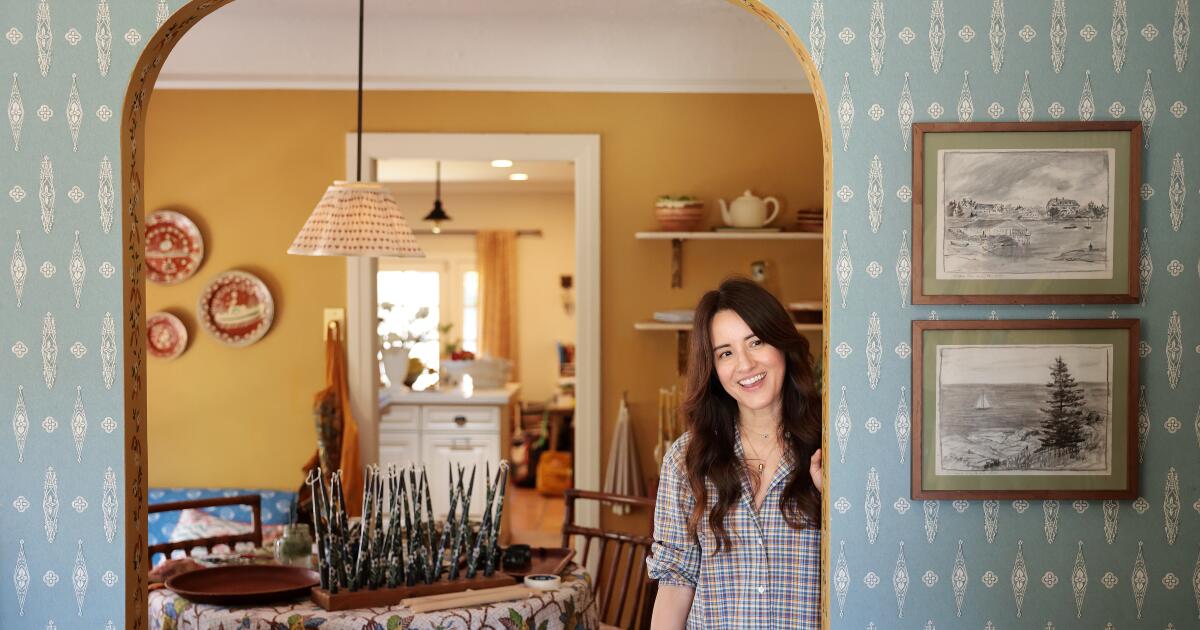
It was after the death of her son, Laith, that Esme Saleh decided to become a folk artist.
She had always been creative, experimenting with watercolors and learning to sew and embroider at a young age.
“I had a creative inkling,” she said, “but I never pursued it.”
Everything changed on Aug. 17, 2013.
In this series, we highlight independent makers and artists, from glassblowers to fiber artists, who are creating original products in and around Los Angeles.
When Saleh was nine months pregnant, she woke up with stomach pains and presumed she was in labor. She and her husband, Nasim, immediately went to the hospital, where doctors checked her and put the baby on a heart monitor. Saleh’s blood pressure was high, however, and the baby’s heart rate kept dropping. After about an hour, his heartbeat stopped. Doctors rushed her in for an emergency C-section, but it was too late. Laith did not survive.
Saleh lost a tremendous amount of blood and developed postpartum HELLP syndrome, a dangerous form of preeclampsia, but doctors were able to stabilize her.
When she woke up, the first thing she asked was, “How’s my baby?”

After losing her son in 2013, Esme Saleh left her job as a television producer. Since then, she has sold her hand-painted candles to local designers in Los Angeles and to LVMH in Paris.
“Aug. 17, 2013, was the most difficult day of my life, and Aug. 22 was the second most difficult, the day we drove home with an empty car seat,” she said of her and her husband’s new reality.
They named their son Laith Finn Saleh.
“His first name means ‘lion’ in Arabic. His middle name is an ode to Huckleberry Finn — sharp wit, kind heart, strong moral compass — all the attributes he’s imparted on us in spirit,” said Saleh, 45.
After such a devastating loss, she found it difficult to trust the world again. “It was hard to trust anything,” she said. “The medical system. Myself. It made me realize the fragility of bringing anything to life. We take so much for granted.”
So after years of working as a television producer, Saleh left broadcast journalism and leaned into her creative spirit.
She grew up in San Diego. Her mother was raised on a farm in Mexico, and her father moved from Tijuana to Los Angeles to be near her mother, who started working for a family in Sherman Oaks at 16. They eventually settled in San Diego, where Saleh’s father, now a church deacon, worked as a car salesman.


“The word Mystic has also become a driving force of what this journey means to me,” Saleh says. “A magical, otherworldly journey that has led me to some beautiful friendships, projects and unlimited well of curiosity. When I paint each pair of candles, it feels like I’m imparting a piece of that magic.”
“He always wanted to be a weatherman on TV,” she said, explaining how he hoped to get his big break on television by doing a weather report from the car lot.
Saleh wanted to be a broadcast journalist as her father had. After graduating from San Diego State, she interned in the sports department at CBS affiliate KFMB-TV although she didn’t know much about sports. She enjoyed sharing information with people, learned how to write plays of the week and felt she had found the right career.
But during a summer class at Mesa College, she started to think journalism might not be for her.


Saleh’s home is filled with her artwork. “My home expresses a lot of the things that I do,” she says. “If it works here, then I feel like I can put it out in the world.”
“I’m an empath — a sensitive soul — so when I was reading news about death and destruction, my eyes could not lie,” she said. Her professor told her, “This may not be your thing.” But when she arranged flowers on camera, she really came alive. She decided to work behind the scenes as a producer.
Her professor helped her get her first network news job in 2003, and she moved to Los Angeles, working on hard news and entertainment coverage.
After losing Laith a decade later, she couldn’t keep doing red-carpet interviews and acting like everything was fine. “It all felt so different, superficial and hard,” she said. “I felt like there was a bigger purpose out there for me. It’s in the small things that we find the big things.”
She started by painting folk art-inspired invitations for a friend’s baby shower. She painted delicate flowers, oranges and leaves on glass, leather and even lampshades. She created a logo. “I was just trying to say yes to things that were really scary,” she said. “Laith gave me the courage to do that.”

“I was just trying to get out of hole,” Saleh says of taking up painting after her son died.
Her first son, she said, became “a catalyst for painting.”
Then, at the first Thanksgiving during the COVID-19 pandemic when people could gather again, she had a light-bulb moment. “I was setting the table and didn’t have flowers or anything to add to decorate, so I thought, ‘I have these candles. I’m going to paint them and make them fancy,’ ” she said.
Her guests were impressed.
As time went on, painting taper candles helped her find joy again, and others noticed too.
“The one thing I hear when people pick up a pair of my candles is, ‘This makes me so happy. It makes me feel like there’s life here,’ ” she said.
1

2

3

1. Saleh sometimes leads painting workshops where participants can decorate items like ornaments and lampshades.
2. Leather napkin rings Saleh has painted for Nathan Turner. 3. Saleh’s hand-painted candles retail for approximately $42 to $50.
One of the hardest parts of losing a child “is that you’re not just grieving the person, you’re grieving the future you imagined with them,” said Chicago-based grief specialist Carla Harvey. “A lifetime of love suddenly has nowhere to go. Creating art doesn’t erase grief, but it can become a way to carry it.”
Saleh created her brand Mystic by Esme in 2021, but it took her some time before she could gather the courage to try to sell them.
When she brought a shoebox full of samples to Nickey Kehoe, the L.A. store agreed to carry her candles. “I was beside myself,” Saleh said.
“Her candles were absolutely beautiful, and she had a fantastic spirit that made selling them a no-brainer,” said interior designer Todd Nickey, co-founder of Nickey Kehoe.

Saleh gets a surprise kiss from her dog Olive while painting candles at her dining room table.
Saleh viewed her new side project as a way to earn extra money for piano lessons for her 11-year-old son Linus, who is an entrepreneur like his mother. “I felt proud painting the candles while he was in lessons in the next room,” she said. “It became this circular economy, and it led to bigger opportunities for me.”
Last year, luxury conglomerate LVMH commissioned Saleh to paint 465 pairs of candles, or 930 candles in total, for its Chaumet jewelry brand. The collection was unveiled at an elaborate event at the Abbaye des Vaux de Cernay, just outside Paris.
“It was fun,” Saleh said about the process, which took six months from conception to delivery. “I felt like I was dressing my candles up for a party.”
Always a hard worker, which she attributes to being a first-generation child of immigrant parents, Saleh has now created a candle collection for Pierce and Ward in Los Feliz, leather napkin holders for interior designer Nathan Turner and pomegranate wrapping paper for Olive Ateliers. The candles retail between $42 to $50 for a pair, and recently, she developed a handsome pewter candle shaver that will be released in the winter.

Her dining room can sometimes feel like “an assembly line,” Saleh says.

Saleh holds a pair of candles she has embellished with florals.
Occasionally, she leads painting workshops, and she loves helping others tap into their creativity. The most meaningful one for her was an ornament workshop attended by several victims of the 2025 Los Angeles wildfires. “Without saying anything, we understood each other,” she said. “I understood that they were trying to create memories.”
Saleh knows what it means for things not to last — “impermanence,” she calls it — whether it is homes, candles or life itself.
She paints every day in the art-filled dining room of her home (unless it’s Little League season), surrounded by her family, candles and her two dogs, Lennon and Olive. ”Painting is like meditation,” she said. “You can sit in your dining room and tune everything out and just be in the moment.”

Even the family’s summer bucket list receives an artistic flourish.

An arch inside Saleh’s home receives a personalized touch.
She knows painting candles isn’t new, but she believes her motivation and the care she puts into each candle makes them special beyond their looks.
She has learned to look at the world that way, that painting in her dining room has offered her healing and joy, that she can trust herself and her body, that continuing to be inspired by her two boys — “one in spirit and the other here on Earth” — means that Laith will always be with her.
Many people think healing means moving on, said grief specialist Harvey, but “it’s really about finding ways to move forward while keeping the people we love woven into our lives. That’s what I see in her candles, not an ending, but an ongoing relationship with her son.”
“I feel like my son is channeling through this medium,” Saleh said, her voice breaking as she painted a taper. “He’s whispering to me, ‘Mom, this is your path.’ That has been my driving force. We’re going to grow this together.”
-
 Business3 minutes ago
Billionaire exodus? California drew 10 times more venture capital than any other state this year
-
 Entertainment6 minutes ago
Disney Channel maximalism to pop-star glam: What fans wore to Hilary Duff’s L.A. show
-
Lifestyle11 minutes ago
L.A. Affairs: It’s hot when a man drives to me. But would this new guy make the trek from the Valley?
-
Politics18 minutes ago
Black mold and $1 wages: Settlement forces immigrant detention centers to protect workers
-
 Science21 minutes ago
Trump administration seeks to limit federal funding that doesn’t ‘advance’ presidential policies
-
 Sports26 minutes ago
Commentary: ‘I don’t want any handouts.’ Amid the Angels’ drought, a starry homecoming for Mike Trout
-

 World36 minutes ago
Does more World Cup history beckon for Norway? England stand in their way
-
 News1 hour ago
Waymo called the cops on teen riders, raising privacy concerns

