Connect with us

California

California Democrats talked a big game on reparations. They're off to slow start

Published

on

California Democrats talked a big game on reparations. They're off to slow start


Gov. Gavin Newsom and California lawmakers in 2020 touted a law to create a “first in the nation” state task force to study and propose remedies to atone for the legacy of slavery.

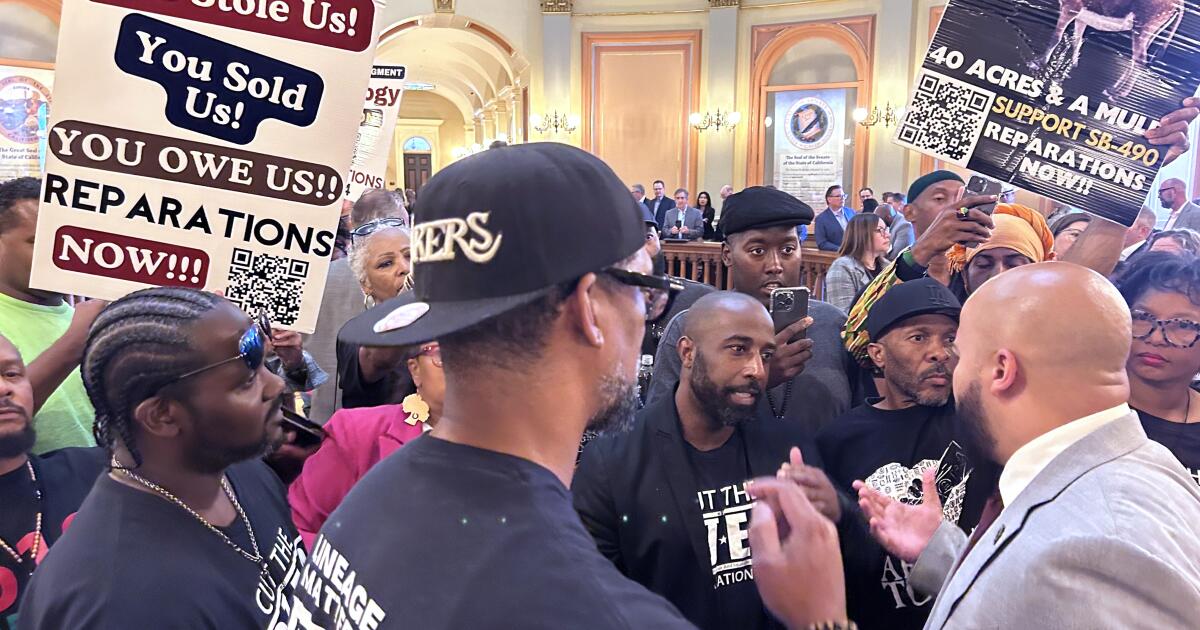
Four years later, their work to deliver reparations is more incremental than recording-breaking, stoking frustration among advocates who filled the Capitol as lawmakers cast their final votes of the legislative session on Saturday.

Hamstrung by a state budget deficit and the challenges of supporting a politically volatile issue in an election year, the California Legislature passed a limited slate of reparations bills. The meager progress, though hailed by some lawmakers and advocates, in a state as liberal as California could serve as a warning on the issue to the rest of the nation.

Advertisement

“I think what it demonstrates is that when the rubber hits the road, Democrats are still unwilling and unable and uninterested in truly supporting these efforts outside of sort of symbolic and less than substantive ways,” said Tatishe Nteta, provost professor of political science at the University of Massachusetts Amherst and director of the UMass poll.

The California Legislative Black Caucus announced 14 priority reparations bills in January based on recommendations made last year by the reparations task force. Lawmakers cast the legislation as a first step focused largely on enacting policy changes in education, healthcare and criminal justice, while omitting cash payments in light of the state’s financial troubles.

Lawmakers passed 10 bills in the package before they adjourned Saturday, including marquee legislation requiring a formal apology from the state for “perpetuating the harms African Americans faced by having imbued racial prejudice through segregation, public and private discrimination, and unequal disbursal of state and federal funding and [declaring] that such actions shall not be repeated.”

The Legislature placed a measure on the November ballot that asks voters to delete language in the California Constitution that allows involuntary servitude as a form of punishment for crimes. Another bill would end a work requirement for able-bodied state prisoners and instead develop a voluntary work program if the ballot measure banning involuntary servitude is approved.

Other bills establish a process for the state to review and investigate claims of racially motivated taking of property by governments using the power of eminent domain, seek to increase and track participation in career training education among Black and low-income students, and expand Medi-Cal coverage, pending federal approval, to include benefits for medically supported food and nutrition.

Advertisement

The legislation now on Newsom’s desk also includes new oversight of book bans in California prisons, a requirement that grocery stores and pharmacies give written notice at least 45 days before closing and the expansion of a state law prohibiting discrimination based on hairstyle to include youth sports.

Bills faltered in the Legislature that sought to restrict solitary confinement in prisons, to prioritize African American descendants of people who were enslaved in the United States for state licenses and to establish grants to fund local efforts to decrease violence in Black communities. A proposal to amend the state constitution to allow funding for programs that increase life expectancy, improve educational outcomes and alleviate poverty among certain racial and ethnic groups of people also failed.

Assemblymember Lori D. Wilson (D-Suisun City), who leads the Legislative Black Caucus, said that work on reparations will continue next year and that the successful bills marked an important first step.

“It was definitely intentional to start laying a foundation,” she said. “We look forward to building on top of that and being able to really engage the community on the work that we’re doing.”

Sen. Steven Bradford (D-Gardena), who introduced the bill to begin the process of reversing racially motivated land and property seizures in the reparations package, pushed two additional bills that failed when the Legislature refused to take them up for a final vote: to create a California American Freedmen Affairs Agency and to establish a Fund for Reparations and Reparative Justice to pay for and carry out reparations policies approved by lawmakers. Neither was included on the Black caucus’ priority list.

Advertisement

As the bills languished in the Assembly on Saturday, reparations advocates gathered in the Capitol Rotunda to lobby lawmakers.

“Bring the bills up!” they shouted every time an Assembly member emerged from the chamber.

Chris Lodgson, wearing a cap embroidered with the words “Cut the check,” said the bills that passed do not represent a meaningful change.

“An apology is not reparations. Extending the Crown Act [to prohibit discrimination against Black hairstyles], that’s not no damn reparations. Passing a bill so that people could read the books that they want to read, that’s not no damn reparations,” he said.

“The only bills to actually let us even do reparations are the bills that they’re scared to bring up.”

Advertisement

Bradford said the bills’ failure was the biggest disappointment of his 14-year career in the Legislature, which came to an end Saturday.

“I think this was the time to strike. The nation’s watching, and I think we owe it to not only African Americans here in California, but across this nation, to set a fine example,” he said. “I”m saddened by it.”

The legislation put forward by the Black caucus was based on recommendations from California’s reparations task force at the conclusion of a historic two-year process last summer to study the effects of slavery, to prove the ways in which government continues to discriminate against Black people and to suggest policy changes to state lawmakers.

The sweeping wish list of reforms included politically challenging proposals to provide cash payments, abolish the death penalty in California and offer free college tuition to eligible descendants, among dozens of other ideas.

Direct financial compensation has become a particularly fraught issue, one sought by activists but opposed by most of the general public.

Advertisement

Newsom, who signed the law that set the reparations movement in motion in California, has yet to endorse the notion of the state providing cash payments to descendants of African Americans who were enslaved. The governor, task force members and lawmakers have repeated the idea that reparations are about more than cash.

A UC Berkeley Institute of Governmental Studies poll in 2023, co-sponsored by The Times, found that 59% of California voters oppose cash payments compared with 28% who support the idea. More than 4 in 10 voters “strongly” opposed cash payments.

A national UMass poll conducted in January found opposition to the federal government providing cash payments at 67%, compared with 34% who said it definitely or probably should pay descendants. Among those against the idea, 29% said their reason was because descendants do not deserve the money.

Nteta said California’s work to investigate and show evidence of the systemic ways in which racial identification has affected the Black community exceeds the federal government’s efforts to detail and trace the impact of slavery. But there’s an inherent tension between advocates who want to apply pressure to enact change now and legislators who recognize that pushing the unpopular idea too hard and failing could be “the death knell for reparations as a policy.”

The nomination of Vice President Kamala Harris, a Black woman and a Californian, as the Democratic presidential candidate adds another level of complexity to the politics of reparations.

Advertisement

Nteta said Republicans mobilize white voters, either directly or implicitly, by suggesting Democratic candidates will improve life for Black Americans and people of color in a way that adversely affects white people.

“When Harris starts to talk about reparations and define herself, there’s a high likelihood that will then be used as a means by which to run ads to demonstrate that she is going to, if elected, disproportionately support the African American community,” Nteta said. “So, her racial identity and her partisan identity intertwining is actually bad news for the notion of a potential president speaking about reparations, or even doing anything on reparations. There’s a lot of political backlash that is going to happen if this is something that she articulates an opinion on.”

Democrats, including those who support reparations, are also unlikely to push her to talk about a controversial subject if it could hurt her chances of beating former President Trump, he said. Harris supported the idea of studying the generational effect of discrimination and institutional racism in order to consider potential interventions before the Democratic primary in her failed bid for the presidency in the 2020 election.

Any action taken in the Golden State could also be pinned on Harris. Trump and his running mate, Sen. JD Vance of Ohio, criticize her as a “left-leaning progressive Californian from San Francisco” to suggest she’s out of touch with America, Nteta said.

“The California Legislature passing a reparations bill would be just like manna from heaven for the Republican Party and for Donald Trump to demonstrate and make the case that this is what the future would look like under a president from California that cut her teeth in a state and has those overarching ideals,” Nteta said. “So it makes sense that there would be very few sort of revolutionary or extremely progressive policies that come out before the fall election.”

Advertisement


Source link

California

Why California is keeping this unusual solar plant running when both Trump and Biden wanted it closed

Published

on

Why California is keeping this unusual solar plant running when both Trump and Biden wanted it closed


The electricity it makes is expensive, its technology has been superseded, and it’s incinerating thousands of birds mid-flight each year. The Trump administration wants to see this unusual power plant closed, and in a rare instance of alignment, the Biden administration did, too.

But the state of California is insisting the Ivanpah power plant in the Mojave Desert stay open for at least 13 more years. It’s an indication of just how much electricity artificial intelligence and data centers are demanding.

Ivanpah’s owners, which include NRG Energy, Google and BrightSource, had agreed with their main customer, Pacific Gas & Electric, to end their contract and largely close Ivanpah. But last month, the California Public Utilities Commission unanimously rejected that agreement, citing concerns about reliability of the grid to deliver electricity. The decision will effectively force two of Ivanpah’s three units to remain running rather than shutting down this year.

PG&E and the federal government had argued that closing would save ratepayers and taxpayers money compared with paying for Ivanpah’s electricity until 2039, when the contract expires. But some experts and stakeholders agreed with the state’s call, noting that the troubled power plant is still providing electricity at a moment when the state has little to spare.

Advertisement

“We’re seeing massive electricity demand, especially from the great need for data centers, and we’re seeing grid reliability issues, so all in all, I think this was a wise move,” said Dan Reicher, a senior scholar at Stanford. “Having said that, I think reasonable people can differ on this one — it’s a closer call.”

Ivanpah was the largest plant of its kind in the world when it opened to great fanfare in 2014. The 386-megawatt facility uses a vast array of about 170,000 mirrors to concentrate sunlight onto towers, creating heat that spins turbines to generate electricity. This is known as solar thermal, because it uses the heat of the sun.

But the plant has been plagued by problems nearly from the start. The mirror-and-tower technology that once seemed so promising was outpaced by flat photovoltaic solar panels, which soon proved cheaper and more efficient and became the industry standard.

Ivanpah has no on-site battery storage, which means it mainly makes power while the sun is shining, and it relies on natural gas to fire up its boilers each morning.

The plant also developed a reputation as a wildlife killer, with a 2016 report from The Times finding about 6,000 birds die each year after colliding with Ivanpah’s 40-story towers — or from instant incineration when they fly into its concentrated beams of sunlight.

Advertisement

Mirrors await the sun on opening day at the Ivanpah Solar Electric Generating System in the Ivanpah Valley near the California/Nevada border February 13, 2014.

(Mark Boster / Los Angeles Times)

Despite these issues, the CPUC determined the facility must stay online to help the state meet “tight electricity conditions” expected in the coming years, including surging demand from data centers and artificial intelligence, building and transportation electrification, and hydrogen production. Ivanpah qualifies as clean energy and California has committed to 100% clean energy by 2045.

The state’s most recent Integrated Resources Plan, which looks ahead at how it will meet energy needs, “would dictate that Ivanpah should remain online in light of the current uncertainty regarding reliability,” the CPUC wrote in its December resolution.

Advertisement

The five-member decision came despite PG&E’s assertion ratepayers will save money if it closes, a conclusion generally supported by an independent review.

It also came despite support for Ivanpah’s closure from both the Biden and Trump administrations, which rarely converge on the issue of energy. Construction of the $2.2-billion plant was backed by a $1.6-billion federal loan guarantee that has not yet been fully repaid.

How much remains on that loan has not been made public, but an internal audit reviewed by The Times indicates it may be as much as $780 million.

In the final weeks of his term, Biden’s Department of Energy helped negotiate terminating the contract between PG&E and Ivanpah’s owners. Trump’s Department of Energy — which has been adversarial toward renewables such as wind and solar — urged California to accept that deal.

“Continued operation of the Ivanpah Projects is not in the interest of California or its customers, nor is it in the interest of the United States and its taxpayers,” Gregory Beard, a senior advisor with the Energy Department’s Office of Energy Dominance Financing, wrote in a Nov. 24 letter to the CPUC.

Advertisement

Yet the California agency pointed to Trump’s policies among its reasons for keeping Ivanpah open. Trump’s tariffs on steel and aluminum will increase prices for new energy technologies and could delay the expansion of the nation’s energy grid, the agency said. Trump also ended tax credits for solar, wind and other renewable energy projects in a move that could reduce up to 300 gigawatts of nationwide build-out by 2035, the CPUC said.

In August, Trump’s Interior Department effectively halted wind and solar development on federal land in favor of nuclear, gas and coal. That decision could affect Ivanpah, which sits on nearly 3,500 acres managed by the Bureau of Land Management near the California-Nevada border.

These “shifting federal priorities” are creating uncertainty in the market, the CPUC noted in its resolution. California ratepayers have already paid in excess of $333 million for grid updates to support the Ivanpah project, and terminating its contracts “risks stranding sunk infrastructure costs,” it said.

The Ivanpah Solar Electric Generating System concentrated solar thermal plant in the Mojave Desert in 2023.

The Ivanpah Solar Electric Generating System concentrated solar thermal plant in the Mojave Desert in 2023.

(Brian van der Brug/Los Angeles Times)

Advertisement

Stanford expert Reicher, who also served at the Energy Department under the Clinton administration and as director of climate change and energy initiatives at Google, said from an energy perspective, the decision is sound.

“I lean toward keeping it online, running it well and making improvements, particularly as we face an electricity shortage the likes of which we haven’t seen in decades,” he said.

Reicher noted that while concentrated solar has fallen out of favor in the U.S., it was seen as an attractive investment at the time. Some places are still building concentrated solar facilities, among them China, Mexico and Dubai, and it can have some advantages over photovoltaics, he said. For example, many new concentrated solar facilities have a higher capacity factor, meaning they can generate electricity more hours of the year.

Stakeholders such as Pat Hogan, president of CMB Ivanpah Asset Holdings and an early investor in the plant, also applauded the CPUC decision. While Ivanpah has never operated at its target of 940,000 megawatt-hours of clean energy per year, it is still providing electricity, he said. The plant produced about 726,000 MWh in 2024, the most recent year for which there are data, according to the California Energy Commission.

“It doesn’t operate at the optimum performance that was originally modeled, but it still generates electricity for 120,000 homes in California,” Hogan said.

Advertisement

Hogan said terminating the power purchase agreements would leave investors and taxpayers in the dust, benefiting the utility company and the plant owners. The plan would have converted a “partially performing federal loan into a near-total loss event,” he wrote in a formal complaint filed with the Energy Department’s Office of the Inspector General.

Others said solar photovoltaic and battery storage are the best, most cost-effective way to secure California’s energy future. The state has invested heavily in both, but Gov. Gavin Newsom’s administration and the CPUC should work to ensure more are brought online quickly, said Sean Gallagher, senior vice president of policy at the Solar Energy Industries Assn., a national trade group.

At the same time, bureaucrats in Washington, D.C., should work to stop the federal solar slowdown, which has placed an estimated 39% of California’s planned new capacity for the next five years in “permitting limbo,” Gallagher said.

“The CPUC’s decision highlights the precarious energy position California is in, with electricity prices and electricity demand rising at historically fast rates,” he said.

But Beard, of the Energy Department, criticized the agency decision as a “continuance of California’s bad policies that drive up energy bills.”

Advertisement

“California’s decision to keep this uneconomic and costly resource open is bad for taxpayers and worse for ratepayers,” Beard said in a statement to The Times.

He declined to say whether the federal government plans to appeal the decision, but said his office “has been working closely with the parties involved to ensure maximum repayment of U.S. taxpayer dollars while driving affordability through customer savings.”

For its part, PG&E said the company is now evaluating next steps.

Thousands of software-controlled heliostats concentrate the sunlight on a boiler.

Thousands of software-controlled heliostats concentrate the sunlight on a boiler mounted on a series of three towers at the Ivanpah power plant in 2014.

(Mark Boster / Los Angeles Times)

Advertisement

“Ending these agreements would have saved customers money compared to the cost of keeping them for the remainder of their terms,” spokesperson Jennifer Robison said in an email.

NRG spokesperson Erik Linden said Ivanpah’s ownership has continued to invest in the facility and “remains steadfast in its commitment to providing reliable renewable energy to the state of California.” The existing power purchase agreements remain in effect and the plant will operate under their terms for the duration of the agreements, he said.

It’s not the first time California has delayed the retirement of a power facility over concerns about system reliability. Last month, the California Coastal Commission struck a landmark deal with PG&E that will extend the life of the Diablo Canyon nuclear power plant in San Luis Obispo until at least 2030. It was originally slated to close last year.


Source link

Advertisement
Continue Reading

California

500-pound bear evicted after living under California home for months

Published

on

500-pound bear evicted after living under California home for months


play

A 500-plus-pound bear living underneath a residence in Southern California has departed the space it called home for months, according to the nonprofit that helped evict the large mammal.

BEAR League announced in a Facebook post on Jan. 8 that it helped remove the bear from Kenneth Johnson’s home after he reached out to the nonprofit. Johnson previously told the Los Angeles Times and KTLA that he found signs of something living under his home as early as April 2025, but he didn’t know what it was for sure until November, when a security camera caught the bear sneaking into a crawl space.

Advertisement

At an estimated weight of 500-plus pounds, the bear “barely fit into the crawlspace and caused extensive damage to the home’s heating ducts,” according to BEAR League. Concerned over a possibly damaged gas line, Johnson shut off his gas service just before Christmas, the nonprofit said.

BEAR League said it stepped in to evict the bear after earlier removal attempts by state wildlife officials were unsuccessful. Two first responders with the nonprofit traveled to Johnson’s home, where one of them crawled beneath the residence — “fully aware the bear was still there” — to get behind the animal and “encourage him to exit through the crawlspace opening,” according to Lake Tahoe-based the nonprofit.

The nonprofit also said it loaned Johnson electric unwelcome mats, which shock bears when they step on them, to give him time to make repairs and secure the crawlspace to prevent future visits.

“If you live in bear country, securing your crawlspace is essential. This time of year, BEAR League evicts multiple bears from under homes every day,” BEAR League said.

Advertisement

Kenneth Johnson creates GoFundMe to help with repairs

At the bottom of BEAR League’s social media post, the nonprofit linked to Johnson’s GoFundMe page, which he created to help cover repair costs.

According to Johnson’s fundraiser page, the 500-plus-pound bear dwelled underneath his home in Altadena for over a month, causing “tens of thousands of dollars in damage.”

“I’m in a situation I never imagined,” Johnson wrote on the fundraising page.

Johnson further explained his current employment situation, saying that right after surviving the Eaton fire in early January 2025, he lost his job, and shortly after that, the “bear began tearing into the structure of (his) home.”

“I have video footage of it twisting gas pipes, which created an extremely dangerous situation and forced me to shut off my utilities just to stay safe,” he continued.

Advertisement

The funds would also go toward making Johnson’s home “safe and livable again,” which includes paying for professional traps. As of Jan. 10, the GoFundMe has raised over $8,000; however, its goal is $13,000.

Jonathan Limehouse covers breaking and trending news for USA TODAY. Reach him at JLimehouse@gannett.com.


Source link

Advertisement
Continue Reading

California

Gavin Newsom proposes $350B California budget — kicks the can on debt

Published

on

Gavin Newsom proposes 0B California budget — kicks the can on debt


California Gov. Gavin Newsom unveiled a record-high $350 billion state budget Friday that makes “historic” investments in areas like education — but kicks the can on paying down federal debt, foisting costs onto struggling employers.

Newsom’s budget incorporates a $43 billion windfall tied to the stock market that he touted in his State of the State speech Thursday, bringing his office’s estimated deficit down to $3 billion — the state’s fourth deficit in a row. The budget plows billions into maintaining education, health care, and other programs but ignores a $20 billion federal loan for Covid unemployment payments — a situation one legislator called “alarming.”

Ignoring the loan means small businesses are on the hook for the state’s debt, said state Sen. Roger Niello of Fair Oaks.

California Gov. Gavin Newsom unveiled a record-high $350 billion state budget Friday REUTERS

“We already have the highest unemployment in the nation and we’re putting this additional burden on our employers. It makes absolutely no sense,” Niello said.

Advertisement

The budget includes $662.2 million in mandatory interest payments, but there is no money going towards the principal.

Since July, the total balance has ballooned to $21.3 billion, and private employers in California pick up the tab under federal rules. Employers pay an $42 extra per employee this year and growing, per KCRA

Every state expect California has paid off the Covid-era loans.

“That is an alarming thing because [Newsom is] basically saying that businesses and employment are not a priority to him and that’s troubling,” Niello added.

At 5.5%, California’s unemployment rate was the highest in the country as of November.

Advertisement

Newsom’s $350 billion budget proposal is about $30 billion higher than this year’s budget, thanks largely to federal healthcare cuts that forced costs onto the state and mandatory set-asides in areas like education.

Newsom’s finance director Joe Stephenshaw highlighted record spending on education. California Governor Gavin Newsom

At a budget briefing Friday, Newsom’s finance director Joe Stephenshaw highlighted record spending on education— amounting to a record $27,418 per K-12 student, $5.3 billion for the University of California system, $15.4 billion to community colleges, and $1 billion to needy schools — along with $500 million towards local homelessness prevention, $195 million in new public safety spending, $3 billion for the state’s rainy day fund and $4 billion for school reserve funds.

The budget includes some cuts to climate-related spending and housing and homelessness, per Calmatters. And it does not include any direct funding for Prop. 36, the anti-crime measure supported by nearly 70% of voters in 2024 — a move Republicans blasted.

But even with Newsom’s unexpected windfall, analysts expect deficits to grow to as high as $35 billion in the coming years as expenditures outpace even optimistic revenue projections.

Newsom and the state Legislative Analyst create separate budget projections, and the governor’s has historically been far rosier on the revenue side. The legislative analyst projected a $18 billion deficit in the coming fiscal year, while the governor calculated $3 billion.

Advertisement

Under Newsom, the state’s general fund spending has increased by 77% partly owing to new programs spun up when the state was flush with cash, according to Republican legislators.

Newsom’s $350 billion budget — the last before he leaves office next year — does little to confront ballooning expenses, dumping the problem on the future governor and Legislature, according to Senate Minority Leader Brian Jones.

“This is more of the same from a lame-duck governor content on leaving the rest of us to pick up the financial pieces when he leaves office,” Jones said in a statement.  

Democrats in the legislature were more measured in their responses.

Advertisement
Newsom’s $350 billion budget proposal is about $30 billion higher than this year’s budget, thanks largely to federal healthcare cuts. California Governor Gavin Newsom

“During these times of uncertainty, we must craft a responsible budget that prioritizes the safety and fiscal stability of California families,” said State Senate Leader Monique Limón in a statement.

Newsom and legislators will refine the budget in the coming months towards a final proposal in May.

One major unknown is how California will handle a loss of about $1.4 billion in funding due toTrump administration changes to low-income health care and food programs.

Last year, Newsom was force to scale back a controversial plan to provide Medicaid coverage for illegal immigrants after costs spiked, forcing California was forced to borrow $3.4 billion, Politico reported.

Newsom’s budget didn’t fully explain what would happen to immigrant health care under federal cuts, and Stephenshaw struggled to answer detailed questions from reporters — saying Newsom’s office was still awaiting guidance from the feds.

Advertisement

“As we work through the May revision, this is something we’ll be well aware of and we’ll make those decision at that time,” he said.


Source link

Continue Reading
Advertisement

Trending