California
California Democrats talked a big game on reparations. They're off to slow start

Gov. Gavin Newsom and California lawmakers in 2020 touted a law to create a “first in the nation” state task force to study and propose remedies to atone for the legacy of slavery.
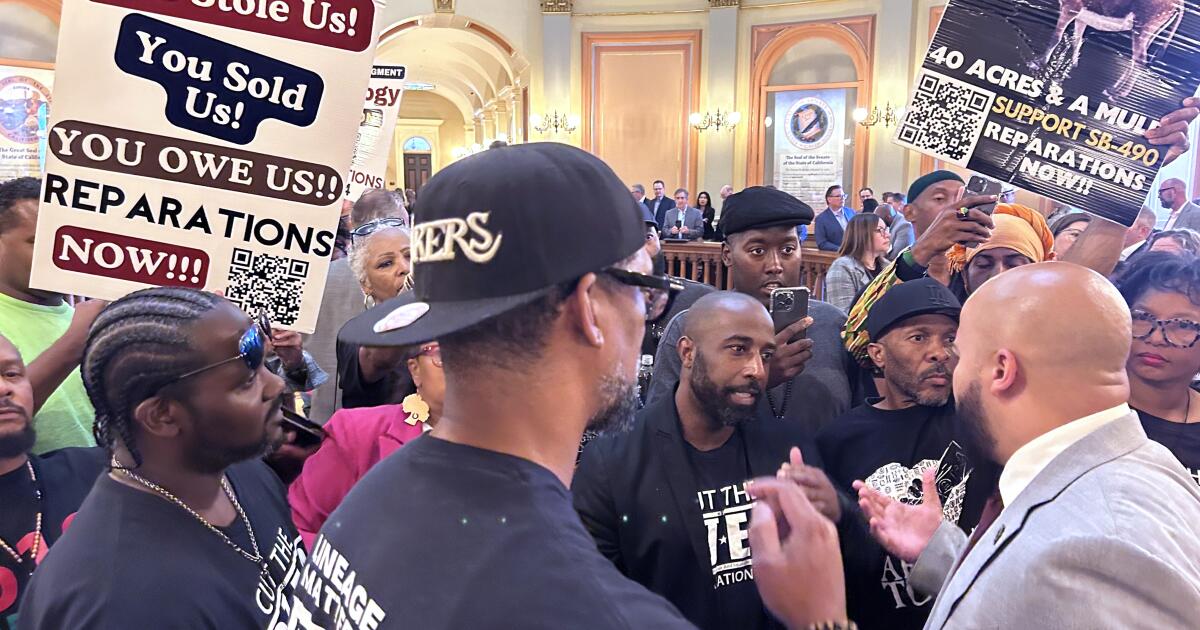
Four years later, their work to deliver reparations is more incremental than recording-breaking, stoking frustration among advocates who filled the Capitol as lawmakers cast their final votes of the legislative session on Saturday.
Hamstrung by a state budget deficit and the challenges of supporting a politically volatile issue in an election year, the California Legislature passed a limited slate of reparations bills. The meager progress, though hailed by some lawmakers and advocates, in a state as liberal as California could serve as a warning on the issue to the rest of the nation.
“I think what it demonstrates is that when the rubber hits the road, Democrats are still unwilling and unable and uninterested in truly supporting these efforts outside of sort of symbolic and less than substantive ways,” said Tatishe Nteta, provost professor of political science at the University of Massachusetts Amherst and director of the UMass poll.
The California Legislative Black Caucus announced 14 priority reparations bills in January based on recommendations made last year by the reparations task force. Lawmakers cast the legislation as a first step focused largely on enacting policy changes in education, healthcare and criminal justice, while omitting cash payments in light of the state’s financial troubles.
Lawmakers passed 10 bills in the package before they adjourned Saturday, including marquee legislation requiring a formal apology from the state for “perpetuating the harms African Americans faced by having imbued racial prejudice through segregation, public and private discrimination, and unequal disbursal of state and federal funding and [declaring] that such actions shall not be repeated.”
The Legislature placed a measure on the November ballot that asks voters to delete language in the California Constitution that allows involuntary servitude as a form of punishment for crimes. Another bill would end a work requirement for able-bodied state prisoners and instead develop a voluntary work program if the ballot measure banning involuntary servitude is approved.
Other bills establish a process for the state to review and investigate claims of racially motivated taking of property by governments using the power of eminent domain, seek to increase and track participation in career training education among Black and low-income students, and expand Medi-Cal coverage, pending federal approval, to include benefits for medically supported food and nutrition.
The legislation now on Newsom’s desk also includes new oversight of book bans in California prisons, a requirement that grocery stores and pharmacies give written notice at least 45 days before closing and the expansion of a state law prohibiting discrimination based on hairstyle to include youth sports.
Bills faltered in the Legislature that sought to restrict solitary confinement in prisons, to prioritize African American descendants of people who were enslaved in the United States for state licenses and to establish grants to fund local efforts to decrease violence in Black communities. A proposal to amend the state constitution to allow funding for programs that increase life expectancy, improve educational outcomes and alleviate poverty among certain racial and ethnic groups of people also failed.
Assemblymember Lori D. Wilson (D-Suisun City), who leads the Legislative Black Caucus, said that work on reparations will continue next year and that the successful bills marked an important first step.
“It was definitely intentional to start laying a foundation,” she said. “We look forward to building on top of that and being able to really engage the community on the work that we’re doing.”
Sen. Steven Bradford (D-Gardena), who introduced the bill to begin the process of reversing racially motivated land and property seizures in the reparations package, pushed two additional bills that failed when the Legislature refused to take them up for a final vote: to create a California American Freedmen Affairs Agency and to establish a Fund for Reparations and Reparative Justice to pay for and carry out reparations policies approved by lawmakers. Neither was included on the Black caucus’ priority list.
As the bills languished in the Assembly on Saturday, reparations advocates gathered in the Capitol Rotunda to lobby lawmakers.
“Bring the bills up!” they shouted every time an Assembly member emerged from the chamber.
Chris Lodgson, wearing a cap embroidered with the words “Cut the check,” said the bills that passed do not represent a meaningful change.
“An apology is not reparations. Extending the Crown Act [to prohibit discrimination against Black hairstyles], that’s not no damn reparations. Passing a bill so that people could read the books that they want to read, that’s not no damn reparations,” he said.
“The only bills to actually let us even do reparations are the bills that they’re scared to bring up.”
Bradford said the bills’ failure was the biggest disappointment of his 14-year career in the Legislature, which came to an end Saturday.
“I think this was the time to strike. The nation’s watching, and I think we owe it to not only African Americans here in California, but across this nation, to set a fine example,” he said. “I”m saddened by it.”
The legislation put forward by the Black caucus was based on recommendations from California’s reparations task force at the conclusion of a historic two-year process last summer to study the effects of slavery, to prove the ways in which government continues to discriminate against Black people and to suggest policy changes to state lawmakers.
The sweeping wish list of reforms included politically challenging proposals to provide cash payments, abolish the death penalty in California and offer free college tuition to eligible descendants, among dozens of other ideas.
Direct financial compensation has become a particularly fraught issue, one sought by activists but opposed by most of the general public.
Newsom, who signed the law that set the reparations movement in motion in California, has yet to endorse the notion of the state providing cash payments to descendants of African Americans who were enslaved. The governor, task force members and lawmakers have repeated the idea that reparations are about more than cash.
A UC Berkeley Institute of Governmental Studies poll in 2023, co-sponsored by The Times, found that 59% of California voters oppose cash payments compared with 28% who support the idea. More than 4 in 10 voters “strongly” opposed cash payments.
A national UMass poll conducted in January found opposition to the federal government providing cash payments at 67%, compared with 34% who said it definitely or probably should pay descendants. Among those against the idea, 29% said their reason was because descendants do not deserve the money.
Nteta said California’s work to investigate and show evidence of the systemic ways in which racial identification has affected the Black community exceeds the federal government’s efforts to detail and trace the impact of slavery. But there’s an inherent tension between advocates who want to apply pressure to enact change now and legislators who recognize that pushing the unpopular idea too hard and failing could be “the death knell for reparations as a policy.”
The nomination of Vice President Kamala Harris, a Black woman and a Californian, as the Democratic presidential candidate adds another level of complexity to the politics of reparations.
Nteta said Republicans mobilize white voters, either directly or implicitly, by suggesting Democratic candidates will improve life for Black Americans and people of color in a way that adversely affects white people.
“When Harris starts to talk about reparations and define herself, there’s a high likelihood that will then be used as a means by which to run ads to demonstrate that she is going to, if elected, disproportionately support the African American community,” Nteta said. “So, her racial identity and her partisan identity intertwining is actually bad news for the notion of a potential president speaking about reparations, or even doing anything on reparations. There’s a lot of political backlash that is going to happen if this is something that she articulates an opinion on.”
Democrats, including those who support reparations, are also unlikely to push her to talk about a controversial subject if it could hurt her chances of beating former President Trump, he said. Harris supported the idea of studying the generational effect of discrimination and institutional racism in order to consider potential interventions before the Democratic primary in her failed bid for the presidency in the 2020 election.
Any action taken in the Golden State could also be pinned on Harris. Trump and his running mate, Sen. JD Vance of Ohio, criticize her as a “left-leaning progressive Californian from San Francisco” to suggest she’s out of touch with America, Nteta said.
“The California Legislature passing a reparations bill would be just like manna from heaven for the Republican Party and for Donald Trump to demonstrate and make the case that this is what the future would look like under a president from California that cut her teeth in a state and has those overarching ideals,” Nteta said. “So it makes sense that there would be very few sort of revolutionary or extremely progressive policies that come out before the fall election.”


California
Mother, daughter found ‘alive and well’ after going missing on Southern California hiking trail

A mother and daughter who went missing after going for a hike on a difficult trail in San Bernardino County’s San Gorgonio Wilderness have been found “alive and well,” the sheriff’s department announced Friday.
The San Bernardino County Sheriff’s Department told KTLA they were uninjured and “walked out on their own.”
Krystal Meyers, 41, and her daughter Alexis Meyers Martinez, 21, were hiking on the Vivian Creek Trail Thursday but didn’t return, according to the San Bernardino County Sheriff’s Department.
They were last known to be at the 10,300-foot elevation mark above the High Creek switchbacks at 11 a.m., according to the San Gorgonio Search and Rescue team.
The Vivian Creek Trail is widely considered one of the more strenuous and hazardous routes in the San Gorgonio Wilderness.
The U.S. Forest Service says it’s the shortest and steepest route to the summit of Mount San Gorgonio and requires experienced mountaineering skills.
Officials did not provide any further details about the circumstances surrounding their disappearance.

BAKERSFIELD, Calif. (KBAK/KBFX) — The California Highway Patrol is urging drivers to stay focused on the road as they head out for Fourth of July celebrations.
The holiday weekend can be a dangerous time on our roads as millions of drivers are expected to travel.
CHP Officer Jorge Toro joined Eyewitness News Mornings to share how drivers can stay safe behind the wheel.
Officer Toro also highlighted the importance of sober driving over the holiday.
BE THE FIRST TO COMMENT
He says anyone hosting a party should make sure all of their guests get home safely, ensuring anyone who may be impaired doesn’t drive.

California is returning a stretch of rugged Mendocino County coast to the Indigenous nations whose ancestors once stewarded its shores.
State transportation officials recently approved the transfer of Blues Beach and the surrounding bluffs to Kai Poma, a nonprofit founded by representatives of the Sherwood Valley Band of Pomo Indians, Round Valley Indian Tribes and Coyote Valley Band of Pomo Indians.
The transfer of 136 acres just south of the community of Westport will mark the first time land managed by the California Department of Transportation has been returned to Indigenous tribes.
“This is beyond huge,” said J. Carlos Rivera, tribal chairman of the Sherwood Valley Band of Pomo Indians. “It’s enormous from our tribal perspective that we are basically obtaining the land that our people once lived on before colonization.”
California purchased the swath of rocky cliffs and windswept shoreline in the 1960s to expand the construction of Highway 1 and create a scenic viewpoint for highway travelers, according to a California Coastal Commission report.
More recently, public access has been largely unregulated, and summer weekends and holidays have drawn large groups who camp and party on the beach, at times driving through sensitive areas, damaging cultural sites and leaving behind trash, the report states.
Kai Poma plans to conduct cultural and archaeological resource studies and environmental surveys and then prepare a resource management plan for the property, according to planning documents. The nonprofit and the Coastal Commission have drafted a public access management plan that states the land will be open from sunrise to sunset.
Rivera described the entire property as a sacred site. The coastal waters are used by tribal people for seaweed and abalone gathering, and the shores host youth cultural camps, he said. “Protecting the land, it has a deeper meaning for us because we’re connected to the land,” he said.
The effort to acquire the land took years — and required a change in state law. Caltrans lacked the ability to transfer land to tribal governments until 2021, when Gov. Gavin Newsom signed a bill sponsored by state Sen. Mike McGuire (D-Healdsburg) that enabled the transfer, according to a news release issued at the time. The law also bars commercial activity on the property and requires public access be maintained.
“With 136 acres now officially transferred into tribal stewardship, one of the most spectacular stretches of the Mendocino Coast will be forever protected,” McGuire said in a statement.
“This agreement, the first of its kind in California, gives these three dynamic Native American tribes the rightful opportunity to reclaim sacred lands and cultural traditions on this special piece of earth. And it’s about damn time.”
The land transfer cleared its last regulatory hurdle June 26 with the approval by the California Transportation Commission, said Neil Thapar, an attorney who works as an advisor and legal consultant to Kai Poma. Caltrans staff will next record the deed transferring the title from the state of California to Kai Poma, which is expected to happen any day, he said.
-

 Technology2 minutes ago
Zoox robotaxi redesign brings big rider upgrades
-
 Business7 minutes ago
Commentary: It’s not just vaccines — from infancy to adolescence, Republicans are waging war on children’s health
-
 Entertainment14 minutes ago
Taylor Swift, Travis Kelce married at lavish Madison Square Garden wedding
-
 Lifestyle16 minutes ago
How to have the best Sunday in L.A., according to Ken Marino
-
Politics22 minutes ago
Trump administration sues California over ‘Glock ban’ law targeting machine gun pistols
-
 Sports32 minutes ago
Folarin Balogun urges U.S. to focus on beating Belgium despite red card he calls unjust
-

 World44 minutes ago
Belgian diamond group that won tariff relief gifts Trump ring
-

 News1 hour ago
Family-owned company prepares to put on the largest fireworks display in history: “It is the biggest show that we’ve ever done”

