Entertainment
If you're a parent, Lauren Greenfield's new doc about teens and social media 'is a horror movie'

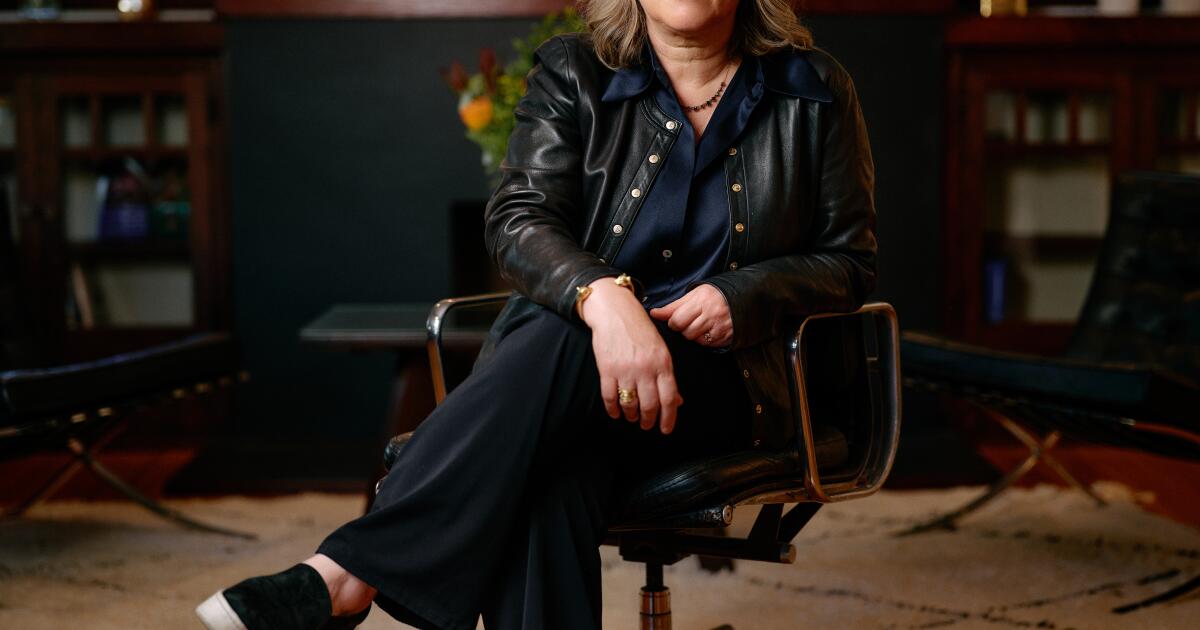
Documentary filmmaker Lauren Greenfield had spent her day with a group of high school students when a startling revelation came up that compelled her to go home and ask her two sons, then about 14 and 20, a question: “Is BDSM really a trend?”
“Oh, yeah, choking is what we’re told girls want,” she recalled one of her sons saying in reference to the risky sexual practice that some teens engage in.
It was 2021 and Greenfield was in the middle of her latest creative frontier: delving into the lives of the first generation raised on social media.
She was interested in unlocking an intimate glimpse of how social media has shaped adolescent minds after seeing her own kids’ distinctive relationship with it.
“They’re different generations,” she said recently from her office in Venice. “My eldest is a reader, my youngest gets his news from TikTok. Just seeing the difference and being concerned about the younger one being on a lot was part of the inspiration for this.”
“Social Studies,” a five-part series premiering Friday at the Telluride Film Festival in Colorado and arriving Sept. 27 on FX, is Greenfield’s latest foray into documenting teen life in Los Angeles.
Her body of work, which includes 2012’s “The Queen of Versailles” and 2019’s “The Kingmaker,” has long chronicled beauty, wealth and power — and the damaging toll of it in excess.
But she’s held a perennial interest in youth culture: “Fast Forward: Growing Up in the Shadow of Hollywood” is a collection of photos and narratives of Los Angeles youth in the 1990s; “Girl Culture” captured the effects of American popular culture on young girls; and her short film “kids + money” features L.A. teens discussing money.
“When I did ‘Fast Forward,’ which was my first project, I was in a very different phase of life,” said Greenfield, who attended the private Crossroads School in Santa Monica as a teenager. “I was just out of college, just starting my career. I very much identified with the kids.”
But for “Social Studies,” “I came to this project as a mother, in terms of how the kids see me,” the filmmaker said.
Dependence on devices and time spent on social media rose dramatically during the pandemic, as restless, isolated teens looked for an escape. In 2021, the surgeon general issued a public health advisory on teen mental health; however, research hasn’t found a direct link between the crisis and social media use.
Sydney, standing to the right, in her freshman dorm room at the University of Arizona. Her relationship to social media, and the temptation to project a sexualized image, is explored in “Social Studies.”
(Lauren Greenfield / Institute )
Greenfield’s series explores the everyday pressures teens confront that have been intensified by social media, including bullying, body-image issues and comparison culture.
“‘Fast Forward’ was all about media influence and how kids were being changed and impacted by media influence. I called it the influence of Hollywood because I was specifically looking at celebrity and image culture and materialism,” Greenfield said. “I wanted to come back and explore the same subject but with this new influence of social media. It was similar but amplified. Social media was everything I had looked at throughout my career but on steroids.”
The series was largely filmed in Los Angeles and features teens from 10 schools, including Pacific Palisades, Los Angeles and Hamilton high schools. Greenfield shot roughly 1,200 hours of footage over 150 days — covering the 2021-22 school year and some subsequent months. She also recorded the teens’ phone and social media use.
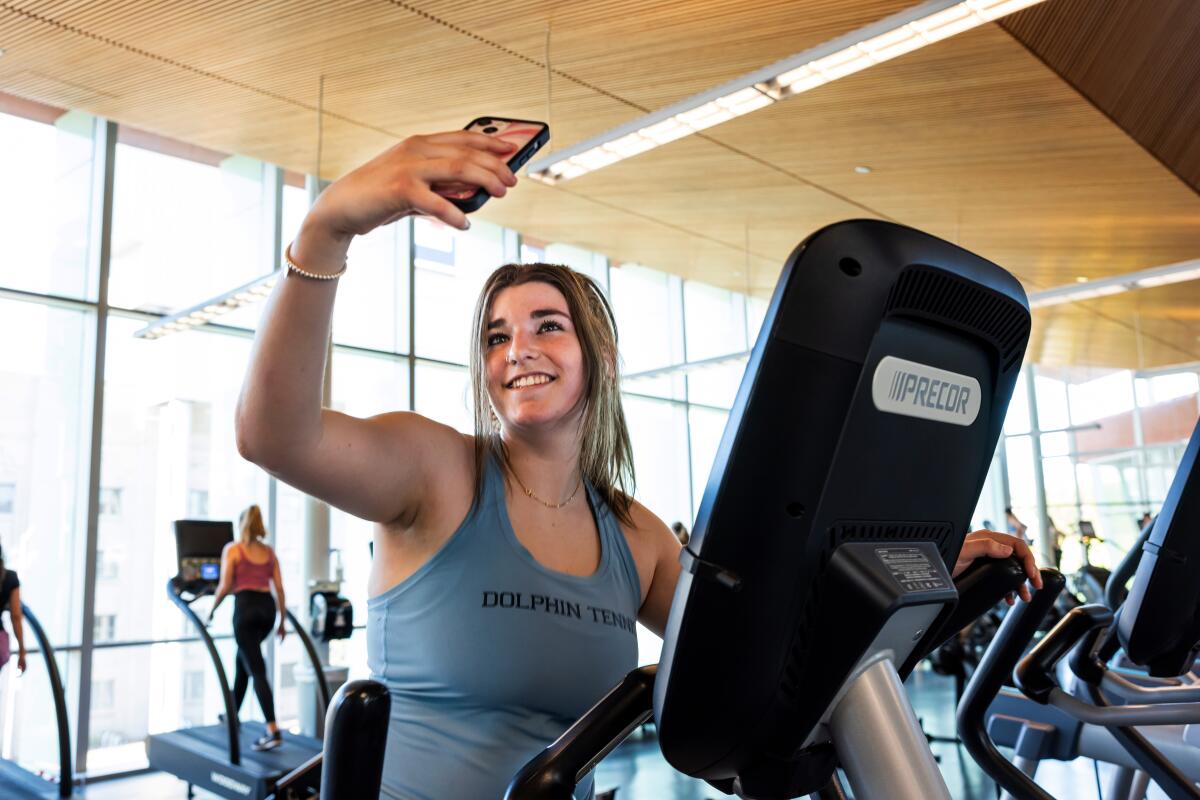
The teens who open up their phones and their lives include Sydney, who grapples with curating her social feeds with provocative videos and images of herself; Ellie, who had a taste of viral fame after her relationship with actor Jack Dylan Grazer (nephew to mega Hollywood producer Brian Grazer); and Jonathan, who volunteers at Teen Line, the nationwide nonprofit hotline. A filmmaker himself, Jonathan sets out on a parallel journey, making a movie about teen life with many of the same subjects while taking part in Greenfield’s documentary.
The series arrives at a pivotal moment. On Wednesday, California legislators passed the Phone-Free Schools Act, which would require public schools to create policies to limit or prohibit cellphone use by 2026. The Los Angeles Unified school board already passed a measure this summer to ban phones on campus; it’s expected to take effect in January.
In a conversation earlier this month, edited here for length and clarity, Greenfield discussed how she treated her young subjects as experts, the ease in capturing teens authentically and why parents should watch.
1
2
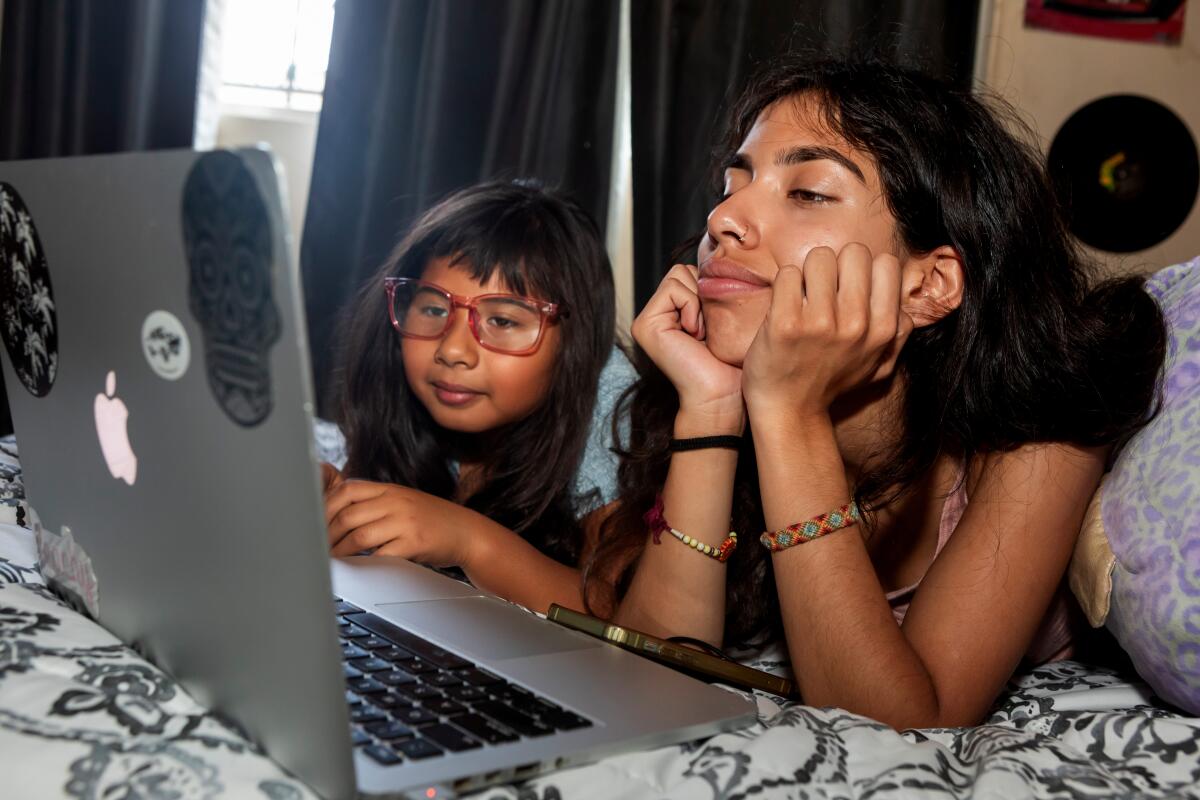
1. Sydney in “Social Studies.” (Lauren Greenfield / Institute ) 2. Ellie, right, in “Social Studies.” (Lauren Greenfield / Institute )
So much of what you’re after is capturing your subject in a raw and authentic way. And when you’re dealing with kids who have grown up in this digital era, where so much of the image they put out there is curated, I imagine it was challenging to know when you’re really getting the authentic piece.
Surprisingly, I felt like they really brought themselves. I remember the first group session, nobody dressed up. It wasn’t even like school, which is a bit of a fashion show. It was more like camp. People were not wearing makeup, they were not curating outfits.
I remember a long time ago, somebody told me, “If you spend enough time, you really get authentic selves,” because posing or pretending takes a lot of energy, and eventually, it’s too taxing. That’s always been really important to my work, slow journalism. There’s always a process of people becoming more and more comfortable with you. I also started with a little bit of a bigger group than I ended up with, but the ones whose stories I really followed, we became very close, and I depend on that. They have to let me know something is happening so I can go and be there. And so they opened up more and more. I felt like by the end, they really presented their authentic selves.
For this one, everybody knew we’re looking at social media and its impact, and even in terms of who I selected, the kids had to care about that because it’s a lot to open up your lives. I think a lot of the kids felt a sense of purpose in doing that.
Having conversations with teens, particularly ones you don’t know, can be challenging. In addition to one-on-one interviews, you held group sessions. It felt a little bit like “The Breakfast Club.” Kids who maybe wouldn’t ordinarily talk to each other are in this room together, realizing their commonalities. Did you see that as a way to get your subjects comfortable?
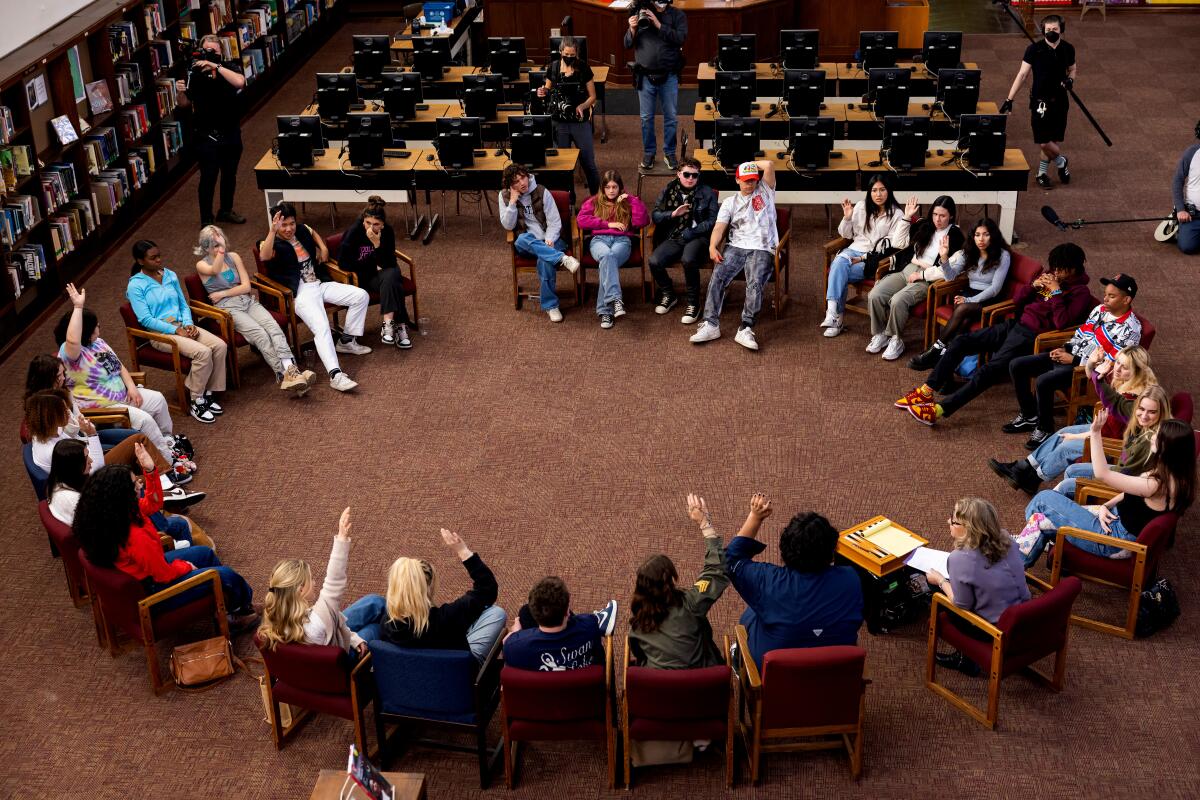
I like that you said “The Breakfast Club” because that was a little bit of inspiration. The first seven groups I did, we weren’t even filming them as groups yet. I just wanted to hear what they thought was important, what I should cover, what were the problems. I wanted to be led by them. One of the big impetuses for this is I felt like the kids are the experts. We’ve seen experts talk about this topic, we’ve heard from parents, we’ve heard from tech, we’ve heard from legislature leaders, but I feel like the kids were the experts. One of the things I really tried to do was capture the duality of them being both subjects and experts.
There’s three elements: There’s the vérité — where we see them in their lives, sometimes they’re posturing, sometimes they’re presenting, sometimes they’re with friends, sometimes they’re lying. There’s the interviews where they’re just brutally honest, they break the fourth wall, they tell me the truth. That was really interesting, because also we have their social [media screen capture,] so we see the difference between what they’re saying and what they’re showing. And then the third perspective is the group where they’re talking to each other, and there they also were very honest. Sometimes they said it was almost like therapy; it was a place where they could talk about things that were affecting them all the time.
1
2
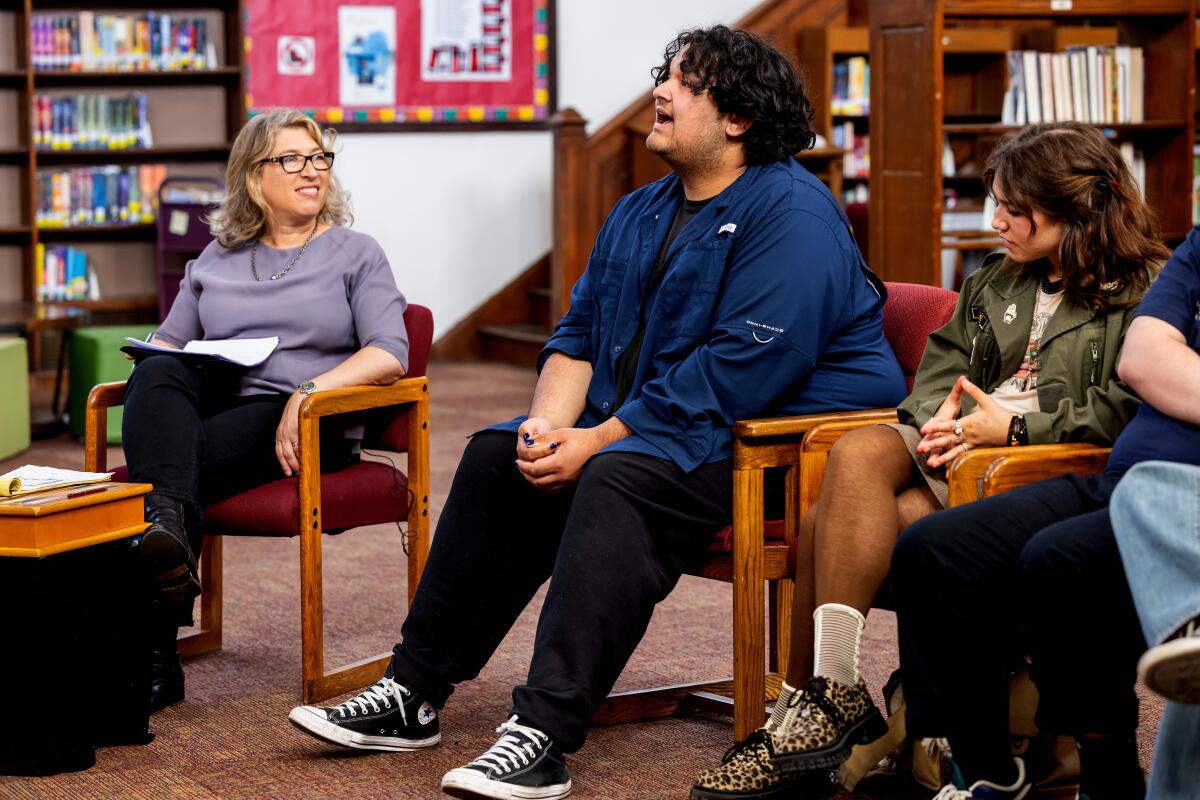
1. Teens featured in “Social Studies” gather for one of the group discussions held by filmmaker Lauren Greenfield. (Lauren Greenfield / Institute ) 2. Dominic, center, speaks during one of the sessions. (Lauren Greenfield / Institute )
One of the striking elements to the series is that you’ve asked your subjects to screen record their activity on their phone. How important was that piece?
So important. I feel like it’s a time capsule of the culture, the stuff that we captured. It’s really shocking to see how the algorithm works, to see how toxic some of the rabbit holes can be and to see the details of it. In the series, I didn’t want to have it be two worlds, like cut to a screen on black. I wanted a lot of the social that we’re seeing to be on top of the live action. I really wanted to show that these worlds are intertwined, intermixed, multitasking, and sometimes they’re opposing each other. Sometimes there’s fiction and nonfiction. I don’t want to give away too much for the audience, but I think there’s a lot of really shocking content.
And my hope for the series, ultimately, is that it leads to some kind of regulation. “Fast Forward” was about the early loss of innocence in the ’90s. Now, there’s no innocence. There’s no childhood. You can’t keep your child from seeing devastating things, and they can’t even keep themselves from it, in the sense that the algorithm is going to take you by the hand, and whatever you’re curious about, feed you more and more stuff, and whatever your weakness is, it’ll pull you further into that. And the companies that are creating the algorithm are not doing it with the kids’ best interest in mind. They’re doing it with the interest of keeping them engaged on the platform.
The other theme that’s gone through all of my work, which came back here with a vengeance, is addiction, because it’s really addictive. I struggled with my own son to give limits. But what I realized when I was doing this is, it’s not fair to ask kids to regulate themselves. It’s like opiate addiction.
With fictional depictions of teen life — whether it’s “Euphoria,” “Thirteen” or even “Beverly Hills, 90210” — it’s easy to say, “That’s the extreme, it’s not really like that for teens.” But the first episode of this series is pretty jarring.
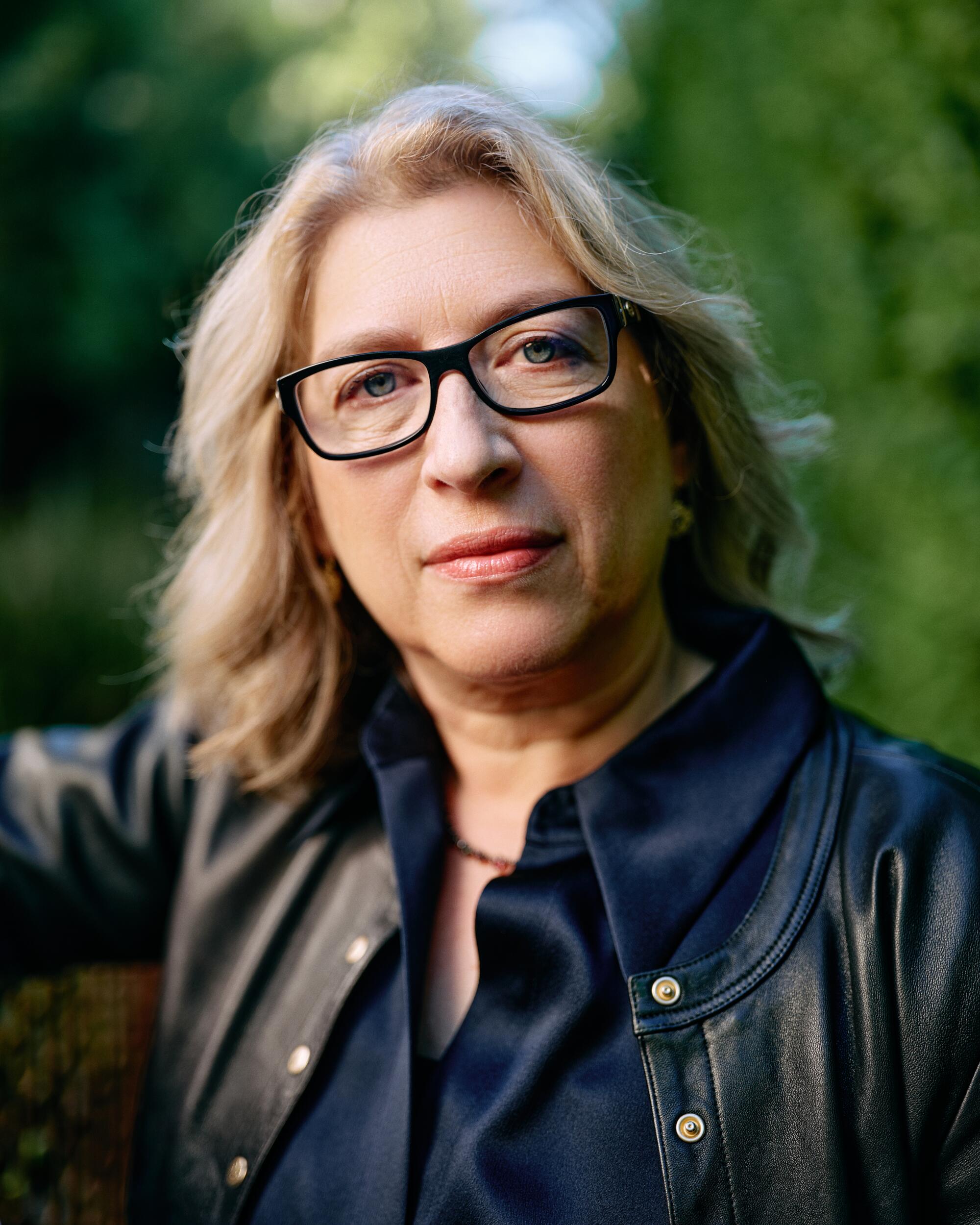
Filmmaker Lauren Greenfield: “My hope for the series, ultimately, is that it leads to some kind of regulation.”
(Marcus Ubungen / For The Times)
When I was doing feedback screenings, I showed [filmmaker] Nicole Holofcener, and after the first episode, she said, “This is a horror movie.” I don’t think it’s a horror movie for kids, though. I think that kids — and also 20-somethings, because I did some feedback screenings with those groups — see themselves. I think the kids are saying: “We need to talk about this.” There’s one part where Sydney’s mom’s like, “I don’t want to go in my kids’ TikTok.” But what I’m trying to do is say, “We need to be in this business. We need to have them share their experience.” What I love is that the kids are the ones who are saying, “This is concerning.” They’re saying, “You need to pay attention.” By the way, the parents — and I’m guilty of this myself — are posting on Facebook, I did this, I did that, but not always realizing how toxic it is.
Right. Sydney’s mother talks about her own social media use, specifically Facebook. How much did you want to hear from the parents?
At first, I wasn’t planning on including the parents. I thought it was going to be more like Charlie Brown, where the parents don’t understand and they’re in the background. Sydney’s mother was a really important voice. I feel like the parents are responsible, loving parents for the most part and yet have no idea. It’s not that they don’t want to help their kids, it’s like they don’t know what’s going on and they don’t know how.
With Sydney’s mom, there was a scene that I filmed where Sydney’s mom was like, “Don’t wear that short skirt outside.” She is an enlightened woman who doesn’t like the sexualization, but it’s a really hard thing to come down on because there’s a feeling among girls, and I’ve seen this in my own capturing of feminism and new feminism, where girls feel like showing their bodies is their right and their self-expression and they want to own that. And from my generation of feminism, I feel like that is not your voice and that it may feel like self-expression, but actually, it’s making the body the primary expression of identity. I don’t think it is good for either girls or boys.
I really tried to not fault the parents because I feel like I also did not know what was going on with my kids. Like I said, I have to sit down at the table and be like, “Is BDSM really a trend” to my teenagers? I was sure they were going to say no, and when they said yes, I almost fell out of my chair.
What were those conversations like to get parents of the teen subjects in the film on board?
I think a lot of them looked at my other work and could see this isn’t entertainment. It’s purpose-driven, and not everybody opted in, but the ones who did saw it as an interesting opportunity. We started talking to kids and parents in spring 2021 and we didn’t start [filming] until August 2021. I’m really grateful to the kids and the families because it was a lot to ask.
What is the push and pull of wanting to provide this anthropological look at teen life today while, in turn, asking them to put themselves out there on, arguably, a more mainstream platform as a TV series?
For one, in terms of choosing kids, of course, one of the big subjects around social media is fame. And one of the things I was looking at was fame as a value and how values have shifted. Even when I was doing “Generation Wealth,” I was really struck by, when you ask kids what they want to be when they grow up, they say rich and famous instead of a particular job. So when I was looking for kids, I did try to correct for not bringing in kids that wanted to be in this project to be famous. It wasn’t as much of an issue as I thought, because I don’t think any of them thought that this was a way to be famous.
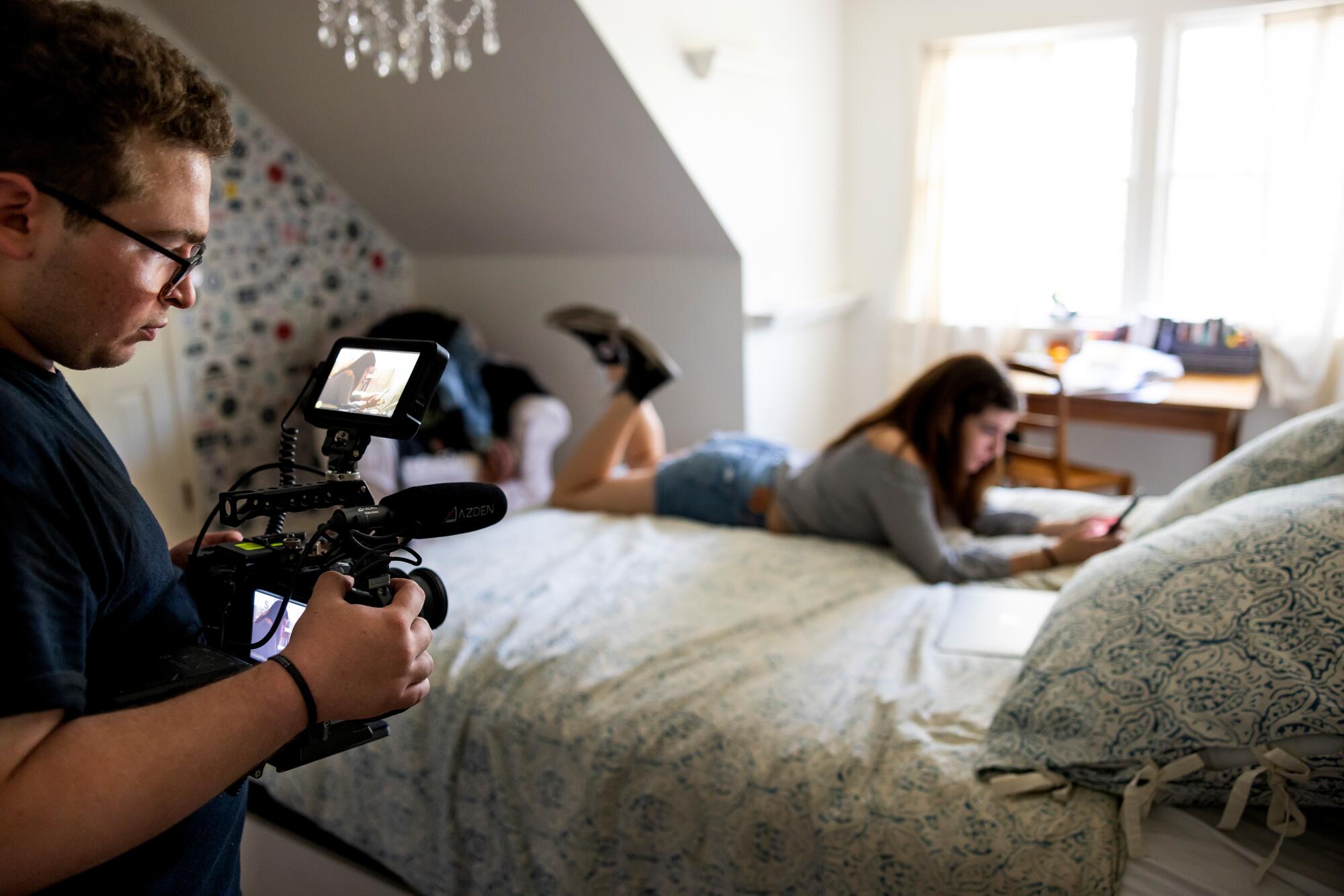
Jonathan films Sydney, 18, in her bedroom. He’s a videographer at his school and began to chronicle the other students in the group for his own documentary.
(Lauren Greenfield / Institute )
One of your teen subjects, Jonathan, also felt inspiration to make his own film, and there’s a bit of parallel documenting that happens. What piqued your interest about his approach or his perspective?
It’s a big thing when you allow yourself to be in a documentary, so I feel like everybody has to get something out of it. And lots of the kids were makers. Jonathan was the videographer for the school, and that was one of the things that was appealing about him. Plus, he had a different relationship with social media. He wasn’t a poster; I didn’t want everybody being big posters. And he was very serious about his filmmaking. And he wanted to interview kids from our group. He was on this parallel journey with me.
Jonathan offered a lot; he’s a very empathetic person in a time of narcissism and a culture of narcissism, and I think he’s part of what we need. Empathy is another antidote to narcissism and focusing a lot on yourself and being in this feedback loop with yourself.
What do you want audiences to take away after watching this documentary?
Empathy, connection. When they say at the end, “Here we are without phones; we’re just talking” — it’s so great. One time when I was watching that, I almost just started laughing because it’s like a revelation— we’re without phones, we’re talking and it’s so amazing.
It’s a really hard time to grow up. I do think kids show resilience and wisdom, but they do that in the face of a really challenging environment, and ultimately, the adults are responsible for this environment. That’s what I hope we take away: We need to do something about it, to protect kids, because it’s just not fair to ask them to protect themselves.


In Sender, writer-director Russell Goldman’s high-anxiety debut, the filmmaker expands on his 2022 short Return to Sender, in which Allison Tolman starred as a woman who receives packages she didn’t order. That may not sound like a premise that would result in a paranoid, darkly comedic thriller, much less a feature. But in extending his story from 18 minutes to just over 90, Goldman follows a maddening scenario involving an online retailer called Smirk, a fictionalized Amazon counterpart. More significantly, he captures the frenzied mindset of his protagonist, who grapples with staying sober and several other major life changes—all compounded by a layer of justifiable paranoia brought on by the endless packages. Goldman’s tweaky style and elusive scripting create a peculiar, out-of-whack presentation that destabilizes the viewer, firmly placing us in his main character’s perspective. However, by the end, the journey through this cine-manic headspace doesn’t add up to much, and the potential character study at the center feels somewhat lost in the mechanics of the conspiracy.
Britt Lower (AppleTV’s Severance) stars as Julia, who has just lost her job and moved into a rental home to get her life on track. She is backed financially by her overbearing sister Tatiana (Anna Baryshnikov), who occasionally comes nosing around to verify that Julia doesn’t backslide. And she doesn’t. Julia attends regular Alcoholics Anonymous meetings, where she meets the steely Whitney (Rhea Seehorn), who isn’t interested in being her sponsor. But at home, Julia receives a Smirk package with her brand of lipstick. The problem? She didn’t order it. She calls customer service, and the representative doesn’t help much before telling her, “Be sure to stay alert and aware.” Wait, what? Sender is loaded with nagging, unplaceable details like this. They’re often amusing, intriguing, and exasperating in the same moment. But these pieces don’t complete a whole picture, at least not a narratively satisfying one.
The Smirk packages, delivered by the outwardly helpful, nice-guy driver Charlie (David Dastmalchian), contain a random assortment of objects, from drum kits to protein powder. The squirrelly Julia, already coming apart at the seams from her recent drama, doesn’t know what to make of it. She’s convinced there’s some plot against her, perhaps by someone at Smirk. To what end, she doesn’t know. But Goldman gives us a glimpse of the long-term consequences of her ordeal in the prologue, which features Jamie Lee Curtis (also a producer) as Lisa, a woman in circumstances similar to Julia’s. Lisa’s response to receiving a box of soil with a broken shin pad (with “Can’t Can’t Can” scrawled on it) entails an attempt to suffocate herself with the bubble wrap, only to do far worse with a sharp edge of the shin pad. To show Lisa’s fate, Goldman’s imagery becomes twisted and surreal but also cryptic.
Sender’s disorienting mood is matched by a skewed formal presentation. Cinematographer Gemma Doll-Grossman’s wide-angle lenses and arch angles might feel at home in a Ken Russell or Terry Gilliam feature such as The Devils (1971) or 12 Monkeys (1996). Julia’s half-remembered drinking binges, accented by blurry close-ups, suggest she may have slept with any number of coworkers. She can’t remember, and it embarrasses her. Her rental is dressed in simple if shabby décor, which gives way to Julia’s erratic collage-like overhaul. Melisa Myers’ stuffed production design makes the most of heightened colors and banal, cluttered rooms that lend a normality to the bizarre, ever more disturbing predicament. Nathan Ruyle’s erratic music delivers what must be described as a soundscape rather than a traditional score, with collusive sound effects and tones driving our certainty that Julia is onto something. Along with Marco Rosas’ discordant editing, Goldman’s technical approach effectively reflects Julia’s fragmented, sleep-deprived mind. But his work as a writer hasn’t done enough to justify this level of technique.
After Julia makes a revelatory discovery that small cameras have been embedded in the products from those mysterious packages, the eventual explanation about what has been happening and why strains logic and underwhelms. It also raises even more unanswered questions. Although well-made and acted—Lower and Seehorn should be on track to movie stardom—Goldman’s script could have used another draft to better work through what unfolds. Sender doesn’t give us enough of its characters’ inner lives beyond the situation at hand, so Julia, Charlie, Tatiana, and Whitney feel like devices in a scenario rather than well-drawn human beings. Even so, Goldman fills his film with deeply broken people who try to gain control of their lives by controlling others, exposing and preying on their weaknesses. Despite the material’s potential resonance, Goldman’s style is overpowering. Still, his kernel of an idea and the way he explores it demonstrate his clear skill, and for much of Sender, its sheer oddball energy earns admiration.

“Lethal Weapon” star Danny Glover has revealed he has been living with Alzheimer’s disease for years.
In an interview with NBC’s Lester Holt that aired on the “Today” show on Wednesday, the 79-year-old actor and activist opened up about living with the disease. According to People, he received his diagnosis in 2023, which was not long after he was awarded an honorary Oscar in 2022.
“I could live with it, in a sense,” Glover says of his condition, which has been affecting his movement, speech and memory. “I’m sure as it advances, things are going to be different and changing.”
A neurodegenerative disease, Alzheimer’s is a type of dementia that affects memory, thinking and behavior and worsens over time, according to the Alzheimer’s Assn. Holt reports that more than 7 million Americans over 65 are living with Alzheimer’s, with Black men suffering at a rate double the national average.
Glover and his family say the Hollywood icon is sharing his story now to “have ownership of his life” and to help remove the stigma around the disease.
“They’ve got my back,” Glover says of his family’s support.
Besides his portrayal of L.A. police Det. Roger Murtaugh in the “Lethal Weapon” film series, Glover is known for roles in movies including “Places in the Heart” (1984), “The Color Purple” (1985), “To Sleep With Anger” (1990), “Angels in the Outfield” (1994), “Dreamgirls” (2006) and “The Last Black Man in San Francisco” (2019). He’s also been a vocal advocate for social justice and humanitarian causes both in the U.S. and abroad.
He was the recipient of the Academy of Motion Picture Arts and Sciences’ Jean Hersholt Humanitarian Award in 2022.
“I don’t feel like it’s the end of my life,” he said in his interview with People about living with Alzheimer’s. “There’s work to do.”

Enter your email and we’ll send a secure one-click link to sign in.
WKRN is provided by Nexstar Media Inc., and uses the My Nexstar sign-in, which works across our media network.
Nexstar Media Inc. is a leading, diversified media company that produces and distributes engaging local and national news, sports, and entertainment content across its television and digital platforms. The My Nexstar sign-in works across the Nexstar network—including The CW, NewsNation, The Hill, and more. Learn more at nexstar.tv/privacy-policy.
-

 Dallas, TX6 minutes ago
Erling Haaland’s Dallas Western wear purchase goes viral
-

 Miami, FL9 minutes ago
Miami’s FIFA Fan Fest draws thousands to Bayfront Park to watch Team USA win World Cup match against Bosnia
-

 Boston, MA14 minutes ago
2026 Yukon Denali Ultimate gets pricey, but tops the charts
-

 Denver, CO21 minutes ago
Nuggets Sign Marvin Bagley to 1-Year Deal: What It Means
-

 Seattle, WA24 minutes ago
FOURTH OF JULY 2026: Here’s where Seattle Parks will leave the lights on longer
-
 San Diego, CA29 minutes ago
USA fans pack San Diego bar to cheer on USMNT’s dominant World Cup knockout win
-
 Milwaukee, WI36 minutes ago
Hundreds rally on Milwaukee’s South Side against ICE arrests and in solidarity with immigrants
-

 Atlanta, GA39 minutes ago
Braves News: Tarik Skubal rumor, Cam Caminiti to the Futures Game, more

