Finance
Nvidia’s business is growing faster than expected. Investors were still disappointed.


Sometimes your best just isn’t good enough. That’s the lesson Nvidia (NVDA) learned Wednesday after the company’s stock price fell 3% despite posting better-than-expected second quarter earnings and guidance for the third quarter.
It’s not as though the company’s growth was unimpressive, either. Revenue jumped 122% year over year to $30 billion, up from $13.5 billion. Nvidia’s all-important data center revenue topped out at $26.3 billion, a 154% year-over-year increase.
But that wasn’t the kind of blowout that investors have quickly grown accustomed to over the last few quarters.
Beyond investor sentiment, Wall Street analysts have also seemingly caught on to Nvidia’s growth after several quarters of big surprises to the upside.
Nvidia’s revenue reported Wednesday beat Wall Street expectations by 4.1%, the slimmest margin since the fourth quarter of its 2023 fiscal year.
As Nvidia’s business has boomed over the last two years, the company’s revenue topped Wall Street forecasts by double-digit percentage points for three straight quarters, including a 22% difference in its fiscal second quarter of 2024.
And as Wall Street appears to have gotten a better feel for Nvidia’s growth at this point in the AI investment cycle, questions have also arisen about the status of Nvidia’s next-generation Blackwell chip.
Ahead of the company’s earnings announcement, the Information reported that the chip, the follow-up to Nvidia’s Hopper line, faced delays that could impact some of the company’s biggest customers including Microsoft and Google.
In her quarterly comments, Nvidia CFO Colette Kress explained that the company made changes to Blackwell to improve its production yield. CEO Jensen Huang, meanwhile, said that the chip is currently being sampled to customers, a major step toward shipping the processor at volume.
Huang said the company expects to ship several billion dollars of Blackwell revenue in the fourth quarter. But the CEO couldn’t pin down exactly how much revenue Blackwell would generate, despite analysts’ questions.
Huang, however, did provide a number of other strong points for Nvidia, including pointing out that demand for Blackwell platforms is well above supply. The CEO also said that Nvidia’s Hopper platform will continue to grow in the second half of the year, and explained that the company expects its data center business to grow “quite significantly next year.”
Huang also said that AI inferencing is driving the company’s data center revenue. Inferencing refers to computers running AI programs and providing users with answers to their queries.

That should put to rest fears of threats to Nvidia’s long-term growth as companies pivot from training AI models to using inference. Huang appears to believe that Nvidia will continue to plow forward as customers use its chips to both train and run their AI models.
Nvidia is still the world leader in AI chips, and it’ll be some time before rivals AMD (AMD) and Intel (INTC) catch up to its hardware and software lead. And while Nvidia may be facing a near-term decline in its stock price, Wall Street is still on board.
In an investor note released following Nvidia’s earnings, BofA’s Vivek Arya raised his price target on the chip designer to $165 from $150 per share, writing, “Despite the quarterly noise, we continue to believe in [Nvidia’s] unique growth opportunity, execution and dominant 80%+ share as generative AI deployments are still in their first 1-1.5 [years] of what is at least a 3 to 4-year upfront investment cycle.”
Raymond James’s Srini Pajjuri also raised the firm’s price target on Nvidia’s stock from $120 to $140, writing in an investor note that “Blackwell delays appear better than feared and management is forecasting a strong ramp in FQ4.”
Pajjuri also said demand for Nvidia’s current-generation Hopper chip continues to be healthy and pointed to anticipated sales growth in Q4, despite Blackwell production ramping up at the same time.
Morgan Stanley’s Joseph Moore, who raised his price target for Nvidia from $144 to $150, called out Nvidia’s sky-high expectations with regards to the company’s stock moves after the earnings report.
“Expectations become more challenging as the superlative becomes mundane, but this was still a very strong quarter given the transitional nature of the current environment.”
Whether that’s enough to satisfy investors next quarter remains to be seen.
Email Daniel Howley at dhowley@yahoofinance.com. Follow him on Twitter at @DanielHowley.
For the latest earnings reports and analysis, earnings whispers and expectations, and company earnings news, click here
Read the latest financial and business news from Yahoo Finance.



Finance
I’m a 25-year-old grad student on a budget. I’ve struggled to accept financial help from my Boomer and Gen X friends.

In August, I quit my steady job as a New York City public high school teacher to start a full-time graduate program in Manhattan. I worried about the choice not only because I loved my work with the kids, but also because I had traded a consistent paycheck and affordable health insurance for tens of thousands of dollars in tuition.
When I was teaching, I prepared for the cost by scrimping to save every cent I could. But my account balance still wouldn’t fully cover two years of school and living expenses.
Throughout my savings journey, I learned a lot of lessons, especially from my older friends.
I jumped into major money-saving mode
As a result, I redoubled my frugal efforts. I made a rule that I wouldn’t eat out or order takeout unless it was someone’s birthday. I asked to meet people in parks rather than restaurants and suggested $5 happy-hour spots from a meticulously crafted list on my phone.
On rare occasions when I dined out, I looked at the prices before deciding what to order and pored over the bill with a calculator.
It worked. While it was still difficult to watch my savings dwindle — buoyed occasionally by small deposits from part-time jobs — I kept my costs (relatively) low for a 20-something in the city. Most friends understood my restrictions or were in similar situations.
I worried when my older friends routinely paid for me
But this approach didn’t work as well with my five older friends from my intergenerational writer’s group. We’d been meeting weekly on Zoom for several years when we started visiting each other in our home states across the country. As women in their 40s and 60s in dual-income households with established careers, they understandably gravitated toward nicer places where the cheapest cocktail cost $20. My dive bars with weirdly stained walls weren’t going to cut it.
When I visited two of these friends in Chicago, I anticipated that we’d go to swanky spots and saved up for weeks, cutting out anything nonessential from my grocery list — chocolate-covered pretzels, bananas, frozen fried rice.
But when I offered to chip in for our multi-course dinners or luxury spa day, they brushed me off.
I was grateful for their generosity, yet overcome with guilt. They had contributed so much to our time together. I didn’t want to be a freeloader, the friend who couldn’t hold up her end of the deal. How could I pay them back and show my appreciation?
At the end of the trip, my friend Andrea, 46, and I ate lunch in a diner in the Gold Coast. I made one last offer to Zelle her. In response, she said something that stuck with me.
“When I was in my 20s, people helped me,” she told me with an easy smile. “When you’re 40, just pay it forward by buying a younger woman dinner.”
Her wisdom helped me slowly release my anxiety
I mulled over her words on the plane home. I was surprised that her view of the situation differed so much from mine, and relieved she didn’t see me as taking advantage of her. Yet it was still hard to fully let go of the weight in my chest — the feeling of being indebted to someone’s kindness, of accepting a gift while knowing you can’t reciprocate.
Months later, my 64-year-old friend from my writer’s group visited from Florida. We went out for coffee, and I thought to myself, Okay, now this I can afford. But when I offered to cover or at least split it, she waved me off, saying, “My treat.”
I thought of Andrea’s words and told myself, She’s being nice. Don’t worry about it.
“Thank you,” I said, and meant it.
A while later, when another friend visited from Washington, she paid most of our checks at the bars and restaurants we visited. Though I felt a twinge of the usual panic at first, by our second day together, I was able to let it go. As we wandered through the Upper West Side, the tightness in my chest lifted, leaving only gratitude that she was here.
I do plan on paying it forward
Andrea was right, I realized. Helping each other was what friends did, and they clearly weren’t bothered by it. Sure, I wasn’t paying for lavish things or hosting people, but I shouldn’t let my own hangups affect our time together, which always produces some of my favorite memories.
Eventually, I’ll be able to do what they’ve done for me for another woman, who can then help someone else.
Instead of worrying, now I let my friends’ kindness bring us together and smile, knowing that every time I pay for a 20-something woman in the future, I’ll think of them.

EL PASO, Texas (KTSM) — The City of Las Cruces’ finance director has received a national honor recognizing “exceptional contributions to public finance and local government service,” the City said.
Finance Director Lesley Doyle was selected by the Government Finance Officers Association (GFOA) to receive the organization’s “Recognition for Outstanding Public Service.”
The award recognizes Doyle’s leadership during a critical financial period for the City.
She stepped into the role of finance director as the City’s FY25 audit identified a projected beginning balance shortfall of more than $10 million in a community of nearly 120,000 residents, the City said.
Doyle led a coordinated effort to communicate the financial situation clearly to City departments, executive leadership, and the City Council, while working with the budget team to close the gap without reducing essential services.
Josie Trevino, assistant finance director, credited Doyle with building a culture of trust and collaboration between the Finance Department and other City departments from the beginning of her tenure.
Doyle came to municipal government after a career in public education, transitioning from a school district into City finance leadership.
“In her first year, she met the challenge with confidence, emphasizing open communication, transparency, and proactive problem-solving. Her leadership has helped strengthen relationships across the organization while fostering a positive and supportive workplace culture within the Finance Department,” the City of Las Cruces said.
“The balance of technical skill and genuine care for people is what makes Lesley’s leadership unique,” Trevino said.
The GFOA has published Doyle’s recognition on its website, and her story will also be highlighted during the upcoming GFOA newsletter and highlighted at the annual GFOA conference.

A former senior Treasury adviser to Gordon Brown has warned that HMRC is on the cusp of using artificial intelligence to track people’s and businesses income and expenditure without them knowing.
Dr Chris Wales, who was a member of Mr Brown’s Council of Economic Advisers for more than six years, has sounded the alarm while launching a chilling book on the conduct of the Spanish tax authority, Agencia Tributaria.
He is set to join former Labour Treasury minister Baroness Dawn Primarolo at an event next week flagging up how the Spanish model of dealing with tax evasion is about to arrive in the UK suggesting that the door is opening for a “surveillance state.”
In a preview of the future, Dr Wales has claimed that confidentiality in personal life – not just finances – “will simply go out of the window” and asks whether there are adequate safeguards in the UK to prevent HMRC from emulating its Spanish counterpart.
He said: “From 1 January, every single invoice will go through the tax agency in Spain. The Inspector can already obtain all your utility bills and will soon find out which clinic and pharmacy you use and what you buy there, which restaurants you eat at, where you purchase wine and groceries, what kind of car you have, how far you drive and where you park, what flights you take and which hotels you use. Information security? A thing of the past.”
He went on: “I am far from being a libertarian, but I see great danger in the direction in which tax authority powers are going, particularly because the process doesn’t seem to involve our active consent. There is little parliamentary debate about it. In Spain it is simply out of control. In the UK, let’s see.”
Highlighting the CONNECT AI program already used by HMRC in the UK, Dr Wales claimed that the UK is now close to following Spain’s lead.
He said: “HMRC has been using sophisticated information technology for years including an AI system called CONNECT which, as early as 2023, was said to contain more than 55 billion taxpayer-related data items.
“It will be much bigger today with these billions of pieces of information about taxpayers capable of being sorted quickly by AI.”
Dr Wales, who is now senior research adviser at International Centre for Tax and Development, added that HMRC also declines to say what algorithms it uses, under the pretext that if you publish them people will “game the system”, a claim that he suggests does not stand up to scrutiny.
“The system is understood to be used to target evasion. For tax authorities, everyone is a potential tax evader. This means that they believe they have a legitimate reason to collect data about all of us,” he said.
-

 Louisiana6 minutes ago
Man killed, officer injured in shooting in alleyway near Sand Bar in downtown Shreveport
-
Maine13 minutes ago
People We’ve Lost
-
 Maryland16 minutes ago
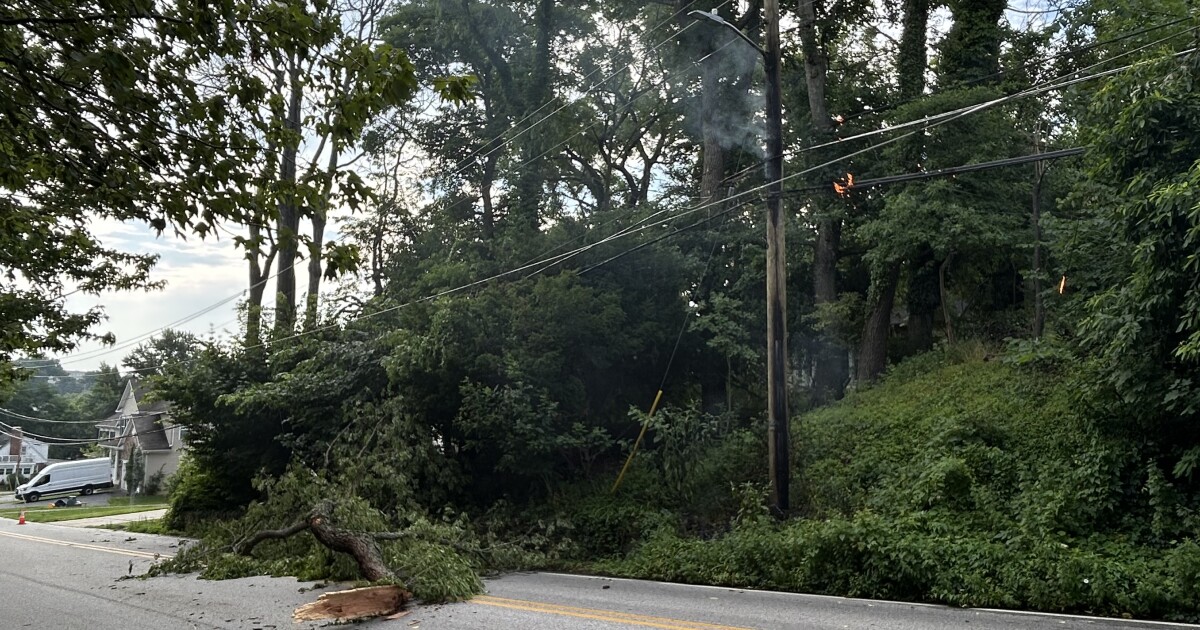
BGE working to restore power to over 40,000 customers after July 4th storms move through central Maryland
-

 Michigan21 minutes ago
Fifth Third, Comerica merger: What Michigan customers need to know
-

 Massachusetts28 minutes ago
EV sales have slowed down. That puts pressure on Massachusetts’ climate goals. – The Boston Globe
-

 Minnesota31 minutes ago
Summer heat and humidity continue in Minnesota with low storm chances midweek
-

 Mississippi36 minutes ago
Oldest Mississippi businesses. These institutions have survived at least a century
-

 Missouri43 minutes ago
Tracking sunnier, milder conditions returning to Mid-Missouri


