Arizona
I sent an Arizona man to prison for 290 years. His case still haunts me


I sent plenty of people to prison during my career as a judge. Now I’m working to get one man out, and not because I think he’s innocent.

How the bail system increased wealth and racial inequalities
There have long been calls to end money bail in the U.S. prison system. Here’s what some jurisdictions are doing to reform it.
Just the FAQs, USA TODAY
I participated in hundreds of sentencing hearings in my 44-year career as a prosecutor and as a judge.
Most of the sentences imposed were within the range I thought reasonable given the crime committed and the defendant’s background.
Occasionally, the law mandated an excessive sentence, which I had to impose.
By far the most egregious example of an excessive mandated sentence that I was ever required to impose came in 2007. The defendant, Carl Ray Buske, was a 47-year-old aviation mechanic with no criminal record other than a 15-year-old conviction for drug possession.
His offense: the possession of 29 printed images of child pornography.
I was required to sentence him to 290 years
Buske did not create the images, sell them or even share the images with anyone.
Yet Arizona law required that his sentence be not less than 10 years for each image, with each sentence to be consecutive to the others — that is, one stacked on top of the other — for a total of 290 years in prison.
Like most people, I abhor child pornography. The possession of such images should be illegal and severely punished.
However, one of the guiding principles of our criminal justice system is that the punishment should be proportionate to and commensurate with the crime.
A sentence of 290 years in prison (a life sentence, in effect) for this conduct is not only disproportionate, it’s unconscionable.
Average sentence in other states is about 5 years
This is not a question of guilt.
It is a question of whether the 17 years the convicted man has already spent in prison is an adequate penalty for his conduct.
To me, the obvious and inescapable answer is yes. This opinion is shared by eight other retired Pima County Superior Court judges who signed a petition in support of Buske’s application for commutation, seeking his release.
It is further supported by the fact that federal law, unlike Arizona law, mandates no prison time and provides for a maximum sentence of 10 years for similar offenses.
Tougher mandatory sentences: Won’t save anyone from fentanyl
A 2022 Federal Sentencing Commission report found that the federal sentences imposed for possession of child pornography for 1,435 defendants with profiles similar to Buske’s was an average of about five years.
It is astounding to realize that his sentence far exceeds the minimum sentence provided in Arizona law for many crimes involving serious violence and physical injury to the victim, such as second-degree murder (10 years), rape (seven years) and sexual assault of a child under 12 (13 years).
Arizona’s harsh sentencing scheme is out of step with all other states. In no other state would he have been exposed to as severe of a sentence as he received here.
Child porn offenses rarely lead to escalated crime
Some worry about releasing those convicted of possessing child pornography, believing that they may graduate to sexual contact offenses. But this same Federal Sentencing Commission report found that for those convicted of non-production child pornography offenses, the overall sexual recidivism rate was 4.3% and for contact sex offenses it was 1.3%.
This is miniscule compared to the overall recidivism rate of 43% for all released federal prisoners and approximately 40% for all Arizona released state prisoners.
The injustice of this sentence has haunted me for the 17 years since it was imposed.
It is an embarrassment to our criminal justice system. To rectify the injustice, I have been working with the University of Arizona Law School on an application for commutation of sentence, which is now pending before the Arizona Board of Executive Clemency.
The board represents the last chance for the Arizona criminal justice system to correct this injustice by recommending that the governor commute Buske’s sentence to time served.
Furthermore, if this injustice is not to be repeated, the Arizona Legislature must amend the mandatory sentencing law that allowed it to happen.
Both acts will require political courage. I hope that justice will not be sacrificed for political expedience.
John Leonardo is a retired Pima County Superior Court judge and a former assistant United States Attorney and United States Attorney for the District of Arizona.



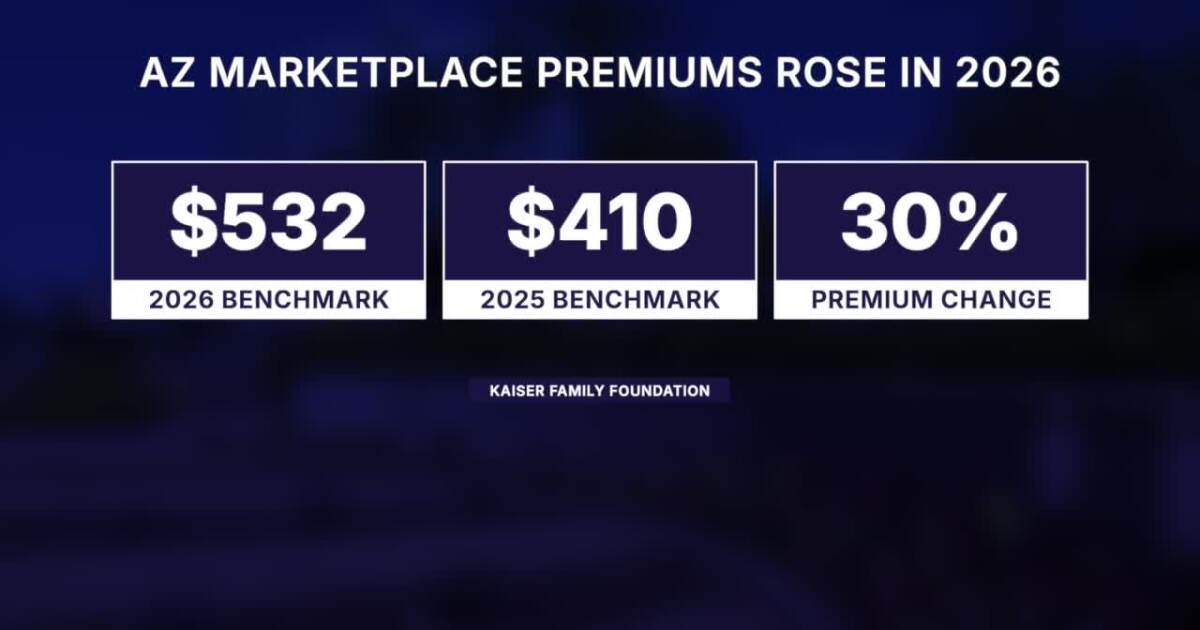
PHOENIX — Arizona’s ACA marketplace enrollment fell from 363,000 to just over 255,000 in a single year — a nearly 30% decline and the third-largest annual drop in the country.
Rising premiums and expired tax credits are driving the trend, with the average benchmark plan premium in Arizona now at $532 — up 30% from 2025.
In the player above, ABC15 Data Analyst Garrett Archer takes a look inside the numbers on how healthcare premiums are impacting health insurance enrollment.
This story was reported on-air by a journalist and has been converted to this platform with the assistance of AI. Our editorial team verifies all reporting on all platforms for fairness and accuracy.
Want more news in your community? Add ABC15 as a preferred source on Google below:

Arizona
Arizona man pleads guilty after illegally living in forest for years among ‘1,000lbs of trash’

A man in Arizona has pleaded guilty to violating federal fire restrictions and unlawfully residing in a national forest, after authorities said he spent years living at a makeshift campsite surrounded by what officials described as “approximately 1,000 pounds of trash”.
Mark Aaron Gatz was arrested on 25 June at his illegal campsite in Arizona’s Tonto national forest, according to court records. A United States Forest Service (USFS) officer wrote in documents submitted to court that Gatz had been operating an “illegal campsite” with a “hot wood burning campfire” despite fire restrictions and that he had told investigators that he had been living in the forest for about eight years.
The officer wrote that a records check found that Gatz had previously received multiple citations and was the subject of six outstanding federal arrest warrants for earlier violations, including for building fires during fire restrictions, constructing on national forest service lands, unsanitary conditions and occupying national forest as a residence.
Gatz “said that he knew about current fire restrictions but had to have fire to eat”, authorities said. The documents show that USFS officers made contact with Gatz multiple times over the last year or so, and issued him warnings as well as a violation notice for having campfires during fire restrictions.
Notes from officers’ previous encounters with Gatz earlier this year, submitted into the court docket, state that authorities observed “trash such as clothing, pans, tools, and plastic cups scattered throughout the campsite along with a structure that was four feet in height build using wood panels”.
During an encounter with Gatz in May, officers reported observing “approximately 1,000 pounds of trash” at the site, which they said included tires, plastic bags, trash bags, aluminum cans and other items. They also wrote that they found that the campfire site had been left unattended by Gatz the previous day while still hot.
In a separate report filed by law enforcement from an encounter in February, one officer wrote that “upon arrival at the camp, I was flabbergasted by the amount of debris in the area”.
Investigators said that during that encounter, the debris consisted of three ladders, six to eight totes “overfilled with debris”, five 55-gallon drums, eight tires, multiple bicycle frames, 5 gallons of motor oil, plywood and other “miscellaneous lumber”, and they wrote that trash was scattered over approximately half an acre of Forest Service land and creating what officers described as public safety concerns.
In a separate report from July 2025, officers said they observed what they described as a “large messy campsite” while patrolling the area due to complaints “from the district office abut one large messy camp”.
“There was roughly half an acre of resources ruined due to so much trash and goods on the ground for an extended period of time,” the officer wrote.
This week, after Gatz pleaded guilty, he was sentenced to time served and three years of probation, according to court records.
A representative for Gatz did not immediately respond to a request for comment.

Odds of winning the Powerball and Mega Millions are NOT in your favor
Odds of hitting the jackpot in Mega Millions or Powerball are around 1-in-292 million. Here are things that you’re more likely to land than big bucks.
The Arizona Lottery offers multiple draw games for those aiming to win big.
Here’s a look at Tuesday, July 7, 2026 results for each game:
Winning Mega Millions numbers
02-31-35-36-63, Mega Ball: 12
Check Mega Millions payouts and previous drawings here.
Winning Pick 3 Evening numbers
Evening: 4-7-2
Winning Fantasy 5 numbers
03-05-10-14-37
Check Fantasy 5 payouts and previous drawings here.
Winning Triple Twist numbers
03-06-18-23-27-32
Check Triple Twist payouts and previous drawings here.
Feeling lucky? Explore the latest lottery news and results
What time is the Powerball drawing?
Powerball drawings are at 7:59 p.m. Arizona time on Mondays, Wednesdays and Saturdays.
How much is a Powerball lottery ticket today?
In Arizona, Powerball tickets cost $2 per game, according to the Arizona Lottery.
How to play the Powerball
To play, select five numbers from 1 to 69 for the white balls, then select one number from 1 to 26 for the red Powerball.
You can choose your lucky numbers on a play slip or let the lottery terminal randomly pick your numbers.
To win, match one of the 9 Ways to Win:
- 5 white balls + 1 red Powerball = Grand prize.
- 5 white balls = $1 million.
- 4 white balls + 1 red Powerball = $50,000.
- 4 white balls = $100.
- 3 white balls + 1 red Powerball = $100.
- 3 white balls = $7.
- 2 white balls + 1 red Powerball = $7.
- 1 white ball + 1 red Powerball = $4.
- 1 red Powerball = $4.
There’s a chance to have your winnings increased two, three, four, five and 10 times through the Power Play for an additional $1 per play. Players can multiply non-jackpot wins up to 10 times when the jackpot is $150 million or less.
Are you a winner? Here’s how to claim your lottery prize
All Arizona Lottery retailers will redeem prizes up to $100 and may redeem winnings up to $599. For prizes over $599, winners can submit winning tickets through the mail or in person at Arizona Lottery offices. By mail, send a winner claim form, winning lottery ticket and a copy of a government-issued ID to P.O. Box 2913, Phoenix, AZ 85062.
To submit in person, sign the back of your ticket, fill out a winner claim form and deliver the form, along with the ticket and government-issued ID to any of these locations:
Phoenix Arizona Lottery Office: 4740 E. University Drive, Phoenix, AZ 85034, 480-921-4400. Hours: 7:30 a.m. to 5 p.m. Monday through Friday, closed holidays. This office can cash prizes of any amount.
Tucson Arizona Lottery Office: 2955 E. Grant Road, Tucson, AZ 85716, 520-628-5107. Hours: 7:30 a.m. to 5 p.m. Monday through Friday, closed holidays. This office can cash prizes of any amount.
Phoenix Sky Harbor Lottery Office: Terminal 4 Baggage Claim, 3400 E. Sky Harbor Blvd., Phoenix, AZ 85034, 480-921-4424. Hours: 8:30 a.m. to 5 p.m. Monday through Sunday, closed holidays. This office can cash prizes up to $49,999.
Kingman Arizona Lottery Office: Inside Walmart, 3396 Stockton Hill Road, Kingman, AZ 86409, 928-753-8808. Hours: 8 a.m. to 8 p.m. Monday through Friday, 8:30 a.m. to 5 p.m. Saturday and Sunday, closed holidays. This office can cash prizes up to $49,999.
Check previous winning numbers and payouts at https://www.arizonalottery.com/.
This results page was generated automatically using information from TinBu and a template written and reviewed by an Arizona Republic editor. You can send feedback using this form.
-

 World3 minutes ago
Trump Says He Thinks He Will Remove Syria From US Terrorism Sponsor List
-
 Lifestyle50 minutes ago
Appeals court denies Trump’s request to halt removal of his name from the Kennedy Center
-

 Technology58 minutes ago
Meta is reportedly working on smart glasses that would be recording all the time
-

 World1 hour ago
Trump says ‘Iran lies and cheats’ as IRGC emerges as dominant force in negotiations with US
-

 Politics1 hour ago
Who is Valli Geiger? Meet the Maine Dem that Platner urged to run for Senate
-

 Health1 hour ago
Deadly Legionnaires’ disease outbreak sparks concern in major US city: Know the symptoms
-

 Sports1 hour ago
Caitlin Clark’s return falls flat after Fever coach limits her in loss to shorthanded Sparks
-
Business1 hour ago
Commentary: Trump wants to let companies make fewer disclosures, thus keeping investors in the dark


