After a rough series in Tampa, Arizona comes home to hopefully get right again against the flailing Giants.
Arizona
Navajo, Arizona attorney general question safety of newly reopened uranium mine

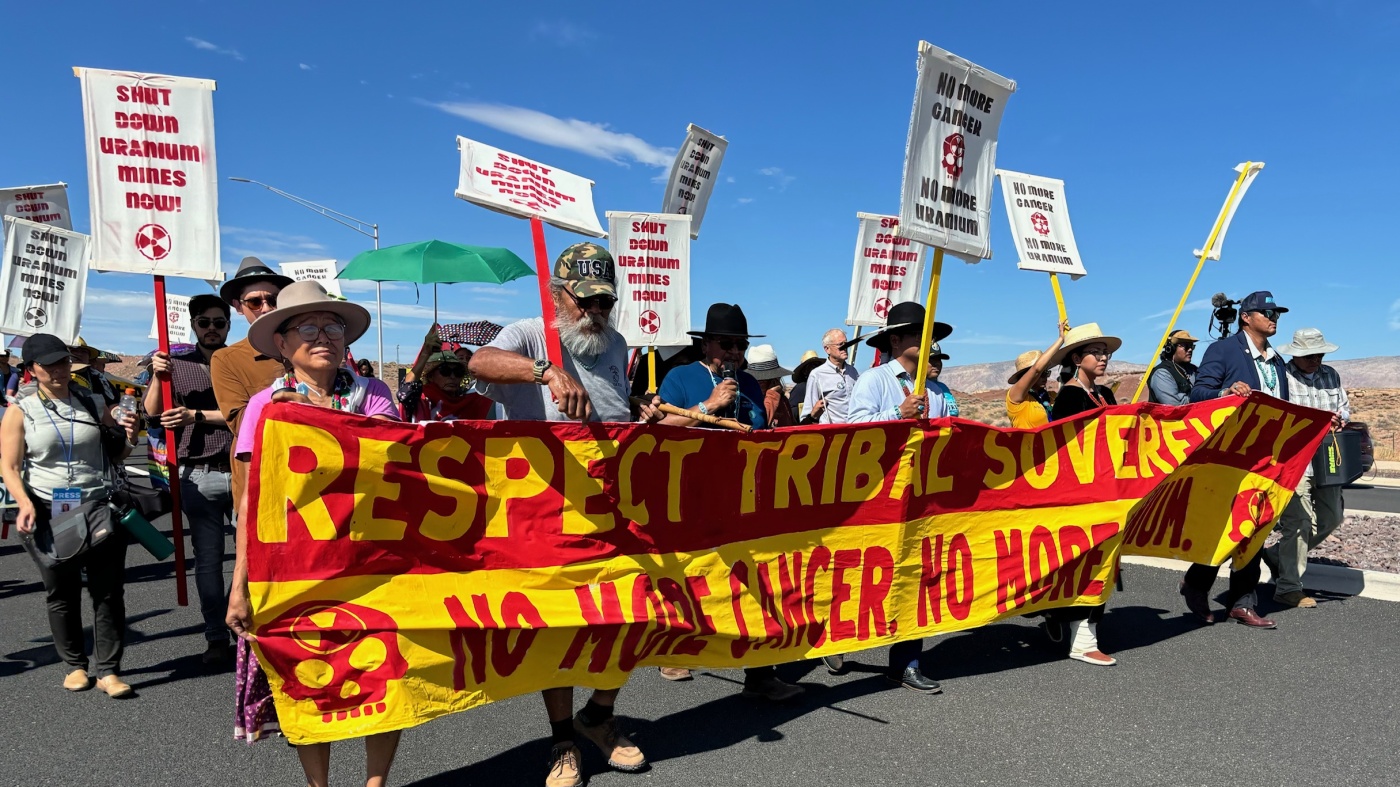
Protestors, led by Navajo Nation President Buu Nygren, marched along Highway 89 in Cameron on Aug. 2, 2024 to protest uranium hauling through the reservation. The highway was part of the route taken by trucks from the Pinyon Plain Mine near the South Rim of the Grand Canyon three days earlier when they began uranium ore transportation through a large swath of the nation.
Ryan Heinsius/KNAU
hide caption
toggle caption
Ryan Heinsius/KNAU
FLAGSTAFF, Ariz. — Uranium mining in the U.S. is picking up after the nuclear fuel’s price hit a 16-year high earlier this year. But now that a mine near the Grand Canyon is producing ore, Native American tribes, local officials and Arizona’s attorney general are questioning its safety.
Last year, on a remote stretch of northern Arizona forest, President Biden designated the Baaj Nwaavjo I’tah Kukveni—Ancestral Footprints of the Grand Canyon National Monument.
“From time immemorial, more than a dozen tribal nations have lived, gathered, prayed on these lands,” Biden said as he addressed an enthusiastic crowd of tribal leaders, members of Congress, Arizona Gov. Katie Hobbs and advocates.
The monument designation permanently banned new uranium mining claims on nearly a million acres adjacent to Grand Canyon National Park and blocks what could have been hundreds of new operations in an area that is culturally significant to the Havasupai, Hopi, Navajo and others.
“Our nation’s history is etched in our people and in our lands. Today’s action is going to protect and preserve that history,” said Biden, as Red Butte, one of the Havasupai Tribe’s most sacred sites, loomed in the background.
The declaration was also a recognition of a far darker history, the more than 500 abandoned uranium mines on and near the Navajo Nation left over from the Cold War era that are blamed for deaths, cancers and other grave health problems in many of the region’s Indigenous communities.
“When it comes to uranium specifically, I think there’s almost a moral obligation to say no and to make that message strong,” says Navajo Nation first lady and former Arizona legislator Jasmine Blackwater-Nygren.
She says radiation exposure killed two of her grandparents, one of whom was a uranium miner. It is an all-too-common story on Navajo and a hardship that’s touched nearly every family there. But one previously established mine that has been on hold for decades and is located within the national monument can legally still operate because of preexisting rights. And it started producing uranium ore earlier this year.

Inside the Pinyon Plain mine near the Grand Canyon in Arizona
Ryan Heinsius/KNAU
hide caption
toggle caption
Ryan Heinsius/KNAU
“It’s just you and the miners that you’re working with accomplishing a goal,” says Pinyon Plain Mine Assistant Superintendent Matt Germansen.
He has just stepped off a cage-like elevator after taking the five-minute ride almost 1,500 feet to the bottom of the mineshaft. A ventilation system whirs above a diesel front-loader and a small team of workers including miners, electricians and welders. They have their sights set on digging out a geological formation called a breccia pipe that contains some of the highest-grade uranium ore in the U.S.
“We have basically everything we need to operate down here from heavy equipment to first aid to electrical power systems,” Germansen says as he walks through the tunnels of the subterranean operation.
He and the mine’s owner, Energy Fuels, say the mine is safe and won’t affect the Grand Canyon’s groundwater or environment — something conservationists have challenged for years. The company says Biden’s designation has stymied the area’s potential for significant uranium development.
“To declare a national monument is certainly frustrating because it feels like it was done without the science backing it,” Germansen says.
But that science remains inconclusive. Hydrologists with the U.S. Geological Survey have studied the area for more than a decade and have sampled thousands of water sources throughout the Grand Canyon. They say there is no definitive evidence of water contamination from Pinyon Plain or other uranium mines. But they caution that they do not yet have a complete picture of its complex geology and many uncertainties remain.
Tribes in the region have been steadfast in their opposition and have fought uranium mining near the Grand Canyon for decades. The Havasupai, whose reservation is at the bottom of the canyon, worry that Pinyon Plain could pollute its sole water source. They, along with environmental groups, challenged a 1986 environmental analysis by the U.S. Forest Service that found almost no risk of contamination. But the 9th U.S. Circuit Court of Appeals ruled it valid and reaffirmed the company’s right to mine in 2022. Earlier this month, Arizona Attorney General Kris Mayes questioned the nearly 40-year-old science in the original study and asked the agency, which manages the land where the mine is located, to conduct a new one.
Carbon emissions-free energy
Energy Fuels maintains that Pinyon Plain, Arizona’s only currently operational uranium mine, is a key part of the global transition away from fossil fuels. It’s expected to produce about 2.5 million pounds of processed uranium over its lifespan of three or more years.
“If we’re going to address climate change, nuclear has to be part of that. There’s just no way to get there without nuclear. Uranium powers nuclear,” says Curtis Moore, Energy Fuels’ senior vice president for marketing and corporate development.
While interest in the U.S. for carbon emissions-free nuclear power is ramping up, a significant supply of uranium just became off-limits for geopolitical reasons.
“A big one is Russia’s unprovoked invasion of Ukraine and the ongoing atrocities in Ukraine,” Moore says.
Earlier this year, Biden signed a law that bans U.S. imports of uranium from Russia. It took effect in August. Previously, the U.S. had imported about $1 billion worth annually.

Last year President Biden created the Baaj Nwaavjo I’tah Kukveni—Ancestral Footprints of the Grand Canyon National Monument. This year he signed a law banning the import of Russian uranium
Ryan Heinsius/KNAU
hide caption
toggle caption
Ryan Heinsius/KNAU
Amid these changes in the global market, in late July Energy Fuels sent its first truckloads of ore from the Pinyon Plain Mine to its White Mesa Mill in southern Utah for processing. The route crosses a large part the Navajo Nation, and the unexpected move by the company ignited numerous protests in the region.
“Our people are still dying today. They’re suffering. There’s so much generational trauma that uranium has brought to our people,” says Navajo Nation President Buu Nygren.
He spoke to several dozen community members, activists and others in early August in the reservation town of Cameron, which is along the haul route on U.S. Highway 89, just days after the ore shipments passed through. Nygren then led a protest march along the highway, which backed up traffic as leaders sang traditional songs in the Diné language and held a large yellow and red banner calling for the closure of the mine and respect for tribal sovereignty.
The tribe outlawed uranium ore hauling in 2012, and Nygren has vowed to stop any future shipments. Energy Fuels, however, says it’s well within its rights to use state and federal highways through the reservation for its deliveries. And they are adamant that the ore has low levels of radiation and is safe to transport.
But soon after the first truckloads crossed the Navajo Nation, the company put the shipments on hold at the request of Gov. Hobbs, who is mediating talks between the Energy Fuels and tribal officials. There’s no timeline for when hauling may restart, but the pause has done little to quell opposition to Pinyon Plain as activists, tribal members and leaders continue to fight uranium mining near the Grand Canyon.
“It’s a humanitarian issue that we face here on Navajo because it’s killed thousands of our people,” Nygren says.



What to know about coming Arizona Medicaid work requirements
Stephanie Innes interviews Meaghan Kramer at the Arizona state Capitol about the coming Arizona Medicaid work requirements.
Not a day goes by without staff at the Valle del Sol health clinic in Phoenix strategizing about the looming date of Jan. 1, 2027, and what it will mean for their low income patients’ health coverage.
“We will absolutely see a spike in uninsured people. My biggest concern is that people who are eligible will be cut because of the administrative burden,” said Mike Renaud, the CEO of Via del Sol, a federally qualified community health center that sees roughly 15,000 patients per year, half of whom are covered by Medicaid, which in Arizona is called the Arizona Health Care Cost Containment System or AHCCCS, pronounced “access.”
“Medicaid is the largest health insurance program for low income people in the United States. It is the largest payor of mental health services in the U.S.”
Jan. 1, 2027 — six months away — is the deadline for Medicaid programs in 43 states across the country, including Arizona, to implement major policy changes that include work requirements and twice-yearly renewals (up from once yearly) for certain enrollees.
In Arizona, the new rules will mark the largest operational change in the history of the AHCCCS program, said Meaghan Kramer, health policy adviser to Gov. Katie Hobbs.
“This is the fastest they’ve ever had to do something that is operationally complex. And this is the most operationally complex thing they’ve ever had to do,” Kramer said. “We’re straining existing systems that are already old and overburdened on the IT side. And we will need much, much more work on the eligibility side than we have now.”
The changes are a result of HR1, the budget reconciliation bill also known as the One Big Beautiful Bill Act, which President Donald Trump signed into law on July 4, 2025.
The law significantly changes both eligibility and financing of Medicaid, which is a government health insurance program primarily for low-income people that has been in place since 1965. Arizona has had a Medicaid program since 1982.
Having only 18 months to prepare for HR1 is an extremely heavy technological lift for states, including Arizona. Arizona’s aggressive implementation of HR1 changes to SNAP, the Supplemental Nutrition Assistance Program once known as food stamps, resulted in the highest rate of loss of SNAP recipients in the country, with about 450,000 dropping from the program from February 2025 to mid-2026.
Recipients and would-be recipients have told The Arizona Republic SNAP benefits are harder to get than ever, with long hold times on the phone and at satellite offices, a dysfunctional website and fewer DES employees to help them.
The new state budget that was recently signed includes a little more than $10 million that will go to technology and to employees who will be handling the increased workload, Kramer said.
Hopefully state officials have learned from the experience with SNAP and “don’t make the same mistake again,” said Will Humble, executive director of the Arizona Public Health Association.
“The computer system needs to improve and the staff needs to be trained,” Humble said. “I’m convinced the majority of people who lose coverage will lose it because of administrative reasons.”
Further complicating the implementation is that the Centers for Medicare & Medicaid Services recently released a 387-page interim final rule with strict new guidelines about Medicaid work requirements. The new guidelines, for example, do not automatically exempt people with cancer and end-stage renal disease, among other conditions, from the work requirements.
“It is written in a way that makes it clear this is going to be a much more challenging task than any state anticipated,” Kramer said of the guidelines. “States are really struggling with what this new guidance means…The new guidance is going to be much more burdensome on the member, the applicant and the Medicaid agency long-term.”
Twenty-four attorneys general, including Arizona Attorney General Kris Mayes, and two governors on June 30 sued the federal government over the document, arguing that it illegally narrows congressional protections of medically frail people enrolled in the program.
AHCCCS as of June 1 provided health insurance to approximately 1.8 million Arizonans, which works out to one in four state residents. About one in four of those AHCCCS enrollees or 400,000 and 500,000 people, are expected to be part of the adult expansion population affected by the work requirements and twice-annual renewals.
At Valle del Sol, Renaud said clinicians and other staff are already educating patients and clearing up misinformation.
“We want to make sure they understand this is not a Medicaid cut. It is increased barriers to maintaining coverage.”
Here are seven things to know about the coming changes to Medicaid in Arizona:
Outreach to AHCCCS enrollees begins in September
AHCCCS will be providing communications to impacted enrollees by Sept. 1. Most enrollees probably don’t know whether they are part of the affected adult expansion population and that’s part of the outreach. People covered by AHCCCS can expect to see communications via mail, text and email.
“The goal will be to make sure we are providing reliable information to everybody to reassure folks that they should continue to fill out paperwork when they are prompted by their health plan or by AHCCCS,” Kramer said.
For now, there is nothing Arizonans need to do, AHCCCS officials say, except to keep their contact information current on Health-e-Arizona Plus; respond if AHCCCS or your health plan reaches out to you; and watch for official updates from AHCCCS, not third parties.
The changes won’t hit all affected enrollees at once
Annual AHCCCS renewals (also known as redeterminations) happen on a rolling basis, and that’s how the twice-annual renewals and work requirements will be handled, too, Kramer said.
“If they were redetermined last Jan. 1 they will get redetermined again the next Jan. 1. And then beginning that year they are getting redetermined every six months,” she said.
The work requirements allow for volunteer work and school
Enrollees who are part of the adult expansion population will need to prove they are working at least 80 hours per month or doing another qualifying activity, like job training or education, to avoid losing coverage.
It’s unclear how enrollees prove they are working, volunteering
State officials are able to verify through pay stubs that some people are already meeting the work requirements, but not for everyone. And at some point “self-attestation” − simply saying you are volunteering or in school − won’t be enough.
“What we know is the rules are more aggressive beginning in year two (2028) and there will be some allowance for self-attestations in the first year,” Kramer said.
“But after the first year, beginning Jan. 1, 2028, self-attestations are only permitted once in a continuous eligibility cycle. So that would place an enormous burden on AHCCCS and DES (the Arizona Department of Economic Security), which plays a large role in Medicaid eligibility determinations.”
Kids, seniors and Native populations won’t be affected
Several categories of Arizona’s Medicaid expansion populations will be exempt from the work requirements, such as but not limited to, pregnant and postpartum women, people who are disabled or medically frail, parents and caretakers of children under 14, caregivers of someone with a disability, American Indians and Alaska Natives, and those already meeting similar requirements under SNAP.
Kramer said that state officials are working to determine on their end who is exempt from the requirements in order to lessen the burden on enrollees.
Arizona will be offering short-term hardship exceptions to the work requirements for people who have recently been hospitalized, who need to travel outside of their community for medical care, who live in a county with high unemployment rates, or who live in a community where a national emergency or disaster has recently been declared, Cordoba, the AHCCCS spokesperson, wrote in an email.
Technology could be a problem in Arizona
AHCCCS relies primarily on two major systems to administer eligibility and benefits and both are old.
PMMIS, the agency’s core Medicaid administration system, was originally implemented in 1991 and is currently undergoing modernization, with the updated platform scheduled to go live in October 2027, Cordoba wrote. HEAplus, Arizona’s eligibility system, was implemented in 2013.
“While both systems have undergone significant upgrades and enhancements over time to support changing federal and state requirements, the PMMIS modernization project will not be complete before the federal requirements in H.R. 1 take effect,” Cordoba wrote.
Health entities are trying to prevent AHCCCS coverage losses
Hospitals, community health centers and health plans already connect people to benefits, including AHCCCS. One of the key goals of those entities statewide is to ensure enrollment specialists are all trained on how to interact with the technology that’s going to be used to implement HR1, Kramer said.
All those entities have an interest in keeping people insured. Without health insurance, people tend to wait until their health problems reach a critical point before seeking care, which can cause personal medical debt, bad debt for hospitals, and increased health costs across the board.
The Health System Alliance of Arizona, which includes major Arizona health systems such as Banner Health and HonorHealth is “extremely concerned about eligible individuals losing Medicaid coverage due to the increased renewals and work requirements passed in HR1,” Brittney Kauffmann, alliance CEO wrote in an email.
“Our systems are assessing all options to ensure Medicaid members are aware of these changes.”
Reach health-care reporter Stephanie Innes at stephanie.innes@usatodayco.com or follow her on X: @stephanieinnes or on Bluesky: @stephanieinnes.bsky.social.

To say that Arizona had a rough go of things while in Tampa is putting things mildly. After a dreadful road trip, Arizona limps home with a record one game below .500 . They remain third in the NL West, but that doesn’t tell the story of their postseason aspirations, as even the Padres (the second place team) are now 10.5 games out of first as the Dodgers are finally putting the daylight between themselves and the division in the manner that most expected them to. No, their path to October baseball runs through the Wild Card, and they remain three games back in that race, trying to charge down the St. Louis Cardinals while also dealing with the four teams between them and the Red Birds from Missouri.
This series is going to force Mike Hazen and his advisors to make some difficult decisions. Continuing to kick the can down the road is not really much of an option anymore. The fallout from those upcoming decisions could go a very long way towards dictating Mike Hazen’s trade deadline strategy. If Arizona wants to have any realistic hope of achieving playoff baseball this year, they need to leave this series at or above .500. They also need to get there without losing any more players to injury.
Tyler Mahle, RHP, 1-7, 5.49 ERA, 61 SO
vs.
Eduardo Rodriguez, LHP, 6-2, 2.27 ERA, 70 SO
Eduardo Rodriguez has been every bit the pitcher they thought they were signing back in 2024. Quite frankly, he has been Arizona’s best starting pitcher this season. Without his return to form, Arizona would likely already been sharing basement space with the Colorado Rockies in the standings. On the other side of things, Mahle is having himself a season to forget. Mahle’s win-loss record is not as indicative of his 12 starts as one might hope. In fact, it makes him look better than he has been. Sporting an ERA+ of 72, Mahle has never struggled this hard at any point in his professional career. The 31-year-old journeyman is coming to the point of pitching for his place on the 26-man roster. This would be an excellent game for the Diamondbacks to make a statement, having the lefty hitters pile on to put a dagger into the heart of the Giants from the outing. The sooner they can swat Mahle out of the game, the sooner thay can burn down the bullpen. Of course, that will mean Arizona will have to finally start having better performances hitting with RISP and taking walks, as Mahle still averages over five innings per outing, despite his struggles.
Landen Roupp, RHP, 5-7, 4.07 ERA, 95 SO
vs.
TBD
Despite some very pedestrian, essentially league average, results, Roupp is averaging a bit over six innings per start. This ability to pitch later into games is another reason for Arizona to do their best to get into the bullpen early in the first game against Mahle. Roupp is 0-2 in his last five starts. In the two losses, he was blown up. In the three no decisions, he held the opposition to two runs or fewer. Roupp does a fair job of limiting the free passes, so Arizona is going to need to be patient. Attacking early plays into Roupp’s ability to go deep. Making him work increases the chances of Arizona finding a crack to exploit. It will also continue to put pressure on San Francisco’s beleaguered bullpen.
To counter, Arizona will be turning to the ageless wonder, TBD. In this case, TBP is looking more and more like Brandon Pfaadt. Jose Barera remains in the rotation already. Mitch Bratt and Kohl Drake are ineligible to return to the 26-man roster unless another injury move is made. Brandon Pfaadt did not pitch during the series in Tampa. How long Pfaadt will be allowed to go (assuming it is him) remains to be seen, as he was only throwing around 50 pitches for a while there in Reno. It could be that Arizona tosses a bullpen game, or potentially uses Pfaadt as an opener before going to the bullpen. There are a lot of moving pieces involved here and the speculation is running rampant while Arizona is (at least currently) playing this decision close to their chest.
Trevor McDonald, RHP, 2-6, 4.94 ERA, 45 SO
vs.
Zac Gallen, RHP, 3-7, 6.15 ERA, 52 SO
Trevor McDonald, like the recently faced Drew Rasmussen, is stingy with the free pass. He isn’t much of a strikeout pitcher, but he simply doesn’t give away at-bats. When he is hitting his spots, it makes him 2023 Merrill Kelly dangerous. When he is missing his spots, he looks like present-day Merrill Kelly. There is a reason McDonald is sporting an ERA+ of 80. Arizona needs to ambush McDonald and put their foot down on the gas. If they can get to him early, Zac Gallen might be nearly irrelevant. On that note, the Diamondbacks will be sending struggling former ace Zac Gallen to the mound. In his last outing, he was mostly adequate against the Rays. He gave up a terrible first inning before settling in and cruising through the next five, albeit without the strikeouts. If that version of Gallen shows up, Arizona should be in a good place for this game. If the Zac Gallen of many other outings this season shows up, this game could become ugly for both teams.
At this point, there really is no primary player to watch. The questions greatly outweigh the answers right now. The players struggling, if they continue to struggle, will continue to weigh the team down. On the other hand, if Zac Gallen builds off his last outing and if the team can salvage the second game of the series, then this team continues to keep the playoff conversations alive. The Giants are having a terrible season and find themselves in much the same place as Arizona, needing to start looking at alternatives for future seasons.
The one exception to this might be Max Kepler. How long will the recently reinstated Kepler be given to make an impact. Even at his height, he was essentially an older version of Pavin Smith, who is already creating issues for Arizona. Kepler only has five plate appearances so far, so it is obviously early days. But it is hard to imagine that his leash is especially long. Look for him to either make an impact soon or to be sent to the DFA rejects heap.
This series presents Arizona with a great chance for a palette cleanser. They get to leave the AL East leading Rays in the rearview. They get to sleep in their own beds. They get to face one of the worst teams in the game right now. If Arizona takes two of three, they exit this series back at .500. If they can manage to dig deep and find their mojo in game two, they have a very good chance of sweeping this series, putting them back at two games over even as they prepare to host the NL Central leading Milwaukee Brewers. It will be important for Arizona to come out of this series on a high note as their next three series are against the Brewers in Phoenix and then the Padres and Dodgers, both in California.

PHOENIX — 89-year-old Robert Young is battling Arizona State University in court over the Louis Emerson home, one of the oldest remaining houses in the Phoenix Churchill area.
At the corner of 4th and Pierce streets sits a home that pre-dates Arizona statehood, and now sits at the center of a legal battle between its owner and Arizona State University.
ASU wants the land where the Louis Emerson home stands. The university is planning a medical and technology school nearby and says it wants to exercise its right of possession over the property.
But Young, who has owned the home since 1975, is not backing down.
“It’s not gonna happen. That’s what I thought then and that’s what I think today. I will not let it happen,” Young said.
Marshall Shore, known as the Hip Historian, says the home is one of the oldest remaining houses in the Phoenix Churchill area, built before Arizona was even a state.
“This house was here before statehood, before Arizona even thought of becoming a state; this house was here, and so it deserves to tell that story and continue on,” Shore said.
Shore says the home’s history is rooted in everyday life.
“It was an everyday man’s house. He was a butcher,” Shore said.
Young says he and his wife lived in the home for 8 years before renting it out. He calls it an architectural and historic treasure that is irreplaceable. He says the legal battle is taking a toll on both of them.
“It’s stressful. You don’t know from day to day if you’re gonna find the house on the corner,” Young said.
Young says the university offered him between $290,000 and nearly $1 million for the property. Maricopa County Superior Court records show the Arizona Board of Regents sued Young for the home earlier this month.
According to the Arizona Republic, ASU gave a written statement explaining that they made several offers to Young on his home. Their final offer was based on an appraisal, and it was not accepted.
Shore says the home does not need to come down and has a vision for how it could coexist with the planned medical school.
“I mean there’s nothing more sustainable than keeping a house where it is. Create a pocket park around it, so that way people can come and enjoy that little pocket park and make it really a gem in the community,” Shore said.
Shore says an online petition in support of preserving the home has gathered more than 10,000 signatures.
Young wants ASU and the public to understand what is truly at stake.
“It’s the way it’s placed on the corner, and it’s the fact that this corner itself is historic,” Young said.
Young is expected to appear in court on Sept. 4 to explain why the home should not be torn down.
Want more news in your community? Add ABC15 as a preferred source on Google below:

-

 Rhode Island6 minutes ago
Rhode Island wins 5 gold medals at 2026 Special Olympics
-

 South-Carolina9 minutes ago
Hricik launches no-money pledge campaign for SC attorney general
-
South Dakota14 minutes ago
SD Lottery Powerball, Lotto America winning numbers for June 29, 2026
-

 Tennessee21 minutes ago
PHOTOS: The Strawberry Moon lights up Middle Tennessee Monday night
-

 Texas24 minutes ago
Hot, muggy and breezy conditions continue for North Texas ahead of Fourth of July
-
 Utah29 minutes ago
‘She gave of herself constantly’: Loved ones remember woman killed in Utah-Colorado wildfire
-

 Vermont36 minutes ago
Catch these concerts in Vermont outdoors in July
-

 Virginia39 minutes ago
Virginia has a new two-year budget. Here’s what lawmakers now require of data centers.

