
Entertainment
Why Amazon Prime's hit anti-superhero series 'The Boys' keeps getting bigger
As the real world seems to get crazier, Amazon‘s superhero satire “The Boys” just gets more popular.
Coincidence? Perhaps. The fourth season of the audacious series set in a society where superheroes are ingrained in every aspect of American life, and often not in a good way, is the most-watched so far, according to Amazon.
The company’s internal data show 55 million viewers have watched some portion of Season 4 of “The Boys” throughout the world in the 39 days since it premiered. The audience has increased 20% compared with Season 3.
In the U.S., “The Boys” — a title that refers to the band of vigilantes out to take down the out-of-control “supes” — has lodged in Nielsen’s top 10 streaming shows for four straight weeks since entering the list in June, with the entire series topping 1 billion minutes viewed each week.
The current batch of eight episodes is the second most-watched season of a TV series in Prime Video’s history, said Vernon Sanders, head of television at Amazon MGM Studios, which produces “The Boys” with Sony Pictures Television.
Ratings growth in the fourth season of a series is a rarity. Sanders, who once oversaw current programs at NBC, is more used to seeing audiences drift away as shows age.
But Sanders said he understands why “The Boys,” created by Eric Kripke and based on the comic book series by Garth Ennis and Darick Robinson, keeps gaining new fans. He believes those who initially passed over it thinking it was another capes-and-tights saga in the tiered superhero genre are taking another look.
“The packaging is deceptive,” Sanders said. “There a lot of people who probably initially thought a show called ‘The Boys’ about bad superheroes won’t really have anything for me. And as they keep hearing about it, they give it a shot and realize how rich and complex it is.”
The endurance of “The Boys” is good news for Prime Video as it moves aggressively into the ad-supported streaming business. Prime Video’s 3% share of all TV viewing is about a third of streaming behemoth Netflix’s share, according to Nielsen. But the tech giant has the potential to reach 115 million U.S. viewers with commercials (Netflix’s nascent ad-supported tier reportedly has around 13 million users). The more hits Prime Video has to offer to advertisers, the better.
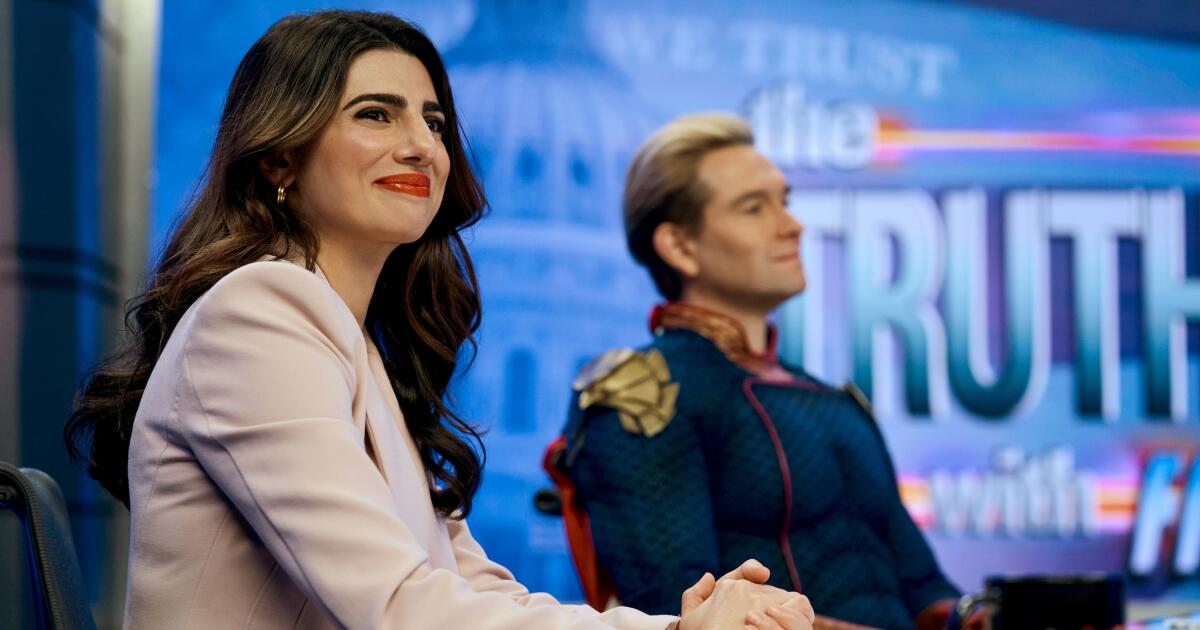
The series provides a humorously snarky look at social media, marketing, TV news, corporate corruption and the extremist political views of our times (as the supes expand their power into government, a TV news commentator says, “Let’s make America super again”).
Even in the fast-moving pop culture landscape where last week’s satire can become this week’s reality, the show has managed to hold onto its currency.
“The Boys” had a scarily on-the-nose moment last month as its fourth season finale depicted a presidential assassination attempt. The episode was scheduled to drop just days after a shooter tried to take the life of former President Trump at an outdoor rally in Pennsylvania. Prime Video changed the title of the episode, originally called “Assassination Run,” and added a disclaimer denouncing political violence.
“There was a lot of nervousness,” said Sanders. “After taking a few days and absorbing it… we realized we were going to release this one way or the other and we felt the best thing to do was to stick to our schedule.”
The show’s look at how fear mongering can corrode a democratic system is also resonating outside of the U.S. “The Boys” is performing especially well in the United Kingdom, India, France and Brazil, all countries that have been dealing with right-wing populist political movements.
The popularity of spin-off “Gen V,” which features a youthful Legion of Super-Heroes-type version of the “supes” of the original series, has also helped. Sanders noted that the younger, female audience for “Gen V,” which has been renewed for a second season, is finding its way to “The Boys.”
Producers are keeping “The Boys” in the pop culture conversation with unexpected cameos and guest stars, such as Will Ferrell turning up as a coach in a fictionalized movie about superhero A-Train. Sanders believes every time a big name appears on the series, more viewers sample it.
The sustained success has led to Amazon discussing ways to keep the franchise going beyond next year’s fifth season, which the producers say will be its last.
“We’ve definitely been in conversations,” Sanders said. “Eric Kripke and the team have been thinking about other things they want to do in the universe.”
Movie Reviews
With Love Movie Review: A romcom with likeable leads and plenty of charm
With Love Movie Synopsis: Sathya meets his school junior, Monisha, in a matchmaking setup. They like each other but Monisha suggests an idea that leads both of them to revisit their school days and old crushes.With Love Movie Review: Debutant Madhan’s With Love is the latest addition to the wave of feel-good films that Tamil cinema has been churning out lately. Though the premise isn’t particularly new, the film attempts to find freshness through its characters and their interactions with each other.Sathya’s (Abishan Jeevinth) sister, who has been pushing for him to get married, sets up a matchmaking meetup between him and Monisha (Anaswara Rajan). Monisha turns out to be his junior in school and the two hit it off instantly. However, Monisha comes up with an idea. She suggests that they try to get in touch and express their untold feelings to their school crushes they aren’t in contact with anymore.It does take a while for the film to find its footing. Initially, it’s difficult not to draw parallels between With Love and other recent Tamil romcoms. The initial interactions between the lead characters also lack a natural ease. However, once the film starts exploring the characters’ flashbacks, With Love becomes more assured and finds its flow.The film relies heavily on the relatability factor. As in all romcoms, the makers have attempted to slice together situations that the audience can resonate with. But this approach doesn’t always work. For instance, a character in the film states that she always knew another character was in love with her because, as a woman, she can sense it. The placement of such broad statements feels engineered for effect rather than organic. It also does not provide further context into the characters’ feelings. With Love works far better when the interactions and one-liner jokes are character-specific rather than when it resorts to being overly generalised.With Love doesn’t reinvent the genre. It follows a conventional pattern but finds the charm in its likeable lead performances, Sean Roldan’s vibrant music and a lovely supporting cast. Abishan, in his debut as a lead, does justice to the boy-next-door role. His unassuming presence helps soften the character of Sathya, who could have come across as off-putting if played by another actor. Anaswara is wonderful. She performs both the emotional and serious moments with a natural ease and without any exaggeration.
Entertainment
Review: Kinky ‘Pillion’ captures the thrill of attachment — even if BDSM is not your thing
Successful romances star at least one looker. I don’t mean someone attractive. I mean an actor who gazes at their scene partner with such delight that we swoon, too. Clark Gable was a looker. Diane Keaton was a looker. The combined eyeball voltage of Ryan Gosling and Emma Stone is so powerful that it’s turned silly scripts into hits.
Harry Melling is a late-blooming looker. Onscreen most of his youth as the Muggle brat Dudley Dursley in the “Harry Potter” franchise, Melling is only just now getting to show off that talent in the funny-kinky “Pillion,” which puts him on his knees beaming up at Alexander Skarsgård’s 6-foot-4 biker as though this blond hunk was the sun. His Colin, a shy gay man who sings the high notes in a barbershop quartet, is so visibly infatuated licking Skarsgård’s leather boots in a dark alley that you believe he lusts for humiliation. Colin has only just discovered that fact about himself. He’s yet to even learn this man’s name. (It’s Ray.)
Perhaps you’d like to be taken to dinner first, but “Pillion” is about Colin’s needs — specifically his need to please — and first-time feature filmmaker Harry Lighton challenges us to root for his bliss. This fetishy adventure is a minimalist romantic comedy in which submissive meets dominant, and submissive explores his physical and emotional vulnerabilities. Marriage and a baby carriage are off the table; the journey matters, not the destination.
“Pillion” is what motorcyclists call the passenger seat, at least in suburban England where this is set. It’s a passive position compared to the driver, but still a cooler upgrade from where Colin starts the movie riding in: the rear of a sedan. Out the car’s back window, he sees Ray zoom by in white Stormtrooper-looking gear and, by happenstance, bumps into him that night at a pub where Colin’s mother, Peggy (Lesley Sharp), has set up a blind date with a nice bloke. That guy gets forgotten the instant Ray slips Colin a note with a time and place to meet.
Peggy isn’t panicked by her son’s alpha-male predilections. “I think a biker sounds exciting,” she says with a grin. His father, Pete (Douglas Hodge), just wants him to wear a helmet. Neither parent is privy to the fact that Ray simply isn’t very nice. Ray controls the gobsmacked Colin quietly, calculating the bare minimum of kindness required to have a house boy willing to cook dinner, tend to his Rottweiler and sleep on the floor. He withholds his approval to keep the paler, smaller man anxious.
That Rottweiler contended for the Palm Dog at last year’s Cannes, a prize for the festival’s best canine. Frankly, Melling himself should have won. His performance is pure puppy, from the way he silently studies Ray’s silent cues to the eagerness with which he leaps up to fetch Ray a beer. When Ray lavishes attention on another biker’s pet pillion, Kevin (Jake Shears of the Scissor Sisters), Colin sulks until his master unzips his trousers and gives him a treat.
Flexing his abs in shiny Motoralls, Skarsgård uses his own appeal to expose an unattractive wrinkle in human behavior: Ray is so gorgeous that everyone just takes it as fact that Colin is lucky to be near him. When a coworker asks this scrawny geek how he bagged a hunk like Ray, Colin brags that he has “an aptitude for devotion,” which includes wearing a padlock around his neck and shaving his Byronesque curls so that he looks like a zealot — which in a way, he is.
Over and over, Colin takes stock of his own debasement. But then he looks at his model-handsome lover and calculates that his suffering is worth it. He’s good at compartmentalizing; he’s a parking violations attendant who tickets angry people all day. When he needs an excuse to cry, he finds one (and it hurts to watch).
Lately, it’s been a thrill to see queer stories confidently leapfrog over coming-out narratives to the trickier question of whether two individuals in particular are a decent match. Lighton leaps further than that — he goes full Evel Knievel by daring to ask how we feel about a relationship that’s indecent, but still has worth as a set of training wheels for a wobbly young man learning what he wants.
It’s a more optimistic take on Colin and Ray’s coupledom than was in the book that inspired the script, Adam Mars-Jones’ 2020 novella “Box Hill,” which was subtitled “A Story of Low Self-Esteem.” A study of the psychology of abuse, that story’s more brainwashed version of Colin finds him decades older looking back on the affair and pining for a relationship that reads as horrible between the lines.
Lighton isn’t oblivious to the power imbalance, but he’s made a movie about going forward, not being stuck. He trusts his naif with more agency, and so “Pillion” is freer to play its insults for laughs. You’ll giggle a lot. That gleam in Melling’s eyes makes it feel like a comic fantasy, although who knows? Perhaps there really are BDSM biker gangs hosting afternoon picnics with serving boys tied spread-eagled on a buffet table. That bucolic scene is filmed in a slow pivot around the park, cinematographer Nick Morris getting a chuckle from how the image shifts from Georges Seurat to “Hellraiser.”
Eventually, Colin’s parents will be more flinchy about his new boyfriend, leading to a beat or two that don’t land with the impact they could. Oddly, Lighton might be too restrained himself. Like his leads, he prefers to say everything with a look.
But while Melling is always endearingly open and responsive, Skarsgård stays unreadable. His Ray always seems to be hiding behind a motorcycle visor even when he’s not and when he deigns to speak, the words trail off in a huff of exhaustion. The only thing we know about Ray’s life are the names of his two previous dogs, and that’s only because he has them tattooed on his chest.
Any more personal facts about Ray — his own job or family or romantic history, even his favorite movie — would risk us clinging onto it too tightly as an explanation of what he gets out of this himself. Serving Ray’s pleasure is Colin’s focus. And our focus is on Colin’s pursuit of that.
Yet with subtle skill, Skarsgård reveals that Ray is thinking about Colin more than he’s willing to let on. Curiosity flickers across his face when his submissive surprises him. He stays gruff, of course, but you sense that Ray is as manacled by his authoritarian role as Colin literally is in his hungry, slurping devotion to his master. Puny and pathetic as Colin appears, he begins to seem like the braver of the two. It takes courage to map your own boundaries — then to cross over that line and get hurt, and get back up and out there. Lighton’s biker BDSM rom-com might sound niche, but free yourself to see it and you’ll discover it’s a universal romance.
‘Pillion’
Not rated
Running time: 1 hour, 47 minutes
Playing: Opens Friday, Feb. 6 in limited release
Movie Reviews
‘The Strangers — Chapter 3’ Review: The Best Film in the Reboot Trilogy Is Still Bad
I’ve been watching Renny Harlin’s three-film reboot of “The Strangers” for several years, because that’s how it was foisted upon us, and now that it’s finally over, I’m willing to give it some credit. It was an ambitious idea to turn a classic home invasion thriller into a gigantic pre-planned slasher trilogy. The filmmakers could have phoned the whole thing in and nobody would have blamed them. Heck, given how it all turned out, phoning it in might have been the better plan. But instead they tried something and they deserve an “A” for effort. And a “D” for everything else.
If you’re just now joining us, the original “The Strangers” was an efficient, tightly-edited home invasion thriller about a young couple attacked by three masked murderers. Why? Because they were home. The ambiguity was the point. It was a horror movie where the horror could happen to anyone, for any reason, at any time, and it was scary as hell. There was an excellent sequel called “The Strangers: Prey at Night,” but when that didn’t set the box office on fire, the studio rebooted the franchise with an inefficient, extremely padded trilogy that revealed everything about the killers and ruined their mystique. They say “If it ain’t broke don’t fix it,” and they didn’t. They just broke it, seemingly on purpose.
Madelaine Petsch stars as Maya. She was attacked in “Chapter 1,” she ran from the killers in “Chapter 2,” and it sounds like there should be more to her story after two films but there really isn’t. When we catch up to Maya in “The Strangers — Chapter 3” she’s celebrating her first proper victory, having finally killed Pin-Up Girl, one of the three title murderers (she wore the “Pin-Up Girl” mask, try to keep up). Unfortunately for Maya, the leader of the slasher cabal had a romantic thing going with Pin-Up Girl, so now Scarecrow (the one in the scarecrow mask) has weird desires for Maya. He doesn’t want to kill her anymore. He wants her to be the new Pin-Up Girl, which means he has to turn her into a serial killer and make her fall in love with him.
That’s a creepy idea. Horror protagonists have been losing their sanity since the dawn of the genre, and several slasher series already tried to get away with a seemingly stalwart hero turning to the dark side, or at least feeling tempted. “Halloween” tried it a couple times. The “Scream” movies feinted in that direction. Heck, “Saw” made it their whole gimmick after a while. The trick is to put the hero through so much hell that hell becomes their new normal. When their sense of identity shatters they could glom onto anything, even evil, just to make sense of it all. I’m not sure that’s good psychology but it’s an unsettling notion, at any rate.
But if that story was going to work we’d have to believe it, and that’s where “The Strangers — Chapter 3” falls flat. Madelaine Petsch barely had a character to play in the first place, and three films later there’s still very little evidence that she’s playing a real human being. Heck, it was hard to believe she was even scared until the second film. It doesn’t help that everyone else in the cast plays arch, unconvincing archetypes, and it really doesn’t help that the villains’ backstories are perfunctory and shallow.
You can’t shatter the audience’s reality, let alone the hero’s, without establishing reality in the first place, and Harlin’s trilogy is too phony to qualify. A character-driven storyline only works if the characters have character, and a plot-driven storyline doesn’t work if you can’t sell the plot. There’s a scene in “The Strangers — Chapter 3” where Scarecrow finally takes his mask off and an audience member gasped, as if it was a big reveal. But there was already a whole, long scene earlier in the movie where that guy talked about being the killer. The scene had such vague dialogue and monotonous acting and generic filmmaking that the plot point didn’t register the first time.
In my review of “The Strangers — Chapter 1” I talked about how the original film’s title referred not just to the murderers, but also the protagonists, who thought they knew each other but didn’t. (In my review of “Chapter 2” I talked about food poisoning. These movies really wore me down.) As we finally, finally put this whole whoopsie-daisy to bed I find myself wondering who “The Strangers” really were in this reboot trilogy. They can’t be the masked killers. We got to know them too well. And “The Strangers” can’t be the victims, because the victims aren’t complicated enough to be unknowable.
So I’m forced to conclude, in the end, that the strangers in Renny Harlin’s “The Strangers” are the people who thought this was a good idea. They watched one of the scariest movies of the 21st century, made an itemized list of everything that made it work, then ignored those lessons. It’s genuinely hard to fathom. They didn’t even go in a wild new direction. They just tried to do the same schtick, but longer and worse, and let’s face it, “longer and worse” is only the goal if you’re trying to torture somebody.
Wait, was that the point this whole time? Was this supposed to be torture? Mission accomplished, I guess. What a strange mission.
-
Indiana5 days ago13-year-old rider dies following incident at northwest Indiana BMX park
-
Massachusetts6 days agoTV star fisherman, crew all presumed dead after boat sinks off Massachusetts coast
-
Tennessee6 days agoUPDATE: Ohio woman charged in shooting death of West TN deputy
-
Indiana4 days ago13-year-old boy dies in BMX accident, officials, Steel Wheels BMX says
-
Politics1 week agoVirginia Democrats seek dozens of new tax hikes, including on dog walking and dry cleaning
-
Austin, TX1 week ago
TEA is on board with almost all of Austin ISD’s turnaround plans
-
Politics3 days agoTrump unveils new rendering of sprawling White House ballroom project
-
Texas6 days agoLive results: Texas state Senate runoff
