One of the hardest jobs at the Olympics is commenting on Simone Biles’s performances. The normally chatty announcers can’t say anything except “Wow!” “Incredible!” “Unbelievable!” I get it. I’ve been an armchair gymnastics fan since I was a kid in the 1980s and ’90s. Biles soars higher than anyone else in the competition. She performs more difficult routines than any other woman. Heck, her vault is so hard that almost no men in the world can land it. And she’s doing all this at a gymnastics “grandma” age of 27. If she wins the most coveted gymnastics prize in Paris — all-around gold — she will be the oldest woman to do so since 1952.
Washington
Opinion | Three big ways Simone Biles changed America


I’m rooting for Biles to win it all not just because she’s the best, but also because she has changed the sport of gymnastics — and her country.
Who can forget what happened at the last Olympics in Tokyo. Biles stunned the world by dropping out of the team competition after a fluke vault. She wasn’t visibly injured. There was no limping or screaming. But she was hurting mentally. Had she kept going, she might have died. Her brain was telling her body to fly and twist, but her body wasn’t complying.
When she tried to explain this, the internet labeled her a disgrace, a traitor, a quitter. She went from “GOAT” to scapegoat for an angry world still largely locked down. Her career seemed over. Yet here she is — back and better than ever with a new tattoo on her collarbone: Maya Angelou’s “And Still I Rise.”
Her actions in Tokyo spurred a shift that affected the world well beyond sports. Suddenly, it was okay to talk about and prioritize mental health. Biles says she wouldn’t have returned to the Olympics without her family — and her therapist. She is transformed. She’s smiling more. And she’s leading her sport. Her parents opened a gym in Houston that has become a haven for Biles and many other elite gymnasts including France’s Melanie De Jesus Dos Santos and Team USA’s Jordan Chiles and alternate Joscelyn Roberson. When Olympian Suni Lee was struggling at the U.S. national championships competition this year, it was Biles, rather than Lee’s coach, who gave Lee the pep talk that made the difference.
Biles has transformed gymnastics from a girls’ to a women’s sport. In the 1970s, ’80s, ’90s and early 2000s, female gymnastics champions were extraordinarily young and thin. Their coaches yelled at them so much, it amounted to borderline child abuse. It took the story of widespread sexual abuse of gymnasts by team physician Larry Nassar to bring the situation into the open. But the brutality wasn’t limited to sexual abuse, especially not in the era when head coaches Bela and Marta Karolyi constantly criticized the girls’ weight and appearance, and urged them to compete while injured. Kerri Strug’s infamous vault on an injured ankle at the 1996 Atlanta Games, as Bela Karolyi yelled “You can do it!” from the sidelines looks alarming to the world today.
“You literally had one job and you couldn’t protect us,” Biles said of USA Gymnastics in 2019. She refused to continue with Karolyi-style training camps. She testified before Congress about the trauma she suffered.
In her new Netflix documentary, she says she still struggles with flashbacks when she arrives at big competitions. But she has found her voice and pushed for change in her sport. Her new coaches put mental fitness first. Her gym has pioneered new training methods. Biles even helped change Team USA leotards — from girly pink to patriotic colors with higher necks and a more elegant, mature style.
She’s also helped diversify the sport, inspiring young gymnasts of all backgrounds to compete. Biles’s personal story is powerful: She lived in foster care until her grandparents adopted her. She had overcome a great deal well before social media trolls criticized her hair, her clothes, her dance moves and even her husband. Today, there is a calm about her. She lets her flips and turns, scores and medals do the talking. China has boasted that the men’s team it is sending to Paris is the most decorated, with 37 Olympic and World Championship medals among its five stars. Biles has won 37 medals all on her own.
America loves a good comeback story, and they don’t come much better than Biles’s. I’m rooting for her to win — for herself, for America and, most of all, to remind the world what a strong woman can do.



This story is from an installment of The Oeno Files, our weekly insider newsletter to the world of fine wine. Sign up here.
While Washington State has become well known for its Cabernet Sauvignon and Bordeaux-style blends in recent years, it is also home to many producers making outstanding Syrah. With just a 40-year history of cultivation in the state, Syrah is now the second most-produced red wine there as well as its best-kept secret. First planted in Washington in 1986, some early releases were treated like Cabernet Sauvignon with a lot of new oak and one-size-fits-all production method, but over time a broad spectrum of expressions has arisen among the state’s Syrahs.
Elsewhere in the U.S.A. it might seem like wineries are holding back the most exciting bottles for their neighbors, but Washington Syrah is more widely available than one might think, especially on restaurant tables. Landry’s Inc.—which operates more than 500 restaurants across the country including steakhouses such as Morton’s, Del Frisco’s, and the Palm—serves more than a dozen Washington Syrahs and a wide range of Syrah blends from the state. Scott Tarwater, corporate director of wine and special events, describes Washington Syrah as “a rugged, mountain man, unshaven, but worldly, down to earth, and plain spoken.” While he enjoys it for its savory character, he also likes that it is full of jammy notes such as boysenberry, black raspberry, and pomegranate alongside hints of ripened olives and pipe tobacco.
One of the drivers of quality in the last 20 years is the adoption of Old World techniques like stem inclusion and the use of concrete vessels, large‑format oak casks, and neutral oak barrels to let the fruit do the talking. Improved vineyard techniques have allowed for site expression to become clearer as well, with the Rocks District and Royal Slope showing savory and mineral characteristics, Red Mountain and Horse Heaven Hills bringing out more power and ripeness, and Yakima Valley showcasing a mix of the two styles.
Matt Reynvaan, founder and winemaker of R|A Family Wines, makes his JDA Project Syrah from a vineyard in the Rocks District that is defined by ancient riverbed soils layered with dense cobblestone. “These stones retain and radiate heat, lending intensity, structure, and unmistakable minerality to the fruit,” he explains. Replanted in 2020, the vineyard was designed with clonal diversity and precision farming practices tailored block by block. “Syrah is interplanted with small amounts of Viognier, and each section contributes a unique dimension, from power and structure to elegance and purity, resulting in a wine that is both complex and site driven,” Reynvaan says.
DeLille’s vineyards
DeLille
At Two Vintners, winemaker and partner Morgan Lee produces four different Syrahs including a Columbia Valley cuvée, a Rocks District bottling and single-vineyard expressions from Horse Heaven Hills and Yakima Valley, working with 13 distinct vineyards across six AVAs. “Each patch of dirt puts a stamp of individuality on the wine,” he says. “The beauty of Syrah is that it absorbs its surroundings like nothing else. It is a chameleon. It is so exciting to taste these individual parcels side by side and see how thrillingly different they are from one another.” Leaning heavily into a Northern Rhône style in his vineyard sourcing, Lee also employs Rhône techniques like native-yeast fermentation and whole-cluster pressing.
Washington’s first Syrah was planted in the Red Willow Vineyard in the foothills of the Cascades in the far northwest portion of the Yakima Valley by Mike Sauer in 1986, and winemaker Nick Bernstein utilizes fruit from that original block for DeLille Red Willow Syrah. “The Syrah here thrives on steep slopes of poor volcanic soils and creates powerful wine with deep concentration,” Bernstein says. In addition to that and DeLille’s Grand Ciel estate vineyard on Red Mountain, Bernstein also buys fruit from Boushey Vineyard, whose proprietor Dick Boushey has been a prominent grower for 45 years. This cooler site allows for more hang time, flavor development, and acid retention, leading to an earthier Syrah with dark fruit notes.
The wide diversity of Syrah can be seen in Liminal’s two offerings, High Canyon Syrah and Block 16 Syrah, which come from blocks in the WeatherEye Vineyard in the Red Mountain AVA that are about 500 yards apart but differ in aspect, elevation, and clonal selection. Liminal winemaker and partner Chris Peterson says the High Canyon block has elements of black fruits, minerals, and cured olive that remind him of Côte-Rôtie. “This is why we co-ferment with about 4 percent Viognier and choose the specific barrels to age it in and accentuate these aspects,” he explains. Meanwhile, the Block 16 exhibits the “wild herb, cured meats, and firm structure” characteristics that recall Cornas, so he ages it in 500-liter puncheons, with a style of new barrel “that shows off this more feral side.”
One of the newest additions to the Evergreen State scene is Dossier Wine Collective, whose head winemaker Billo Naravane crafts its flagship Syrah with an eye on the Northern Rhône, especially Côte-Rôtie and Cornas. Sourced from three vineyards, it offers the aromatic elegance and finesse of Côte-Rôtie alongside the structure, focus, and depth of Cornas. “Our use of concrete during fermentation is intentional. Concrete preserves purity and freshness while lending the wine a tighter, more focused profile, a hallmark we admire in many traditional Northern Rhône Syrahs,” Naravane says.
On the east coast, diners at JF Restaurant’s eateries can enjoy Syrah from Walla Walla and Columbia Valley. Beverage director and partner Amy Racine tells clients unfamiliar with the style that “Washington Syrah is a crossover between the States and Rhône Valley. It has a savory, peppery backbone similar to the northern Rhône and a ripe and juicy fruit you can find in the States.” Calling it “a category that rewards curiosity,” she tells Robb Report, “Most guests come in with a fixed idea of what Syrah is supposed to taste like, usually a Rhône reference point, and Washington Syrah surprises them by being a little familiar yet entirely its own thing.”
Do you want access to rare and outstanding reds from Napa Valley? Join the Robb Report 672 Wine Club today.
Authors

Mike DeSimone and Jeff Jenssen
Washington
Divorces granted July 2-8 in Washington, Benton counties | Northwest Arkansas Democrat-Gazette

The following divorces granted were recorded July 2-8 in the Benton and Washington county clerks’ offices:
BENTON COUNTY
25-1094. Heather Jones v. Michael Mazzarisi
25-1993. Sarah Waddle v. Brandon Waddle
26-46. Samantha Hines v. Garrett Hines
26-266. Donna Boyd v. Russell Boyd
26-329. Tara Whitwam v. Brett Whitwam
26-354. April Timboe v. Matthew Timboe
26-397. Troy Hull v. Kaley McManamon
26-419. Mark Hagel v. Michelle Hagel
26-437. Deborah Luper v. Donald Luper
26-470. Amanda Russell v. Christopher Russell
26-561. Audrey Mosher v. Dustin Mosher
26-562. Jacob King v. Ashley King
26-649. Chris Edwards v. Sara Edwards
26-664. David Carpenter v. Hannah Holtrey
26-774. Lauren Armfield v. Alexander Armfield
26-775. Sandra Saldana v. Luis Saldana
26-785. Maritza Campos v. Luis De Los Santos
26-798. Darell Shepard v. Rachel Lipscomb
26-802. Jeffery Nicholas v. Tracy Nicholas
26-809. Alicia Moreland v. Travis Moreland
26-814. Mellisa Dugger v. Matthew Crowne
26-817. Sabra Utting v. Derek Utting
26-825. Laura Wortman v. Brian Wortman
26-827. Laura Dean v. Seth Dean
26-845. William Austen v. Krystal Austen
26-846. Janine Robin v. Henry Robin
WASHINGTON COUNTY
24-472. Breayonda Bendickson v. Zackery Thompson
25-1333. Joshua Stephens v. Tiffany Pershall
25-1475. Jacqueline Lybrand v. Zachary Lybrand
25-1720. Jennifer McMahon v. Timothy McMahon
26-10. Janiky Rosario Madera v. Angel Ortiz Fuentes
26-225. Carol Kaufman v. Charles Axtell
26-268. Elizabeth Lasiter v. Prashanth Kumaresan
26-367. Shawn Harp v. Angela Harp
26-414. Patricia Johnson v. Robert Pritchard
26-518. Francisco Ramirez v. Nicole Franz
26-633. Debra Andrews v. Randy Brown
26-695. Jorge Azahares v. Dianelis Rodriguez

The Washington Huskies saw one of their most hotly contested offensive line targets in the 2027 class go elsewhere on Saturday afternoon when four-star offensive lineman DaJohn Yarborough announced his pledge to the California Golden Bears
The 6-foot-5, 340-pound product of Basha High School in Arizona, who is ranked as the nation’s No. 426 overall prospect and No. 25 interior offensive lineman by the 247Sports Composite, picked coach Tosh Lupoi and the Golden Bears out of a final four that also included Florida State, Mississippi State, and UW.
Although his junior year was cut short due to a fractured ankle, Fisch and offensive line coach Michael Switzer kept up a strong relationship with the hulking prospect, who has the size, physicality, and skill set the pair looks for from early contributors up front. However,
“The big man slides smoothly in pass protection and balances his weight well, always finding himself on the winning end of collisions with defenders,” Huskies Wire’s Alex Katson wrote in an evaluation of his film. “With such prototypical size and technique, Yarborough profiles as a player who could find himself in the NFL rather quickly with the right coaching staff during his time in college.”
As Washington continues to build up its offensive line for the rigors of the Big Ten, Yarborough would have been viewed as a promising building block alongside Freshman All-American John Mills, former five-star Kodi Greene, and former four-star Champ Taulealea, who should make up the core of Switzer’s unit in 2027.
While the Huskies had consistently been viewed among the top suitors for Yarborough’s services, but Lupoi’s staff has shown early that it can make a big impact quickly on recruits all over the West. Without Yarborough, Washington’s 2027 class consists of three offensive linemen: four-star interior prospect Gecova Doyal, four-star center Reis Russell, and three-star offensive tackle Tye Kennedy.
-
 Lifestyle41 minutes ago
‘House of the Dragon,’ Season 3, Episode 4: “Now we begin?” It’s Season 3!
-

 Technology53 minutes ago
Lorde says Ray-Ban Meta AI glasses are ‘not sexy’
-

 World59 minutes ago
Four Americans caught in horrific Mexico highway pileup that killed at least 10
-

 Politics1 hour ago
Medical examiner releases preliminary findings in Lindsey Graham’s death as death certificate remains pending
-

 Health1 hour ago
Terminally ill man marries longtime love in hospital as final wish comes true
-

 Sports1 hour ago
Stefon Diggs, still seeking new NFL home, insists no team has a better No 2 receiver ‘than me’
-

 Technology1 hour ago
Google may use your photos and voice to train AI
-
 Business1 hour ago
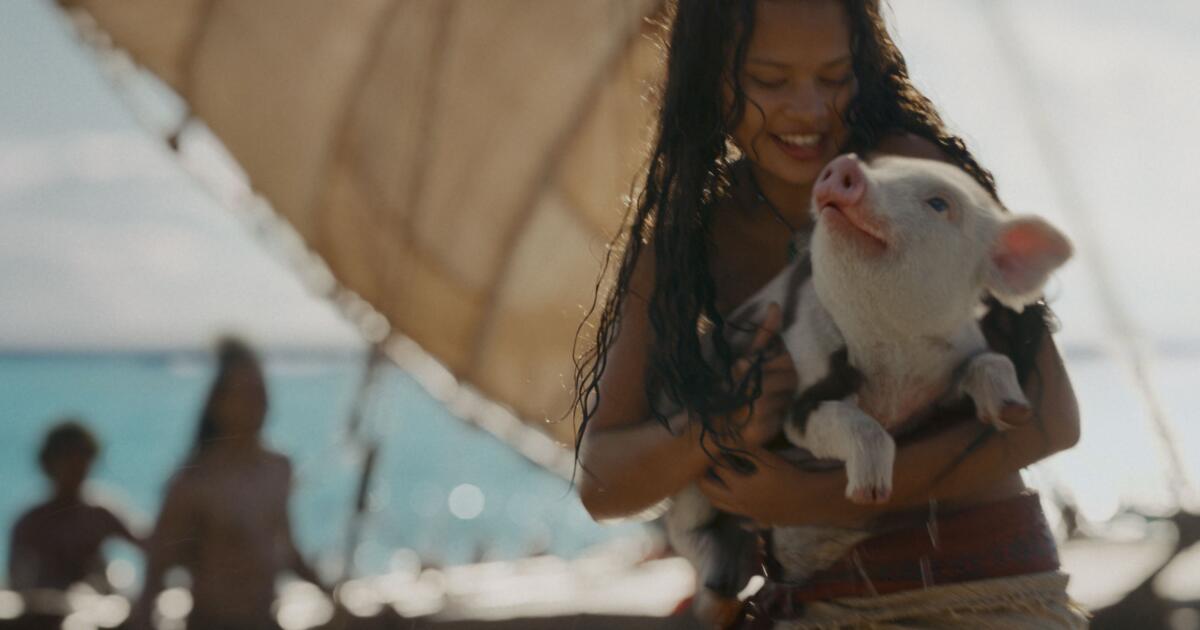
‘Moana’ loses its way at the box office with a $43-million domestic opening

