Lifestyle
This could be the way we watch movies in the future


Visitors watch Jesus VR: The Story of Christ during the 73rd Venice Film Festival in 2016.
Andreas Rentz/Getty Images
hide caption
toggle caption
Andreas Rentz/Getty Images
Marvel Studios’ What If…? — An Immersive Story is tricky to describe. Part interactive game, part narrative-driven movie and part 3D comic book, it puts you — the viewer? the player? — at the center of a narrative that reimagines the fates of superheroes and villains from the Marvel Cinematic Universe.
To experience What If…? you must wear an Apple Vision Pro headset, which is considered “mixed reality.” That means that it incorporates both virtual reality, or VR — transporting you to a different world — as well as augmented reality, or AR — where other video is layered on top of the actual room that you are in. The story toggles between scenes in AR in which characters appear to materialize in the user’s real room, and a series of dizzying VR landscapes in the Multiverse.
Some parts involve passive viewing, like a sequence in which the supervillain Thanos is on trial for theft. But there’s also a lot of interactivity: one character explains how to use hand gestures, like making a fist, to defend yourself against enemies and cast magic spells.

A screenshot from What If…? — An Immersive Story.
Marvel Studios/ILM Immersive
hide caption
toggle caption
Marvel Studios/ILM Immersive
This is a much different experience than traditional TV or movie watching, and industry insiders think it will change the face of entertainment.
“It’s kind of creating a new canvas,” said ILM Immersive’s Shereif Fattouh, the executive producer of the immersive version of What If…?.

Although interactivity is at the heart of the experience, viewers can opt out.
“There’s a lot of audience that are traditional gamers that really want to shoot things,” Fattouh said. “And there’s folks that don’t play games and want to just see a great story.”
Catering to a wide variety of tastes
Gamers have been using VR systems for decades. But in the last 10 years or so, new headsets — with more powerful graphics and motion tracking technologies — have started to broaden audiences.
The current entertainment offerings cater to a wide variety of tastes. For example, Meta headset users can sit with friends at an NBA basketball game with its Xtadium app, explore a haunted Irish castle in The Faceless Lady, a VR live action horror series, or take in pop star Sabrina Carpenter’s recent immersive VR concert.
Trailer for ‘The Faceless Lady,’ a VR horror TV series
YouTube
“Sitting courtside at your favorite basketball game or seeing your favorite superhero is a completely different experience [in virtual reality],” said Jason Thompson, the creator and host of The Construct, a consumer VR-focused YouTube channel. “It can’t really be compared to watching things on a flat screen.”
Thompson said he uses apps like Bigscreen to watch traditional TV shows and films in his headset. If he chooses, it can be a social experience; users can chat with others at a watch party or mute them if there’s too much conversation. They can also change their surroundings, so a living room couch transforms into what seems like a plush movie theater, complete with virtual popcorn. Thompson said he sometimes watches in Bigscreen’s bedroom setting, lying flat on a bed.
“The screen is actually on the ceiling,” said Thompson. “And you have to lay back to see the screen.”
Lying down to watch content in VR isn’t just whimsy. It serves a practical purpose. Most of today’s headsets are heavy and awkward to wear. Thompson said reclining to watch takes the load off the head and neck.
“In order for VR to excel it has to become comfortable,” he said.
An industry finding its feet
Tech players are working on it.
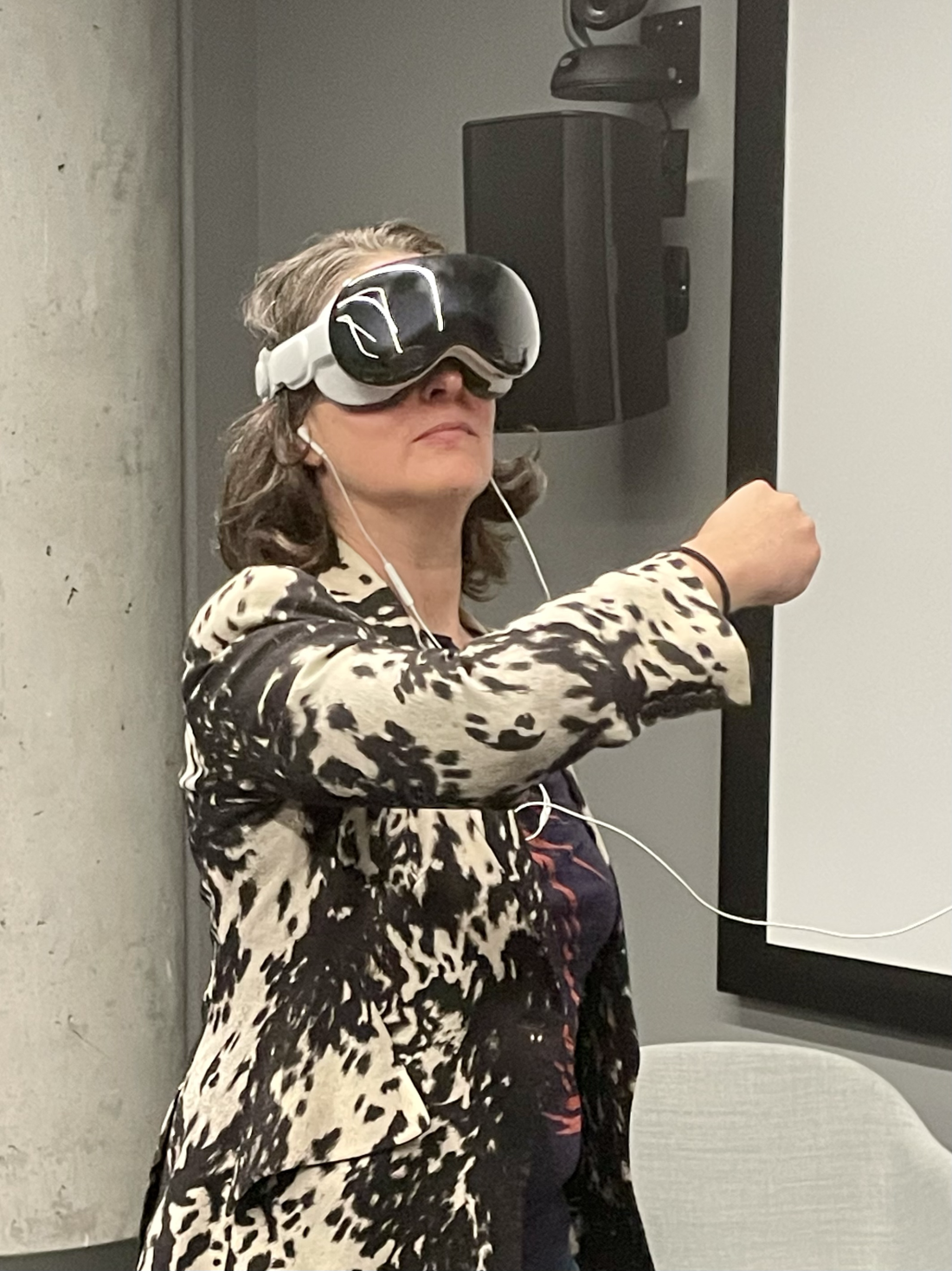
NPR correspondent Chloe Veltman tries What If…? An Immersive Story at ILM Immersive’s headquarters in San Francisco.
Chloe Veltman/NPR
hide caption
toggle caption
Chloe Veltman/NPR
“As every year passes and we improve the technology, make it easier to set up, more seamless to what you do on other devices, we see more and more people actually adopt,” said Sarah Malkin, director of immersive entertainment at Meta, the current market leader in consumer VR. “We knew we would be investing in what is essentially the future of computing and that it would take time.”
Malkin said Apple’s arrival in the market — it launched the Apple Vision Pro in February — is a good sign that headsets are becoming more mainstream, even as they cost anywhere from $300 to more than $3,000. However, Apple and Meta are not disclosing specific sales figures, so it’s hard to know for sure how the market is developing.
“The key for this market is consumer adoption,” said Ben Arnold, a consumer technology analyst with the market research firm Circana. “Because that is something that makes development of the applications more attractive.”
Adoption depends on both tech and content
Filmmakers say that the technology also needs to be friendly to creatives, so they can tell better stories in VR.
“The basic interaction methods have yet to be figured out,” said VR film writer and director Eugene Chung of Penrose Studios, the company behind several VR movies, including Arden’s Wake, a post-apocalyptic ocean adventure which won the first Lion Award for Best VR at the Venice Film Festival in 2017. “It should feel as natural as using your iPhone. And we’re so far away from that.”
Penrose – Arden’s Wake – Trailer
YouTube
Chung said it’s easy for people to get frustrated with many of the current TV and film VR offerings because users don’t know where to direct their attention in a given scene, or they want to fully interact with a character but often can’t.
“You see stuff happening, but things aren’t reacting to you the way that you think they should,” Chung said. “For example, you can’t just go up to a character and talk to them about Shakespeare or ask them about what they ate for lunch.”
Yet he’s excited about continuing to explore the creative potential of this new medium, especially since many young people today are growing up as VR natives.
“I have no doubt that this will be the future of all of entertainment and really all of computing,” he said.
Jennifer Vanasco edited the audio and digital versions of this story. Isabella Gomez Sarmientomixed the audio version.
With thanks to Will Mitchell and James Mastromarino


Sydney (Ayo Edebiri) and Carmy (Jeremy Allen White).
FX
hide caption
toggle caption
FX
There has always been a metaphorical parallel between The Bear, the television show, and The Bear, the fictional restaurant on the television show. Even as Carmy (Jeremy Allen White) and Sydney (Ayo Edebiri) transformed the Italian beef joint into the fancy restaurant of their dreams and wished for a Michelin star, there were undoubtedly locals who thought, “This is great and all, and I’m sure the food is good, but … I liked the beef sandwiches.” There’s still a window at The Bear to get them, but the focus is certainly elsewhere.
When it started, The Bear was mostly about the work that took place in the kitchen. The stresses of too many orders, territoriality from Richie (Ebon Moss-Bachrach), the arrival of Sydney, and the tightly wound but undeniably talented Carmy, making everybody both extremely stressed and significantly better. Over time, it shifted and grew, putting together beloved departure episodes like “Fishes” in Season 2, which introduced a boatload of guest stars for a flashback story of a disastrous family dinner before Mikey (Jon Bernthal) died. It spent time with Sydney’s family, it explored the way Tina (Liza Colón-Zayas) and Mikey originally met, it followed Marcus (Lionel Boyce) to Copenhagen, and it went with Richie to work for Andrea (Olivia Colman). All these episodes were excellent. And there was still a kitchen. But the focus seemed to be elsewhere.

At times, the show seemed to have disappeared up its own nose, to the point where you weren’t watching the show The Bear as much as you were watching the phenomenon The Bear. There were too many real-life chef cameos, until it seemed like those chefs were checking a box on a list of “things all the cool kids do.” There were too many other cameos, culminating in a rare miss from the reliably charismatic John Cena. The show placed a lot of narrative weight on Carmy’s love interest, Claire (Molly Gordon) — weight that the underwritten character couldn’t support. But even if every experiment and every diversion had worked, viewers couldn’t be blamed for missing the close focus on the kitchen and the camaraderie — for thinking, “This is all really special, but I do miss the beef sandwiches.”
The fifth and final season dispenses with the departure episodes, and it mostly dispenses with cameos. It all takes place on one day, just after Carmy tells Richie and Sydney that he wants to step back from the restaurant and give it to them and Sugar (Abby Elliott) to run, and it mostly takes place right there at The Bear. Now that the clock set by Jimmy (Oliver Platt) has run out, his money has run out as well, and a series of cascading disasters puts Sydney, Carmy and Richie behind the 8-ball from very early in the day, not least because of the tension hanging over all three of them as they prepare to tell the staff about Carmy’s decision to leave.

Tina (Liza Colón-Zayas).
FX
hide caption
toggle caption
FX
We spend this day mostly with the people we know best: our three leads, along with Sugar, Tina, Marcus, and the rest of the staff — including Luca (Will Poulter), who has stayed around to keep working with Marcus. Jimmy is running around with Computer (Brian Koppelman) and a young apprentice of his named Cheese (Elsie Fisher of Eighth Grade), trying to figure out what to do about his finances since it is Jimmy, and not just the restaurant, who’s out of money.
This day takes a while to get cooking, so to speak. The first three episodes of the season are slow, the first two in particular. It’s pouring rain outside, the lighting is dim, and the score maintains the same contemplative melancholy for a long, long time. For about two and a half episodes, it feels like one extended, low-energy scene.
But after that, there’s a shift in tone as the staff looks to get through service, and through seven episodes (FX did not make the finale available in advance for critics), the rest of the season is terrific. What you see is the core story of The Bear, which is people trying to serve food and overcome problems, but through the lens of everything that has happened over the show’s run: Carmy’s retreat from his obsessiveness, Richie’s expansive (and inspiring) discovery of his gift for hospitality; Sydney’s stepping forward from second-in-command to leader; Tina’s complex relationship with the restaurant and her grief over Mikey; Sugar and Carmy’s relationship with Donna (Jamie Lee Curtis); the arrival of Marcus as a high-end pastry chef.
The question the show asks over the last four episodes is: Given all those digressions and flashbacks, given all those visits with families and others, given everything we know about where all these people have been and what they’ve experienced, how does a high-pressure service — of the same kind we used to see in that first season — look now? How do they behave differently, and how does their behavior read differently? How are they the same people we have always known, but at a different juncture, in a different context? How do their wins mean more to them, and to the audience?
On the one hand, making a season this way, there are fewer surprising grace notes, like “Napkins,” the Tina/Mikey flashback episode in Season 3, or “Worms,” the episode in Season 4 where Sydney hung out with her cousin (Danielle Deadwyler) and her cousin’s kid. The Bear feels less daring and more conventional.
But oh, when they have victories under pressure? Victories, large or small? It is immensely, richly satisfying. There’s also more comedy other than just the goofy Faks family than we’ve had in a few seasons; Richie is perhaps the MVP of the season, and that’s partly because of how often he gets to be really funny. Ayo Edebiri continues to be the show’s best reactor, showing Syd eternally a little bit surprised (dismayed?) that she’s chosen to throw in her lot with these people.
There are a couple of questions yet to answer in the finale, both little plot items and broader character resolutions. Over these seven episodes, though, there is much to cheer.


Lifestyle
John Cena wanted to step away from the WWE ring before he became ‘too slow for the show’ : Wild Card with Rachel Martin

A note from Wild Card host Rachel Martin: First a confession: I have never watched a WWE match in its entirety. Don’t get me wrong, I appreciate the athleticism and the performance, it’s just not my thing. But there is something about John Cena I’ve never been able to shake.
Yes, he is a wrestling legend, but he has built a career as an entertainer that transcends the ring. The first time I saw him lead a cast was the 2019 family movie “Playing with Fire” and his rapport with kids in that film didn’t seem like acting at all. The man contains multitudes!
He co-stars with Eric Andre in his newest film, “Little Brother.”
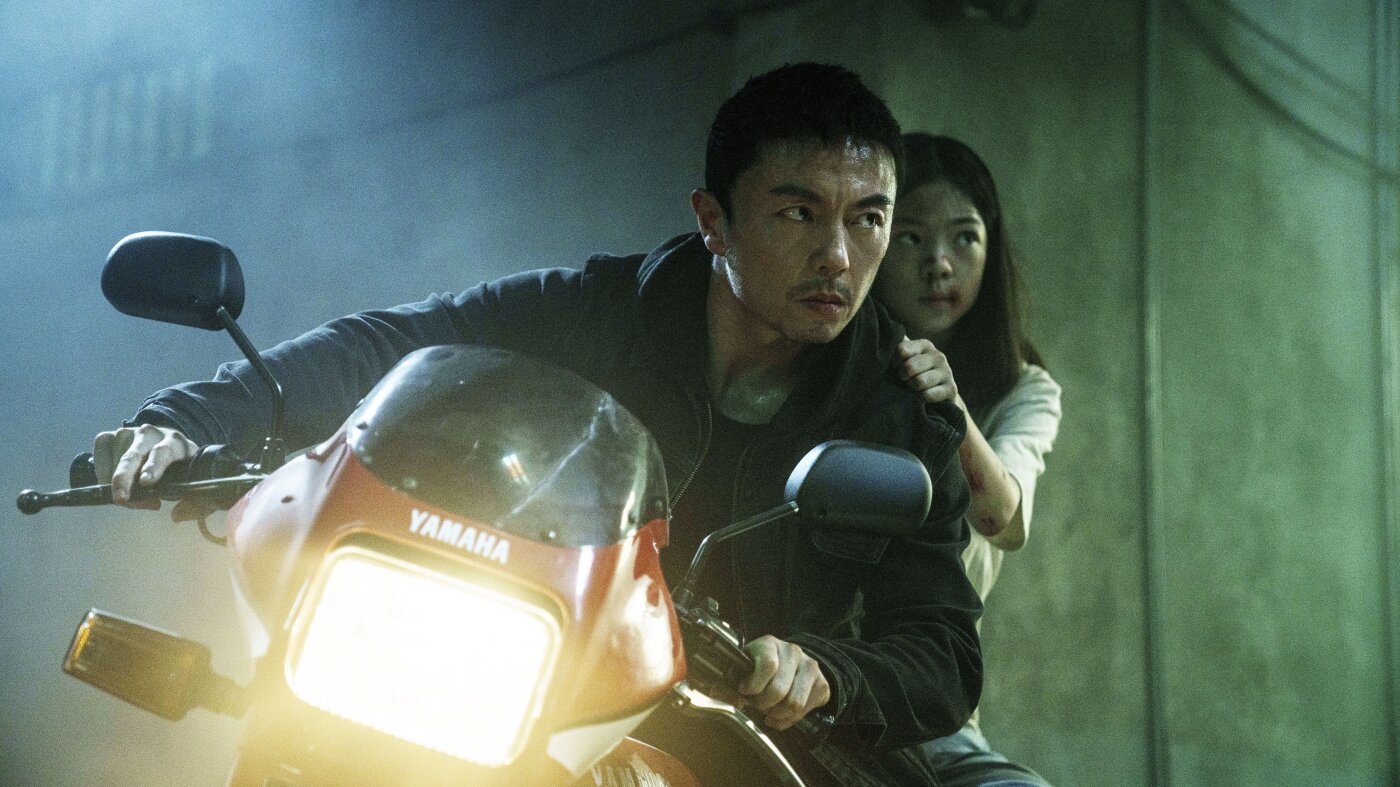
Xie Miao and Yang Enyou in The Furious.
Norachai Kajchapanont/Lionsgate
hide caption
toggle caption
Norachai Kajchapanont/Lionsgate
There have been some fantastic movies released this year, and we know you can’t see them all. So we’re recommending four recent movies we missed that you should add to your watchlist: The Furious, Tuner, She’s The He, and Heresy.
If you need a few more fun film recommendations, check out these episodes:
Fun movies you may have missed
Our favorite movies on Tubi
We debate the best movies to watch on an airplane
Connect with Pop Culture Happy Hour:
Letterboxd / Facebook
Our weekly newsletter
Support Pop Culture Happy Hour+
-

 Florida5 minutes ago
Florida tattoo shop refuses service to military and veterans for being ‘war criminals’
-

 Georgia8 minutes ago
What would it take for Missouri football to stun Georgia in 2026?
-

 Hawaii13 minutes ago
Scientists say major earthquakes feel frequent, but activity is on track
-
 Idaho20 minutes ago
Eagle Road’s long-awaited variable speed signs one step closer to operation
-

 Illinois23 minutes ago
Illinois Lt. Gov. candidates focus on affordability in pitch to Rockford voters
-

 Indiana28 minutes ago
Indiana Fever President Addresses Player Safety After Alyssa Thomas' Suspension
-

 Iowa35 minutes ago
Iowa City Regina baseball finds winning formula under new leadership
-
 Kansas38 minutes ago
Video shows disruption during Osawatomie City Council meeting with data center developer

