Milwaukee, WI
Outside the RNC, small Milwaukee businesses and their regulars tried to salvage a sluggish week


MILWAUKEE (AP) — Jay Nelson was standing outside the convenience store he manages in downtown Milwaukee when one of his regular customers walked by on her daily stroll around the neighborhood.
“I’ve been telling people to come and buy even just a bottle of wine,” she said, stretching out her arms. “I hope it helps.”
Pulling her in for a hug, Nelson said they needed all the help they could get.
The store he has managed for nearly a decade, Downtown Market & Smoke Shop, was among the many businesses sealed off by tall metal fencing for the 2024 Republican National Convention, a sprawling footprint that shut down portions of the city’s downtown for more than a week.
For small businesses like Downtown Market, the RNC didn’t deliver a decisive victory, instead hindering sales despite earlier promises that it would bring an economic boost.
“I want you to take all your money to Milwaukee, spend it that week, and leave it in Milwaukee,” Mayor Cavalier Johnson said two years ago at the RNC’s summer meeting where it was announced that the city would host the GOP’s national convention.
But Samir Saddique, owner of Downtown Market and the neighboring Avenue Liquor, said the convention brought “a lot of nothing.” Traffic and sales took a nose dive soon after the fencing went up in front of the stores. By Thursday, the RNC’s final day, the liquor store had made just 10% of its usual sales, he said.
“We’re barricaded away from the rest of the world,” Saddique said.
Claire Koenig, a spokesperson for Visit Milwaukee, which promotes the city as a tourism destination, said economic impact reports will likely take three months to compile.
Across the Milwaukee River, which marked the eastern edge of the RNC secure zone, just one seat was taken at the bar inside Elwood’s Liquor & Tap during their Wednesday happy hour, which is usually a reliably busy night for the red-booth bar near Fiserv Forum where the convention’s main stage was housed.
“Everybody was promised that this was going to be a giant moneymaker for businesses,” bar manager Sam Chung, 30, said. “So it’s strange seeing how much it’s actually killed business for a lot of people outside the perimeter.”
Even their most loyal customers hadn’t stopped by this week, Chung said.
“They don’t even want to come down here because it’s obviously a mess to get here,” she said, adding that she thought “a big part of it is that a lot of our regulars are Democrats.”
What to know about the 2024 Election
- Read the latest: Follow AP’s live coverage of this year’s election.
- Democracy: American democracy has overcome big stress tests since 2020. More challenges lie ahead in 2024.
- AP’s Role: The Associated Press is the most trusted source of information on election night, with a history of accuracy dating to 1848. Learn more.
- Stay informed. Keep your pulse on the news with breaking news email alerts. Sign up here.
Milwaukee is the deepest blue city in Wisconsin, a key swing state.
Adam Buker, a 21-year-old barista at a coffee shop near one of the convention’s exits, which leads attendees onto a wide-open street, said that all week he had been playing music by queer artists as his own protest.
Yet the door kept swinging open at Canary Coffee Bar.
“It 100% has to do with our location,” Buker said Thursday as he packed espresso grounds for a cortado, with a Frank Ocean track playing in the background.
Though it was outside the secure zone, the cafe’s glass storefront and buttery yellow sidewalk seating weren’t obstructed by the fencing like Saddique’s liquor and convenience stores were. RNC attendees also didn’t have to cross the river to get to the coffee shop, unlike Elwood’s.
After closing this week, Buker said he had been spending his cash tips at some of the struggling bars around the convention’s perimeter.
“From one service worker to another,” he said. “Spread the love.”
As Buker’s final shift during RNC week was coming to an end Thursday evening, a last-minute party outside Saddique’s convenience store was just underway. Saddique and Nelson, the manager, hoped catered tacos and ice-cold green tea flowing from orange coolers would bring customers into the stores that have been open for 20-plus years, surviving a recession and a global pandemic.
Debra Lampe-Revolinski, who has lived in the building adjacent to Saddique’s businesses for 15 of those years, said she pitched the idea for the party earlier in the week, when she realized the expected boost in business would not materialize for her friends.
She knew Saddique and Nelson went to great lengths preparing for the RNC, having seen them hard at work for weeks while they remodeled parts of the stores, she said.
“And then there was just this deflation because the stores were blocked out by those tall metal fences,” she said. “It was so uninviting.”
By the time Trump took center stage Thursday to formally accept the GOP nomination, Lampe-Revolinski said the party, originally aimed at bringing in business, instead had turned into a celebration of surviving the week.
“If anything, this week strengthened our little community on this block to support its local businesses,” she said.
___
Associated Press writer Todd Richmond contributed from Madison, Wisconsin.



Every morning throughout Summerfest 2026, we’ll deliver a guide that covers the day’s entertainment and how you can get in the gate free of charge. This is where you’ll find info about the AmFam Amp headliners, eclectic picks from our knowledgeable staff and the music lineup for the day (see the full 2026 Summerfest lineup here).
Today at the AmFam Amp + Radio Milwaukee staff pick #1
Carín León, 7 p.m.
For the first time in the festival’s 58-year history, a Spanish-language artist is headlining the main amphitheater. As a Mexican, it’s super exciting to see rising stars bring our music and vibrant dancing to an entirely new crowd. Hearing live banda is a whole new world and something everyone needs to experience at least once in their life. Think of it as a taste of what Mexican Fiesta brings to the lakefront every August (coming very soon, too!). Grab a beer your boots and your tickets to witness a very special moment.
— Leslie Garcia Ramirez
Radio Milwaukee staff pick #2
The Academy Is… @ Miller Oasis, 10:30 p.m.
In the midst of the emo and screamo wave of the early to mid 2000s, this Midwest band made a name for themselves. Still, you may have missed The Academy Is… like I did.
Fortunately, I got some help after becoming a diehard fan boy of the Milwaukee indie-rock outfit Whips (RIP! 😢) and discovered that band wasn’t Milwaukee-based drummer Andy Mrotek’s first rodeo. Mrotek was with The Academy Is… almost from day one, did his own thing when the group broke up and returned when they got back together a few years back.
Since reconnecting, the band have been touring and recording, and this past March they released their most recent album — their first in nearly 20 years. Whether you’re a fan of The Academy Is… or just loved the genre, reunite with your mid-2000s self and check them out at the Miller Oasis (and come early to check out fellow emo greats Braid, which you may hear about momentarily).
— Jay Burseth
Radio Milwaukee staff pick #3
Braid @ Miller Oasis, 8:30 p.m.
Hailing from the Midwest Emo Holy Land of Champaign, Ill., Braid is the sonic personification of everything it means to grow up in the chilling plains of Middle America. The stinging lyrics and pouting guitars amalgamate to anthems that have had angsty teens in a chokehold since well before their landmark 1998 album, Frame and Canvas.
This posse of sad dads is set to take on the Miller Oasis, making their return to the Summerfest grounds for the first time since 2015, when they closed the set with their love note for our great city, “Milwaukee Sky Rocket.” Braid’s irrefutable impact on our city’s emo scene will be sure to draw in kickers and screamers from all over, and you won’t want to miss it.
— Matthew Poulton
Radio Milwaukee staff pick #4
Trapper Schoepp @ Uline Warehouse, 5:30 p.m.
It’s always a special treat to see Milwaukee bands playing Summerfest. I get excited to think about all the new fans our local artists reach when they hit the stage — something singer-songwriter Trapper Schoepp has experienced a time or two over his wonderful career.
One of Milwaukee’s true artists, Schoepp’s career in music literally started as an accident. While recuperating from a BMX-related back injury, he heard Bob Dylan’s “Hurricane” and was inspired to pick up a guitar as a “safer” hobby. He put out his first record at the age of 17 with his brother Tanner; he’s collaborated with Bob Dylan, Nicole Atkins and Wilco; and — almost two decades later — he’s still one of those musicians who seems to thrive onstage.
Schoepp’s songs are a slice of Americana with a bit of a punk-rock edge. He sings about the nostalgia of his youth on Bay Beach Amusement Park, and his journey through addiction and recovery on new album Osborne. Will he come out into the crowd and play guitar while standing on the benches with you? Check out the show this today and find out for yourself.
How to get in free today
Briggs & Stratton United Way Diaper & Wipe Drive
Help United Way of Greater Milwaukee & Waukesha County provide essential diapers and wipes to families across the community. Between noon and 3 p.m., the first 1,500 patrons who donate new unopened wipes or diapers with a total minimum value of $10 per person will receive one free admission ticket, valid for the day and time of the promotion only. All donations benefit United Way of Greater Milwaukee & Waukesha County’s Diaper Bank network.
Summerfest schedule for Saturday, June 20
American Family Insurance Amphitheater
American Family Insurance House
- 4 p.m. — Weston Estate
- 2 p.m. — Flipturn
BMO Pavilion
- 9 p.m. — David Lee Roth
- 7:15 p.m. — Kirstie Kraus
- 5:30 p.m. — Substitute: Tales From The Who
Miller Lite Oasis
- 10:30 p.m. — The Academy Is…
- 8:30 p.m. — Braid
- 6:30 p.m. — The Juliana Theory
- 4:30 p.m. — Colin Bracewell
- 2:45 p.m. — American Progress
- 1:15 p.m. — IDKCONUNDRUM
T-Mobile Stage
- 10:15 p.m. — Nate Smith
- 8:15 p.m. — McCoy Moore
- 6:15 p.m. — Scott Wolverton
- 4:15 p.m. — Rhys Rutherford
- 2:30 p.m. — Will Terry
- 12:45 p.m. — Lauren Gottshall
Generac Power Stage
- 9:30 p.m. — Flipturn
- 7:30 p.m. — Penelope Road
- 5:30 p.m. — Winyah
- 3:30 p.m. — Old Mervs
- 2 p.m. — Tobacco Road
- 12:30 p.m. — The Band Solstice
Uline Warehouse
- 9:30 p.m. — Christopher Cross
- 7:30 p.m. — Don Felder
- 5:30 p.m. — Trapper Schoepp
- 3:30 p.m. — A.J. Croce
- 2 p.m. — Kenneth Brian Band
- 12:30 p.m. — Milly & The Mayhem
Briggs & Stratton Big Backyard
- 10 p.m. — Connor Price
- 8 p.m. — Weston Estate
- 6 p.m. — Graham
- 4 p.m. — SM6
- 2:30 p.m. — Noah Richardson
- 1 p.m. — Sarah Krohn
Aurora Pavilion
- 9 p.m. — Aspen
- 7 p.m. — Dexter & The Moonrocks
- 5:45 p.m. — Red Leather
- 4:30 p.m. — Altered By Mom
- 3:15 p.m. — Cigarettes @ Sunset
- 2:15 p.m. — Candy Cigarette
- 1:45 p.m. — Woraz
- 1:15 p.m. — Take Back the Sun
- 12:45 p.m. — White Paper Walls
- 12:15 p.m. — Mala Mala

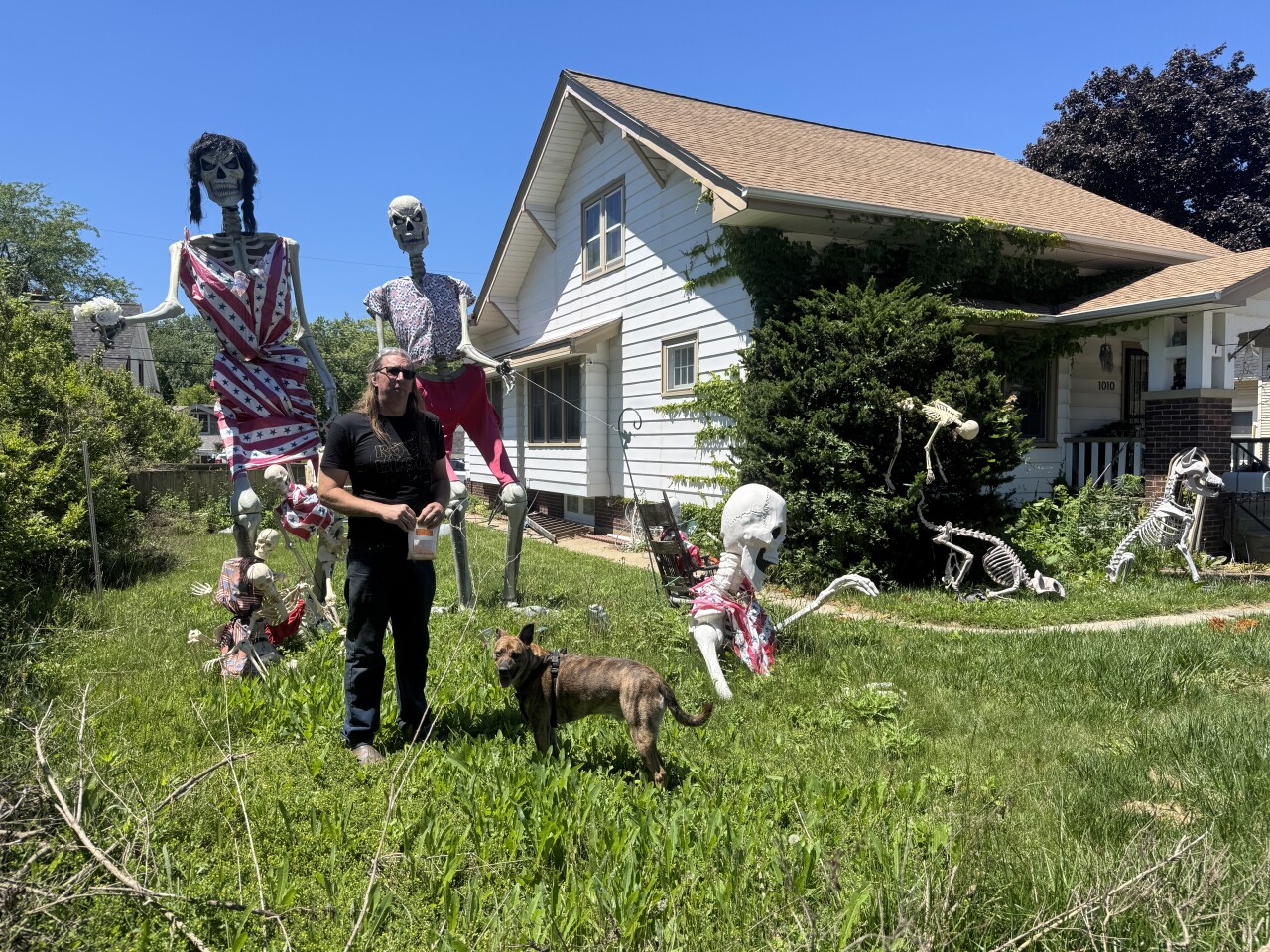
SOUTH MILWAUKEE, Wis. — A South Milwaukee homeowner is pushing back after the city ordered him to take down his year-round skeleton display, calling it a violation of property maintenance codes.
Sean Oster and his wife have maintained the display — featuring skeletons named Hector and Henrietta along with other decorations— for nearly two years, dressing them up for holidays, sports events, and other occasions.
Mike Beiermeister
The display has drawn attention from neighbors and passersby, with some saying it has become part of the neighborhood’s character.
Watch: South Milwaukee homeowner fights city order to remove year-round skeleton display
South Milwaukee homeowner fights city order to remove year-round skeleton display
“It’s like an expression of the owner’s passion… and I think it’s cool they can use their lawn that way,” neighbor Jeremy Payment said.

Mike Beiermeister
Last month, Oster received a letter from the city of South Milwaukee describing the skeletons as Halloween decorations being displayed outside the appropriate time of year and ordering him to remove them by July 7.
Under the city’s property maintenance code, yards must be kept free of anything considered an “unreasonable blighting influence,” which the city says can include displays left up out of season. The notice also flagged an inoperable vehicle on the property. Each violation could result in fines of up to $500 per day if not corrected by the deadline.
Oster says he understands part of the city’s concern.
“They have a few points… I’ve got a couple collector cars… I understand those shouldn’t be out,” Oster said.
Mike Beiermeister
He plans to move the cars into the garage and clean up the yard, but says the skeletons are staying.
“I don’t think it’s hurting anybody. It’s literally a victimless crime,” Oster said.
Oster also had a message for whoever filed the complaint.
“Live with it… more people like it than hate it. And if we’re enforcing this, then we should go around and take down Christmas lights that are up year-round,” Oster said.
The city administrator did not respond to a request for comment.
This story was reported on-air by a journalist and has been converted to this platform with the assistance of AI. Our editorial team verifies all reporting on all platforms for fairness and accuracy.
Let’s talk:
Hey there! At TMJ4 News, we’re all about listening to our audience and tackling the stuff that really matters to you. Got a story idea, tip, or just want to chat about this piece? Hit us up using the form below. For more ways to get in touch, head over to tmj4.com/tips.
It’s about time to watch on your time. Stream local news and weather 24/7 by searching for “TMJ4” on your device.
Available for download on Roku, Apple TV, Amazon Fire TV, and more.
Report a typo or error // Submit a news tip

The Milwaukee Bucks’ impending trading of Giannis Antetokounmpo to a new team has been the buzziest NBA story since the New York Knicks won the title. But what if it never happens?
The stars are aligning for the Bucks to pitch a narrative to Giannis that for the second straight transaction cycle they’ve dangled him to the rest of the Association and gotten a tepid response.
A few teams, like the Miami Heat, have been clearly interested. Many others, like the Boston Celtics, seem much more cautious and coy about their pursuit of the Greek Freak. Juggernauts like the Oklahoma City Thunder and San Antonio Spurs are less than a Giannis away from winning the championship, and neither team even seems willing to bid.
Even Miami’s dogged pursuit may not include exhausting every possible means to add Giannis. After all, he’s into his 30s now, with a lot of basketball miles between NBA and international competition, and his representatives want a seat at the table, plus the injury history is getting extensive…
The important distinction, as @Anthony_Chiang and I, and @EthanJSkolnick have noted, is while only Bam is off limits, the Heat cannot in good conscience offer every single good young player and every single available first and every pick swap. Most, sure. But offer everything…
— Barry Jackson (@flasportsbuzz) June 18, 2026
And then there’s the Bucks, an organization so committed to winning with Giannis they waived and stretched Damian Lillard last summer because they thought adding Myles Turner would lead to the next great Milwaukee frontcourt following Brook Lopez’s decline. There’s a pitch to be made right now from Jon Horst and the Bucks’ leadership that there’s no other NBA team out there who wants to win with Giannis as badly as they do.
Outside from the human element of feeling wanted, there are more tangible elements in play. Giannis can’t sign his next massive extension until October 1 with Milwaukee, or six months following a trade if he is dealt. If his next team is hesitant to give up players or picks to trade for Giannis, is there really any guarantee that a max extension is on the table in 2027?
The collective bargaining agreement’s extension rules offer somewhat of a double-edged sword in this case. It hurts the Bucks’ ability to keep Giannis that he can’t formally extend until the draft and free agency are over, but also the prospect of being able to sign before suiting up in 2026-27 is more appealing to Giannis than having to wait until January or February. Especially given the series of injuries that have plagued him.
All of this sentiment and security still isn’t enough in itself for Milwaukee. The Bucks would require a plan to improve quickly to get Antetokounmpo bought in again to avoid ending up back here, but in an even more desperate spot, come February. Upgrading from Doc Rivers to Taylor Jenkins is a great start, but executing trades and smart free agent signings will be crucial.
Is it serendipitous timing that the Bucks biggest position of need is wing players and the New Orleans Pelicans reportedly want to get into the range of the 2026 NBA Draft where Milwaukee is slated to pick, with rival teams eyeing young wings Trey Murphy and Herb Jones? Notably, those same Pelicans infamously overpaid to “get their guy” last Draft.
This is more than likely some combination of pipe dream and fairy tale, given most of the reporting around Giannis continues to conclude he’ll be departing Milwaukee in the coming weeks. But even that is strangely optimistic for the Bucks, as they’ve reportedly quietly walked back ownership’s stated timeline of having a decision made by the draft.
All of that said, it still feels more likely that Giannis is traded than not. But this saga has had its share of twists and turns so far and throughout all the noise Giannis has re-signed with the Bucks. Who’s to say that couldn’t happen one more time?
Follow
-
 Entertainment5 minutes ago
From YouTube to the multiplex: How low-budget horror films are beating big-budget studio bets
-
 Politics12 minutes ago
Commentary: Behested payments aren’t illegal, but they are a problem. Especially for Newsom
-
 Sports22 minutes ago
Dodgers’ walk-off stuns Orioles as Dalton Rushing helps cap wild comeback
-

 World34 minutes ago
Trump doubles down on Meloni photo comments
-

 News58 minutes ago
The Real Love Company made her feel whole. Then ‘Daddy’ said to strip naked.
-

 Los Angeles, Ca2 hours ago
Woman, man found shot to death in Pomona, suspect leads officers on erratic chase
-

 Detroit, MI3 hours ago
Today in History: June 20, race-related rioting erupts in Detroit
-

 San Francisco, CA3 hours ago
San Francisco hotels see steady World Cup business, but fall short of Super Bowl surge

