Lifestyle
What is a Bojin facial? The luxury L.A. treatment feels like 'gua sha on steroids'

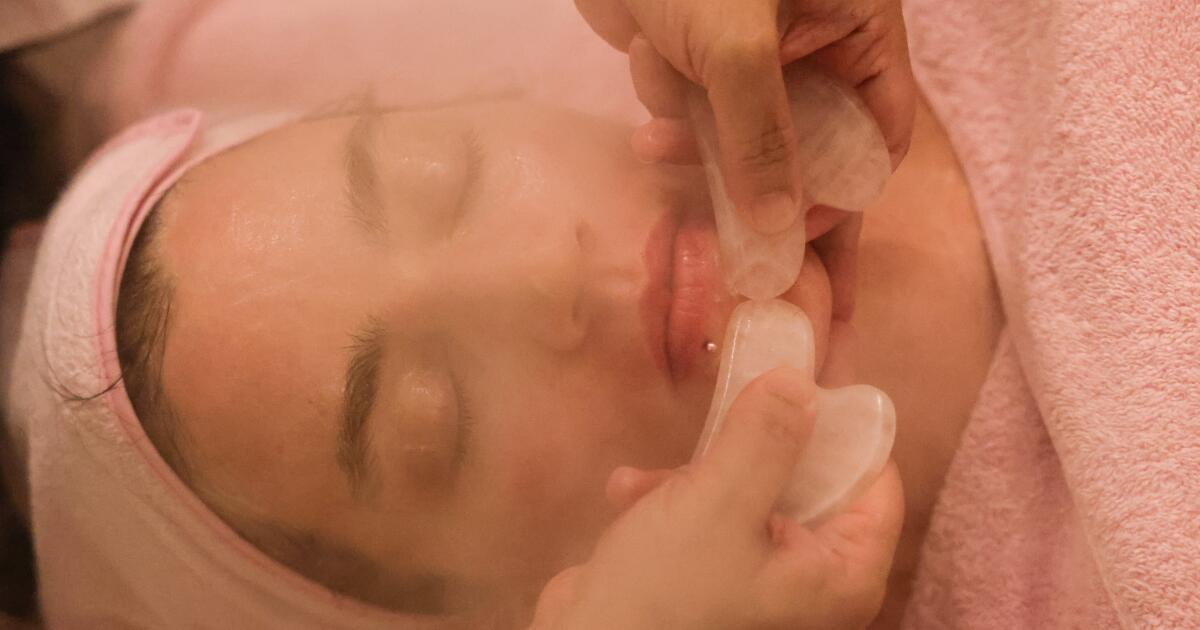
I know my way around a facial. I have well-formed opinions about collagen face masks and laser treatments. I planned a trip to Seoul, in part, so I could visit a famous spa known for its advanced skin care techniques and K-drama celebrity clientele. So when I saw a TikTok video that described a local L.A. treatment as “gua sha on steroids,” I couldn’t resist.
The $108 service is offered at JY Beauty in San Gabriel. Owner Yajing Lu opened the shop in 2021 after she cut her teeth in local salons for six years. Before launching her own business, Lu traveled to China to gather inspiration, incorporating ideas like Bojin, a traditional Chinese technique that stimulates facial muscles, into her spa’s offerings. On the menu, it’s listed as “face tendon,” which, as Lu explained to me through a translator, is a direct translation from Chinese.
Lu said the facial contours the face, firming and lifting the skin. It can also reduce the appearance of pores and minimize wrinkles like marionette lines, which go from the nose to the mouth. Overall, she said, it reduces signs of aging.
This is all pretty close to the claims of face sculpting, another beauty trend that promises at least temporarily tighter-looking skin. But Bojin goes beyond face sculpting and relies on traditional Chinese medicine (TCM) practices that focus on manipulating the body’s energy pathways.
Different facial products used by JY Beauty, where Bojin facials are on the menu of offerings.
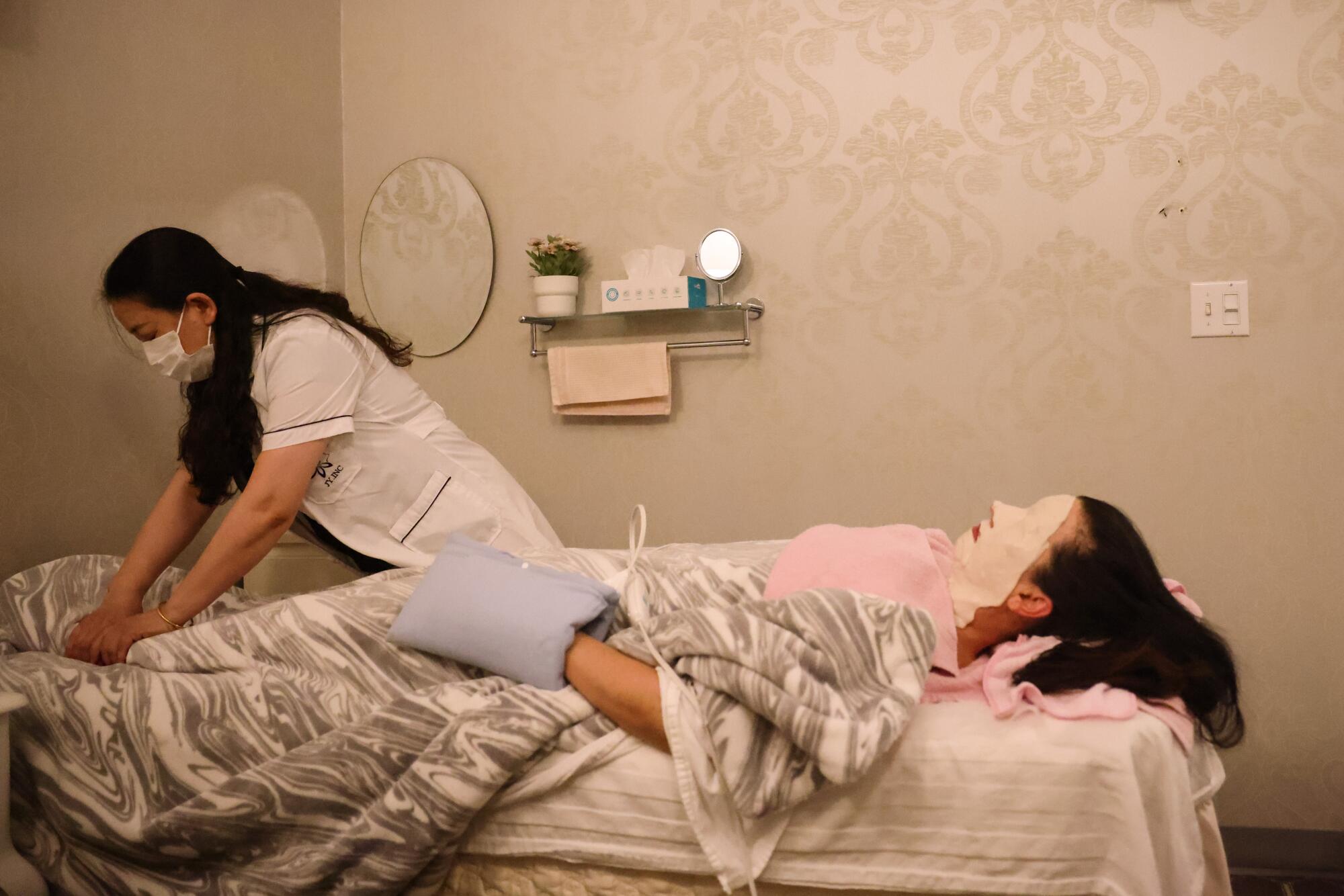
Yajing Lu massages the author as a nourishing facial mask sets on her face during a Bojin facial at JY Beauty.
In TCM, these pathways, known as meridians, are believed to channel qi, or life energy, throughout the body, according to Dr. Elizabeth Ko, an assistant clinical professor of medicine at the David Geffen School of Medicine and medical director of the UCLA Health Integrative Medicine Collaborative.
“A central credo in TCM is that blockages in meridians lead to imbalances in health, including illness or pain,” Ko said. “Like acupuncture, which uses fine needles, Bojin is a method of unblocking stuck qi using a pointed tool made of stone or horn.”
Bojin involves the same tool as gua sha, another TCM technique that uses a flat, smooth-edged scraper usually made of jade or stone. Gua sha allows for targeted massage to release tension along muscles, tendons, ligaments and fascia of the face and neck so that qi can flow properly through the meridians, thereby restoring balance. Bojin might allow for a more targeted and precise treatment, enhancing circulation and promoting lymphatic drainage, according to Yu.
“The benefit of skin care resides in skin clarity and health, and Bojin is a tool that might offer some benefit when combined with a comprehensive facial in the skilled hands of a trained aesthetician,” Ko said, adding that its risks are low beyond slight pain from the pointed tool used.
Beyond those benefits, Yu says she’s seen the treatment reduce dark circles around the eyes and brighten the skin for many customers. There has been a surge in interest in TikTok since the “gua sha on steroids” video from Jing Zhang, an L.A.-based beauty influencer who posted herself getting the facial in January, which has garnered more than 2.6 million views, bringing in new customers who Yu says often request the “TikTok facial.”
“A lot more people know about Bojin and love it,” Yu said about the video.
All of the 90-minute facials at JY Beauty include the usual facial steps, such as cleansing, extraction and moisturizing. There is also a lymphatic facial massage section, which includes the chest, neck and shoulders.

Frames decorate the entrance at JY Beauty.
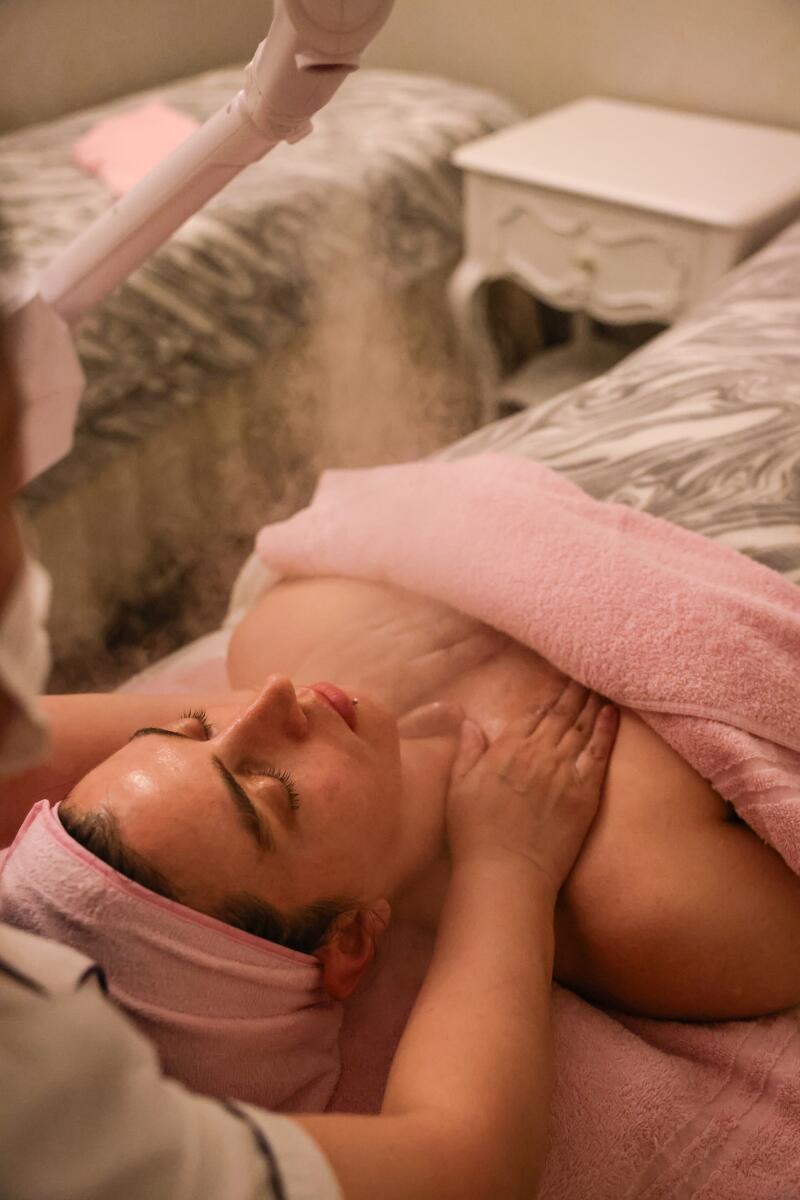
Yajing Lu gives the author a facial and shoulder lymphatic detox massage.

Yajing Lu applies a nourishing facial mask on the author’s face during a Bojin facial.
The treatment began with me changing into a dressing gown that wrapped around just under my armpits, exposing my shoulders and upper chest. Then I lay down in a cozy room, where Yu quickly cleansed my face. She set up a steam machine to keep me hydrated and help open up my pores.
Yu then performed a facial lymphatic massage with her fingers, a process that focused not only on obvious areas like the muscles in my jaw, but also surprisingly tight areas, like under my eyebrows. The process made it clear that I have been woefully neglecting these parts of my face. She applied gentle pressure slowly down my face toward the lymph nodes in my neck and down into my chest. Beyond feeling wonderful, I had to keep swallowing, which can be a sign that lymphatic drainage is occurring, according to Yu.
To do the Bojin section of the facial, she took out two gua shas and worked the tools along my face and neck. This part was pretty gentle, but it still felt like part of the massage and despite Ko’s warning, there was no pain.
Then came my least favorite part of any facial: extraction, or the process of clearing clogged pores by pushing out blackheads and whiteheads. This part always feels like the start of a “Saw” movie, but maybe because the massage relaxed me this extraction was not that painful.
Next up was a hydrating serum. Yu pulled out a serum booster device, something I recognized from other facials, to supercharge the serum’s effectiveness. It was a nice cooling experience after the extraction.
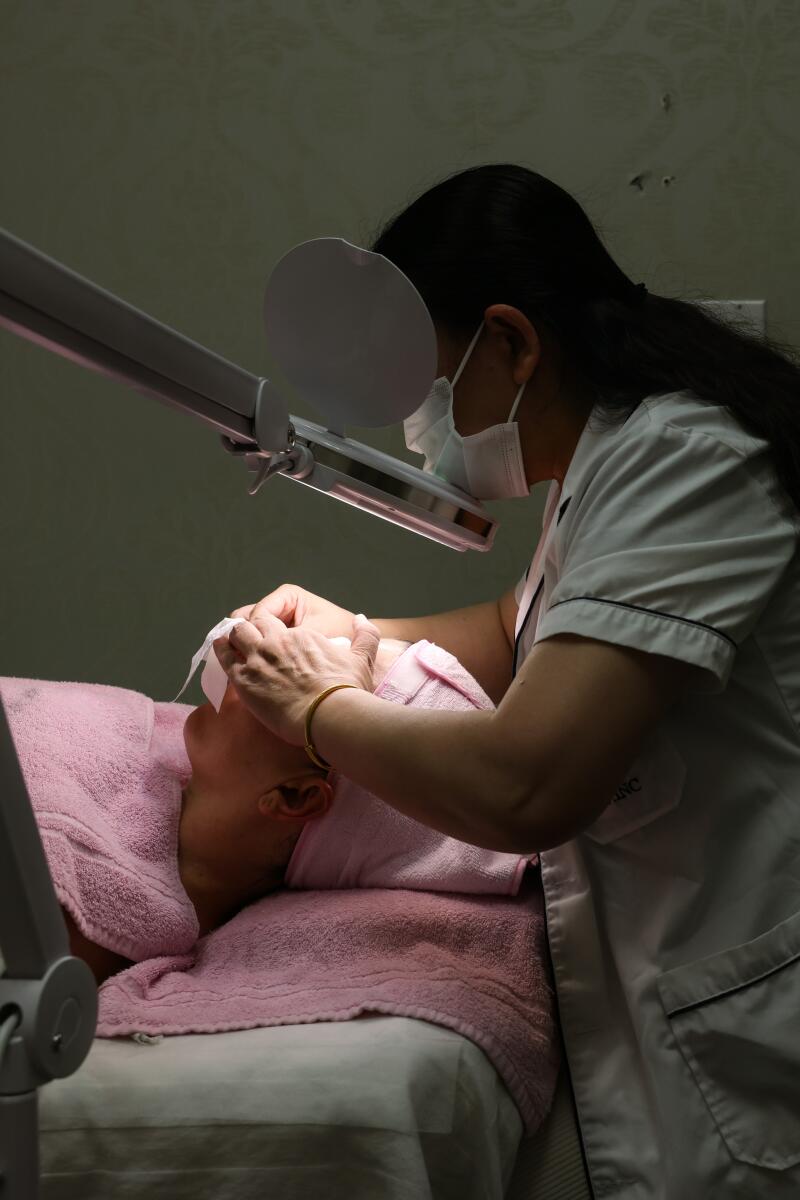
Yajing Lu does extractions on the author’s face.
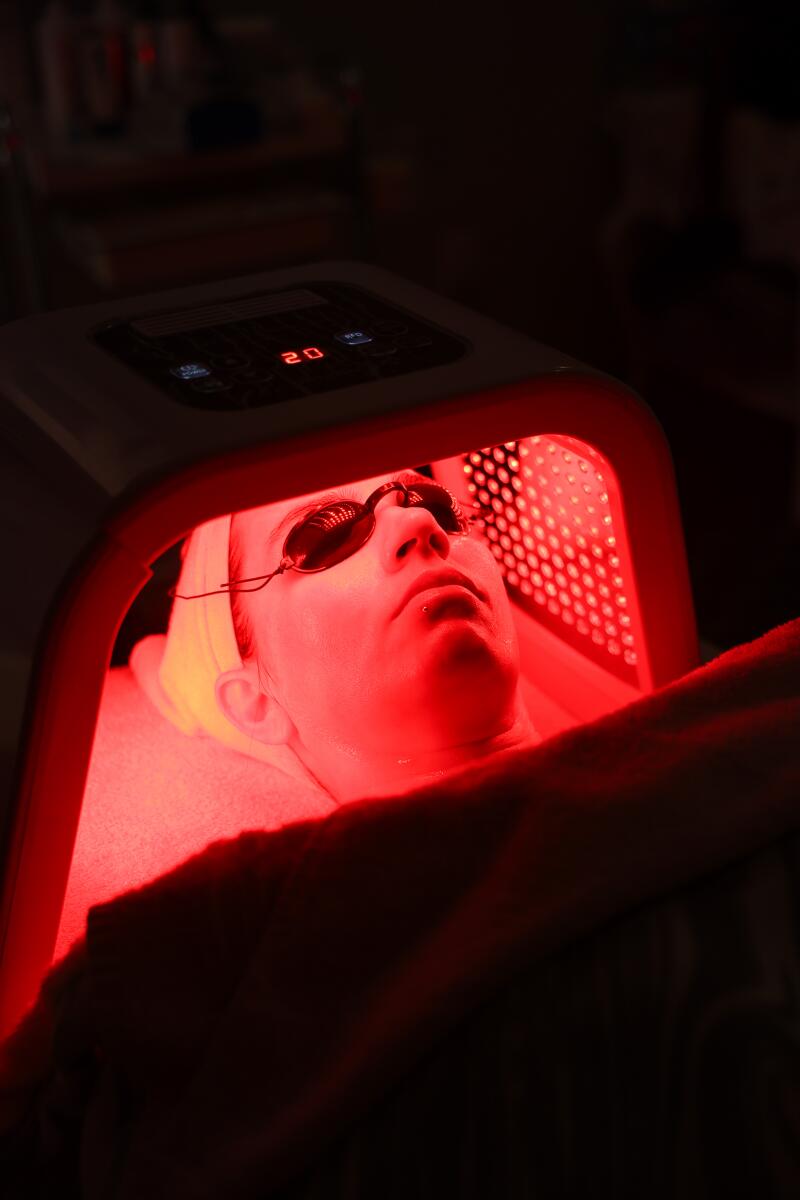
The author receives a red light treatment. (Dania Maxwell/Los Angeles Times)
After that, Yu put covers over my eyes before placing a panel of red lights around my face. A red light treatment can treat wrinkles, acne, scars and, most importantly for me at that moment, redness. While my face was getting blasted, Yu rubbed and moisturized my hands before putting them into warm mittens, a process that left me feeling like I was on a beach somewhere, snoozing in the sun.
JY Beauty also offers 30-minute eye and head Bojin treatments that can be tacked on to a facial. Yu demonstrated a few minutes of what the head addition would feel like. While it wasn’t not painful by any means, I was left wanting a good head scratch, but maybe there is just less tension there for me.
The finale was a cool, clay face mask thick enough to make me feel like a cake being frosted. While it dried, Yu rubbed my legs. The mask peeled off in one giant piece.
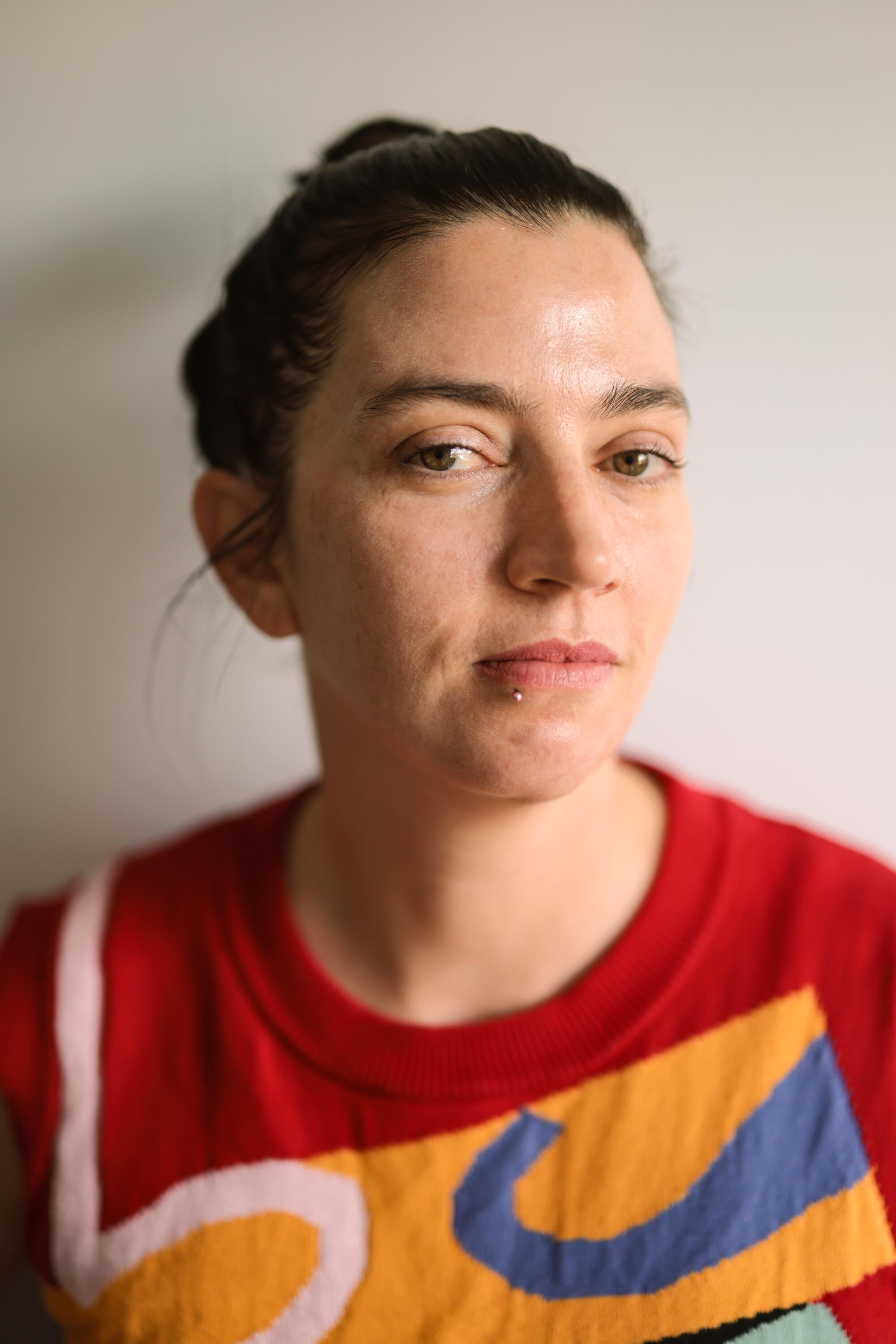
The author after receiving a Bojin facial from JY Beauty.
Finally, Yu rubbed some sunscreen into my face and finished the facial with some quick pats on the back. It was half-facial, half-massage, and all relaxation.
Post-facial, I asked Lu about my blockages. She gestured at my eyes, hinting that I might need that extra eye treatment next time. This is totally fair: I can feel my eyes ache even as I type up this article.
I’ll certainly be back to try it out. With my skin moisturized, and my qi unblocked, my skin glowed. I’m not sure I can go back to plain old facials or massages now that I’ve experienced this hybrid heaven.



Denis Novikov/Getty Images
I tend to romanticize summer. The movies and TV shows I grew up with made me think that the season was about adventure and big-time transformation.
I imagined myself building a tight-knit friend group and getting out of a pickle together, like in The Sandlot or Camp Nowhere. Or traveling across the world, say, to Greece, like Lena Kaligaris, a character in The Sisterhood of the Traveling Pants, having a whirlwind summer romance and returning an entirely different person.
I’ve never actually had a summer like that.
Even when your expectations are more modest than mine, “so often, the summer just flies by, and we haven’t taken the picnics or gone for the day trip or whatever it was that we thought we were gonna do,” says happiness expert Gretchen Rubin.
Rubin, author of The Happiness Project and host of the podcast Happier With Gretchen Rubin, has been sharing ideas on social media about how to make the season more memorable and satisfying.
She walks through four exercises to help you get what you want — and more — out of the season. Print out our worksheet here, fill it out and stick it on your fridge to keep you accountable. Or take a screenshot and post it to Instagram (don’t forget to tag @NPRLifeKit!).
🍑 Give your summer a theme
Pick a single word or phrase that you want to embrace this season — something that captures the feeling you want to have over the next few months.
“My theme for the summer is ‘ketchup,’” Rubin says. “It has a kind of a summer feeling, because you think of putting ketchup on your burger.”
“It’s a metaphor,” she says. It means to look for “whatever I could add [this season] to make something elevated and more fun.”
Meanwhile, my theme word this summer is “juice.” I no longer think that I need to travel far or completely transform to have a delicious summer. I just need to take advantage of the abundance that the season offers: ripe peaches and tomatoes, juicy softball pitches and the opportunity to feel juicy in my body when I wear a bathing suit.

Print out our worksheet here, fill it out and stick it on your fridge to keep you accountable. Or take a screenshot and post it to Instagram (don’t forget to tag @NPRLifeKit!).
Malaka Gharib/NPR
hide caption
toggle caption
Malaka Gharib/NPR
🪣 Create a summer bucket list
What do you want to do this summer? On my bucket list: ride the Ferris wheel at a summer fair, have more barbecues at my parents’ house and see the sunrise at least once.
There might even be something you don’t necessarily want to do but have been trying to accomplish for a long time — like cleaning out the garage or learning how to swim.
“Some people love a long list with a lot of easy things to cross off,” Rubin says. “I’m a fan of that approach myself.”
But some people like a list with fewer goals that are more ambitious. If you take this path, just make those items realistic, she says. “It’s easy to get discouraged if you set the bar too high.”
🏁 Set a fun challenge
It could be fun to gamify a few of the items on your bucket list — or to come up with an entirely different kind of dare for yourself.
You might try 10 new taco joints this summer or read five romance novels. Or you might come up with a theme, like “Freaky Flavor Friday,” Rubin says. Every Friday, you go to a different ice cream shop and try a new and ambitious flavor.
A good challenge can make your summer feel more memorable, she says. “If you did ‘Freaky Flavor Friday’ all summer long, that would stand out in your mind. Years later, you’d be like, ‘That’s the summer I discovered creamed corn ice cream.’”
Two challenges I’m considering: taking a swim class and rewatching all the best Pixar movies.
🖼️ Take a “five-senses portrait”
Experience the summer through your five senses — then reflect on each one. What does summer look like, smell like, taste like, sound like and feel like?
“It’s one thing to look at photographs, but that’s very flat,” Rubin says. “A ‘five-senses portrait’ puts you back into that experience. It’s a creative, fun way to look back on summer and capture the memories that you’ve created.”
Do this exercise either for your whole summer or for a specific summer adventure, she says. Do it with yourself or with a group. You can journal about it, make a collage, draw a picture or simply have a conversation.
When I think of summer, here’s what comes to mind: the smell of smoke from a crackling outdoor fire and the taste of toasted marshmallows on a stick.
More summer-worthy goals from Life Kit
Learn how to swim. Knowing how to swim can help you have fun at the pool or beach this summer. But it could also save your life. Here are some tips to start swimming at any age.
Focus on rest and relaxation. In Dr. Saundra Dalton-Smith’s book Sacred Rest, she outlines different kinds of rest you may be craving. From the mental to the physical, Dalton-Smith shares how to identify what kind of respite you need and how to embrace rest.
Get into running. Ready to kick-start a new running habit? Coach Martinus Evans breaks down a common misconception to get you into the mindset and offers quick tips on pace, form and more.
Declutter your home. Got piles of stuff you just can’t seem to get rid of? Professional organizer Star Hansen explains how to let go of unnecessary items and keep your home neat and tidy.
This episode was produced by Clare Marie Schneider. The story was edited by Meghan Keane. The visual editor is CJ Riculan. We’d love to hear from you. Leave us a voicemail at 202-216-9823, or email us at LifeKit@npr.org.
Listen to Life Kit on Apple Podcasts and Spotify, and sign up for our newsletter. Follow us on Instagram: @nprlifekit.

Night is falling in Altadena as bats circle, peacocks wail and photographer Kevin Cooley tries to capture what’s left of a tree.
Using strobes and a long exposure time to allow the maximum amount of available light to hit his lens, Cooley snags about 50 shots of the 20-foot-tall tree, which stands vigil over a street where nearly all the homes burned. The tree’s limbs were lopped off in the wake of January 2025’s Eaton fire, which ravaged Altadena and part of Pasadena, but all these months after the fire, there’s new growth on the tree.
Photographer Kevin Cooley sets up a camera to take photos for his series.
(Jason Armond / Los Angeles Times)
Little tufts of green leaves have emerged from the raw cuts where the burned branches once were, proving the tree to be more resilient than its otherwise relatively stark exterior might suggest.
A fine art and news photographer for decades, Cooley, 51, is using pictures like the one he snapped of the tree as part of his new project, “In the Gardens of Eaton.” A collection of 6,000 photos and counting that Cooley has taken around Altadena on wild lots where homes once stood, “In the Gardens of Eaton” aims to capture bits of natural beauty that have endured despite the ravages of the fire and its aftermath.
Cooley has lived in Altadena since 2000 and he knew his neighbors well. He started working on the photo project several months after losing his home in the fire. He’d enlisted a group called Samaritan’s Purse to come up to his lot, where he’d found a metal flat file he’d used to store his photographic prints. Cooley was hopeful some had survived, but when the group popped it open, he says it quickly became clear that the burning metal had acted somewhat like an oven, burning almost everything inside to a charred crisp.

A ponytail palm on Athens Street photographed for Kevin Cooley’s “In the Gardens of Eaton.”
(Kevin Cooley)
One piece Cooley could identify, though, was a 2020 copy of Wired magazine for which he’d shot the cover. It featured a swirling plume of smoke, accompanying the story “The West’s Infernos Are Melting Our Sense of How Fire Works,” and the irony wasn’t lost on him.
“You could still kind of make out the word Wired across the top of the masthead and something about that just blew me away,” Cooley says. “It’s as if the whole thing had come full circle. I immediately wanted to photograph it in the same way I had originally photographed the smoke, which was in a studio with lighting, and I guess that made something click for me. I started feeling like there was a way to make something positive after the fire, and that’s when I started spending more time back in Altadena.”
Driving around town, looking at the lots and the wreckage, Cooley says he started to notice the bits of nature that were trying to persevere. He spotted a begonia poking through a burned fence on his neighbor’s property and snapped a photo, and soon he was accumulating more and more similar images. Cooley says if you’d told him before the fire he’d be taking so many pictures of flowers, he’d have scoffed, but now images like one he captured recently of a group of blooming roses in front of a cluster of dead vines remind him that perseverance is possible no matter the odds.

Cooley stands in front of some of his photos on display in a gallery in Culver City.
(Jason Armond / Los Angeles Times)
“It’s inspiring what nature is doing up there,” Cooley says. “We live in this environment where fire is very much part of the ecology, but people’s gardens are also pushing through. Nonnative species and native species are both there. And people are planting more wildflowers, and it feels cathartic. It’s making me excited to rebuild too, because I really can’t wait to get back.”
Letizia Ragusa, an Altadena resident who lost her home, says Cooley shot her flower-filled lot without her even knowing it. Before the fire, her yard was a wonderland of 16 fruit trees, a koi pond and both a vegetable and an herb garden. All of that was lost in the blaze. As a method of coping and of shoring up the land, Ragusa enlisted a Sierra Madre company called Hardy Californians to plant a remediation seed mix across her lot.

El Molino geraniums captured for Cooley’s “In the Gardens of Eaton.”
(Kevin Cooley)
Seeing the native plants and flowers begin to pop up on her lot was important, Ragusa says. She’s been living in a rental with her family since the fire, and there’s no yard or room for a garden.
“It’s just really comforting to me to have some sense of control when everything else feels so out of control right now,” Ragusa says. “At least I have this little piece of land that I can plant things on and I know it’s what’s going to happen. It’s very predictable, and I also think it makes other people happy. I see people driving and walking by that stop to look at it. And our neighbors have all commented on it too, so that’s nice.”
The pictures Cooley took on Ragusa’s property were of rows of pink and purple native flowers and sunflowers set amid city lights and a dreamy sunset. Ragusa says they’re surreal and beautiful.
“It’s outdoor photography, but with a studio element,” she says, noting that she’s especially open to Cooley’s process because she’s an artist herself, previously producing ceramics and sculpture from a home studio that she also lost.

Cooley works sets up lights for a recent photo shoot.
(Jason Armond / Los Angeles Times)
While the initial photos Cooley took of her yard were from the street and her driveway, she’s since given him permission to go deeper into her lot. It’s something Cooley says is important to him because he knows firsthand that a lot of people’s lots are what he calls “hallowed ground.”
Most of the pictures Cooley has taken so far have been from a distance, though he has set up his equipment near the end of people’s driveways to get a good photo. As word of Cooley’s project has gotten around Altadena — with one resident posting a photo of him on their lot captured via trail cam to a local Facebook group, looking for more information — more and more people have expressed an openness to having him come shoot their gardens.

Honeysuckle on Via Maderas captured for “In the Gardens of Eaton.”
(Kevin Cooley)
Cooley has created a Google Form for interested residents to use and he keeps a spreadsheet of the responses in a clipboard on his car’s dashboard. When he’s at a loss for what to shoot next, he’ll glance at it, mentally mapping out addresses in his mind and looking at resident-submitted descriptions of their lots, which include phrases like “We don’t have much left, but we saved our banana plant” and “[Our house] made me into the gardener I am and I adorned her in plants.”
Cooley says he intends to shoot photos for all the owners who have responded to his Google Form, hoping to gift them prints when the project is complete. Starting in July, he’s headed to Portugal for a six-month art fellowship, but says he plans to continue the photo project later. Cooley would also like to produce an art book of his favorite photos from the project.
He’s also aware that, in some respects, he’s up against a time limit in terms of what he can shoot. He says he spent the beginning part of the project “rushing against the Army Corps” as they were clearing lots, and now he’s trying to photograph rough-and-tumble lots full of nature before their owners level them and start to rebuild.

Calaveras roses photographed for “In the Gardens of Eaton.”
(Kevin Cooley)
Sometimes, Cooley says, he had to shoot on lots where he hadn’t known the owner. When he started the project, he made an effort to track down who lived on the property before he set up his camera, but the process was surprisingly arduous and he’d often lose his intended shot as flowers or plants died or changed shape.
“It wasn’t practical,” Cooley says. “It’s not that I didn’t want to, but I just couldn’t figure it out. I will eventually, though, and then I’ll be able to present people with a photograph when they’re back in their new homes.
“I just think Altadena is a special place,” he says on a spring day. “Six months ago, it was so depressing to come up here, but now it’s not. It’s still emotional, of course, but seeing all the rebuilding, it’s clear that people see value in being here, even now. When all this is done, if Altadena is even 50% or 75% as special as it was before, it’ll still be great.”

Wendell Pierce stars in Othello at the Shakespeare Theatre Company in Washington, D.C.
Teresa Castracane
hide caption
toggle caption
Teresa Castracane
Wendell Pierce says there’s a joke actors have about the five stages of their careers:
“There’s ‘Who is Wendell Pierce?’ ‘Get me Wendell Pierce.’ ‘Get me someone like Wendell Pierce.’ ‘Get me a younger Wendell Pierce.’ And then the last and final and fifth stage is: ‘Who is Wendell Pierce?’” he says.
After starring roles on The Wire and Treme, and a 2023 Tony Award nomination as the first Black actor to play Willy Loman in the Broadway revival of Death of a Salesman, Pierce is working as hard as ever. He says he’s motivated by the “ticking clock of mortality” — but also by the desire to challenge himself as an actor.
Though many entertainers shy away from the label “journeyman actor,” Pierce proudly embraces the term: “It’s not just to go from job to job, but [to] be intentional about the jobs I take,” he says. “I try to do the trifecta, as I call it — television and film and theater — every year.”

Pierce currently plays a captain on CBS’ Elsbeth and a CIA officer in the film Tom Clancy’s Jack Ryan: Ghost War. He’s also starring in the Shakespeare Theatre Company production of Othello in Washington, D.C.
Pierce likens tackling Shakespeare to detective work. First, he says, there’s the “mining the text for all of its understanding and everything that Shakespeare is telling you not only about the characters, but how to portray them and what’s happening.”
More than that, though, there’s also the emotional aspect of connecting with the character — and the physical and vocal strength required of a three-hour production. “The challenge is physical, it’s intellectual, and it’s emotional, and that’s the great thing about doing Shakespeare, and even specifically doing Othello,” Pierce says. “I always think of these … iconic roles and large roles like the beginning of a hike up Mount Everest.”
Interview highlights
On how many years ago, jazz helped him crack the code on Shakespeare

I went to the club to hear Arthur Blythe, a great alto saxophonist. And he’s pretty avant-garde, but he had this really hip, swinging tune. I was humming along with it. And then he went into his solo, which was free and wild and all over the place. And I was just looking around the club, still humming the song in my head. And when he finished his solo, we were right exactly on the same note in the melody of the song.
And that’s when I had this epiphany that while he was free and wild and doing his solo, he was aware of the structure of the song, and knew exactly where he was at all times, and came back to it. So he was free within the form, and then I understood that’s what Shakespeare is like: To have freedom within the form, don’t allow the verse to constrict you, but let it be the guard rails of where you’re supposed to be. But you have the opportunity to take it wherever you would like to take it. That’s really what all great art is about, a merger of technical proficiency and expression, and unlimited expression, but being able to be technically proficient and exact. And that opened up Shakespeare to me, that night, in September, 1981, in New York, listening to jazz at the Village Vanguard.
On why he almost quit The Wire
During the course of The Wire, people would challenge us all the time — “You are only demonstrating the thuggery and the crime and you’re perpetuating this idea that, the stereotype that Black folks are criminally inclined and violent and all.”

I remember a woman on the train challenging me, African American woman who worked on Wall Street. And I said, “I accept your criticism. … I welcome the challenge and the criticism so I can make sure that we don’t fall victim to that criticism. … But we have judges, the mayor, the president of the city council, the city council members, police officers, lawyers, doctors, teachers, who are all African American. But you’re only seeing the criminals. Imagine how tough it is for a little kid in those neighborhoods. They don’t see the lawyers or the doctors. If you don’t see them as an educated woman, a professional, and you can only see the thuggery, imagine how susceptible those young kids are to it. And that’s what we’re trying to tell and the story we’re trying to tell.”
Now, in the fourth season, I almost quit because at our wrap party a young lady comes up to me. She says, “Mr. Pierce, I was on the show this year. I really wanted to work with you. We didn’t have anything together. I just wanted to tell you how much I enjoy your work and all.” And I said, “Who did you play?” And she says, “I look younger than I am, so I was one of the kids in the middle school.” … She played this out of control young woman who slashes another girl’s face. … She was like, “I’m going to Brown University on full scholarship.”

And I thought to myself, why are we not telling your story? … And I thought about the criticism and I said, that woman was right. And I said, I should leave the show because we’re perpetuating a stereotype. And then the episode came on for the fourth season and it was so impactful. And we see exactly where we lose our kids. And we see that inflection point where we can save them and put them on the right track. And where we make them the young woman who goes to Brown on a full scholarship, and where we lose them and send them into that pipeline, into the penal system, and calling our dysfunction out in our society that creates the criminality, that doesn’t celebrate the education of this young woman going to school and all. So it wasn’t arbitrary, and then that’s the only thing that made me come back.

U.S. Attorney General Eric Holder, left, and Wendell Pierce participate in a panel discussion during a Federal Interagency Drug Endangered Children (DEC) Task Force event at the Justice Department May 31, 2011 in Washington, D.C. The event was organized to announce a public awareness campaign, addressing the challenges faced by children and families affected by drug abuse.
Chip Somodevilla/Getty Images
hide caption
toggle caption
Chip Somodevilla/Getty Images
On taking care of his late father in his last 10 years

He was two months away from his 99th birthday. He passed in my hands, we were holding hands. I was there with him. I had my father for a long time. I got closer to my father in the last 10 years of his life than I ever had before. My mother passed, and one of her dying wishes was, “Wendell, take care of your father.” She knew. While I was working in Budapest, if I got four days off, I would go home to New Orleans, and spend time with him. It was a blessing. I was traveling the world and being an actor and at the same time my home base is New Orleans, and here I would have my father with me for all those years and he was fuel to my fire. He was reminding me of everything that he taught me and as I attack these challenges of these great roles and the different roles that I play, he is very much in my process.
This is a man who fought in [the Battle of] Saipan in World War II, fought for the country that he loved when this country wasn’t loving him back and came back and his voting rights weren’t even protected and here he was risking his life in The Double V campaign in the Black community — victory abroad and victory at home. So he very much believed in that.
On the erasure of Black history

The idea of trying to eliminate any sort of contributions that the African-American community has made to this country in the year that we try to celebrate 250 — it is so insulting. … It feels like a visceral attack.
My brother was purged out of his job here in Washington, D.C. I know so many people and so many Black women in particular, this attack on minorities and women in a world where people are trying to erase them, we realize that that is our call to duty of our generation. We know now that we have to mark our passing on the tree and declare who we are, who we were, what our accomplishments are and have been and what we have created. And exercise our right of self-determination and declaration of accomplishment. We owe that to our ancestors, we owe that to the generations yet to come because there are those who do not have our best interest at heart.
Ann Marie Baldonado and Nico Gonzalez Wisler produced and edited this interview for broadcast. Bridget Bentz, Molly Seavy-Nesper and Beth Novey adapted it for the web.
-
News10 minutes ago
Federal judge bars Trump from implementing proof of citizenship requirement to vote
-

 Los Angeles, Ca2 hours ago
Clue may identify SUV in Long Beach hit-and-run that left woman injured
-

 Detroit, MI2 hours ago
Ilitch Companies creates gaming platform, expands beyond Detroit
-

 San Francisco, CA2 hours ago
First of its kind queer museum in San Francisco Chinatown amplifies Chinese LGBTQ artists
-

 Dallas, TX2 hours ago
These children were sold for sex. Then the system failed them again
-

 Miami, FL2 hours ago
Hard Rock Cafe lets Downtown Miami lease lapse after 30-plus years
-

 Boston, MA2 hours ago
Federal judge in Boston bars Trump from implementing proof of citizenship requirement to vote – The Boston Globe
-

 Denver, CO2 hours ago
Denver Broncos Foundation launches extension of ‘ALL IN. ALL COVERED.’ emphasizing youth football participation

