Illustration by Annelise Capossela for NPR
Three years ago, Jessa Davis had an epiphany: After she came out as a trans woman, remaining in deep-red Texas felt untenable. So, she sold her house in Odessa and moved to the liberal bastion of Seattle, Wash.
Davis describes herself as a trans refugee. Back in Texas, she says, lived in a “pretty hostile and frankly dangerous” place. “I had a lot of close calls, a lot of threats.”
Davis volunteered with organizations advocating for trans and queer rights in Odessa and remembers thinking, “I’ve got one life and I don’t want to spend the next 20 years of [it] fighting a battle that I’m not sure we’re going to win in a place like Texas.”
Her fight for LGBTQ rights continues, but it feels more manageable in a city she views as welcoming and supportive. After arriving, Davis quickly became active in local issues and now serves as co-chair on a commission advising the city on LGBTQ issues. She and other commissioners have urged Seattle to declare a state of emergency to provide more resources for the growing number of people relocating there to escape anti-LGBTQ laws and hostile social climates elsewhere in the country.
Jenna Davis in Seattle in a photo taken last month.
Cadence Sagan
hide caption
toggle caption
Cadence Sagan
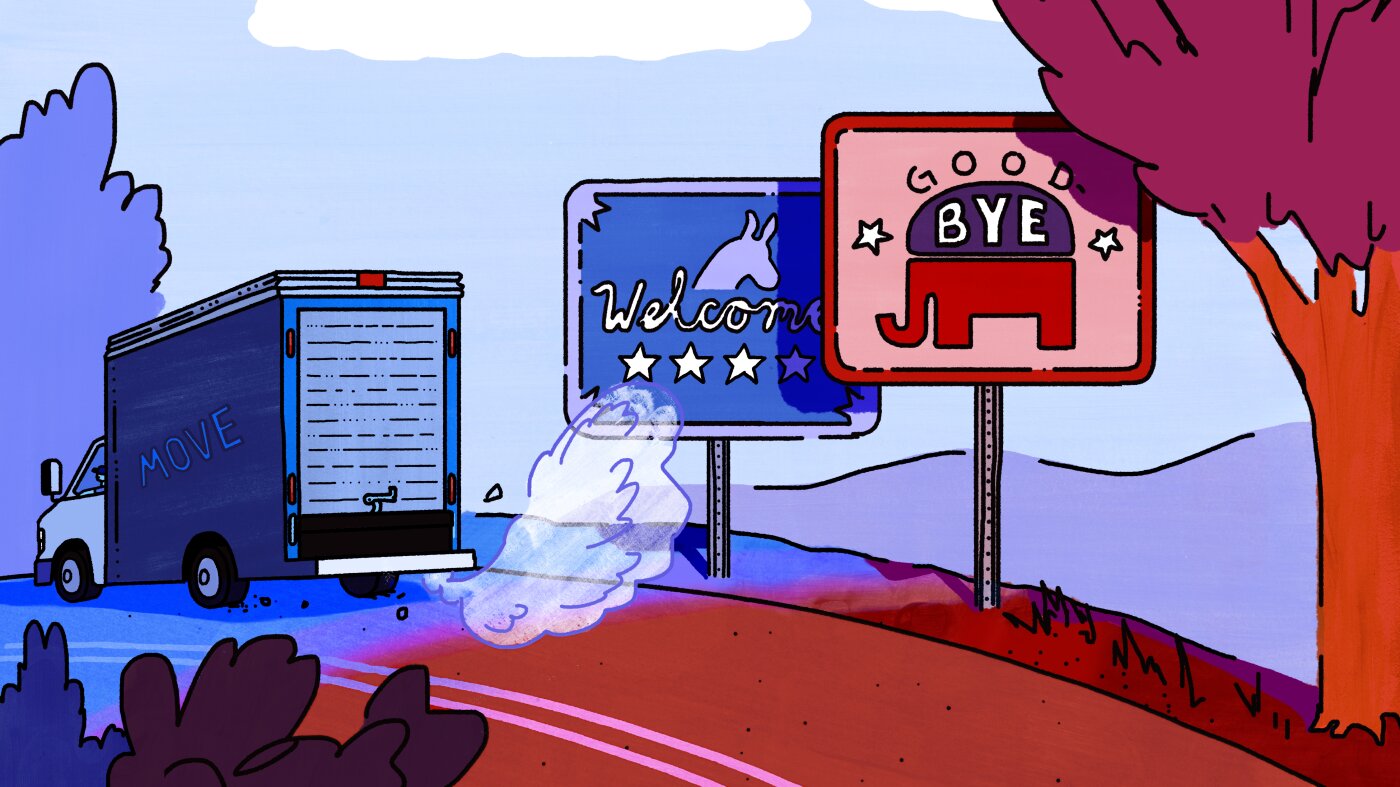
Davis’ case reflects what sociologists call “ideological sorting” — the tendency to choose communities aligned with one’s political and cultural values. Popularized in the 2008 book The Big Sort, it sets out to explain the widening divide between red and blue America.
In a country that’s growing ever-more polarized, the shifting demographics cut in both directions — and it is happening across the country. In one study from 2022, researchers concluded that “at no point since the Civil War have partisans been as clustered within individual states as today.”
Research in recent years, however, suggests that the story is more complex and nuanced — and that simply seeking out like-minded neighbors is more often than not just one factor among several driving the shift.
From blue state to red
As Davis and others arrive in Seattle seeking refuge from hostile laws and rhetoric, some of Seattle’s longtime residents, like Kirby Wilbur, have moved out, fleeing to conservative enclaves.
Wilbur also describes himself as a “refugee.” He relates an experience that is a virtual mirror image of Davis’. In Seattle, the local conservative talk show host — who also briefly served as Washington state Republican chair — felt like a stranger in a strange land.
As he neared retirement, he and his wife Trina began thinking about an escape plan. A friend told them about McKinney, Texas, a conservative Dallas-Fort Worth suburb. Wilbur had never heard of McKinney, but decided to have a look.
Kirby Wilbur, with wife Trina, in a photo taken last year.
Courtesy of Kirby Wilbur
hide caption
toggle caption
Courtesy of Kirby Wilbur
“There were like 3,000 square foot homes with a pool for $300,000,” he says.
In Texas, Wilbur met with Paul Chabot in 2020, who runs a specialty realty service, Conservative Move. Started in 2017, the company has helped thousands of people relocate from blue states to red states, Chabot says.
But the Wilburs still weren’t ready. Then came the 2020 George Floyd protests in Seattle. Kirby Wilbur says after the mobs, looting and vandalism, he and Trina had their own epiphany. “We looked at each other and said, ‘No, we can’t live this way. This is it.’”
Chabot, a retired U.S. Navy commander, says Wilbur — who has since become a part-time realtor with Conservative Move — is like most of his clients, who “feel like they can’t talk politics with people on their street.”
Conservative Move assists a lot of families with children who say they want a better quality of life for their kids — things like lower crime, stronger schools and lower taxes, according to Chabot. They also want to be somewhere they don’t feel judged for their political beliefs, he says.
“It’s not like people are leaving just because they hate Democrats. They don’t like Democrat policies, but they really feel like they’re alone, alienated, ostracized,” he says.
Chabot’s counterpart on the left is Bob McCranie. In 2020, McCranie started a web page called Flee Texas. “Very quickly… it got overwhelmed by people from all sorts of other places saying, ‘Oh my gosh, talk to me,’” he says.
As a result, he broadened the reach a few years later, launching Flee Red States. Since then, he says he has 40 closings related to the project and more than 875 people on a mailing list. He says he’s even helped people move out of the country.
McCranie says for some of his clients, the stakes are much higher than simply whether they can have a political conversation over the back fence. “People are moving because they don’t feel safe in their own state, in their own country,” he says.
For instance, some conservative groups are trying to overturn Obergefell v. Hodges, the U.S. Supreme Court’s landmark 2015 ruling that established same-sex marriage as a constitutional right. McCranie says some of his clients are wondering, “Where would we be safe as a couple and as a family?”
U.S. Census Bureau data for 2024 indicates that almost exactly as many people moved from Texas to Washington as went the other direction. However, a nationwide Stateline analysis paints a more one-sided picture. Republican counties, defined by the 2020 presidential election vote, gained 3.7 million people from mid-2020 to mid-2023, while blue counties lost the same amount — a time period that encompasses pandemic dislocations and lockdowns and the rise of remote work, Stateline notes.
But those broad trends can belie individual experiences. Rachelle Vega, interviewed last year by NPR, moved from Austin — widely considered the most progressive city in Texas — to Santa Fe, N.M., which has some of the country’s strongest LGBTQ protections. Vega wanted a more welcoming environment for her two adult trans children. In her new home, “There’s this sense of live and let live that is pervasive,” she told NPR.
This political sorting is not only occurring from state to state, but on a city, county and neighborhood level, according to Bruce Desmarais, a professor of political science and social data analytics at Penn State University. In a 2019 study, Desmarais and colleagues found that “people tend to be moving from one very sort of left-leaning city to the next” — like Vega — and the same is true, Desmarais says, for people moving from one right-leaning area to another.
Ticking the boxes beyond party affiliation
Take Stefanie Chiappetta’s experience. Four years ago, she and her husband, Samuel, moved from Middleborough, Mass., to Conway, S.C., and politics were the main reason.
In solidly blue Massachusetts, the town of Middleborough is an exception. It went for President Trump over Vice President Kamala Harris by a comfortable margin in 2024.
Chiappetta says “more conservative” was “box one” on her list when looking for a fresh start after retirement. Second was taxes. She and her husband had been paying nearly $7,000 a year in property taxes in Massachusetts, but in Conway, it’s a fraction of that, she says. The last important item was the weather. Chiappetta says she and her husband both have back issues. The cold weather “was making us more miserable,” she says.
Although Chiappetta puts politics at the forefront, her weighting of other factors illustrates a key caveat, says Steven Webster, an associate professor of political science at Indiana University.
“Americans do have a preference for living near co-partisans,” Webster, who has also researched ideological sorting, says. However, “things like the affordability of homes [and] living in a good school district far outweigh any explicit partisan-based motivation for choosing one location over another.”
The neighbor agreeing with you about President Trump is “the cherry on top,” he says.
Just as Chiappetta gravitated to a lower-tax city and state — which often tend to be conservative — “a Democrat might move to an area with good access to public transportation,” Webster says.
“While desiring access to public transportation may correlate with being a Democrat, one’s decision to move to that area is based [on] that desire rather than being with other Democrats,” he says.
“Places shape people more than people sort into places,” he concludes.
Political birds of a feather
Some researchers put more weight on party realignment — a long-term shift in the political landscape caused by voters changing their allegiances – than voter migration to explain the biggest share of the ideological sorting.
“Southern whites converted Republican, suburbs of major cities converted Democratic, and the political map redrew itself without most people moving,” notes Josh Zhang, an assistant professor of sociology at Stony Brook University.
In 2023, Zhang and colleagues published a study that looked at ideological sorting on a granular level. Using anonymized cell-phone data and other real-time information, they found that “people in heavily Democratic or Republican neighborhoods tend to visit places — religious institutions, schools, restaurants — whose other visitors lean the same way.”
James Henson, director of the Texas Politics Project at the University of Texas at Austin, points out that while the general trend is understood, “geographic sorting is rarely, if ever, going to be absolute. Despite aggregate sorting, there are always going to be individual exceptions in a given area.”
Despite Wilbur’s decision to move to be closer to fellow conservatives, he readily acknowledges that such ideological sorting is a negative for the country as a whole. “Nobody talks to each other anymore,” he says. The divisions in our political discourse have increasingly led to physical division, he says.
Davis is also concerned about “isolating ourselves in bubbles” and recalls the rare occasions when she was able to break through to someone in Odessa. She argues that physical sorting reduces those opportunities for connection.
“That’s the importance of being able to sit down with someone, share a beer in a dive bar in West Texas, and have a conversation about why I’m leaving — what’s happening, and why I feel I have to go.”