Lifestyle
'House of the Dragon,' Season 2, Episode 4: A dragon-drop interface


Ser Simon Strong (Sir Simon Russell Beale) and Daemon (Matt Smith).
Ollie Upton/HBO
hide caption
toggle caption
Ollie Upton/HBO
This is a recap of the most recent episode of HBO’s House of the Dragon. It contains spoilers. That’s what a recap is.
Credits! No additions to the “Die, You!” Tapestry this week, but dollars to donuts there will be next week, after the events that finish off this episode. Because: Sheesh.
Daemon – whom you’ll recall is currently staying at dark, decaying (and hella cursed) Harrenhal castle and attempting to build an army of Riverlords – is dreaming.
He’s dreaming of a dark and empty Great Hall in the Red Keep. He crosses to the Iron Throne, where sits a younger Rhaenyra (aka Milly Alcock). She descends the steps of the throne and accuses him of wanting to destroy her. This is all sufficiently creepy to dislodge the Perma-Smirk (TM) from Daemon’s face long enough for us to register his abject fear.

But then he resorts to old habits. In this example, “old habits” refers to “beheading someone at the foot of the Iron Throne,” a thing he did to Vaemond Velaryon last season. Young Rhaenyra’s head gazes up at him, telling him he got what he’s always wanted. She’s not wrong; her crown now lies at his feet. Then he wakes up, imagining for a fleeting second that his palm is smeared with blood.
I don’t love the show splitting Daemon off from the rest of the ensemble, and I don’t love this thuddingly literal “symbolic” dream stuff (blood on his hands, seriously?) but I do love Matt Smith finally getting to play any emotion besides sneering, omnidirectional disdain.
Ser Simon Strong informs him that Criston Cole has struck out from King’s Landing and taken the castles of House Rosby and House Stokeworth, and added their soldiers to his number. He wonders if they may be headed to Harrenhal (spoiler: They’re not headed to Harrenhal).
Daemon had hoped to meet with the Lord of the Riverlands, Grover Tully, but it turns out he’s on death’s door and ringing the doorbell like he’s a vacuum salesman with a quota to meet. House Tully has instead sent his grandson and heir Oscar, a stammering tween who is loath to take any action while his grandfather clings to life. (Yes, yes – Grover and Oscar. In the book, there are other Tullys named Elmo and Kermit. You get it.)
Corlys and his seamen
On Driftmark, Rhaenys shows up to the dock and casts an appraising gaze upon Alyn the sailor. She takes a particular interest in his cheekbones, so similar to the ones she sees across the dinner table every night. She tells Corlys that she knows who Alyn’s father is, and he doesn’t deny it. She then says she’s headed to Dragonstone because Rhaenyra’s missing (Again! Some more!) and her advisors are growing restless.
In King’s Landing, in the Red Keep, Alicent meets with Maester Orwyle, who supplies her with Moon Tea, a potion that aborts pregnancies. They both pretend it’s for an unnamed friend of Alicent. Alicent, succumbing to the doubts planted in her head after her wildly improbable plot-contrivance of a meeting with Rhaenyra last episode, asks him if Viserys really wanted Aegon to inherit the Iron Throne. Orwyle, sagely, pretends not to have any opinion whatsoever on the subject and gets the hell out of there so fast he practically leaves an Orwyle-shaped hole in the wall.
On Dragonstone, Rhaenyra’s advisors squabble over what to do about Criston Cole’s growing army, and its as-yet-unknown destination. The chief complainant here is Ser Alfred Broome (keep an eye on this guy), who promptly gets shut down by Corlys. With Rhaenrya still MIA, Rhaenys urges her fellow advisors to trust that she’s attempting to end the conflict.

Rhaenys (Eve Best) and Corlys (Steve Toussaint).
Ollie Upton/HBO
hide caption
toggle caption
Ollie Upton/HBO
Cut to: The conflict! Specifically, the walled port town of Duskendale, ruled by House Darklyn. Criston Cole, leading Aegon’s army, has sacked the town and littered the shore with many dead Darklyn soldiers. Cole summarily beheads Lord Gunthor Darklyn (who warns Cole that he will die in a similar manner; put a pin in that, too), cleans his sword with a cloth and tosses the cloth aside. And you thought they couldn’t make Cole any more of a jerk. Traitor, murderer … and a litterbug? Overkill! Also that haircut is still not doing him any favors.
He tells Gwayne Hightower that they will take their army northeast, along the coast – and not make for Harrenhal, after all. (Told you!)
At the Small Council, Aegon the Aess fumes, as is fast becoming his wont. He’s heard that Daemon has taken Harrenhal and is worried. Lord Larys Strong assures him that Harrenhal is a cursed place that will overpower Daemon and sap his will. Aemond, who’s been secretly trading raven-messages with Cole (DO U LIKE MY NEW HAIRCUT? CHECK ONE: __ YES __ NO), informs Aegon that Cole is marching on the small, poorly defended castle of Rook’s Rest, along the coast. If he takes it, snoots Aemond snootily, they will have seized all the coastline near the island of Dragonstone, meaning that Rhaenyra’s ships and armies will have to travel very far out of their way to land on Westeros.
Aemond then proceeds to throw some shade at Aegon, but is careful to do so in the language of High Valyrian, which the rest of the council seems not to understand. Aegon responds in kind, albeit in a halting, grammatically tortured manner. (A nice, small, characterizing touch.)
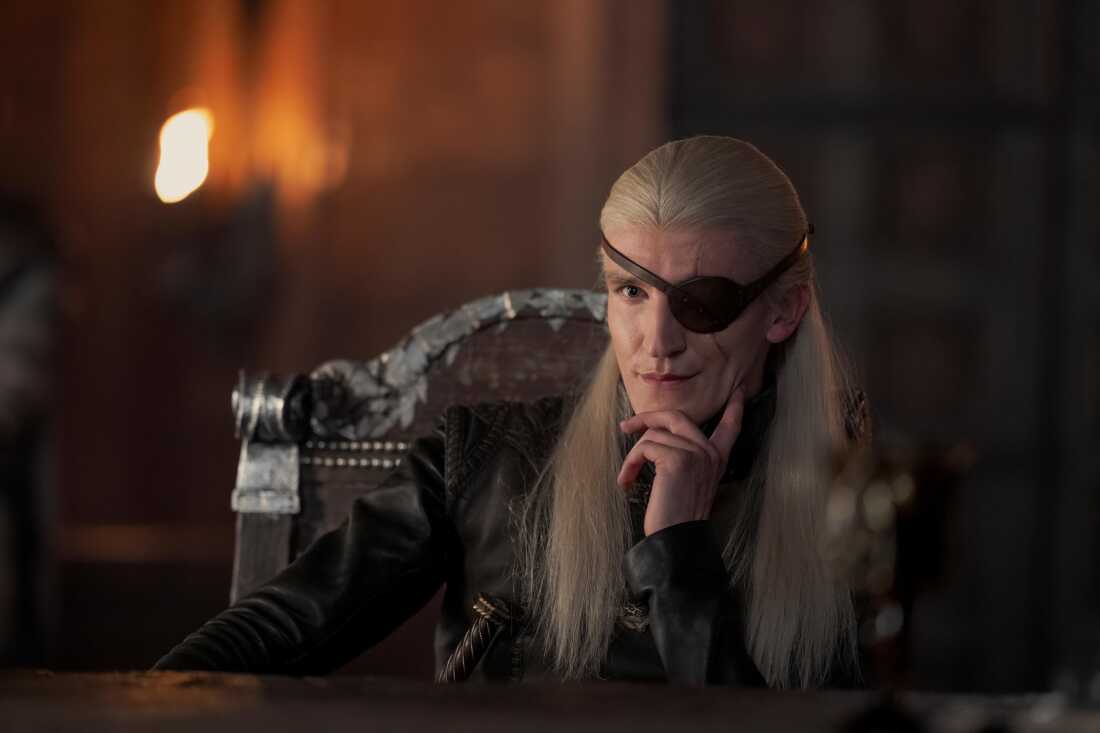
Aemond (Ewan Mitchell).
Ollie Upton/HBO
hide caption
toggle caption
Ollie Upton/HBO
Sir Larys visits Alicent to ask about her absence from the Small Council and, being Larys, quickly gets up to speed on absolutely everything going on with her, though she speaks to him only in empty platitudes. To wit, he 1. Sees the empty vial of Moon Tea – and her suffering its physical side effects, 2. Inquires after her feelings for Criston Cole, and reads the truth in her reaction and 3. Notices that she’s been reading the same tomes that Viserys used to obsess over and can tell she’s questioning her role in placing Aegon on the Iron Throne. He seems reassured when Alicent tells him that whomever Viserys intended to succeed him, it no longer matters. The die is cast, what’s done is done, you dance with the dragon what brought you, etc.
Murder and pestle
Back to Harrenhal, back to Daemon’s creepy ham-fisted dreams: He follows a figure through several hallways, until it finally stops and turns to him: It’s himself, wearing Aemond’s eyepatch. He’s then in a kitchen as Alys Rivers – the witchy woman we met last episode – is preparing a potion.
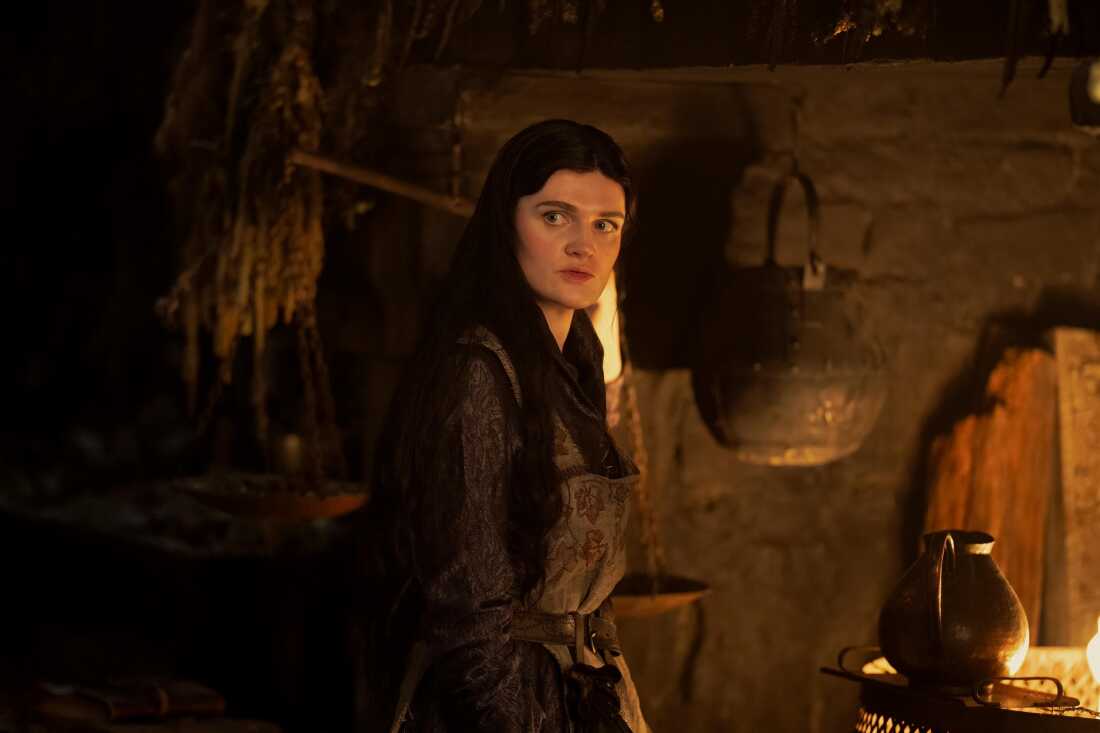
Alys Rivers (Gayle Rankin).
Ollie Upton/HBO
hide caption
toggle caption
Ollie Upton/HBO
She’s got Daemon’s number, all right. She tells him tales about the curse of Harrenhal, and mentions that she knows he fought with his wife, because he’s been at the castle for a while and sent no ravens back to her. Does he perhaps hope to raise an army to challenge her himself? Does he not resent her? Having successfully gotten under his skin, in his head – and under his lacefront – she gives him the potion she’s been preparing. To help him sleep, she says.
The next day, at a meeting with various Riverlords, Daemon is still guzzling down her goof-juice and is seriously tripping. Ser Willem Blackwood tells him he’ll join Rhaenyra’s army – but only if Daemon uses his dragon to reduce the Blackwood’s longtime rivals, House Bracken, to cinders.
But Daemon is miles away, hallucinating that a serving girl is his dead wife Laena.

At the Small Council in the Red Keep, Aegon gets fed up with all the talk of shrinking resources and the heroism of Criston Cole, who keeps scoring victory after victory and earning the sobriquet “Kingmaker” in the people’s eyes. He storms out and heads to his bedchamber, where Alicent is searching for Viserys’s old books. This kicks off a difficult but chewy conversation in which Alicent makes it plain that she, like her father Otto, sees Aegon for what he is, and is bitterly disappointed in him.
“You have no idea the sacrifices that were made to put you on that throne,” she tells him. She’s right, he doesn’t. But he desperately wants to be respected and now sees in the eyes of his mother, and in those of his Council, that it will never happen.
I really dug these scenes, because they efficiently set up the stupid, willful decision that Aegon’s about to make, but they don’t only do that. They also give us a peek inside Alicent’s head, as the story she told herself about Aegon, and about her own pure, noble intentions, continues to crumble.
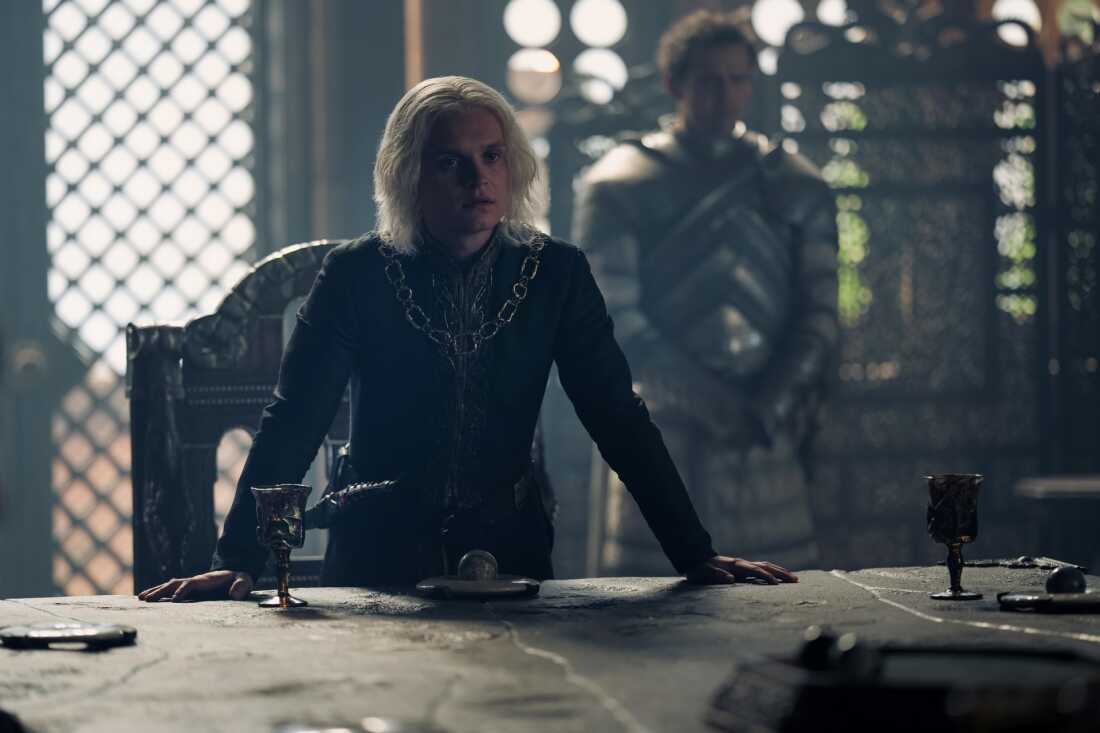
Aegon (Tom Glynn-Carney).
Ollie Upton/HBO
hide caption
toggle caption
Ollie Upton/HBO
In the woods near the castle of Rook’s Rest, Criston’s now sizable army prepares to attack. (Note: Rook’s Rest is the seat of House Staunton – and Lord Simon Staunton is one of Rhaenyra’s advisors around the Painted (But Not Actually Painted, Technically Glowing) Table.
Criston insists on advancing on the castle in broad daylight, something Gwayne thinks is insane, given the danger of Rhaenyra’s dragons. He’s not wrong, but there’s something Criston isn’t telling him – and, by extension, not telling us. This show loves its inessential mystery.


Queen Rhaenyra returns to Dragonstone and has to deal with a lot of butthurt white dudes, who, in their defense, react to her stealth mission to King’s Landing with the same angry incredulousness that I did. She apologizes for her absence (too quickly!) and explains (too patiently! She owes these jamokes nothing!) that she needed to know for certain that peace was no longer an option, and she knows that now. But she cautions them not to mistake her patience for weakness. (You guys? I think she’s talking to us.) She has decided to send a dragon to challenge Cole at Rook’s Rest.
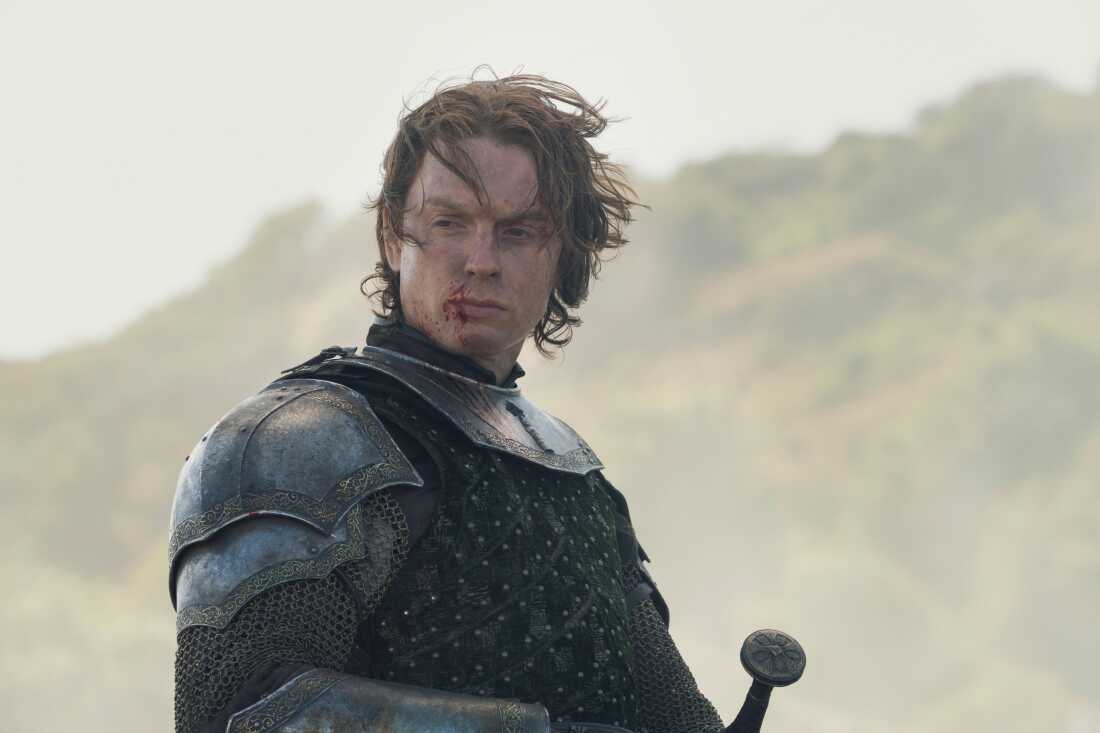
Gwayne Hightower (Freddie Fox).
Theo Whitman/HBO
hide caption
toggle caption
Theo Whitman/HBO
Her suggestion that she go herself, on Syrax, is shot down. She’s too important. Jacaerys volunteers to go, on Vermax. But no, he’s too inexperienced. Finally Rhaenys steps up, because of course my girl Rhaenys steps up. What could she do but step up? She’s Rhaenys.
Rhaenys will fly to Rook’s Rest on Meleys, the Black’s largest and most battle-tested dragon. The Goldilocks choice! Make way for Princess Rhaenys the Always Right about Absolutely Everything! Except This Decision She’s Making Right Now, Possibly!
A game of dunces and dragons
Pre-battle montage!
King’s Landing: A petulant, drunk King Aegon heads to the Dragonpit and mounts Sunfyre.
Dragonstone: A badass, confident, grimly smiling Princess Rhaenys heads to the Dragon…dock(?) and mounts Meleys.
Rook’s Rest: Cole’s army approaches the castle, some 1500-men strong.
Meanwhile, Rhaenyra tells an impatient Jacaerys about the secret that Viserys passed down to her: Aegon the Conqueror’s dream, the Song of Ice and Fire, the prophecy of the Prince that was Promised, and how you just have to gut out those last coupla seasons because you can tell they’re rushing things to get to the end oh and don’t get me started on that whole “And who has a better story than Bran the Broken?” nonsense. We cut away before Jacaerys has a chance to ask her if his cable package includes HBO, does that mean he has MAX too, or …?

The attack on Rook’s Rest is on: Cole’s army advances, while the castle’s archers proceed to turn them into so many of your nana’s tomato pincushions.
But then the cry goes up: Dragon! Specifically, Meleys, with Rhaenys the Badass on her back. They proceed to turn a few of those tomato pincushions into flame-roasted tomato pincushions.

Gwayne Hightower (Freddie Fox) and Criston Cole (Fabien Frankel).
Theo Whiteman/HBO
hide caption
toggle caption
Theo Whiteman/HBO
Gwayne snaps at Cole in a very “I told you so” manner, which is not a good look on him. But Cole sends up a signal – a series of soldiers tootle on a series of horns. It’s no lighting the beacons of Gondor, but it suffices. A few miles away, Aemond, mounted on Vhagar, hears the battle-toots and prepares to take off – but before he can, King Aegon flies overhead astride Sunfyre. (This is accompanied on the soundtrack by an effect that sounds an awful lot like “Wheeeeeee!” which I hope is Sunfyre and not Aegon but I am not entirely convinced of that.)
This angers Aemond, and, for reasons of his own, he decides to hold off on entering the fray. He tells Vhagar to chill, and the dragon sullenly flumps his head down onto the forest floor and heaves a big sigh like a yellow lab when you stop throwing the tennis ball.
The confrontation between Rhaenys/Meleys and Aegon/Sunfyre is nasty, brutish and short. Sunfyre lights Meleys up with dragonbreath, and then Meleys tears into Sunfyre’s flesh with her huge talons. And teeth. And probably whispers some really vicious, cutting insults into Sunfyre’s ears while she’s at it. Point is: Meleys and Rhaenys are winning the day.

But just then, Aemond shows up, astride Vhagar – and Vhagar is older and meaner and bigger than the other two dragons, who currently are locked in combat above the battlefield, combined. At first, Aegon is heartened by this, but quickly realizes that Aemond is just going to have Vhagar dracarys the hell out of both he and Rhaenys at once. Which means Aemond could defeat the enemy and take the crown in one fell-beast swoop.
Vhagar breathes fire, and Sunfyre takes the brunt of it. He and Aegon tumble into the nearby forest; a worried Criston Cole takes off to help his dumbass king.
As for Rhaenys and Meleys? They’re fine, but you knew that. Oh sure, Rhaenys’s platinum-blonde Edgar-Winter-is-Coming wig got a bit singed, but it’s Rhaenys, so it looks damn good on her. She begins to retreat from the battle, but looks back at Vhagar. We can assume she hears Daemon’s words from the season premiere – how they’d need two dragons to challenge Vhagar.
But Rhaenys gonna Rhaenys; she and Meleys turn and face Vhagar and Aemond head-on.
It, um, doesn’t go well. Vhagar grabs Meleys in her claws and proceeds to brulee the smaller dragon’s creme. They tumble into the battlefield, taking out many soldiers as they do. Cole falls off his horse and passes out.
Vhagar gets up and takes off, Godzilla-ing much of Cole’s army under her talons as she goes.
Meleys is still airborne, though; she and Rhaenys survey the carnage and look for Vhagar, who has somehow vanished, despite being the size of a super-yacht. There’s a fun moment when Meleys looks back at Rhaenys; dragon and rider exchange a look of, “I got you, girl.”
But alas: As Meleys and Rhaenys fly above the castle, Vhagar swoops up and clamps Meleys’s neck in her jaws. The two dragons and their two riders soar higher, and then Meleys’s neck snaps. Vhagar lets go and flies away, as Rhaenys falls back earthward, staring down the barrel of the camera all the way. (If she’s gotta go out, I suppose there are worse ways to go out than to Hans Gruber it.) As they crash into the castle’s courtyard, Meleys explodes, which is not a thing I knew dragons did, but I probably should have guessed.
Cole awakens on a field of battle that looks like a vast plain of blackened chicken. He sees that what’s left of his army is winning the day by invading the castle through the new, Meleys-shaped breach in its walls.
He resumes his search for Aegon, and at one point tries to get a soldier to help him, but the soldier has been reduced to ash. Cremains of the day joke goes here.
Cole finds a gravely wounded Sunfyre, and also finds Aemond, who’s advancing on his older brother’s dragon with his sword drawn. Cole shouts at him, and Aemond stops. He kneels and picks up Aegon’s dagger (yes, that same damn dagger again, you know the one, the Forest Gump of Westeros, I don’t have to go into it all again, do I?).
When Cole gets a little closer, he sees the (possibly lifeless) body of Aegon lying beneath Sunfyre. Meanwhile, Aemond saunters out of frame in a very self-satisfied “Welp, my work is done here; gotta be hitchin’ a ride on the wiiiiind” sort of way.
Parting Thoughts
- Join in me pouring out a few shots of Alys Rivers’ goof-juice for our gal Rhaenys. Rhaenys, the Queen Who Never Was But Damn Well Should Have Been And So Would Have If It Hadn’t Been For The Patriarchy. Rhaenys the Always Right. Rhaenys Whom You Should Have Listened To All Along. Rhaenys Who Made The Silly Wig Work For Her. Rhaenys, My Queen.
- Another couple shots for Eve Best, who was never given enough to do, but did what she did with steely eyed intelligence and tremendous authority. With her loss, the show suffers a considerable hit, both in terms of its cast and its characters. Best gave a standout performance – but Rhaenys was the only character who talked sense to Rhaenyra and Corlys. With no Otto for the Greens, or Rhaenys for the Blacks, Westeros now suffers from a dearth of grownups.
- Never a fan of dramatizing dreams, in fiction. It’s a crutch. Too often they’re used like a cheat-code to “reveal” a character’s thoughts, anxieties, obsessions, fears, etc. And just as often, they don’t actually reveal much. Did we need to see Daemon pop off young Rhaenyra’s head to understand that he’s ambitious? We did not. (But I suppose a case could be made that what Daemon’s dreams do reveal is that he’s feeling guilty about it all.)
- I like Alys Rivers. I am not alone. She’s a survivor, that one.
- Still loving Sir Simon Russell Beale as Ser Simon Strong! I like how pays due deference to Daemon, but he’s no lickspittle. Dude’s got some dignity, some gravitas.
- Next week: Dragon recruiting drive! Semper fi-re! The few, the proud, the Meereen!


Lifestyle
A meal with an animated Mona Lisa? Immersive dining goes high tech — but will L.A. eat it up?

My dinner course is served. It is a Campbell’s-inspired soup can, lightly angled so strands of broccoli are peeking out. I lift the can to uncover a slow-braised short rib and mashed potatoes. An American dish to represent an American artist, here Andy Warhol.
The room is overtaken with projections, scenes of bustling New York traffic paired with bachelor-pad-like guitar riffs. Shown on a wall above a dinner table is a selection of Warhol silkscreens. It’s a Friday night in West Hollywood, and I’m surrounded by a mix of out-of-towners and those celebrating an anniversary. And while this is a special occasion, we’re urged to get a little messy with our food — to use our hands, to paint with a salad, to draw on a cookie.
The main course: A tomato soup can? “7 Paintings” is an immersive event that occasionally hides dishes in artist-inspired presentations.
(Christina House / Los Angeles Times)
Play is the primary side dish at “7 Paintings,” a tech-infused dinner theater that aims to be a crash course in fine art. That selection of veggies paired with multiple mini cups of colorful dressings? Guests are encouraged to mix and match the vinaigrettes into a mess of hues, a nod to abstractionist Jackson Pollock. And yellowfin tuna with dashes of avocado and taro chips? That’s an edible tribute to Banksy, of course. What does raw fish have to do with stenciled street art? It’s bold, heavily angled and has a short shelf life? Maybe? Perhaps don’t overthink it.

Even the paper is edible.
(Christina House / Los Angeles Times)
“Have you ever eaten a painting before?” says Nadine Beshir, the Dubai-based creator of “7 Paintings.” “We try to get people out of their comfort zones and eating paper. I want to bring out the child in them.”
“7 Paintings,” held at Sunset House L.A. through the end of August, is the latest example of immersive dining to arrive in this city. These experiences often involve guest participation and are accentuated with advanced multimedia technology and sometimes theatrical elements.
Worldwide, there have been standouts. For instance, Eatrenalin at Germany’s Europa-Park, a dining room-meets-ride where participants are whisked around the space on trackless “floating chairs,” has just received a coveted Michelin star. Ibiza’s Sublimotion has similar haute ambitions, pairing 12 diners together in a room that will come alive with otherworldly projections and performers. At times, diners will win don virtual reality headgear.
But tech-driven immersive dining experiences have never quite taken off in Los Angeles as a trend. Last year, the Gallery, where fantastical cityscapes and projections surrounded downtown L.A. diners, stood just a couple months before the concept was abandoned.

“7 Paintings” pairs food with art and music. It’s “fun dining, not fine dining,” says its founder.
(Christina House / Los Angeles Times)

Bartender Luca Famulari shakes a cocktail at the immersive dining event.
(Christina House / Los Angeles Times)
“The economics of a restaurant are not the same as the economics of theater and the challenge of combining the two lies in thinking outside the box with respect to pricing and cost structure, such that the customer perceives high value from both the food and the experience,” says the Gallery co-founder Daren Ulmer.
Entrepreneurs keep aiming for that careful balance. “Le Petit Chef and Friends” is currently running at Tangier at downtown’s Hotel Figueroa, an event in which a fully animated film is projected on our plates and tables. Long-running pop-up event Fork N’ Film leans more dinner and movie, pairing dishes directly inspired by what is happening on screen. Upcoming films include “Ratatouille” and “Lilo and Stitch.”
The field comes with challenges. “The costs are very high,” says Joanna Garner, an immersive designer and former creative director with experiential art firm Meow Wolf. Garner has been experimenting herself with communal, immersive dinner events, and her next, the flirtatious “Please Open Your Mouth,” is set for July 11. (No tech there, as Garner is after a more sensual, adult-focused gathering.) Tickets for her event are $150 and a spot in the “7 Paintings” dining room runs $175, priced on par with a number of city’s most acclaimed restaurants.
There is also the reality that all public dining is in some fashion immersive, usually requiring varying combinations of engagement, communication and presentation. And then, are all these added elements distracting?

An animated Mona Lisa sits on the wall as guests enjoy their meals. Throughout the dinner, the painting provides factoids on various artists.
(Christina House / Los Angeles Times)
Throughout “7 Paintings,” for instance, an animated Mona Lisa, situated on the wall next to the main dinner table, will provide brief biographical details of each artist represented.
“Being able to nail the food, and nail the story, those are two very difficult threads to weave,” Garner says. “I do think, ultimately, people come to a dinner table to talk to the people at the table and to have intimate experiences. To have an experience where you’re constantly being taken away from the food, I’m not so sure if that’s what people are looking for.”
Food is framed as a star of “7 Paintings” but tasting it is just one component. At one point, we must uncover a cheese course in a tiny treasure chest, the code for the lock hidden in the projections (don’t stress, it’s not a hard puzzle). Beshir highlights the Pollock-inspired salad course, which is accentuated with a jazz soundtrack, as the thesis of the evening.
1

2

1. A guest uses a silicon brush to apply sauces onto an entree, a nod to abstractionist Jackson Pollock. 2. Projections fill up the dining table during meals.
“This course is really about getting people to free their minds from preconceived ideas,” Beshir says. “Like, you have to eat with a fork and knife, or the salad comes and then the dressing. No, the dressing comes and then the salad, and it’s trying with big brushes to paint the way he did. A lot of people do not understand Abstract Expressionism, and they think it’s people just splashing colors around. But when you understand the link between the rhythm of the music and painting, you live it. We give you time to paint with your salad dressing.”
In L.A., Beshir has partnered with nightlife impresario Kim Kelly, who is plotting a “Sleep No More”-inspired walk-around theatrical show for the Sunset House venue later this year. “7 Paintings,” however, is fully seated, and purposefully a little silly. Beshir and Kelly have been evolving it during its L.A. run, recently adding a stronger painting component by giving guests their own canvas to work on throughout the evening. Each night crowns a winner.
“Everyone comes over to look at their art,” Kelly says. “It just kind of changed the whole thing, to be honest. People are now being creative throughout the entire evening. Instead of just watching and occasionally painting, you’re now painting the whole time.”
As for what, perhaps, soba noodles with edamame and mushrooms have to do with Pablo Picasso, or why Salvador Dali gets an unexpected dessert course of a white chocolate potato souffle, Beshir clarifies the goal of the evening. While the animated Mona Lisa will provide backstories on each painter, this isn’t an educational night. “It’s fun dining, not fine dining,” Beshir says.
And by the end of my night, strangers were socializing, showing off their painted cookie creations, sharing Banksy tidbits and asking for recommendations on various vinaigrette combinations. Ultimately, it’s an evening of discovery, packed with surprises like finding an entire course hidden under a canvas.

Darryl Mayes of Charlotte, N.C., left, and Taylor Smith of North Hollywood, right, uncover their course.
(Christina House / Los Angeles Times)
“We try not to have too much sophistication, like fried ants or something. I’m personally very adventurous in how I eat, but if I want to have this in 100 cities around the world, I cannot be too meticulous.”
And Beshir has big goals.
“I want this be your movie and dinner thing,” Beshir says. “I want people to be waiting for our next show, and to be able to afford to come every couple months.”
And to come home not with leftovers, but perhaps a painting of their own.

Matthew Rhys was nominated for his role in Widow’s Bay.
Apple TV
hide caption
toggle caption
Apple TV
The 2026 Emmy nominations are here. We’re unpacking the record-breaking nominations for Hacks, plus a big day for Widow’s Bay, The Pitt, and The Bear. We’ll also talk about the snubs and make some early predictions of who will win.
Connect with Pop Culture Happy Hour:
Letterboxd / Facebook
Our weekly newsletter
Support Pop Culture Happy Hour+

-

 Technology2 minutes ago
Meta is reportedly working on smart glasses that would be recording all the time
-

 World9 minutes ago
Trump says ‘Iran lies and cheats’ as IRGC emerges as dominant force in negotiations with US
-

 Politics12 minutes ago
Who is Valli Geiger? Meet the Maine Dem that Platner urged to run for Senate
-

 Health17 minutes ago
Deadly Legionnaires’ disease outbreak sparks concern in major US city: Know the symptoms
-

 Sports24 minutes ago
Caitlin Clark’s return falls flat after Fever coach limits her in loss to shorthanded Sparks
-
Business32 minutes ago
Commentary: Trump wants to let companies make fewer disclosures, thus keeping investors in the dark
-
 Entertainment39 minutes ago
Justin Baldoni and wife break silence after ‘It Ends With Us’ legal battle with Blake Lively
-
Lifestyle42 minutes ago
A meal with an animated Mona Lisa? Immersive dining goes high tech — but will L.A. eat it up?

