Plus special access to select articles and other premium content with your account – free of charge.
By entering your email and pushing continue, you are agreeing to Fox News’ Terms of Use and Privacy Policy, which includes our Notice of Financial Incentive.
Please enter a valid email address.
A dozen employees said they watched a “large, disc-shaped craft” hover above a Colorado concert venue and then vanish.
“What’s even crazier is that as soon as we all started noticing it and stopped what we were doing to pay attention to it, the craft tipped at an angle and slowly started moving belly-first to the east,” an employee reported to the National UFO Reporting Center about the June 5 sighting at the Red Rocks Ampitheatre in Morrison.
Advertisement
“Then it started fading away until it was invisible. It didn’t shoot off into the distance. It simply dissolved into the ether. We all watched it vanish.”
The “silent” hovering object was long – about the size of a “three-story office building” – with three levels of windows and lights, according to the National UFO Reporting Center.
ALIEN VIDEO SHOWS AT LEAST 2 ‘BEINGS’ USING ‘CLOAKING’ DEVICE: ‘I’M OPENING IT UP TO PEER REVIEW’
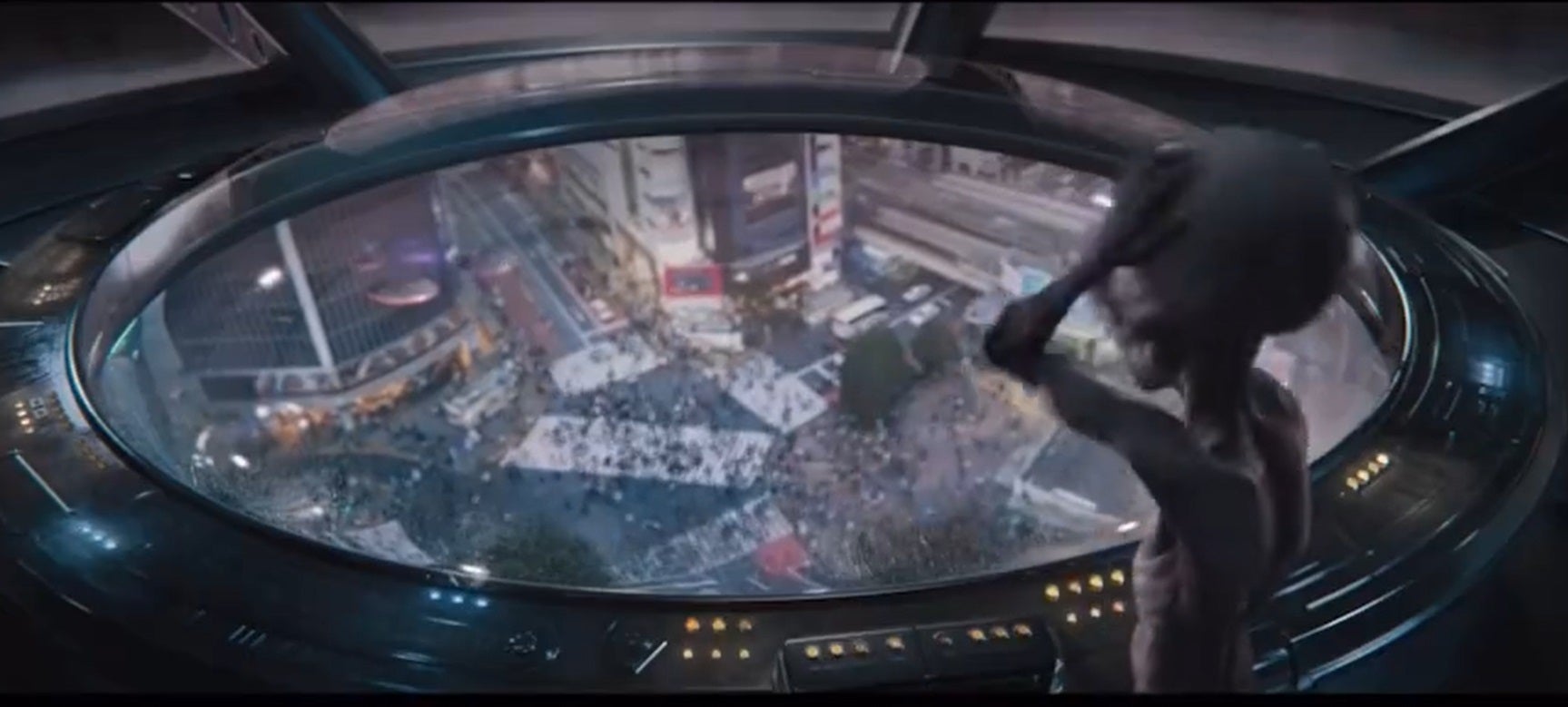
Part of the UFO Super Bowl commercial shows an alien watching humans on Earth.(Squarespace)
“One of our coworkers suddenly said to us, ‘Hey, what is that over there? It looks like a spaceship,’” the anonymous reporting employee wrote.
Advertisement
ALIENS ‘TRY TO STAVE OFF PESKY HUMANS’ IN WILD VIDEO: ‘WHAT ARE THEY DOING HERE?’
“We all turned to look in the direction he was pointing and sure enough, there was a UFO hovering about half a mile to a mile north of Red Rocks.”
They all turned their attention to the strange object in the sky, and it suddenly “fade(d) into nothing as soon as it knew it was being watched,” according to the National UFO Reporting Center post.
Employees at Red Rocks Ampitheatre reported seeing a hovering craft.(iStock)
That’s when it “simply dissolved into the ether.”
Advertisement
“A dozen of us saw it. We all kept asking each other, ‘Are you seeing this too?’ It was a resounding, ‘Yes,’ from everyone in the group,” the worker wrote in the post.
ALIEN VIDEO SHOWS AT LEAST 2 ‘BEINGS’ USING ‘CLOAKING’ DEVICE: ‘I’M OPENING IT UP TO PEER REVIEW’
“This was not a plane. It wasn’t a satellite, a drone, or anything like that. There was no mistaking what this was.”
The way it appeared to “simply dissolve into the ether” is similar to a potential alien encounter reported last April in Las Vegas, when “beings” seemingly vanished.
Scott Roder, a veteran crime scene recreation expert, used artificial intelligence and computer software to break down a short video to prove there’s movement and at least two “beings” in the Las Vegas alien video, which has been debated.(Jim Quirk/QuirkZone on YouTube)
Advertisement
Scott Roder, a veteran crime scene reconstruction analyst, broke down the Las Vegas witnesses’ video and outlined two “smokey filters” that didn’t match the background.
He theorized that “the beings” used some sort of “cloaking mechanism” to “shield” themselves from the curious family and, later, responding police officers.
WATCH: CRIME SCENE RECREATION ANALYST BREAKS DOWN REPORTED ALIEN SIGHTING
In one second of real time, there are 30 frames that show a “head… with smoke around it,” which Roder called “some sort of cloaking device,” moving into the top right corner of the video and peering over the fence.
Advertisement
“I applied the same principles that I would apply to any kind of homicide investigation,” said Roder, who testified in cases like Oscar Pistorious’ murder trial.
“At this particular time, with what we’ve seen here, is proof of a couple of things. That these entities… are real. They’re there. This is not fake. This is not a fraud.”
A crime scene recreation analyst breaks down a video of a reported alien in Las Vegas and outlines where he said “there’s no doubt” two creatures appear.
There are believers, skeptics and people on the fence about extraterrestrial life, but there’s a growing interest in UFOs, or UAPs (unidentified anomalous phenomena), as they’re referred to today.
Roder worked with Jim Quirk, a reporter who runs the Extraterrestrial Reality podcast and who shared videos and images with Fox News Digital, to recreate the scene in the Las Vegas backyard on April 30, 2023.
Advertisement
Roder wants to open it up to “peer review.”
“Bring it on,” he said.
“I want to open this up. Everything that we’ve done. I’m opening it up for peer review… I’m willing to hear what professionals in my field have to say about this and open it up. And if I’m wrong, you know, I’ll admit it,” Roder said, although he’s certain he’s right.
“These two items, these two beings, are in the real world environment with the Kenmore family. That’s a fact,” Roder said. “Now the question is, Who are they? Where are they from and what do they want? That’s where the conversation goes.”
LAS VEGAS, N.M. — The approaching desert dusk did nothing to settle Travis Regensberg’s nerves as he and a small herd of stray cattle awaited the appearance of a state livestock inspector with whom he had a 30-year feud.
This was Nov. 3, 2023, and, as Regensberg tells it, the New Mexico Livestock Board had maintained an agreement for almost a decade: Livestock Inspector Matthew Romero would not service his ranch due to a long history of bad blood between the two men. False allegations of “cattle rustling” had surfaced in the past, Regensberg said.
A dramatic standoff that evening, caught on lapel camera video, shows Regensberg at the entrance gate of his ranch. Defiant, Regensberg says anyone but Romero can pick up the stray cattle he had asked state livestock officials to pick up earlier in the day. Romero, who is backed up by two New Mexico State Police officers, directs Regensberg to open the gate or he will be arrested.
Advertisement
“You guys can send somebody who is not Matthew Romero,” Regensberg says in the video, which The New Mexican received through a public records request.
Then-New Mexico Livestock Board Deputy Director Darron “Shawn” Davis can be heard in the video during a call on Romero’s phone, saying, “Matthew, go ahead and arrest Mr. Regensberg for obstruction.”
Regensberg, a contractor and rancher, filed a civil rights lawsuit in February against the New Mexico Livestock Board, Romero and Davis, alleging an “appalling misuse” of power from the state agency. Initially filed in the state District Court in San Miguel County, the suit has been moved to U.S. District Court.
Advertisement
Travis Regensberg, rancher and contractor, practices his throw on a roping dummy in his barn in Las Vegas, N.M., on Feb. 17, 2025.
Gabriela Campos/The New Mexican
Regensberg, 60, maintains the incident that evening and the criminal charges later filed against him marked a “conspiracy” on the part of state livestock officials to use the weight of the agency to ruin his reputation amid a long-standing grudge held by Romero.
Advertisement
The District Attorney’s Office in San Miguel County filed criminal charges against Regensberg after the incident, although he was not arrested that night. The counts included unlawful dispossession of animals, livestock running at large and use of a telephone to intimidate and harass — all of which were dismissed “with prejudice,” meaning prosecutors could not refile them, in late 2024. An unlawful branding charge also did not stick.
Regensberg’s suit asserts the board pursued charges of cattle dispossession against him, even though he had called livestock officials and told them to pick up the stray cattle that had wandered onto his property. It says the agency also pursued a charge of cattle running at large, after state officials left a gate open on his property, allowing some of his own cattle to get loose that night.
Romero and Davis both declined to comment on the case.
Davis said he retired in July after 25 years with the agency, noting his retirement was unrelated to the case.
Romero has also retired from the agency; the livestock board did not answer a question about whether his retirement had any connection to the lawsuit.
Advertisement
Legal counsel for the defendants filed a 30-page motion Feb. 16 seeking to dismiss the case, arguing the defendants had cause to charge Regensberg.
“In this view, Plaintiff appears to argue that his history of conflict with Defendant Romero legally permits him to obstruct the performance of Defendant Romero’s duties. No facts support that this unlawful obstruction was anticipated,” the motion states.
“Just like any individual would not be able to choose which [state police] officer could pull them over for a traffic infraction, Plaintiff is not allowed to unilaterally decide which [livestock] Inspector would show up to a call,” the motion continues.
Unlawful impound?
The dislike between the two men evidently started when they were teenagers or in their early 20s. The suit states the pair had once shared rides to bull-riding events at rodeos, but the relationship soured when Regensburg made a certain pointed comment to Romero.
Advertisement
The lawsuit lays out subsequent flare-ups between the two men, including at a Wagon Mound rodeo and at a state park in San Miguel County where Romero was working as a ranger.
A small herd of Travis Regensberg’s cattle eat feed on his property in Las Vegas, N.M.
Advertisement
Gabriela Campos/The New Mexican
Belinda Garland, executive director of the New Mexico Livestock Board, declined to comment on the case.
“This matter is currently before the courts,” she wrote in an email. “Out of respect for the legal process, we cannot comment further. We intend to vigorously defend against the allegations and are confident in our position.”
State police officers were able to defuse the situation that night and convince Regensberg to let officials onto his property after they promised to manage any conflicts between him and Romero.
Advertisement
Someone left a gate open when they entered, allowing about 20 of Regensberg’s cattle to escape. All of those cattle were gathered back onto his ranch, except for a steer.
He alleges state officials later impounded the steer and sold it for just $75 at the Belen livestock auction without telling him.
In the motion to dismiss the case, lawyers for Romero, Davis and the livestock board say officials had informed Regensberg earlier in the day the cattle belonged to a neighbor.
“Plaintiff refused to allow [his neighbor] to pick up the cattle and demanded that NMLB come get the cattle, even though he was told that the cattle were [his neighbor’s] cattle by a NMLB Inspector,” the motion states. “Plaintiff fed and watered the cattle, without consent of the owner.”
Regensberg said he did not turn the cattle over to his neighbor because the receipt his neighbor presented to him from a Valencia County livestock auction showed they had been purchased at 2:56 p.m. that day, while the stray cattle had turned up on his property that morning.
Advertisement
“The invoice shown to him was for cattle purchased only minutes earlier at location more than a two-hour drive from Regensberg’s ranch in Las Vegas,” his lawsuit says.
Legal counsel for the livestock board have offered up a different narrative.
“By refusing to allow Defendant Romero on his property, and by knowingly herding, locking away, feeding, and watering [his neighbor’s] cattle, there was more than enough probable cause to charge Plaintiff with unlawful disposition of an animal,” states the motion to dismiss.
“I’m just going to go with obstruction, failure to comply,” Romero says in the lapel camera video, talking to two state police officers about Regensberg, who by that time in the evening had gone into his own residence on the property. “I can get him on unlawful impound, too.”
The history
Advertisement
What occurred Nov. 3, 2023, could have been a fairly routine job for state livestock agents, according to the lawsuit. Stray cattle had wandered onto Regensberg’s land that morning through a gate opened by a family member who had driven onto his property.
Regensberg, the suit states, herded the strays into an enclosure around 11:15 a.m. and then called a state livestock inspector to remove the animals, following what he believed to be correct protocol.
Eventually Regensberg, according to the lawsuit, fed the cattle as the day lengthened and as no state inspectors had come to remove the animals. Regensberg was told Romero was the only agent available to get the stray cattle, even as he insisted the agency send someone else.
Advertisement
Travis Regensberg takes a bag of feed out to his cattle followed by his dog Rooster in Las Vegas, N.M., on Feb. 17, 2025.
Gabriela Campos/The New Mexican
The suit states Romero had previously accused Regensberg in a 2014 lawsuit of threatening to kill him, so Regensberg was concerned Romero would try to shoot him that night.
Advertisement
In the late 1980s or early 1990s, according to the lawsuit, Regensberg was riding a motorcycle on a park roadway heading to a July 4 family gathering when he was stopped by Romero, who told him motorcycles were prohibited from the park and he would have to leave. Regensberg sought to explain he was on his way to a family gathering and would only ride on the road.
“Romero flared, insisting Regensberg’s motorcycle was prohibited and demanded he leave the Park,” the lawsuit says. “Regensberg left, which meant he missed the family gathering. After becoming a livestock inspector, Romero began confronting and harassing Regensberg at various events.”
‘A matter of principle’
It is not the first such lawsuit the agency has recently faced.
A suit filed in a little over a year ago in state District Court by Mike Archuleta, a Rowe cattleman, accuses the board of violating his civil rights by relying on false accusations made by a Texas-based rancher as the basis for seizing five unbranded calves from their home in 2023 and selling them at auction before the couple could prove through DNA testing the animals belonged to them.
Advertisement
Travis Regensberg gathers his rope while practicing his throw on a roping dummy in his barn in Las Vegas, N.M., on Feb. 17, 2025.
Gabriela Campos/The New Mexican
Advertisement
Regensberg, a team roper, reflected on how the whole affair has hurt his reputation in the small communities where he has spent his whole life.
He thinks the power of the state should not be used to settle what is, in his view, a personal score. Bringing feed pelts out to the pasture on a recent day — the wind tearing across the landscape and tearing at his clothing — Regensburg said he had to sell about 30 head of cattle just to pay legal fees.
“It’s about accountability,” he said of the lawsuit. “It’s a matter of principle.”
PORTLAND, Ore. (KATU) — A member of Oregon’s Iranian community on Monday reacted to American and Israeli strikes in his home country and the death of Iran’s supreme leader over the weekend.
That reaction came as the conflict in the Middle East expanded into a third day. President Donald Trump indicated it could go on for several weeks.
Amin Yousefimalakabad says right now he is concerned about his family, who he says lives near military bases in Tehran, the capital of Iran.
He described businesses with shattered windows and explosions near his family’s home.
Advertisement
At the same time, Yousefimalakabad says he felt relief learning about the killing of the ayatollah.
He says he fled Iran four years ago after facing political persecution.
“I used to be a political prisoner in Iran. I got arrested in one of the protests that happened in Iran, and I was under torture for two weeks,” he said in an interview with KATU News. “They put me in prison for six months. I had, even when I was thinking about those days, it made my body shake from inside because I didn’t deserve that. I just wanted the first things that I can have in a foreign country like America in my country. I wanted freedom. I wanted to have freedom of speech, freedom of religion, to choose who I want to be.”
Meanwhile, Yousefimalakabad says he still can’t return to Iran, fearing he would be punished for his Christian beliefs and says although the regime could change, the ideology in Iran might not.
SALT LAKE CITY (KUTV) — The 2025-2026 winter season isn’t quite over, but it’s no secret that it’s been a rough one when it comes to snow. Right now, statewide snowpack numbers are hovering around 60% of the median.
But you don’t have to know those numbers to understand what a strange winter it’s been.
“It’s kind of good,” said Carrie Stewart, who lives in Salt Lake City. “I mean, I like it because I like a milder climate. But I realize this summer is going to be hard.”
MORE | Snowpack
“I’m not sad I’m not shoveling,” said Sally Humphreys of Salt Lake City. “But it’s definitely worrying.”
Advertisement
State water officials are also worried. The clock is ticking to bulk up those snowpack numbers.
“We’re running out of time to get the snowpack that we need,” said Jordan Clayton, supervisor of the Utah Snow Survey. “We have about 40 or so days until our typical snowpack peak.”
There is still some time to make up lost ground, but the odds aren’t great. Clayton estimates a 10% chance of reaching normal by the end of the season.
“Those are terrible odds,” he said.
In fact, the odds of having a record low snowpack are greater, sitting at 20%. It’s a grim reality that has officials looking toward the summer anxiously.
Advertisement
“I would expect to see watering restrictions outdoors for a lot of places,” said Laura Haskell, Utah’s drought coordinator.
It’s unknown what the next few weeks will bring, but if Haskell had to guess, she doesn’t see state reservoirs filling up much from where they are now.
“In the spring when that runoff hits, we do get a noticeable peak in our reservoir storage,” Haskell said. “The water just starts coming in. But this year, we don’t anticipate getting that.”
Haskell says we have enough reservoir storage to likely make it through the summer, but there are other implications to worry about.
Our autumn season was pretty wet. That led to decent soil moisture levels, which can then lead to higher vegetation growth.
Advertisement
“If we then have a snowpack that melts out really early, we’ll have a longer than normal summer, if you will, with forage growth that might dry out, and so that’s kind of a bad recipe for promoting fire hazard,” Clayton said.
Utahns have dealt with low snowpack levels in the past. Many Utahns are familiar with their lawn turning brown because of water restrictions.
“We’ll probably just let it go that nice, sandy, golden color that it gets in the summer in a dry climate,” said Dea Ann Kate, who lives in Cottonwood Heights.
As we wait to see what the next few weeks bring, people like Carrie Stewart are just reflecting on an unusual winter.
“It is worrying,” she said. “We need snow. We’ve only shoveled once this season, and that’s very unusual.”
Advertisement
Water officials are now hoping for something else unusual: climbing out of the snowpack hole that’s been created.
“But there are no times going back where the snowpack totals for the state were close to where they are right now, and we ended up actually at a normal peak,” Clayton said. “So while it’s possible, it’s very unlikely.”