West
Rare white buffalo sacred to Native Americans not seen since June 4 birth, Yellowstone officials say

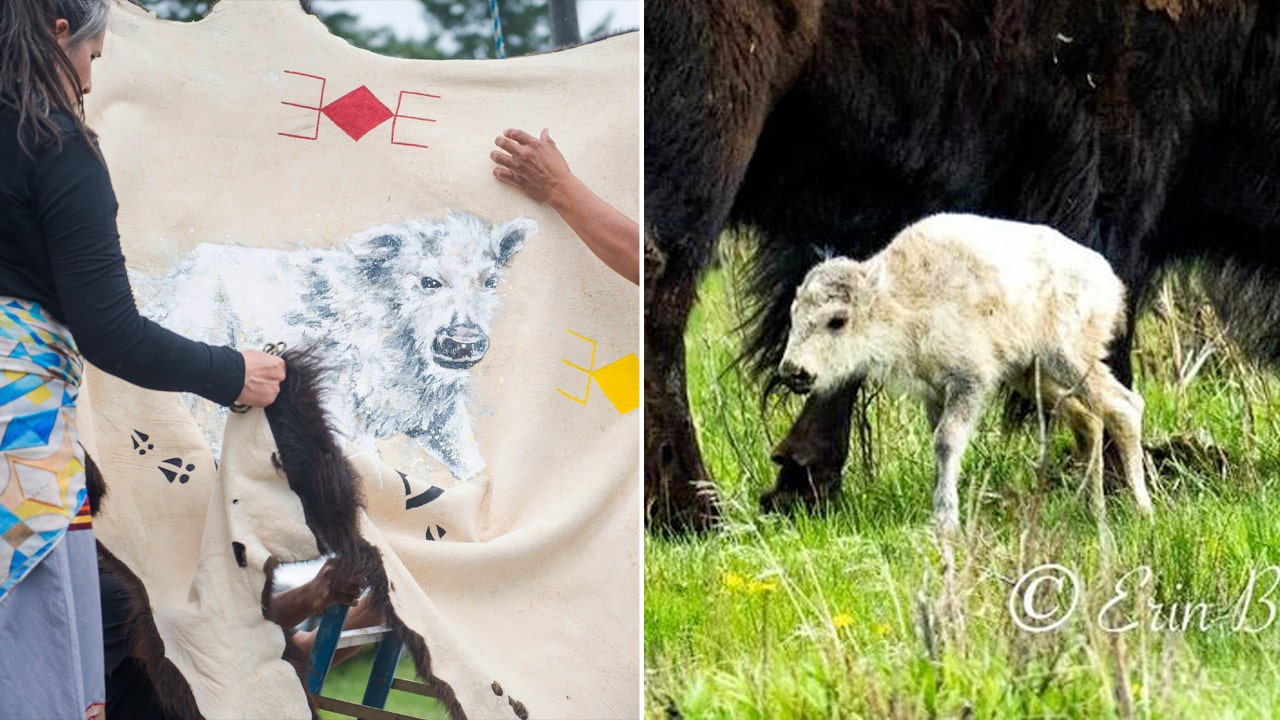
Yellowstone National Park officials said Friday a rare white buffalo sacred to Native Americans has not been seen since its birth on June 4.
The birth of the white buffalo, which fulfilled a Lakota prophecy that portends better times, was the first recorded in Yellowstone history and is a landmark event for the recovery of buffalo, said park officials in confirming the birth for the first time.
VERY RARE WHITE BUFFALO CALF BORN IN MONTANA’S YELLOWSTONE, ‘SACRED’ NAME REVEALED
It is an extraordinarily rare occurrence: A white buffalo, also known as bison, is born in the wild once in every 1 million births, or even less frequently, the park said.
The rare calf has been named Wakan Gli, which means “Return Sacred” in Lakota. (AP Photo/Sam Wilson; Erin Braaten: Dancing Aspens Photography)
Whether the calf — named Wakan Gli, which means “Return Sacred” in Lakota — is still alive is unknown.
The park’s statement mentioned that each spring, about one in five calves die shortly after birth due to natural hazards but officials declined to directly respond to questions about whether they believed it has died.
They confirmed the birth of the white buffalo after receiving photos and reports from multiple park visitors, professional wildlife watchers, commercial guides and researchers. But since June 4, park staffers have not been able to find it and officials are not aware of any other confirmed sightings in the park, one of the last sanctuaries for free-roaming American bison.
Rangers that regularly work in the more accessible areas of the park, as well as its backcountry, have not seen the animal, park spokesperson Morgan Warthin said.
Miss Shoshnone-Bannock Queen Develynn Hall takes the stage during a naming ceremony for a white buffalo calf at the headquarters of the Buffalo Field Campaign in West Yellowstone, Mont., on Wednesday. (AP Photo/Sam Wilson)
Native American leaders earlier this week held a ceremony to honor the sacred birth of the animal and give the name. Lakota members caution that the prophecy tied to the birth of the white buffalo is also a signal that more must be done to protect the earth and its animals.
Suspicion about the calf’s fate has grown as weeks have passed without another sighting since its birth in the Lamar Valley, a prime spot for wildlife viewing in Yellowstone. Young buffalo can fall victim to predators, river currents, illness and other hazards.
Mike Mease, a co-founder of the Buffalo Field Campaign, a conservation group that works with tribes to protect and honor wild buffalo and hosted this week’s ceremony, said he thinks the calf is alive somewhere in the park, away from the roads and walkways most visitors stick to. He said a grizzly bear seen by Yellowstone visitors earlier this month with five cubs, an unusually large brood, has not been seen since either.
But the most important thing about the white buffalo is that a prophecy, which is both a warning and a blessing, has been fulfilled, Mease said.
“Whether it’s dead or alive, the message has been relayed from the heavens and times are different now. We have to make changes for the future,” he said.
Read the full article from Here


Mechanical problems with a water treatment plant in Hawaii have left thousands of soldiers without central air conditioning in the barracks, a spokesman for U.S. Army Garrison Hawaii confirmed Tuesday in a statement to Military Times.
Four thousand soldiers in Area North Barracks are opening windows, turning on fans or using other tools to beat the heat while the base grapples with pump issues.
On July 10, deep-well pumps supporting Army installations in central and northern Oahu started experiencing problems.
According to the garrison, only one pump is currently pushing water to the surface. To maintain essential water services, water chiller systems have been turned off. Without the chiller systems — which make up almost 40% of the daily water use — the barracks do not receive central air conditioning. The incident was initially reported by Task & Purpose.
According to the National Weather Service, temperatures for the remainder of the week range from the mid-70s to the upper-80s.
Units are able to move troops to MWR facilities with central air conditioning, according to the service, but as of Sunday, no units had done so.
Repairs are underway, but an exact timeline for when the pumps will be fully functional again was not provided.
The cause of the issues has not been definitively identified, however “age and extreme heat due to ventilation system repairs are believed to be part of the cause,” said Nathan Wilkes, the garrison’s external communications chief.
The installation is prioritizing keeping safe drinking water available.
Barracks and residential housing have access to drinkable water, and plumbing and sanitation systems are operational. Wilkes also said the installation has paused irrigation systems pulling from Area North water supply.
Family housing still has air conditioning and water access, Wilkes added.
The garrison’s commander, Col. Rachel Sullivan, was scheduled to host a town hall on the installation’s Facebook page on Tuesday.
Eve Sampson is a reporter and former Army officer. She has covered conflict across the world, writing for The New York Times, The Washington Post and The Associated Press.
Idaho
Idaho is home to the nation's first DarkSky Reserve. Now it's home to the nations first DarkSky Certified Resort


If a furry, playful, hugg-able, lovable kitten would be a great addition to your place, now’s the time to visit the Humane Society of Western Montana.
MEET BAKER AND BUSBOY
It was another Take Me Home Tuesday at the radio stations with the Humane Society. Katie brought in “Baker” (black kitty) and “Busboy” (gray kitty), who along with their two siblings “Chef” and “Cook” form a Fantastic Four of pure joy.
These two-month-old little ones were found in the Polson area and surrendered to the shelter. They just had their spay/neuter surgeries Monday (July 13) and they will be looking for their forever homes starting Wednesday (July 15).

Whether you are looking for one kitten or the whole “kitchen,” visit the shelter and fall in love with Baker, Busboy, Chef and Cook.
EVER CONSIDERED BEING A FOSTER HOME FOR SHELTER PETS?
It is kitten season at the Humane Society of Western Montana. The Humane Society is always looking for Fosters to take care of tiny kittens until they are old enough to be adopted. They currently have some that are with mom cats, and some that are bottle babies. And there is always a need for volunteers willing to nurture them until they are of adoption age.
And of course one of the perks of being a Foster is, if you fall in love with a kitten, you pretty much get first dibs.
READ MORE: Volunteers Hit ‘The Ridge’ To Improve Montana Elk Hunting Opportunities
So, whether you are looking to adopt or would like more information about being a foster home, be sure to visit the Humane Society of Western Montana soon. They are open from 1:00 – 6:00 pm Wednesdays through Sundays at 5930 Highway 93 South in Missoula. See more cats AND dogs waiting to be adopted on the shelter’s ADOPT webpage here.
LOOK: Can you tell the difference between these common pets?
Can you tell the difference between a hamster and a guinea pig? How about a betta and a guppy? Test your pet ID skills in our cute quiz.
Gallery Credit: Stephen Lenz
-

 Georgia1 minute ago
Athlon Sports tabs Florida-Georgia among SEC’s best games in 2026
-

 Hawaii8 minutes ago
4,000 troops lose air conditioning in Hawaii
-

 Idaho14 minutes ago
Idaho is home to the nation's first DarkSky Reserve. Now it's home to the nations first DarkSky Certified Resort
-

 Illinois20 minutes ago
2 teens hospitalized after being rescued by bystanders from Lake Michigan at Illinois Beach State Park near Zion
-

 Indiana25 minutes ago
‘Big Boy’ locomotive returns for overnight stay in northeast Indiana
-

 Iowa31 minutes ago
Meet the 3 Best New Food at the Iowa State Fair finalists for 2026
-

 Kansas37 minutes ago
‘Explosive diarrhea’ outbreak includes 5 cases in Sedgwick County, 22 in Kansas
-
 Kentucky43 minutes ago
Gun safety advocates discuss Kentucky’s new concealed carry law for young adults

