

Entertainment
Review: In the underpowered 'Daddio,' the proverbial cab ride from hell could use more hell
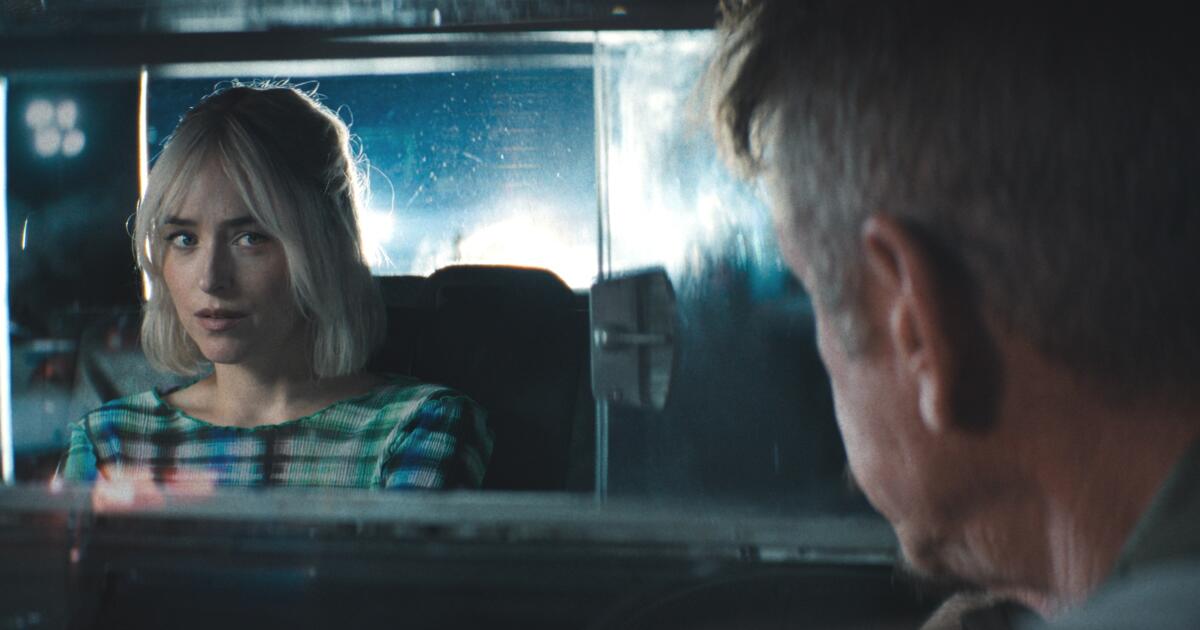
The art of conversation has been a casualty in these deeply divided days of ours, and the poor state of talk in the movies — so often expositional, glib or posturing — is an unfortunate reflection of that. The new film “Daddio” is an attempt to put verbal discourse front and center, confining to a yellow taxi a pair with different life paths, as you would expect when your leads are Sean Penn and Dakota Johnson. (Guess which one is the cabbie.)
Johnson’s coolly elegant, nameless traveler, a computer programmer returning to New York’s JFK airport from a trip visiting a big sister in Oklahoma, may be getting a flat rate for her journey, but the meter’s always running on the mouth of Penn’s gleefully crusty and opinionated driver, Clark. He’s a twice-married man prone to streetwise philosophizing about the state of the world and, over the course of the ride, the unsettled romances of his attractive fare. And as she drops clues about her life — sometimes unwittingly, then a little more freely — she gives back with some probing responses of her own, trying to pry him open.
Writer-director Christy Hall, who originally conceived the scenario as a stage play, lets the chatter roll — there’s a significant stretch in which the cab isn’t even moving. And when silence sets in, there’s still an exchange to tend to, as Johnson occasionally, with apprehension, responds to a lover’s insistent sexting. This third figure (unseen, save one predictable picture sent to her phone) becomes another source of conjectural bravado for Clark, a self-proclaimed expert in male-female relations, who makes eye contact through the rearview mirror.
Sean Penn in the movie “Daddio.”
(Sony Pictures Classics)
Watching the unremarkable “Daddio,” you’ll never worry that anything untoward or combustible will happen between the chauvinist driver with a heart of gold and the smart if vulnerable young female passenger who “can handle herself,” as Clark frequently observes. That lack of tension is the problem. The movie is less about a nuanced conversation between strangers than a writer’s careful construction, designed to bridge a cultural impasse between the sexes. Hall is so eager to stage a big moment that upends expectations and triggers wet-eyed epiphanies — He’s a compassionate blowhard! She can laugh at his crassness! — that we’re never allowed to feel the molecules shift from moment to moment in a way that isn’t unforced. Life may be the subject, but life is what’s missing.
It doesn’t help that in directing her first feature, Hall has given herself one of the hardest jobs, getting the most out of only two ingredients and one container. It’s probably why Jim Jarmusch went the variety route with five different tales for his memorable 1991 taxi suite “Night on Earth.” That film conveyed a palpable sense of time and space.
“Daddio,” on the other hand, is nowhere near as assured visually or in its pacing. Hall has an experienced cinematographer in Phedon Papamichael (“Nebraska,” “Ford v Ferrari”) but chooses an unfortunate studio gloss that suggests utter control, rather than a what-might-happen vibe. Not that there’s anything wrong with a movie so clearly made on a set. But Johnson’s well-rehearsed poise and Penn’s coasting boldness make them seem like the stars of a commercial for a scent called Common Ground rather than flesh-and-blood people. At times, they hardly seem to be sharing the same car interior, leaving “Daddio” feeling like a safe space, when what it needs is danger.
‘Daddio’
Rating: R, for language throughout, sexual material and brief graphic nudity
Running time: 1 hour, 41 minutes
Playing: In limited release Friday, June 28
Movie Reviews
Movie Review – Nirvanna the Band the Show the Movie (2025)
Nirvanna the Band the Show the Movie, 2026.
Directed by Matt Johnson.
Starring Matt Johnson and Jay McCarrol
SYNOPSIS:
When their plan to book a show at the Rivoli goes horribly wrong, Matt and Jay accidentally travel back to the year 2008. Blah blah blah.
“You don’t notice getting older when you have a good friend”. That is something along the lines of what was said to co-writer/director/star Matt Johnson, playing a version of himself in Nirvanna the Band the Show the Movie. One gets the sense that such a strong friendship, personally and creatively with co-writer/co-star Jay McCarrol, is what has taken this duo to, well, a band, a web series show, and now a feature-length, sidesplittingly, brilliantly funny buddy comedy mockumentary.
Without any prior knowledge of the shenanigans these two have been up to with this concept, all one can say is that Matt and Jay (with a friendship (one reminiscent of a cross between the antics found in Wayne’s World and Beavis and Butthead) are in a band (the former doing vocals, the latter on piano), desperately trying anything they can to get booked to play a gig at the Toronto-based Rivoli. We see one of those plans fail, only for the film to inform us that 17 years have passed.
But by God, Matt and Jay are still trying to live their dream!
The next plan: The Seventh Inning Skydive. It’s a plan founded on the supremely dangerous, supremely stupid idea of bungee jumping off of the Toronto SkyDome into the Rogers Centre where Major League Baseball’s Toronto Blue Jays happen to be playing, parachuting onto the diamond during the celebratory seventh-inning stretch, which Matt, apparently, believes will make them look so cool that the concert hall venue will have no choice but to phone them and book them. This, too, ends in a hilarious disaster, though the interactions with real people along the way are similarly amusing, some of whom are privy to the plan and openly say it’s not a good idea.
Who could blame Jay for getting sick of this shit and wondering if he would have become famous on his own? Thanks to an unbelievably ridiculous inadvertent activation of a time machine by Matt, who was trying to rip off Back to the Future for his next scheme, he and Jay are going to get a taste of different realities for them and the band, which will test their friendship and whether it can be repaired. Like everything else here, nearly every sequence perfectly walks that line between stupidly and brilliantly uproarious. Even the jokes that border on tasteless or offensive, such as a 9/11 one, are deployed with such whipsmart precision to make them work.
At one point, Matt Johnson breaks the fourth wall, exclaiming that if you are watching this in a theater, it will probably be for the only time, given the copyright nightmare the making of this film must have provided. Following a roadshow release last year, it is now, somehow, getting a traditional release. It should not be skipped. Typically, several comedies quickly run their course and stop being as funny as when they started once the audience has a grasp of the plot and where certain situations are headed.
Nirvanna the Band the Show the Movie maintains that momentum until its genuinely exciting DIY spectacle of a climax, all while going all out selling the look and feel of the time travel element (whether it be getting the cameraman following them around with an older model, or copious amounts of pop culture references, one of them taking place inside a movie theater setting up a killer punchline). It’s a joke operating on several levels, from being funny to commenting on past entertainment culture to signalling something good to the audience, all blending together for an unforgettable laugh.
Even if one is unfamiliar with this duo, it will probably come as no surprise that their comedic chemistry together is an on-point, witty, irreverent delight. Again, what is impressive is how often these jokes land and how consistently funny Nirvanna the Band the Show the Movie is, practically shaking up the dynamic of this friendship across time travel with a new approach roughly every 20 minutes. This is one hell of an evolution of their act, in comedy, craft, and ambition. Good friends they are indeed.
Flickering Myth Rating – Film: ★ ★ ★ ★ / Movie: ★ ★ ★ ★
Robert Kojder
https://www.youtube.com/watch?v=embed/playlist
Entertainment
Super Bowl 2026 ads, ranked from best to worst
Were you ready for some non-football consumerism? Ready or not, the Super Bowl’s annual blitz of commercials landed before and during the Seattle Seahawks and New England Patriots defense-first matchup, with some ads served up in advance while others were unveiled for the first time during the game. As in previous years, there were serious clunkers (looking at you Bud Light rolling keg ad), but also a few that transcended their buy-more mission (may you live forever, Melissa McCarthy). Other trends we noticed: celebrities double dipping to appear in more than one Super Bowl commercial (three if you’re Sofía Vergara), lots of borderline-gross humor (exploding heads, singing clumps of shaved body hair, singing toilets and plenty of ads trying to convince America that artificial intelligence tools aren’t a waste of time and energy).
While many of this year’s ads promoted AI and the usual rah-rah-America nods to patriotism, one trend we noticed was that the longer versions for some of the best Super Bowl ads, found online, were even better than the condensed cuts that made it to broadcast. What if next year, we make the Super Bowl three quarters and the commercial breaks 15 minutes long? Any takers?
While we wait for that brilliant idea to make it to the NFL’s offices, here are the big game ads we loved the most and a few that fumbled the ball — big time.
Movie Reviews
‘Marianne’ Review: Isabelle Huppert’s One-Woman Conceptual Art Project Sparks Deep Thoughts and Profound Annoyance
Well, that’s a wrap. As I look back on my two-decade tenure at Variety, I’m incredibly proud of the 2,000-plus reviews that the publication (and you, my readers) have entrusted me with. It’s the greatest privilege any film critic could ask for. And yet, I can’t shake the responsibility of what I refer to as my “guilt list”: all the films I’ve seen, but didn’t have the time to review. Most critics don’t have this problem. They have clear-cut assignments, which they fulfill in time for a film’s release. At an industry paper like Variety, however, we endeavor to cover as many films as humanly possible, from Hollywood blockbusters to relatively obscure art films and indies. And because that mission matters to me, I don’t forget the ones that slip through the cracks.
Maybe it was something I saw at a festival, but couldn’t get around to, like György Pálfi’s dialogue-free “Hen” (which ranks right up there with Cannes sensation “Eo,” but never got the same critical attention) or Jack Begert’s smart, self-questioning Sundance orphan “Little Death,” which radically pivots from jaded industry cynicism to something more life-affirming midway through. Or else a movie looking for distribution that just might have found a home if I’d only had time to review it, such as Ari and Ethan Gold’s resonant, one-shot “Brother Verses Brother,” a Linklater-esque walk-and-talk gem that shadows the pair around San Francisco. I bear the responsibility of not covering these and so many odd outliers, from fringe offerings like “Abruptio,” a serial killer thriller made entirely with puppets, to Andy Warhol’s “San Diego Surf” (thought lost until 2012), in which Taylor Mead takes an enthusiastic interest in SoCal water sports.
I reckon I have time to scratch just one of these oversights off my guilt list before leaving, and so I find myself circling back to an earnest little movie called “Marianne,” whose squeaky-wheel director, Michael Rozek, has been pestering me on X for more than a year. Rozek, who felt compelled to make his first feature late in life, describes the project as a “revolutionary one-woman film,” starring my all-time favorite actress, Isabelle Huppert. So after several frustrated attempts, I finally made time to watch it (since Rozek claims a release is coming later this year).
Looking elegant as ever, Huppert appears with script in hand, half-reading, half-reciting a long, self-important monologue, written by Rozek. It’s not so much a performance as a run-through, shot in several long takes in which the camera zooms, wobbles and repositions itself while she speaks. Alas, English is not Huppert’s native language, and though gravitas comes easy, the red-headed actress makes strange pauses and even stranger gestures, which can be disconcerting. Huppert reacts to the text as it leaves her mouth, when we ought to believe that these words are hers (or “Marianne’s”) to begin with.
How Rozek convinced the courageous French star to do this, I can only imagine, but accepting such an assignment is the kind of fearless act we’ve come to appreciate from Huppert, who’s played a demented disciplinarian in “The Piano Teacher” and a woman excited by assault in “Elle” — risky roles few would even consider, much less embrace. A few years back, I managed to catch Huppert onstage. She was performing “Mary Said What She Said,” an avant-garde one-woman show directed by Robert Wilson, which she has toured around the world. I can only assume Rozek must have seen this as well, since it was around the time he made “Marianne” (three years ago now), and yet, he opted not to emulate it.
In that piece, Huppert “played” Mary Queen of Scots (in the sense that she “plays” a character named Marianne in “Marianne,” making no attempt to embody or otherwise become a different person). The French star moved energetically back and forth, up and down the stage — it was a positively calisthenic performance — as she delivered her lines in double time. I’m no expert on Brecht, but this seems like a classic example of the “alienation effect,” whereby audiences are intended to be made aware of the theatrical artificiality of the experience.
Rozek mischievously seeks something similar. Huppert spends most of “Marianne” seated on an expensive blue couch with his script in her hands, holding what’s meant to feel like a one-way conversation with the audience — more of a lecture, really, as “Marianne” represents Rozek’s manifesto about what is “real” in a medium where every creative choice is constructed. Plots aren’t real. Stories aren’t real. Lord knows reality TV isn’t real.
“Wake up!” Huppert screams at one point, looking directly into the camera. “Be real!”
Who is Rozek chiding exactly? And who exactly does this indignant idealist suspect is “suppressing” his film? (That’s the word he keeps using on X to describe a dynamic in which buyers aren’t swarming to release Rozek’s tedious disquisition on all that’s wrong with the film industry today.) There’s no such conspiracy. The truth is, nobody cares. He might as well carve it up into 30-second clips and share it on TikTok. Responding as someone who found “Marianne” too pedantic to watch through to the end until now — but who identifies with many of Rozek’s frustrations — I would argue that cinema can achieve much nobler goals than “realism.”
Consider this: A photograph captures whatever appears directly in front of the camera, but it’s still composed, excluding whatever exists beyond the frame. It’s far more difficult to create something expressionistic — that is, an entirely stylized alternate reality — that audiences still find engaging, relatable and emotionally true. Picture Jean Cocteau’s “Beauty and the Beast,” the best of Tim Burton’s films or anything brought to life from scratch by brilliant animation artists. That should be the goal: achieving some kind of communion between the audience and whoever they’re watching on-screen. That’s what Rozek (in his “revolutionary” way) imagines he’s offering with “Marianne.” But it’s also what the most bottom-line-minded studio execs most want when attempting to make a hit popcorn movie.
About midway through, Huppert-as-Marianne says, “Some will say, ‘This is not a film. This is a play.’” Why is Rozek being so defensive? Audiences aren’t as dumb as the film implies — certainly not the ones who’d seek out and watch something as nontraditional as “Marianne.” Neither are distributors and other would-be backers, any of whom can see that such a project, while not without merit, stands no chance of financial success (budgeted at an estimated $350,000, it will be lucky to break even). “Marianne” is a film, just not a very good one — it’s nowhere near as effective as Julian Rosefeldt’s “Manifesto,” in which we sit riveted as a shape-shifting Cate Blanchett recites a range of world-changing treatises, from Karl Marx to Dogma 95. The validity of his argument aside, Rozek may as well be screaming into the void.
I don’t recall Martin Luther complaining, after nailing his 95 theses to the Castle Church door, that a bidding war didn’t immediately break out among publishers to reprint his grievances. “Marianne” means well, but comes from a place of profound naivete. It’s meant to get audiences thinking about what they watch — the “content” they consume — by raising awareness of what film can be. But it hasn’t figured out the carrot that will entice them to hear its message. If even a die-hard Huppert admirer like me has trouble getting through it, why would a casual cinephile bother?
“They think that you need to escape,” Huppert says, “to forget … your pain.” The royal “they” in this case are “the suits” who call the shots and hold the purse strings. Rozek believes that he’s on to something new when he suggests that if the film industry would only “help you get to the bottom of your pain, instead of numb it,” they’d have people lining up to pay. Sounds great, but movies don’t work that way, and “Marianne” isn’t well written enough — not performed with sufficient conviction — to prove otherwise.
Sure, it can be demoralizing for intelligent adults to investigate what’s available at their local megaplex and see only prequels, sequels, spinoffs and superhero movies. But tens of thousands of films are made each year, and quite a few of them break the rules, defy conventional narrative expectations and smack us deep in our souls. To repeat Bergman (as paraphrased in the film), the greatest filmmakers capture life in a reflection. Film is a looking glass — a role it plays quite literally here when the scene changes and Huppert reads the “love chapter” from I Corinthians into the mirror.
In its most profound moments, “Marianne” alludes to mortality, to “real life.” But it doesn’t dare suggest what others have (here I’m thinking of Kubrick at the end of “Eyes Wide Shut”), that movies may illuminate life, but they can’t replace it. Now, I say this as someone who’s spent nearly as many hours in the dark vicariously sharing the lives of others — imaginary people, no less — as I have engaging with real people: In order to succeed as a revolutionary act, “Marianne” must achieve the kind of cathartic epiphany Rozek refers to, but ultimately fails to deliver. It needs to serve up an insight that hasn’t already occurred to us, rather than a Holden Caufield-callow attack on phoniness. Alternately, at any point, Huppert could interrupt herself, stare the audience straight in the face and advise them to turn off, walk out and experience the world.
That, my dear Marianne, is what it means to get real.
-
Indiana1 week ago13-year-old rider dies following incident at northwest Indiana BMX park
-
Massachusetts1 week agoTV star fisherman, crew all presumed dead after boat sinks off Massachusetts coast
-
Tennessee1 week agoUPDATE: Ohio woman charged in shooting death of West TN deputy
-
Indiana1 week ago13-year-old boy dies in BMX accident, officials, Steel Wheels BMX says
-
Politics6 days agoTrump unveils new rendering of sprawling White House ballroom project
-
San Francisco, CA5 days agoExclusive | Super Bowl 2026: Guide to the hottest events, concerts and parties happening in San Francisco
-
Politics4 days agoWhite House says murder rate plummeted to lowest level since 1900 under Trump administration
-
Texas1 week agoLive results: Texas state Senate runoff
