Connect with us

News

Iowa floodwaters breach levees as even more rain dumps onto parts of the Midwest

Published

on

Iowa floodwaters breach levees as even more rain dumps onto parts of the Midwest

A tornado is seen near Cedar Rapids, Iowa, on Tuesday. More severe weather was forecast to move into the region, potentially bringing large hail, damaging winds and tornadoes in parts of western Iowa and eastern Nebraska, according to the National Weather Service.

Nick Rohlman/The Gazette/AP


hide caption

toggle caption

Advertisement

Nick Rohlman/The Gazette/AP

DES MOINES, Iowa — Tornado warnings, flash flooding and large hail added insult to injury for people in the Midwest already contending with heat, humidity and intense flooding after days of rain.

The National Weather Service on Tuesday afternoon and evening issued multiple tornado warnings in parts of Iowa and Nebraska as local TV news meteorologists showed photos of large hail and spoke of very heavy rain.

Earlier on Tuesday, floodwaters breached levees in Iowa, creating dangerous conditions that prompted evacuations.

Advertisement

A vast swath of lands from eastern Nebraska and South Dakota to Iowa and Minnesota has been under siege from flooding from torrential rains since last week, while also being hit with a scorching heat wave. Up to 18 inches of rain have fallen in some areas, and some rivers rose to record levels. Hundreds of people were rescued, homes were damaged and at least two people died after driving in flooded areas.

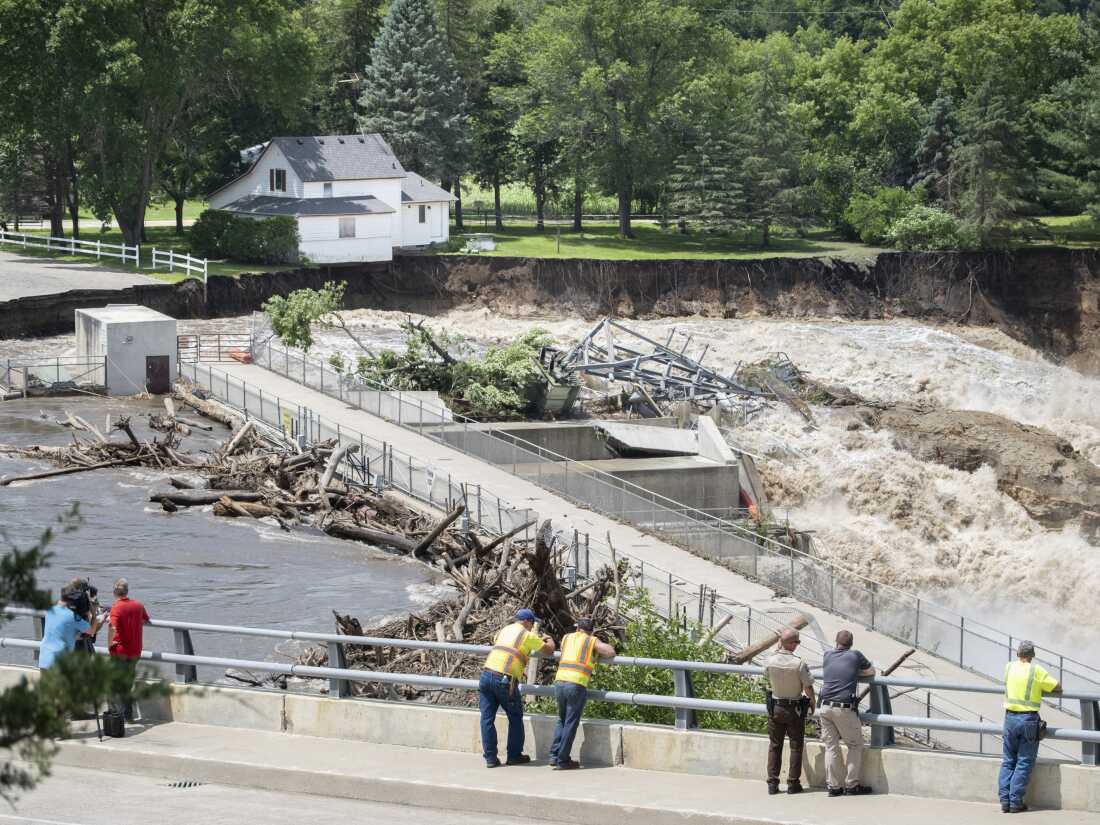
Onlookers take in the catastrophic damage to the Rapidan Dam site in Rapidan, Minn., on Monday. Debris blocked the dam, forcing the heavily backed up waters of the Blue Earth River to reroute along the bank nearest the Dam Store.

Onlookers take in the catastrophic damage to the Rapidan Dam site in Rapidan, Minn., on Monday. Debris blocked the dam, forcing the heavily backed up waters of the Blue Earth River to reroute along the bank nearest the Dam Store.

Casey Ek/The Free Press/AP


hide caption

toggle caption

Advertisement

Casey Ek/The Free Press/AP

The sheriff’s office in Monona County, near the Nebraska border, said the Little Sioux River breached levees in several areas. In neighboring Woodbury County, the sheriff’s office posted drone video on Facebook showing the river overflowing the levee and flooding land in rural Smithland. No injuries were immediately reported.

Patrick Prorok, emergency management coordinator in Monona County, described waking people at about 4 a.m. in Rodney, a town of about 45 people, to recommend evacuation. Later Tuesday morning, the water hadn’t yet washed into the community.

“People up the hill are saying it is coming our way,” Prorok said.

Advertisement
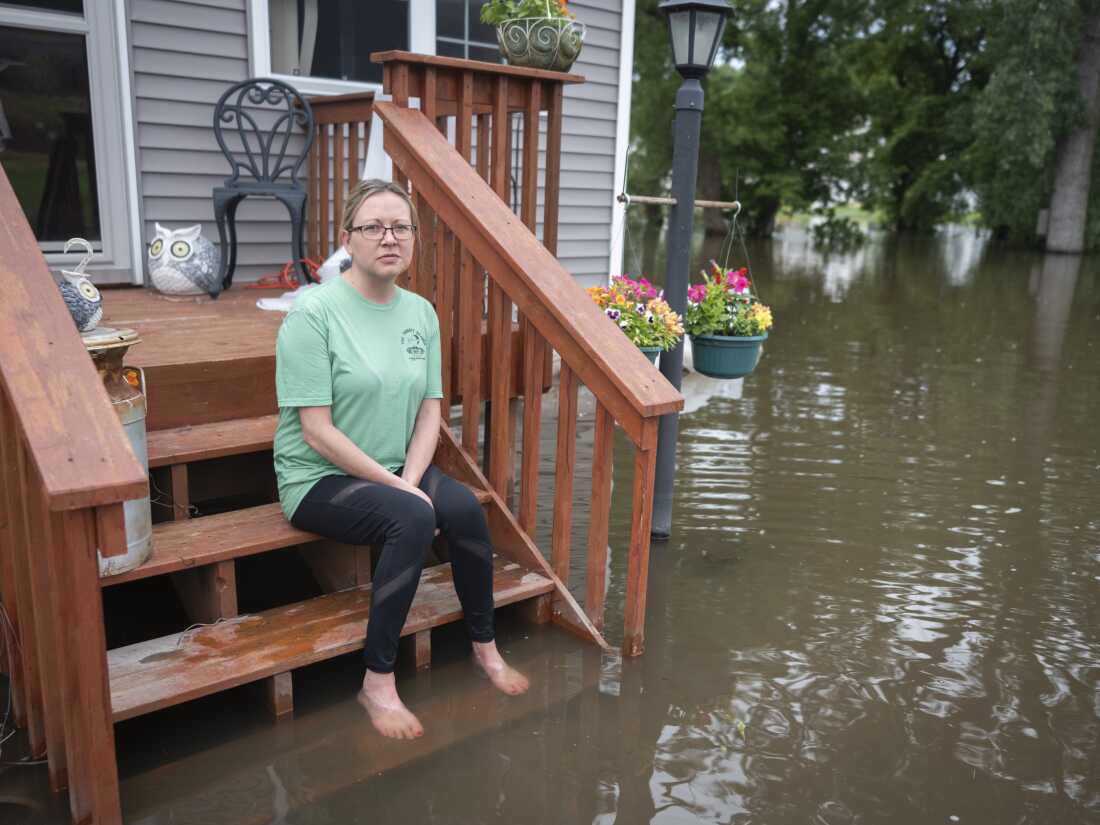
Rachel Morsching sits Tuesday on the flooded porch of her father Dean Roemhildt's home in Waterville., Minn. Waters from the nearby Tetonka and Sakatah lakes have encroached on the town amid recent heavy rains.

Rachel Morsching sits Tuesday on the flooded porch of her father Dean Roemhildt’s home in Waterville., Minn. Waters from the nearby Tetonka and Sakatah lakes have encroached on the town amid recent heavy rains.

Casey Ek/The Free Press/AP


hide caption

toggle caption

Casey Ek/The Free Press/AP

Advertisement

As new areas were flooding Tuesday, some cities and towns were cleaning up after the waters receded while others downstream were piling sandbags and taking other measures to protect against the oncoming swelled currents. Some normal, unassuming tributaries ballooned into rushing rivers, damaging homes, buildings and bridges.

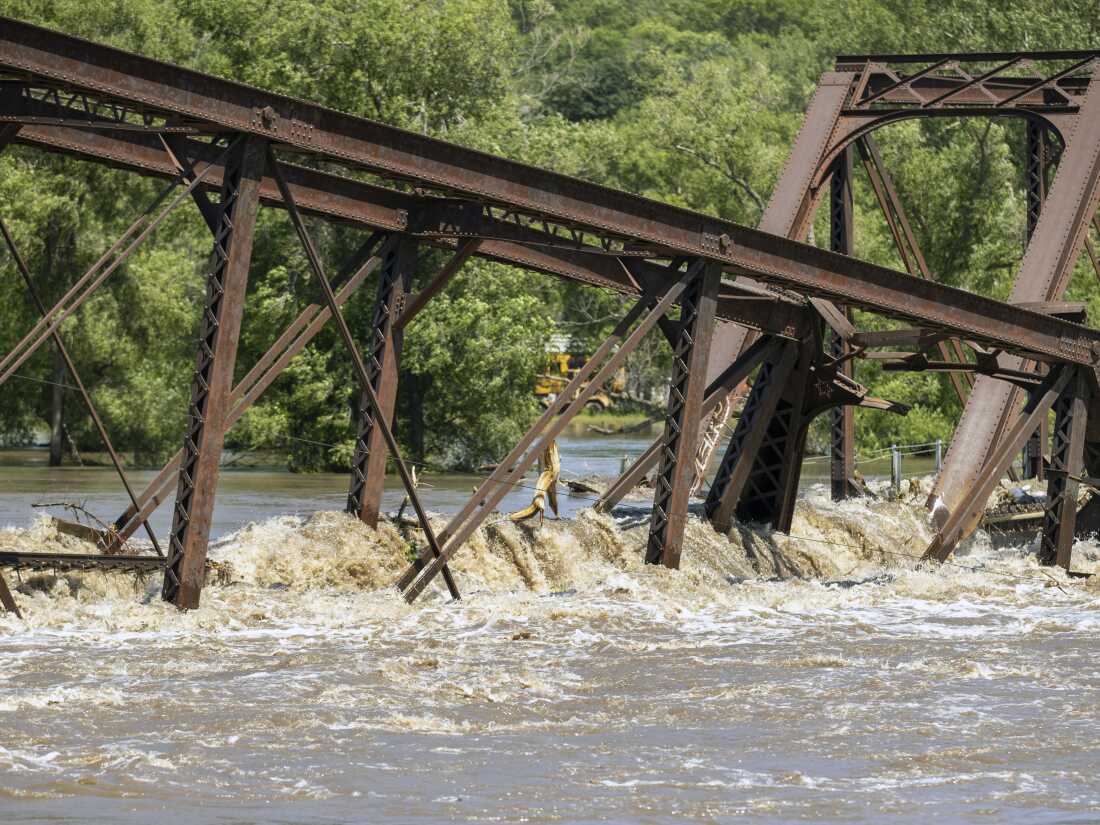
“Normally, this river is barely a trickle,” 71-year-old Hank Howley said as she watched the Big Sioux’s waters gush over a broken and partially sunken rail bridge in North Sioux City, South Dakota, on Monday. “Really, you could just walk across it most days.”

South Dakota state geologist Tim Cowman said that the five major rivers in the state’s southeastern corner have crested and are dropping, albeit slowly. The last of those rivers to crest, the James, did so early Tuesday.

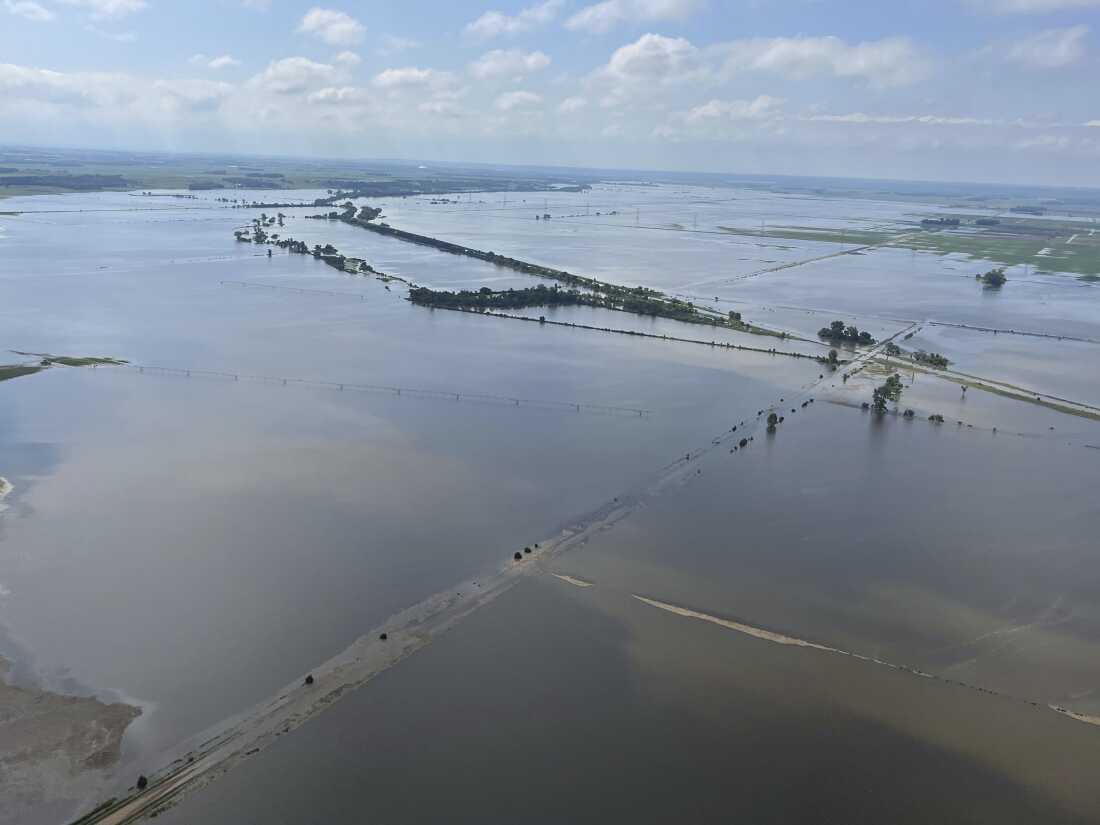
Heavy rains in recent days have submerged farmland near Vermillion, S.D., on Tuesday. Flooding has devastated communities in several states across the Midwest.

Heavy rains in recent days have submerged farmland near Vermillion, S.D., on Tuesday. Flooding has devastated communities in several states across the Midwest.

Jake Hoffner/AP

Advertisement


hide caption

toggle caption

Jake Hoffner/AP

Advertisement

In a residential development along McCook Lake in North Sioux City, the devastation became clear Tuesday as floodwaters began to recede from Monday, exposing collapsed streets, utility poles and trees. Some homes had been washed off their foundations.

“Currently, there is no water, sewer, gas or electrical service in this area,” Union County Emergency Management said in a Facebook post.

President Biden approved a major disaster declaration for affected counties in Iowa on Monday, a move that paves the way for federal aid to be granted.

To the south in Sioux City and Woodbury County, Iowa, officials responded to residents’ complaints that they had received little warning of the flooding and its severity. Sioux City Fire Marshal Mark Aesoph said at a news conference Tuesday that rivers crested higher than predicted.

“Even if we would have known about this two weeks ago, there was nothing we could do at this point. We cannot extend the entire length of our levee,” Aesoph said. “It’s impossible.”

Advertisement

Water had spilled over the Big Sioux River levee, and Aesoph estimated hundreds of homes likely have some internal water damage.

Homes on the south side of Spencer, Iowa, near the Little Sioux River are unlivable as water has reached the main floor, resident Ben Thomas said. A lot of people in town are facing a “double whammy,” with homes and businesses affected.

Officials in Woodbury County said around a dozen bridges over the Little Sioux River had been topped by flood water, and each would need to be inspected to see if they can reopen to traffic.

Forever Wildlife Lodge and Clinic, a nonprofit animal rescue, in northwest Iowa has answered over 200 calls since the flooding started, said licensed wildlife rehabilitator Amanda Hase.

Hase described the flooding as “catastrophic” for Iowa wildlife, which are getting washed out of dens, injured by debris and separated from each other. She and other rehabilitators are responding to calls about all kinds of species, from fawns and groundhogs to bunnies and eaglets.

Advertisement

“I’ve never seen it this bad before, ever,” she said.

Floodwaters rush over a collapsed railroad bridge over the Big Sioux River near North Sioux City, S.D., on Monday.

Floodwaters rush over a collapsed railroad bridge over the Big Sioux River near North Sioux City, S.D., on Monday.

Josh Jurgens/AP


hide caption

toggle caption

Advertisement

Josh Jurgens/AP

Further to the east in Humboldt, Iowa, a record crest of 16.5 feet was expected Wednesday at the west fork of the Des Moines River. Amid high temperatures and humidity, nearly 68,000 sandbags have been laid, according to county emergency manager Kyle Bissell.

Bissell told reporters Tuesday that there was no water on the streets yet, but flooding had begun in some backyards and was reaching up to foundations. Humboldt is home to nearly 5,000 residents.

More severe weather was forecast to move into the region Tuesday, potentially bringing large hail, damaging winds and even a brief tornado or two in parts of western Iowa and eastern Nebraska, according to the National Weather Service. Showers and storms were also possible in parts of South Dakota and Minnesota, the agency said.

Advertisement

In Michigan, more than 150,000 homes and businesses were without power Tuesday morning after severe thunderstorms barreled through, less than a week after storms left thousands in the dark for days in suburban Detroit.

The weather service also predicted more than two dozen points of major flooding in southern Minnesota, eastern South Dakota and northern Iowa, and flood warnings are expected to continue into the week.

Many streams, especially with additional rainfall, may not crest until later this week as the floodwaters slowly drain down a web of rivers to the Missouri and Mississippi. The Missouri will crest at Omaha on Thursday, said Kevin Low, a weather service hydrologist.

North of Des Moines, Iowa, the lake above the Saylorville Dam was absorbing river surge and expected to largely protect the metro area from flooding, according to the Polk County Emergency Management Agency. The U.S. Army Corps of Engineers projected Tuesday that water levels at Saylorville Lake will rise by more than 30 feet by the Fourth of July.

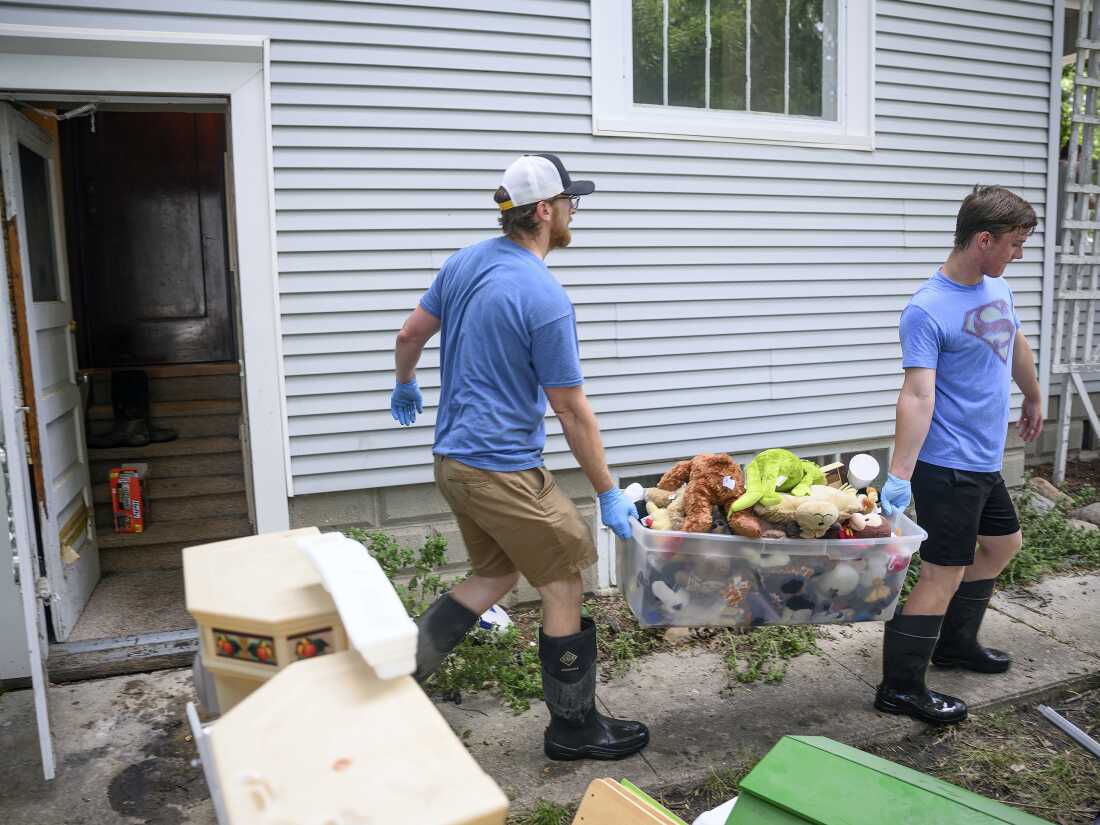
Jared Gerlock (left) and his son, Robbie, carry a bin of water-logged stuffed animals out of the flood-damaged basement of their home on East Second Street in Spencer, Iowa, on Tuesday. Officials said about 40% of properties in the city were affected after the Little Sioux River flooded.

Jared Gerlock (left) and his son, Robbie, carry a bin of water-logged stuffed animals out of the flood-damaged basement of their home on East Second Street in Spencer, Iowa, on Tuesday. Officials said about 40% of properties in the city were affected after the Little Sioux River flooded.

Tim Hynds/Sioux City Journal/AP

Advertisement


hide caption

toggle caption

Tim Hynds/Sioux City Journal/AP

Advertisement

Outside Mankato, Minnesota, the local sheriff’s office said Monday that there was a “partial failure” of the western support structure for the Rapidan Dam on the Blue Earth River after the dam became plugged with debris. Flowing water eroded the western bank, rushed around the dam and washed out an electrical substation, causing about 600 power outages.

Eric Weller, emergency management director for the Blue Earth County sheriff, said the bank would likely erode more, but he didn’t expect the concrete dam itself to fail. The two homes downstream were evacuated.

Minnesota Gov. Tim Walz on Tuesday cautioned against rebuilding too fast, instead emphasizing more sustainable repairs that could prevent or mitigate future flooding.

“Nature doesn’t care whether you believe in climate change or not,” Walz said. “The insurance companies sure believe in it. The actuarials sure believe in it, and we do.”

Advertisement

News

Family, former presidents and a Hall of Famer give Rev. Jesse Jackson a final sendoff

Published

on

Family, former presidents and a Hall of Famer give Rev. Jesse Jackson a final sendoff

The casket with the Rev. Jesse Jackson is seen before the Public Homegoing Service at the House of Hope in Chicago, on Friday, March 6, 2026.

Erin Hooley/AP


hide caption

toggle caption

Advertisement

Erin Hooley/AP

The rare qualities that distinguished the Rev. Jesse Jackson — his fortitude as a civil rights leader, and the love he shared as a mentor, a friend and father — were praised time and again on Friday, as his family and a roster of luminaries, including three former U.S. presidents, gathered for Jackson’s funeral service on Chicago’s South Side.

Repeatedly, it came down to three words that Jackson made famous.

“I am! Somebody!” the crowd chanted in the House of Hope megachurch, repeating Jackson’s belief that every person matters, no matter their race or economic standing.

Advertisement

“He paved the road,” former President Barack Obama said. He noted that Jackson brought social change, and also proved, in the 1980s, that a Black presidential candidate could be taken seriously.

“His voice called on each of us to be heralds of change, to be messengers of hope, to step forward and say, ‘Send me,’” Obama said. “Wherever we have a chance to make an impact, whether it’s in our schools, our workplaces, our neighborhoods, our cities.”

Jackson’s son, Yusef, gave vivid detail to Jackson’s commitment to helping those who need it most.

“I intend to die with my shoes on,” Yusef Jackson said, quoting his father’s refusal to let health problems stop him from aspiring to help people in war-torn Ukraine, and Americans struggling with food insecurity. Along the way, Yusef Jackson said, his father also managed to find time to share his love for his children and grandchildren.

“Keep hope alive,” Yusef Jackson said in closing, echoing another of Jesse Jackson’s mottos.

Advertisement

Speakers emphasized Jackson’s message of hope throughout the service, especially as some referenced the Trump administration. 

Obama said “it’s hard to hope” when “every day you wake up to things you just didn’t think were possible. Each day we’re told … to fear each other, to turn on each other and that some Americans count more than others, and that some don’t even count at all.” 

Former presidential candidate Kamala Harris said she predicted how President Trump’s second term would play out. 

“I’m not into saying ‘I told you so,’ but we did see it coming,” Harris said. “But what I did not predict is that we would not have Jesse Jackson with us to get through this.”

Several speakers credited Jackson for sowing the seeds that would carry them through storied careers. 

Advertisement

For Judge Greg Mathis, from the hit daytime television show Judge Mathis, hearing Jackson say “I am somebody” began a domino effect that would catapult him to success in the worlds of law and entertainment. 

“Those were the three words that I heard 50 years ago this month that changed my life forever,” Mathis said. 

He first met Jackson when he was a teenager incarcerated in Detroit. Jackson had stopped at the facility where Mathis was being held during a speaking tour. Mathis wanted to join Jackson’s cause right then and there. But it wouldn’t happen that fast. Jackson told Mathis to go to college first.

After graduating, Mathis worked on Jackson’s 1988 presidential campaign, and was later elected to a judgeship in Detroit. Years later, he reunited with Jackson to serve as vice president of Jackson’s nonprofit, the Rainbow PUSH Coalition.

Then, Mathis got the offer to be on television. 

Advertisement

“‘Oh yeah, you gotta take this,’” Mathis said, recalling Jackson’s reaction. “‘But primarily, I want you to take this so that you can spread a message of hope to millions and millions of people who you will inspire to overcome their obstacles, as we’ve overcome ours.’” 

Obama reminisced about being a college student while watching Jackson’s first presidential debate.

“When that debate was over, I turned off that TV, and I thought the same thing that I know a lot of people thought, even if they didn’t want to admit it. That in his idea, and his platform, in his analysis, in his intelligence, in his insight, Jesse hadn’t just held his own. He had owned that stage,” Obama said. 

He continued, “And the message he sent to a 22-year-old child of a single mother with a funny name, an outsider, was that there wasn’t any place, any room, where we didn’t belong.”

One of the most emotional speeches came from NBA Hall of Famer Isiah Thomas, a longtime friend of Jackson’s who recalled meeting the civil rights leader when Thomas was a child in Chicago. In those days, Thomas said, his family was living in poverty, relying on a soup line for sustenance.

Advertisement

That’s when, Thomas said, he and his mother encountered Jackson walking down a street.

When Jackson saw the boy, he bent down and looked Thomas in the eye.

“When society was telling me I was a nobody, when society was telling me we don’t even want to go to school with you,” Thomas said, Jackson shared a different message.

“You are somebody,” Jackson told Thomas.

Advertisement
Continue Reading

News

A dead woman’s key fob and two grisly crime scenes: How the Utah triple-murder suspect was tracked across state lines | CNN

Published

on

A dead woman’s key fob and two grisly crime scenes: How the Utah triple-murder suspect was tracked across state lines | CNN

As investigators raced to find the person responsible for three killings in rural Wayne County, Utah, they used automated license plate readers and a victim’s own vehicle key fob to track their suspect – a man police said has no connection to the victims or the region that is known for its awe-inspiring landscapes dotted with quiet, small towns.

It would take just hours to pin down the suspect in a search that spanned multiple states in the Four Corners region of the Southwest – ending early Thursday with the arrest of 22-year-old Iowa resident Ivan Miller, who is charged with three counts of first-degree, aggravated murder, officials said.

Miller was taken into custody in Colorado, officials said –– more than 350 miles from where the bodies of three women were found at two locations in Utah.

Miller’s first court appearance is scheduled for Friday afternoon in Archuleta County, Colorado. He will be represented by a public defender, court records show.

The victims were identified as Margaret Oldroyd, 86; Linda Dewey, 65; and Natalie Graves, 34, Utah’s Department of Public Safety said.

Advertisement

Dewey and Graves, an aunt and niece who’d gone for a hike together, were found dead near a trailhead just outside the town of Torrey, Utah’s DPS said. The women’s bodies were found by their husbands who grew concerned when the pair didn’t return from their hike, Utah Highway Patrol spokesperson Lt. Cameron Roden said at a news conference Thursday.

Investigators found Oldroyd’s vehicle at the trailhead and deputies went to her home in nearby Lyman, where they discovered her body, Roden said.

After his arrest, Miller told investigators he spent a night in Oldroyd’s back shed and snuck into her house while she was out, according to an indictment filed in court Thursday. Miller “waited for her behind a door and shot her in the back of the head … while she was sitting down to watch television,” the indictment said.

Miller made efforts to clean up the scene before dragging the 86-year-old’s body to a cellar under the shed, where she was later found, the indictment read. He then stole her Buick Regal and traveled to the trailhead, investigators said. Miller told investigators “he did not like the car and wanted to find a different vehicle,” the indictment said.

At the trailhead, Miller said he saw Dewey and Graves get out of a white Subaru and shot them both, according to the indictment. Miller told investigators he stabbed one of the women in the chest multiple times because she was still moving, the document said.

Advertisement

He then admitted dragging their bodies into a ditch, where the two were discovered by their husbands, the indictment said.

Officials said Miller ditched Oldroyd’s car at the trail and drove away in the white Subaru. Miller also admitted stealing the women’s credit cards and using one to pay for gas, according to documents.

Investigators used a network of license plate scanners to track the Subaru “through southern Utah into northern Arizona and eventually into Colorado,” Roden said.

“Colorado law enforcement located the vehicle abandoned in Pagosa Springs, Colorado, and after a brief search, took the individual into custody without incident,” Utah DPS said Thursday.

One of the husbands was also able to track the car’s location using an app that monitored the vehicle’s key fob, investigators said. Just after 9 p.m. Wednesday, the key fob appeared to be in Farmington, New Mexico — about two hours southwest of where Miller would later be taken into custody, according to the indictment.

Advertisement

Miller had a handgun and a large knife in his possession at the time of his arrest, according to police in Pagosa Springs.

Miller told investigators he killed the women because he needed money, according to the indictment. “Miller confessed that it ‘had to be done’ but he did not like to do it,” the document reads.

Miller, who lived in Blakesburg, Iowa, set out on a cross-country road trip about two and a half weeks ago, his brother, who spoke with The New York Times on condition of anonymity, said.

Miller’s brother said the two stayed in contact during the trip, and Miller mentioned crashing his truck after hitting an elk, according to the Times.

The brother was concerned about how Miller was traveling around after that and offered to bring him back to Iowa, which he declined, the Times reported.

Advertisement

After his arrest, Miller told officials that he had been staying at a hotel in the area for a few days after he hit an elk with his truck, which he then sold to a tow truck company, according to the indictment.

On Thursday, shaken residents across Wayne County placed pink ribbons around trees and fences in their communities as they remembered the three women who were killed in apparently random attacks carried out by a stranger.

“We wanted to honor our friend and neighbor,” Mary Sorenson, who put up ribbons around Lyman, told CNN affiliate KSL.

The Wayne County School District announced it would be closed for the rest of the week and would “have counselors in place to support students when we are back in session next week.”

In a statement Thursday, Torrey Mayor Mickey Wright described the multiple homicides as a “heartbreaking moment for our small, close‑knit community.”

Advertisement

“Our community is strong. In the coming days, we will support one another, check on our neighbors, and ensure that those affected by this tragedy are not alone,” Wright said. “We stand together today — in grief, in compassion, and in solidarity.”

Continue Reading

News

Iran’s fight for survival / The widening war / Trump’s nebulous goals : Sources & Methods

Published

on

Iran’s fight for survival / The widening war / Trump’s nebulous goals : Sources & Methods
The U.S.-Israeli war with Iran is spilling out across the region. What are the goals? And how does it end?Host Mary Louise Kelly talks with International Correspondent Aya Batrawy, based in Dubai, and Pentagon correspondent Tom Bowman, about the U.S.-Israeli war with Iran. Six days of war have turned the middle east upside down, and it’s still not clear how the U.S. will determine when its objectives have been accomplished.Recommended Iran reading:Blackwave by Kim GhattasAll the Shah’s Men by Stephen KinzerPrisoner by Jason RezaianPersian Mirrors by Elaine SciolinoListener spy novel recommendation: Pariah by Dan FespermanEmail the show at sourcesandmethods@npr.orgNPR+ supporters hear every episode without sponsor messages and unlock access to our complete archive. Sign up at plus.npr.org.
Continue Reading

Trending