Lifestyle
This time last year, Hollywood writers were on strike. Now, many can’t find work


Striking Writers Guild members picket alongside SAG-AFTRA members outside Netflix studios in September 2023.
Mario Tama/Getty Images
hide caption
toggle caption
Mario Tama/Getty Images
This time last year, Hollywood writers were picketing outside the offices of major studios and streaming companies. Throughout their nearly five month-long strike, writers often convened at Bob’s Big Boy, where TV host Drew Carey often picked up the check.
“I remember eating a lot of hash browns, and then if it was dinner, they’ve got a good soup situation,” says Taylor Orci, who recently returned to the Burbank diner to reminisce with writer Bill Wolkoff.
“It saved us,” Wolkoff nods. “It was a vote of confidence that ‘I believe in writers.’ Thank you, Drew Carey, for that.”
Wolkoff writes and produces the series Star Trek: Strange New Worlds. Last year, when the show took a pause, he was a Writers Guild of America strike captain outside CBS Studios in L.A. Thanks to the union’s new contract, he’s looking forward to getting higher streaming residuals with each hit season.
“That’s going to be a noticeable difference in my life,” Wolkoff says. “And the AI protections too. I mean, we got in our contract language that ensures that AI will not replace writers. That’s huge.”
But, he admits, he’s one of the lucky few Hollywood writers still working these days.
Like many others, Taylor Orci still struggles. One writing job fell through recently, and they’re still living on loans, with max’d out credit cards and a baby on the way.

Writer Taylor Orci outside Bob’s Big Boy, a diner in Burbank.
Mandalit del Barco/NPR
hide caption
toggle caption
Mandalit del Barco/NPR
“I knew it was gonna be slow, but I thought I’d have a job,” they say. “It’s tough right now to find work, especially if you didn’t have a job before.”
‘We needed a sea change’
Across town in Encino, Lannet Tachel says that the union’s gains are helpful, but, “in the long run, you still have to be one of the lucky few to get in so that help applies to you.”
Her writing partner Corey Grant agrees: there’s not much production these days.
“It was hard before the strike. It’s even harder now,” he says. “I think it’s a backlash because of the strike. I think they’re trying to … shore up their pockets a little bit, but it’s less TV, less episodes getting made, tighter budgets, half the shows got canceled.”

Lanett Tachel and writing partner Corey Grant.
Mandalit del Barco/NPR
hide caption
toggle caption
Mandalit del Barco/NPR
NPR reached out to eight major studios and streamers for a response. They didn’t get back to us. But the president of the WGA West, Meredith Stiehm, says those production changes started before the strike, not because of it. She says there had been a boom, with streaming companies ordering a glut of new shows. But in 2022, so-called “peak TV” went bust.
“Netflix announced that they’d lost subscribers. Streaming was not profitable for anybody. It was kind of a failed model. Everybody started retreating. At the same time,” she says, “our contract was untenable and we needed a sea change.”

The WGA spent nearly five months on strike last year starting in May. Actors and performers in the union SAG-AFTRA also went on strike last summer. The writers union reached a tentative deal with studios in September, with new residual models in streaming, new minimum lengths of employment for TV gigs, more guaranteed paid work for feature films and other protections. Then, SAG-AFTRA reached their own tentative agreement in November.
“When we all returned to work, the decline continued, meaning not as much content is being ordered,” Stiehm says. “And it seems that the studios are sort of regrouping, and writers are feeling the post-Peak TV pinch.”
During a recent earnings call, SONY Pictures Entertainment CEO Tony Vinciquerra said his company was hit by more than just the streaming revolution.
“We had to go from a pandemic where production was severely limited, to a strike, where there was no creative work being done for literally seven or eight months,” he said. “It had to restart. And that’s what you’re seeing right now.”
The industry continues to transform, with shrinking ad revenue and layoffs at just about every entertainment and media company. Last month, Netflix announced it would produce more non-scripted material, like reality shows and game shows. Disney said it will offer even more live sports through ESPN over the coming years.
Nick Geisler got his first writing job in Los Angeles in 2018. He was a strike captain outside Amazon Studios last year. After the strike ended, he says, he returned for a few months to the writers room for the Disney show Bunk’d: Learning the Ropes. But he says he hasn’t had much luck with other studios.
“There’s just no appetite for risk,” Geisler says. “And there’s a lot of requests for rewrites. A lot of them are free. There’s a lot of, ‘Hey, we’re so, so close. Can you just make these changes and get it over the line?’ ‘Hey, we’re turning it into our higher ups tomorrow. Can you do this in three hours?’ I don’t think that’s really changed much. Because of the climate we’re in, there’s a lot of ‘Well, I’ll just get this done because there’s not a lot going on.’”
Now, he says, “I’m actually working on a short film for a writer that I met on the picket line.”
‘This time feels different’
Things are tough for those who’ve been in the business for decades, too.
“I reach out to my agent and he tells me it’s really bad out there. Hopefully it will turn around,” says Jon Sherman, who hasn’t had a writing assignment for three years.

Jon Sherman began his career in Hollywood three decades ago.
Mandalit del Barco/NPR
hide caption
toggle caption
Mandalit del Barco/NPR
He began his career 30 years ago, writing for Bill Nye the Science Guy. He also wrote and produced for the original TV series Frasier. Sherman was a WGA strike captain outside Amazon Studios last year.
“It’s been the first time in a long career, for which I’m grateful, that I’ve had a real long layoff. I’ve reached a point where I’m like, ‘Oh, this time feels different.’”
To pay the bills, Sherman says he was in a focus group for dried fruit and in a UCLA research study on exercise. He’s also now a TV game show contestant. But he sure would still love to write for television.
Note: NPR News staffers are also members of SAG-AFTRA, the union of actors and performers that also went on strike last year. Broadcast journalists are under a different contract, however, and were not on strike.


Lifestyle
A meal with an animated Mona Lisa? Immersive dining goes high tech — but will L.A. eat it up?
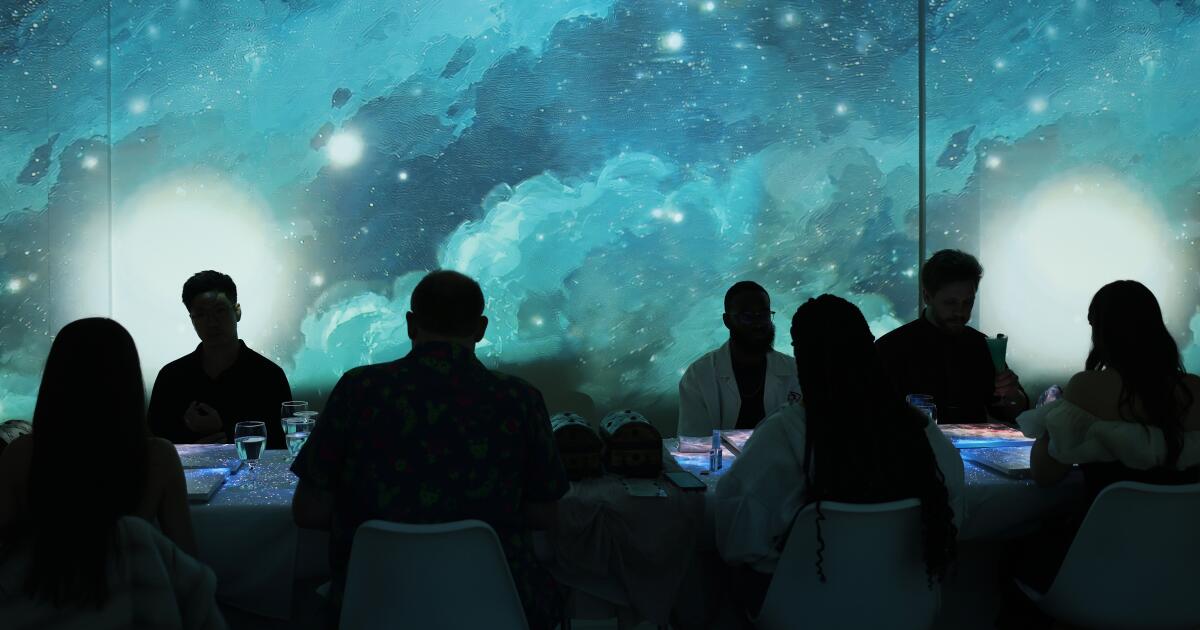
My dinner course is served. It is a Campbell’s-inspired soup can, lightly angled so strands of broccoli are peeking out. I lift the can to uncover a slow-braised short rib and mashed potatoes. An American dish to represent an American artist, here Andy Warhol.
The room is overtaken with projections, scenes of bustling New York traffic paired with bachelor-pad-like guitar riffs. Shown on a wall above a dinner table is a selection of Warhol silkscreens. It’s a Friday night in West Hollywood, and I’m surrounded by a mix of out-of-towners and those celebrating an anniversary. And while this is a special occasion, we’re urged to get a little messy with our food — to use our hands, to paint with a salad, to draw on a cookie.
The main course: A tomato soup can? “7 Paintings” is an immersive event that occasionally hides dishes in artist-inspired presentations.
(Christina House / Los Angeles Times)
Play is the primary side dish at “7 Paintings,” a tech-infused dinner theater that aims to be a crash course in fine art. That selection of veggies paired with multiple mini cups of colorful dressings? Guests are encouraged to mix and match the vinaigrettes into a mess of hues, a nod to abstractionist Jackson Pollock. And yellowfin tuna with dashes of avocado and taro chips? That’s an edible tribute to Banksy, of course. What does raw fish have to do with stenciled street art? It’s bold, heavily angled and has a short shelf life? Maybe? Perhaps don’t overthink it.

Even the paper is edible.
(Christina House / Los Angeles Times)
“Have you ever eaten a painting before?” says Nadine Beshir, the Dubai-based creator of “7 Paintings.” “We try to get people out of their comfort zones and eating paper. I want to bring out the child in them.”
“7 Paintings,” held at Sunset House L.A. through the end of August, is the latest example of immersive dining to arrive in this city. These experiences often involve guest participation and are accentuated with advanced multimedia technology and sometimes theatrical elements.
Worldwide, there have been standouts. For instance, Eatrenalin at Germany’s Europa-Park, a dining room-meets-ride where participants are whisked around the space on trackless “floating chairs,” has just received a coveted Michelin star. Ibiza’s Sublimotion has similar haute ambitions, pairing 12 diners together in a room that will come alive with otherworldly projections and performers. At times, diners will win don virtual reality headgear.
But tech-driven immersive dining experiences have never quite taken off in Los Angeles as a trend. Last year, the Gallery, where fantastical cityscapes and projections surrounded downtown L.A. diners, stood just a couple months before the concept was abandoned.

“7 Paintings” pairs food with art and music. It’s “fun dining, not fine dining,” says its founder.
(Christina House / Los Angeles Times)

Bartender Luca Famulari shakes a cocktail at the immersive dining event.
(Christina House / Los Angeles Times)
“The economics of a restaurant are not the same as the economics of theater and the challenge of combining the two lies in thinking outside the box with respect to pricing and cost structure, such that the customer perceives high value from both the food and the experience,” says the Gallery co-founder Daren Ulmer.
Entrepreneurs keep aiming for that careful balance. “Le Petit Chef and Friends” is currently running at Tangier at downtown’s Hotel Figueroa, an event in which a fully animated film is projected on our plates and tables. Long-running pop-up event Fork N’ Film leans more dinner and movie, pairing dishes directly inspired by what is happening on screen. Upcoming films include “Ratatouille” and “Lilo and Stitch.”
The field comes with challenges. “The costs are very high,” says Joanna Garner, an immersive designer and former creative director with experiential art firm Meow Wolf. Garner has been experimenting herself with communal, immersive dinner events, and her next, the flirtatious “Please Open Your Mouth,” is set for July 11. (No tech there, as Garner is after a more sensual, adult-focused gathering.) Tickets for her event are $150 and a spot in the “7 Paintings” dining room runs $175, priced on par with a number of city’s most acclaimed restaurants.
There is also the reality that all public dining is in some fashion immersive, usually requiring varying combinations of engagement, communication and presentation. And then, are all these added elements distracting?

An animated Mona Lisa sits on the wall as guests enjoy their meals. Throughout the dinner, the painting provides factoids on various artists.
(Christina House / Los Angeles Times)
Throughout “7 Paintings,” for instance, an animated Mona Lisa, situated on the wall next to the main dinner table, will provide brief biographical details of each artist represented.
“Being able to nail the food, and nail the story, those are two very difficult threads to weave,” Garner says. “I do think, ultimately, people come to a dinner table to talk to the people at the table and to have intimate experiences. To have an experience where you’re constantly being taken away from the food, I’m not so sure if that’s what people are looking for.”
Food is framed as a star of “7 Paintings” but tasting it is just one component. At one point, we must uncover a cheese course in a tiny treasure chest, the code for the lock hidden in the projections (don’t stress, it’s not a hard puzzle). Beshir highlights the Pollock-inspired salad course, which is accentuated with a jazz soundtrack, as the thesis of the evening.
1

2

1. A guest uses a silicon brush to apply sauces onto an entree, a nod to abstractionist Jackson Pollock. 2. Projections fill up the dining table during meals.
“This course is really about getting people to free their minds from preconceived ideas,” Beshir says. “Like, you have to eat with a fork and knife, or the salad comes and then the dressing. No, the dressing comes and then the salad, and it’s trying with big brushes to paint the way he did. A lot of people do not understand Abstract Expressionism, and they think it’s people just splashing colors around. But when you understand the link between the rhythm of the music and painting, you live it. We give you time to paint with your salad dressing.”
In L.A., Beshir has partnered with nightlife impresario Kim Kelly, who is plotting a “Sleep No More”-inspired walk-around theatrical show for the Sunset House venue later this year. “7 Paintings,” however, is fully seated, and purposefully a little silly. Beshir and Kelly have been evolving it during its L.A. run, recently adding a stronger painting component by giving guests their own canvas to work on throughout the evening. Each night crowns a winner.
“Everyone comes over to look at their art,” Kelly says. “It just kind of changed the whole thing, to be honest. People are now being creative throughout the entire evening. Instead of just watching and occasionally painting, you’re now painting the whole time.”
As for what, perhaps, soba noodles with edamame and mushrooms have to do with Pablo Picasso, or why Salvador Dali gets an unexpected dessert course of a white chocolate potato souffle, Beshir clarifies the goal of the evening. While the animated Mona Lisa will provide backstories on each painter, this isn’t an educational night. “It’s fun dining, not fine dining,” Beshir says.
And by the end of my night, strangers were socializing, showing off their painted cookie creations, sharing Banksy tidbits and asking for recommendations on various vinaigrette combinations. Ultimately, it’s an evening of discovery, packed with surprises like finding an entire course hidden under a canvas.

Darryl Mayes of Charlotte, N.C., left, and Taylor Smith of North Hollywood, right, uncover their course.
(Christina House / Los Angeles Times)
“We try not to have too much sophistication, like fried ants or something. I’m personally very adventurous in how I eat, but if I want to have this in 100 cities around the world, I cannot be too meticulous.”
And Beshir has big goals.
“I want this be your movie and dinner thing,” Beshir says. “I want people to be waiting for our next show, and to be able to afford to come every couple months.”
And to come home not with leftovers, but perhaps a painting of their own.
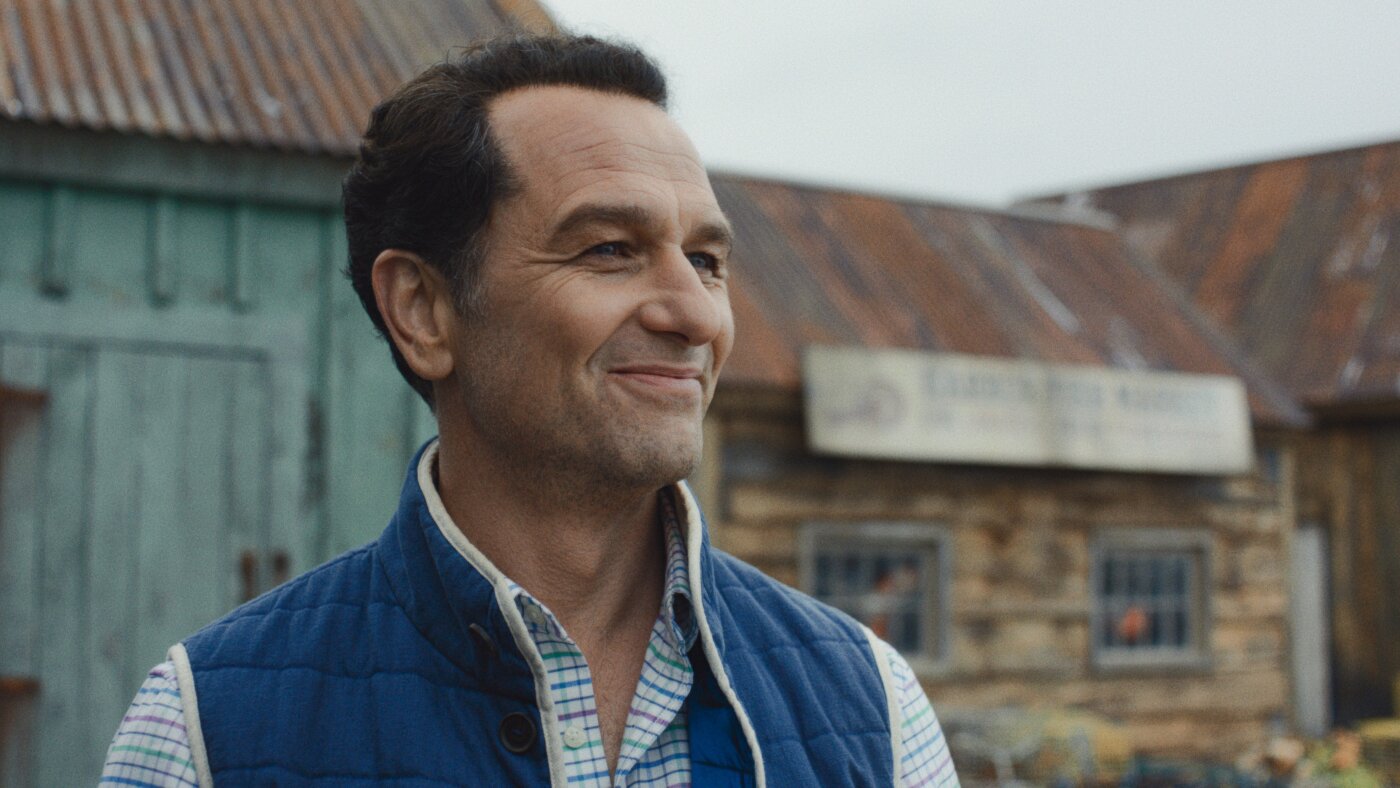
Matthew Rhys was nominated for his role in Widow’s Bay.
Apple TV
hide caption
toggle caption
Apple TV
The 2026 Emmy nominations are here. We’re unpacking the record-breaking nominations for Hacks, plus a big day for Widow’s Bay, The Pitt, and The Bear. We’ll also talk about the snubs and make some early predictions of who will win.
Connect with Pop Culture Happy Hour:
Letterboxd / Facebook
Our weekly newsletter
Support Pop Culture Happy Hour+

-

 Technology2 minutes ago
Meta is reportedly working on smart glasses that would be recording all the time
-

 World9 minutes ago
Trump says ‘Iran lies and cheats’ as IRGC emerges as dominant force in negotiations with US
-

 Politics13 minutes ago
Who is Valli Geiger? Meet the Maine Dem that Platner urged to run for Senate
-

 Health17 minutes ago
Deadly Legionnaires’ disease outbreak sparks concern in major US city: Know the symptoms
-

 Sports24 minutes ago
Caitlin Clark’s return falls flat after Fever coach limits her in loss to shorthanded Sparks
-
Business32 minutes ago
Commentary: Trump wants to let companies make fewer disclosures, thus keeping investors in the dark
-
 Entertainment39 minutes ago
Justin Baldoni and wife break silence after ‘It Ends With Us’ legal battle with Blake Lively
-
Lifestyle42 minutes ago
A meal with an animated Mona Lisa? Immersive dining goes high tech — but will L.A. eat it up?

