Sports
'One of the worst things': How Grigor Dimitrov shook off 'Baby Fed' label to find himself


A decade has passed since Grigor Dimitrov announced himself to the wider tennis world. It was the summer of 2014, and in the space of a few weeks, Dimitrov won the title at Queen’s and beat defending champion Andy Murray at Wimbledon, to reach the semifinals. He was 23 — gregarious, glamorous and the boyfriend of tennis royalty in Maria Sharapova.
Such was Dimitrov’s talent and magnetism that he was quickly hailed as the future of the sport. With his silky-smooth technique and single-handed backhand, he was even given the nickname “Baby Fed” — no small name to live up to, at a time when Roger Federer had already won seven of his eight Wimbledon titles.
It’s a comparison that Dimitrov came to strongly dislike.
“Honestly, I found it funny at the beginning, and then I started… not hating it but I didn’t like it because there was no point to it,” he tells The Athletic 10 years on from that spectacular summer. “We’re so different and we have some resemblances but we’re really not the same people and I think it was so unnecessary. One wish I would have for a young kid is not to be compared to someone. I think it was probably one of the worst things I had to deal with in my career.
“I never liked it and it never brought me any good. Of course I’m flattered but I always wanted to be my own person.”
Grigor Dimitrov in the 2014 Wimbledon semifinal that he lost to Novak Djokovic. (Al Bello / Getty Images)
A decade on from his first Grand Slam semifinal, still the furthest he has ever gone at a major, Dimitrov’s story arc has an enticingly simple shape that is not representative of everything that constitutes it. From a distance, it appears to trace a classic case of someone being overhyped, unable to fulfil their rich potential: a player who made three Grand Slam semifinals and four further quarterfinals, but never kept the promise of winning one.
In reality, it’s more complicated, illustrated by the fact that Dimitrov will arrive at Wimbledon next week looking rejuvenated and, despite a disappointingly early exit at Queen’s last week, playing possibly the best and most consistent tennis of his career since the dog days of summer 2014. There have been notable highs as well as the crushing lows in the Bulgarian’s last decade: Dimitrov reached those other Grand Slam semifinals, at the Australian Open in 2017 and the US Open in 2019, and after that January 2017 run in Melbourne, he ended the year by winning the ATP Finals and securing a career-high ranking of No 3.
Now, he is back in the world’s top 10 for the first time in six years; 2024 has brought his first title since 2017 and a final in Miami that he reached by dismantling Carlos Alcaraz along the way.
He has been one of the tour’s most reliable performers all year, reaching the quarterfinals at Roland Garros in May to make it a last-eight appearance at all four Grand Slam tournaments, even if the nature of his ultimate exit, a heavy straight-sets defeat to Jannik Sinner, felt disappointingly reminiscent of many of his defeats in the latter stages of Grand Slams: a loss to a higher-ranked and ultimately better player.
Back in 2014, that was also the story of his Wimbledon semi-final defeat to Novak Djokovic, and even if a decade on he is not the Grand Slam champion that everyone assumed he would become, at 33 that door is not yet closed. At Wimbledon, he will be among a select few top players who feels comfortable on grass.
“It’s been great so far,” he says. “I’ve done a lot of things right, and I feel in a good place.”
A strong end to 2023 foreshadowed Dimitrov’s positive 2024, including a semifinal and a final at the Shanghai and Paris Masters respectively. Those results brought him a year-end ranking of No 14, comfortably his best since 2017; in the intervening seven years, his year-end ranking has bobbed frustratingly between No 19 and No 28.
Dimitrov puts his upturn down to a combination of factors: a new coaching team; a change in mentality; and learning to best deploy the fitness and experience he has accumulated over his 16-year professional career.
Dimitrov has been working with Andy Murray’s former coach Jamie Delgado since the end of 2022, when he also brought back former charge Dani Vallverdu. Vallverdu is another of Murray’s previous coaches, and a man with whom Dimitrov has tended to enjoy his best results.
“Jamie’s been amazing,” Dimitrov says.
“He has so much experience, that he really helps me to look at myself from a different perspective. That automatically gives me a good mentality to look forward and experience the game a bit differently.”
Dimitrov adds that he’s always been self-critical, ever since he was a kid being put through his paces by his dad. “I get very hard on myself and he (Delgado) is the one who always keeps me on a good level, to navigate myself a bit more.”

A typically silky volley during his Miami Open run this year. (Michele Eve Sandberg / Icon Sportswire via Getty Images)
The highlight of 2024 so far was a 6-2, 6-4 thumping of then Wimbledon, and now French Open, champion Alcaraz in the Miami quarter-finals in March. The shellshocked Spaniard said afterwards that: “He made me feel like I’m 13 years old. It was crazy. I was talking to my team saying that I don’t know what I have to do. I don’t know his weakness.”
Dimitrov laughs when reminded of the “13 years old” quote, and says it was one of those rare matches when every single thing you try comes off. Coming from as skilled a shotmaker as Dimitrov, that rarity makes for one hell of a spectacle — including drop volleys on the stretch, screaming passing shots and return winners from both wings.
“I played an amazing match, it happens — when whatever you touch turns to gold,” Dimitrov says. “They’re very rare but when they come, take them, and that was one of those matches.
“I know that when I’m playing tennis like that it’s extremely difficult to beat me. There was a reason I got to the final of that tournament.”
What’s it like being in that kind of zone? “It’s the flow, a state of mind,” Dimitrov says.
“It’s very difficult to achieve. It’s happened to me more than a few times in a career, but it’s very difficult to tap into on a daily basis. One of those things that once you’ve experienced it, it sucks when it doesn’t come again. You get so frustrated with it.
“I’ve heard so many athletes from different sports saying they’ve had it, and then they’ve never been able to have it again. I feel like I’m one of the lucky ones, that I’ve been able to do it a few times in my career.
“When you activate that mode you know nothing can go wrong.”
To get to his current state of contentment, Dimitrov has had to endure some hardships.
The match that torments him the most is a five-set loss to Nadal in the Australian Open semi-final seven years ago. Even now Dimitrov can’t understand how he didn’t win, to the point that he misremembers what actually happened. In Dimitrov’s telling, “I was 4-2 up in the fifth,” but he wasn’t — the closest he got was two break points at 4-3 which would have left him serving for the match. Both of which were saved not by Dimitrov mistakes, but by Nadal playing out of his mind.
“The match with Rafa took me seven or eight months to get over,” Dimitrov says.
“I often felt like there were invisible powers that tipped it over. I was 4-2 up in the fifth and played an amazing… there was no way I could lose the match, and yet I lost the match.”
How did he finally get over it?
“Mental strength, overall,” Dimitrov says.

Dimitrov and Nadal after that match that the Bulgarian still can’t comprehend. (Greg Wood / AFP via Getty Images)
“You try to build on your own experiences, ask yourself questions. I’ve always been a believer that you have to speak to someone — whether it’s professionals, family or friends — I think it’s a vital thing for us to do and that should come from within yourself. Talking doesn’t mean anything unless you make the first step.”
He ultimately rebounded in style, winning the 2017 ATP Finals that November — the biggest title of his career and his last until triumphing in Brisbane in January this year. Casting his mind further back, Dimitrov says that he is “a completely different person and player” from his original breakout in 2014.
The perception of him at that time was one of pure showbusiness. He was already rumoured to have dated Serena Williams when his relationship with Sharapova helped to make him one of the most talked-about players on the tour. Now, Dimitrov is philosophical about the direction his career has taken and what he’s learned from the last 10 years.
“A lot has changed,” he says. “There comes a point where I had to make some tough decisions on and off the court.
“Sometimes with my coaching team, sometimes there were things I had to focus on outside of tennis. It’s life. For me, part of growing as a human is you have basic experiences, which I didn’t really have, being a tennis player.
“I always wanted to make sure that I did have those things and maybe that’s why at times they were taking me away from the game. But I definitely don’t regret it.”
Is that something away from the court?
“Things that don’t have much to do with the sport itself, which of course takes your mind away. Once your mind is going in a different direction, inevitably you get to a different place.”
Having spent so long navigating fulfilment on and off the court, does Dimitrov feel he has the right balance now?
“I think so, but I don’t like to say balance because what does that really mean?” he asks.
“To be the best in the sport you have to be obsessed, that’s how it is. To a point where you don’t have much margin for error. So when you look from that perspective, it’s pretty difficult.
“But I think I’m navigating myself better with things, and I also know that at the moment I’m way closer to the end than the beginning, and that also gives you a very different perspective.”
Because of Dimitrov’s geniality off the court — he’s a very popular locker-room presence — and his lack of killer instinct in some of his biggest matches, it’s been tempting to characterise him as someone lacking ruthlessness. He doesn’t feel that way.
“If I didn’t have it, I wouldn’t be here right now. And I think to have it something must have happened with you — like a bad experience that pushes you over the edge, that after you’re like, ‘OK, we’re on now.’
“I had that, of course. Both on and off the court. I had many of those experiences and I’m very grateful for them. Some of them have been extremely hard but it’s part of the game and part of life. I always link the game, our sport, to our life. I think they go hand-in-hand — it teaches you life as well.”

Sharapova and Dimitrov at Wimbledon in 2018. (TPN / Getty Images)
Part of that hand-in-hand relationship has led him to consider his views on what it means to be selfish and ruthless as a tennis player, whether in pursuit of wider goals or individual points, while still knowing how to behave. “Selfishness (for an athlete) goes without saying but it’s a fine line between it being a bad kind and a good kind,” he says. “I could have been more selfish with some decisions I had to make, but I’m contradicting myself a little bit because I always wanted to grow as a person, and now I’m kind of bitching on it.
“Ruthlessness, of course, that’s how it is. You want to win. You can be the nicest guy off the court but on it you can be a total… That’s the bit I find, I don’t know if it’s difficult with some players but I make sure I say something because I think it’s also vital for our sport to have a good etiquette in that way.”
Dimitrov takes his role as one of the more experienced heads on the tour seriously. He is part of the ATP Player Advisory Council for the second year running and outside of Djokovic is the oldest player in the world’s top 20. Dimitrov believes that tapping into all the experience he has accumulated means that “of late I’ve been able to win some matches maybe I shouldn’t”.
He also says he’s learned not to bother competing unless he’s ready to give everything. “The place where I’m at in my career, I have the luxury that I can pick and choose,” he says. That also allows him to be always looking for an edge, with more time to put any benefits into practice. He’s recently started working with a sleep consultant to help with one of the most important, and often overlooked, areas of a player’s wellbeing.
Outside of tennis, Dimitrov enjoys pursuing his passion for art collection. “I have developed a very good relationship with some galleries — in England, in LA, so it’s been a really interesting time for me,” he says. Living in Monte Carlo, Dimitrov also enjoys driving cars and motorbikes; the relentlessness of the tennis circuit means he can only get back to his native Bulgaria two or three times a year.
For the moment, Dimitrov’s focus is on maintaining the good start he’s made to 2024 at Wimbledon. “This period is always a bit more tricky, with a few tough tournaments,” he says. “It’s the time of the year when you have to give everything you have.”
(Top photos: Shi Tang; Paul Gillam / Getty Images; Design: Eamonn Dalton for The Athletic)



NEWYou can now listen to Fox News articles!
The 2026 FIFA World Cup is almost here, and fans stateside are starting to feel the excitement.
For the next month, some of the best soccer players and teams the world has to offer will duke it out on North American soil for the right to hoist the World Cup.
The U.S. Men’s National Team in particular is an exciting young soccer squad that is looking to make some noise on their home turf, and their road to the knockout stage couldn’t have been much easier (with all due respect to their fellow group members).
Folarin Balogun #20 of United States celebrates with teammates after scoring during the second half of the international friendly match between United States and Senegal at Bank of America Stadium on May 31, 2026 in Charlotte, North Carolina. (Cory Knowlton/ISI Photos/ISI Photos via Getty Images)
The Stars and Stripes will begin their quest for a World Cup on Friday, June 12, at 9 p.m. Eastern against Paraguay in Los Angeles.
US MEN’S NATIONAL TEAM GETS FAVORABLE GROUP MATCHUPS AT WORLD CUP DRAW
The Paraguayans will be making their return to the World Cup stage for the first time since 2010, and have been giant killers throughout their qualifying rounds, taking down the likes of South American heavyweights Uruguay, Argentina and Brazil.
Next on the docket, the U.S. will face off against Australia on Friday, June 19, at 3 p.m. Eastern in Seattle.
The Socceroos will try their best to muck it up and play a very defensive brand of soccer against America, while also boasting a great goalkeeper in Matthew Ryan.
SEATTLE, VANCOUVER COORDINATE CROSS-BORDER PLANNING FOR 2026 WORLD CUP TOURISM
Tyler Adams of the United States looks on before the FIFA World Cup Qatar 2022 Round of 16 match between the Netherlands and the United States at Khalifa International Stadium in Doha on Dec. 3, 2022. (Maddie Meyer/FIFA/Getty Images)
Goals will be at a premium for anyone who plays Australia in this tournament.
To conclude group play, the United States will play Turkey on Thursday, June 25, at 10 p.m. Eastern back in Los Angeles.
Fresh off a quarterfinals appearance in Euro 2024, this is a very talented Turkey who may not have the star power of a France or Brazil, but will be a very dangerous out for anyone in the World Cup.
ZERO BS. JUST DAKICH. TAKE THE DON’T @ ME PODCAST ON THE ROAD. DOWNLOAD NOW!
Team USA fans celebrate with a flag during the soccer game between the United States and Panama at Mercedes-Benz Stadium in Atlanta, Ga., on June 27, 2024. (David J. Griffin/Icon Sportswire)
Though the subject of who moves on may already be decided when Türkiye and the United States square off, these are the two heavyweights of Group D and should make for an exciting conclusion to group play.
All three games will be streaming on Fox Sports and Fox One, with both the Australia and Paraguay matchups available on Fox (blackout restrictions may apply).
CLICK HERE TO DOWNLOAD THE FOX NEWS APP
Additionally, the U.S.-Paraguay matchup will be available for free on Tubi.
Happy World Cup, everyone, and go, go USA!
Sports
World Cup referee, denied entry to U.S. because of suspected ties to terrorists, hailed in return to Somalia
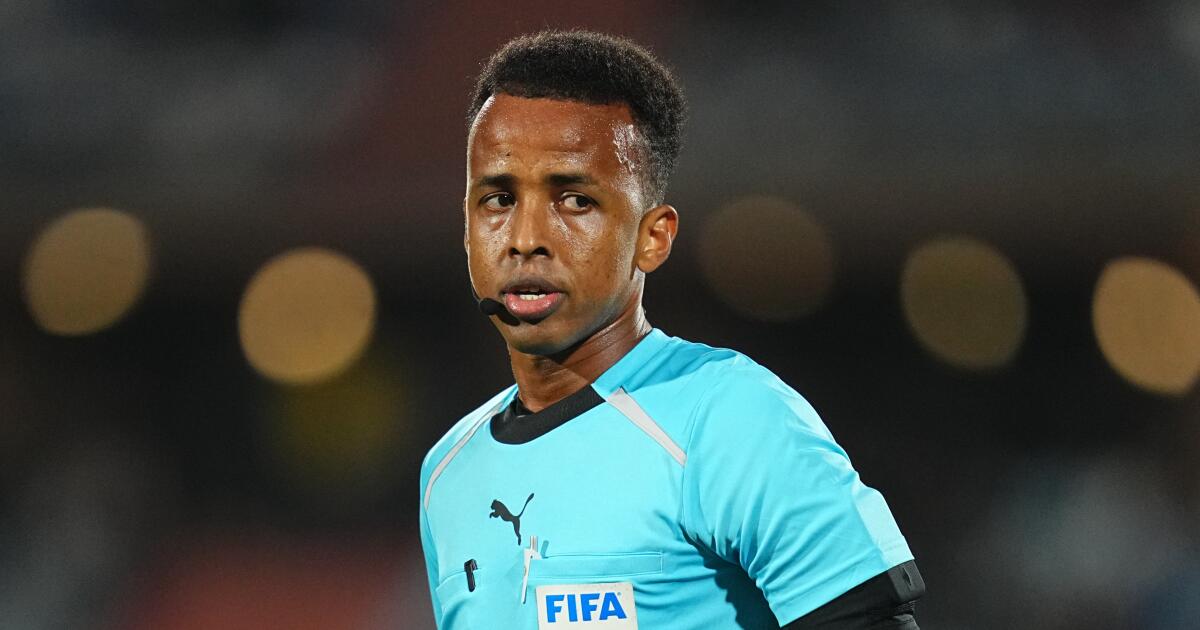
Somali referee Omar Abdulkadir Artan was denied entry into the United States for the World Cup after enduring an 11-hour interrogation in Miami, according to media reports. Andrew Giuliani, head of the White House Task Force on the World Cup, indicated Artan was suspected to having ties to a Somali militant group.
“We want to make sure we are not going to allow a soccer tournament to be the opportunity for terrorists to potentially get in the country or anybody who is actually talking to them,” Giuliani told the British Broadcasting Corporation.
The New York Times reported that Artan’s name is similar to that of a man identified as linked to Al Shabab, a group that has been the target of U.S. government sanctions.
“I am very, very disappointed,” Artan told the Times from Istanabul, where he stopped on his way back to Somalia. “I’m just simply a referee who’s trying to live his dream, the biggest dream of my life, to come to the World Cup.”
Safety was purportedly the concern with Artan, whose interrogation was conducted by the U.S. Customs and Border Protection.
“During processing, the traveler underwent additional inspection, a routine part of CBP’s inspection process when officers need to verify information or determine admissibility,” CBP said in a statement. “Following inspection, the traveler, a referee for the FIFA World Cup, was determined to be inadmissible due to vetting concerns and was denied entry.”
Somalia is on the U.S. list of banned countries for immigration, although exceptions can be made. Artan is considered one of the best referees in Africa, having officiated in the Somali national football league championship and at the African Cup of Nations.
“Despite the circumstances, I am in a positive mood and focused on the next challenges in my refereeing career,” Artan said in a statement. “I would like to thank FIFA and [the African federation] for all their support and I promise to keep my refereeing levels up as I concentrate on the future.”
Artan, Africa’s Referee of the Year in 2025, was greeted Wednesday at Aden Adde International Airport in Somalia by government officials and hundreds of well-wishers.
“I want to thank FIFA for supporting me all the way, and for Somali people also,” he told Al Jazeera. “So I am very grateful for FIFA and for CAF also. This is what I have to say.”
Sports
Jordan Staal’s two-goal night lifts Hurricanes past Golden Knights, evening Stanley Cup Final series

Tyler Reddick Makes History! Inside His 3-Peat and Historic Start to the Season
Fresh off his victory at Circuit of the Americas, Tyler Reddick joins Kevin Harvick on this week’s Victory Lap to break down his historic third consecutive NASCAR Cup Series win to open the 2026 season. Reddick discusses how he and 23XI Racing have built early-season momentum, what has clicked across the organization, and how the team has elevated its performance to championship level. He details his intense battle with road course standout Shane van Gisbergen at COTA, the strategy and execution that helped him secure the win, and what it means to become the first Cup driver to win the first three races of a season. Reddick also reflects on his viral 3-peat photo tribute to team owner Michael Jordan, the confidence inside the garage, and how this dominant start shapes expectations for the rest of the year.
NEWYou can now listen to Fox News articles!
The Carolina Hurricanes have evened up the Stanley Cup Final once more thanks to Jordan Staal’s two-goal night in Las Vegas to beat the Golden Knights in Game 4, 5-3.
The series now sits at 2-2 with Game 5 slated for a return back to Carolina’s Lenovo Center on Thursday to see who will have the edge in this pivotal clash on ice.
This game didn’t need overtime like the previous two, but it did need someone to break the 3-3 tie that went into the third period between these opponents.
Jordan Staal of the Carolina Hurricanes celebrates his power play goal with teammates against the Vegas Golden Knights during the first period of Game Four of the Stanley Cup Final at T-Mobile Arena in Las Vegas, Nev., on June 9, 2026. (Brian Babineau/NHLI via Getty Images)
With 13:39 left in Game 4, Shea Theodore made a disastrous turnover in the Golden Knights’ own zone, and Hurricanes star Seth Jarvis picked it off right in front of the net.
Luckily for Vegas, Carter Harter stopped Jarvis’ backhand, but the threat wasn’t averted just yet. Jarvis battled to get the puck back out in front, and it ended up trickling to the stick of Nikolaj Ehlers, who tried flipping it to Staal.
SETH JARVIS SCORES OVERTIME GAME-WINNER AS HURRICANES STORM BACK FROM 2-0 DEFICIT TO EVEN STANLEY CUP FINAL
Staal lost his edge on his skate, but that didn’t stop him from swatting a back-handed shot of his own toward the net. It just trickled past Hart, and Staal celebrated while still down on the ice. He became the first player in 44 years to score a goal in each of the first four games of the Stanley Cup Final.
With the way these games have been going, though, a one-goal lead was not safe. This time, however, the Hurricanes had the defense and timely saves by Brandon Bussi, who head coach Rod Brind’Amour went with over Frederik Anderson, and the decision paid off.
The Golden Knights took 20 shots on goal, with Bussi saving 7 in his first time on ice for Carolina in this series. And Ehlers sealed victory when he cleverly banked the puck out of his own zone with an empty net on the other end that walked into the net for the 5-3 win.
Jordan Staal of the Carolina Hurricanes scores a first-period goal against Carter Hart of the Vegas Golden Knights in Game Four of the 2026 Stanley Cup Final at T-Mobile Arena in Las Vegas, Nev., on June 9, 2026. (Bruce Bennett/Getty Images)
The Hurricanes came out roaring in the first period in this one as well, scoring three goals to the Golden Knights’ one by captain Mark Stone. Logan Stankoven notched his 11th of these playoffs just 1:06 into the game. Jackson Blake quickly followed on a goal assisted by Taylor Hall and Ehlers.
Then, Staal’s first goal of the game came 12:48 into the period on a power play. Shayne Gostisbehere ripped a shot on goal, and after Hart made the save, Staal was first to find the puck and a clear shot right in front of the goal.
With a 3-1 lead after the first 20 minutes, the Hurricanes had to feel good. But again, no lead is safe, and Vegas reminded them of that in the second period.
Logan Stankoven of the Carolina Hurricanes celebrates after scoring a first-period goal against the Vegas Golden Knights in Game Four of the 2026 Stanley Cup Final at T-Mobile Arena in Las Vegas, Nevada, on June 9, 2026. (Bruce Bennett/Getty Images)
CLICK HERE TO DOWNLOAD THE FOX NEWS APP
William Karlsson got Vegas closer with his third goal of the playoffs, while Brett Howden, adding to his case for the Conn Smythe Trophy, scored his 14th to tie it all up at three.
In the end, Staal’s heroics for the Hurricanes is why he has a “C” on his sweater.
Follow Fox News Digital’s sports coverage on X and subscribe to the Fox News Sports Huddle newsletter.
-

 Technology3 minutes ago
Claude Fable is too scared to teach you about the powerhouse of the cell
-

 World8 minutes ago
World court prosecutor who went after Netanyahu for war crimes suspended over sexual misconduct
-

 Politics15 minutes ago
Republicans fear of ‘fatal mistake’ in must-win Platner race
-

 Health18 minutes ago
Americans born after 1970 face higher death rates from several major causes in middle age
-

 Sports23 minutes ago
Tracking America’s World Cup journey: How and when to watch the US Men’s National Team
-

 Technology30 minutes ago
Texas mom jailed over dirty water Facebook post
-
 Business33 minutes ago
Rivian begins deliveries of cheaper electric vehicles
-
 Entertainment38 minutes ago
Glen Walker is returning to broadcast news, months after being cut from KTLA

