Sports
'One of the worst things': How Grigor Dimitrov shook off 'Baby Fed' label to find himself


A decade has passed since Grigor Dimitrov announced himself to the wider tennis world. It was the summer of 2014, and in the space of a few weeks, Dimitrov won the title at Queen’s and beat defending champion Andy Murray at Wimbledon, to reach the semifinals. He was 23 — gregarious, glamorous and the boyfriend of tennis royalty in Maria Sharapova.
Such was Dimitrov’s talent and magnetism that he was quickly hailed as the future of the sport. With his silky-smooth technique and single-handed backhand, he was even given the nickname “Baby Fed” — no small name to live up to, at a time when Roger Federer had already won seven of his eight Wimbledon titles.
It’s a comparison that Dimitrov came to strongly dislike.
“Honestly, I found it funny at the beginning, and then I started… not hating it but I didn’t like it because there was no point to it,” he tells The Athletic 10 years on from that spectacular summer. “We’re so different and we have some resemblances but we’re really not the same people and I think it was so unnecessary. One wish I would have for a young kid is not to be compared to someone. I think it was probably one of the worst things I had to deal with in my career.
“I never liked it and it never brought me any good. Of course I’m flattered but I always wanted to be my own person.”
Grigor Dimitrov in the 2014 Wimbledon semifinal that he lost to Novak Djokovic. (Al Bello / Getty Images)
A decade on from his first Grand Slam semifinal, still the furthest he has ever gone at a major, Dimitrov’s story arc has an enticingly simple shape that is not representative of everything that constitutes it. From a distance, it appears to trace a classic case of someone being overhyped, unable to fulfil their rich potential: a player who made three Grand Slam semifinals and four further quarterfinals, but never kept the promise of winning one.
In reality, it’s more complicated, illustrated by the fact that Dimitrov will arrive at Wimbledon next week looking rejuvenated and, despite a disappointingly early exit at Queen’s last week, playing possibly the best and most consistent tennis of his career since the dog days of summer 2014. There have been notable highs as well as the crushing lows in the Bulgarian’s last decade: Dimitrov reached those other Grand Slam semifinals, at the Australian Open in 2017 and the US Open in 2019, and after that January 2017 run in Melbourne, he ended the year by winning the ATP Finals and securing a career-high ranking of No 3.
Now, he is back in the world’s top 10 for the first time in six years; 2024 has brought his first title since 2017 and a final in Miami that he reached by dismantling Carlos Alcaraz along the way.
He has been one of the tour’s most reliable performers all year, reaching the quarterfinals at Roland Garros in May to make it a last-eight appearance at all four Grand Slam tournaments, even if the nature of his ultimate exit, a heavy straight-sets defeat to Jannik Sinner, felt disappointingly reminiscent of many of his defeats in the latter stages of Grand Slams: a loss to a higher-ranked and ultimately better player.
Back in 2014, that was also the story of his Wimbledon semi-final defeat to Novak Djokovic, and even if a decade on he is not the Grand Slam champion that everyone assumed he would become, at 33 that door is not yet closed. At Wimbledon, he will be among a select few top players who feels comfortable on grass.
“It’s been great so far,” he says. “I’ve done a lot of things right, and I feel in a good place.”
A strong end to 2023 foreshadowed Dimitrov’s positive 2024, including a semifinal and a final at the Shanghai and Paris Masters respectively. Those results brought him a year-end ranking of No 14, comfortably his best since 2017; in the intervening seven years, his year-end ranking has bobbed frustratingly between No 19 and No 28.
Dimitrov puts his upturn down to a combination of factors: a new coaching team; a change in mentality; and learning to best deploy the fitness and experience he has accumulated over his 16-year professional career.
Dimitrov has been working with Andy Murray’s former coach Jamie Delgado since the end of 2022, when he also brought back former charge Dani Vallverdu. Vallverdu is another of Murray’s previous coaches, and a man with whom Dimitrov has tended to enjoy his best results.
“Jamie’s been amazing,” Dimitrov says.
“He has so much experience, that he really helps me to look at myself from a different perspective. That automatically gives me a good mentality to look forward and experience the game a bit differently.”
Dimitrov adds that he’s always been self-critical, ever since he was a kid being put through his paces by his dad. “I get very hard on myself and he (Delgado) is the one who always keeps me on a good level, to navigate myself a bit more.”

A typically silky volley during his Miami Open run this year. (Michele Eve Sandberg / Icon Sportswire via Getty Images)
The highlight of 2024 so far was a 6-2, 6-4 thumping of then Wimbledon, and now French Open, champion Alcaraz in the Miami quarter-finals in March. The shellshocked Spaniard said afterwards that: “He made me feel like I’m 13 years old. It was crazy. I was talking to my team saying that I don’t know what I have to do. I don’t know his weakness.”
Dimitrov laughs when reminded of the “13 years old” quote, and says it was one of those rare matches when every single thing you try comes off. Coming from as skilled a shotmaker as Dimitrov, that rarity makes for one hell of a spectacle — including drop volleys on the stretch, screaming passing shots and return winners from both wings.
“I played an amazing match, it happens — when whatever you touch turns to gold,” Dimitrov says. “They’re very rare but when they come, take them, and that was one of those matches.
“I know that when I’m playing tennis like that it’s extremely difficult to beat me. There was a reason I got to the final of that tournament.”
What’s it like being in that kind of zone? “It’s the flow, a state of mind,” Dimitrov says.
“It’s very difficult to achieve. It’s happened to me more than a few times in a career, but it’s very difficult to tap into on a daily basis. One of those things that once you’ve experienced it, it sucks when it doesn’t come again. You get so frustrated with it.
“I’ve heard so many athletes from different sports saying they’ve had it, and then they’ve never been able to have it again. I feel like I’m one of the lucky ones, that I’ve been able to do it a few times in my career.
“When you activate that mode you know nothing can go wrong.”
To get to his current state of contentment, Dimitrov has had to endure some hardships.
The match that torments him the most is a five-set loss to Nadal in the Australian Open semi-final seven years ago. Even now Dimitrov can’t understand how he didn’t win, to the point that he misremembers what actually happened. In Dimitrov’s telling, “I was 4-2 up in the fifth,” but he wasn’t — the closest he got was two break points at 4-3 which would have left him serving for the match. Both of which were saved not by Dimitrov mistakes, but by Nadal playing out of his mind.
“The match with Rafa took me seven or eight months to get over,” Dimitrov says.
“I often felt like there were invisible powers that tipped it over. I was 4-2 up in the fifth and played an amazing… there was no way I could lose the match, and yet I lost the match.”
How did he finally get over it?
“Mental strength, overall,” Dimitrov says.

Dimitrov and Nadal after that match that the Bulgarian still can’t comprehend. (Greg Wood / AFP via Getty Images)
“You try to build on your own experiences, ask yourself questions. I’ve always been a believer that you have to speak to someone — whether it’s professionals, family or friends — I think it’s a vital thing for us to do and that should come from within yourself. Talking doesn’t mean anything unless you make the first step.”
He ultimately rebounded in style, winning the 2017 ATP Finals that November — the biggest title of his career and his last until triumphing in Brisbane in January this year. Casting his mind further back, Dimitrov says that he is “a completely different person and player” from his original breakout in 2014.
The perception of him at that time was one of pure showbusiness. He was already rumoured to have dated Serena Williams when his relationship with Sharapova helped to make him one of the most talked-about players on the tour. Now, Dimitrov is philosophical about the direction his career has taken and what he’s learned from the last 10 years.
“A lot has changed,” he says. “There comes a point where I had to make some tough decisions on and off the court.
“Sometimes with my coaching team, sometimes there were things I had to focus on outside of tennis. It’s life. For me, part of growing as a human is you have basic experiences, which I didn’t really have, being a tennis player.
“I always wanted to make sure that I did have those things and maybe that’s why at times they were taking me away from the game. But I definitely don’t regret it.”
Is that something away from the court?
“Things that don’t have much to do with the sport itself, which of course takes your mind away. Once your mind is going in a different direction, inevitably you get to a different place.”
Having spent so long navigating fulfilment on and off the court, does Dimitrov feel he has the right balance now?
“I think so, but I don’t like to say balance because what does that really mean?” he asks.
“To be the best in the sport you have to be obsessed, that’s how it is. To a point where you don’t have much margin for error. So when you look from that perspective, it’s pretty difficult.
“But I think I’m navigating myself better with things, and I also know that at the moment I’m way closer to the end than the beginning, and that also gives you a very different perspective.”
Because of Dimitrov’s geniality off the court — he’s a very popular locker-room presence — and his lack of killer instinct in some of his biggest matches, it’s been tempting to characterise him as someone lacking ruthlessness. He doesn’t feel that way.
“If I didn’t have it, I wouldn’t be here right now. And I think to have it something must have happened with you — like a bad experience that pushes you over the edge, that after you’re like, ‘OK, we’re on now.’
“I had that, of course. Both on and off the court. I had many of those experiences and I’m very grateful for them. Some of them have been extremely hard but it’s part of the game and part of life. I always link the game, our sport, to our life. I think they go hand-in-hand — it teaches you life as well.”

Sharapova and Dimitrov at Wimbledon in 2018. (TPN / Getty Images)
Part of that hand-in-hand relationship has led him to consider his views on what it means to be selfish and ruthless as a tennis player, whether in pursuit of wider goals or individual points, while still knowing how to behave. “Selfishness (for an athlete) goes without saying but it’s a fine line between it being a bad kind and a good kind,” he says. “I could have been more selfish with some decisions I had to make, but I’m contradicting myself a little bit because I always wanted to grow as a person, and now I’m kind of bitching on it.
“Ruthlessness, of course, that’s how it is. You want to win. You can be the nicest guy off the court but on it you can be a total… That’s the bit I find, I don’t know if it’s difficult with some players but I make sure I say something because I think it’s also vital for our sport to have a good etiquette in that way.”
Dimitrov takes his role as one of the more experienced heads on the tour seriously. He is part of the ATP Player Advisory Council for the second year running and outside of Djokovic is the oldest player in the world’s top 20. Dimitrov believes that tapping into all the experience he has accumulated means that “of late I’ve been able to win some matches maybe I shouldn’t”.
He also says he’s learned not to bother competing unless he’s ready to give everything. “The place where I’m at in my career, I have the luxury that I can pick and choose,” he says. That also allows him to be always looking for an edge, with more time to put any benefits into practice. He’s recently started working with a sleep consultant to help with one of the most important, and often overlooked, areas of a player’s wellbeing.
Outside of tennis, Dimitrov enjoys pursuing his passion for art collection. “I have developed a very good relationship with some galleries — in England, in LA, so it’s been a really interesting time for me,” he says. Living in Monte Carlo, Dimitrov also enjoys driving cars and motorbikes; the relentlessness of the tennis circuit means he can only get back to his native Bulgaria two or three times a year.
For the moment, Dimitrov’s focus is on maintaining the good start he’s made to 2024 at Wimbledon. “This period is always a bit more tricky, with a few tough tournaments,” he says. “It’s the time of the year when you have to give everything you have.”
(Top photos: Shi Tang; Paul Gillam / Getty Images; Design: Eamonn Dalton for The Athletic)



Sports
Pirates star pitcher makes unfortunate history after being taken out in middle of perfect game bid

NEWYou can now listen to Fox News articles!
Jared Jones was flirting with Major League Baseball history on Wednesday night — he got it, but it was not what he originally envisioned.
The Pittsburgh Pirates pitcher retired the first 18 batters he faced, but he was taken out in the middle of his perfect game bid after six innings.
Now, the Pirates certainly have their reasons — the 24-year-old Jones hasn’t thrown more than 81 pitches in eight starts since returning May 20 after missing all of last season while undergoing ulnar collateral ligament internal brace surgery on May 21, 2025. He was yanked with 77 pitches and likely would have needed more than 100 pitches to record the 25th perfect game in MLB history.
Jared Jones of the Pittsburgh Pirates pitches during the first inning against the Atlanta Braves at PNC Park on July 8, 2026, in Pittsburgh, Pennsylvania. (Photo by Joe Sargent/Getty Images)
However, Jones left the game after getting zero run support, so when the Atlanta Braves tacked on three runs late for a 3-0 victory, Jones instead found himself in the wrong chapter of the history books.
According to Opta Stats, Jones became the first pitcher in the modern era (since 1920) to pitch at least six perfect innings and not record a win.
“It does suck. Something’s cool coming on, but I’m on what? My eighth start off of surgery? I completely understand it, and it is what it is,” Jones told reporters after the game.
Pittsburgh Pirates starting pitcher Jared Jones (17) makes his way to the field to warm up before pitching against the Atlanta Braves at PNC Park. (Charles LeClaire/Imagn Images)
JUSTIN VERLANDER ANNOUNCES HE WILL RETIRE AFTER THIS SEASON: ‘I’VE REALIZED THAT TIME HAS COME’
Jones said he didn’t entertain attempting to complete the perfect game.
“Not with the pitch count,” he said. “Not really ever expecting to go nine right now, so that was never in my head.”
Joey Bart, traded to the Braves from the Pirates on June 18, followed a double by Mike Yastrzemski with a 422-foot, two-run homer to left-center field off a slider from Dennis Santana. Drake Baldwin added an RBI single to center in the ninth for good measure.
It was the second time in less than a week that a pitcher was taken out of the game with a perfect bid through six innings — the Miami Marlins took Eury Perez out after seven innings in which he had 92 pitches. Perez, too, is in the midst of returning from injury and has surprisingly found himself right in the postseason mix.
He was pulled for Lake Bachar to start the eighth, and the Marlins allowed eight runs to the Athletics in the final two innings, but held on to win 9-8.
Jared Jones (17) of the Pittsburgh Pirates delivers a pitch during a MLB game against the Cincinnati Reds on June 27, 2026, at PNC Park in Pittsburgh, Pennsylvania. (Joe Robbins/Icon Sportswire via Getty Images)
CLICK HERE TO DOWNLOAD THE FOX NEWS APP
The Pirates are 4.0 games out of the final wild card spot, which is held by the Marlins.
The Associated Press contributed to this report.
Follow Fox News Digital’s sports coverage on X, and subscribe to the Fox News Sports Huddle newsletter.
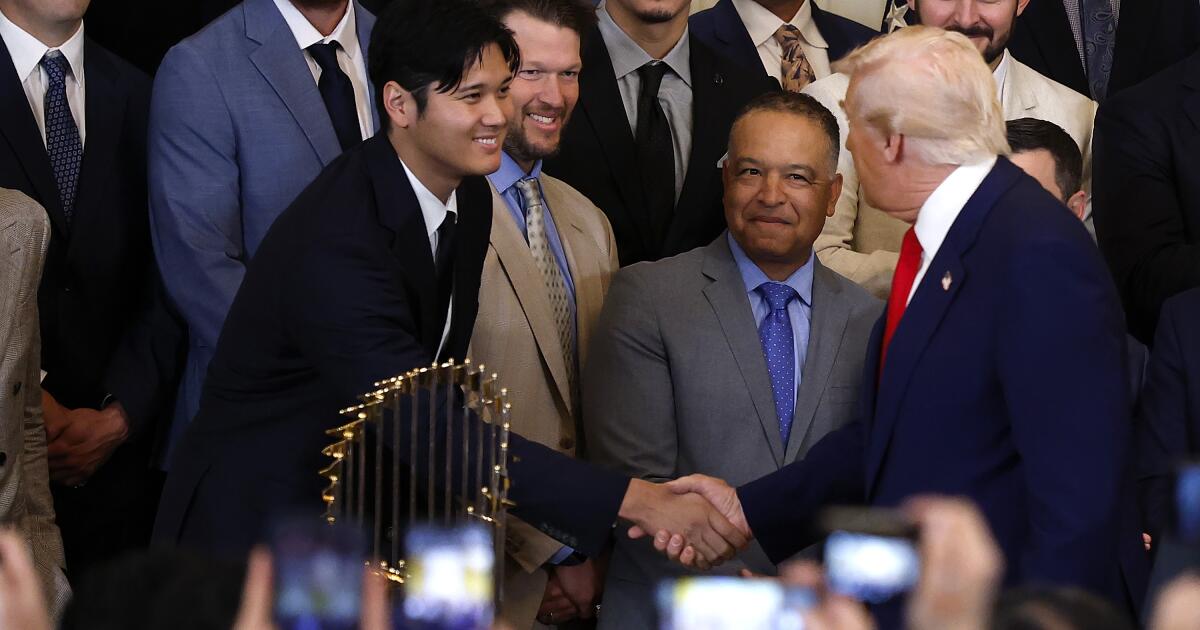
WASHINGTON — The Dodgers are scheduled to visit the White House on July 23 to celebrate their latest World Series title.
“President Trump is excited to welcome the Los Angeles Dodgers BACK to the White House to celebrate their World Series championship!,” White House spokesperson Taylor Rogers said in a statement to The Times.
The date falls on a scheduled off day in the middle of a nine-game East Coast road trip for the Dodgers. The team will play three games in Philadelphia against the Phillies July 20-22 before ending the trip with a three-game series against the New York Mets July 24 to 26.
The visit continues a tradition from the Dodgers’ two previous World Series championships. They were hosted by President Biden in 2021 and President Trump in April 2025.
After the Dodgers claimed their second consecutive World Series title with a dramatic Game 7 victory over the Toronto Blue Jays, a visit to the White House was planned, but it wasn’t until Thursday that a date was officially booked and confirmed.
Questions swirled around whether players would decline the visit this year after it did not happen during a scheduled visit to Washington in April.
Kiké Hernández said in 2018 he was unsure he would have gone had the Dodgers won the World Series the previous year. Mookie Betts said he was undecided and needed to talk it over with his family when last year’s visit was announced. After winning his first World Series with the Boston Red Sox in 2018, Betts skipped their trip to the White House the following year during Trump’s first term.
Both players, along with every returning member of the 2024 team who was with the team during its road trip, participated in the visit. The only notable absence was first baseman Freddie Freeman, who remained in Los Angeles to nurse an ankle injury.
Manager Dave Roberts, who indicated in comments to The Times in 2019 he might not go to the White House if Trump was president, also participated in last year’s ceremony.
Asked at the Dodgers’ fan festival in January about the possibility of returning to the White House, Roberts told The Times’ Bill Shaikin: “For me, I stand by: I’m a baseball manager. That’s my job.”
“I was raised — by a man who served our country for 30 years — to respect the highest office in our country,” Roberts said. “For me, it doesn’t matter who is in the office, I’m going to go to the White House. I’ve never tried to be political. … For me, I am going to continue to try to do what tradition says and not try to make political statements, because I am not a politician.”
Clayton Kershaw, who retired after last season but was on Team USA for this year’s World Baseball Classic, told The Times in the spring that he was aware Dodgers fans are split over whether the team should visit the White House again this year, but he said he is looking forward to it.
“I went when President Biden was in office. I’m going to go when President Trump is in office,” Kershaw said. “To me, it’s just about getting to go to the White House. You don’t get that opportunity every day, so I’m excited to go.”
Times deputy sports editor Ed Guzman contributed to this report.

NEWYou can now listen to Fox News articles!
All eyes were on Caitlin Clark on Wednesday night as she made her anticipated return from injury in a road matchup in Los Angeles.
But instead of a triumphant comeback, the Fever spent the entire night chasing the Sparks as Clark’s rough return fueled a 106-92 rout.
The superstar never found a groove, looking completely out of sync in her return from a back injury.
STEPHANIE WHITE GIVES CAITLIN CLARK STATUS UPDATE AHEAD OF FEVER-SPARKS, BUT HER NEXT MOVE RAISES QUESTIONS
Caitlin Clark huddles with teammates as the Indiana Fever battle the Sparks. (Photo by Katelyn Mulcahy/Getty Images) ((Photo by Katelyn Mulcahy/Getty Images))
Much of that disjointed performance falls squarely on head coach Stephanie White, who kept Clark on a ridiculously tight leash by limiting her to just 16 minutes. The stop-and-go approach could have sabotaged any chance for the phenom to establish a rhythm.
Clark finished with just 9 points, 4 rebounds and 3 assists. Her minus-16 plus-minus told the story.
The Los Angeles Sparks were severely shorthanded, taking the floor without stars Kelsey Plum and Cameron Brink.
MERCURY’S NOW-DELETED SOCIAL MEDIA POST MOCKING CAITLIN CLARK DRAWS SCRUTINY AFTER STAR’S INJURY
Yet while a depleted Sparks roster played to win, Indiana spent the night over-managing its biggest asset.
With Clark on a minutes restriction and Aliyah Boston out of the lineup, Kelsey Mitchell was forced to shoulder the entire offensive burden.
Mitchell did her part, pouring in 29 points while shooting 5-of-9 from beyond the arc.
Caitlin Clark orchestrates the Fever offense as Indiana battles the Los Angeles Sparks in primetime action. (Photo by Katelyn Mulcahy/Getty Images) ((Photo by Katelyn Mulcahy/Getty Images))
But one hot hand couldn’t stop an efficient LA squad.
The Sparks shot 45% from three-point range, going 9-of-20 from deep to cruise to the 106-92 victory.
White’s next move is to sit Clark against the Mercury on Thursday while Boston returns.
CLICK HERE TO DOWNLOAD THE FOX NEWS APP
After Wednesday’s loss to a shorthanded Sparks team, it’s fair to question whether Indiana’s cautious approach is working. The Fever dropped to 12-9.
Caitlin Clark and Dearica Hamby face off as Fever and Sparks battle at Crypto.com Arena in Los Angeles. (Photo by Tyler Ross/NBAE via Getty Images) ((Photo by Tyler Ross/NBAE via Getty Images))
Send us your thoughts: alejandro.avila@outkick.com / Follow along on X: @alejandroaveela
-

 Denver, CO1 minute ago
Victor Marx wins GOP primary for Colorado governor, defeating veteran lawmaker after unorthodox campaign
-

 Seattle, WA8 minutes ago
Widower of pregnant woman who was shot to death in Seattle sues homelessness authority
-

 San Diego, CA11 minutes ago
Terrifying moment huge sea lions chase tourists off popular California beach
-

 Milwaukee, WI23 minutes ago
Milwaukee leaders condemn ICE arrests as agency ignores City mask ordinance
-

 Atlanta, GA26 minutes ago
Georgia Secretary of State opens investigation into voter registration mailers sent to deceased residents
-

 Minneapolis, MN31 minutes ago
Minneapolis chief communications officer Adam Fetcher out amid possible criminal charges
-

 Indianapolis, IN38 minutes ago
Indiana Workforce Pell Grant options limited so far
-

 Pittsburg, PA41 minutes ago
Pennsylvania leaders take new approach to cracking down on robocalls

