Lifestyle
'House of the Dragon' season 2, episode 2: A real no-twin scenario

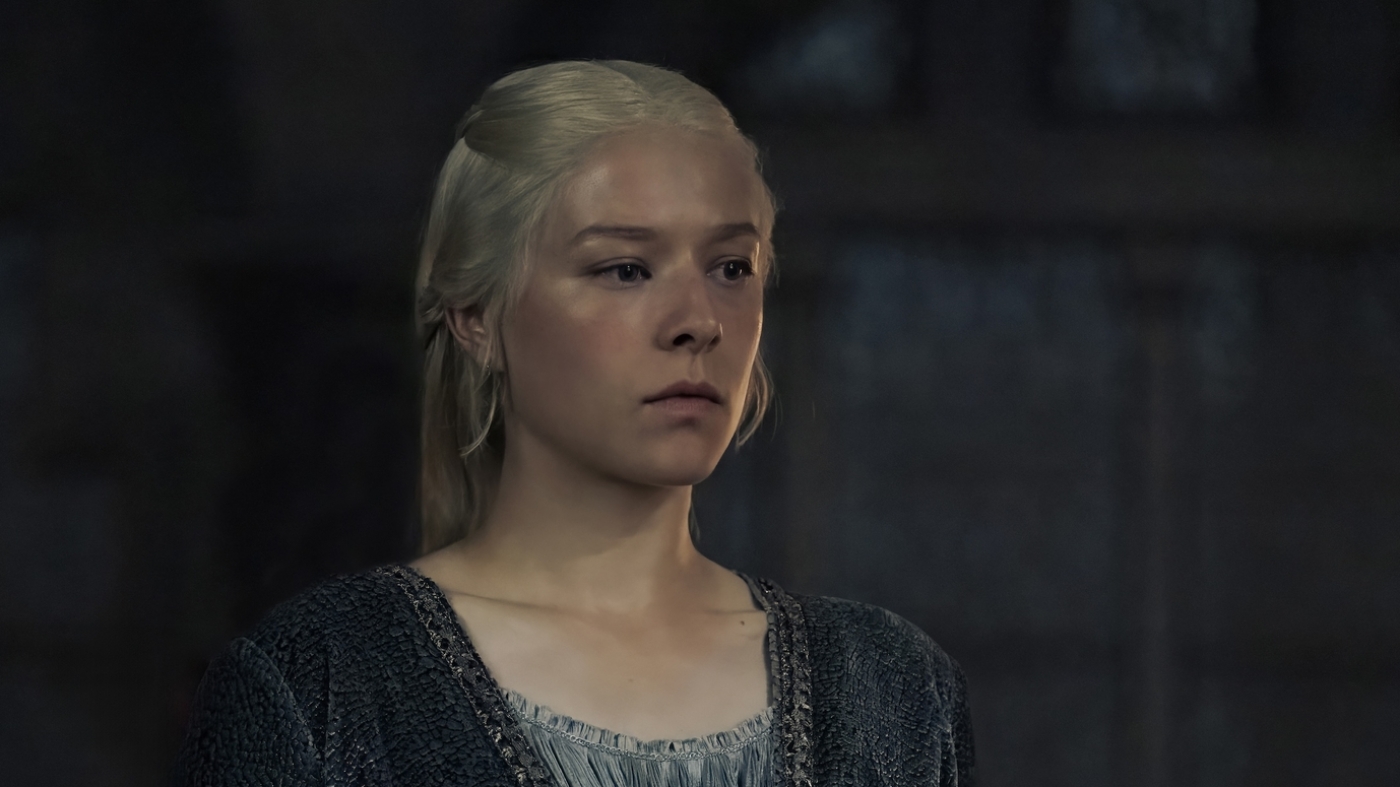
Emma D’Arcy as Rhaenyra.
Theo Whitman/HBO
hide caption
toggle caption
Theo Whitman/HBO
This is a recap of the most recent episode of HBO’s House of the Dragon. It contains spoilers. That’s what a recap is.
Chaos in the Red Keep! The heir to the king is dead! Li’l Jaehaerys’s body – and only his body, as assassins Blood and Cheese have scampered off with his head – has been discovered, and the guards are rounding up everyone. By this logic, their next move should be to run to the now-empty royal barn and shut its doors.
King Aegon is furious, and takes it out on the late King Viserys’s elaborately sculpted facsimile of Old Valyria, the Targaryen ancestral home. Confronted with the destruction of his line’s future, Aegon destroys a representation of its past. Way to live in the now, there, My Grace.
Aemond finds the secret door Blood and Cheese used in the room that he and Criston Cole were plotting in. He then picks up a coin that the show seems to want to invest with symbolic importance, but I rewound several times and still couldn’t make out its design, so your guess is as good as mine.
Alicent is a wreck over the news and blames herself, suggesting that the gods are punishing her for … something she has the good sense not to mention to her father. (Read: The fact that Cole’s White Cloak is more of an Ecru Cloak, these days.) Otto is predictably sanguine: “Some good may yet come of this,” he says. Real goblet-half-full guy, is our Otto.
At the Small Council, Aegon is fuming and foaming, blaming everyone, including Criston Cole, who tells the king that he was “abed,” but not what he was adoing, or awhom he was adoing it with. Lord Larys appears with news that they’ve caught Blood red-handed (and platinum-headed).
Otto suggests Aegon can garner public support and sympathy for himself while turning the people – and the Great Houses who are still undecided — against Rhaenyra. He suggests a funeral procession through the streets of King’s Landing, so that the smallfolk can see Rhaenyra’s cruelty for themselves. That Citadel extension course in marketing is really coming in handy.
Neither Alicent or, especially, Helaena is exactly jazzed about the idea, but they acquiesce. During the procession, the wagon bearing Jaehaerys’s body hits a pothole, because although Aegon II is always announcing Infrastructure Week, nothing ever gets done. The wagon rocks back and forth; Jaehaerys’s tiny body gets jostled. If you, at this point in the proceedings, felt certain that Jaehaerys’s precious little noggin was gonna come loose and bounce down the street like a platinum-haired soccer ball, then A. You are a bad person, and B. Come sit here by me.
Meanwhile, in the Red Keep’s dungeon, Blood hastily confesses that Daemon hired him and a ratcatcher to kill Aemond. But that doesn’t spare him a mace to the face from Aegon. (In the book, Blood suffers thirteen days of torture before being “allowed to die,” so we’re spared that subplot, at least.)
“Mistakes were made.”
On Dragonstone, at the Painted (But Actually Not Painted, Technically Glowing) Table, Rhaenyra hears from her advisors about Jaehaerys, and that she’s being held responsible. She’s legit shocked, but Rhaenys the Always Right isn’t; she casts an accusatory look at Daemon, who avoids her penetrating and insightful gaze. Rhaenyra’s a bit slower on the uptake, but she gets it eventually.

Alicent (Olivia Cooke), Otto Hightower (Rhys Ifans), Aegon II (Tom Glynn-Carney), Criston Cole (Fabien Frankel), Ironrod (Paul Kennedy), and Orwyle (Kurt Egyiawan).
Ollie Upton/HBO
hide caption
toggle caption
Ollie Upton/HBO
In private, Rhaenyra lays into Daemon about the murder. He attempts to shift the blame, and conspicuously refuses to tell her what his specific instructions to Blood and Cheese were, if they couldn’t find Aemond. (You’ll remember the show cut away from that scene before he gave those instructions.) She starts listing his manifold shortcomings – can’t be trusted, thinks only of himself, etc. It’s about damn time; dude’s got more red flags than the Kremlin on May Day.
Daemon … doesn’t take this well. He snarls, hurls his goblet across the room and backs Rhaenyra into a corner, because that has always worked for him. But Rhaenyra’s not having it. She finally sees him for what he is, and lets him know it. He still resents that King Viserys passed him over for Rhaenyra, and has convinced himself that that Viserys chose her because he knew that she could never overshadow him the way Daemon would. Rhaenyra corrects him: Viserys didn’t fear him, he distrusted him, just as she now does. She calls him pathetic; he storms out.
This was a corker of a scene, and one that Emma D’Arcy dominated, even when Daemon was physically threatening Rhaenyra. That’s because Rhaenyra’s written and performed with more nuance than Daemon is, with access to wider range of emotions. As a character, Daemon’s still stuck in Underwritten Perma-SmirkTM mode; here’s hoping Matt Smith gets a bit more to work with as the season plays out.

Daemon (Matt Smith) and Rhaenyra (Emma D’Arcy).
Theo Whitman/HBO
hide caption
toggle caption
Theo Whitman/HBO
Rhaenyra summons Baela to her chambers. Player Scorecard Time: Baela is one of two kids that Daemon had with his previous wife, Laena Velaryon, who last season immolated herself by dragonfire. (Laena’s dragon, Vhagar, is now ridden by Aemond.)
Rhaeyra asks Baela to take her dragon Moondancer and monitor King’s Landing, making sure to fly high enough to avoid their weapons.
We get a few scenes establishing that both Criston Cole and Alicent feel guilty about Jaehaerys’s murder, given that they were both in, let’s say, a compromising position when it happened. They decide to take a break.

A guilt-ridden and sexually frustrated Cole needs to do something with all that pent-up energy, so he lashes out at Ser Arryk; accusations of dereliction of duty get heatedly exchanged. Cole takes Arryk’s insubordination as a flimsy excuse to task him with infiltrating the heavily defended Dragonstone to kill Rhaenyra. What transforms this Mission: Impossible into a Mission: Highly Unlikely, of course, is that Arryk can pose as his twin brother Erryk.
On Dragonstone, Baela and Jacaerys compare their Daddy issues, which is as good a topic as any for these two to bond over, given that they’re betrothed to each other. Jacaerys acknowledges both his dads – his dad-on-paper, dear queer Laenor (“He had a weakness for cake,” which, hell yeah he did!) and his biological dad Harwin Strong (“They called him Breakbones”).
In which an ill-advised attempt is made to give Aemond some depth
We interrupt this episode to remind you that this is a Game of Thrones show on HBO, so yeah anyway here’s your periodic network-mandated Brothel Scene, ya filthy animals.
Aemond is visiting his favorite sex worker, and confesses to her that he regrets killing Lucerys. Now, I suppose this is another example of the show trying to lend its characters a bit of nuance, something I’d normally appreciate. (As I said, Matt Smith’s Daemon desperately needs more layers – that guy’s a big hunk of narrative matzo.)
But this one really doesn’t sit right, because the show has already tried to issue Aemond a pass for that lethal act. You’ll recall that the season 1 finale went out of its way to depict Lucerys’s murder as a wilful, disobedient act by Aemond’s dragon Vhagar. Between that, and the bit in this scene where Aemond whines that Lucerys used to tease him because he was different, it seems like the writers don’t understand the difference between humanizing a villain (a good thing!) and thinking they need to excuse them (very bad!). Enough with the mealy-mouthed pop-psych justifications! Let Aemond be Aemond, show!
We get a quick scene in King’s Landing with Hugh the blacksmith – the guy who asked King Aegon to pay for the weapons and armor he forged, last episode. That payment still hasn’t come, and he’s got a sick kid and a wife who’s finding it harder to put food on the table, due to Queen Rhaenyra’s blockade of the bay. Seems random, I know, but it isn’t – Hugh’s thread will get embroidered into the “Die, You!” Tapestry soon enough.
Cut to: the island of Driftmark, home of House Velaryon. Alyn the sailor, whom we met last episode, greets his brother Addam, a shipwright. They discuss the war, and Addam mentions that Lord Corlys, head of House Velaryon, “owes you. He owes us.” Hunh. How about that. Sure seems like they’re introducing a lot of non-noble randos for us to follow, all of a sudden. I wonder what that’s about. (I mean, I don’t, because I read the book. But you should.)
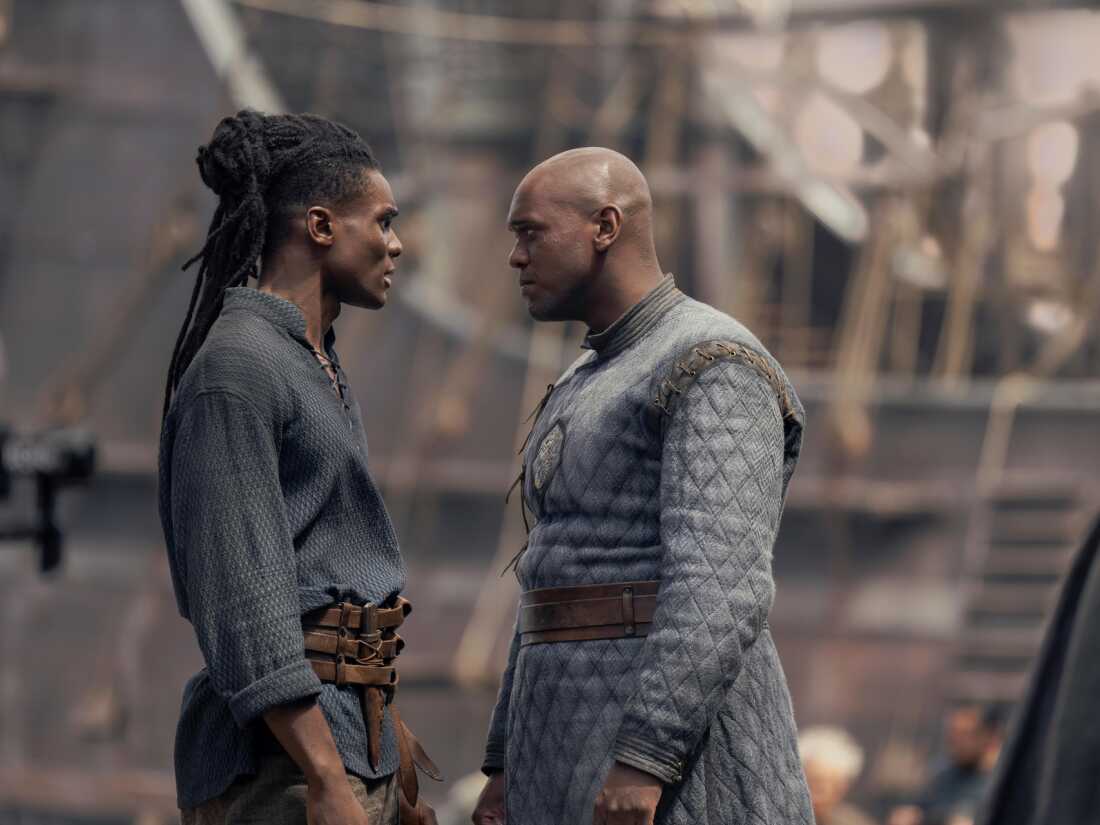
Addam (Clinton Liberty) and his brother Alyn (Abubakar Salim).
Ollie Upton/HBO
hide caption
toggle caption
Ollie Upton/HBO
Cut to: Pillow talk between Corlys and Rhaenys, both of whom worry about Daemon’s ambition. They mention that he’s left Dragonstone on his dragon Caraxes to try to capture the stronghold of Harrenhal, in the Riverlands.
Speaking of Dragonstone: Rhaenyra is pondering over many a quaint and curious volume of forgotten lore in a spiffy new season 2 set. She summons Mysaria from the dungeons, and asks about her role in Jaehaerys’s murder. Mysaria gives Rhaenyra a version of the spiel she gave Daemon last week: I’m a leaf in the wind, I go where the money is, etc. She mentions that Daemon promised her her freedom, but Rhaenyra is unmoved. Mysaria, who knows how to read a room, mentions that the powerful men of the Seven Kingdoms have never seen her as a person. This, as intended, lands with Rhaenyra, who sees a bit of herself in Mysaria – down to the scar she still carries from her own stint as Daemon’s lover.
On the beach of Driftmark, Addam spies Seasmoke, the dragon once ridden by the dearly departed Laenor (who let’s remember is not dead, just … departed). The beast seems restless. Foreshadowing? More like fiveshadowing.

In King’s Landing, we meet still another random, lowborn dude that we’ll see a lot more of in the weeks ahead. (His name’s Ulf; clip and save for your records.) For now, we follow him through the streets until he stumbles across a grisly scene – by order of King Aegon, every ratcatcher in the city has been hanged by the neck. And yes, Cheese is among them, though the birds have pecked enough holes in him that it’d be more accurate to call him Emmentaler at this point.
Let’s give the boy a Hand
In the Red Keep, Otto storms in on Criston Cole and King Aegon, bitterly berating them for ordering the mass execution of innocent citizens. He fumes to a tipsy, uncaring Aegon that the king’s brutal action has just squandered all the goodwill that Jaehaerys’s funeral procession earned them.
It’s good to see Rhys Ifans let off the leash in this scene – gone is Otto’s static pose of sage and sober-minded concern, replaced by the fury of man who can no longer stomach serving someone as weak as Aegon. Otto gets to spit words like “idiot,” “fool,” “thoughtless,” “feckless,” “self-indulgent,” “ill-considered” and “trifling” and throws his whole body into it. For my money, though, it’s Ifans’s hilarious, slow-burn reaction to hearing about Criston Cole’s Erryk vs. Arryk plan that’s the high point of this episode.
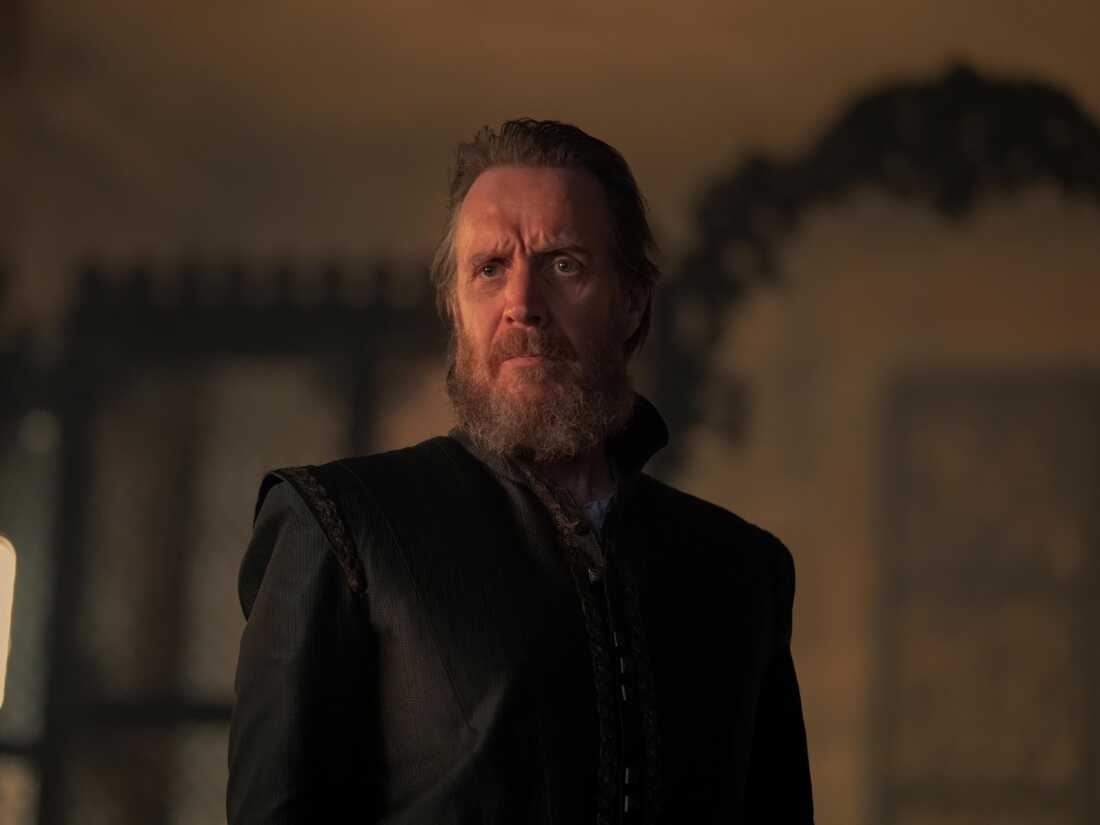
Rhys Ifans as Otto Hightower.
Ollie Upton/HBO
hide caption
toggle caption
Ollie Upton/HBO
“I wish to spill blood, not ink!” whines Aegon, which is a line straight from the book, but it’s a good ‘un. He tells Otto to surrender his status as Hand of the King, and names Criston Cole Otto’s successor. Otto leaves, but not before letting on that he’s always known that Viserys never really named Aegon as his successor. The fact that he accompanies this revelation with a rich, sneering, villainous chuckle? Icing on the cake. That Laenor had a weakness for. That cake.
On Dragonstone, Rhaenyra decides to keep Daemon’s promise and frees Mysaria. On her way down to the docks, however, Mysaria spots a disguised Ser Arryk Cargyll making his way up to the castle. She pauses.
Arryk easily Splinter-Cells his way into the castle (it’s all about timing the guard’s movements and shooting out the security cams). He tells the member of the Queensguard stationed outside her bedchamber – Ser Lorent Marbrand, if you’re scoring at home – that he’ll take over. As soon as Lorent is gone, he enters her room and advances on her.
And promptly gets interrupted by his brother, Ser Erryk Cargyll. They fight.
The funk soul brothers, check ‘em out now
As epic throwdowns go, Cargyllbowl is no Cleganebowl. But then, how could it be? That matchup was looming for years, and it pitted one character we’d come to know enough to dearly love against another we knew enough to dutifully loathe.
By contrast, these beardy bros haven’t clocked nearly enough screentime to truly register, separately or together. Still, it’s a solid fight, and it places Rhaenyra in more danger than the book version does. But ultimately Erryk defeats Arryk. The victory is fleeting, however, as a remorseful Erryk throws himself on his sword. Which is stupid and pointless but, you have to admit, metal AF.
Back in the Red Keep, Otto is doing the Seven Kingdoms equivalent of packing up his desk into a cardboard box from the supply closet – you know: picture frames, succulents, a couple of Dilbert strips. He’s still angry, cursing Aegon and Criston for their foolishness. Alicent agrees – mostly. Her eyes dart guiltily as she avers that Criston, at least, is loyal, so you know … there’s that.

Otto says he’ll return to Oldtown, home of House Hightower, where Alicent’s youngest son Daeron awaits.
WHOOP WHOOP WHOOP NEW CHARACTER ALERT WHOOP WHOOP WHOOP. No, you’re not crazy. This is the first we’ve heard mention of Daeron on the show. Daeron’s a teenager who’s been in Oldtown acting as a squire to the head of House Hightower. He’s got a (very young) dragon named Tessarion, and they’ve both got a role to play in this story. Dunno if he’s gonna show up this season, but at least we know he officially exists in the world of this show, now.
Alicent urges Otto not to go to Oldtown, but to Highgarden, home of House Tyrell. (Odds of Daeron showing up this season … shrinking … ) She assures Otto that she can talk some sense into Aegon, and he seems to believe her, because clearly neither one of them has been watching this show.
In fact, when Alicent does try to go to Aegon’s chambers for some of that sense-talking, she finds him weeping – alone, grieving, frightened, caving under the pressure. She leaves.
In her bedchamber, Criston is waiting.
Parting Thoughts
- Rhaenyra, Rhaenys, Rhaena. Daemon, Aemond. Jacaerys, Jaehaerys. And now, with this episode: Daemon, Daeron. I know George R.R. Martin has pointed to English history – all those Edwards and Henrys – to justify so many characters having such maddeningly similar names. But then a thing like Daemon-Daeron comes along and it starts to seem like he’s just goading us.
- House of the Dragon focuses on the noblemen and noblewomen of the Seven Kingdoms. But that means it’s missing something Game of Thrones had in spades – the perspective of the commoner. Don’t get me wrong, all this palace intrigue is fun. But I’ve been missing the earthiness and ego-puncturing humor of characters like Bronn and Davos and Sandor. This episode seems intent on course-correcting that, tossing Alyn and Addam and Hugh and Ulf in the mix.
- I know I’ve already praised it, but Rhys Ifans’s incredulous take upon hearing Cole’s plan was iconic. Jack Benny-level. He should take it on the road, if Westeros has a vaudeville circuit.
- How we feeling about the pacing, this season? I figured we’d be in the thick of it by now. But then Alyn’s still all “War is coming,” and I realized I’m comparing the book, which is a faux-historical account, to a dramatized TV series, which seems in no particular hurry to get to the wildfire factory.

Matthew Rhys was nominated for his role in Widow’s Bay.
Apple TV
hide caption
toggle caption
Apple TV
The 2026 Emmy nominations are here. We’re unpacking the record-breaking nominations for Hacks, plus a big day for Widow’s Bay, The Pitt, and The Bear. We’ll also talk about the snubs and make some early predictions of who will win.
Connect with Pop Culture Happy Hour:
Letterboxd / Facebook
Our weekly newsletter
Support Pop Culture Happy Hour+


Can you say no to a friend’s wedding?
Getty Images/Getty images
hide caption
toggle caption
Getty Images/Getty images
Are we spending too much on other people’s weddings?
Going to a friend’s weddings can be so fun and meaningful… but it can also really hurt your wallet. A survey by LendingTree found that 31% of people who had been to a wedding in the past five years had accrued debt to attend. So what’s driving up the cost of weddings for guests? And what makes it so hard to say no to these expenses?
Brittany breaks it down with Allyson Rees, senior analyst at trend forecasting firm WGSN, and Annie Joy Williams, assistant editor at The Atlantic.
This episode was produced by Liam McBain, with additional support from Corey Antonio Rose. It was edited by Neena Pathak. Our Supervising Producer is Cher Vincent. Our Executive Producer is Barton Girdwood. Our VP of Programming is Yolanda Sangweni.
-

 Los Angeles, Ca37 minutes ago
Loved ones search for missing 34-year-old Southern California woman
-

 Detroit, MI57 minutes ago
Chickens, geese found at vacant home after nonprofit reports them stolen
-

 San Francisco, CA1 hour ago
What’s next for San Francisco Giants as MLB trade deadline approaches?
-
 Dallas, TX1 hour ago
Dallas millionaire files lawsuit against groundwater district
-

 Miami, FL1 hour ago
7 more women arrested at southwest Miami-Dade massage parlors, accused of prostitution in undercover sting
-

 Boston, MA1 hour ago
‘They’re my buddies’: 96-year-old Back Bay woman befriends French soccer team
-

 Denver, CO1 hour ago
Denver officers cited for separate incidents, 1 fired
-

 Seattle, WA2 hours ago
Study finds dangerous chemicals in the breast milk of Seattle moms

