Northeast
Hochul's revival of mask mandate to curb hate crimes won't work, has 'laundry list' of exceptions: residents
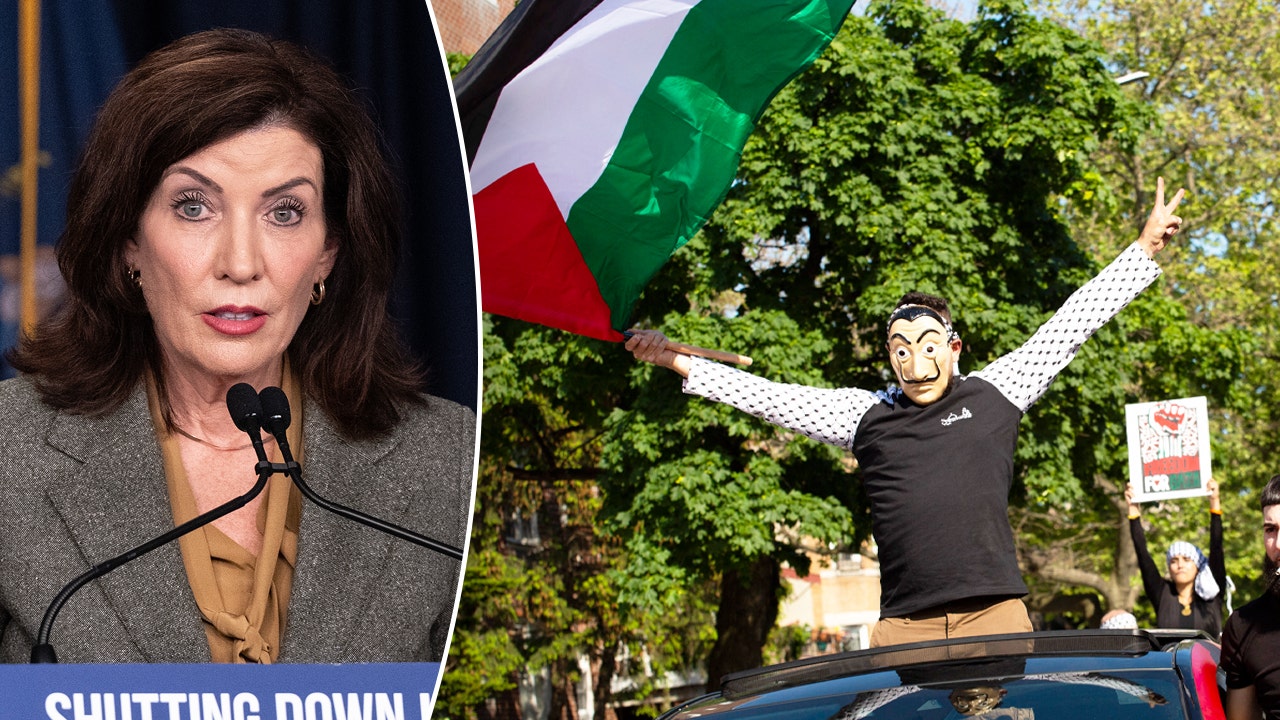
Some residents in New York City believe New York Gov. Kathy Hochul will face an uphill battle — one that’s essentially of her own making — after she suggested she’s willing to start “discussions” about a partial mask ban for Big Apple subways and protests amid the spread of antisemitism.
Highlighting an event that took place on a subway earlier this week in New York City, where a group of people “donning masks took over a subway car, scaring riders and chanting things about Hitler and wiping out Jews,” Hochul said Thursday during a public safety announcement that her administration “will not tolerate individuals using masks to evade responsibility for criminal or threatening behavior.”
“My team is working on a solution, but on a subway, people should not be able to hide behind a mask to commit crimes,” she said.
Hochul, who took office in 2021 and was responsible for implementing mask mandates amid the spread of coronavirus, realizes the issue is “complex” and that there are “legitimate reasons” why some choose to wear face coverings, mask coverings and head coverings.
NY GOV. HOCHUL SAYS SHE’S CONSIDERING A MASK BAN TO REDUCE HATE CRIMES, TRIGGERS COVID FEARFUL X USERS
“My team is working on a solution, but on a subway, people should not be able to hide behind a mask to commit crimes,” New York Gov. Kathy Hochul said Thursday. (Getty Images)
Hochul mentioned several reasons people might wear face coverings, like religious practices, protection from COVID or the flu, delivery drivers battling the elements, cultural events and Halloween.
Emily Alexander, a full-time nanny who works in New York City and frequents the subway system nearly every day, expressed concern to Fox News Digital over how such a ban could be implemented amid Hochul’s “laundry list” of exceptions.
“It’s frightening what I see sometimes during my commute, and there is a reason this is being talked about right now,” said Alexander. “I would certainly support a no-mask law, but how is it going to be possible when the governor and nearly every other lawmaker in the state will provide those health and religious exemptions?”
“People won’t be surprised when everyone starts changing their religion or claiming health-related statuses just so they can bully, threaten or belittle others,” she added. “That’ll be the new norm that’ll then have to be worked out. It’s all likely to fail.”
Another resident in the city who uses the city’s subway system from Wednesday to Saturday each week told Fox News Digital that he’s not too thrilled about the idea because he doesn’t believe “anything will come of it.”
“I really don’t think anything will come of it,” said the 47-year-old Brooklyn resident, who wished to speak anonymously. “I really don’t think there’s anything that could really stop these people. They are a different kind of evil. They’ll just say they need masks to prevent themselves from getting Covid, which we know is an excuse. How does anyone tell them they can’t wear them?”
NYC SEES RISE IN HATE CRIMES, LED BY SURGING ANTISEMITISM, POLICE DATA SHOWS
NYPD officers patrol a Manhattan subway station in New York City on March 18. (Spencer Platt/Getty Images)
“You certainly have to say, ‘There are major exemptions,’” Hochul said Thursday while fielding questions about the potential mask ban.
Hochul’s office did not respond to Fox News Digital’s request for information on how the governor plans to navigate who uses masks with good intentions from those who are using them to “evade” punishment for criminal wrongdoing.
Nonetheless, Hochul said Thursday that it’s time for a “reset” and noted that a previous law that outlawed masks in certain places “didn’t anticipate this back in 1845.”
An effort to push through a ban on masks or face coverings in subways or other areas in the state for those who do not have legitimate reason to wear one would require legislative action.
New York’s legislative session ended last week, though Hochul could call state lawmakers back to Albany to further discuss the issue.
“There’s no reason why those conversations can’t start now,” she said. “We’ll have a strategy and then determine the right time to address it.”
Following the Monday incident that was highlighted by Hochul in which Jewish Americans were targeted on a New York City subway, the governor has faced calls to reinstate an anti-mask law that was once used to prevent Ku Klux Klan members from donning hoods.
“A mask law will make a difference,” Scott Richman, regional director for the Anti-Defamation League, told The New York Post this week.
“It effectively tanked the Ku Klux Klan. Nobody wanted their face to be seen,” Richman added of the previous anti-mask law, which was on the books for nearly 200 years before being repealed in 2020 amid the COVID-19 pandemic.
Hochul said she wants to work with “legislative leaders and find out how we can address this in a way that’s thoughtful,” and she appears to have the support of New York City Mayor Eric Adams.
“I’ve spoken to Mayor Adams, who’s been outspoken on this issue with the [Metropolitan Transportation Authority], with local law enforcement. And beginning conversations with the Legislature since this takes legislative action, which we’re considering. There’s obviously a problem here. This will be dealt with,” Hochul said.
New York City Mayor Eric Adams arrives at a press conference at City Hall on March 19. (Luiz C. Ribeiro/New York Daily News/Tribune News Service)
Adams, a Democrat, has also been vocal about his support for reviving a ban on masks at protests, saying during a Thursday interview on 77 WABC’s “Cats & Cosby” that “cowards hide their faces.”
“Dr. [Martin Luther] King did not hide his face,” he said. “I agree with those who are calling for removal of the ban, not only for the protesters who are using vile language, but also for criminal behavior.”
“Now is the time to go back to the way we were pre-COVID, where you should not be able to wear masks at protests,” the mayor added.
Read the full article from Here
New York
Democrats Weigh Whether a Lawmaker’s Ethnicity Counts More Than Ideology
Outside a Sikh temple in the Little Punjab section of Queens, hundreds of people lined up around the block, waiting to receive plates of hot chickpea curry and deep-fried bhatura bread. It was the third Sunday in April, and the temple had prepared thousands of meals to celebrate the Indian harvest festival Vaisakhi.
Inside, the local assemblywoman, Jenifer Rajkumar, who had traded her signature red dress for one in harvest yellow, was working the crowd.
“Who here likes to have a Punjabi representative in office?” she asked the congregants, referring to herself. About half of them raised their hands.
Ms. Rajkumar registered faint disapproval. Everyone should raise their hands, she said, because “as a community, we have never been more powerful.”
She had a point. Last November, many of the people in the room had helped elect Zohran Mamdani as the first South Asian American to become the mayor of New York City. But as Ms. Rajkumar seeks another term in office, her race may test whether this community’s support of Mr. Mamdani was rooted more in identity or ideology.
Her Democratic primary opponent, David Orkin, is a democratic socialist who is also courting the mayor’s supporters, and earlier that afternoon, he had also visited the temple. He was accompanied by an entourage of progressive South Asian volunteers who helped to ingratiate him with the local community.
Ms. Rajkumar, who had brought her mother along, gave an impassioned speech; Mr. Orkin helped make the festival’s bread.
The June primary contest has grown fractious, with each candidate accusing the other of election fraud and Mr. Orkin recently suing to kick Ms. Rajkumar off the ballot. The primary may also be a measure of the Democratic Socialists of America’s growing momentum in New York.
Mr. Orkin is the first Democrat to primary Ms. Rajkumar, the incumbent, since she won her seat in 2020, when she and Mr. Mamdani made history as the first South Asian Americans elected to the State Assembly.
But this year, the same progressive South Asian and Indo-Caribbean networks that helped elect Mr. Mamdani as mayor are trying to rally an energized South Asian electorate around Mr. Orkin, potentially dividing voters in Queens who might otherwise gravitate toward backing Ms. Rajkumar.
Mr. Orkin, an anti-Zionist Jew, has now become a familiar figure at South Asian temples and community events in Queens, being squired about by members of DRUM Beats, the political arm of Desis Rising Up & Moving, and the newly formed Hindus for Human Rights Action.
“During Ramadan I probably went to like eight iftars,” Mr. Orkin said. “Every Friday, I’m going to masjid and doing jummah prayer, and then I think we’re gonna get into a practice of, every Sunday, going to a gurudwara.”
Andrew Singh, an Indo-Caribbean DRUM Beats organizer who lives around the block from Ms. Rajkumar’s office, spends much of his free time phone-banking for Mr. Orkin and introducing him to congregants at local temples, so as to “not let the identity politics get in the way,” he said.
Ms. Rajkumar is running on more than her identity. She came to office after serving as the state’s first director of immigration affairs under Gov. Andrew M. Cuomo, where she created a $31 million fund to provide legal services for immigrants.
As a second-term lawmaker, she successfully championed legislation in 2023 that made Diwali — a festival observed by Hindus, Sikhs, Jains and Buddhists — a public school holiday in New York, an achievement noted by many people interviewed for this article.
More recently, Ms. Rajkumar gained broader attention for her frequent and often perplexing appearances at news conferences and events held by Eric Adams, Mr. Mamdani’s predecessor as mayor. She also unsuccessfully ran for public advocate last year, losing to the incumbent, Jumaane Williams, by more than 50 percentage points in the Democratic primary.
Ms. Rajkumar has always said that her Indian parents’ rags-to-riches journey was what inspired her to work in government. Her family was one of millions that had been dispossessed during the 1947 Partition of India, and her parents, both doctors, “came to America with $300 and a suitcase.”
Her back story, as well as her work in the Legislature, has earned the respect and continued support from members of the Bangladeshi American Society, including many who also backed Mr. Mamdani’s mayoral candidacy.
“The vote that we did with Mamdani is totally different,” explained Mohammad Ali, the head of the Bangladeshi American Society. He and a dozen other local leaders who have supported Ms. Rajkumar said that they voted for Mr. Mamdani not because of his socialist platform, but, at least in part, because they felt they knew him.
Mr. Ali characterized Ms. Rajkumar as “a true friend to our community.”
But her track record has failed to impress DRUM Beats, whose leaders say she has not meaningfully delivered for her working-class constituents.
“Vast parts of the community know that she is just like every other politician,” said Simran Thind, a Punjabi organizer who recently took Mr. Okrin to two Sikh temples during Vaisakhi. “She shows up, she says a few words in our language and she leaves.”
The organization’s executive director, Fahd Ahmed, said that, early on, it had been willing to try to work with Ms. Rajkumar. Then the assemblywoman formed a close alliance with Mr. Adams, and any hope that they could reconcile their differences evaporated.
“It just reinforced what we were already assessing her to be: pro-police, pro-real estate, pro-corporation, highly focused on personal relationships,” Mr. Ahmed said.
Ms. Rajkumar defended her relationship with Mr. Adams, saying that she “got to be involved in every single issue in this city,” adding, “everyone saw me everywhere.”
It was also a practical calculation, she said, allowing her to “deliver for my constituents in ways they had never been delivered for before,” like making Diwali a school holiday. She compared her appearances with Mr. Adams to Mr. Mamdani’s visits to the Trump White House.
Some left-leaning groups remain dubious.
In March, Mr. Orkin, 34, met with progressive organizers at Saar Indian restaurant in Midtown Manhattan, where he chatted over masala coated canapés and happily accepted the endorsement of Hindus for Human Rights Action.
The posters decorating the walls of the restaurant championed “A Free Palestine,” but the Hindu group, which has modeled itself after Jewish Voice for Peace Action, aims to fight right-wing Hindu nationalism in the Indian diaspora.
The group’s political director, Ria Chakrabarty, explained that its decision to endorse Mr. Orkin was motivated by its distrust of Ms. Rajkumar. Since 2020, Ms. Rajkumar has been accused — including by Mr. Mamdani — of welcoming right-wing Hindu nationalist ideology into her orbit, by accepting campaign donations from people and groups supportive of India’s Prime Minister Narendra Modi. (Ms. Rajkumar and the Coalition of Hindus of North America have characterized those accusations as discriminatory for singling out the Hindu donors of a Hindu politician.)
“Five years ago, she might not have been as unpalatable,” Ms. Chakrabarty said. “But this is, for us, a moment of real clarity.”
When Mr. Orkin addressed the gathering that night at Saar, he acknowledged the seeming incongruity of his own presence.
“Probably to some of you I am just a random white guy,” he said. But as a longstanding member of Jewish Voice for Peace, he said he was also someone who could understand the perspective of the progressive Hindus and noted the importance of “speaking out against Hindu nationalism and its very obvious connections to Zionism.”
A resident of Ridgewood, in the district’s more liberal northern enclave, Mr. Orkin spent the last three years working as a staff attorney at the immigrant-advocacy nonprofit Make the Road New York. He is openly gay, Jewish, Mexican on his mother’s side, and speaks fluent Spanish. He got the idea to run for office last July, after campaigning for Mr. Mamdani, and his background was appealing enough to DRUM Beats that the group endorsed him on Day 1 of his campaign.
Amit Pratap Shah, a leader of the Ridgewood Nepalese Society, said that “at a very grass-roots level, when it comes to support, we have to first look at who can be the best candidate for our community.” He said that he voted for Mr. Mamdani and supported Ms. Rajkumar, but added that his Nepali cultural center welcomes diverse voices and “it’s up to our community members to decide what they want to support.”
At the moment, Mr. Shah said, he thought that Ms. Rajkumar was the favorite because “people know her.” Then he reconsidered. Mr. Orkin, he allowed, “also visited our community center.”
Boston, MA
Buffalo visits Boston with 2-1 series lead
Buffalo Sabres (50-23-9, in the Atlantic Division) vs. Boston Bruins (45-27-10, in the Atlantic Division)
Boston; Sunday, 2 p.m. EDT
LINE: Bruins -115, Sabres -105; over/under is 6
NHL PLAYOFFS FIRST ROUND: Sabres lead series 2-1
BOTTOM LINE: The Buffalo Sabres visit the Boston Bruins in the first round of the NHL Playoffs with a 2-1 lead in the series. The teams meet Thursday for the eighth time this season. The Sabres won 3-1 in the last meeting.
Boston has a 45-27-10 record overall and a 12-14-3 record in Atlantic Division games. The Bruins rank second in league play serving 11.9 penalty minutes per game.
Buffalo has a 50-23-9 record overall and an 18-7-4 record in Atlantic Division play. The Sabres have a 46-4-8 record when scoring three or more goals.
TOP PERFORMERS: Morgan Geekie has 39 goals and 29 assists for the Bruins. Mark Kastelic has three goals and one assist over the last 10 games.
Rasmus Dahlin has 19 goals and 55 assists for the Sabres. Alex Tuch has scored six goals and added four assists over the last 10 games.
LAST 10 GAMES: Bruins: 3-5-2, averaging 2.4 goals, 4.5 assists, 4.4 penalties and 10.7 penalty minutes while giving up 2.3 goals per game.
Sabres: 6-3-1, averaging 3.4 goals, 5.7 assists, 5.3 penalties and 14.4 penalty minutes while giving up 2.5 goals per game.
INJURIES: Bruins: None listed.
Sabres: Jiri Kulich: out for season (ear), Sam Carrick: out (arm), Josh Norris: day to day (undisclosed), Justin Danforth: out for season (kneecap).
___
The Associated Press created this story using technology provided by Data Skrive and data from Sportradar.
Pittsburg, PA
Off-site parking remains a critical part of Pittsburgh International Airport’s operations
-
Fitness3 minutes agoThis High-Performance, Stylish Activewear Brand Has Topped My List of Workout Clothes for Nearly a Decade
-
Movie Reviews15 minutes ago1986 Movie Reviews – 8 Million Ways to Die, Crimewave, and Violets are Blue | The Nerdy
-
World27 minutes agoTrump hosts crypto contest winners at Mar-a-Lago as his coin languishes
-
News33 minutes agoUnder Trump, Green Card Seekers Face New Scrutiny for Views on Israel
-
Politics39 minutes agoTennessee Passed a Slate of Immigration Bills. Here’s What They Do.
-
Business45 minutes agoIran’s Meme War Against Trump Ushers In a Future of ‘Slopaganda’
-
Science51 minutes agoTrump Seeks to Abolish Iran’s Atomic Stockpile, a Problem He Helped Create
-
Culture1 hour agoVideo: Poetry Month Reading Recommendations