Politics
Californians less likely to vote cite a common reason: They don’t like the presidential candidates

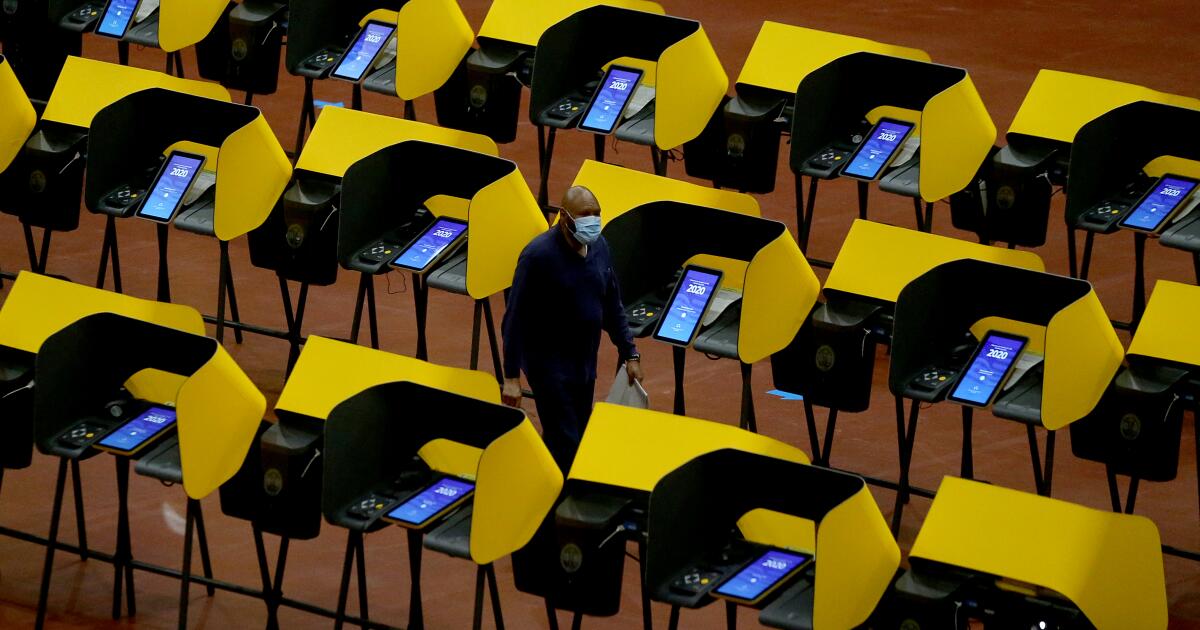
Most Californians say they’re likely to vote in the November election, but among those who aren’t sure, there’s a common reason: They don’t like the presidential candidates.
That finding comes from a poll released Friday by the UC Berkeley Institute for Governmental Studies, which asked 5,095 registered voters across California to reflect on their likelihood of voting in the Nov. 5 general election that will feature a rematch between President Biden and former President Trump.
The poll, conducted for the nonprofit Evelyn and Walter Haas, Jr. Fund, found that about 78% of California’s registered voters say they’re highly likely to vote. The poll also found that the intent to vote varies widely by age, race and political affiliation — as do the reasons why people say they aren’t likely to cast a ballot.
Californians who see themselves as highly likely to vote said participating in the presidential election is the leading reason. But among those who say they’re less likely to vote, 40% cited not liking the candidates for president as a reason. That rose to 55% among voters who have voted regularly in the past but aren’t sure whether they’ll vote this year.
Trump, a Republican, is now running as the first former president convicted of crimes after a jury last month found him guilty of falsifying records in a scheme to conceal payments to a porn actor who alleged they’d had an affair. Biden, a Democrat, is facing criticism from some in his own party over his support for Israel in its war against Hamas, as well as his moves to restrict asylum at the Mexico border. And both are facing questions about their age: Trump is 77 and Biden is 81.
“The presidential election seems to be cutting both ways,” said Mark DiCamillo, the director of the Berkeley IGS poll. “It’s a motivating factor for those who are already on board and likely to vote, but it seems to be inhibiting others.”
Democrats and liberals were more likely than Republicans and conservatives to say that their dislike of the presidential candidates is one reason they may not vote, the poll found.
More than 1 in 3 voters in the state said they weren’t likely to vote because “special interests and big money are controlling things,” and almost 3 in 10 voters said they weren’t well informed about the issues and the candidates.
“It’s clear that when it come to our politics, belief is low and cynicism is high,” Jonathan Mehta Stein, the executive director of California Common Cause, said in a statement.
California’s ballot on Nov. 5 will be a lengthy one, including the presidential election, a growing list of statewide ballot initiatives and several competitive legislative races that could determine which party controls Congress. Some races in purple areas are expected to be won on razor-thin margins.
Overall, the poll found that the groups that appear to be most inclined to vote are over the age of 65, white voters, Republicans, homeowners and those with post-graduate degrees.
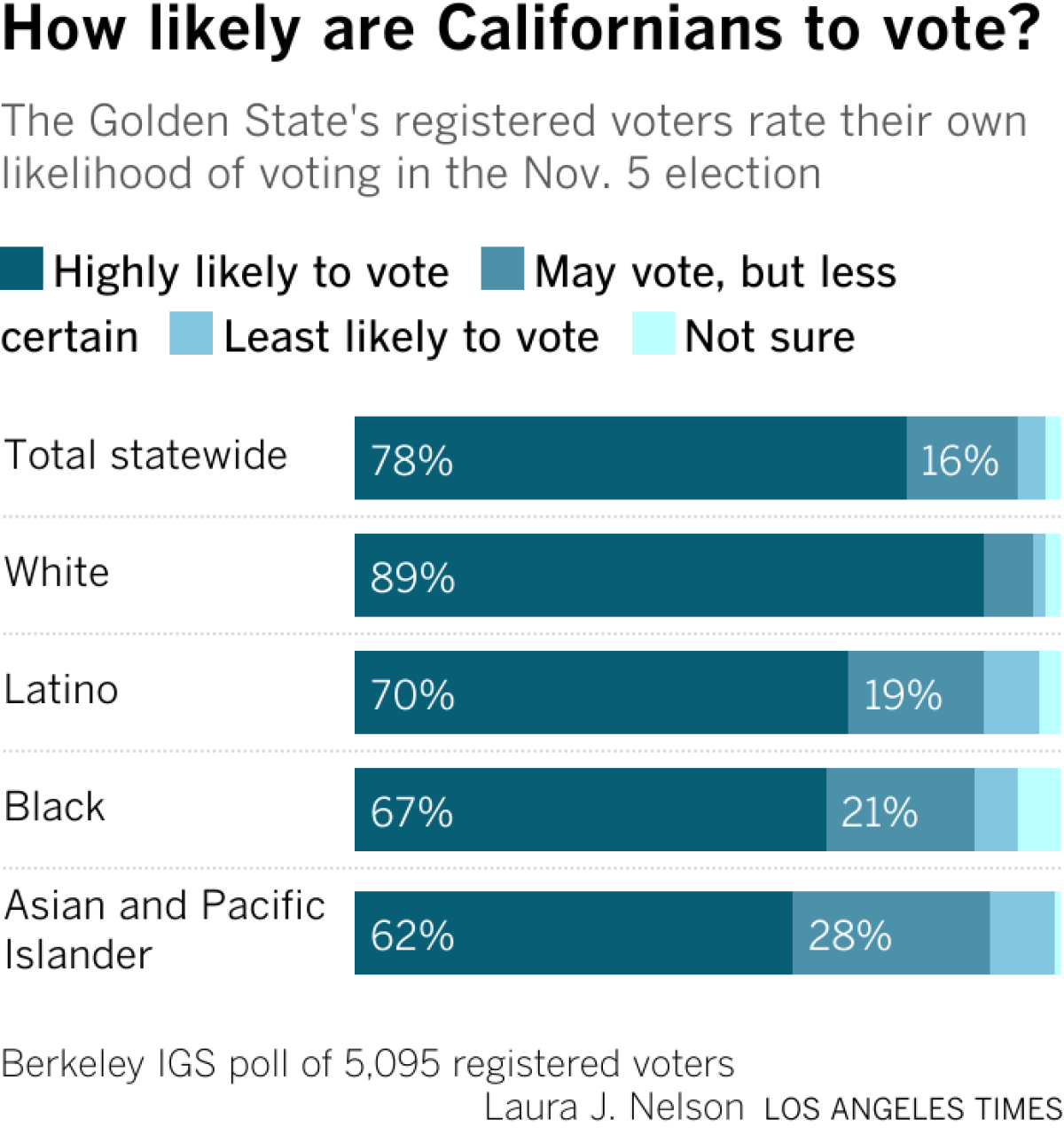
The groups in which the fewest people said they were likely to vote include voters who are young, Black or Asian American, have no post-high school education, or are naturalized citizens.
“It’s pretty much what we’ve seen in past elections — that older voters, white voters, the better educated voters are the most likely to turn out,” DiCamillo said.
The likelihood of voter participation varied widely by race, the poll found. Among white respondents, 90% said they were highly likely to vote. The share was 66% among Black voters, 70% among Latino voters and 62% among Asian American voters.
The foundation provided special funding to focus on Asian Americans, California’s fastest-growing demographic group, DiCamillo said.
The poll used voter-roll information to find voters who requested voting materials in Chinese, Korean and Vietnamese, then asked the poll questions in those languages. (The poll always asks questions in both English and Spanish.)
The results give “a better read of those voting constituencies than we’ve ever had in the past,” DiCamillo said, and suggest that there are wide disparities in voting propensity among Asian Americans.
Nearly 2 in 3 Vietnamese Americans described themselves as highly likely to vote. That rate rose to 71% among other Asian American and Pacific Islander groups, including Filipino and Japanese Americans.
By comparison, slightly less than half of Korean Americans and 54% of Chinese Americans said they were likely to vote.
The poll also asked California’s registered voters what could make them more engaged in the general election.
White and Asian American voters were most likely to say that their chances of voting would rise if they felt that “ballot measures or candidates would advance my interests.”
Latinos were most likely to say that their chances of voting would increase if “election results were more trustworthy.” And Black voters most frequently said that they would be more likely to vote if they “had access to an unbiased and trusted source of news about the election.”
Christian Arana, a vice president of the Latino Community Foundation, said in a statement that investment in voter education is crucial to ensure that voters “understand the significance of their vote and the influence they hold.”
Voters under the age of 30 were four times more likely than voters over 65 to say that “getting more information about how and when to vote” could improve their changes of participation.
They were also far more likely to say that their voting behavior could change if voting were more convenient, or if they had assistance from “a person or group that I trust to help me better understand the issues and the candidates.”
DiCamillo cautioned that 78% of respondents rating themselves as highly likely to vote does not mean a prediction of 78% turnout. Most voters have good intentions about voting, he said, “but they probably overestimate it.”
During the 2020 presidential election, more than 80% of registered voters cast a ballot in California, the highest percentage since 1976.
The poll was conducted May 29 to June 4 in five languages. The margin of error for the overall sample of registered voters was estimated to be plus or minus 2 percentage points, and could be higher for subgroups.


NEWYou can now listen to Fox News articles!
President Donald Trump is pushing for an unexpected replacement to fill the vacancy left by the late Sen. Lindsey Graham, R-S.C., in the Senate.
Trump wants South Carolina Gov. Henry McMaster to tap Graham’s sister, Darline Graham Nordone, to be appointed to the lawmaker’s suddenly open seat for the remainder of his term.
“I recommended, to Governor Henry McMaster, Lindsey Graham’s wonderful sister, Darline, to serve as interim Senator from the Great State of South Carolina,” Trump said on Truth Social on Monday. “This would be a fabulous tribute to Lindsey, who loved her dearly!”
Graham and his younger sister, Darline, had a unique bond, given that, after their parents died, the lawmaker legally adopted and raised her.
GRAHAM’S DEATH IGNITES GOP SCRAMBLE FOR SENATE SEAT AS TRUMP HINTS HE ALREADY HAS A FAVORITE
President Donald Trump wants to see Lindsey Graham’s sister, Darline Graham Nordone, appointed to his vacant seat in the Senate to act as caretaker for the remainder of his term. (Justin Sullivan/Getty Images)
Trump’s announcement comes as a scramble behind the scenes is taking place to fill Graham’s spot, and further, find a new GOP nominee to run in November to keep his seat in the hands of Republicans.
McMaster is expected to announce his pick for the seat at 4 p.m. on Monday. He has so far kept quiet about who he would prefer. Fox News Digital did not immediately hear back from McMaster’s office on who he is eyeing in the interim.
Meanwhile, a key Republican, Sen. Tim Scott, R-S.C., also wants to see Graham’s sister get the nod for his seat.
GRAHAM REPORTEDLY REFUSED MEDICAL HELP BEFORE SCHEDULED TV APPEARANCE
“Lindsey Graham’s sister, Darline Graham Nordone, would be a fantastic pick to serve out the remainder of the Senate term,” Scott said on X. “After speaking with Darline, there is no one better who understands Lindsey’s love for family, our state, and our country.”
Scott, earlier in the day, floated both former Rep. Trey Gowdy and former Sen. Jim DeMint as possible replacements in the interim. He hoped that McMaster would “put a placeholder and let the voters decide” later during a forthcoming special election.
“I think in the next several hours or next day or so we’ll figure out who that person is,” Scott said. “I love Trey Gowdy and Jim DeMint has been in the conversation.”
“[Graham’s] sister would be a wonderful placeholder as well,” he continued. “So we’ve got lots of candidates who could hold the place so that the voters decide. And remember the election starts August the 11th in South Carolina, three weeks from now, we’ll have a primary process.”
FROM ‘DISGRACE’ TO ‘FAMILY’: TRUMP’S REMARKABLE JOURNEY WITH LINDSEY GRAHAM
Sen. Lindsey Graham speaks with reporters aboard Air Force One with President Donald Trump and Secretary of Commerce Howard Lutnick on the way back to Washington, D.C., on Jan. 4, 2026. (Jim Watson/AFP via Getty Images)
Both Gowdy and DeMint have served in Congress — Gowdy in the House and DeMint in the Senate, preceding Scott. Graham Nordone, however, has never held public office.
Multiple sources close to Scott, who chairs the National Republican Senatorial Committee (NRSC) told Fox News Digital that he is pushing McMaster to choose one of the three to effectively be a placeholder and not seek a six-year term in the Senate.
CLICK HERE TO DOWNLOAD THE FOX NEWS APP
While the appointment race nears its conclusion, the race for the GOP nomination to run in South Carolina is still wide open.
Reps. Nancy Mace, R-S.C., and Ralph Norman, R-S.C., are already hinting at leaping into the special election, which is set for Aug. 11. Rep. Joe Wilson, R-S.C., said that he would stay in the House, but the rest of the Palmetto State’s GOP congressional delegation have not said what their plans are.
California Atty. Gen. Rob Bonta and 11 other Democratic state attorneys general filed a lawsuit Monday to block Paramount Skydance’s proposed $111-billion takeover of Warner Bros. Discovery — a last-ditch effort to derail a deal that would transform Hollywood.
Tech scion David Ellison’s proposed merger has been hurtling toward the finish line after securing approvals from the U.S. Justice Department and numerous foreign governments. President Trump, an ally of Ellison’s billionaire father Larry Ellison, favors the deal. He is eager for a big shakeup at CNN, which is currently controlled by Warner Bros.
David Ellison now faces his biggest challenge yet as he attempts to build a new entertainment behemoth.
A Paramount representative did not immediately comment.
The suit, filed in federal court in San Francisco, alleges that the proposed merger would violate the U.S. Clayton Act, a century-old antitrust law to prevent mergers that weaken competition and increase costs for consumers.
“Consolidation here not only leads to higher prices — it also leads to fewer opportunities for important stories to come to life, and fewer ways for audiences to encounter stories, ideas, and perspectives beyond their own experiences,” Bonta said in a statement.
“California and our sister states are fighting for free and fair markets, not rigged markets,” he said.
California and the 11 other states, including New York, New Jersey, Washington and Colorado, allege the merger would devastate the theatrical film business by combining two historic film studio rivals. The Ellison family would control such storied franchises as Harry Potter, Bugs Bunny, Batman, “Top Gun” and “Game of Thrones.”
The proposed purchase also would unite two prominent news organizations — CNN and CBS News.
The states have asked Paramount to delay the closing of its Warner Bros. takeover until the litigation can be resolved.
If Paramount refuses, Bonta said the coalition would seek a temporary restraining order asking a judge to hold up the merger, a move that would cause costly delays and escalate legal expenses for Paramount in their quest to finalize the deal.
Larry Ellison, co-founder of software giant Oracle, is bankrolling his son’s ambitions to acquire a second major entertainment company in less than a year. The Ellison family acquired control of CBS-owner Paramount in August and, at the time, David Ellison touted the move of Paramount’s headquarters from New York’s Times Square to Hollywood.
Now, Paramount is reportedly threatening to leave California in the face of Bonta’s legal action.
If the merger goes through, Paramount would own four streaming services, including Warner’s HBO Max and the dominant U.S. cable TV channel owner with HBO, TBS, HGTV, Animal Planet, Food Network, Comedy Central and Nickelodeon.
The U.S. Justice Department last month approved the merger, saying the combination would likely bolster competition — not harm it. The agency’s decision had been expected because of Larry Ellison’s strong support of Trump.
In a show of confidence earlier this year, the Ellisons agreed to increase the payout to Warner investors should the regulatory approval process drag on. Those extra 25-cent-per-share payments begin with the October-December quarter, and would add more than $650 million in deal costs each quarter — giving David Ellison an increased incentive to quickly close the deal.
The proposed merger has sparked fears in Hollywood that it will bring thousands of job losses — similar to past consolidations, including Walt Disney Co.’s 2019 takeover of Fox entertainment properties.
Some theater owners, hard hit by the pandemic and production slowdowns, have expressed concerns the merger would lead to fewer films being made.
The new colossus would significantly dampen competition, Bonta and the other Democrat prosecutors argue. They pointed to the wide-release movie film distribution business, where Warner Bros. and Paramount control about 27% of the market.
After the merger just four companies — Paramount-Warner, Disney, NBCUniversal and Sony Pictures — would control 86% of the films that were widely released, Bonta said.
Paramount has said the deal will boost competition — not hamper it. Ellison has promised to continue releasing 30 films a year with a combined Warner Bros.-Paramount studio, roughly the current output of the two studios.
Ellison also vowed to protect the HBO brand.
Another concern is the licensing of basic cable TV channels, including CNN and HGTV, to pay-TV providers such as Charter’s Spectrum, DirecTV and Google’s YouTube TV. Warner Bros. is the second largest cable channel owner and Paramount is the third largest. Together their channels would represent about 27% of the market.
The typical threshold for antitrust concerns is at least 30% marketshare.
More than 5,000 entertainment industry workers, including Jane Fonda, Ben Stiller, Bryan Cranston, Javier Bardem, Lin-Manuel Miranda and Mark Ruffalo, signed an open letter calling on Bonta to block the merger.
Some have expressed concerns about marrying CNN and CBS News following months of turmoil at CBS News since David Ellison hired journalist Bari Weiss as CBS News editor in chief. Last month, Weiss orchestrated a dramatic shakeup at the iconic “60 Minutes” news program, with top executives and three well-known correspondents tossed out.
The Ellison family recently shed its movie theater chain, which it picked up as part of the Paramount acquisition, to clear the way for the Warner deal.
California Atty. Gen. Rob Bonta is leading an effort by state attorneys general to block Paramount’s proposed takeover of Warner Bros. Discovery.
(Paul Kuroda/For The Times)
The deal also faces opposition outside the U.S.
. The British culture minister in late June said she was weighing whether to intervene in the deal due to concerns about maintaining a competitive media market. Britain’s Competition and Markets Authority also has opened an investigation into Paramount’s proposed merger.
In April, a federal judge in Sacramento granted a request from Bonta and seven other attorneys general for a preliminary injunction, which freezes the merger of Nexstar Media Group, which owns KTLA-TV Channel 5, and Tegna. The deal was designed to create the nation’s largest TV outlet group .
A larger group of state attorneys general also won a New York jury verdict against Live Nation Entertainment and its subsidiary Ticketmaster. Jurors found that Live Nation had illegally monopolized the live concert industry.
Bonta also has an ongoing case against Amazon for price fixing, which the company denies.
Still, legal experts say the states may face an uphill climb to detrail the Paramount-Warner Bros. merger because the arrival of Netflix, Amazon and Apple dramatically shifted the landscape.
The tech giants, which introduced consumer-friendly streaming options, have lessened the influence of traditional companies like Paramount and Warner Bros.
Paramount’s deal would mark the third time Warner has changed hands in the last decade.
AT&T bought the company in 2018 and then sold it to the smaller Discovery four years later. That deal left Warner Bros. burdened by debt, leading to deep cost cuts and setting the stage for the Ellison takeover.
Politics
Medical examiner releases preliminary findings in Lindsey Graham’s death as death certificate remains pending

Lindsey Graham’s sudden death prompts medical questions, political reactions
Fox News senior medical analyst Dr. Marc Siegel examines the shocking death of Sen. Lindsey Graham, R-S.C., at 71. Siegel discusses the emergency response, including chest pains and a delayed entry due to a deadbolt. He connects the death to a family history of heart attacks and considers how a long flight to Ukraine may have contributed to heart stress, dehydration, and a fatal arrhythmia.
NEWYou can now listen to Fox News articles!
The District of Columbia’s Office of the Chief Medical Examiner on Sunday released preliminary findings indicating Sen. Lindsey Graham suffered an aortic dissection due to arteriosclerotic cardiovascular disease before his death.
Graham, 71, was pronounced dead at George Washington University Hospital at 10:23 p.m. Saturday, according to a joint statement from the Metropolitan Police Department and the District of Columbia’s Office of the Chief Medical Examiner. An autopsy was performed Sunday.
The medical examiner emphasized that the findings are not final and that Graham’s death certificate will remain pending while toxicological and microscopic testing is completed.
“The preliminary examination findings were: Aortic Dissection due to Arteriosclerotic Cardiovascular Disease,” the medical examiner’s office said in a statement.
SEN. LINDSEY GRAHAM DEAD AT 71 AFTER ‘BRIEF AND SUDDEN’ ILLNESS, OFFICE SAYS
Sen. Lindsey Graham, R-S.C., speaks to reporters after a briefing by Trump administration officials on U.S. strikes on Iran at the U.S. Capitol in Washington, D.C., on March 3, 2026. (Nathan Posner/Anadolu)
The office emphasized that the findings are preliminary and that Graham’s death certificate remains pending. Officials said comprehensive toxicological and microscopic testing is routinely conducted when an autopsy is performed in the District and must be completed before the death certificate is updated with the cause and manner of death.
An aortic dissection is a tear in the inner layer of the aorta, the body’s largest artery, that allows blood to flow between the layers of the vessel wall, according to the Mayo Clinic. The condition is considered a life-threatening medical emergency that can lead to severe internal bleeding or organ damage.
Arteriosclerotic cardiovascular disease refers to the buildup of plaque inside the arteries, which can restrict blood flow and increase the risk of serious heart and vascular complications.
LINDSEY GRAHAM, SOUTH CAROLINA SENATOR WHO ROSE FROM SMALL-TOWN ROOTS TO GOP POWER BROKER, DIES AT 71
Sen. Lindsey Graham, Member of the US Senate, speaks to the people during the demonstration for human rights in Iran at Theresienwiese during the 62nd Munich Security Conference on February 14, 2026 in Munich, Germany. (Hannes Magerstaedt/Getty Images)
The release of the preliminary findings comes after Graham, 71, died Saturday night, shocking colleagues in Washington and across the nation.
Graham, a Republican who was first elected to the Senate in 2002 after serving four terms in the House of Representatives, became one of the chamber’s most influential voices on national security, foreign policy and the judiciary. He chaired the Senate Judiciary Committee during President Donald Trump’s first term and was one of the president’s closest allies on judicial nominations and defense policy.
A U.S. flag flies at half-staff over the Capitol on July 12, 2026, after the death of Sen. Lindsey Graham, R-S.C. Emergency dispatch audio reviewed by Fox News Digital documents the emergency response before his office announced his death. (Kevin Carter/Getty Images)
CLICK HERE TO DOWNLOAD THE FOX NEWS APP
Following news of Graham’s death, tributes poured in from lawmakers across the political spectrum, with colleagues remembering his decades of public service and his influence on some of the Senate’s most consequential debates.
The Office of the Chief Medical Examiner said it will update Graham’s death certificate after toxicological and microscopic testing is complete.
-

 New Jersey3 minutes ago
Heat wave to bring near 100 degree weather. When does NJ heat wave start
-

 North Carolina15 minutes ago
E. 4th Street in Washington to close July 14-15 for sewer line replacement
-

 North Dakota21 minutes ago
Carmen Tweeten
-

 Ohio27 minutes ago
Come Hang Out With Your Fellow Autopians In Detroit And Ohio Next Week – The Autopian
-

 Oklahoma33 minutes ago
OKFB pleased with newly proposed settlement in long-running State of Oklahoma poultry case | Oklahoma Farm Bureau
-

 Oregon39 minutes ago
Oregon joins multistate lawsuit seeking to block Warner Bros.-Paramount merger
-

 Pennsylvania45 minutes ago
Governor Josh Shapiro signs overdue Pennsylvania state budget with bipartisan support
-

 Rhode Island51 minutes ago
Rhode Island Foundation is offering three composers $30,000 grants — applications due Aug. 10 – What’s Up Newp

