Entertainment
Angelica Garcia unpacks the 'strange cultural tug of war' behind her new album, 'Gemelo'


Angélica Garcia has been busy finding herself. Or, rather, her selves. The Los Angeles pop singer’s new record, “Gemelo” — twin in Spanish — is a rhythmic exploration of the spiritual world and our relationship to our inner, intuitive beings.
It also is a study of dualities, whether of culture, gender or language. For the first time, Garcia sings almost entirely in Spanish, something she first experimented with on 2020’s “Cha Cha Palace.” A move back to L.A. from Virginia in the spring of that year led her to reconnect with her Latin heritage, and with it her ancestry.
As a result, “Gemelo” is a fascinating mix of the mystical and the feminine, of self-love and grief, that glides effortlessly from synth-pop to cumbia to trip-hop. Songs like “Color de Dolor” or “Juanita” slink and shimmy infectiously, even as they channel generational trauma or commune with the dead.
“It really means a lot that I’m writing a song about intuition in Spanish and how it’s connected to our ancestry, and there are people in the audience that are like, ‘Yeah!’” Garcia says over a Zoom call, just after stepping offstage at a festival in Germany. “Maybe that’s my weirdo perspective, but that’s kind of what I do.”
On the heels of her album’s Friday release, Garcia discussed the upheaval that spawned the album, her difficulties writing in Spanish, and how creating the new songs helped her to know and assert herself better than ever before.
There are all these dualities on “Gemelo,” and so much self-discovery. What started that journey for you to explore those themes?
It’s kind of just what was coming out at the time, to be honest. There was a lot grief processing, different types of big life changes happening at the same time. The first song to come out was “Color de Dolor.” That kind of represents that, because when you’re asking, “What is the color of pain? What is the color of grief?” — it can have many forms.
What kinds of grief were you processing?
I was reconciling distance from people that I loved, but also realizing that, being close to them, I didn’t necessarily feel particularly good either. Because sometimes the people that raise you, although there’s love there, it doesn’t necessarily mean that you’re seen.
There was also this strange cultural tug of war that I was feeling within myself. I was working really hard at the time to educate myself about ancestors and generations past in the family. The more I started down that rabbit hole, the more I realized, wow, these are things that I’ve always felt in me, that I’m only discovering now. So there’s a weird sadness that comes with that too.
[And] also just being a woman and feeling like I was really tired of having people speak for me and on my behalf.
Was family history or ancestry part of your life growing up?
My family moved to Virginia when I was a teenager … so I went from having Latino, Mexican American, Chicano culture all around me to, suddenly, it was very hard to come by. That separation from my culture, I had to work hard to keep it alive within me.
With “Gemelo,” I really began to realize the severity of the grief I’d been given. There was a lot that I wanted to know that sometimes even my family themselves couldn’t answer, and I had to go deeper to figure out.
What sorts of things do you feel you’ve figured out?
Patterns, like questions of nature and nurture. For example, alcoholism. You look back and go, “Oh, this person had it. This person had it.” Or maybe I realized there are abandonment wounds in my family. And it’s very interesting, when you think back to the time in which people were born. For women, especially — my mom, my grandma couldn’t make choices that I can make now.
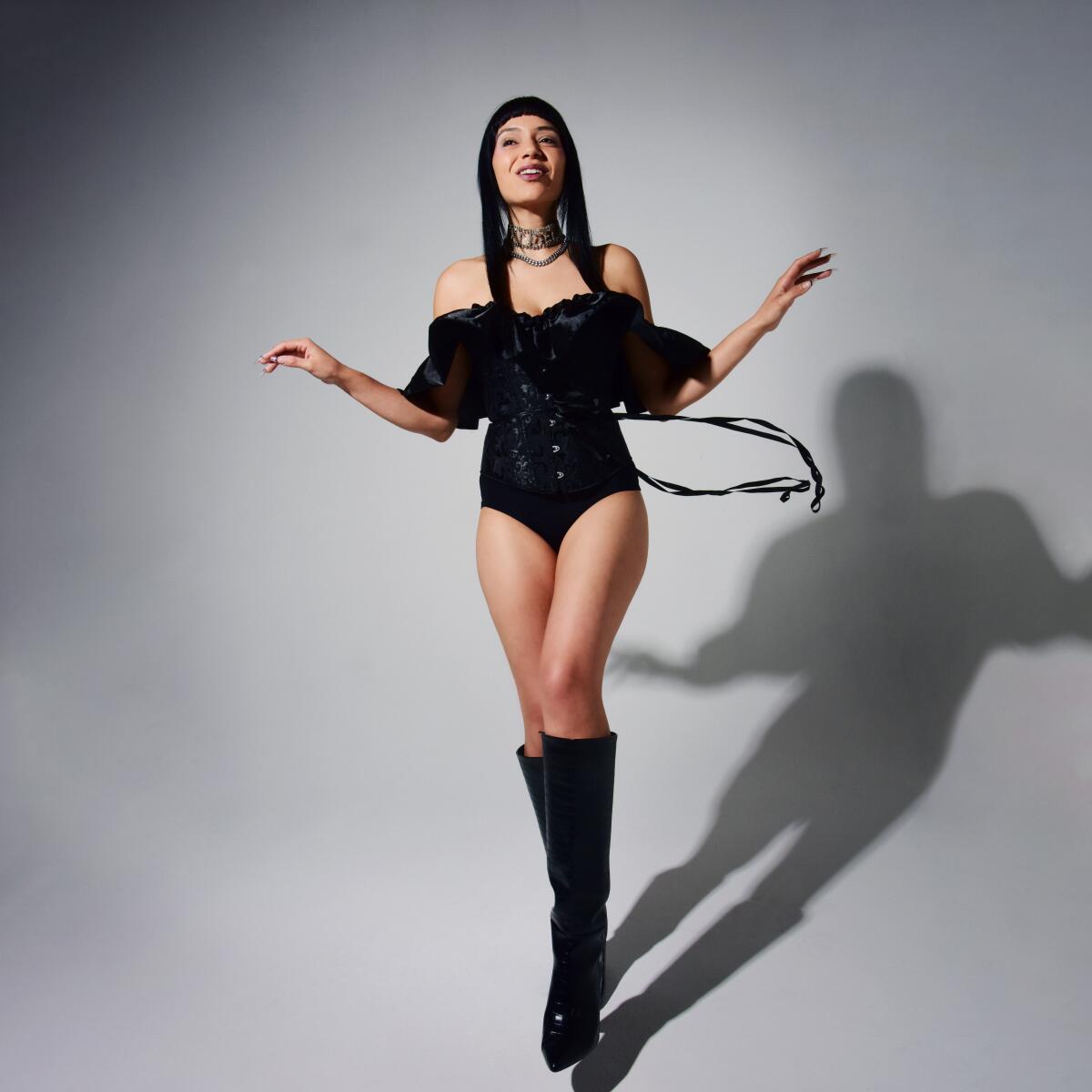
“I can just be. And just being is so much,” says Garcia.
(Shervin Lainez)
What did being in L.A., and presumably being around more family, add to that process?
It felt like I had a little more clarity, so when I came back I felt more of the things that I loved and wanted to preserve. And also the things that were like, “It’s time to abolish this. I’m over it.”
What made you decide to sing most of this album in Spanish?
My grandmother’s like a mother to me, and I realized, when I brought home the LP of “Cha Cha Palace,” that she didn’t understand anything. Over time, as I got better with my Spanish, I remember sitting with my grandmother and I was like, “Holy s—, you’re so funny.” And I had no idea, because I was so bad at Spanish.
How was it to trying to actually write in Spanish, then?
It was pretty brutal. Everybody that I showed it to had a problem with how I expressed myself. … I was also being stubborn in the sense I still wanted it to be in my voice, as a human and as a writer. A lot of people I showed it to wanted to rewrite the whole thing. So it was a pretty arduous process that almost took me out a few times.
Did you speak Spanish a lot at home as a kid, or was it mostly English?
The first thing I ever spoke were prayers that my grandmother taught me in Spanish, and we spoke it a lot at home. But then with public schooling and everything, it kind of disappeared. The older I got, the more conversations I had with other first-gen, second-gen kids like me, that was a common thing.
But yeah, I mean, the first music that I learned how to sing, as well, with my mom was mariachi music, because she was a mariachi singer, like ranchera music. As a child, she sang it at rodeos with the whole outfit and everything. So it was a thing we did at parties.

Does it feel risky at all, commercially, to sing mostly in Spanish, or does it feel like now’s a good moment in terms of how receptive general audiences would be?
I kind of don’t care. So many countries speak Spanish, and it’s such a poetic language. It’s beautiful. The more I started to express myself, the more I was like, “Oh, English kind of feels like a sword fight.” It’s very precise and very cunning. Spanish, it’s just very romantic. And Latino music always hits hard at parties.
Are you able to express yourself in certain ways in Spanish that you maybe couldn’t in English?
I got to be more philosophical. Like “El Que,” for example, is an inner monologue, my spirit watching over my flesh body going through something and guiding it, trying to wake up the person below. So I got to play with perspective. I don’t know, maybe it just felt more natural for me to do it in Spanish than it did in English because it was me doing something different than I normally do.
That goes back to that idea of dualities. Is there a particular duality that feels most central here?
The biggest one to me was body and spirit. I think our bodies get so in routine and focused on survival. But I’ve always been a spiritual person. I’ve always felt like when I’m able to step outside myself, there’s a spirit self that guides me. Some people call that intuition.
Some of those dualities could easily turn into a divided self. But you treat it more like a special perspective, like you can see things from different sides.
So many things went into that. In going back home, I’d been thinking, “Oh, if I just go back to L.A., I’ll be seen by my culture, my people.” And then it was like, no, that didn’t happen. These identities that we tie ourselves to, it’s bigger than that. Your people are the people that see you and understand you.
That being said, I am still Latina. I am still queer. I’m still these things. But it’s much bigger than I thought.
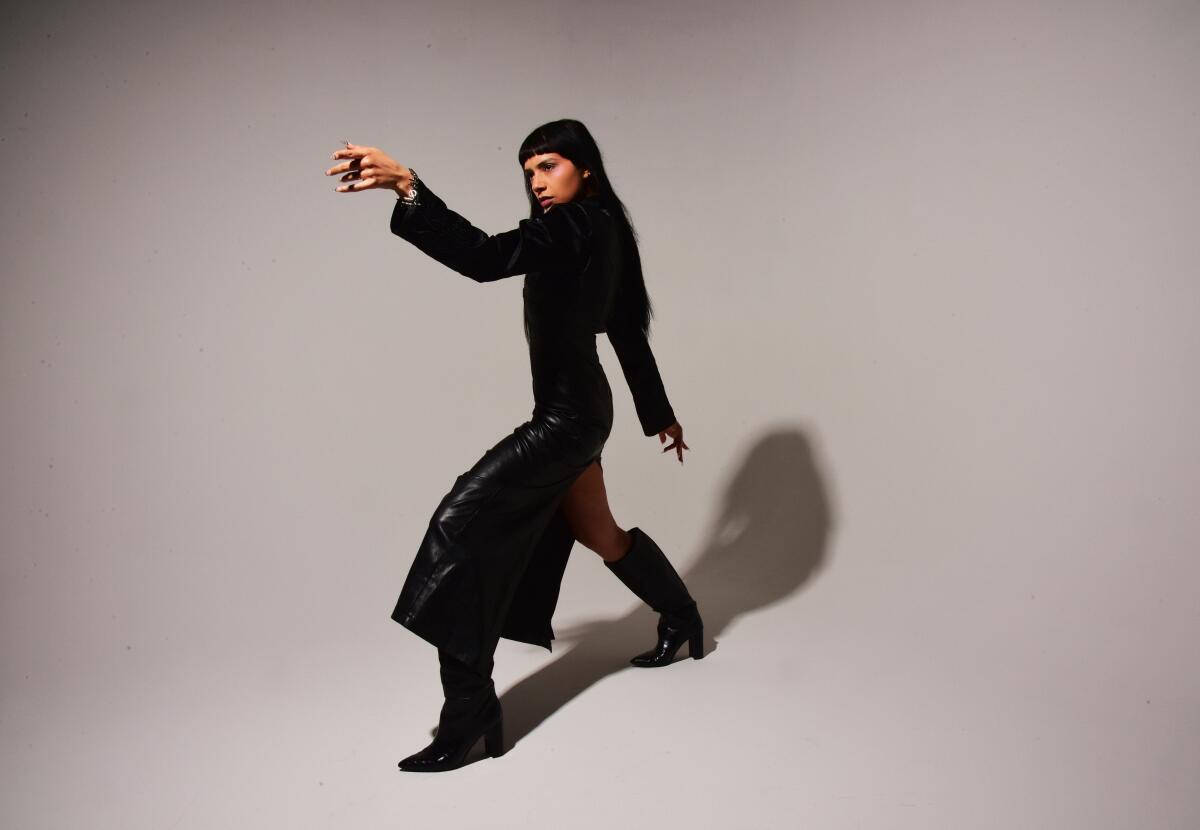
“On this record, I tapped into a very specific type of rage that comes from femininity. I also think I showed love and gentleness,” Garcia says of “Gemelo.”
(Shervin Lainez)
You mentioned the idea of being a woman and how other people were always speaking for you. How do you feel you were able to speak for yourself here?
On this record, I tapped into a very specific type of rage that comes from femininity. I also think I showed love and gentleness.
You have a song like “El Que” that talks about how sometimes people don’t understand how intelligent you are. … It happens to women all the time. We’re just used to that rage, the fact that we have to get used to that and have to navigate it.
Then there’s the mysticism and wonder I see in “Juanita.” And on the other end of the spectrum is “Paloma,” where I’m talking about the divine reflected in people, how that is beauty, that is love.
What do you feel making this album has done for you, more broadly, for where you are in life, as Angélica Garcia, right now?
I definitely feel way more like I just have to speak very loudly and clearly in my voice. I realized how much of my life I had felt conditioned to check on other people first. A lot of my Latina friends, we’ve talked about that, how we’re conditioned to take care of our families and the men in our family and the youth, and not feeling guilty about just doing my damn thing.
It’s been very affirming to see people support that. So I need to do that and not feel a pressure to make a certain kind of thing, or be more polite, or be more sexual, or be more anything. I can just be. And just being is so much.


In the last decade or so, Angelina Jolie has been on screen less frequently. So when she is — and not in forgettable tentpoles like “Eternals” — it’s worth paying attention. There seems to be a thoughtful intentionality to the roles she now chooses, almost as if this astoundingly famous woman wants to tell us something vital about herself, offering clues into her understandably guarded personal life.
Take 2015’s “By the Sea,” which she wrote and directed. Coincidentally or not, that pained study of marital dissolution, co-starring Jolie’s then-husband Brad Pitt, intersected with the couple’s real-life breakup — not to mention Jolie’s grief over the death of her mother, Marcheline Bertrand. Two years ago, Jolie portrayed a version of the elusive, emotionally closed-off opera singer Maria Callas in “Maria.” The conception of the role, marked by a dim view of stardom’s suffocating alienation, was something Jolie clearly understood. Moviegoers should be careful not to read too much autobiography into an actor’s creative choices, but Jolie makes such speculation tantalizing, adding additional layers of drama to her films.
The intermittently affecting “Couture” feels similarly close to her heart, depicting a filmmaker whose life is interrupted by a cancer diagnosis — a reality Jolie knows all too well. In 2013, she underwent a preventive double mastectomy over concerns of her likelihood to develop breast or ovarian cancer. (Bertrand died of cancer in 2007.) Knowledge of Jolie’s circumstance will inform a viewer’s reaction to her wounded, resilient performance, but our inherent sympathies can only take French writer-director Alice Winocour’s ensemble piece so far.
Jolie plays Maxine, an American indie director hired to create a flashy opening film for Paris Fashion Week. Newly arrived in the City of Light, she has only a few days to put together the short, assisted by her trusted cinematographer Anton (Louis Garrel). As we deduce from the phone calls Maxine makes back home, she’s also going through an acrimonious divorce and has trouble connecting with her blasé teenage daughter. At least this Paris paycheck gig will bolster her finances — and get her ready for the feature film she’s been wanting to make for years.
Just then, though, Maxine’s future gets a rewrite. A French doctor (Vincent London) tells her she has breast cancer and needs a double mastectomy immediately. Maybe she can finish the Fashion Week film, but her passion project must wait. An artist and mother who has spent her adulthood in constant motion will have to learn what it means to stop everything and be still.
The film’s title would appear to be a reference to the story’s setting, but in French, “coutures” can also mean “stitches,” and indeed Winocour sews together three thematically linked story strands. As Maxine wrestles with her cancer diagnosis, an inexperienced South Sudanese model named Ada (Anyier Anei) works Fashion Week so she can send money home to her family. (Ada has no interest in modeling, hoping instead to become a pharmacist.) Meanwhile a makeup artist, Angèle (Ella Rumpf), longs to be an author, although she cannot get anyone interested in her writing. Each one becomes a part of the fabric of Fashion Week, but their disparate problems are a far cry from the glitzy event’s self-importance.
Winocour has often made films about women balancing their public-facing life with their private selves In 2019’s “Proxima,” Eva Green played an astronaut missing her young daughter. In 2022’s “Paris Memories,” Virginie Efira starred as an interpreter recovering from the shock of surviving a terrorist attack. Winocour shows us the intimate, vulnerable spaces within her characters that those on the outside don’t have access to.
“Couture’s” three principals rarely interact with one another, but those meaningful exchanges argue that, amid the mad clatter of the everyday, a brief, unguarded moment with a stranger can be supremely restorative. Unfortunately, the juggling of storylines ends up being more schematic than insightful. Angèle’s narrative never catches fire and while Anei is striking as Ada, that section of the film feels slightly patronizing, reducing this immigrant tale to yet another strained salute to perseverance.
This leaves Jolie as the movie’s magnetic center, with Maxine drifting through despair as she ponders what to do. Her doctor insists that the surgery cannot wait, but putting her ambitions on hold means losing a part of herself — a different kind of death sentence than the one she’s now facing.
The character is underwritten but Jolie picks up much of the slack through her silently shattered expression. As she’s gotten older, the Oscar winner has become more comfortable doing less in her performances, allowing for a fragile serenity that is belied by the anguish and anxiety roiling underneath. It’s not just our recognition of the real-life parallels that make Jolie so touching in “Couture” — it’s that ineffable star power she’s possessed for so long. In a story about a potential tragedy, what’s saddest is that Winocour’s film cannot match its lead’s effortless command.
‘Couture’
In French and English, with subtitles
Rated: R, for language, some sexuality, nudity and brief bloody violence
Running time: 1 hour, 46 minutes
Playing: Opens Friday, June 26 in limited release

By ABBIE BERNSTEIN / Staff Writer
Posted: June 26th, 2026 / 08:03 PM
SUPERGIRL movie poster | ©2026 Warner Bros./DC Studios
Rating: PG-13
Stars: Milly Adcock, David Corenswet, Eve Ridley, Matthias Schoenaerts, Diarmaid Murtagh, Jason Momoa, David Krumholtz, Emily Beecham
Writer: Ana Nogueira, based on characters created by Jerry Siegel & Joe Shuster
Director: Craig Gillespie
Distributor: Warner Bros./DC Studios
Release Date: June 26, 2026
The new SUPERGIRL doesn’t have that “Eureka! This is how you do this now” spark that galvanized its immediate franchise predecessor, last year’s SUPERMAN. Director Craig Gillespie and screenwriter Ana Nogueira, basing the film on characters created by DC Comics’ Jerry Siegel & Joe Shuster, probably wisely, aren’t going for that.
Instead, the SUPERGIRL makers are intent on providing a lively adventure, getting to the point quickly and letting the action unspool with unquestionably strong motivation, abetted by plenty of punch-ups, kicking and frequent explosions.
Supergirl, aka Kara Zor-El (Milly Adcock), is from the now-dead planet Krypton, just like her cousin Clark/Kal-El/Superman (David Corenswet). However, where Clark has chosen to remain on Earth, where the yellow sun gives him superpowers that allow to help Earth’s residents, Kara likes to party on planets that have a red sun, where she has no unusual abilities.
This is because Kara seems to have taken to heart a dictum from a different comic book universe – with great power comes great responsibility – and decided the inverse is true: with no power comes no responsibility.
We get insight into exactly why Kara is so duty-averse over the course of SUPERGIRL, and it’s probably not a spoiler to say that she re-examines some attitudes as events unfold.
Kara plans to celebrate her twenty-third birthday on a backwater red sun planet. The bar where Kara chooses to drink is entered by preteen Ruthye Knoll (Eve Ridley), whose family has been murdered by brigands, led by the horrendous Krem (Matthias Schoenaerts). Ruthye is out for revenge. Kara thinks Ruthye is a bit young and pure-hearted to be on a murderous quest.
Even on a planet with a red sun, though, Kara is still handy with fists and feet. Ruthye sees what Kara can do and concludes she is the ideal ally. Kara absolutely refuses to help. Then something occurs that credibly rouses Kara to do whatever it takes to achieve her aims, which sort of line up with Ruthye’s.
No explanation is needed for why Kara feels such urgency, which we easily share. Her concern for Ruthye is understandable and her connecting to larger purpose is shown rather than spoken.
Intriguingly, the aesthetics of SUPERGIRL are largely those of STAR WARS, with some MAD MAX and BLADE RUNNER thrown in. The filmmakers have a good time with all sorts of utterly nonhuman alien people and figuring out how to make interplanetary versions of familiar items like vending machines.
The pace is pleasingly brisk and the structure doesn’t require much exposition. When they hit a hard-to-answer question like why Kara is Supergirl while Clark is Superman, they acknowledge it and then get out from under without irritating anybody.
For anyone wondering about the veracity of the recording from Superman’s parents that appeared in SUPERMAN, a quick line of dialogue here confirms it (sorry, Jor-El supporters).
There is the expected amount of CGI involved, including a great motion-capture performance by Kara’s dog Krypto (modeled upon executive producer/SUPERMAN director James Gunn’s dog), but a lot of the stunts and makeup appear gratifyingly practical.
Adcock is fine in all of Kara’s moods, from wasted to resistant to determined, with a delightful reaction to feeling her body’s response to the yellow sun. Ridley is an appealing young hero, and Corenswet offers wholesome support. Schoenaerts lets Krem revel in his own soft-spoken vileness, and Jason Momoa enthusiastically portrays an intergalactic bounty hunter. David Krumholtz is affecting as Kara’s scientist father.
SUPERGIRL isn’t going to redefine superhero movies, but it’s a perfectly enjoyable example of the form.
Related: Movie Review: THE GET OUT
Related: Movie Review: CAMP
Related: Movie Review: LEVITICUS
Related: Movie Review: DISCLOSURE DAY
Related: Movie Review: KRAKEN
Related: Movie Review: FIND YOUR FRIENDS
Related: Movie Review: CHUM
Related: Movie Review: CAROLINA CAROLINE
Related: Movie Review: THE SUMMONING
Related: Movie Review: BACKROOMS
Related: Movie Review: SPEED DEMON
Related: Movie Review: PRESSURE
Related: Movie Review: PASSENGER
Related: Movie Review: I LOVE BOOSTERS
Related: TV Review: GREAT PERFORMANCES: STAGEBOUND
Related: Movie Review: OBSESSION
Related: Movie Review: LIFEHACK
Related: Movie Review: IS GOD IS
Related: Movie Review: AFFECTION
Related: Movie Review: ITCH!
Related: Movie Review: HOKUM
Related: Movie Review: ANIMAL FARM
Related: Movie Review: OVER YOUR DEAD BODY
Related: Movie Review: LEE CRONIN’S THE MUMMY
Related: Movie Review: HAPPY HALLOWEEN
Related: Movie Review: NORMAL
Related: Movie Review: FACES OF DEATH
Related: Movie Review: EXIT 8
Related: Movie Review: READY OR NOT 2: HERE I COME
Follow us on Twitter at ASSIGNMENT X
Like us on Facebook at ASSIGNMENT X
Article Source: Assignment X
Article: Movie Review: SUPERGIRL
Related
Related Posts:

In 2015, musician Roberto Carlos launched Boleros de Noche, an annual concert series held in Los Angeles that aimed at preserving and showcasing the Latin American bolero music genre.
This year, the event is celebrating its 10th anniversary with performances at the Ford on Aug. 1 by Puerto Rican singer and former Calle 13 member iLe and L.A.-based bolero trio Voz Bohemia
On Friday, the city of L.A. honored the series’ decade-long run and legacy of uplifting bolero music by declaring Aug.1 “Día del Bolero.”
Boleros are ballads noted for their slow tempo and romantic lyrics accompanied by a crooning vocal style. Though the genre originated in Cuba, it quickly gained popularity across Latin America, with each culture putting their own spin on it. In the early 20th century, the evolving sound of boleros was shaped by the Cuban group Trio Matamoros, Mexican composer Agustín Lara, Puerto Rican artist Rafael Hernández and Ecuadorian singer Julio Jaramillo.
The genre saw a resurgence in popularity in the 1980s and ‘90s when famed Mexican artists Juan Gabriel and Luis Miguel embraced the bolero sound. In recent years, the bolero movement has been modernized and electrified by artists such as Mon Laferte, Romeo Santos, Adrian Quesada and Kali Uchis. In the last five years, Quesada has released two bolero albums, “Boleros Psicodélicos” and “Boleros Psicodélicos II,” that mix the genre’s classic sounds with elements of psychedelic rock.
“Over the past decade, Boleros de Noche has presented numerous concerts featuring both local and international artists, has brought together thousands of people across the city to bask in the lush orchestration of this music,” said City Councilmember Nithya Raman, who presented Carlos with the honor. “For so many in the Latino community and beyond, this isn’t just music, it’s memory, it’s home, and perhaps most importantly, it’s heritage being carried forward.”
Raised in L.A. County by parents who immigrated from the Mexican state of Oaxaca, Carlos says he first fell in love with live performance and bolero music in his midteens, when he would frequent the now-defunct Teatro los Pinos in South Gate.
He yearned for that same level of comfort and awe at music and wanted to share that with a larger audience. The first iteration of Boleros de Noche took place in 2015 at an art gallery in Echo Park.
“Over the years, I have heard countless stories from audience members who tell me how this music reminds them of their parents, grandparents, first loves and family traditions,” Carlos said Friday at City Hall. “Ten years ago, bolero was rarely part of our city’s cultural conversation, and today bolero programming can be found across Los Angeles, and I’m honored that Boleros de Noche has been a driving force behind its growth.”
Boleros de Noche has sold out shows at the Ford over the last few years and has featured artists such as Gaby Moreno, Marisoul and the legendary trio Los Panchos. In 2025, the event made its debut at Chicago’s historic Symphony Center.
The bolero genre’s popularity and cultural significance has been spotlighted outside of L.A. in recent years as well.
On Dec. 5, 2023, UNESCO, the United Nation’s agency aimed at safeguarding social and cultural foundations, recognized the musical genre as an Intangible Cultural Heritage of Humanity.
As part of Friday’s ceremony, Carlos and his bolero group Los Rebeldes Románticos performed several tunes, including the Mexican bolero classic “Sabor a Mí.”
Last year, Carlos spoke with The Times about his ambitions for Boleros de Noche and the mentality that drives the event series.
“At Boleros de Noche, [I want] for us to speak in Spanish, to feel recognized, to do this music as a celebration for all these artists that unfortunately became background music for a lot of like weddings and quinceañeras,” he said. “How about if we celebrate them and give them recognition? How about if, through my events, I can take people back to the 1940s to my experience at Teatro los Pinos?”
Given recent attacks on Latinos on the local and national levels, Carlos said he hoped his events would create a safe and welcoming gathering place.
“It’s about bolero music. It’s about community. It’s about people. It’s about the musicians,” he said. “Many of the musicians were undocumented. They brought this music to L.A. through their hometowns.”
-

 Technology2 minutes ago
Empty envelopes in your mailbox? Do not scan that code
-
 Business5 minutes ago
Truck parking lot plans near Port of Los Angeles spark backlash among residents
-
Entertainment10 minutes ago
Review: A mesmerizingly vulnerable Angelina Jolie fails to fully redeem ‘Couture’
-
 Lifestyle17 minutes ago
He turned his one-bedroom West Hollywood apartment into an entertainer’s paradise
-
 Politics20 minutes ago
Quicker count, bigger turnout: L.A. County certifies 2026 primary election ballots
-
 Science25 minutes ago
Water from Boyle Heights warehouse fire carries foam into L.A. River, sparks testing
-
 Sports32 minutes ago
Cameron Carr on Lakers acquiring him draft night: ‘It didn’t feel real’
-

 World40 minutes ago
Why is Crimea critical to the Russia–Ukraine war?

