Business
'Who's going to live here?' What happens when an e-commerce warehouse takes out your neighborhood


Benjamin and Christine Granillo bought their 2.25-acre property in San Bernardino County four decades ago. They built their home by hand and surrounded it with a lush grove of avocado, orange and lemon trees.
“We thought we’d be here for the rest of our life,” Christine Granillo, 77, said as she tended to her trees on a recent afternoon.
But their neighborhood in unincorporated Bloomington is rapidly transforming, as developers convert the 10 Freeway and its adjacent communities into a logistics corridor connecting goods shipped into Southern California ports with online shoppers across the nation. An industrial real estate company based in Orange County is demolishing 117 homes and ranches in rural Bloomington to make way for more than two million square feet of warehousing space. The project will serve as yet another distribution center dedicated to storing and moving the vast array of products consumers want delivered to their doorsteps.
Benjamin and Christine Granillo, who built their home by hand in rural Bloomington, will soon look out on a sprawling online fulfillment center.
(Robert Gauthier / Los Angeles Times)
All the neighbors across the street from the Granillos sold their homes to the developer, and many have already been bulldozed. The Granillos opted not to sell — and now look out their stately front gate at the rubble, soon to be supplanted with a 479,000-square-foot fulfillment center. Their street will become a busy truck route. Next door will be a parking lot with hundreds of truck and trailer stalls.
Christine Granillo mourns the loss of her neighbors and her view of the San Bernardino Mountains. But, she added, “What can you do about it? There’s really nothing you can do about it.”
In November 2022, San Bernardino County supervisors voted 4-0 to approve the Bloomington Business Park, a 213-acre industrial park that promises to bring several thousand jobs to Bloomington, a majority Latino community of 23,000 residents.
The deal came with trade-offs familiar to the Inland Empire communities being asked to shoulder the massive distribution centers integral to America’s online shopping habit: An environmental impact report found the development would have “significant and unavoidable” impacts on air quality. But it would bring jobs to a working-class community in need of them, and Howard Industrial Partners has pledged to provide millions of dollars in infrastructure improvements: new streets with traffic lights and sidewalks; a modern sewer system in an area that still relies on aging septic systems.
And because the warehouse project would be about 50 feet from Zimmerman Elementary School, the developer agreed to pay $44.5 million to the Colton Joint Unified School District in a land swap that will usher in a state-of-the-art school nearby.
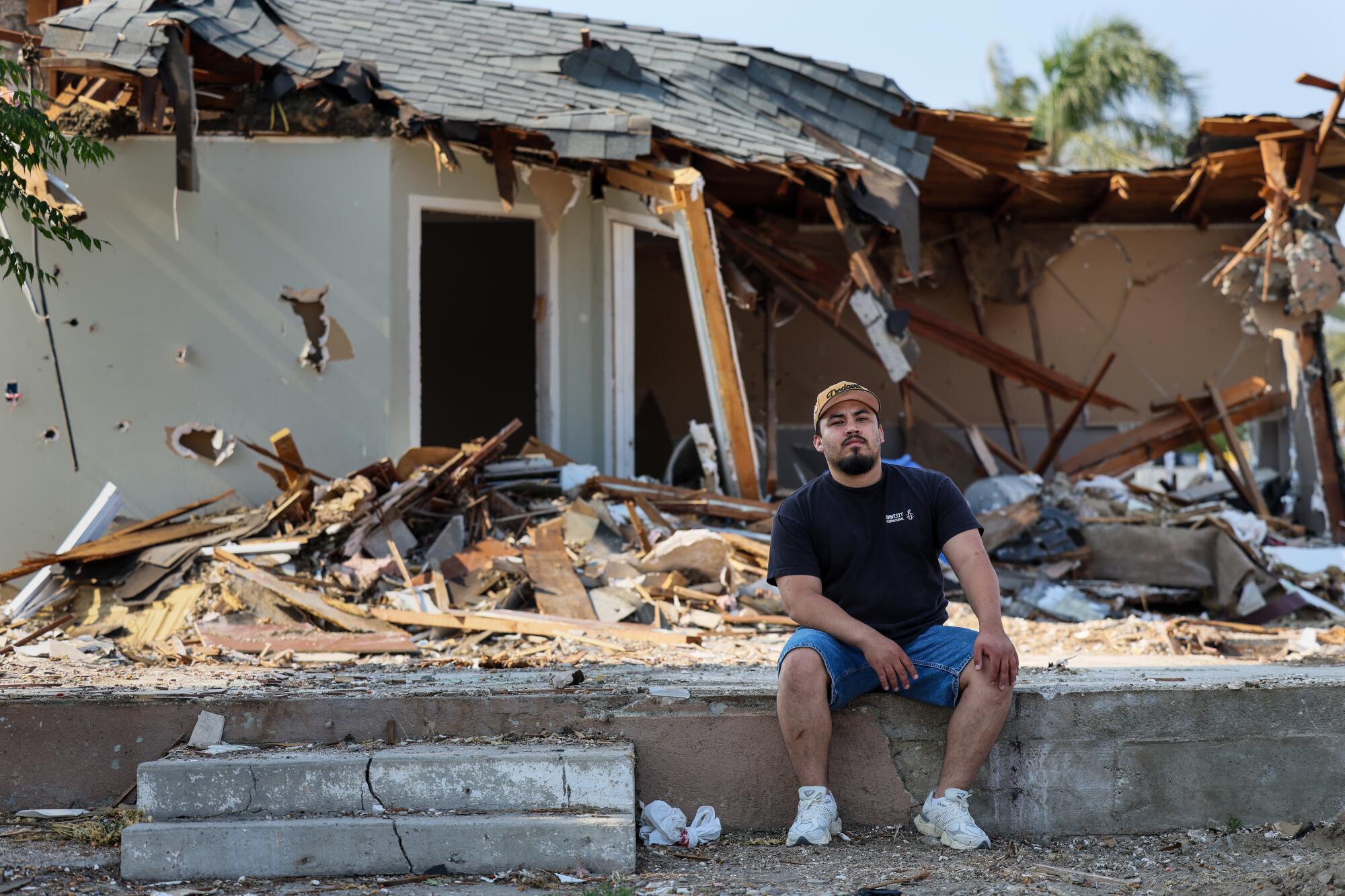
Joaquin Castillejos advocates for Bloomington residents whose neighborhoods are targeted for warehouse projects. But he said people are experiencing the impact of years of poor planning.
(Robert Gauthier / Los Angeles Times)
Gary Grossich, a member of Bloomington’s Municipal Advisory Council, recommended that supervisors support the development. Surrounding cities like Rialto and Fontana are embracing warehouse development, he said, and this was an opportunity for Bloomington to reap the benefits of a booming industry.
“The warehouse industry was the hot market,” he said, “and that was the only way that myself and others could see that we were going to get to the greater good, which is to get more sheriff’s deputies, more public safety, more services for our community and eventually balance our books.”
Mike Tunney, vice president of development at Howard Industrial Partners, said the developer shares those goals. “Overcoming these types of challenges and opportunities are the fundamental tenets of our development philosophy,” Tunney said.
But the project has left Bloomington fractured, with a stinging sense of winners and losers: Many who sold their homes say they got a good price and were happy to move on, while many of the neighbors left behind see a future with more concrete and semi-trailers and a hollowing out of the community’s rural culture.
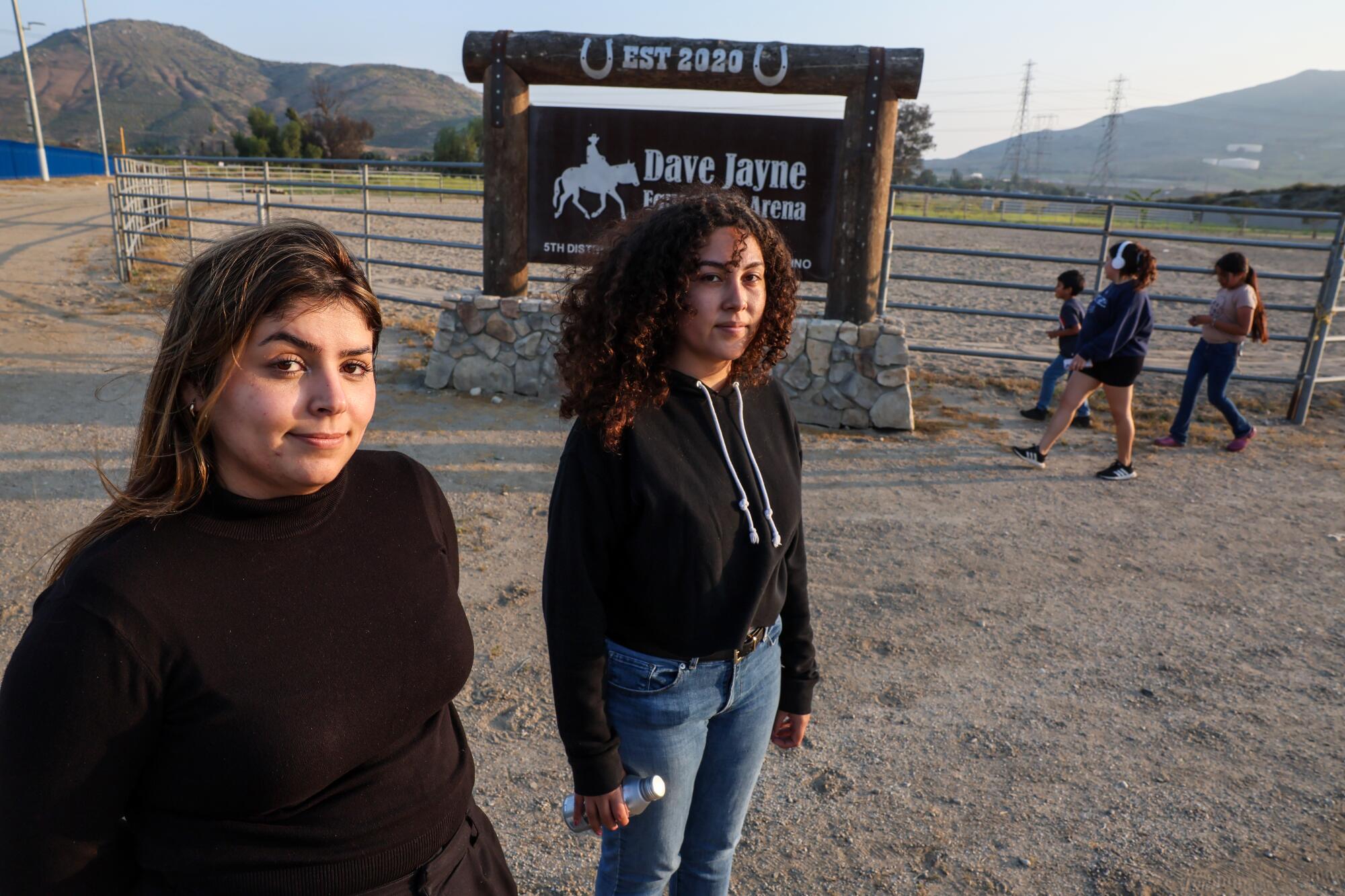
Esmeralda Tabares, left, calls the conversion of rural neighborhoods to industrial developments “just a complete shift in the culture and lifestyle” of Bloomington.
(Robert Gauthier / Los Angeles Times)
Esmeralda Tabares, 23, part of a group called Concerned Neighbors of Bloomington, described the transition from rural residential to industrial development as “just a complete shift in the culture and lifestyle we have.” Many Bloomington residents ride horses; her family owns a plant nursery.
She questions why San Bernardino County is relying on a developer to provide the community with critical infrastructure such as sidewalks and sewers.
“It’s just easier for them to shift to a warehouse and say, ‘Well, we’re going to let them come in and take over your community,’” she said. “But now what community is that going to be? Because they’re taking people out, and soon who’s going to go to the school? Who’s going to live here?”
Agents associated with Howard Industrial Partners approached Raquel Diaz several years ago about selling her home in a Bloomington neighborhood a mile south of the 10 Freeway with an offer that wouldn’t go through until the county approved the project.
She and her family had purchased their home in 2012 for $140,000. It was the first home for her family of five, she said, and they were “super excited.” But the three-bedroom house on Locust Avenue quickly became a nightmare.
The house flooded whenever it rained. It reeked of moisture, and she and her husband worried about raising young kids amid mold.
Their street had no sidewalks, but that didn’t stop people from speeding by in their cars. Accidents were alarmingly common, she said. Her kids were forbidden from checking the street-side mailbox or taking out the trash.
“We ended up with a lemon of a house,” she said. “We were happy to be in Bloomington, and it just didn’t end up working out for us.”
By the time the county approved the warehouse development, home prices across Southern California had skyrocketed. Diaz said the developer encouraged them to find a home they wanted to buy — even if it cost above the price they had originally negotiated — and to make sure it was on a hill. The company would cover the cost.
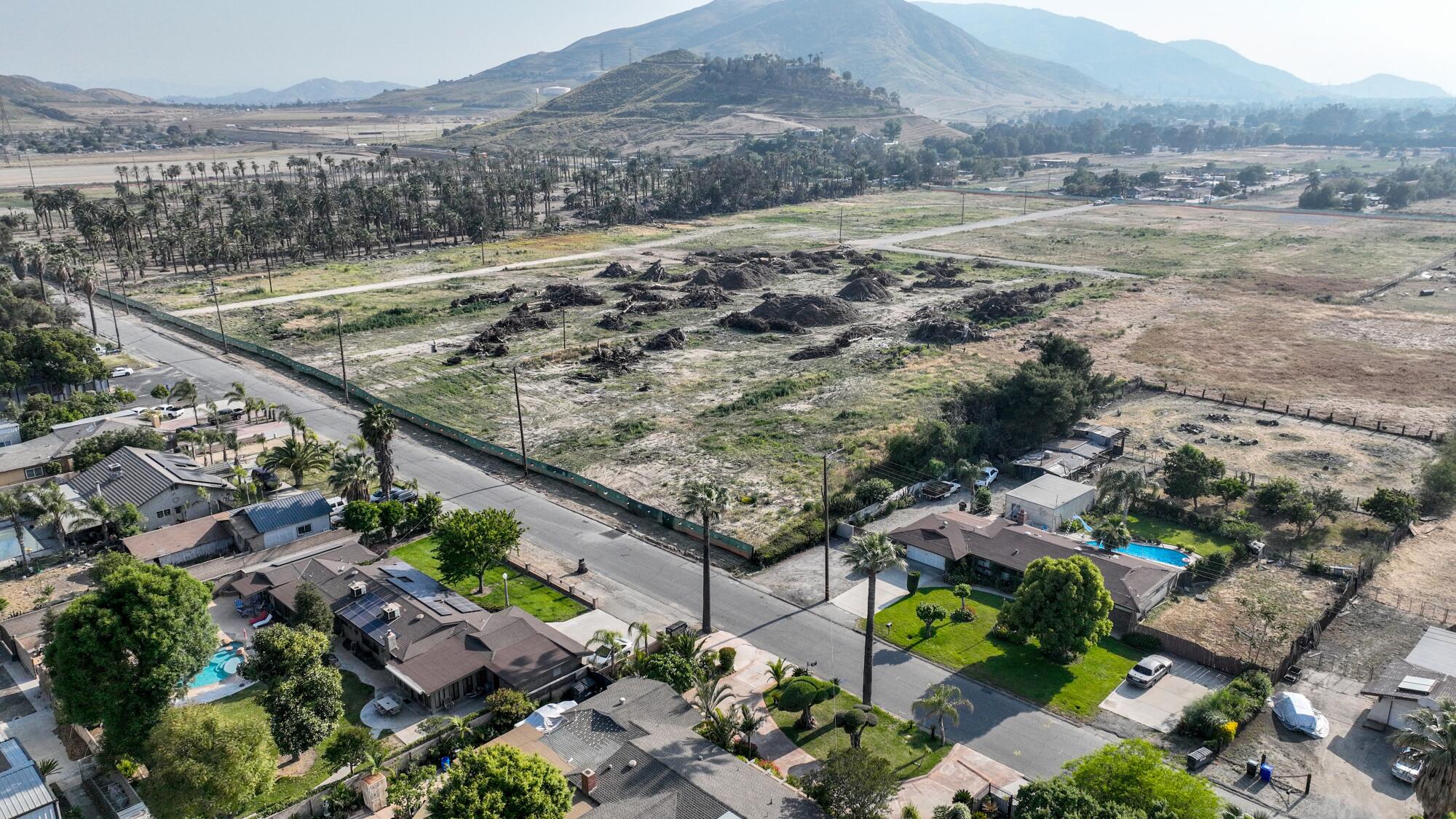
Unincorporated Bloomington is transforming, as developers look to raze neighborhoods near the 10 Freeway to create a logistics corridor dedicated to online shopping needs.
(Robert Gauthier / Los Angeles Times)
They selected a five-bedroom, five-bathroom home in Highland, a nearby suburb at the base of the San Bernardino Mountains, and closed on the property in January 2023 for $1.05 million. The 3,800-square-foot home has a pool and views. It’s on a sewer system, and while their residential street doesn’t have sidewalks, the nearby roads have sidewalks and bike lanes.
“It still feels unreal where we ended up,” she said. “It’s beautiful. I completely love where I live.”
Diaz has heard other residents say that homeowners were harassed and pressured to sell. She is adamant that’s not the case.
“No one is forcing me out,” she said. “It was a blessing to get the opportunity to be able to have a new start.”
Carolina Rios also saw the developer’s offer as an opportunity.
Rios and her family paid $225,000 for their Bloomington home and lived there about 13 years. She has fond memories of the three-bedroom house on Laurel Avenue: She threw her daughter’s quinceañera there, and she and her husband were married in the yard.
But the house was old, and instead of storm drains, the homes on her street had pipes under the driveways that flowed into ditches. The street flooded every time it rained. They had to walk atop pallets and bricks to cross the yard.
“Across the street, their ditch was 24/7, 365 days a year full of water and mosquitoes and raccoons and snakes and all sorts of fun wildlife to go to the zoo and look at,” she said. “But not in my house, around my kids.”
She agreed to sell in 2016; she said the developer adjusted the purchase price in 2023 — to $1.4 million — after the county approved the project, in recognition of rising home prices. In late December, she closed on a new house in Riverside with an extra bedroom, a swimming pool and an enclosed patio. She paid $1.2 million in cash.
She knows some people are opposed to warehouse development, but she says the industry is bringing good jobs. Her oldest children, ages 27 and 24, both work at a FedEx warehouse in Bloomington, where they have flexible hours and get frequent raises, she said.

Jessie Ortiz practices roping skills in the backyard of his family’s Bloomington home.
(Robert Gauthier / Los Angeles Times)
While some homeowners seized on the opportunity to move out of Bloomington, Felipe and Blanca Ortiz felt blindsided when their landlord sold the ranch home they were renting to the developer.
The Ortizes and their four children have lived on the two-acre property for more than a decade. They’ve maintained their family traditions from the Mexican state of Morelos, raising horses, goats and chickens on their small property.
They loved riding their horses through the hills behind their home, and regularly traveled to other cities to ride their horses in parades, decked out in traditional Mexican cowboy and cowgirl attire. They organized 100-horse processions as fundraisers for neighbors in need.
“It’s their entire lives,” Felipe Ortiz said, as he shared TikTok videos of his kids performing on horseback.

Felipe Ortiz and his family are being evicted from the ranch home they have rented for more than a decade.
(Robert Gauthier / Los Angeles Times)
In February, the family got a notice informing them their rental agreement would end in 60 days. It came from a company connected to Timothy Howard of Howard Industrial Partners — the only indication the family had that their rental home had been sold.
That same day, footage from the Ortiz family’s security camera shows an excavator knocking down the chain link gate in front of the ranch. The two youngest Ortiz kids, ages 6 and 12, were home at the time. The family viewed it as an act of intimidation.
Tunney, with Howard Industrial Partners, said it was “regrettable” that the previous owner didn’t disclose the sale to the Ortiz family.
“Additionally, it was not disclosed to us that there were occupants on the property,” Tunney said. “The incident with the excavator was inadvertent as the operator was scheduled to work at a nearby site and confused the addresses.”
Several months later, the family is still living in the home, waiting out the eviction process. Ortiz says he is struggling to find another property that will accommodate the family of six and their eight horses. As their search wears on, he said, his kids are traumatized. His youngest returns from school each day wondering if their home has been knocked down.
“Every day, the machines pass by here to knock down homes behind us,” Ortiz said. “And you’re left with the fear that they are coming to knock down our house.”
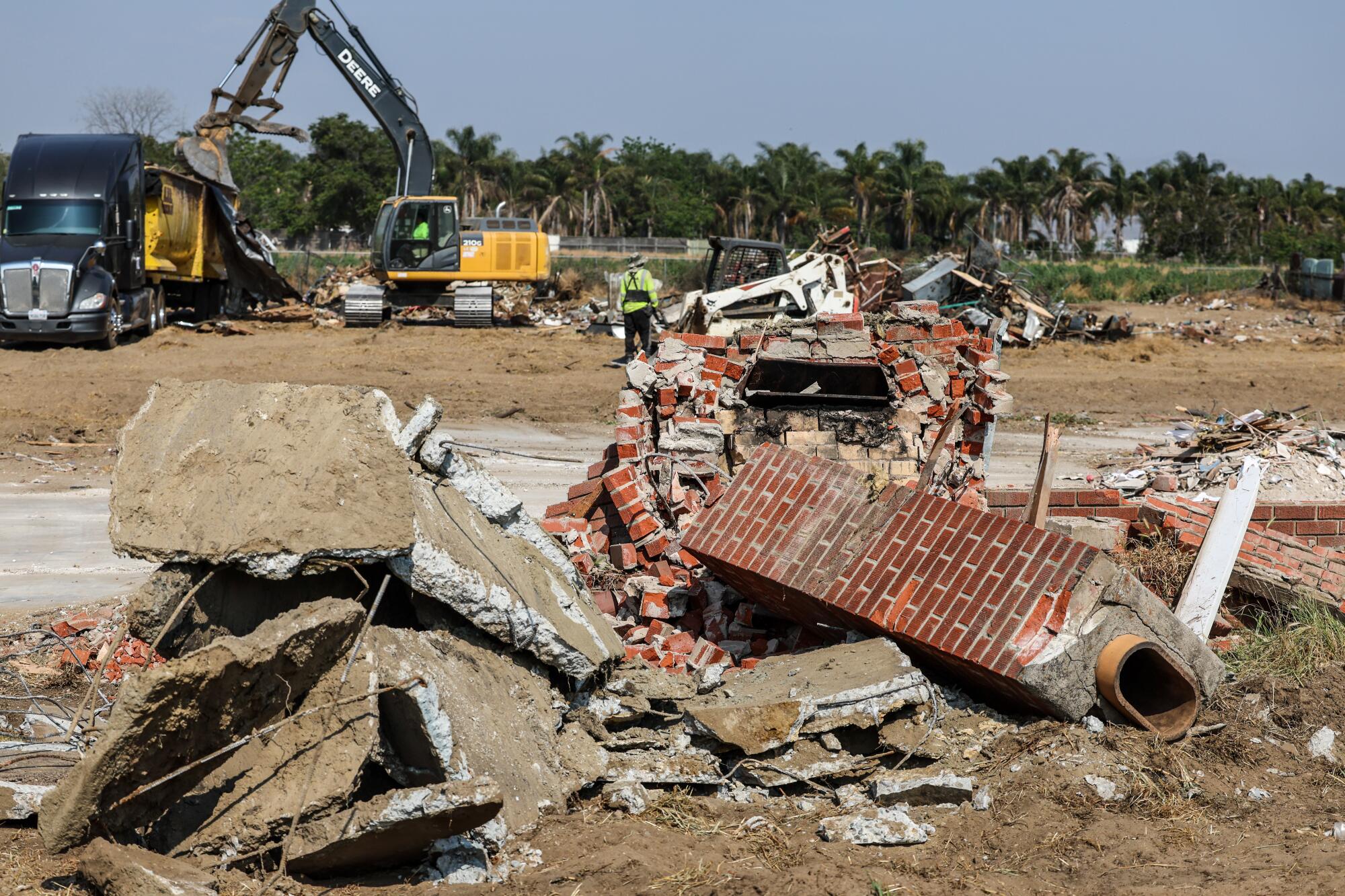
As homes are demolished in rural Bloomington to make way for a warehousing project, the neighbors who remain look out at rubble.
(Robert Gauthier / Los Angeles Times)
As the demolitions proceed, a coalition of environmental groups has sued San Bernardino County and Howard Industrial Partners, trying to halt the project. The lawsuit, alleging violations of state environmental and fair housing laws, seeks to vacate the county’s approval and require a more “meaningful” review.
Adrian Martinez is deputy managing attorney for Earthjustice, the group representing the defendants. He called their effort a key moment in “the fight against the freight industry and its disregard for public health.”
“There are people who don’t want these warehouses in their communities and they just want to be left with peace,” Martinez said. “I think the inflection point is this kind of misguided notion that to give a community resources, you have to stuff thousands of trucks in the community and air pollution. And there’s no place in the country that this story is more robust than the Inland Empire and Bloomington in particular.”
A hearing is scheduled for later this month in San Bernardino County Superior Court.

“Everyday, the machines pass by here to knock down homes behind us,” Felipe Ortiz says of his family’s plight. “And you’re left with the fear that they are coming to knock down our house.”
(Robert Gauthier / Los Angeles Times)
Meanwhile, just a couple miles away, residents in southeastern Bloomington are starting to hear from developers interested in building more warehouses in the area.
Daniela Vargas, 24, said her parents bought their house there more than two decades ago. For her parents, both Mexican immigrants, it’s a deep source of pride to own a home they could pass down to their four children.
Vargas’ family raises chickens on their land, but the surrounding area is pockmarked with industry. Just a short drive from the family’s home is another warehouse complex, a railroad and the 10 Freeway.
Recently, they’ve received phone calls and “strange-looking mail” from developers interested in buying their home, Vargas said: “It looks like a check that says, ‘Here’s X amount of money, call us to make it real.’”
She said her family doesn’t want to leave, but it feels inevitable that their neighborhood will be the next to transform.
“Anyone that moves out of Bloomington, it’s all valid reasoning,” Vargas said. “My family is really prideful. But if the decision comes that warehouses are going to be developed here and everybody is leaving, we can’t remain with so much pollution around us, with so much traffic and with no real neighbors or neighborhood amenities.”
This article is part of The Times’ equity reporting initiative, funded by the James Irvine Foundation, exploring the challenges facing low-income workers and the efforts being made to address California’s economic divide.



Tech stocks took another big hit Tuesday as investors sold off shares of companies that have powered the artificial intelligence boom.
Technology companies have been spending billions of dollars investing in data centers and infrastructure needed to support the race to advance AI. But sky-high valuations and geopolitical tensions have some investors questioning whether massive AI spending will pay off, analysts said.
Reflecting the unease, the tech-heavy Nasdaq composite dropped roughly 2%. The Standard & Poor’s 500, a stock market index that tracks the performance of the largest U.S. publicly traded companies, fell by more than 1%.
Share prices for major California tech companies including Nvidia, Qualcomm, Intel and Marvell Technology all dropped. Meta Platforms, Apple, and Google’s parent company, Alphabet, also saw their stock prices slide, though the decline wasn’t as large as the drop in chip stocks.
Shares of Micron Technology, a U.S. memory chip manufacturer, plunged by more than 13% a day before the company was scheduled to report its third-quarter financial results. Anxiety in the U.S. spilled over from Asia, where South Korean tech companies SK Hynix and Samsung Electronics, both major computer memory chip manufacturers, saw their stocks plunge Tuesday by more than 12%.
“Investors are just a bit skittish after very strong moves in tech stocks where any hint of caution causes some investors to hit the sell button,” said Dan Ives, an analyst who heads technology research at Wedbush Securities, adding that it’s a “gut-check moment.”
On Monday, SpaceX saw its shares plunge 16% after a record-breaking initial public offering this month. Its share price then rebounded Tuesday, closing up less than 1% to roughly $156.
Tech companies have been making big bets on the role AI will play in people’s work and personal lives. They’ve been improving chatbots that can generate code, words, photos and videos. The companies also are betting that “AI agents” will be able to proactively tackle more in the future, automating repetitive tasks in customer service, online shopping and other industries. They’re releasing more AI-powered hardware such as smartglasses.
Major tech companies are going head-to-head in the race to dominate AI, competing to sway talent and consumers into using their products. Alphabet saw its stock slip after two of the company’s prominent AI researchers left for rival companies OpenAI and Anthropic.
Despite profitability questions, AI use has been growing. Roughly half of U.S. adults use an AI chatbot, according to a Pew Research Center report released this month. They’re using these tools for search, work tasks, entertainment and even companionship. More U.S. adults reported using OpenAI’s ChatGPT, followed by Google’s Gemini, Microsoft Copilot and Meta AI.
Amid all the hype and spending, there also have been growing fears about whether AI will take over people’s jobs and whether the boom will lead to a bubble that will eventually burst. California AI startups OpenAI, valued at $852 billion, and Anthropic, valued at nearly $1 trillion, are preparing to potentially become publicly traded companies.
“I don’t view this as a bubble,” Ives said. “I view it as we’re going to go through these white-knuckle moments as tech stocks continue to move higher, but the bears will continue to yell fire in a crowded theater when we have these pullbacks.”
Economic factors also could affect how much people are willing to invest in tech company stocks. There’s anxiety over whether the new Federal Reserve Chair Kevin Warsh will raise interest rates, making it more expensive to borrow money. That could cut into a company’s profit margin or decrease consumer spending. United States’ war with Iran is driving up gas prices while the U.S. inflation rate rose to 4.2% in May.
The AI boom is fueling the demand for memory and storage chips, but prices for them are on the rise, prompting some companies such as Apple to look at raising prices for consumer electronics.
Globally, AI spending is projected to increase to $2.59 trillion in 2026, up 47% year over year, according to a forecast by research firm Gartner.
Driven by AI demand, memory and storage vendors have significantly outperformed the S&P 500 and the SOX index, a global semiconductor and microchip index, since the start of 2025, according to a note to clients from BNP Paribas.
Still, investors are on edge ahead of Idaho-based Micron Technology’s earnings report Wednesday, said Gil Luria, head of technology research at financial services company D.A. Davidson. Since January, Micron Technology’s stock has climbed more than 233% to more than $1,000 per share.
“Any indication of a slowdown in demand for AI is seen as a potential turn in the cycle,” Luria said. “While the overwhelming sense is that demand is still far exceeding supply, investors are waiting for Micron to indicate that is still the case.”
Times staff writer Nilesh Christopher contributed to this report.

Tired of the same old dating apps like Bumble and Hinge, Marie Lansley tried talking to an artificial intelligence matchmaker.
For roughly 15 minutes, she chatted with an AI voice on the dating app Known, answering questions about her upbringing, personality, education, lessons from past relationships and whether she’s looking for a serious relationship or something more casual.
“Divorced at 36. Yea, you’re not here to waste time. The way you build your days matter,” the AI voice told her after Lansley replied she was looking for a serious relationship.
Weeks later, the San Francisco resident got a match along with a written summary of why the pair could be compatible. But the stranger wasn’t her type and she wasn’t keen on paying $15 to meet up.
Startups like Known are roping in new users by hosting in-person dating events in San Francisco.
“I want to be able to use AI to improve efficiency in dating and to help navigate a pretty frustrating dating landscape. But there are just some things that are so deeply human that AI technology cannot capture,” said Lansley, who has posted about her dating experience on social media.
Singles like Lansley are dipping their toes into the wacky world of AI dating but they’re also skeptical if it will make it easier to find love. Online dating is ripe for disruption, and tech companies big and small are turning to AI as a potential solution to find people better matches more quickly and help them improve their chances of landing a date.
For years, people have been frustrated and exhausted by the seemingly endless amount of swiping and small talk that go nowhere on dating apps. They’re turning to in-person options such as running clubs, pickleball and speed dating but finding the right partner is still tough.
Online dating remains a popular way people search for a partner but some are dumping the platforms. Tinder’s monthly active users in March dropped 7% year-over-year, though its parent company Match Group noted that the rate of decline has been slowing as it revamps the app.
West Hollywood-based Tinder, which has roughly 50 million monthly users, has been experimenting with using AI to analyze a user’s camera roll and recommend better matches.

Known, an AI dating app, has its branding plastered on a storefront in the Marina District in San Francisco.
Its rival Bumble — an app that initially stood out for having women message their matches first — saw its paying users drop 21% to 3.2 million in the first quarter this year compared to 2025. The company has been working on AI matchmaking and plans to ditch swiping in the last three months of the year in select markets.
Even dating services that have grown users such as West Hollywood-based Grindr, an app for the LGBTQ+ community, and Facebook Dating, which is included in the main social network, are also leveraging AI more.
And new AI dating startups are popping up in California, New York and other states that could change the way people find a partner online. Former Hinge co-founder and Chief Executive Justin McLeod is working on an AI dating app called Overtone, stating on its website that “AI, if used correctly, can help us invent an entirely new way for people to find their partners that is far more personal, far more efficient, and far more effective.”
Some of those startups started in the San Francisco Bay area, where AI dating apps are hosting parties, speed dating, coffee meet-ups and other in-person events to rope people into using their new service.

Singles who downloaded the Known dating app mingle over drinks at Left Door, a cocktail lounge in San Francisco, on Thursday.
On one recent Thursday night, dating app startup Known hosted a dating event at a swanky San Francisco cocktail lounge for people who completed their matchmaking call on the app. The event’s description said attendees would be greeted with “champagne, caviar bumps, and a mysterious envelope” that reveals who the AI matchmaker paired them up with.
Known Chief Executive and co-founder Celeste Amadon, who dropped out of Stanford University to create the AI dating app, said Americans are spending more time alone at home as online services have made it more convenient to do everything from getting food delivered, online shop and date. Young people complain about traditional dating apps yet they’re also still on them.
“The more I understood today’s dating apps, the more clear it became that they have been for the better part of two decades now, designed, tweaked, redesigned, rebuilt, to not work,” she said.
1

2

3

1. A sign that reads, “I love my AI boyfriend” hangs in a San Francisco window. 2. Known, an AI-driven dating app, has their branding plastered on a store front in the Marina District in San Francisco. 3. Celeste Amadon, CEO of Known, poses for a portrait.
The company charges per date to ensure people show up but the startup also has a business incentive to find people a match they actually want to meet, she said. Known plans to expand to San Diego in July, she said. Amadon said she expects the AI matching technology to become more accurate over time.
Known hasn’t shared its user numbers or revenue figures. Founded in 2025, the startup launched the dating app in February and has raised roughly $10 million from investors such as Coelius Capital, Forerunner Ventures and NFX, according to PitchBook.
Grindr is learning more about how much users are willing to use and pay for AI features.
The company has been testing a subscription tier called “Edge” in Australia, New Zealand, the United States and Canada that includes AI tools that recap meaningful chats, display personalized profile recommendations and show users who they’re likely to match with.
Unlike other dating apps, Grindr users don’t swipe through profiles. The app displays a grid of people who are nearby that they’re able to chat with. Grindr has expanded beyond casual dating, allowing people to find friends, travel companions and others in the LGBTQ+ community.
Grindr’s Chief Product Officer AJ Balance said the company is still testing subscription pricing for Edge but some users are willing to pay $350 per month because they’re “seeing a lot of value” and saving time.
“We view AI and new paradigm shifts like it as opportunities to build great, new product experiences that haven’t been developed before,” he said. “Our approach is really to leverage AI, like we did with mobile, to facilitate better conversations, deeper connections, ultimately more success in dating in the real world.”
Other popular dating services aren’t charging for AI matchmaking features. On Facebook Dating, which has more than 21.5 million daily users worldwide, users can use AI to write their profile intro and chat with an dating assistant for free.

AI dating startups are popping up in California, New York and other states that could change the way people find a partner online.
The AI assistant can recommend people looking for a serious relationship, someone with common hobbies or even above a certain height or age. Roughly 1 million people use Facebook Dating’s AI assistant daily in the United States and Canada, Meta said.
Facebook Dating product manager Neha Kumar said AI can help combat “swipe fatigue” facing online dating users.
“You’re sifting through a bunch of profiles. It’s really hard to understand and find somebody that’s compatible for you based on your specific types of preferences,” she said. “We really wanted to think about leveraging AI to solve this growing pain point.”
Technology is also a double-edged sword. The rise of AI tools means people can use technology to easily manipulate photos and craft messages on dating apps that might make them seem much more attractive or charismatic than they are in person. Some people are even turning to AI chatbots for companionship.
“How do we maintain human authenticity and human connection through an AI world? I don’t have a perfect answer to that. I think we’re still figuring it out,” Kumar said.
Lansley, the online dating user, said apps do make dating more convenient but it’s much more interesting to meet people face-to-face. She worries people will rely too much on AI as a “crutch” to replace human intimacy or emotional judgment.
“Chemistry,” she said, “is always going to be analog.”

Los Angeles County saw job gains in May, likely driven in part by rebuilding after the January 2025 wildfires, which destroyed or damaged more than 18,000 structures.
Construction added 2,300 jobs since April, while postings for new jobs in the industry jumped 45% over a year ago —indicating rebuilding in Pacific Palisades, Altadena and nearby is helping boost the local economy, according to a report by the Los Angeles County Economic Development Corp.
“This is consistent with the possibility that wildfire rebuilding activity is increasing construction labor demand in the area,” Max Chomas, an economist at the LAEDC Institute for Applied Economics, said at a presentation this week based on California Employment Development Department and other data.
Motion picture and sound recordings also added 2,800 jobs during the month, despite a deep downturn in Hollywood caused by a reduction in streaming filming, runaway production and other factors. The industry lost 6,700 jobs compared with a year ago.
Still, the job growth since April in construction and Hollywood were among the highlights of a month that saw total county payroll jobs — excluding agriculture and certain other sectors — grow by 9,000 jobs, to 4,618,400. Employment was virtually flat from the same time a year ago.
“May was a relatively good month for employment growth,” Chomas said.
The biggest monthly job gainers were the hotel and restaurant industries, which added 3,700 jobs.
Manufacturing, which has been hit by job losses over recent years, added 400 jobs since April. It also saw a 15% increase in job postings compared with a year ago.
That could reflect the resurgence in Southern California’s aerospace and defense industries, which have seen a sharp rise in startups.
Postings for all new jobs were up 1,134, or 2.4%, since a year ago. Chomas noted that May was only one of five months over the last three years that saw year-over-year growth in job postings.
The gains helped stabilize the county’s unemployment rate at 5.2%, matching April’s rate and down from 5.4% in May 2025.
Still, that is higher than May’s 4.3% national unemployment rate, and it masked some weakness in the local economy.
The rate is calculated by a household survey to determine which members are working, looking for work or no longer seeking employment.
It found 18,000 workers had dropped out of the county labor force in May, artificially driving down the unemployment rate, according the California EDD.
Similarly, California recorded a 5.3% unemployment rate in May, on par with April, despite a drop in the labor force.
That rate is higher than every state other than Delaware. In May, California only added 3,100 non-farm jobs month-over-month — a job growth rate that lags behind the nation, according to an analysis by the Inland Empire Economic Partnership and the Lowe Institute of Political Economy at Claremont McKenna College.
The LAEDC’s report also examined the potential effects the growth in artificial intelligence has been having on L.A. County jobs “exposed” to AI, meaning they are vulnerable to AI replacement.
California has been hit hard by thousands of AI-related layoffs in Silicon Valley as the software has been integrated into the tech workplace — even though there is fierce competition for software engineers with skills and expertise in the field.
The report found that since July 2023, job listings in Los Angeles County for AI-exposed positions — such as clerical and translation positions — have lagged behind other jobs. However, it is unclear whether businesses have replaced or are waiting to replace those workers with AI.
It may be that employers overhired for those positions during the COVID-19 pandemic and are now shedding them, since there is a correlation between AI-exposed positions and those jobs that can be completed from home, Chomas said.
The report also examined macroeconomic trends and policy decisions affecting the national, state and Los Angeles County economies — which have been hit by tariffs, the crackdown on immigrant labor and high energy costs, among other factors.
Nevertheless, consumers continue to spend despite affordability strains, and employers continue to hire selectively amid higher interest rates to battle inflation, said institute economist Shannon Sedgwick.
“During the previous decade, we experienced extraordinarily low inflation, near zero interest rates, relatively stable globalization, and abundant capital. So those conditions may have conditioned us to think that environment was normal,” she said.
“But historically speaking, today’s world of higher rates, greater geopolitical uncertainty and tighter labor markets, they may actually be closer to that long-run average,” Sedgwick noted.
-

 Mississippi2 minutes ago
Mississippi’s Top High School Quarterbacks: 10 Passers to Watch in 2026
-
Missouri5 minutes ago
Missouri Lottery Pick 3, Pick 4 winning numbers for June 28, 2026
-
Montana10 minutes ago
French Montana, Rick Ross & Max B Turn the BET Awards Into “ – BET Awards 2026 | BET
-

 Nebraska17 minutes ago
"They've Built This": Nebraska commit Barrett Kitrell carries on family football legacy
-

 Nevada20 minutes ago
One dead, four hospitalized after head-on crash on I-15 in Clark County
-

 New Hampshire32 minutes ago
Nashua downtown apartment project earns Plan NH 2026 Merit Award of Excellence » Nashua Ink Link
-

 New Jersey35 minutes ago
Princeton Plasma Forge to power New Jersey innovation
-

 New Mexico40 minutes ago
Search operation continues to close area in Cochiti Lake

