

Connect with us

Entertainment

Ketamine trips, electric scooters, bucket hats. Seth Rogen and Rose Byrne get physical

Published

on

Ketamine trips, electric scooters, bucket hats. Seth Rogen and Rose Byrne get physical

Seth Rogen and Rose Byrne don’t remember the exact date or location of their first introduction more than a decade ago — it was either via a chance backstage encounter at a talk show, according to Byrne, or through one of their many mutual friends, according to Rogen — but a real-life friendship and a successful working relationship were forged when they played a married couple in 2014’s hit comedy “Neighbors.”

“I remember the ‘Neighbors’ audition very clearly,” Byrne says.

“I don’t remember anything that clearly, if I’m being honest, but I do remember that,” Rogen quips. “We did an extensive round of looking for people to co-star. [Director] Nick Stoller had worked with Rose on ‘Get Him to the Greek’ and was always saying how funny she was. She came in and read and it was no contest. There was no one else [we wanted].”

Ten years and a “Neighbors” sequel later, they’ve brought their comedic chemistry to the small screen via AppleTV+’s half-hour “Platonic.” The series, co-created by Stoller, revolves around estranged college friends who reconnect at pivotal points in midlife. It premiered last May and received a Season 2 renewal in December.

“I never dreamed I’d have this great kind of partnership in comedy with someone,” Byrne says.

Advertisement

“I’d say the comfort [between us] has only grown, which made it easier and hopefully funnier for audiences,” Seth Rogen says of working with Rose Byrne.

(Paul Sarkis / Apple TV+)

“We definitely understand each other’s rhythms better,” Rogen adds. “I’d say the comfort [between us] has only grown, which made it easier and hopefully funnier for audiences.”

Over a recent video call, the two stars, who also serve as executive producers of “Platonic,” discussed the joy of doing physical comedy, coveting Rogen’s colorful wardrobe and those pesky scooters.

Advertisement

You both got to lean into some physical comedy. Rose, I read that you found some unique videos in your research about ketamine trips.

Byrne: Oh my God, yeah. These [YouTube] videos, they’re really wild because it’s a lot of footage from convenience stores where they’ve recorded people, and it’s really pretty disturbing. That was one of those [scenes] that was really, really fun to do. And then Seth’s just game. I was all over the place. He kept having to prop me up, and I was kicking him in the face, his wine is everywhere.

Rogen: Yeah, that was something where it was helpful to know each other well. And YouTube is an amazing resource for comedy. I think that’s the first place to stop if you’re going to do a physical gag.

Seth, you had some physical work with those electric scooters that are everywhere in L.A. Do you or Nick or someone on the writing staff have a personal vendetta against them?

Rogen: No, I don’t hate the scooters. I don’t love them either. I lived in West Hollywood for a long time and I would come outside and there would be a pile of them outside my front door. It’s impossible not to feel some sort of resentment toward them. What’s funny, my father-in-law actually hates them. He tried to throw one and majorly f— up his shoulder for a year and a half. I also hurt my shoulder throwing them pretty early on in the shoot. It hurt for quite a while. Those things are a lot heavier than they look.

Advertisement
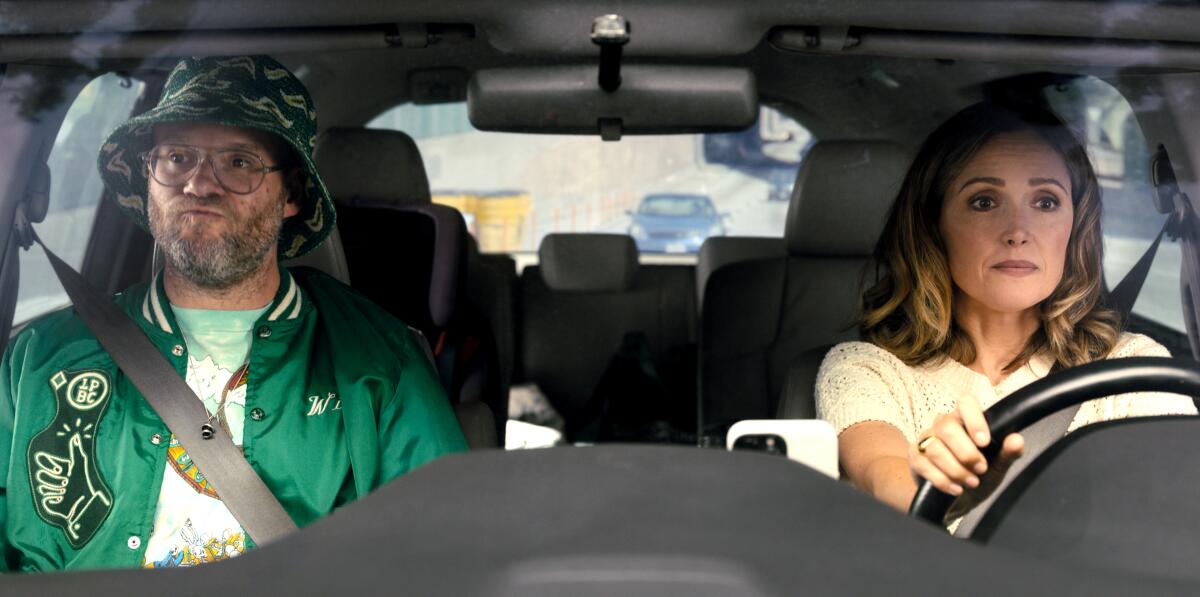
A man wearing a bucket hat rides in a car with a woman driving, each looking a little tense in "Platonic."

“I never left the bucket hat. I don’t know if it’s back or not, but it’s back with me,” Seth Rogen says. “I’ve been a consistent believer of the bucket hat.” So too is his “Platonic” character.

(Paul Sarkis / Apple TV+)

A hopefully less painful subject: You got to keep your character’s clothes. How are you wearing them?

Rogen: I do wear them. The clothes were a strong choice; it was an idea I had. The character was not scripted as dressing any specific way, but to me this guy is desperately trying to be cool and hang onto his youth and also trying to assert himself as a unique individual in this downtown Arts District world. He’s also someone who’s probably just friends with a lot of people with clothing companies, and I know people who work in this type of field, so it was representative of things I’ve seen, but mostly it was a way to look like a sad old man trying to be young.

Byrne: I loved it. And it also gave me an opportunity to make fun of you. It was always like a good warmup joke [for Sylvia], being like, “What are you wearing?” It’s just such a specific kind of needle that you were threading. It was really fun.

Advertisement

You’re also one of the few that pulls off the bucket hat really well. It’s not a good look for everyone.

Rogen: I actually do wear bucket hats. We went out for dinner yesterday, and my sister was like, “You’re really sticking with the bucket hat?” I’ve never left them. I went with it in the ’90s when it started and I never left the bucket hat. I don’t know if it’s back or not, but it’s back with me. I’ve been a consistent believer of the bucket hat.

Byrne: It is a hard one to pull off. I look ridiculous in a bucket hat.

Rogen: You could argue that I also look ridiculous, but I embrace it.

Is there a specific line that fans quote to you or something that people want to talk to you about regarding this show?

Advertisement

Rogen: I get a lot of talk from people who hate the scooters.

Byrne: People have strong feelings about the scooters.

Rogen: Very strong. And guys who bleached their hair. I got a lot of middle-aged men [coming up to me] like, “I saw you, thought it looked pretty good.”

Byrne: I’ve had a lot of [positive feedback] from mothers trying to get back in the workforce. It’s a passage in life for a lot of women, and that was definitely part of this character. And then also people who’ve had similar friendships with a guy or a girl and have this history of a great friendship that is not the same anymore and how that is. I hadn’t really seen a show like this before where it really is about a friendship, and that was nice.

Looking ahead, what can you share about your hopes for Season 2?

Advertisement

Rogen: I don’t know what I can say. I’m looking forward to it.

Byrne: I’m kind of in the same camp. It’s great to get a second go. You really can lean into more of what was working and leave what wasn’t.

Rogen: Yeah. I think especially with TV, there’s a sense that it gets better as you do it. There’s probably the wave, probably crests, but I know as you’re shooting the sixth episode, I’m always like, oh, we’re all so much funnier than we were when on the second episode. That’s what I’m looking forward to is, to Rose’s point, knowing each other, knowing what works a little bit better and having a little less concern that people will just massively reject what we are doing.

Advertisement

Movie Reviews

Movie Review: ‘Supergirl’ – Catholic Review

Published

on

Movie Review: ‘Supergirl’ – Catholic Review

NEW YORK (OSV News) – At what is meant to be a poignant moment in the DC Comics adaptation “Supergirl” (Warner Bros.), the title character, played by Milly Alcock, is told by her mother (Emily Beecham) that she doesn’t have to be nice but she must be good. The recipient of this advice takes it to heart in a way that lends the whole film an unpleasant tone.

We’re not talking Deadpool depths of obscene snark here. Yet scrappy Supergirl, aka Kara Zor-El, in contrast to her affable cousin — and fellow Kryptonian — Superman (David Corenswet), does not come across as especially likeable.

Nor is she a figure to be imitated since, before she embarks on the quest to which most of the running time is devoted, early scenes show her waking up with a succession of staggering hangovers. She gets blotto, we later learn, in an effort to blot out her troubled past. The only positive ingredient in her current life is the bond she shares with her beloved dog, Krypto.

So when evil alien Krem of the Yellow Hills (Matthias Schoenaerts) wounds Krypto with a poisoned dart, leaving him with only hours to live, Supergirl is desperate to help the pup survive. Learning that Krem carries the antidote with him wherever he goes, she sets off on an interplanetary hunt for the villain, racing against time.

Supergirl has already crossed paths with another of Krem’s victims, Ruthye (Eve Ridley). Having watched as Krem slaughtered her entire family, Ruthye is out for revenge and wants to join forces with Supergirl.

Advertisement

Since Ruthye, though courageous, is undersized and completely untrained for combat, Supergirl initially tries to ditch her. But Ruthye is not to be so easily rebuffed.

The unlikely duo eventually acquire an informal ally in the person of cigar-chomping, motorcycle-riding freelance warrior Lobo (Jason Momoa). Lobo has reasons of his own for hating the band of brigands Krem leads.

As scripted by Ana Nogueira, director Craig Gillespie’s scifi adventure includes more than one exchange in which Supergirl warns Ruthye about the morally corrupting effects of exacting vengeance. Yet this thoroughly respectable ethical message is completely undermined as the action reaches its climax.

“Supergirl” may not be a dose of Kryptonite. But it’s no energy-infusing sunbath either.

The film contains much harsh but bloodless violence, a scene of urination, a passing reference to nonscriptural religious ideas, a couple of mild oaths, several uses each of crude and crass language and an obscene gesture. The OSV News classification is A-III – adults. The Motion Picture Association rating is PG-13 — parents strongly cautioned. Some material may be inappropriate for children under 13.

Advertisement

Read More Movie & Television Reviews

Copyright © 2026 OSV News

Continue Reading

Entertainment

Movies, books, art and music to explore as America turns 250

Published

on

Movies, books, art and music to explore as America turns 250

A crazed newscaster prompts his viewers to do a wild thing: open their windows and shout, “I’m as mad as hell and I’m not going to take this anymore.” And they do it, from Atlanta to Baton Rouge, so much yelling. It’s a prescient scene in “Network” from 1976, the year of America’s bicentennial. Fast forward to the semiquincentennial and Americans holler versions of that slogan through windows in real life, just on phones and computers.

When the national mood wobbles, we turn to the arts, which have the power to free buried desires, soothe souls and cross divides. So as America turns 250, the Entertainment team considered how this country’s ups and downs have shaped what we watch, listen to and read. Throughout this week those stories will appear here. Bookmark this page to come back for more.

To start, “Network” makes our list of movies that illustrate frictional historical moments. (“Team America: World Police” does too so expect range!) We also spotlight a new generation of playwrights reimagining Americanness with a sense of hope that America’s best years are still ahead of us. —Brittany Levine Beckman, Entertainment and Features editor

Advertisement
Continue Reading

Movie Reviews

‘Balaramana Dinagalu’ review: A restrained look at the gangster mind

Published

on

‘Balaramana Dinagalu’ review: A restrained look at the gangster mind

In K M Chaitanya’s Aa Dinagalu (2007), actor Atul Kulkarni, playing gangster Agni Sreedhar, says man is the biggest weapon in the underworld. “The rest are just properties,” he adds. The yesteryear Kannada crime drama, based on the real incidents from a big chapter of the Bengaluru underworld, stood out for its understated storytelling.

In Balaramana Dinagalu, which has the skeleton of a sequel to Aa Dinagalu, weapons are seen in the first scene. As the film progresses, we encounter an arsenal of knives, razors, machetes, and guns — each an extension of the gangsters’ identities and an indispensable tool in their quest to remain feared and lethal. Chaitanya attempts to make the movie a mix of reality and entertaining tropes.

Balaramana Dinagalu (Kannada)

Director: K M Chaitanya

Cast: Vinod Prabhakar, Priya Anand, Atul Kulkarni, Ashish Vidyarthi, Ramesh Indira

Runtime: 151 minutes

Advertisement

Storyline: Balarama, an ordinary young man from a remote village in Karnataka, becomes a dreaded gangster who rules Bengaluru

The director has roped in the same cast, who played the dreaded gangster trio of Kotwal Ramachandra (essayed by Sharath Lohitashwa), Jayaraj (Ashish Vidyarthi), and Agni Sreedhar (Atul) in Aa Dinagalu. That’s what makes one instantly curious about Balaramana Dinagalu. The only difference in the latest movie from the previous one is the fictionalised names of the real dons. Jayaraj becomes Jayaram, Sreedhar is Shashidhar, and Muthappa Rai is called Monnappa Rai (played by Ramesh Indira).

Even if these characters are the big draw in the movie, the plot revolves around the journey of Balarama, a character with a small yet significant presence in Aa Dinagalu. Vinod Prabhakar’s portrayal of the titular role is the film’s biggest takeaway. He makes us feel for the character, and is quite impressive in the final portions of the movie, where Balarama struggles to break free from the underworld’s trap.

Balaramana Dinagalu is impressive when it reflects the psychology of a gangster. Jayaram is shown helping the needy while Balarama urges young boys to focus on education. It’s as if these men who commit heinous acts, have a heart as well. Shashidhar is often called “intellectual gangster”, as the film reflects how the underworld fears well-read men in the field. Politicians and policemen, the supposedly the protectors of people being part of the crime nexus, strengthen the movie’s world-building.

The film falters in its inability to rise above the plot’s predictability. Balarama’s journey is no different from the often-seen life of an innocent man from a small town who becomes a gangster owing to uncontrollable circumstances. I wish the film had delved a bit more into Balaram’s personality. Why does he not resist becoming a gangster? What dreams did he have when he moved to Bengaluru from a small town?

Advertisement

“My hands speak louder than my words,” says Balarama. This signals that he is someone who settles conflicts with fists rather than conversations. Despite this detail, Balaram’s entry into the underworld feels too sudden. The predictability strips the sheen away from the well-shot action sequences, as the result of every fight is known beforehand.

Chaitanya is careful not to glorify the act of violence. He wants to portray the negative effects of violence on the children in a family, as the movie ends with a hard-hitting frame. It’s impressive that the actor-director duo has delivered a non-hero-worshipping gangster saga.

That said, the movie could have benefited from a couple of gripping episodes. While it’s important not to romanticise the life of a gangster, there is no harm in delivering moments of peak tension, the biggest plus of the genre. 

The assassination of Jayaram, the impact of Kotwal’s elimination on the underworld, or the Sakleshpura incident involving Monnappa Rai, had the potential to offer edge-of-the-seat, high-stakes portions, but they are rushed. The love story is simple, but it lacks emotional intensity between the lead couple. Santhosh Narayanan’s dance numbers are forgettable (despite it being his forte) while his montage melodies are beautiful.

Balaramana Dinagalu adopts a restrained, almost clinical approach to the gangster genre. While that keeps it from glorifying violence, it also leaves the narrative feeling a touch too neat and emotionally muted.

Advertisement

Balaramana Dinagalu is currently running in theatres

Published – June 28, 2026 07:58 pm IST

Continue Reading
Advertisement

Trending
