

Entertainment
Ketamine trips, electric scooters, bucket hats. Seth Rogen and Rose Byrne get physical
Seth Rogen and Rose Byrne don’t remember the exact date or location of their first introduction more than a decade ago — it was either via a chance backstage encounter at a talk show, according to Byrne, or through one of their many mutual friends, according to Rogen — but a real-life friendship and a successful working relationship were forged when they played a married couple in 2014’s hit comedy “Neighbors.”
“I remember the ‘Neighbors’ audition very clearly,” Byrne says.
“I don’t remember anything that clearly, if I’m being honest, but I do remember that,” Rogen quips. “We did an extensive round of looking for people to co-star. [Director] Nick Stoller had worked with Rose on ‘Get Him to the Greek’ and was always saying how funny she was. She came in and read and it was no contest. There was no one else [we wanted].”
Ten years and a “Neighbors” sequel later, they’ve brought their comedic chemistry to the small screen via AppleTV+’s half-hour “Platonic.” The series, co-created by Stoller, revolves around estranged college friends who reconnect at pivotal points in midlife. It premiered last May and received a Season 2 renewal in December.
“I never dreamed I’d have this great kind of partnership in comedy with someone,” Byrne says.
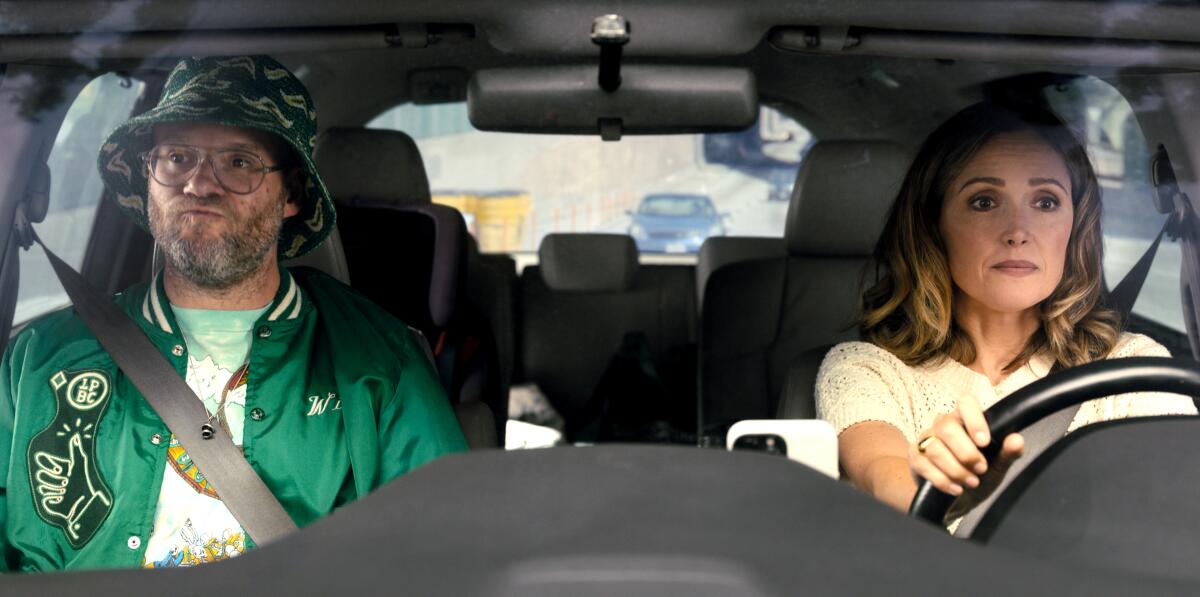
“I’d say the comfort [between us] has only grown, which made it easier and hopefully funnier for audiences,” Seth Rogen says of working with Rose Byrne.
(Paul Sarkis / Apple TV+)
“We definitely understand each other’s rhythms better,” Rogen adds. “I’d say the comfort [between us] has only grown, which made it easier and hopefully funnier for audiences.”
Over a recent video call, the two stars, who also serve as executive producers of “Platonic,” discussed the joy of doing physical comedy, coveting Rogen’s colorful wardrobe and those pesky scooters.
You both got to lean into some physical comedy. Rose, I read that you found some unique videos in your research about ketamine trips.
Byrne: Oh my God, yeah. These [YouTube] videos, they’re really wild because it’s a lot of footage from convenience stores where they’ve recorded people, and it’s really pretty disturbing. That was one of those [scenes] that was really, really fun to do. And then Seth’s just game. I was all over the place. He kept having to prop me up, and I was kicking him in the face, his wine is everywhere.
Rogen: Yeah, that was something where it was helpful to know each other well. And YouTube is an amazing resource for comedy. I think that’s the first place to stop if you’re going to do a physical gag.
Seth, you had some physical work with those electric scooters that are everywhere in L.A. Do you or Nick or someone on the writing staff have a personal vendetta against them?
Rogen: No, I don’t hate the scooters. I don’t love them either. I lived in West Hollywood for a long time and I would come outside and there would be a pile of them outside my front door. It’s impossible not to feel some sort of resentment toward them. What’s funny, my father-in-law actually hates them. He tried to throw one and majorly f— up his shoulder for a year and a half. I also hurt my shoulder throwing them pretty early on in the shoot. It hurt for quite a while. Those things are a lot heavier than they look.
“I never left the bucket hat. I don’t know if it’s back or not, but it’s back with me,” Seth Rogen says. “I’ve been a consistent believer of the bucket hat.” So too is his “Platonic” character.
(Paul Sarkis / Apple TV+)
A hopefully less painful subject: You got to keep your character’s clothes. How are you wearing them?
Rogen: I do wear them. The clothes were a strong choice; it was an idea I had. The character was not scripted as dressing any specific way, but to me this guy is desperately trying to be cool and hang onto his youth and also trying to assert himself as a unique individual in this downtown Arts District world. He’s also someone who’s probably just friends with a lot of people with clothing companies, and I know people who work in this type of field, so it was representative of things I’ve seen, but mostly it was a way to look like a sad old man trying to be young.
Byrne: I loved it. And it also gave me an opportunity to make fun of you. It was always like a good warmup joke [for Sylvia], being like, “What are you wearing?” It’s just such a specific kind of needle that you were threading. It was really fun.
You’re also one of the few that pulls off the bucket hat really well. It’s not a good look for everyone.
Rogen: I actually do wear bucket hats. We went out for dinner yesterday, and my sister was like, “You’re really sticking with the bucket hat?” I’ve never left them. I went with it in the ’90s when it started and I never left the bucket hat. I don’t know if it’s back or not, but it’s back with me. I’ve been a consistent believer of the bucket hat.
Byrne: It is a hard one to pull off. I look ridiculous in a bucket hat.
Rogen: You could argue that I also look ridiculous, but I embrace it.
Is there a specific line that fans quote to you or something that people want to talk to you about regarding this show?
Rogen: I get a lot of talk from people who hate the scooters.
Byrne: People have strong feelings about the scooters.
Rogen: Very strong. And guys who bleached their hair. I got a lot of middle-aged men [coming up to me] like, “I saw you, thought it looked pretty good.”
Byrne: I’ve had a lot of [positive feedback] from mothers trying to get back in the workforce. It’s a passage in life for a lot of women, and that was definitely part of this character. And then also people who’ve had similar friendships with a guy or a girl and have this history of a great friendship that is not the same anymore and how that is. I hadn’t really seen a show like this before where it really is about a friendship, and that was nice.
Looking ahead, what can you share about your hopes for Season 2?
Rogen: I don’t know what I can say. I’m looking forward to it.
Byrne: I’m kind of in the same camp. It’s great to get a second go. You really can lean into more of what was working and leave what wasn’t.
Rogen: Yeah. I think especially with TV, there’s a sense that it gets better as you do it. There’s probably the wave, probably crests, but I know as you’re shooting the sixth episode, I’m always like, oh, we’re all so much funnier than we were when on the second episode. That’s what I’m looking forward to is, to Rose’s point, knowing each other, knowing what works a little bit better and having a little less concern that people will just massively reject what we are doing.
Movie Reviews
Review | Paper Tiger: Adam Driver and Scarlett Johansson lead dark gangster movie
3.5/5 stars
The American filmmaker started his career with 1994’s Little Odessa, starring Tim Roth as a Russian-Jewish hitman operating in the Brighton Beach area of New York. His next two films, The Yards (2000) and We Own the Night (2007), kept him ensconced in the world of low-life criminals.
Paper Tiger also casts the Russian mob as the antagonists. Set in 1986 in Queens, New York, it stars Miles Teller and Adam Driver as the Pearl brothers, Irwin and Gary.
Irwin (Teller), an engineer, is married to Hester (Scarlett Johansson) and has two teenage sons: Scott (Gavin Goudey), who is about to turn 18, and the younger Ben (Roman Engel), who is diligently studying for his exams.
Gary (Driver), a former policeman who still has connections on the force, encourages Irwin to team up and create an environmental clean-up business involving the filthy Gowanus Canal.
Entertainment
Pedro Pascal goes undercover for ‘Star Wars’ surprise at Disneyland
Pedro Pascal took his “Star Wars” character to the streets on Saturday, going undercover as the Mandalorian to surprise Disneyland guests aboard the Millennium Falcon: Smuggler’s Run attraction.
A video posted on Disney’s social media showed the actor in full costume, then lifting his helmet to reveal himself.
“Now you all have to die because you’ve seen my face,” he joked to the stunned parkgoers.
After the surprise, Pascal posed for pictures with the dozen or so fans.
Pascal was later joined by co-star Sigourney Weaver, director Jon Favreau and LucasFilm President Dave Filoni at Galaxy’s Edge, the 14-acre “Star Wars”-themed section of the park modeled after an outpost on the fictional planet of Batuu.
The appearance was part of the press tour for “The Mandalorian and Grogu,” a spinoff of the Disney+ series “The Mandalorian.” The film, which releases on May 22, is the first “Star Wars” movie to hit theaters since 2019.
Movie Reviews
‘Avedon’ Review: Ron Howard’s Admiring Profile of Groundbreaking Photographer Richard Avedon Embraces His Genius, Flair and Mystery
For Richard Avedon, as with most significant artists, work and life were inseparable. When the photographer died in 2004, at 81, he was on the road, mid-project — “with his boots on,” in the words of Lauren Hutton, one of the many beautiful people he helped to immortalize over a 60-year career. Hutton and the two dozen or so other interviewees in Ron Howard’s admiring documentary make it clear how much affection the New York native inspired while reinventing fashion photography and putting his iconoclastic stamp on fine-art portraiture.
The profile Avedon paints is that of a relentless seeker and high-flying achiever, and a deliciously unapologetic contrarian. How can you not adore an image-maker who says, “Beautiful lighting I always find offensive,” and, regarding little kids as potential photographic subjects: “I find them intensely boring.” Avedon’s interest in the grown-up human face, in what it conceals and reveals, was his lifelong project, one that he pursued within circles of rarefied fame, on the backroads of the American West, and in a poignant late-in-life connection with his father.
Avedon
The Bottom Line A solid mix of glitz and angst.
Venue: Cannes Film Festival (Special Screenings)
Director: Ron Howard
1 hour 44 minutes
As confrontational as his images could be, the camera was Avedon’s way of experiencing the world, a way of seeking truth through invention. Howard, whose previous doc subjects include Jim Henson and Luciano Pavarotti, and whose fiction movies are designed more to engage rather than to confront, seems particularly inspired here by Avedon’s auteur approach to still photography — it was a narrative impulse, not a documentary one, that shaped his vision, a drive to create moments and mise-en-scènes for the camera.
Avedon built his career at magazines in an era when magazines mattered. He was only 21 when he joined Harper’s Bazaar, where he stayed for 20 years, leaving to follow fashion editor Diana Vreeland to Vogue, where he stayed even longer. And when Tina Brown took the helm at The New Yorker and overturned its age-old no-photos policy, she hired Avedon as its first staff photographer.
When Harper’s sent him to Paris in 1947 with an edict to summon some of the battered capital’s prewar glamour, he turned to movies for inspiration and conjured visions of romantic fantasy amid the ruins. It was his first significant assignment, and a turning point for fashion photography. The doc emphasizes how, at a Dior show, the images he captured of the designer’s voluminous skirts mid-twirl expressed an ecstatic moment after years of wartime rationing. “People were weeping,” recalls Avedon, a vivid presence in the doc thanks to a strong selection of archival material.
The kinetic energy of those shots would become a defining element of his approach. Injecting movement and a theatrical edge into fashion photography, he lifted it out of the era of posed mannequins. To get models into the spirit of his concepts, he often leapt and danced alongside them. It’s no wonder that in Funny Face, the romantic musical loosely inspired by his career and first marriage, Fred Astaire played the photographer. Eventually Avedon shifted to a large-format camera, an 8×10, that allowed him to interact with his subjects directly, rather than through a viewfinder. There would be more scripted and carefully choreographed moments in his TV spots for Calvin Klein jeans and Obsession, collaborations with the writer Doon Arbus (daughter of Diane and Allan Arbus) that took chances (and which, for some viewers, are inseparable from memorable spoofs on SNL).
Fashion and advertising were mainstays, but he also became a notable portraitist. Positioning his subjects against a plain white background, he removed flattery from the equation. It was an artist-subject relationship in which he held all the power, and he didn’t pretend otherwise; on that point, Brown offers a trenchant anecdote. Remarkably, even though his refusal to sugarcoat was well established — not least by his notorious photo of the Daughters of the American Revolution — an Avedon portrait carried such cachet that establishment figures including the Reagans, Henry Kissinger and George H.W. Bush all submitted themselves to his crosshairs.
The film suggests that a moral imperative was as essential to Avedon’s work as his unconventional aesthetic vocabulary. He threatened to sever his contract with Harper’s when the magazine didn’t want to publish his photos of China Machado, and he prevailed: In 1959, she became the first model of color to appear in the editorial pages of a major American fashion magazine. Howard looks beyond the catwalks and salons to Avedon’s portraits of wartime Saigon, Civil Rights leaders and patients at Bellevue, many of those images collected in Nothing Personal, the book he did with James Baldwin, a friend from high school. A superb clip from a D.A. Pennebaker short of the book launch encapsulates the painfully awkward disconnect between the artist and the corporate media contingent. Most surprising, though, is how hard Avedon took it when the book was lambasted by critics. A later book, In the American West, would also meet harsh criticism; Avedon was, in the eyes of some, a condescending elitist.
Howard’s film is a celebration of a complicated man. It acknowledges Avedon’s naysayers, as well as his struggles and doubts, but this is very much an official story, made in association with the Richard Avedon Foundation, and steering clear of the disputed 2017 biography by Avedon’s business partner. The commentary, whether from models (Hutton, Isabella Rossellini, Twiggy Lawson, Penelope Tree, Beverly Johnson) or writers (Adam Gopnik, John Lahr, Hilton Als) or Avedon’s son, John, can be gushing, but it’s always perceptive.
The connection he sought with his subjects wasn’t about star worship but the instant when the ego lets down its guard, yet at the same time he was more interested in what he called “the marriage of the imagination and the reality” than straight documentation. Without putting too fine a point on it, Avedon links those twinned yet seemingly contradictory impulses to certain formative experiences. There was the devastation of extreme mental illness for Avedon’s sister and his second wife. There was the pretense of happiness in his childhood home in Depression-era New York (the city is captured in terrifically evocative clips). He recalls, discerning and exasperated, the staged domestic harmony — “the borrowed dogs!” — in family photos.
Avedon doesn’t aim to unsettle, like Avedon himself did, but neither does it tie things up neatly. There’s nothing simple or reductive about the emotional throughlines the documentary traces. It embraces the complexities of a man who turned artifice into a kind of superpower, whether he was dreaming up scenarios for fashion spreads or confronting an America as far removed from haute couture Manhattan as you could get.
-
Detroit, MI21 minutes ago5 players who could help Detroit Lions in NFL free agency
-
San Francisco, CA33 minutes agoSan Francisco forward David Fuchs commits to Clemson out of NCAA transfer portal
-
Dallas, TX39 minutes agoWhataburger revives iconic A-frame design at new Texas restaurants
-
Miami, FL45 minutes agoAi’King Hall’s Recruiting Flip to Miami Signals Concerning Oregon Trend
-
Boston, MA51 minutes agoSexual assault trial of Alvin Campbell, Massachusetts attorney general’s brother, begins today
-
Denver, CO57 minutes agoWhy the Broncos don’t let players wear these 6 jersey numbers
-
Seattle, WA1 hour agoGunfire outside Capitol Hill nightclub leaves 3 men shot, Seattle Police searching for suspects – MyNorthwest.com
-
San Diego, CA1 hour agoAcquisitions Night: An Evening with UC San Diego Library’s Special Collections & Archives
